Design and Performance of a Heated Gas Injector for Producing Cold Molecular Beams
Pith reviewed 2026-06-26 21:37 UTC · model grok-4.3
The pith
A polyamide-imide tube forms a cryogenic seal that allows warm gas delivery into a cold buffer gas cell with less than 200 mW heat load.
A machine-rendered reading of the paper's core claim, the machinery that carries it, and where it could break.
Core claim
We realize an injector device that supplies warm gas directly into a cryogenic environment using a polyamide-imide tube to achieve thermal isolation between a ~300 K copper fill line and a <3 K cryogenic buffer gas cell, resulting in less than 200 mW heat load. The tube connects the fill line to the cell via a slip-fit onto a brass nipple, forming a leak-tight seal upon contraction when cooled. Performance is characterized by producing cold BaF free radicals through laser ablation with SF6 and He buffer gas, demonstrating suitability for delivering reagents like SF6 and H2O into the cell for experiments with RaF and RaOH molecules.
What carries the argument
The polyamide-imide (PAI) tube, which contracts onto a brass nipple to create a rigid, thermally isolating, vacuum-tight connection between hot and cold sections.
If this is right
- The design supports leak-tight delivery of SF6 and H2O for producing RaF and RaOH molecules.
- Heat load on the cryogenic cell stays below 200 mW under realistic experimental conditions.
- The injector is robust, easily mountable and demountable, and shows no significant fill line displacement during cooldown.
- It enables studies of symmetry-violating nuclear properties in radium-containing molecules without compromising the cryogenic environment.
Where Pith is reading between the lines
- This injector mechanism could simplify cryogenic setups in other molecular beam experiments by reducing the need for separate temperature staging.
- Adaptations of the contraction seal might apply to other temperature differential interfaces in vacuum systems.
- Further characterization with different gases could reveal broader applicability for cold molecule production.
Load-bearing premise
The polyamide-imide tube contracts on the brass nipple when cooled to form a cryogenic leak-tight seal while keeping the fill line rigid with no significant displacement during cooldown to 4 K.
What would settle it
A measurement showing heat load exceeding 200 mW on the cell or failure to maintain vacuum integrity at the PAI-brass interface after cooling to 4 K would disprove the injector's performance claims.
Figures
read the original abstract
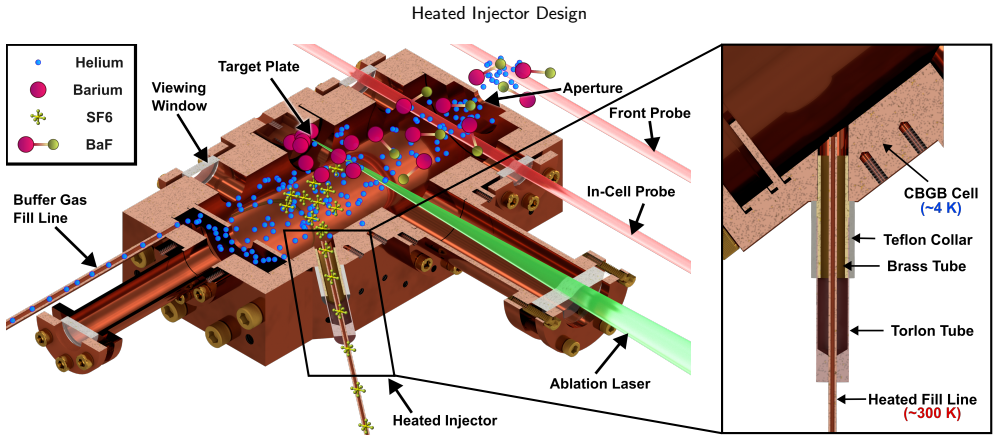
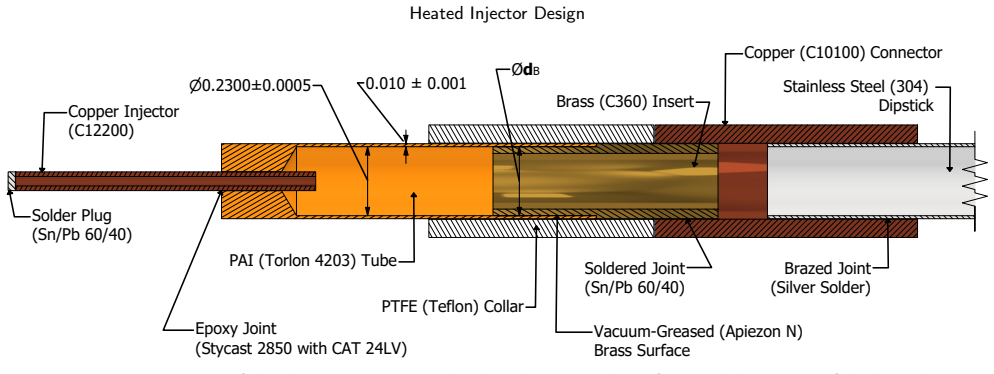
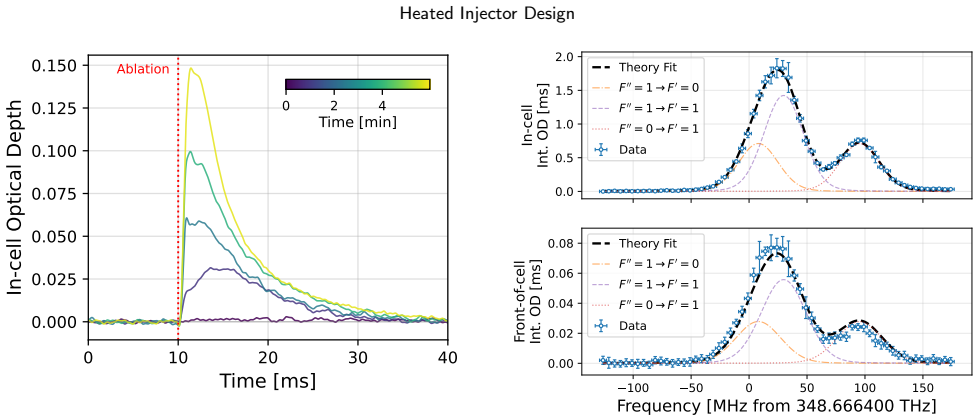
We realize an injector device that supplies warm gas directly into a cryogenic environment. This injector has several advantageous features, including robustness, rigidity, simple installation, and excellent thermal isolation between a hot ($\sim$300 K) copper fill line and a cold ($<$3 K) cryogenic buffer gas cell. Less than 200 mW heat load on the cell is observed in realistic conditions of a molecular precision measurement experiment. A polyamide-imide (PAI) tube is the essential design feature. The fill line is epoxied to one end of the tube while the other end of the tube is connected to the cell via a slip-fit onto a brass nipple, realizing a complete vacuum-tight seal. PAI contracts on the brass nipple when cooled, forming a cryogenic leak-tight seal. The injector is easily (de-)mountable and rigid, with no significant displacement of the fill line relative to the cell observed during cooldown to 4 K. We characterize injector performance by flowing into the cell $\text{SF}_6$ through the hot fill line and cold $\text{He}$ buffer gas through a separate cryogenic fill line while laser ablating a barium-containing target. This produces cold BaF free radicals, detected using absorption spectroscopy. This injector design will be employed to laser cool radium-containing molecules, such as $\text{RaF}$ and $\text{RaOH}$, where leak-tight delivery of $\text{SF}_6$ and $\text{H}_2\text{O}$ reagents into a cryogenic buffer gas cell is required for scientific and safety reasons. These molecules are of particular interest for the study of symmetry-violating nuclear properties and searches for physics beyond the Standard Model.
Editorial analysis
A structured set of objections, weighed in public.
Referee Report
Summary. The manuscript describes the design of a heated gas injector that delivers warm (~300 K) gas into a cryogenic (<3 K) buffer gas cell using a polyamide-imide (PAI) tube for thermal isolation. A slip-fit connection to a brass nipple forms a vacuum-tight seal via differential contraction upon cooling. The device is reported to impose <200 mW heat load, remain rigid with no significant fill-line displacement on cooldown to 4 K, and enable production of cold BaF radicals when SF6 is flowed through the injector during laser ablation of a barium target in the presence of cold He buffer gas. The design is intended for future use with RaF and RaOH in precision measurements.
Significance. If the performance metrics hold, the injector provides a practical, robust, and easily installed solution for introducing molecular reagents into cryogenic cells with minimal heat load. This capability is directly relevant to laser-cooling experiments on heavy molecules for tests of fundamental symmetries and searches for physics beyond the Standard Model. The empirical demonstration via BaF production supplies concrete evidence of functionality under realistic experimental conditions.
major comments (2)
- Abstract: the central performance claim of less than 200 mW heat load is presented without any accompanying measurement details, time series, error analysis, or data table. Because this metric is the primary quantitative result supporting the design's utility, the absence of supporting data weakens the ability to evaluate the claim.
- Abstract: the statement that 'no significant displacement of the fill line relative to the cell' occurs on cooldown to 4 K is given without quantitative bounds, a figure, or a description of the measurement method. This rigidity claim is load-bearing for the assertion of a reliable, rigid injector.
minor comments (2)
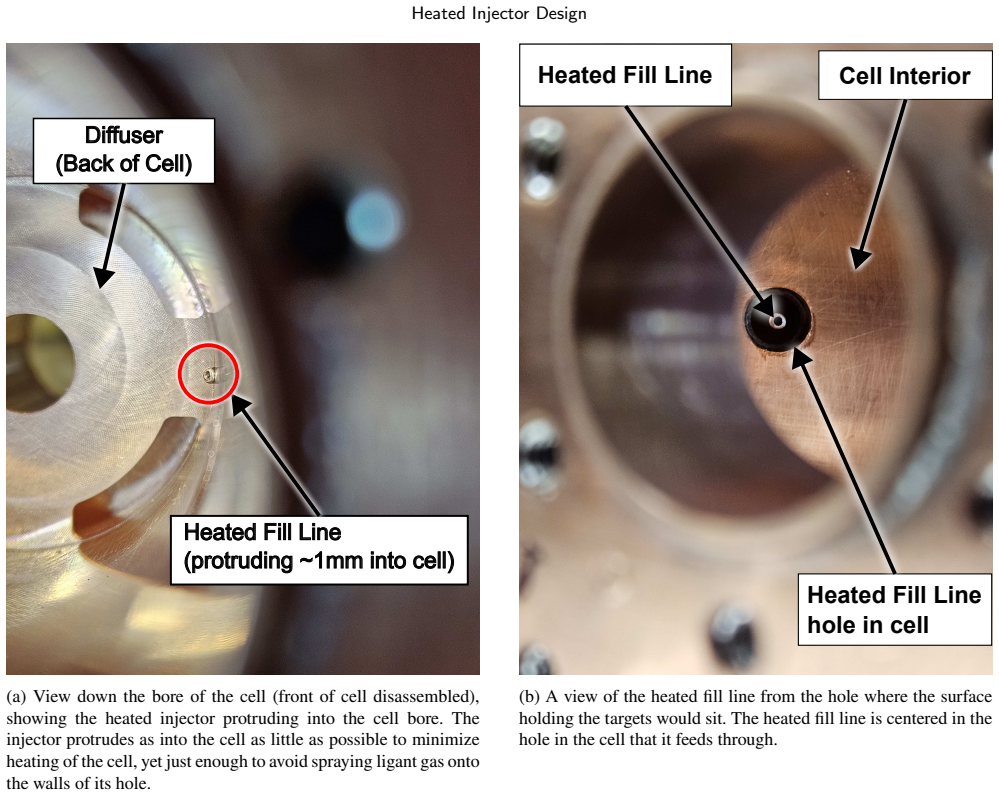
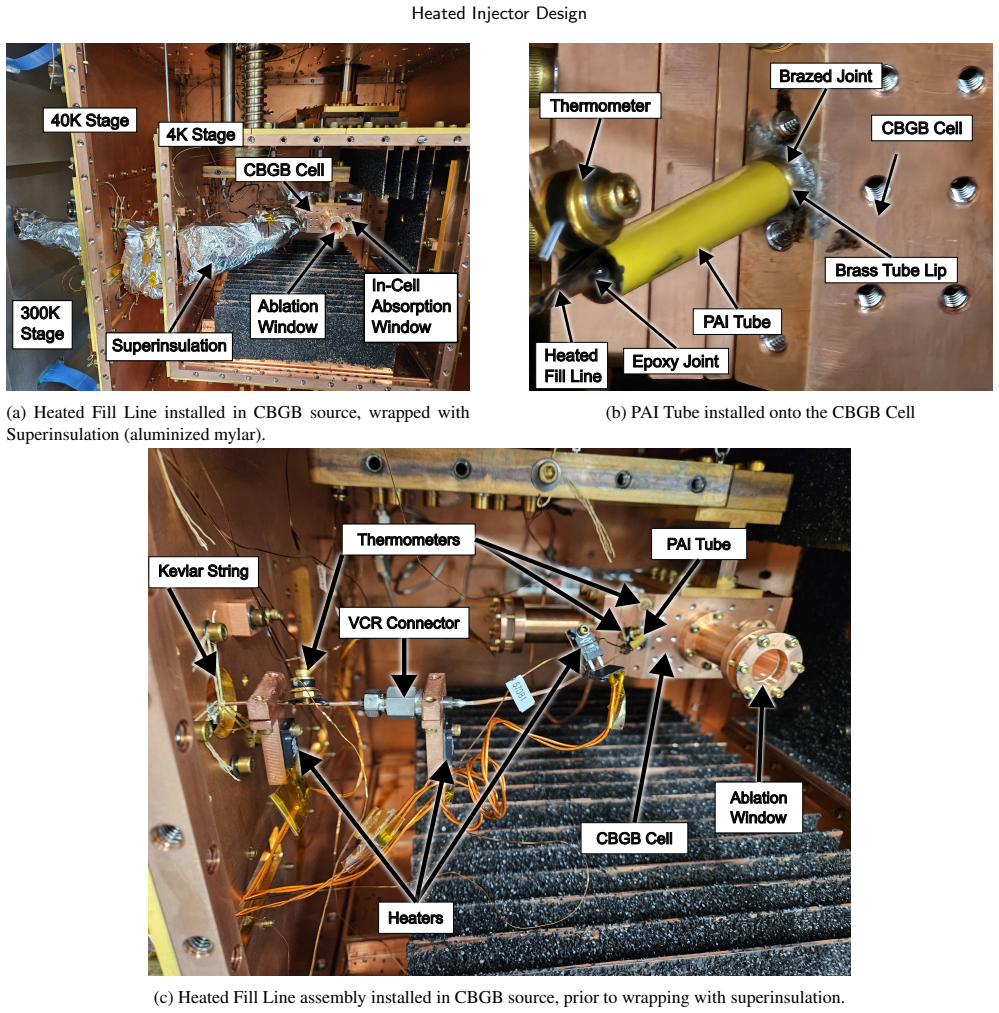
- A labeled schematic or photograph of the assembled injector, including the PAI tube, brass nipple, and epoxy joints, would improve clarity of the thermal-isolation and seal mechanism.
- The manuscript would benefit from a brief comparison to existing cryogenic gas-delivery methods to better situate the novelty of the PAI-tube approach.
Simulated Author's Rebuttal
We thank the referee for their careful reading of the manuscript and for the positive recommendation of minor revision. The comments on the abstract are well taken, and we address them point by point below. We have revised the manuscript to strengthen the presentation of the key performance claims.
read point-by-point responses
-
Referee: Abstract: the central performance claim of less than 200 mW heat load is presented without any accompanying measurement details, time series, error analysis, or data table. Because this metric is the primary quantitative result supporting the design's utility, the absence of supporting data weakens the ability to evaluate the claim.
Authors: We agree that the abstract would be improved by brief context on the heat-load measurement. The main text (Section III) describes the procedure: a resistive heater on the cell is used to maintain constant temperature while SF6 flows through the injector, with the additional heater power directly giving the heat load; temperature time series are recorded with calibrated sensors. We will revise the abstract to state that the <200 mW value was obtained from heater-power measurements under realistic flow conditions, thereby directing readers to the supporting data and analysis already present in the body of the paper. revision: yes
-
Referee: Abstract: the statement that 'no significant displacement of the fill line relative to the cell' occurs on cooldown to 4 K is given without quantitative bounds, a figure, or a description of the measurement method. This rigidity claim is load-bearing for the assertion of a reliable, rigid injector.
Authors: We acknowledge the abstract lacks quantitative bounds and a method description for the displacement claim. The main text reports that post-cooldown visual inspection and mechanical alignment checks showed no observable shift of the fill line relative to the cell. We will revise the abstract to include a concise description of the inspection method and to note that any displacement was below the ~1 mm resolution of the inspection technique. If space permits, we can also reference the relevant paragraph in the main text. revision: yes
Circularity Check
No significant circularity
full rationale
The manuscript is an engineering report describing the fabrication, assembly, and direct empirical testing of a PAI-tube injector. It contains no equations, no derivations, no fitted parameters, no predictions, and no self-citations that serve as load-bearing premises. All performance claims (heat load <200 mW, leak-tight seal via differential contraction, rigidity on cooldown, successful BaF production) are presented as measured outcomes from the described hardware rather than results obtained by reducing one quantity to another by construction. The central claim is therefore self-contained against external benchmarks and receives the default non-circularity finding.
Axiom & Free-Parameter Ledger
Reference graph
Works this paper leans on
-
[1]
Bright, Guided Molecular BeamwithHydrodynamicEnhancement
David Patterson and John M. Doyle. “Bright, Guided Molecular BeamwithHydrodynamicEnhancement”.In:The Journal of Chem- ical Physics126.15 (Apr. 17, 2007), p. 154307.ISSN: 0021-9606. DOI:10.1063/1.2717178.URL:https://doi.org/10.1063/1.2717178 (visited on 02/09/2026)
work page doi:10.1063/1.2717178.url:https://doi.org/10.1063/1.2717178 2007
-
[2]
The Buffer Gas Beam: An Intense, Cold, and Slow Source for Atoms and Molecules
Nicholas R. Hutzler, Hsin-I Lu, and John M. Doyle. “The Buffer Gas Beam: An Intense, Cold, and Slow Source for Atoms and Molecules”.In:Chemical Reviews112.9(Sept.12,2012),pp.4803– 4827.ISSN: 0009-2665.DOI:10.1021/cr200362u.URL:https://doi. org/10.1021/cr200362u(visited on 02/08/2026)
-
[3]
Cryogenic Buffer Gas Beams of AlF, CaF, MgF, YbF, Al, Ca, Yb and NO – a Comparison
Sidney C. Wright et al. “Cryogenic Buffer Gas Beams of AlF, CaF, MgF, YbF, Al, Ca, Yb and NO – a Comparison”. In:Molecular Physics121.17–18 (Sept. 17, 2023), e2146541.ISSN: 0026-8976. DOI:10 . 1080 / 00268976 . 2022 . 2146541.URL:https : / / doi . org / 10 . 1080/00268976.2022.2146541(visited on 05/07/2026)
arXiv 2023
-
[4]
The Chemistry of AlF and CaF Production in Buffer GasSources
X. Liu et al. “The Chemistry of AlF and CaF Production in Buffer GasSources”.In:The Journal of Chemical Physics157.7(Aug.18, 2022), p. 074305.ISSN: 0021-9606.DOI:10.1063/5.0098378.URL: https://doi.org/10.1063/5.0098378(visited on 02/09/2026)
-
[5]
Chemistry in a Cryogenic Buffer Gas Cell
Qi Sun et al. “Chemistry in a Cryogenic Buffer Gas Cell”. In: The Journal of Physical Chemistry Letters17.2 (Jan. 15, 2026), pp. 640–646.DOI:10 . 1021 / acs . jpclett . 5c02840.URL:https : / / doi.org/10.1021/acs.jpclett.5c02840(visited on 06/12/2026). Page 7 of 12 Heated Injector Design
-
[6]
EnhancedMolecularYieldfromaCryogenic Buffer Gas Beam Source via Excited State Chemistry
ArianJadbabaieetal.“EnhancedMolecularYieldfromaCryogenic Buffer Gas Beam Source via Excited State Chemistry”. In:New Journal of Physics22.2 (Feb. 2020), p. 022002.ISSN: 1367-2630. DOI:10.1088/1367- 2630/ab6eae.URL:https://doi.org/10.1088/ 1367-2630/ab6eae(visited on 02/09/2026)
-
[7]
A National Experiment Reveals Where a Growth Mindset Improves Achievement
ACME Collaboration. “Improved Limit on the Electric Dipole Mo- ment of the Electron”. In:Nature562.7727 (Oct. 2018), pp. 355– 360.ISSN: 0028-0836, 1476-4687.DOI:10.1038/s41586- 018- 0599- 8.URL:http://www.nature.com/articles/s41586-018-0599-8(visited on 03/14/2023)
-
[8]
SlowMolecularBeamsfromaCryogenicBufferGas Source
A.D.White.“SlowMolecularBeamsfromaCryogenicBufferGas Source”. In:Physical Review Research6.4 (2024).DOI:10 . 1103 / PhysRevResearch.6.043232
2024
-
[9]
Laser Cooling of Molecules
M. R. Tarbutt. “Laser Cooling of Molecules”. In:Contemporary Physics59.4 (Oct. 2, 2018), pp. 356–376.ISSN: 0010-7514, 1366- 5812.DOI:10 . 1080 / 00107514 . 2018 . 1576338. arXiv:1902 . 05628 [physics].URL:http : / / arxiv . org / abs / 1902 . 05628(visited on 08/08/2024)
2018
-
[10]
Laser-Cooled Molecules
N.J. Fitch and M.R. Tarbutt. “Laser-Cooled Molecules”. In:Ad- vances In Atomic, Molecular, and Optical Physics.Vol.70.Elsevier, 2021, pp. 157–262.ISBN: 978-0-12-824610-8.DOI:10 . 1016 / bs . aamop . 2021 . 04 . 003.URL:https : / / linkinghub . elsevier . com / retrieve/pii/S1049250X21000033(visited on 08/08/2024)
2021
-
[11]
ThermalConductivityofTorlonbetween4.2and 300 K
M.Baruccietal.“ThermalConductivityofTorlonbetween4.2and 300 K”. In:Cryogenics45.4 (Apr. 1, 2005), pp. 295–299.ISSN: 0011-2275.DOI:10.1016/j.cryogenics.2004.11.006.URL:https: //www.sciencedirect.com/science/article/pii/S0011227505000032 (visited on 11/05/2025)
work page doi:10.1016/j.cryogenics.2004.11.006.url:https: 2005
-
[12]
Bradley and Ray Radebaugh.Properties of Selected Ma- terials at Cryogenic Temperatures
Peter E. Bradley and Ray Radebaugh.Properties of Selected Ma- terials at Cryogenic Temperatures. CRC Press, Boca Raton, FL, June 17, 2013.URL:https : / / www . nist . gov / publications / properties - selected - materials - cryogenic - temperatures(visited on 02/17/2026)
2013
-
[13]
Ultracold Molecules in an Optical Tweezer Array: From Dipolar Interaction to Ground State Cooling
Yicheng Bao. “Ultracold Molecules in an Optical Tweezer Array: From Dipolar Interaction to Ground State Cooling”. Cambridge, Massachusetts: Harvard University, May 2024
2024
-
[14]
Ultracold Molecules in Optical Arrays: From LaserCoolingtoMolecularCollisions
Loïc G. Anderegg. “Ultracold Molecules in Optical Arrays: From LaserCoolingtoMolecularCollisions”.Cambridge,Massachusetts: Harvard University, Sept. 2019
2019
-
[15]
LaserCooling,OpticalTrappingandZeeman- Sisyphus Deceleration of Heavy Polyatomic Molecules for Probing Physics beyond the Standard Model
HiromitsuSawaoka.“LaserCooling,OpticalTrappingandZeeman- Sisyphus Deceleration of Heavy Polyatomic Molecules for Probing Physics beyond the Standard Model”. Cambridge, Massachusetts: Harvard University, May 2025
2025
-
[16]
Thermal Expansion and Thermal Conductivity of Torlon at Low Temperatures
G Ventura et al. “Thermal Expansion and Thermal Conductivity of Torlon at Low Temperatures”. In:Cryogenics39.5 (May 1, 1999), pp. 481–484.ISSN: 0011-2275.DOI:10.1016/S0011-2275(99)00051- X.URL:https : / / www . sciencedirect . com / science / article / pii / S001122759900051X(visited on 11/05/2025)
-
[17]
364 pp.ISBN: 978-0-08-044479-6
GuglielmoVenturaandLaraRisegari.The Art of Cryogenics: Low- Temperature Experimental Techniques.1sted(Online-Ausg.)Ams- terdam Boston: Elsevier, 2008. 364 pp.ISBN: 978-0-08-044479-6
2008
-
[18]
MeasurementofMechanicalPropertiesofElectronic Materials at Temperatures down to 4.2 K
M.Finketal.“MeasurementofMechanicalPropertiesofElectronic Materials at Temperatures down to 4.2 K”. In:Cryogenics48.11 (Nov. 1, 2008), pp. 497–510.ISSN: 0011-2275.DOI:10 . 1016 / j . cryogenics . 2008 . 07 . 006.URL:https : / / www . sciencedirect . com / science/article/pii/S0011227508001112(visited on 02/25/2026)
2008
-
[19]
Temperature Behaviour of Permeation of Helium through Vespel and Torlon
U. Schmidtchen et al. “Temperature Behaviour of Permeation of Helium through Vespel and Torlon”. In:Cryogenics34.2 (Feb. 1, 1994), pp. 105–109.ISSN: 0011-2275.DOI:10.1016/0011- 2275(94) 90032 - 9.URL:https : / / www . sciencedirect . com / science / article / pii/0011227594900329(visited on 12/12/2025)
-
[20]
Precision Spectroscopy of the𝐴2Π←𝑋 2Σ+ Transition in BaF
M.C. Mooij et al. “Precision Spectroscopy of the𝐴2Π←𝑋 2Σ+ Transition in BaF”. In:Molecular Physics0.0 (Nov. 26, 2025), e2588274.ISSN: 0026-8976.DOI:10.1080/00268976.2025.2588274. URL:https://doi.org/10.1080/00268976.2025.2588274(visited on 05/26/2026)
-
[21]
Molecular-Beam Optical Stark and Zeeman Study of the𝐴 2Π–𝑋 2Σ+ (0,0) Band System of BaF
Timothy C. Steimle et al. “Molecular-Beam Optical Stark and Zeeman Study of the𝐴 2Π–𝑋 2Σ+ (0,0) Band System of BaF”. In:Physical Review A84.1 (July 19, 2011), p. 012508.DOI:10 . 1103/PhysRevA.84.012508.URL:https://link.aps.org/doi/10.1103/ PhysRevA.84.012508(visited on 06/12/2026)
2011
-
[22]
com / Atomic - physics - exploration - problems - solutions / dp / 0199532419
DmitryBudker,DerekKimball,andDavidDeMille.Atomic Physics: An Exploration through Problems and Solutions.OxfordUniversity Press, USA, 2008.ISBN: 0-19-953241-9.URL:http://www.amazon. com / Atomic - physics - exploration - problems - solutions / dp / 0199532419
2008
-
[24]
Benchmarking of the Fock-space Coupled-ClusterMethodandUncertaintyEstimation:MagneticHy- perfineInteractionintheExcitedStateofBaF
NL-eEDM Collaboration et al. “Benchmarking of the Fock-space Coupled-ClusterMethodandUncertaintyEstimation:MagneticHy- perfineInteractionintheExcitedStateofBaF”.In:Physical Review A105.5 (May 31, 2022), p. 052811.DOI:10 . 1103 / PhysRevA . 105 . 052811.URL:https : / / link . aps . org / doi / 10 . 1103 / PhysRevA . 105 . 052811(visited on 05/28/2026)
2022
-
[25]
FelixKogeletal.“High-ResolutionSpectroscopyofBariumMonoflu- oride:OddIsotopologues,HyperfineStructure,andIsotopeShifts”. In:Physical Review A112.4 (Oct. 9, 2025), p. 042807.DOI:10 . 1103/rdpt-99qy.URL:https://link.aps.org/doi/10.1103/rdpt-99qy (visited on 05/08/2026)
-
[26]
Diffusion, Thermalization, and Optical Pumping of YbF Molecules in a Cold Buffer-Gas Cell
S. M. Skoff et al. “Diffusion, Thermalization, and Optical Pumping of YbF Molecules in a Cold Buffer-Gas Cell”. In:Physical Review A83.2 (Feb. 23, 2011), p. 023418.ISSN: 1050-2947.DOI:10.1103/ PhysRevA . 83 . 023418.URL:http : / / link . aps . org / doi / 10 . 1103 / PhysRevA.83.023418(visited on 10/07/2019)
2011
-
[27]
Shaped Nozzles for Cryogenic Buffer-Gas Beam Sources
Di Xiao et al. “Shaped Nozzles for Cryogenic Buffer-Gas Beam Sources”.In:Physical Review A99.1(Jan.3,2019),p.013603.DOI: 10.1103/PhysRevA.99.013603.URL:https://link.aps.org/doi/10. 1103/PhysRevA.99.013603(visited on 05/07/2026)
work page doi:10.1103/physreva.99.013603.url:https://link.aps.org/doi/10 2019
-
[28]
Radioactive Molecules as Laboratories of Fundamental Physics
A. Jadbabaie et al. “Radioactive Molecules as Laboratories of Fun- damental Physics”. May 12, 2026.DOI:10.48550/arXiv.2605.12767. arXiv:2605.12767 [physics.atom-ph].URL:http://arxiv.org/abs/ 2605.12767(visited on 05/28/2026)
work page internal anchor Pith review Pith/arXiv arXiv doi:10.48550/arxiv.2605.12767 2026
-
[29]
Conn et al.Production and Spectroscopy of Cold Ra- dioactive Molecules
Chandler J. Conn et al.Production and Spectroscopy of Cold Ra- dioactive Molecules. Aug. 11, 2025.DOI:10 . 48550 / arXiv . 2508 . 08368. arXiv:2508 . 08368 [physics].URL:http : / / arxiv . org / abs / 2508.08368(visited on 02/08/2026). Pre-published
arXiv 2025
-
[30]
Diffusion Coefficient, Solubility, and Permeability for Helium in Glass
W. A. Rogers, R. S. Buritz, and D. Alpert. “Diffusion Coefficient, Solubility, and Permeability for Helium in Glass”. In:Journal of Applied Physics25.7(July1,1954),pp.868–875.ISSN:0021-8979. DOI:10.1063/1.1721760.URL:https://doi.org/10.1063/1.1721760 (visited on 12/13/2025)
work page doi:10.1063/1.1721760.url:https://doi.org/10.1063/1.1721760 1954
-
[31]
ADatabaseofMetallicMaterialsEmissivitiesand Absorptivities for Cryogenics
JiříFrolecetal.“ADatabaseofMetallicMaterialsEmissivitiesand Absorptivities for Cryogenics”. In:Cryogenics97 (Jan. 1, 2019), pp. 85–99.ISSN: 0011-2275.DOI:10.1016/j.cryogenics.2018.12. 003.URL:https : / / www . sciencedirect . com / science / article / pii / S0011227518302583(visited on 06/12/2026)
-
[32]
Brown and Alan Carrington.Rotational Spectroscopy of Diatomic Molecules
John M. Brown and Alan Carrington.Rotational Spectroscopy of Diatomic Molecules. Cambridge Molecular Science. Cambridge: Cambridge University Press, 2003.ISBN: 978-0-521-53078-1.DOI: 10 . 1017 / CBO9780511814808.URL:https : / / www . cambridge . org / core / books / rotational - spectroscopy - of - diatomic - molecules / D22ED9CC569BFEA46F6C8ADACBA1138B(v...
2003
-
[33]
Berlin, Heidelberg: Springer Berlin Heidelberg, 1985.ISBN: 978- 3-642-82479-1.DOI:10
Eizi Hirota.High-Resolution Spectroscopy of Transient Molecules. Berlin, Heidelberg: Springer Berlin Heidelberg, 1985.ISBN: 978- 3-642-82479-1.DOI:10 . 1007 / 978 - 3 - 642 - 82477 - 7.URL:http : //link.springer.com/10.1007/978-3-642-82477-7
-
[34]
SSD: Single Shot MultiBox Detector
Arian Jadbabaie.Measuring Fundamental Symmetry Violation in Polyatomic Molecules. Springer Theses. Cham: Springer Nature Switzerland, 2025.ISBN: 978-3-031-84905-3.DOI:10 . 1007 / 978 - 3- 031- 84905- 3.URL:https://link.springer.com/10.1007/978- 3- 031-84905-3(visited on 12/02/2025)
-
[35]
Arian Jadbabaie et al. “Characterizing the Fundamental Bending VibrationofaLinearPolyatomicMoleculeforSymmetryViolation Searches”. In:New Journal of Physics25.7 (July 2023), p. 073014. ISSN: 1367-2630.DOI:10.1088/1367-2630/ace471.URL:https://dx. doi.org/10.1088/1367-2630/ace471(visited on 10/16/2023). A. Diffusion Constant Estimation Theheliumdiffusioncon...
discussion (0)
Sign in with ORCID, Apple, or X to comment. Anyone can read and Pith papers without signing in.