REVIEW 4 major objections 5 minor 53 references
Modelling physical limits of migration by a kinetic model with non-local sensing
T0 review · 4 major / 5 minor · reviewed 2026-08-14 · deepseek-v4-flash
Pith's one-line read This paper claims that near physical limits of migration, cells' sensing radius becomes direction-dependent, making the leading-order macroscopic velocity nonzero and forcing a hyperbolic, not diffusive, macroscopic limit.
desk verdict A useful modeling extension—direction-dependent sensing radius—but the claimed global hyperbolic macroscopic limit is not proven; the kinetic model and simulations are worth a referee's time. read the letter →
The pith
A machine-rendered reading of the paper's core claim, the machinery that carries it, and where it could break.
The reading
What carries the argument
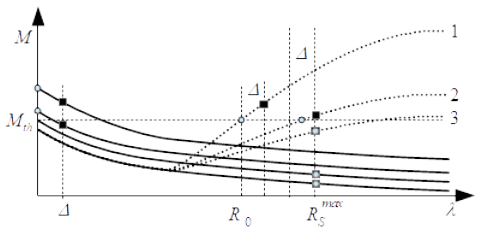
The load-bearing object is the limited sensing radius defined by $R^M(t,x,\hat v)=\inf\{\lambda\in[0,R^{\max}_{S'}):M(t,x+\lambda\hat v)>M_{\mathrm{th}}\}$ and $R^M_{S'}=\min\{R^M+\Delta,R^{\max}_{S'}\}$: a cell integrates information only up to the first point along its polarization direction where the environment is impassable, plus a fixed poking depth (set to zero in the simulations). This replaces the constant sensing radius of the earlier kinetic model and makes the sensing support, and therefore the normalization $\Gamma_{S'}$, depend on direction. It is this direction-dependent $\Gamma_{S'}$ that enters the zeroth-order velocity formula and spoils the evenness condition near barriers, forcing the hyperbolic scaling. The polarization factor $B[S]$ and the speed density $\Psi[S']$ enter the transition probability as independent averages over the direction-dependent interval.
What would settle it
Compute the zeroth-order macroscopic velocity (38) for the same transition probability but with a smooth sensing kernel that never fully cuts off, for instance $\gamma_{S'}(\lambda')=\exp(-\lambda'/\Lambda)$ independent of $M$, while keeping the speed cue unchanged; if $U^0_{S,S'}$ vanishes wherever the speed cue is even in $\hat v$, then the hard-threshold cutoff is the mechanism forcing the hyperbolic limit. In the laboratory, microfluidic channels with a pore-size gradient could test the predicted direction-dependent speed near a barrier: the model says a cell's measured speed depends on which way it is polarized even with no chemoattractant present.
Extended reading notes
Core claim
The discovery is that the direction dependence of the sensing radius, and not the direction dependence of the sensed cue itself, is what breaks the standard diffusive regime. In the model, the sensing distance in direction $\hat v$ stops at the first point where the mechanical cue $M$ exceeds a threshold $M_{\mathrm{th}}$, possibly plus a small poking depth $\Delta$. This makes the effective sensing weight $\Gamma_{S'}(x,\hat v)=\int_0^{R^M_{S'}(x,\hat v)}\gamma_{S'}(\lambda')\,d\lambda'$ direction dependent. The zeroth-order macroscopic velocity $U^0_{S,S'}(x)=c(x)\int_{\mathbb S^{d-1}}\Gamma_{S'}(x,\hat v)B[S]_0(\hat v)\bar U^0_{S'}(x|\hat v)\,\hat v\,d\hat v$ then lacks the symmetry that would make it vanish, so the condition $U^0_{S,S'}=0$ required for a parabolic limit fails. The paper states this directly: as soon as a physical barrier appears, points close to it develop an asymmetry in the evaluation of the sensing radius that invalidates the evenness condition, and the macroscopic limit is the hyperbolic equation $\partial_\tau\rho+\nabla\cdot(\rho U^0_{S,S'})=0$.
Load-bearing premise
The load-bearing premise is the hard threshold in sensing: a cell ignores everything beyond the first point where the mechanical cue exceeds $M_{\mathrm{th}}$, plus a fixed poking depth that is set to zero in the simulations; if sensing attenuated gradually or could pass through dense regions, the direction asymmetry that produces the nonzero leading-order velocity would no longer be forced.
Editorial extensions
If this is right
- Near any physical barrier, the continuum description of a cell population should be a hyperbolic conservation law for the density with flux $\rho U^0_{S,S'}$; diffusive approximations should be used only away from the barrier.
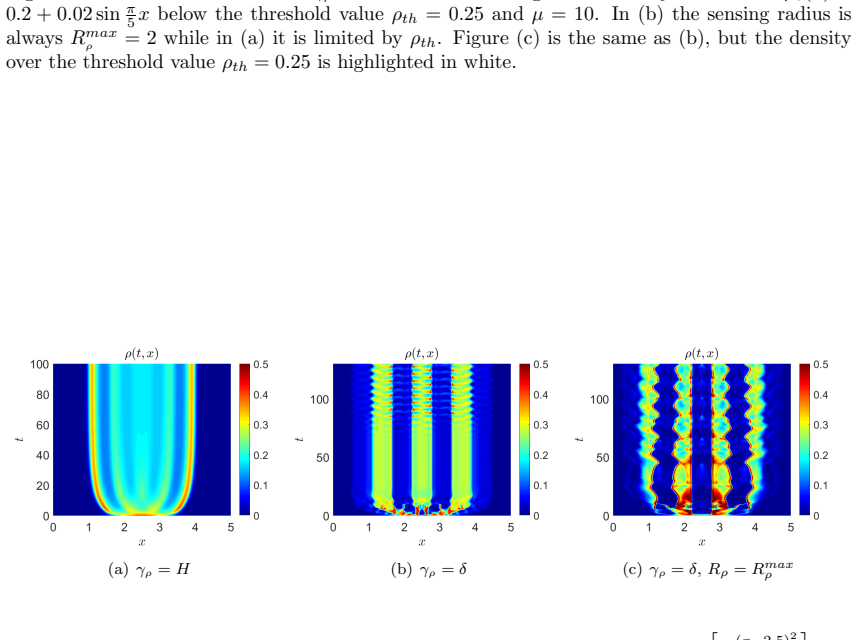
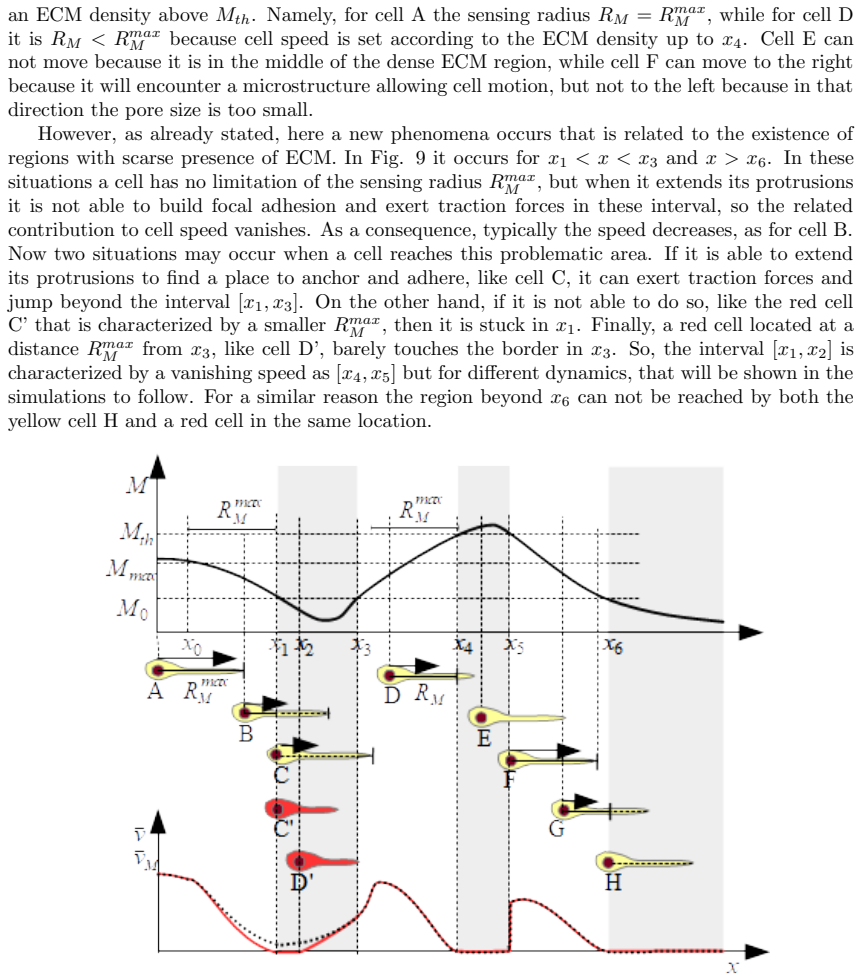
- If the sensing radius is not limited at the barrier, simulated cells inside a dense ECM region can sense beyond it and escape; with the threshold-limited radius they stay trapped, matching the biological picture of a nucleus-imposed pore limit.
- Cell speed near a barrier depends on polarization direction: a cell at the edge of a crowded region can move outward but not inward, so the macroscopic velocity can be nonzero and directed away from the crowd.
- The sensing kernel changes the predicted pattern: a Dirac-delta kernel produces patterns with wavelength of order $R^{\max}$ and a zig-zag dynamics, while a Heaviside kernel averages the signal and keeps densities smoother and below threshold.
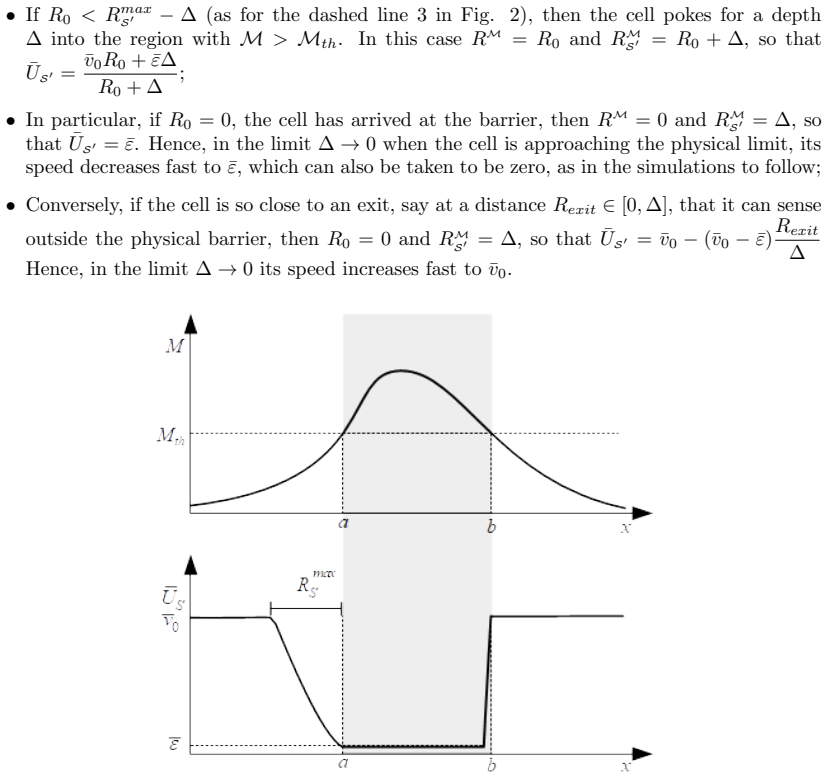
- With a nonzero poking depth $\Delta$, a cell approaching a barrier decelerates gradually rather than stopping abruptly, and a cell within $\Delta$ of an exit accelerates quickly; a vanishing $\Delta$ makes the stop at the barrier sharp.
Reading between the lines
- An implication the authors leave implicit is that the same parity-breaking mechanism should appear in any model where perception is truncated by obstacles—bacterial chemotaxis in porous media, animal movement in fragmented landscapes, pedestrian flows—making hyperbolic macroscopic limits more common than diffusive ones in confined environments.
- The hyperbolic limit implies that density fronts steepen into shocks at barriers, so a stability analysis of the hyperbolic equation could predict the observed pattern wavelength $R^{\max}$ directly, without resolving the kinetic equation.
- Replacing the hard threshold by a smooth, direction-independent attenuation of the signal with distance should weaken the asymmetry; computing $U^0$ under such a kernel would isolate whether the threshold cutoff is the essential ingredient of the conclusion.
Signed reviews
Editorial analysis
A structured set of objections, weighed in public.
Referee Report
Summary. The paper extends the non-local kinetic model of Loy and Preziosi (2019) to account for physical limits of migration. The key novelty is that the sensing radius in the turning operator is no longer constant but depends on position, sensing direction, and time, through a hard-threshold rule (13)-(14): a cell senses up to the first point where a mechanical cue M exceeds a threshold Mth, plus a small poking depth Δ. The authors derive macroscopic limits of the kinetic transport equation and argue that, near physical barriers, the direction dependence of the sensing radius makes the leading-order macroscopic velocity U0 nonzero, so the appropriate scaling is hyperbolic (Eq. 42), with parabolic scaling possible only away from barriers. The modelling framework is then illustrated with one- and two-dimensional simulations for volume filling, cell-ECM interactions, cell-cell adhesion, and chemotaxis, showing pattern formation, barrier crossing, and aggregation phenomena.
Significance. If the central claim is valid, the paper offers a useful modelling mechanism: physical limits of migration introduce a direction-dependent sensing radius, which breaks the symmetry needed for a purely diffusive macroscopic description. The model is flexible and biologically well motivated, separating polarization from speed sensing and incorporating a hard threshold for sensing. The numerical experiments demonstrate interesting phenomena (e.g., spontaneous pattern formation with wavelength set by the sensing radius, trapping near dense ECM, and the importance of protrusion length for crossing poor-adhesion regions). The paper is clearly written and builds transparently on prior work. However, the theoretical derivation of the macroscopic limit has a gap concerning sharp barriers, which is load-bearing for the paper's central claim that the global appropriate limit is hyperbolic.
major comments (4)
- [Section 4, Eqs. (28)-(42)] The expansion T = T0 + ε T1 + O(ε²) and the subsequent derivation of the hyperbolic limit (42) assume that the turning kernel T and the sensing radius R_{S'}(ξ, v̂) are smooth functions of the macroscopic variable ξ. For the sharp barriers that motivate the model (e.g., the step-like density in Fig. 7 or the thresholded regions in Section 5.1), R_{S'} defined in Eq. (13)-(14) is discontinuous in x at the barrier. Under the rescaling ξ = εx, this discontinuity varies on the fast scale x/ε, so the expansion is not uniform and the limit (42) is not justified as a global macroscopic equation. Away from the barrier the sensing radius is effectively constant and the parabolic limiting equation (47) applies, with the barrier entering through an interface or no-flux condition rather than through a bulk hyperbolic advection term. A matched-asymptotic or boundary-layer analysis is needed to establish the claimed hyperbolic limit, or the claim should be reformulated as a statement about the boundary layer only.
- [Section 5.1, Eqs. (62)-(63)] The argument that η = R̄ρ/lρ ≫ 1 near barriers rules out a diffusive time scale only shows that a single parabolic scaling is not uniform in Ω. It does not imply that the global hyperbolic equation (42) is the correct macroscopic model, because the derivation of U0 in Eq. (60) still requires the Taylor expansion (58) to be legitimate. Near a sharp barrier, lρ is small and the sensing radius Rρ is large compared with lρ, so the nonlocal contribution cannot be approximated by a local gradient term; the macroscopic flux is not a smooth function of ξ. Thus the reasoning does not bridge the gap from 'no uniform diffusive scaling' to 'global hyperbolic equation'.
- [Section 4, Eqs. (38)-(46)] The statement that condition (41) (U0 = 0) cannot be satisfied when R_{S'} depends on v̂ is too strong. For a cell positioned symmetrically between two identical barriers, Γ_{S'}(ξ, v̂) is even in v̂, and with B constant the integral in Eq. (38) vanishes identically even though R_{S'} is direction-dependent. The paper acknowledges this possibility with 'unless for very peculiar cases', but the exception is not characterized. Since the dichotomy between hyperbolic and parabolic limits is central to the paper, this oversight should be addressed either by giving a precise condition for U0 = 0 or by softening the claim to 'in generic configurations'.
- [Sections 5 and 6] The numerical simulations are presented without convergence checks, mesh refinement studies, or quantitative validation. The paper makes a theoretical claim about macroscopic limits, so at least one grid-convergence study (for example, for the key simulation in Fig. 7 or Fig. 15) is necessary to rule out numerical artifacts. This is particularly important for the Dirac-delta sensing kernel (Section 5.1), where the observed patterns have a wavelength comparable to the sensing radius and potentially to the grid size. Without such checks, the qualitative conclusions (e.g., that Rρ = Rmaxρ allows densities to exceed the threshold, while the limited-radius model does not) rest on unverified numerical evidence.
minor comments (5)
- [Eq. (17) and (20)] In Eq. (17) and Eq. (20), the argument of T is written as (x, v, v) instead of (x, v, ˆv); this is a typographical error.
- [Section 4, after Eq. (43)] The notation S′ is used both for the field and for the variable in ψ(v|S′(y)); this dual use is confusing and should be disambiguated, for example by writing the field as S′(x) and the variable as s.
- [Eq. (45)] In Eq. (45), the subscript on U0_{S′} is inconsistent with the notation U0_{S,S′} used in Eqs. (38)-(40); this should be harmonized.
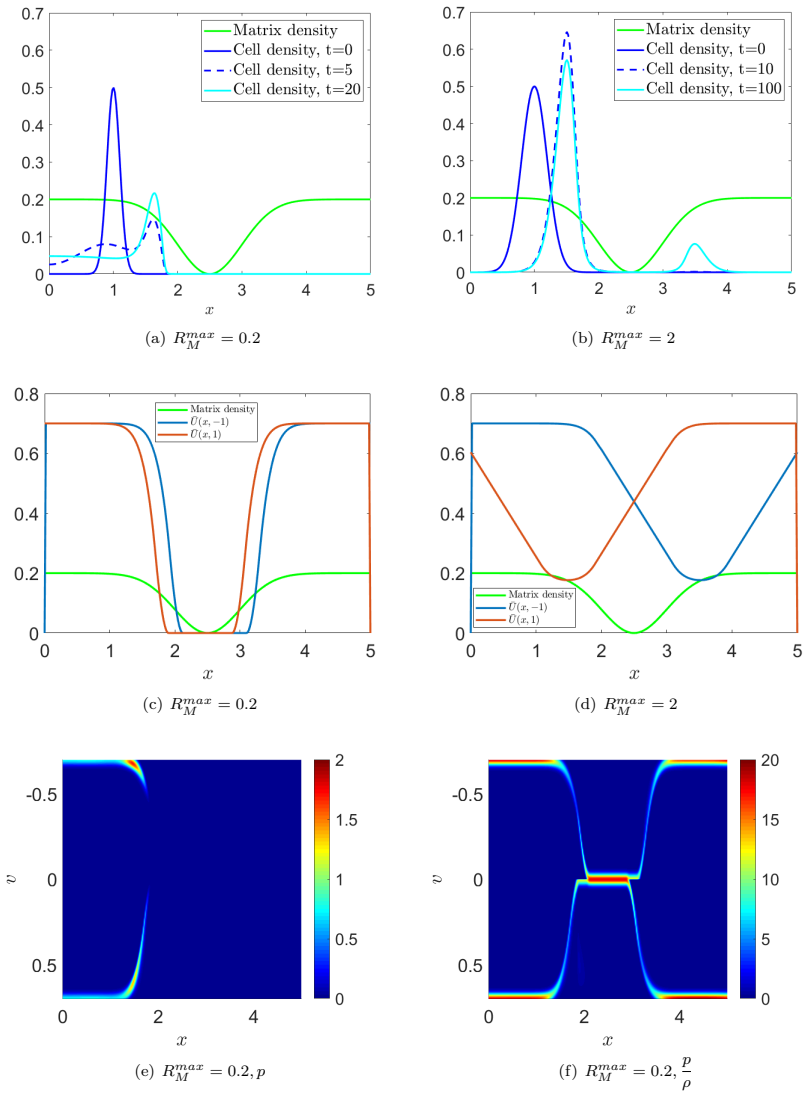
- [Fig. 12] The labels in subfigures (e) and (f) are incomplete: 'Rmax_M = 0.2,p' and 'Rmax_M = 0.2,p/ρ' should indicate the time at which the plots are taken and what the color scale represents.
- [Section 5.1, Eq. (54)] The set notation in Eq. (54) is slightly imprecise: [0, Rρ(t,x,ˆv)] = { λ′∈[0,Rmaxρ] | ρ(t, x+λ′ˆv) ≤ ρth } defines an interval of λ′ values, but the right-hand side is a set of admissible λ′; this is acceptable but could be phrased more cleanly.
Circularity Check
No significant circularity: the paper's macroscopic-limit conclusion is a direct consequence of its explicitly stated sensing-radius model, not a renamed fit or a self-citation chain.
full rationale
The derivation chain is self-contained. The authors define the direction-dependent sensing radius RM in Eqs. (13)-(14) as the first hitting point of the threshold Mth (plus a poking depth Δ), and the leading-order macroscopic velocity U0 in Eq. (38) is then the velocity-space integral of the turning kernel that depends on RM through ΓS′. Showing that U0 need not vanish when ΓS′ depends on v̂ (Eqs. (41)-(46)) is a mathematical consequence of those definitions, not a prediction obtained by fitting a parameter to data or by importing an external result. The paper's actual modeling assumption is the hard-threshold, first-hit sensing rule; once that is granted, the asymmetry near a barrier follows by construction, but the paper does not present this as an empirically independent prediction, so it is not circular in the sense used here. The self-citations to Loy and Preziosi (2019) supply the prior kinetic-sensing framework (factorized turning kernel, normalization, choice of reference scales), but the novel claim about physical limits and hyperbolic scaling is analyzed with the standard Hilbert-expansion technique of Othmer and Hillen (2000) applied to the new definitions, so the self-citations are not load-bearing. A remaining concern, outside circularity, is that the two-scale expansion assumes smooth dependence on ξ; near a sharp barrier the sensing radius varies on the fast scale, so the global hyperbolic limit (42) may require a boundary-layer or matched-asymptotics justification. That is a correctness/rigor question, not a circularity, and per the review rules it is not scored here.
Assumptions & free parameters
free parameters (6)
- rho_th (volume filling threshold) =
0.25, 0.4, 0.5 in different simulations
- Mth (ECM density threshold) =
0.4, 0.8, 1.39, 1.5 in different simulations
- M0 (minimal ECM density for adhesion) =
0, 0.1, 0.01 in different simulations
- Rmax (maximum sensing radius) =
0.2, 0.6, 2, 0.3, 1.5 in different simulations
- mu (turning frequency) =
2, 10, 20, 200 in simulations
- vM (maximal cell speed) =
0.7, 1 in simulations
assumptions (5)
- domain assumption Velocity-jump process with no memory of pre-turning velocity, so T = T(x,v,hat v).
- domain assumption Turning kernel factorizes into directional bias B[S] and speed distribution Psi[S'] with independent cues.
- ad hoc to paper Physical limit is a hard threshold: sensing stops at the first point where M > Mth, with a small poking depth Delta.
- domain assumption The mechanical cue M is a prescribed field, not dynamically coupled to cell motion.
- domain assumption The sensing kernels gamma_S and gamma_S' have compact support and are taken as Heaviside or Dirac delta functions.
Cite this review
Pith. "Pith review of Modelling physical limits of migration by a kinetic model with non-local sensing." pith.science (2026). https://pith.science/paper/YAMOQ54E
@misc{pith2026190808325,
  author       = {Pith},
  title        = {Pith review of: Modelling physical limits of migration by a kinetic model with non-local sensing},
  year         = {2026},
  howpublished = {\url{https://pith.science/paper/YAMOQ54E}},
  note         = {Machine review of arXiv:1908.08325}
}
read the original abstract
Migrating cells choose their preferential direction of motion in response to different signals and stimuli sensed by spanning their external environment. However, the presence of dense fibrous regions, lack of proper substrate, and cell overcrowding may hamper cells from moving in certain directions or even from sensing beyond regions that practically act like physical barriers. We extend the non-local kinetic model proposed by Loy and Preziosi (2019) to include situations in which the sensing radius is not constant, but depends on position, sensing direction and time as cells' behavior might be determined on the basis of information collected before reaching physically limiting configurations. We analyze how the actual possible sensing of the environment influences the dynamics by recovering the appropriate macroscopic limits and by integrating numerically the kinetic transport equation.
Figures

Figures from the paper (12 more)







Reference graph
Works this paper leans on
-
[1]
Abercrombie, M. and Heaysman, J. E. (1953). Observations on the social behaviour of cells in tissue culture: I. S peed of movement of chick heart fibroblasts in relation to their mutual contacts. Experimental Cell Research , 5(1):111 -- 131
work page 1953
-
[2]
Adler, J. (1966). Chemotaxis in bacteria. Science , 153(3737):708--116
work page 1966
-
[3]
Alt, W. (1980). Biased random walk models for chemotaxis and related diffusion approximations. Journal of Mathematical Biology , 9(2):147--177
work page 1980
-
[4]
Arduino, A. and Preziosi, L. (2015). A multiphase model of tumour segregation in situ by a heterogeneous extracellular matrix. International Journal of Non-Linear Mechanics , 75:22--30
work page 2015
-
[5]
Armstrong, N. J., Painter, K. J., and Sherratt, J. A. (2006). A continuum approach to modelling cell-cell adhesion. Journal of Theoretical Biology , 243(1):98--113
work page 2006
-
[6]
Bisi, M., Carrillo, J. A., and Lods, B. (2008). Equilibrium solution to the inelastic B oltzmann equation driven by a particle bath. Journal of Statistical Physics , 133(5):841--870
work page 2008
-
[7]
Bitsouni, V. and Eftimie, R. (2018). Non-local parabolic and hyperbolic models for cell polarisation in heterogeneous cancer cell populations. Bulletin of Mathematical Biology , 80(10):2600--2632
work page 2018
-
[8]
Block, S. M., Segall, J. E., and Berg, H. C. (1983). Adaptation kinetics in bacterial chemotaxis. Journal of Bacteriology , 154(1):312--323
work page 1983
Show all 53 references
-
[9]
Buttensch \"o n, A., Hillen, T., Gerisch, A., and Painter, K. J. (2018). A space-jump derivation for non-local models of cell-cell adhesion and non-local chemotaxis. Journal of Mathematical Biology , 76(1):429--456
2018
-
[10]
Carrillo, J., Hoffmann, F., and Eftimie, R. (2015). Non-local kinetic and macroscopic models for self-organised animal aggregations. Kinetic & Related Models , 8:413--441
2015
-
[11]
Cercignani, C. (1987). The B oltzmann Equation and its Applications . Springer, New York
1987
-
[12]
Chauviere, A., Hillen, T., and Preziosi, L. (2007a). Modeling cell movement in anisotropic and heterogeneous network tissues. Networks & Heterogeneous Media , 2(2):333--357
2007
-
[13]
Chauviere, A., Hillen, T., and Preziosi, L. (2007b). Modeling the motion of a cell population in the extracellular matrix. Discrete and Continuous Dynamical Systems B , 2007(Supplemental volume):250--259
2007
-
[14]
Colombi, A., Scianna, M., and Preziosi, L. (2017). Coherent modelling switch between pointwise and distributed representations of cell aggregates. Journal of Mathematical Biology , 74(4):783--808
2017
-
[15]
Colombi, A., Scianna, M., and Tosin, A. (2015). Differentiated cell behavior: a multiscale approach using measure theory. Journal of Mathematical Biology , 71:1049--1079
2015
-
[16]
M., Denais, C., Bakshi, M
Davidson, P. M., Denais, C., Bakshi, M. C., and Lammerding, J. (2014). Nuclear deformability constitutes a rate-limiting step during cell migration in 3-d environments. Cellular and Molecular Bioengineering , 7(3):293--306
2014
-
[17]
and Janetopoulos, C
Devreotes, P. and Janetopoulos, C. (2003). Eukaryotic chemotaxis: Distinctions between directional sensing and polarization. Journal of Biological Chemistry , 278(23):20445--20448
2003
-
[18]
Eftimie, R. (2012). Hyperbolic and kinetic models for self-organized biological aggregations and movement: a brief review. Journal of Mathematical Biology , 65(1):35--75
2012
-
[19]
Eftimie, R., Perez, M., and Buono, P.-L. (2017). Pattern formation in a nonlocal mathematical model for the multiple roles of the tgf- pathway in tumour dynamics. Mathematical Biosciences , 289:96 -- 115
2017
-
[20]
Friedl, P., Wolf, K., and Lammerding, J. (2011). Nuclear mechanics during cell migration. Current Opinion in Cell Biology , 1:55--64
2011
-
[21]
Giverso, C., Arduino, A., and Preziosi, L. (2017). How nucleus mechanics and ECM microstructure influence the invasion of single cells and multicellular aggregates. Bulletin of Mathematical Biology , 80:1--29
2017
-
[22]
Giverso, C., Grillo, A., and Preziosi, L. (2014). Influence of nucleus deformability on cell entry into cylindrical structures. Biomechanics and Modeling in Mechanobiology , 13:481--502
2014
-
[23]
L., Risse, G., and Mark, K
Goodman, S. L., Risse, G., and Mark, K. (1989). The E 8 subfragment of laminin promotes locomotion of myoblasts over extracellular matrix. The Journal of Cell Biology , 109:799--809
1989
-
[24]
Harley, B., Kim, H., Zaman, M., Yannas, I., Lauffenburger, D., and Gibson, L. J. (2008). Microarchitecture of three-dimensional scaffolds influences cell migration behavior via junction interactions. Biophysical journal , 95(8):4013–4024
2008
-
[25]
Hillen, T. (2006). M5 mesoscopic and macroscopic models for mesenchymal motion. Journal of Mathematical Biology , 53:585--616
2006
-
[26]
J., and Schmeiser, C
Hillen, T., Painter, K. J., and Schmeiser, C. (2007). Global existence for chemotaxis with finite sampling radius. Discrete & Continuous Dynamical Systems - B , 7(1):125--144
2007
-
[27]
Lods, B. (2005). Semigroup generation propertiesof streaming operators with noncontractive boundary conditions. Mathematical and Computer Modelling , 42:1441--1462
2005
-
[28]
and Preziosi, L
Loy, N. and Preziosi, L. (2019). Kinetic models with non-local sensing determining cell polarization and speed according to independent cues. Journal of Mathematical Biology-accepted (arXiv:1906.11039v3)
2019 arXiv
-
[29]
Wood, D., Kwon, S., P
Nam, K.-H., Kim, P., K. Wood, D., Kwon, S., P. Provenzano, P., and Kim, D.-H. (2016). Multiscale cues drive collective cell migration. Scientific Reports , 6:29749
2016
-
[30]
and Hillen, T
Othmer, H. and Hillen, T. (2002). The diffusion limit of transport equations ii: Chemotaxis equations. SIAM Journal of Applied Mathematics , 62:1222--1250
2002
-
[31]
and Stevens, A
Othmer, H. and Stevens, A. (2001). Aggregation, blowup, and collapse: The ABC 's of taxis in reinforced random walks. SIAM Journal on Applied Mathematics , 57:311--338
2001
-
[32]
G., Dunbar, S
Othmer, H. G., Dunbar, S. R., and Alt, W. (1988). Models of dispersal in biological systems. Journal of Mathematical Biology , 26(3):263--298
1988
-
[33]
Othmer, H. G. and Hillen, T. (2000). The diffusion limit of transport equations derived from velocity-jump processes. SIAM Journal of Applied Mathematics , 61:751--775
2000
-
[34]
Painter, J. K. and Hillen, T. (2002). Volume-filling and quorum-sensing in models for chemosensitive movement. Canadian Applied Mathematics Quarterly , 10:501--543
2002
-
[35]
J., Armstrong, N
Painter, K. J., Armstrong, N. J., and Sherratt, J. A. (2010). The impact of adhesion on cellular invasion processes in cancer and development. Journal of Theoretical Biology , 264(3):1057--1067
2010
-
[36]
J., Bloomfield, M
Painter, K. J., Bloomfield, M. J., Sherratt, J. A., and Gerisch, A. (2015). A nonlocal model for contact attraction and repulsion in heterogeneous cell populations. Bulletin of Mathematical Biology , 77:1132--1165
2015
-
[37]
Painter, K. J. and Sherratt, J. A. (2003). Modelling the movement of interacting cell populations. Journal of Theoretical Biology , 225(3):327--339
2003
-
[38]
Palcewski, A. (1992). Velocity averaging for boundary value problems . Series on Advances in Mathematics For Applied Sciences. World Scientific Publishing Company
1992
-
[39]
Pettersson, R. (2004). On solutions to the linear B oltzmann equation for granular gases. Transport Theory and Statistical Physics , 33(5-7):527--543
2004
-
[40]
Peyton, S. R. and Putnam, A. J. (2005). Extracellular matrix rigidity governs smooth muscle cell motility in a biphasic fashion. Journal of Cellular Physiology , 204(1):198--209
2005
-
[41]
Plaza, R. G. (2019). Derivation of a bacterial nutrient-taxis system with doubly degenerate cross-diffusion as the parabolic limit of a velocity-jump process. Journal of Mathematical Biology , 78:1681--1711
2019
-
[42]
and Nouri, A
Schmeiser, C. and Nouri, A. (2017). Aggregated steady states of a kinetic model for chemotaxis . Kinetic and Related Models , 10(1):313 -- 327
2017
-
[43]
D., Louvard, D., and Vignjevic, D
Schoumacher, M., Goldman, R. D., Louvard, D., and Vignjevic, D. M. (2010). Actin, microtubules, and vimentin intermediate filaments cooperate for elongation of invadopodia. The Journal of Cell Biology , 189(3):541--556
2010
-
[44]
and Preziosi, L
Scianna, M. and Preziosi, L. (2013). Modeling the influence of nucleus elasticity on cell invasion in fiber networks and microchannels. Journal of Theoretical Biology , 317:394 -- 406
2013
-
[45]
and Preziosi, L
Scianna, M. and Preziosi, L. (2014). A cellular P otts model for the MMP -dependent and-independent cancer cell migration in matrix microtracks of different dimensions. Computational Mechanics , 53:485--497
2014
-
[46]
Scianna, M., Preziosi, L., and Wolf, K. (2013). A cellular P otts model simulating cell migration on and in matrix environments. Mathematical Biosciences and Engineering , 10:235--261
2013
-
[47]
M., Foster, L
Shankar, J., Messenberg, A., Chan, J., Underhill, T. M., Foster, L. J., and Nabi, I. R. (2010). Pseudopodial actin dynamics control epithelial-mesenchymal transition in metastatic cancer cells. Cancer Research , 70(9):3780--3790
2010
-
[48]
Stroock, D. W. (1974). Some stochastic processes which arise from a model of the motion of a bacterium. Zeitschrift f \"u r Wahrscheinlichkeitstheorie und Verwandte Gebiete , 28(4):305--315
1974
-
[49]
te Boekhorst, V., Preziosi, L., and Friedl, P. (2016). Plasticity of cell migration in vivo and in silico. Annual Review of Cell and Developmental Biology , 32:491--526
2016
-
[50]
and Frasca, P
Tosin, A. and Frasca, P. (2011). Existence and approximation of probability measure solutions to models of collective behaviors. Networks & Heterogeneous Media , 6(1):561--596
2011
-
[51]
Wolf, K., Te Lindert, M., Vortmeyer-Krause, M., Alexander, S., te Riet, J., L Willis, A., M Hoffman, R., Figdor, C., J Weiss, S., and Friedl, P. (2013). Physical limits of cell migration: Control by ECM space and nuclear deformation and tuning by proteolysis and traction force...
2013
-
[52]
I., Liu, Y., Geiger, J., Tam, E., Overall, C., Stack, M
Wolf, K., Wu, Y. I., Liu, Y., Geiger, J., Tam, E., Overall, C., Stack, M. S., and Friedl, P. (2007). Multi-step pericellular proteolysis controls the transition from individual to collective cancer cell invasion. Nature Cell Biology , 9(8):893--904
2007
-
[53]
H., Trapani, L
Zaman, M. H., Trapani, L. M., Sieminski, A. L., Mackellar, D., Gong, H., Kamm, R. D., Wells, A., Lauffenburger, D. A., and Matsudaira, P. (2006). Migration of tumor cells in 3 D matrices is governed by matrix stiffness along with cell-matrix adhesion and proteolysis. Proceedin...
2006
Reviewed August 14, 2026 · model on record in the stance chip above.
Discussion (0). Continue with ORCID to comment.