REVIEW 4 major objections 6 minor 1 cited by
Modeling Human Spatial Mobility Patterns with the L\'evy Flight Cluster Model
T0 review · 4 major / 6 minor · reviewed 2026-08-05 · deepseek-v4-flash
Pith's one-line read The paper introduces the Lévy Flight Cluster Model, a generative Bayesian mixture that turns irregular GPS records into per-person activity regions, long jumps, and returns, with the posterior serving as a simulator of realistic synthetic t
desk verdict The LFCM is a real methodological contribution for activity-space estimation from irregular GPS—just don't over-read the synthetic-trajectory claims until the temporal assumptions get tested. read the letter →
The pith
A machine-rendered reading of the paper's core claim, the machinery that carries it, and where it could break.
The reading
What carries the argument
The LFCM mixture density (Eq. 23) is the load-bearing object: Brownian components with per-activity drift µg and covariance Σ*g scaled by elapsed time Δt, plus a jump component with Pareto lengths, von Mises angles, and a return term that places normal density at the posterior mean and covariance of each previously identified contiguous Brownian path. Four latent indicator vectors carry the classification — b (jump vs. Brownian), c (activity group), η (return vs. exploration), z (activity region) — and a collapsed MCMC sampler integrates out the Normal-Wishart, Dirichlet, Beta, and Pareto-Gamma parameters so the chain explores the discrete allocation space, with absorption/ejection proposals
What would settle it
Fit the LFCM to high-frequency GPS records with known activity labels (e.g., travel diaries): if the posterior allocation of time to activity regions versus jumps systematically misestimates observed dwell times, or if re-fitting the same data subsampled to 5, 15, and 60-minute intervals shifts the estimated activity share substantially, the instantaneous-jump assumption is doing the work. A direct check is regressing observed jump length on elapsed time between consecutive records — the flight assumption predicts no relationship once the mixture allocation is accounted for, whereas a Lévy wal
Extended reading notes
Core claim
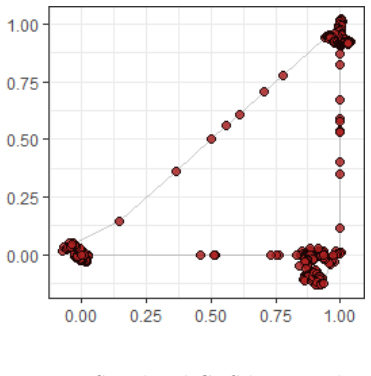
Definition 5.1 (Eq. 23) gives the model: a trajectory's first differences mix Brownian motion within one of NG activity groups (probability 1−ν) with jumps (probability ν) whose lengths are Pareto and directions von Mises; each jump is exploratory or, with probability p, a return to a previously visited activity region. Conjugate priors and a collapsed MCMC sampler integrate out nuisance parameters, leaving a chain over latent allocations b, c, η, z and the group count NG. The paper's central object is the resulting joint posterior, used generatively: it reproduces jump-length, MSD, and radius-of-gyration statistics on 293 devices' GPS records, gives exploration growth ~t^0.52 versus the lit
Load-bearing premise
The model assumes each long move is an instantaneous Lévy jump whose probability does not depend on elapsed time, even though real travel takes time — so the model's split of a person's time between activity and travel rests on a premise the data do not verify.
Editorial extensions
If this is right
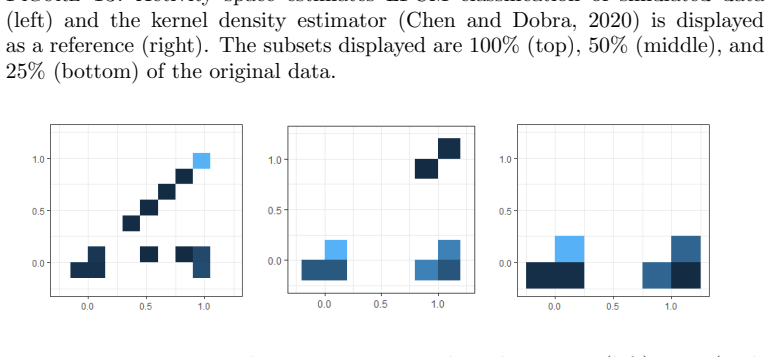
- Irregular, application-driven GPS sampling need not be binned onto grids: the LFCM estimates per-person probabilistic activity regions with uncertainty bounds directly from observed times and locations.
- Posterior samples generate synthetic trajectories that preserve jump-length, MSD, radius-of-gyration, and frequented-location statistics, offering a practical anonymization route for sharing mobility data.
- Because trajectories can be interpolated and extrapolated to a common time window from posterior samples, pairwise distances between individuals can be computed even when their device data were recorded at different times, yielding probabilistic contact matrices.
- Activity-region estimates stabilize quickly — roughly 50% overlap of top regions with 12-week estimates from just 2 weeks of data, rising to about 60% at 4 weeks — so short observation windows can support downstream inference.
Reading between the lines
- None of the model's components is human-specific; the same mixture of Brownian clusters, Lévy jumps, and returns should transfer to animal telemetry or transit data, where per-individual uncertainty around activity regions is similarly needed.
- If the instantaneous-jump (Lévy flight) assumption is wrong for travel that occupies real time, then subsampling high-frequency GPS to coarser intervals should change the estimated activity-versus-travel time split; if it does, a Lévy-walk variant with speed-dependent jump durations would be needed.
- The model's sensitivity to the minimal-jump-distance ε suggests a natural upgrade — a prior or empirical-Bayes estimate of ε from the data — which would make the method fully unsupervised and remove the calibration step.
- The probabilistic overlap matrices are presently pairwise-distance summaries; coupling them with network models could turn them into inference tools for social structure, segregation, or disease-contact risk.
Signed reviews
Editorial analysis
A structured set of objections, weighed in public.
Referee Report
Summary. The paper introduces the Lévy Flight Cluster Model (LFCM), a hierarchical Bayesian mixture model for individual human mobility from temporally irregular GPS observations. The model represents spatial increments as a mixture of Brownian-motion activity clusters and Lévy jumps, augmented by a return mechanism to previously identified activity regions. Posterior inference is performed with a collapsed MCMC sampler, and the estimated posterior is used to generate synthetic trajectories, estimate activity regions, and construct probabilistic overlap matrices. The paper reports a simulation study and an application to 293 mobile devices observed over 12 weeks, comparing mobility metrics (jump length, MSD, radius of gyration) with a grid-based conservative proportional time (CPT) estimator.
Significance. If the model's generative assumptions were valid, the LFCM would be a useful contribution to activity-space estimation, anonymized data generation, and probabilistic contact networks. The collapsed MCMC sampler with conjugate priors is computationally attractive, and the comparison with a grid-based CPT estimator is a sensible baseline. The model's ability to produce uncertainty-aware activity regions from sparse, irregular GPS is potentially valuable. However, the temporal misspecification of the jump component and an inconsistency in the return-region distribution affect the central claims about generative realism and the headline applications. These issues are substantial but appear addressable within the manuscript's scope.
major comments (4)
- [Section 5, Eqs. (15)–(17), (23); Table 1] The jump component is temporally misspecified. In a Lévy process, the jump intensity must scale with interval length: for a compound Poisson process, P(N(Δt)>0)=1−exp(−λΔt) and the distribution of the aggregate jump depends on Δt. Eq. (17) writes f_J*(Δr; α, Δt), but the implemented prior and likelihood put a Pareto distribution on ||Δx||_2 alone, with no dependence on Δt, and ν is treated as a constant per observation. Because the GPS data are explicitly temporally irregular (Section 2), this cannot correctly allocate time between activity and travel. The Brownian variance scaling does not repair the issue: it can absorb long gaps as large Brownian displacements, but it does not capture the increased opportunity for long trips over long intervals. This directly affects the synthetic-trajectory and overlap-matrix applications, where travel time is misrepresented as instantaneous teleport
- [Section 5.1, Eqs. (22)–(23); Appendix A] The return-region distribution is inconsistent. Eq. (22) derives the distribution of the time-average of a Brownian motion over [0,T], with mean μ0+T/2·diag(μ) and variance (T/3)·diag(σ²). This is an average location, not an endpoint distribution. Yet Eq. (23) uses N(Δx(t); rμ_z, Σ_z) inside a model for increments, while Appendix A uses N(x(t_i); rμ_z, Σ_z) for the absolute location. A displacement and an absolute activity-region center are not interchangeable, and the time-average distribution is not the appropriate likelihood for a return point. This affects the classification of returns and the geometry of estimated activity regions. The authors should either model the absolute location with a properly derived endpoint distribution, or explicitly define the activity-region center as a time-average and derive the resulting return likelihood.
- [Section 7, Table 2] The model validation is in-sample and partly circular. The metrics compared in Table 2 — jump length, MSD, and radius of gyration — are the same heavy-tailed and clustering features that the LFCM was constructed to reproduce. The table reports only means and standard deviations, without uncertainty intervals or a comparison of full distributions. The pooled tail index α≈1.71–1.74 estimated in Section 3 is obtained from the same dataset and is not used as an independent prediction. The claim that the LFCM 'accurately captures the key characteristics of human mobility' therefore needs stronger support, for example by fitting the model on early weeks and simulating later weeks, or by reporting posterior predictive checks against held-out data.
- [Section 6, 'Data Generation'] The simulation study does not test the temporal allocation that is central to the model's intended applications. The simulated data include finite-speed travel — e.g., a 20-minute commute between home and work — while the LFCM assumes instantaneous Lévy jumps. The simulation demonstrates recovery of activity regions, but it does not evaluate whether the model correctly apportions time between activity regions and travel. At a minimum, the authors should report time spent in travel versus time spent in activity regions for LFCM-generated trajectories compared with the true simulation, and ideally include a simulation scenario that matches the Lévy-flight assumption to separate the model's spatial clustering performance from its temporal realism.
minor comments (6)
- [Throughout] There are numerous typographical errors: 'L´evy' spacing inconsistencies, 'Mendelbrot' (Section 4), 'noticably' (Section 7), and 'activity activity spaces' (Section 7).
- [Eq. (24)] The definitions of A and B in Eq. (24) are hard to parse due to nested indicators and line breaks. Rewriting with explicit indicator products would improve readability.
- [Table 1] The prior for N_G is listed as Poiss(λ) with Gamma(1/2,1/2) hyperprior, but the text in Section 5.2 says the prior N_G ~ Gamma(1/2,1/2). Also, Table 1 uses α_g for the Pareto parameter while Eq. (23) uses a common α; clarify which is intended.
- [Section 5.2 and Algorithm 2] The maximum number of activity groups M_G is a required input to the algorithm but is not defined in the main text or given a default value. Its role in the absorption/ejection step should be stated.
- [Section 7] The paper discusses careful calibration of ε in the simulation study, but for the real-data analysis it does not report the value of ε used or the calibration procedure. This should be stated for reproducibility.
- [Section 3] The relation α = α_c + α_r for the conditional jump-length distribution is stated without derivation or citation; please provide a reference or a brief derivation.
Circularity Check
Jump-length agreement in Table 2 is an in-sample posterior fit, but independent checks give the model real content.
-
fitted input called prediction
[Section 5, 'Pure Jump Size Distribution'; Section 7, Table 2]
"We model jump lengths as a Pareto distribution with common parameters α, ε between activity groups, that is, fΔr/Δt(Δr/Δt; α, ε)=αε^α(Δr/Δt)^{-(α+1)}1{(Δr/Δt)≥ε}. ... Table 2 displays the mean and standard deviation of jump length, MSD, and radius of gyration ... Whereas the LFCM closely reproduces jump length, MSD, and radius of gyration, simulations from the CPT estimator tend to exhibit under-bias on mean jump length and MSD."
The LFCM likelihood in Eq. (23) defines jump lengths as Pareto random variables whose parameters (α, ε) are estimated from the same observed jump-length data (ε by the empirical KS/AD/Kuiper fitting described in Section 5; α through the MCMC posterior of Table 1). Consequently, when Table 2 reports that trajectories simulated from the MAP posterior have jump-length mean 1.580 versus the observed 1.556, the agreement is not an emergent prediction but a draw from the fitted Pareto likelihood that was itself fit to those observed jump lengths. The claim that the LFCM 'captures' jump length is therefore an in-sample posterior predictive check of an assumed distribution, not an independent validation. The MSD and radius-of-gyration comparisons retain more independent content because they depend
full rationale
The LFCM's central construction (Definition 5.1, Eq. 23) is an assumed generative mixture: jumps are modeled with a Pareto distribution, local movement with Brownian mixtures, and returns with Gaussian activity regions. This is a model assumption, not a derivation from the data. The main in-sample evidence is Table 2, where the same observations used to estimate Pareto parameters are then 'reproduced' by posterior simulation; as argued above, the jump-length agreement is partly forced by construction. However, several important checks are genuinely external or not fitted to the claimed outcome: the pooled tail index α ≈ 1.71–1.74 in Section 3 is compared with independent prior estimates (Brockmann et al., Gonzalez et al., Zhao et al.); the simulated rate of newly visited locations t^0.52 in Figure 19 is compared with Song et al.'s external t^0.6 benchmark; and the activity-space stability analysis in Section 7 is a self-contained convergence assessment. I found no load-bearing self-citation chain, no imported uniqueness theorem, and no renaming of a known result. The Lévy-flight-versus-Lévy-walk limitation is a substantive modeling concern but not an instance of circular reasoning: the paper explicitly acknowledges it as an assumption (Section 5). Overall, the central claim is not reducible to its inputs by construction, but one headline quantitative comparison is an in-sample fit, so a moderate circularity score is appropriate.
Assumptions & free parameters
free parameters (3)
- ε (minimal jump length) =
0.1 in simulation (visual inspection); unspecified in real-data analysis
- MG (maximum number of activity groups) =
not stated
- Neighborhood averaging radius r and neighborhood size k =
not given
assumptions (8)
- standard math Lévy-Itô decomposition theorem
- domain assumption Small jumps of the Lévy process are well approximated by Brownian motion
- domain assumption The movement process is a Lévy flight, not a Lévy walk
- domain assumption Jump lengths follow a Pareto distribution with common α and ε across activity groups
- domain assumption Jump angles follow a von Mises distribution
- ad hoc to paper Return to an activity region is distributed as N(μz, Σz) with the specific form in Eq. (22)
- domain assumption Jump probability ν is constant and does not depend on Δt
- domain assumption First differences are independent conditional on latent states
Cite this review
Pith. "Pith review of Modeling Human Spatial Mobility Patterns with the L\'evy Flight Cluster Model." pith.science (2026). https://pith.science/paper/YANC2OCG
@misc{pith2026250900298,
  author       = {Pith},
  title        = {Pith review of: Modeling Human Spatial Mobility Patterns with the L\'evy Flight Cluster Model},
  year         = {2026},
  howpublished = {\url{https://pith.science/paper/YANC2OCG}},
  note         = {Machine review of arXiv:2509.00298}
}
read the original abstract
Despite the extensive collection of individual mobility data over the past decade, fueled by the widespread use of GPS-enabled personal devices, the existing statistical literature on estimating human spatial mobility patterns from temporally irregular location data remains limited. In this paper, we introduce the L\'{e}vy Flight Cluster Model (LFCM), a hierarchical Bayesian mixture model designed to analyze an individual's activity distribution. The LFCM can be utilized to determine probabilistic overlaps between individuals' activity patterns and serves as an anonymization tool to generate synthetic location data. We present our methodology using real-world human location data, demonstrating its ability to accurately capture the key characteristics of human movement.
Figures


Figures from the paper (22 more)





Forward citations
Cited by 1 Pith paper
-
Bayesian Gaussian Mixture Modeling for Symmetric Matrix Variate Data
A Bayesian mixture model for symmetric matrix data writes one precision matrix as a single power of the other; applied to GPS mobility, it links crime and youth employment to weekly activity patterns.
Reference graph
Works this paper leans on
-
[1]
Handbook of mathematical functions with formulas, graphs, and mathematical table
Milton Abramowitz and Irene A Stegun. Handbook of mathematical functions with formulas, graphs, and mathematical table. US Department of Commerce; National Bureau of Standards Applied Mathematics Series, 55, 1965
work page 1965
-
[2]
Mahshid Ahmadian, Edward L. Boone, and Grace S. Chiu. A new perspective to fish trajectory imputation: A methodology for spatiotemporal modeling of acoustically tagged fish data, 2025
work page 2025
-
[3]
Multi-scale spatio-temporal analysis of human mobility
Laura Alessandretti, Piotr Sapiezynski, Sune Lehmann, and Andrea Baronchelli. Multi-scale spatio-temporal analysis of human mobility. PloS One, 12 0 (2): 0 e0171686, 2017
work page 2017
-
[4]
Linking movement ecology with wildlife management and conservation
Andrew M Allen and Navinder J Singh. Linking movement ecology with wildlife management and conservation. Frontiers in Ecology and Evolution, 3: 0 155, 2016
work page 2016
-
[5]
Barry C. Arnold. Pareto Distribution, pages 1--10. John Wiley & Sons, Ltd, 2015. ISBN 9781118445112. doi:https://doi.org/10.1002/9781118445112.stat01100.pub2. URL https://onlinelibrary.wiley.com/doi/abs/10.1002/9781118445112.stat01100.pub2
-
[6]
Approximations of small jumps of l \'e vy processes with a view towards simulation
S ren Asmussen and Jan Rosi \'n ski. Approximations of small jumps of l \'e vy processes with a view towards simulation. Journal of Applied Probability, 38 0 (2): 0 482--493, 2001
work page 2001
-
[7]
Albert-L \'a szl \'o Barab \'a si and H. Eugene Stanley. Fractal Concepts in Surface Growth. Cambridge University Press, 1995
work page 1995
-
[8]
L \'e vy processes , volume 121
Jean Bertoin. L \'e vy processes , volume 121. Cambridge university press Cambridge, 1996
work page 1996
Show all 65 references
-
[9]
Deriving and validating trip purposes and travel modes for multi-day gps-based travel surveys: A large-scale application in the netherlands
Wendy Bohte and Kees Maat. Deriving and validating trip purposes and travel modes for multi-day gps-based travel surveys: A large-scale application in the netherlands. Transportation Research Part C: Emerging Technologies, 17 0 (3): 0 285--297, 2009
2009
-
[10]
The scaling laws of human travel
Dirk Brockmann, Lars Hufnagel, and Theo Geisel. The scaling laws of human travel. Nature, 439 0 (7075): 0 462--465, 2006
2006
-
[11]
Urban form and household activity-travel behavior
Ron N Buliung and Pavlos S Kanaroglou. Urban form and household activity-travel behavior. Growth and Change, 37 0 (2): 0 172--199, 2006
2006
-
[12]
Exploring spatial variety in patterns of activity-travel behaviour: initial results from the toronto travel-activity panel survey (ttaps)
Ron N Buliung, Matthew J Roorda, and Tarmo K Remmel. Exploring spatial variety in patterns of activity-travel behaviour: initial results from the toronto travel-activity panel survey (ttaps). Transportation, 35 0 (6): 0 697--722, 2008
2008
-
[13]
The fractal geometry of nature
JW Cannon. The fractal geometry of nature. by benoit b. mandelbrot. The American Mathematical Monthly, 91 0 (9): 0 594--598, 1984
1984
-
[14]
Measuring human activity spaces from gps data with density ranking and summary curves
Yen-Chi Chen and Adrian Dobra. Measuring human activity spaces from gps data with density ranking and summary curves. Annals of Applied Statistics, 14 0 (1): 0 409--432, 2020
2020
-
[15]
Power-law distributions in empirical data
Aaron Clauset, Cosma Rohilla Shalizi, and Mark EJ Newman. Power-law distributions in empirical data. SIAM review, 51 0 (4): 0 661--703, 2009
2009
-
[16]
Spatiotemporal detection of unusual human population behavior using mobile phone data
Adrian Dobra, Nathalie E Williams, and Nathan Eagle. Spatiotemporal detection of unusual human population behavior using mobile phone data. PloS One, 10 0 (3): 0 e0120449, 2015
2015
-
[17]
A statistical framework for measuring the temporal stability of human mobility patterns
Zhihang Dong, Yen-Chi Chen, and Adrian Dobra. A statistical framework for measuring the temporal stability of human mobility patterns. Journal of Applied Statistics, pages 1--19, 2020
2020
-
[18]
Stochastic processes, volume 7
Joseph L Doob and Joseph L Doob. Stochastic processes, volume 7. Wiley New York, 1953
1953
-
[19]
Comparing distributions: the two-sample anderson-darling test as an alternative to the kolmogorov-smirnoff test
Sonja Engmann and Denis Cousineau. Comparing distributions: the two-sample anderson-darling test as an alternative to the kolmogorov-smirnoff test. Journal of applied quantitative methods, 6 0 (3), 2011
2011
-
[20]
Urban form, individual spatial footprints, and travel: Examination of space-use behavior
Yingling Fan and Asad J Khattak. Urban form, individual spatial footprints, and travel: Examination of space-use behavior. Transportation Research Record, 2082 0 (1): 0 98--106, 2008
-
[21]
An Introduction to Probability Theory and Its Applications, Volume II
William Feller. An Introduction to Probability Theory and Its Applications, Volume II. John Wiley & Sons, 1971
1971
-
[22]
Closure of ‘third places’? exploring potential consequences for collective health and wellbeing
Jessica Finlay, Michael Esposito, Min Hee Kim, Iris Gomez-Lopez, and Philippa Clarke. Closure of ‘third places’? exploring potential consequences for collective health and wellbeing. Health & place, 60: 0 102225, 2019
2019
-
[23]
Gardiner
Crispin W. Gardiner. Stochastic Methods: A Handbook for the Natural and Social Sciences. Springer, 4th edition, 2009
2009
-
[24]
anomalous
Stefan Gheorghiu and Marc-Olivier Coppens. Heterogeneity explains features of “anomalous” thermodynamics and statistics. Proceedings of the National Academy of Sciences, 101 0 (45): 0 15852--15856, 2004
2004
-
[25]
Limit distributions for sums of independent
BV Gnedenko, AN Kolmogorov, BV Gnedenko, and AN Kolmogorov. Limit distributions for sums of independent. Am. J. Math, 105, 1954
1954
-
[26]
Crossing the border? exploring the cross-state mobility of the teacher workforce
Dan Goldhaber, Cyrus Grout, Kristian L Holden, and Nate Brown. Crossing the border? exploring the cross-state mobility of the teacher workforce. Educational Researcher, 44 0 (8): 0 421--431, 2015
2015
-
[27]
Understanding individual human mobility patterns
Marta C Gonzalez, Cesar A Hidalgo, and Albert-Laszlo Barabasi. Understanding individual human mobility patterns. Nature, 453 0 (7196): 0 779--782, 2008
2008
-
[28]
Finding the location of a signal: A bayesian analysis
Peter Guttorp and Richard A Lockhart. Finding the location of a signal: A bayesian analysis. Journal of the American Statistical Association, 83 0 (402): 0 322--330, 1988
1988
-
[29]
Development of M o A L s ( M obile A ctivity L oggers supported by G S phones) for travel behavior analysis
Eiji Hato. Development of M o A L s ( M obile A ctivity L oggers supported by G S phones) for travel behavior analysis. In Proceedings of the 85th Annual Meeting of the Transportation Research Board. Washington D.C., 2006
2006
-
[30]
Hooten, Devin S
Mevin B. Hooten, Devin S. Johnson, Brett T. McClintock, and Juan M. Morales. Animal movement: statistical models for telemetry data. CRC press, 2017
2017
-
[31]
Analyzing animal movements using brownian bridges
Jon S Horne, Edward O Garton, Stephen M Krone, and Jesse S Lewis. Analyzing animal movements using brownian bridges. Ecology, 88 0 (9): 0 2354--2363, 2007
2007
-
[32]
On stochastic processes (i) infinitely divisible laws of probability
Kiyosi It \^o . On stochastic processes (i) infinitely divisible laws of probability. In Japanese journal of mathematics: transactions and abstracts, volume 18, pages 261--301. The Mathematical Society of Japan, 1941
1941
-
[33]
Terrestrial animal tracking as an eye on life and planet
Roland Kays, Margaret C Crofoot, Walter Jetz, and Martin Wikelski. Terrestrial animal tracking as an eye on life and planet. Science, 348 0 (6240): 0 aaa2478, 2015
2015
-
[34]
Transport and social exclusion: investigating the possibility of promoting inclusion through virtual mobility
Susan Kenyon, Glenn Lyons, and Jackie Rafferty. Transport and social exclusion: investigating the possibility of promoting inclusion through virtual mobility. Journal of Transport Geography, 10 0 (3): 0 207--219, 2002
2002
-
[35]
LaPoint, Martin Wikelski, and Kamran Safi
Bart Kranstauber, Roland Kays, Scott D. LaPoint, Martin Wikelski, and Kamran Safi. A dynamic brownian bridge movement model to estimate utilization distributions for heterogeneous animal movement. Journal of Animal Ecology, 81: 0 738--746, 2012
2012
-
[36]
Bivariate gaussian bridges: directional factorization of diffusion in brownian bridge models
Bart Kranstauber, Kamran Safi, and Frederic Bartumeus. Bivariate gaussian bridges: directional factorization of diffusion in brownian bridge models. Movement Ecology, 2 0 (1): 0 1--10, 2014
2014
-
[37]
Brownian bridge interpolation for human mobility? In Proceedings of the 29th International Conference on Advances in Geographic Information Systems, pages 175--183, 2021
John Krumm. Brownian bridge interpolation for human mobility? In Proceedings of the 29th International Conference on Advances in Geographic Information Systems, pages 175--183, 2021
2021
-
[38]
The uncertain geographic context problem
Mei-Po Kwan. The uncertain geographic context problem. Annals of the Association of American Geographers, 102 0 (5): 0 958--968, 2012
2012
-
[39]
Th \'e orie de l’addition des variables al \'e atoires
P L \'e vy. Th \'e orie de l’addition des variables al \'e atoires. Bull. Amer. Math. Soc, 44 0 (Part 1): 0 19--20, 1938
1938
-
[40]
Temporal understanding of human mobility: A multi-time scale analysis
Tongtong Liu, Zheng Yang, Yi Zhao, Chenshu Wu, Zimu Zhou, and Yunhao Liu. Temporal understanding of human mobility: A multi-time scale analysis. PloS One, 13 0 (11): 0 e0207697, 2018
2018
-
[41]
Explore spatiotemporal and demographic characteristics of human mobility via twitter: A case study of chicago
Feixiong Luo, Guofeng Cao, Kevin Mulligan, and Xiang Li. Explore spatiotemporal and demographic characteristics of human mobility via twitter: A case study of chicago. Applied Geography, 70: 0 11--25, 2016
2016
-
[42]
Mandelbrot and John W
Benoit B. Mandelbrot and John W. Van Ness. Fractional brownian motions, fractional noises and applications. SIAM Review, 10 0 (4): 0 422--437, 1968
1968
-
[43]
Spatial polygamy and contextual exposures (spaces) promoting activity space approaches in research on place and health
Stephen A Matthews and Tse-Chuan Yang. Spatial polygamy and contextual exposures (spaces) promoting activity space approaches in research on place and health. American behavioral scientist, 57 0 (8): 0 1057--1081, 2013
2013
-
[44]
The ecology of human mobility
Mark G Meekan, Carlos M Duarte, Juan Fern \'a ndez-Gracia, Michele Thums, Ana MM Sequeira, Rob Harcourt, and V \' ctor M Egu \' luz. The ecology of human mobility. Trends in ecology & evolution, 32 0 (3): 0 198--210, 2017
2017
-
[45]
Urban activity spaces: Illustrations and application of a conceptual model for integrating the time and space dimensions
Tracy H Newsome, Wayne A Walcott, and Paul D Smith. Urban activity spaces: Illustrations and application of a conceptual model for integrating the time and space dimensions. Transportation, 25 0 (4): 0 357--377, 1998
1998
-
[46]
Bayesian finite mixtures with an unknown number of components: The allocation sampler
Agostino Nobile and Alastair T Fearnside. Bayesian finite mixtures with an unknown number of components: The allocation sampler. Statistics and Computing, 17 0 (2): 0 147--162, 2007
2007
-
[47]
The third place
Ramon Oldenburg and Dennis Brissett. The third place. Qualitative sociology, 5 0 (4): 0 265--284, 1982
1982
-
[48]
The problem of the random walk
Karl Pearson. The problem of the random walk. Nature, 72 0 (1865): 0 294--294, 1905
1905
-
[49]
Pandemic precarity: Covid-19 is exposing and exacerbating inequalities in the american heartland
Brea L Perry, Brian Aronson, and Bernice A Pescosolido. Pandemic precarity: Covid-19 is exposing and exacerbating inequalities in the american heartland. Proceedings of the National Academy of Sciences, 118 0 (8), 2021
2021
-
[50]
Injong Rhee, Minsu Shin, Seongik Hong, Kyunghan Lee, S. J. Kim, and Song Chong. On the levy-walk nature of human mobility. IEEE/ACM transactions on networking, 19 0 (3): 0 630--643, 2011
2011
-
[51]
On bayesian analysis of mixtures with an unknown number of components (with discussion)
Sylvia Richardson and Peter J Green. On bayesian analysis of mixtures with an unknown number of components (with discussion). Journal of the Royal Statistical Society: series B (statistical methodology), 59 0 (4): 0 731--792, 1997
1997
-
[52]
Plasticity in elk migration timing is a response to changing environmental conditions
Gregory JM Rickbeil, Jerod A Merkle, Greg Anderson, M Paul Atwood, Jon P Beckmann, Eric K Cole, Alyson B Courtemanch, Sarah Dewey, David D Gustine, Matthew J Kauffman, et al. Plasticity in elk migration timing is a response to changing environmental conditions. Global change b...
2019
-
[53]
Bayesian model selection for the latent position cluster model for social networks
Caitriona Ryan, Jason Wyse, and Nial Friel. Bayesian model selection for the latent position cluster model for social networks. Network Science, 5: 0 70--91, 03 2017. doi:10.1017/nws.2017.6
2017 doi
-
[54]
Scharf, Mevin B
Henry R. Scharf, Mevin B. Hooten, Timothy J. Hefley, and David E. Russell. Dynamic social networks inferred from movement data via latent regime switching. Journal of Animal Ecology, 84 0 (5): 0 1230--1241, 2015
2015
-
[55]
Scharf, Timothy Hefley, Daniel Morin, and Mevin B
Henry R. Scharf, Timothy Hefley, Daniel Morin, and Mevin B. Hooten. Hierarchical bayesian imputation of animal trajectories from sparse telemetry data. Journal of Wildlife Management, 81 0 (2): 0 123--136, 2017
2017
-
[56]
Activity spaces: measures of social exclusion? Transport policy, 10 0 (4): 0 273--286, 2003
Stefan Sch \"o nfelder and Kay W Axhausen. Activity spaces: measures of social exclusion? Transport policy, 10 0 (4): 0 273--286, 2003
2003
-
[57]
On the variability of human activity spaces
Stefan Sch \"o nfelder and Kay W Axhausen. On the variability of human activity spaces. In The Real and Virtual Worlds of Spatial Planning, pages 237--262. Springer, 2004
2004
-
[58]
A suite of methods for representing activity space in a healthcare accessibility study
Jill E Sherman, John Spencer, John S Preisser, Wilbert M Gesler, and Thomas A Arcury. A suite of methods for representing activity space in a healthcare accessibility study. International journal of health geographics, 4 0 (1): 0 1--21, 2005
2005
-
[59]
Modelling the scaling properties of human mobility
Chaoming Song, Tal Koren, Pu Wang, and Albert-L \'a szl \'o Barab \'a si. Modelling the scaling properties of human mobility. Nature Physics, 6 0 (10): 0 818--823, 2010
2010
-
[60]
Deducing mode and purpose from gps data
Peter Stopher, Eoin Clifford, Jun Zhang, and Camden FitzGerald. Deducing mode and purpose from gps data. 2008. URL http://hdl.handle.net/2123/19552
2008
-
[61]
Van Kampen
N.G. Van Kampen. Stochastic Processes in Physics and Chemistry. Elsevier, 3rd edition, 2007
2007
-
[62]
Measures of human mobility using mobile phone records enhanced with gis data
Nathalie E Williams, Timothy A Thomas, Matthew Dunbar, Nathan Eagle, and Adrian Dobra. Measures of human mobility using mobile phone records enhanced with gis data. PloS One, 10 0 (7): 0 e0133630, 2015
2015
-
[63]
Elimination of the travel diary: Experiment to derive trip purpose from global positioning system travel data
Jean Wolf, Randall Guensler, and William Bachman. Elimination of the travel diary: Experiment to derive trip purpose from global positioning system travel data. Transportation Research Record, 1768 0 (1): 0 125--134, 2001
2001
-
[64]
Block clustering with collapsed latent block models
Jason Wyse and Nial Friel. Block clustering with collapsed latent block models. Statistics and Computing, 22 0 (2): 0 415--428, 2012
2012
-
[65]
Explaining the power-law distribution of human mobility through transportationmodality decomposition
Kai Zhao, Mirco Musolesi, Pan Hui, Weixiong Rao, and Sasu Tarkoma. Explaining the power-law distribution of human mobility through transportationmodality decomposition. Scientific reports, 5 0 (1): 0 1--7, 2015
2015
Reviewed August 5, 2026 · model on record in the stance chip above.
Discussion (0). Continue with ORCID to comment.