Deformation and breakup of droplets in an oblique continuous air stream
Pith reviewed 2026-05-25 09:30 UTC · model grok-4.3
The pith
Critical Weber numbers for bag breakup decrease sharply as air stream angle departs from cross-flow toward in-line.
A machine-rendered reading of the paper's core claim, the machinery that carries it, and where it could break.
Core claim
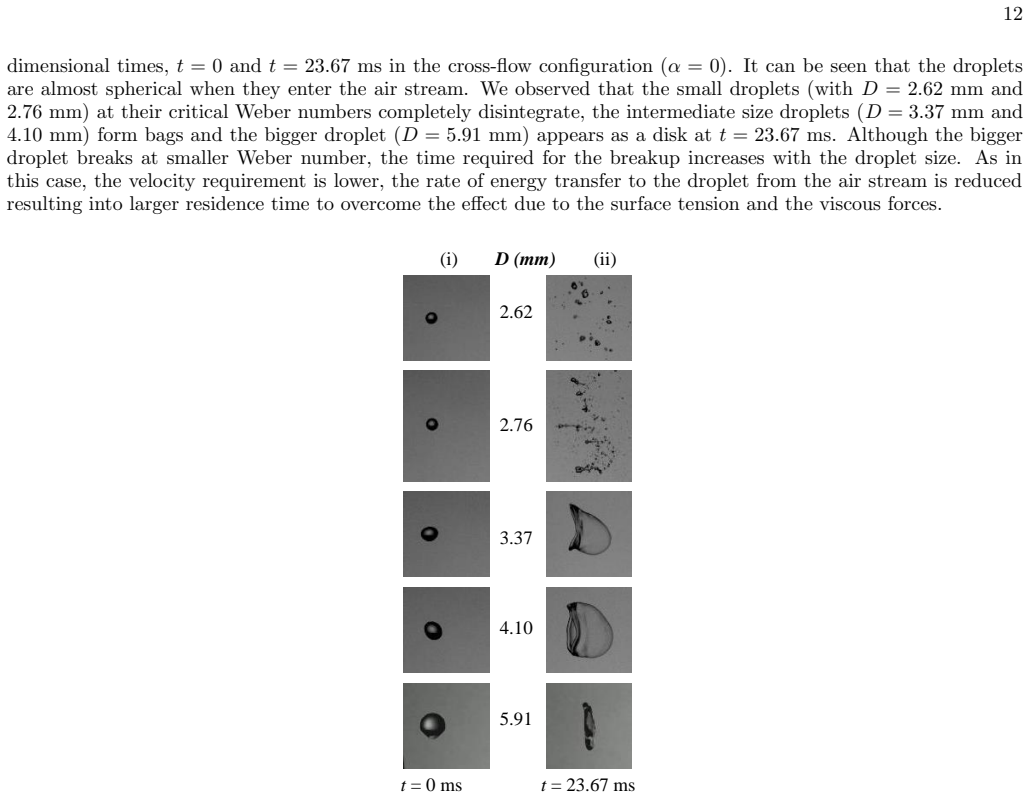
The authors establish that the critical Weber numbers for bag-type breakup are obtained as a function of the Eötvös number, angle of inclination of the air stream and the Ohnesorge number. The departure from the cross-flow arrangement shows a sharp decrease in the critical Weber number for the bag breakup which asymptotically reaches a value associated with the in-line flow configuration for the droplet breakup. The droplet follows a rectilinear motion initially that transforms to a curvilinear motion at later times when the droplet undergoes topological changes, and the apparent acceleration of the droplet and its size influence the critical Weber number for the bag breakup mode.
What carries the argument
The critical Weber number We_cr for vibrational-to-bag breakup transition, expressed as a function of Eötvös number Eo, inclination angle α, and Ohnesorge number Oh, extracted from high-speed imaging of droplet trajectories and deformation modes in oblique air streams.
If this is right
- The apparent acceleration of the droplet influences the critical Weber number for bag breakup.
- Droplet size affects the threshold for the bag breakup mode.
- The droplet's motion changes from rectilinear to curvilinear upon onset of topological changes.
- We_cr values approach those of opposed-flow breakup as the angle departs from the cross-flow arrangement.
Where Pith is reading between the lines
- Models of aerodynamic droplet breakup should incorporate flow angle as an explicit parameter instead of defaulting to perpendicular incidence.
- The observed asymptotic approach to in-line thresholds could be tested by extending the angle range closer to 180 degrees in controlled setups.
- Industrial spray or atomization systems using angled air streams may achieve breakup at lower relative velocities than cross-flow predictions suggest.
Load-bearing premise
That breakup mode transitions can be unambiguously identified from high-speed images and that the air stream remains uniform and continuous, allowing direct attribution of We_cr variation to initial momentum and angle rather than imaging artifacts or flow non-uniformity.
What would settle it
Repeated experiments with a demonstrably uniform oblique air stream that show no dependence of We_cr on inclination angle α, or that yield identical We_cr values across all angles.
Figures




read the original abstract
We experimentally investigate the deformation and breakup of droplets interacting with an oblique continuous air stream. A high-speed imaging system is employed to record the trajectories and topological changes of the droplets of different liquids. The droplet size, the orientation of the air nozzle to the horizontal and fluid properties (surface tension and viscosity) are varied to study different breakup modes. We found that droplet possessing initial momentum prior to entering the continuous air stream exhibits a variation in the required Weber number for the vibrational to the bag breakup transition with a change in the angle of the air stream. The critical Weber numbers $(We_{cr})$ for the bag-type breakup are obtained as a function of the E\"{o}tv\"{o}s number $(Eo)$, angle of inclination of the air stream $(\alpha)$ and the Ohnesorge number $(Oh)$. It is found that although the droplet follows a rectilinear motion initially that transforms to a curvilinear motion at later times when the droplet undergoes topological changes. The apparent acceleration of the droplet and its size influence the critical Weber number for the bag breakup mode. The departure from the cross-flow arrangement shows a sharp decrease in the critical Weber number for the bag breakup which asymptotically reaches to a value associated with the in-line (opposed) flow configuration for the droplet breakup.
Editorial analysis
A structured set of objections, weighed in public.
Referee Report
Summary. The manuscript reports an experimental investigation using high-speed imaging of droplet deformation and breakup in an oblique continuous air stream. Droplet size, air-stream inclination angle α, and fluid properties are varied. The central claim is that the critical Weber number We_cr for the vibrational-to-bag breakup transition is a function of Eötvös number Eo, inclination angle α, and Ohnesorge number Oh, exhibiting a sharp decrease as α departs from cross-flow (90°) toward in-line configurations, with an asymptotic approach to the opposed-flow value.
Significance. If the reported We_cr(Eo, α, Oh) dependence is robust, the work supplies new empirical data on the effect of flow obliqueness on breakup thresholds, which could inform multiphase-flow models in atomization or aerosol applications. The noted transition from rectilinear to curvilinear droplet motion during topological change is a secondary observation. The study is purely experimental and does not include machine-checked proofs, reproducible code, or parameter-free derivations.
major comments (2)
- [Abstract] Abstract: the headline result that We_cr decreases sharply with departure from α = 90° rests on unambiguous classification of the vibrational-to-bag transition in high-speed images. No quantitative criteria (aspect-ratio threshold, bag-inflation time relative to aerodynamic time, or rim-feature presence) are stated for mode identification, so the functional dependence on α could partly reflect observer-dependent or imaging-artifact effects rather than the claimed momentum/angle mechanism.
- [Abstract] Abstract and implied results: no error bars, sample sizes per (Eo, α, Oh) condition, or data-exclusion criteria are reported. Without these, the statistical significance of the reported sharp decrease and the asymptotic approach to the in-line We_cr value cannot be assessed.
Simulated Author's Rebuttal
We thank the referee for the careful reading and constructive comments on our manuscript. We address each major comment below and will incorporate revisions to improve clarity and statistical reporting.
read point-by-point responses
-
Referee: [Abstract] Abstract: the headline result that We_cr decreases sharply with departure from α = 90° rests on unambiguous classification of the vibrational-to-bag transition in high-speed images. No quantitative criteria (aspect-ratio threshold, bag-inflation time relative to aerodynamic time, or rim-feature presence) are stated for mode identification, so the functional dependence on α could partly reflect observer-dependent or imaging-artifact effects rather than the claimed momentum/angle mechanism.
Authors: We agree that explicit quantitative criteria for mode classification would strengthen reproducibility. The full manuscript identifies the vibrational-to-bag transition through direct observation of bag inflation and rim formation in high-speed sequences, following conventions in prior droplet breakup literature. However, these criteria are not quantified in the text. In revision we will add a dedicated methods subsection specifying thresholds (e.g., aspect-ratio > 2.5 sustained for at least one aerodynamic time scale together with visible bag rim) and will include representative image sequences with annotations. revision: yes
-
Referee: [Abstract] Abstract and implied results: no error bars, sample sizes per (Eo, α, Oh) condition, or data-exclusion criteria are reported. Without these, the statistical significance of the reported sharp decrease and the asymptotic approach to the in-line We_cr value cannot be assessed.
Authors: The referee correctly notes the absence of these details. Each (Eo, α, Oh) condition was repeated at least five times with consistent outcomes, yet sample sizes, standard deviations, and exclusion rules (e.g., discarding runs with nozzle misalignment > 5°) were omitted. In the revised manuscript we will report error bars on all We_cr plots, tabulate the number of valid trials per condition, and state the exclusion criteria explicitly so that the robustness of the observed α dependence can be evaluated. revision: yes
Circularity Check
Purely experimental reporting with no derivations or self-referential steps
full rationale
The manuscript is an experimental study that records droplet trajectories and breakup modes via high-speed imaging and directly tabulates critical Weber numbers We_cr as functions of Eo, α, and Oh from observed transitions. No equations, models, or predictions are derived; the reported functional dependence is the measured data itself. No self-citations, ansatzes, or fitted inputs are invoked to support any claim, so the result does not reduce to its inputs by construction and remains self-contained.
Axiom & Free-Parameter Ledger
axioms (2)
- domain assumption The air stream is continuous, uniform in velocity, and maintains constant direction throughout the interaction region.
- domain assumption Breakup regimes (vibrational versus bag) can be reliably distinguished by visual inspection of high-speed image sequences.
Reference graph
Works this paper leans on
-
[1]
Deformation and breakup of droplets in an oblique continuous air stream
and natural phenomena [2]. In atomization, initially fuel jet forms ligaments and breaks into droplets (primary atomization). These droplets become unstable when the aerodynamic force overcomes the influence of the surface tension force and the viscous force, and subsequently break into smaller satellite droplets (secondary atomization). The surface area t...
work page internal anchor Pith review Pith/arXiv arXiv 1907
-
[2]
Experimental investigation of liquid jet breakup in a cross flow of a swirling air stream,
T. Sikroria, A. Kushari, S. Syed, and J. A. Lovett, “Experimental investigation of liquid jet breakup in a cross flow of a swirling air stream,” J. Eng. Gas Turb. Power 136, 061501 (2014)
work page 2014
-
[3]
Single-drop fragmentation determines size distribution of raindrops,
E. Villermaux and B. Bossa, “Single-drop fragmentation determines size distribution of raindrops,” Nature Physics 5, 697 (2009)
work page 2009
-
[4]
Initial breakup of a small-diameter liquid jet by a high-speed gas stream,
C. M. Varga, J. C. Lasheras, and E. J. Hopfinger, “Initial breakup of a small-diameter liquid jet by a high-speed gas stream,” J. Fluid Mech. 497, 405 (2003)
work page 2003
-
[5]
A. H. Lefebvre and V. G. McDonell, Atomization and sprays (CRC press, ADDRESS, 2017)
work page 2017
-
[6]
The shape and acceleration of a drop in a high speed air stream,
G. I. Taylor, “The shape and acceleration of a drop in a high speed air stream,” The scientific papers of GI Taylor 3, 457 (1963)
work page 1963
-
[7]
Secondary breakup of a drop at moderate Weber numbers,
M. Jain, R. S. Prakash, G. Tomar, and R. V. Ravikrishna, “Secondary breakup of a drop at moderate Weber numbers,” Proc. R. Soc. Lond. A 471, 20140930 (2015)
work page 2015
-
[9]
M. Pilch and C. A. Erdman, “Use of breakup time data and velocity history data to predict the maximum size of stable fragments for acceleration-induced breakup of a liquid drop,” Int. J. Multiphase Flow 13, 741 (1987)
work page 1987
-
[10]
Temporal properties of secondary drop breakup in the bag breakup regime,
W.-H. Chou and G. M. Faeth, “Temporal properties of secondary drop breakup in the bag breakup regime,” Int. J. Multiphase Flow 24, 889 (1998)
work page 1998
-
[12]
D. R. Guildenbecher, C. L´ opez-Rivera, and P. E. Sojka, “Secondary atomization,” Exp. Fluids 46, 371 (2009)
work page 2009
-
[13]
A new breakup regime of liquid drops identified in a continuous and uniform air jet flow,
X.-K. Cao et al. , “A new breakup regime of liquid drops identified in a continuous and uniform air jet flow,” Phys. Fluids 19, 057103 (2007)
work page 2007
-
[14]
S. R. and G. Tomar, “Secondary atomization,” J. Indian I. Sci. 99, 77 (2019)
work page 2019
-
[15]
Bag breakup of low viscosity drops in the presence of a continuous air jet,
V. Kulkarni and P. E. Sojka, “Bag breakup of low viscosity drops in the presence of a continuous air jet,” Phys. Fluids 26, 072103 (2014)
work page 2014
-
[16]
A. K. Flock et al. , “Experimental statistics of droplet trajectory and air flow during aerodynamic fragmentation of liquid drops,” Int. J. Multiphase Flow 47, 37 (2012)
work page 2012
-
[17]
Shock tube investigation of the breakup of drops by air blasts,
A. R. Hanson, E. G. Domich, and H. S. Adams, “Shock tube investigation of the breakup of drops by air blasts,” Phys. Fluids 6, 1070 (1963)
work page 1963
-
[18]
Deformation and breakup of liquid drops in a gas stream at nearly critical Weber numbers,
A. Wierzba, “Deformation and breakup of liquid drops in a gas stream at nearly critical Weber numbers,” Exp. Fluids 9, 59 (1990)
work page 1990
-
[19]
Measurement of liquid droplet disintegration mechanisms,
S. A. Krzeczkowski, “Measurement of liquid droplet disintegration mechanisms,” Int. J. Multiphase Flow 6, 227 (1980)
work page 1980
-
[20]
Drop properties after secondary breakup,
L. P. Hsiang and G. M. Faeth, “Drop properties after secondary breakup,” Int. J. Multiphase Flow 19, 721 (1993). 18
work page 1993
-
[21]
Modeling of drop breakup in the bag breakup regime,
C. Wang, S. Chang, H. Wu, and J. Xu, “Modeling of drop breakup in the bag breakup regime,” Appl. Phys. Lett. 104, 154107 (2014)
work page 2014
-
[22]
Temporal properties of secondary drop breakup in the multimode breakup regime,
Z. Dai and G. M. Faeth, “Temporal properties of secondary drop breakup in the multimode breakup regime,” Int. J. Multiphase Flow 27, 217 (2001)
work page 2001
-
[23]
Temporal properties of secondary drop breakup in the bag breakup regime,
W. H. Chou and G. M. Faeth, “Temporal properties of secondary drop breakup in the bag breakup regime,” Int. J. Multiphase Flow 24, 889 (1998)
work page 1998
-
[24]
Influence of surfactant on the drop bag breakup in a continuous air jet stream,
H. Zhao et al. , “Influence of surfactant on the drop bag breakup in a continuous air jet stream,” Phys. Fluids 28, 054102 (2016)
work page 2016
-
[25]
Visualization of airflow around a single droplet deformed in an airstream,
T. Inamura, H. Yanaoka, and T. Kawada, “Visualization of airflow around a single droplet deformed in an airstream,” Atomization and Sprays 19, 667 (2009)
work page 2009
-
[26]
Spreading of droplets on a solid surface,
M. Brenner and A. Bertozzi, “Spreading of droplets on a solid surface,” Physical review letters 71, 593 (1993)
work page 1993
-
[27]
Fragmentation of falling liquid droplets in bag breakup mode,
M. Jalaal and K. Mehravaran, “Fragmentation of falling liquid droplets in bag breakup mode,” Int. J. Multiphase Flow 47, 115 (2012)
work page 2012
-
[28]
Aerodynamic shattering of liquid drops.,
J. A. Nicholls and A. A. Ranger, “Aerodynamic shattering of liquid drops.,” AIAA J. 7, 285 (1969)
work page 1969
-
[29]
Time evolution of liquid drop impact onto solid, dry surfaces,
R. Rioboo, M. Marengo, and C. Tropea, “Time evolution of liquid drop impact onto solid, dry surfaces,” Exp. Fluids 33, 112 (2002)
work page 2002
-
[30]
http://www.aciscience.org/docs/physical-properties-of-glycerine-and-its-solutions.pdf,
“http://www.aciscience.org/docs/physical-properties-of-glycerine-and-its-solutions.pdf,”
-
[31]
K. Merkle, H. Haessler, H. B¨ uchner, and N. Zarzalis, “Effect of co-and counter-swirl on the isothermal flow-and mixture- field of an airblast atomizer nozzle,” International Journal of Heat and Fluid Flow 24, 529 (2003)
work page 2003
-
[32]
Swirl effects on combustion characteristics of premixed flames,
A. K. Gupta, M. J. Lewis, and M. Daurer, “Swirl effects on combustion characteristics of premixed flames,” J. Eng. Gas Turbines Power 123, 619 (2001)
work page 2001
-
[33]
Deformation and drag properties of round drops subjected to shock-wave distur- bances,
C. Aalburg, B. v. Leer, and G. Faeth, “Deformation and drag properties of round drops subjected to shock-wave distur- bances,” AIAA journal 41, 2371 (2003)
work page 2003
discussion (0)
Sign in with ORCID, Apple, or X to comment. Anyone can read and Pith papers without signing in.