Covariate-Adjusted Functional Principal Components Analysis for Modeling Hazard Rates of Physical Activity in the US Population
Pith reviewed 2026-06-26 15:34 UTC · model grok-4.3
The pith
Hazard functions from minute-level accelerometer data reveal activity intensity differences across groups that mean summaries miss.
A machine-rendered reading of the paper's core claim, the machinery that carries it, and where it could break.
Core claim
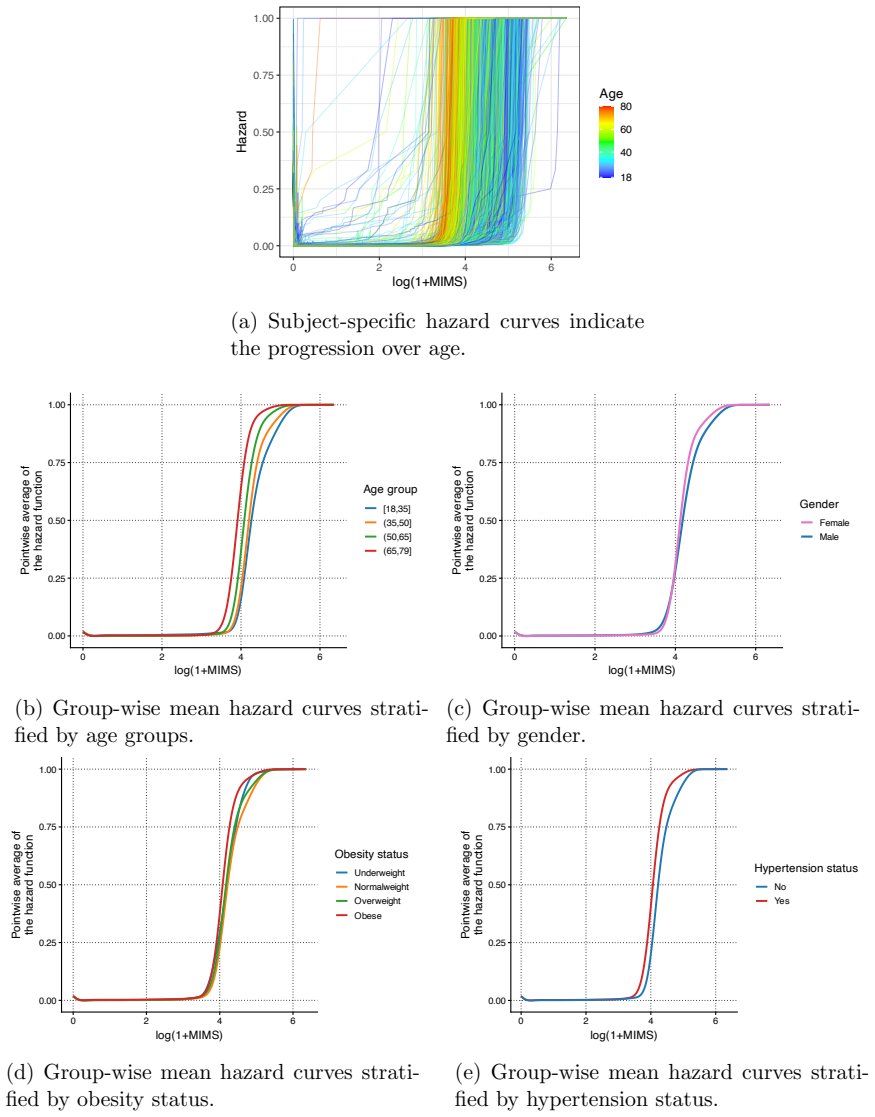
By deriving nonparametric activity-intensity hazard functions from minute-level MIMS data for 4297 adults and performing functional principal component analysis on both the hazard curves and their log-transforms, the approach identifies dominant modes of variation in the distributions. Group-wise mean hazard functions display little difference at lower intensities but substantial differences at higher intensities, showing that hazard-based functional representations characterize heterogeneity more flexibly than mean-based summaries and enable principled subgroup comparisons.
What carries the argument
Nonparametric activity-intensity hazard function derived via survival approach from MIMS data, treated as functional object for principal component analysis.
If this is right
- Group differences appear mainly at higher activity intensities rather than across the full range.
- Hazard-based representations support more detailed comparisons of physical activity patterns across population subgroups than averages do.
- The functional approach captures heterogeneity in intensity distributions that mean summaries overlook.
- Covariate-adjusted functional principal components can isolate variation modes while accounting for demographic factors.
Where Pith is reading between the lines
- The extracted components could be tested as predictors of later health events such as cardiovascular outcomes to check added value over averages.
- The same hazard modeling might apply to other continuous sensor streams like heart rate or sleep stages for distributional comparisons.
- Extending the method to link specific principal components directly to intervention effects would test its utility for personalized activity guidance.
Load-bearing premise
The hazard derived from the minute-level data accurately represents individual activity patterns without material bias from device wear compliance, intensity grid choice, or transformation to functional objects.
What would settle it
Re-running the analysis after correcting for wear-time compliance or switching to an alternate intensity grid would materially alter the extracted principal components or remove the observed high-intensity group differences.
Figures
read the original abstract
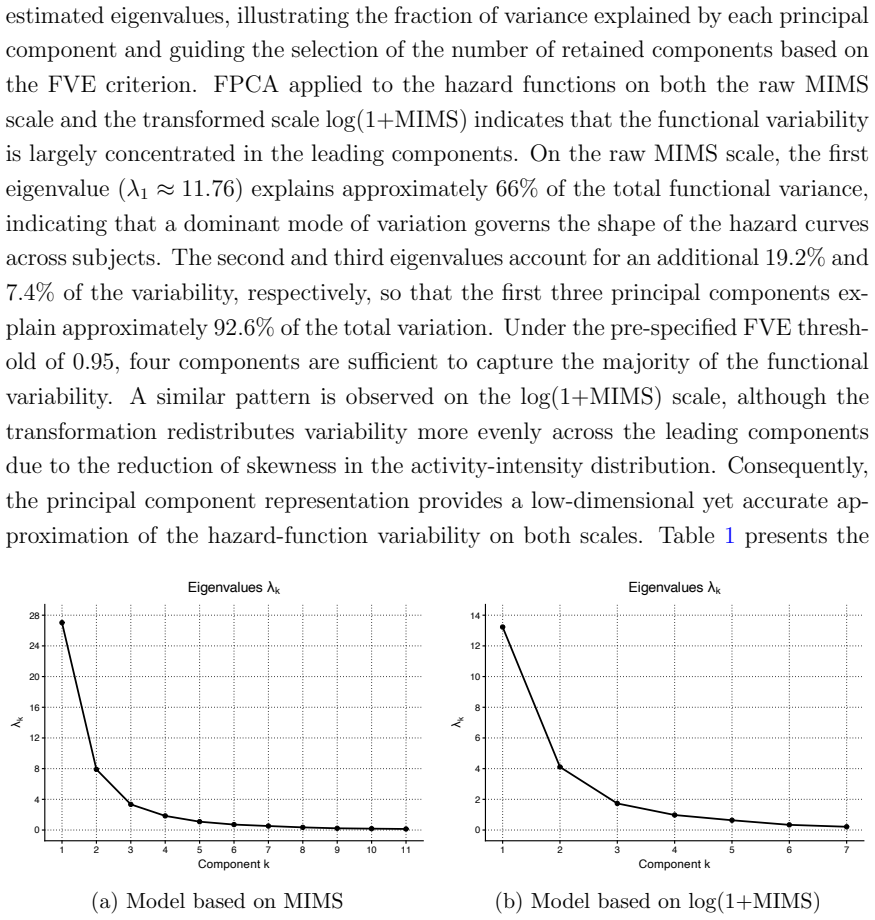
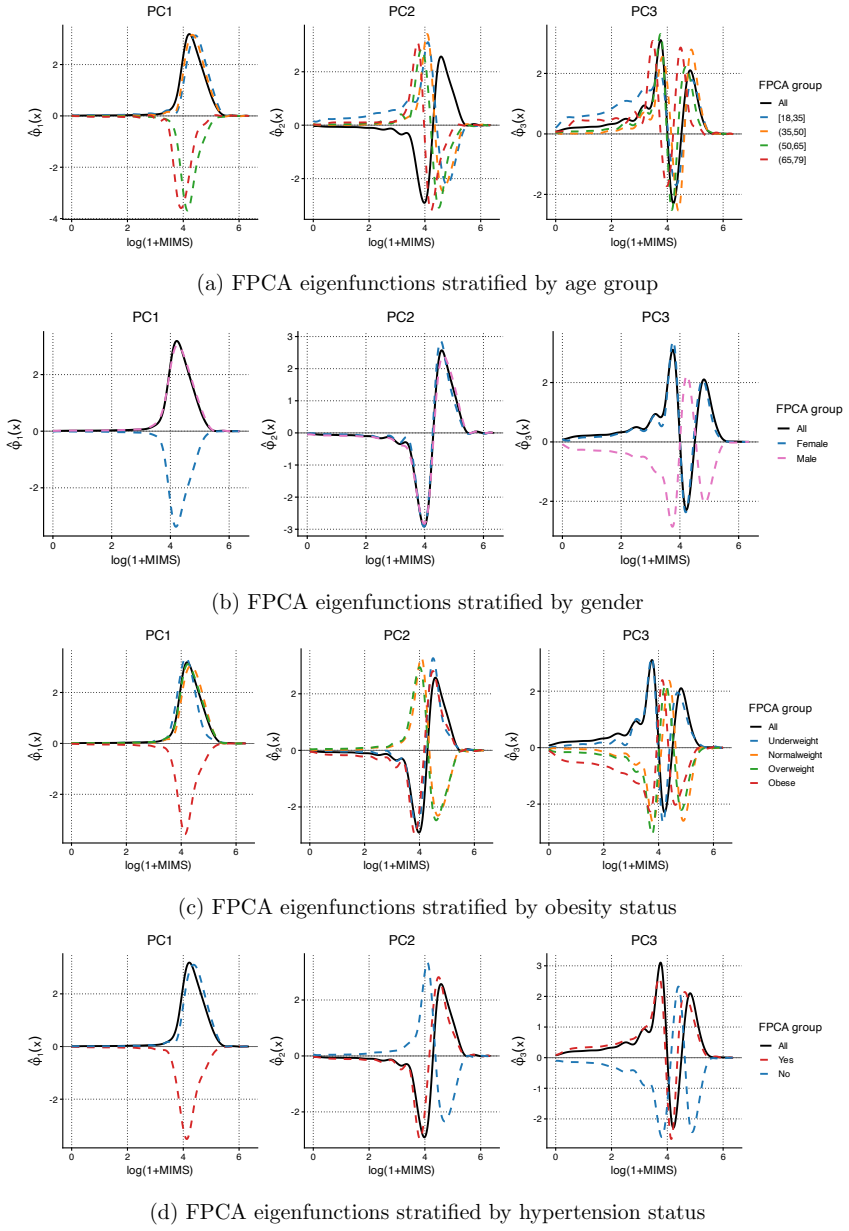
Physical activity plays a vital role in human health. Its entire distribution differs among people. Commonly used summary measures cannot describe this distributional pattern. We present a distribution-based analytical approach to describe physical activity by modeling individual-level activity-intensity patterns through hazard functions derived from wrist-worn accelerometer data. We analyzed minute-level Monitor-Independent Movement Summary (MIMS) data of 4297 adults with seven continuous days of device wear from the 2011- 2012 National Health and Nutrition Examination Survey (NHANES). We derived a nonparametric activity-intensity hazard using a survival-based approach for each individual on a common intensity grid, treating both the hazard curves from MIMS and their log-transformed MIMS as functional objects. We used functional principal component analysis (FPCA) on both scales of MIMS to characterize dominant modes of variation in activity-intensity distributions. Group-wise mean hazard functions showed little difference at lower intensity levels, while we observed a substantial difference at higher intensity levels. Our results demonstrate that hazard-based functional representations for capturing differences in physical activity intensity distributions across individuals offer a flexible and interpretable way to characterize heterogeneity. This approach works better than mean-based summaries and supports principled comparisons of physical activity patterns across population subgroups.
Editorial analysis
A structured set of objections, weighed in public.
Referee Report
Summary. The paper proposes modeling individual physical activity intensity distributions via nonparametric hazard functions estimated from minute-level MIMS wrist-accelerometer data using a survival-based approach on a common intensity grid. These hazard curves (and their log-MIMS versions) are treated as functional objects and subjected to FPCA to extract dominant modes of variation. Applied to NHANES 2011-2012 data from 4297 adults with seven days of wear, the analysis reports little subgroup difference at low intensities but substantial differences at high intensities, concluding that hazard-FPCA provides a flexible, interpretable characterization of heterogeneity that outperforms mean-based summaries.
Significance. If the per-individual hazards are shown to be unbiased representations of intensity distributions, the approach could supply a more nuanced alternative to mean summaries for describing and comparing physical activity patterns across population subgroups in epidemiological studies. The large, nationally representative NHANES sample is a positive feature for generalizability.
major comments (2)
- [Abstract] Abstract: the claim that the hazard-FPCA approach 'works better than mean-based summaries' is unsupported by any quantitative comparison, validation metric, cross-validated R², classification accuracy, or explained-variance ratio; only qualitative inspection of group-wise mean hazard curves is described, leaving the central superiority assertion unverified.
- [Abstract / hazard estimation procedure] Hazard derivation (survival-based nonparametric estimation on MIMS data): no description is given of non-wear detection, censoring, or sensitivity to the intensity grid or log-MIMS transform. Because the reported high-intensity tail differences between subgroups are the key empirical finding, unmodeled non-wear that preferentially removes vigorous minutes would render those differences potentially artifactual and undermine the subsequent FPCA results.
minor comments (1)
- [Abstract] Abstract: the phrasing 'treating both the hazard curves from MIMS and their log-transformed MIMS as functional objects' is ambiguous about whether separate FPCAs were performed and how their results were compared or combined.
Simulated Author's Rebuttal
We thank the referee for their constructive comments, which help clarify the presentation of our methods and strengthen the manuscript. We respond to each major comment below and will revise the paper accordingly.
read point-by-point responses
-
Referee: [Abstract] Abstract: the claim that the hazard-FPCA approach 'works better than mean-based summaries' is unsupported by any quantitative comparison, validation metric, cross-validated R², classification accuracy, or explained-variance ratio; only qualitative inspection of group-wise mean hazard curves is described, leaving the central superiority assertion unverified.
Authors: We agree that the abstract's assertion of superiority lacks quantitative support and is based solely on qualitative inspection of the mean hazard curves. This is a fair criticism. We will revise the abstract to remove the phrase 'works better than mean-based summaries' and rephrase the conclusion to state that the hazard-based approach offers a flexible and interpretable characterization of heterogeneity in activity intensity distributions that complements mean-based summaries. We will also add a short quantitative comparison in the results (e.g., proportion of variance captured by the leading FPCs versus a simple mean) to provide additional context without shifting the paper's primary focus on distributional modeling. revision: yes
-
Referee: [Abstract / hazard estimation procedure] Hazard derivation (survival-based nonparametric estimation on MIMS data): no description is given of non-wear detection, censoring, or sensitivity to the intensity grid or log-MIMS transform. Because the reported high-intensity tail differences between subgroups are the key empirical finding, unmodeled non-wear that preferentially removes vigorous minutes would render those differences potentially artifactual and undermine the subsequent FPCA results.
Authors: We acknowledge that the methods section would benefit from more explicit detail on these points. Although the manuscript references the NHANES 2011-2012 accelerometer protocol and seven-day wear requirement, we will expand the hazard estimation subsection to describe non-wear detection (following standard NHANES validation procedures), the treatment of right-censoring in the nonparametric survival-based hazard estimator, and the rationale for the chosen intensity grid and log-MIMS transform. We will also include a brief sensitivity discussion or analysis addressing robustness of the high-intensity tail differences to these choices, to mitigate concerns about potential artifacts. revision: yes
Circularity Check
No circularity: standard application of hazard estimation and FPCA to external data
full rationale
The provided abstract and context describe deriving per-individual nonparametric activity-intensity hazards via survival methods on NHANES MIMS data, then applying FPCA to the resulting functional objects (and log-transformed versions). No equations, fitted parameters, or claims are shown that reduce by construction to self-definitions, renamed predictions, or load-bearing self-citations. The derivation chain relies on independent external data and standard statistical procedures without internal equivalence to inputs.
Axiom & Free-Parameter Ledger
axioms (2)
- domain assumption Nonparametric hazard functions can be reliably estimated from minute-level MIMS data using a survival-based approach on a common intensity grid
- domain assumption Hazard curves and their log transforms behave as suitable functional objects for standard FPCA
Reference graph
Works this paper leans on
-
[1]
Updating the evidence that physical activity is good for health: an epidemiological review 2000–2003 , journal =. 2004 , note =. doi:https://doi.org/10.1016/S1440-2440(04)80273-1 , url =
-
[2]
Frontiers in sports and active living , volume=
What is physical activity? A holistic definition for teachers, researchers and policy makers , author=. Frontiers in sports and active living , volume=. 2020 , publisher=
2020
-
[3]
Reflections on Physical Activity and Health: What Should We Recommend? , journal =. 2016 , issn =. doi:https://doi.org/10.1016/j.cjca.2016.01.024 , url =
-
[4]
Physical activity, fitness, and health: International proceedings and consensus statement , pages=
Heredity, activity level, fitness, and health , author=. Physical activity, fitness, and health: International proceedings and consensus statement , pages=. 1994 , organization=
1994
-
[5]
Worldwide trends in insufficient physical activity from 2001 to 2016: a pooled analysis of 358 population-based surveys with 1
Guthold, Regina and Stevens, Gretchen A and Riley, Leanne M and Bull, Fiona C , journal=. Worldwide trends in insufficient physical activity from 2001 to 2016: a pooled analysis of 358 population-based surveys with 1. 2018 , publisher=
2001
-
[6]
Journal of aging research , volume=
Physical activity and telomere biology: exploring the link with aging-related disease prevention , author=. Journal of aging research , volume=. 2011 , publisher=
2011
-
[7]
Public health reports , volume=
Physical activity, exercise, and physical fitness: definitions and distinctions for health-related research , author=. Public health reports , volume=
-
[8]
, author=
Energy expenditure: components and evaluation methods. , author=. Nutricion hospitalaria , volume=. 2011 , publisher=
2011
-
[9]
Frontiers in physiology , volume=
Physical activity and nutritional influence on immune function: an important strategy to improve immunity and health status , author=. Frontiers in physiology , volume=. 2021 , publisher=
2021
-
[10]
Richards and Erin Hennessy and Heather A
Marah Aqeel and Jiaqi Guo and Luotao Lin and Saul Gelfand and Edward Delp and Anindya Bhadra and Elizabeth A. Richards and Erin Hennessy and Heather A. Eicher-Miller , keywords =. Temporal physical activity patterns are associated with obesity in U.S. adults , journal =. 2021 , issn =. doi:https://doi.org/10.1016/j.ypmed.2021.106538 , url =
-
[11]
The Physician and Sportsmedicine , volume =
Jenny Rossen and Philip Von Rosen and Unn-Britt Johansson and Kerstin Brismar and Maria Hagströmer , title =. The Physician and Sportsmedicine , volume =. 2020 , publisher =. doi:10.1080/00913847.2019.1684811 , note =
-
[12]
International Journal of Behavioral Nutrition and Physical Activity , volume=
Does duration of physical activity bouts matter for adiposity and metabolic syndrome? A cross-sectional study of older British men , author=. International Journal of Behavioral Nutrition and Physical Activity , volume=. 2016 , publisher=
2016
-
[13]
International Journal of Wellbeing , volume=
Enhancing our understanding of physical activity and wellbeing with a lifespan perspective , author=. International Journal of Wellbeing , volume=
-
[14]
Malaysian Journal of Sustainable Environment (MySE) , volume=
A review on socio-demographic factors influencing physical activities , author=. Malaysian Journal of Sustainable Environment (MySE) , volume=. 2021 , publisher=
2021
-
[15]
Research quarterly for exercise and sport , volume=
Tracking of physical activity and physical fitness across the lifespan , author=. Research quarterly for exercise and sport , volume=. 1996 , publisher=
1996
-
[16]
Journal of Science and Medicine in Sport , volume=
Physical activity across the lifespan: the need for a gender perspective , author=. Journal of Science and Medicine in Sport , volume=. 2022 , publisher=
2022
-
[17]
Journal of Public health , volume=
Gender inequality is associated with gender differences and women participation in physical activity , author=. Journal of Public health , volume=. 2022 , publisher=
2022
-
[18]
Journal of clinical epidemiology , volume=
Ethnic, socioeconomic, and sex differences in physical activity among adolescents , author=. Journal of clinical epidemiology , volume=. 1996 , publisher=
1996
-
[19]
Journal of school health , volume=
Gender differences in physical activity and determinants of physical activity in rural fifth grade children , author=. Journal of school health , volume=. 1996 , publisher=
1996
-
[20]
Psychiatric Clinics , volume=
Obesity and physical activity , author=. Psychiatric Clinics , volume=. 2011 , publisher=
2011
-
[21]
Trends in adult body-mass index in 200 countries from 1975 to 2014: a pooled analysis of 1698 population-based measurement studies with 19
NCD Risk Factor Collaboration and others , journal=. Trends in adult body-mass index in 200 countries from 1975 to 2014: a pooled analysis of 1698 population-based measurement studies with 19
1975
-
[22]
Journal of geriatric physical therapy , volume=
Physical activity, central adiposity, and functional limitations in community-dwelling older adults , author=. Journal of geriatric physical therapy , volume=. 2016 , publisher=
2016
-
[23]
, author=
The Effect of Body Mass Index on Physical Activity Level in Children between 10-11 Years of Age. , author=. Asian Journal of Education and Training , volume=. 2019 , publisher=
2019
-
[24]
The bidirectional associations between leisure time physical activity change and body mass index gain
Sagelv, Edvard H and Ekelund, Ulf and Hopstock, Laila A and Fimland, Marius Steiro and L. The bidirectional associations between leisure time physical activity change and body mass index gain. The Troms. International Journal of Obesity , volume=. 2021 , publisher=
2021
-
[25]
Diabetes/metabolism research and reviews , volume=
Sedentary behaviour as a new behavioural target in the prevention and treatment of type 2 diabetes , author=. Diabetes/metabolism research and reviews , volume=. 2016 , publisher=
2016
-
[26]
2011 , school=
The vicious cycle of inactivity, obesity, and metabolic health consequences in at-risk pediatric populations , author=. 2011 , school=
2011
-
[27]
Preventive medicine , volume=
Cardiorespiratory fitness and development of abdominal obesity , author=. Preventive medicine , volume=. 2019 , publisher=
2019
-
[28]
Revista Brasileira de Cineantropometria & Desempenho Humano , volume=
Barriers to physical activity practice and associated factors in patients with hypertension , author=. Revista Brasileira de Cineantropometria & Desempenho Humano , volume=. 2024 , publisher=
2024
-
[29]
Reviews in Cardiovascular Medicine , volume=
Physical activity and hypertension , author=. Reviews in Cardiovascular Medicine , volume=
-
[30]
Journal of Public Health , volume=
Analyzing hypertension and diabetes mellitus status among Bangladeshi adults: Evidence from Bangladesh Demographic Health Survey (BDHS) 2017--18 data , author=. Journal of Public Health , volume=. 2024 , publisher=
2017
-
[31]
Heliyon , volume=
Physical inactivity and its association with hypertension among adults in Ethiopia: A systematic review and meta-analysis , author=. Heliyon , volume=. 2022 , publisher=
2022
-
[32]
Journal of hypertension , volume=
The impact of physical activity on mortality in patients with high blood pressure: a systematic review , author=. Journal of hypertension , volume=. 2012 , publisher=
2012
-
[33]
Nature Reviews Cardiology , volume=
Lifestyle interventions for the prevention and treatment of hypertension , author=. Nature Reviews Cardiology , volume=. 2021 , publisher=
2021
-
[34]
World Journal of Cardiology , volume=
Exercise-mediated adaptations in vascular function and structure: Beneficial effects in coronary artery disease , author=. World Journal of Cardiology , volume=
-
[35]
PloS one , volume=
Combined effects of time spent in physical activity, sedentary behaviors and sleep on obesity and cardio-metabolic health markers: a novel compositional data analysis approach , author=. PloS one , volume=. 2015 , publisher=
2015
-
[36]
Applied physiology, nutrition, and metabolism , volume=
Canadian 24-hour movement guidelines for children and youth: an integration of physical activity, sedentary behaviour, and sleep , author=. Applied physiology, nutrition, and metabolism , volume=. 2016 , publisher=
2016
-
[37]
Obesity , volume=
Use of quantile regression to investigate the longitudinal association between physical activity and body mass index , author=. Obesity , volume=. 2014 , publisher=
2014
-
[38]
Journal of the American Statistical Association , volume=
Modeling hazard rates as functional data for the analysis of cohort lifetables and mortality forecasting , author=. Journal of the American Statistical Association , volume=. 2009 , publisher=
2009
-
[39]
Journal of economic perspectives , volume=
Quantile regression , author=. Journal of economic perspectives , volume=. 2001 , publisher=
2001
-
[40]
2023 , publisher =
Functional Data Analysis with R , author =. 2023 , publisher =
2023
-
[41]
Annual Review of Statistics and its application , volume=
Functional data analysis , author=. Annual Review of Statistics and its application , volume=. 2016 , publisher=
2016
-
[42]
2014 , publisher=
National health and nutrition examination survey: sample design, 2011-2014 , author=. 2014 , publisher=
2011
-
[43]
Preventive Medicine Reports , volume=
The association between visceral adiposity index and chronic kidney disease in the elderly: A cross-sectional analysis of NHANES 2011--2018 , author=. Preventive Medicine Reports , volume=. 2023 , publisher=
2011
-
[44]
World Health Organ Tech Rep Ser , volume=
Obesity: preventing and managing the global epidemic , author=. World Health Organ Tech Rep Ser , volume=
-
[45]
British Journal of Sports Medicine , volume=
Evolution of accelerometer methods for physical activity research , author=. British Journal of Sports Medicine , volume=
-
[46]
Sports Medicine , volume=
Accelerometer data collection and processing criteria to assess physical activity and other outcomes: a systematic review and practical considerations , author=. Sports Medicine , volume=
-
[47]
PLOS ONE , volume=
Large scale population assessment of physical activity using wrist worn accelerometers: the UK Biobank study , author=. PLOS ONE , volume=
-
[48]
British Journal of Sports Medicine , volume=
Objective measurement of 24-hour movement behaviors: current state and future directions , author=. British Journal of Sports Medicine , volume=
-
[49]
Biostatistics , volume=
Distributional data analysis via quantile functions and its application to modeling digital biomarkers of gait in Alzheimer’s disease , author=. Biostatistics , volume=. 2023 , publisher=
2023
-
[50]
Biostatistics , volume=
Functional quantile principal component analysis , author=. Biostatistics , volume=. 2025 , publisher=
2025
-
[51]
Multiple sclerosis (Houndmills, Basingstoke, England) , pages=
Quantifying observable movement reserve in multiple sclerosis via upper diurnal activity quantiles , author=. Multiple sclerosis (Houndmills, Basingstoke, England) , pages=
-
[52]
arXiv preprint arXiv:2410.20620 , year=
Hazard and Beyond: Exploring Five Distributional Representations of Accelerometry Data for Disability Discrimination in Multiple Sclerosis , author=. arXiv preprint arXiv:2410.20620 , year=
-
[53]
Scalar-on-distribution regression via generalized odds with applications to accelerometry-assessed disability in multiple sclerosis , author =. 2026 , eprint =. doi:10.48550/arXiv.2601.09126 , url =
-
[54]
Zur spektraltheorie stochastischer prozesse , author=. Ann. Acad. Sci. Fennicae, AI , volume=
-
[55]
Revue science , volume=
Functions aleatoire de second ordre , author=. Revue science , volume=
-
[56]
Journal of the Royal Statistical Society Series B: Statistical Methodology , volume=
Fast bivariate P-splines: the sandwich smoother , author=. Journal of the Royal Statistical Society Series B: Statistical Methodology , volume=. 2013 , publisher=
2013
-
[57]
Statistics and computing , volume=
Fast covariance estimation for high-dimensional functional data , author=. Statistics and computing , volume=. 2016 , publisher=
2016
-
[58]
2017 , publisher=
Introduction to functional data analysis , author=. 2017 , publisher=
2017
-
[59]
2005 , publisher=
Functional data analysis , author=. 2005 , publisher=
2005
-
[60]
2006 , publisher=
Nonparametric functional data analysis: theory and practice , author=. 2006 , publisher=
2006
-
[61]
2012 , publisher=
Inference for functional data with applications , author=. 2012 , publisher=
2012
-
[62]
2015 , publisher=
Theoretical foundations of functional data analysis, with an introduction to linear operators , author=. 2015 , publisher=
2015
discussion (0)
Sign in with ORCID, Apple, or X to comment. Anyone can read and Pith papers without signing in.