REVIEW 4 major objections 5 minor 5 cited by
A Measurement of the Largest-Scale CMB E-mode Polarization with CLASS
T0 review · 4 major / 5 minor · reviewed 2026-08-10 · deepseek-v4-flash
Pith's one-line read A ground-based telescope has measured the CMB's largest-scale E-mode polarization and detected cosmic reionization at 99.4% significance.
desk verdict The pixel-space transfer-matrix extension of xQML is the real contribution here, and the tau measurement is an honest but fragile first step from the ground that deserves a serious referee. read the letter →
The pith
A machine-rendered reading of the paper's core claim, the machinery that carries it, and where it could break.
The reading
What carries the argument
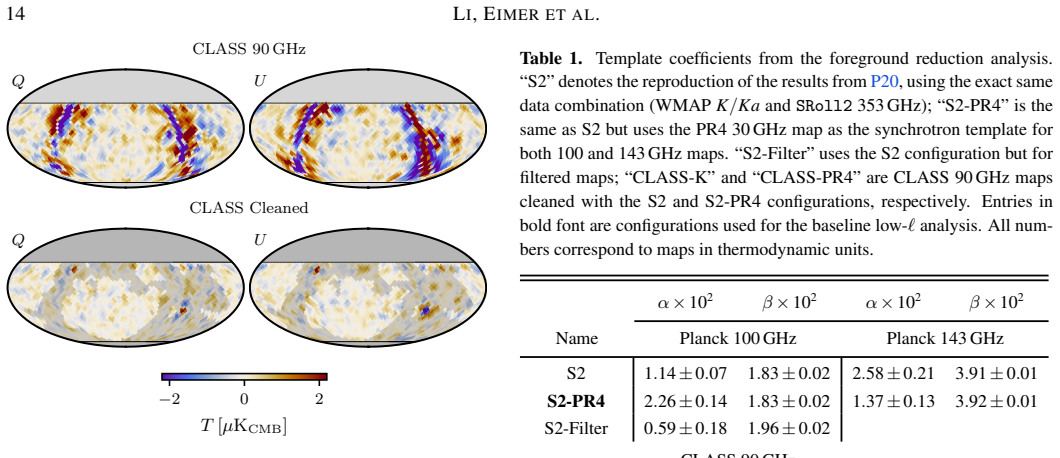
The paper's key object is the pixel-space transfer matrix $\mathbf{F}_{16,N_F}$, a linear operator constructed by reobserving and downgrading single-pixel input maps with the map-making pipeline's reobservation operator $\mathbf{R}$, which fixes the noise model to a realization-independent form. This matrix forward-models the effect of time-domain filtering on sky signals at the map level, and is paired with a modified quadratic maximum-likelihood cross-spectrum estimator (xQML) that incorporates the transfer matrix into the signal covariance, allowing unbiased power spectrum recovery down to $\ell=2$. The transfer matrix is evaluated at $N_\mathrm{side}=32$ for signal maps and $N_\mathrm{side}=16$ for noise covariance matrices, and it is also used to filter foreground templates so that cleaning is performed consistently with the filtered data.
What would settle it
An end-to-end simulation that applies the measured map-making nonlinearity correction at $\ell=4$ specifically, recomputing the likelihood, would settle whether the $\tau$ central value shifts by more than the quoted uncertainty; alternatively, an independent ground-based or balloon-borne low-$\ell$ E-mode measurement with comparable sky coverage returning $\tau$ outside $0.053 \pm 0.019$ would contradict the detection.
Extended reading notes
Core claim
The central discovery is that the large-scale E-mode signal, which encodes the reionization history and is enhanced roughly as $\tau^2$ on the largest angular scales, is recoverable from a ground-based instrument after the time-domain filtering bias is forward-modeled and corrected. The authors demonstrate this by cross-correlating the CLASS 90 GHz map with foreground-reduced Planck 100/143 GHz maps, obtaining a detection of reionization at 99.4% confidence and $\tau = 0.053^{+0.018}_{-0.019}$. They further show that the only uncorrected bias, arising from the nonlinearity of the maximum-likelihood map-maker's noise weighting, is less than 3% at $\ell=3$ and is small enough not to be applied in the spectra. The cross-spectrum is validated by null tests, consistency with Planck at intermediate angular scales ($\ell > 30$), and robustness to masks, multipole ranges, and external data sets, with the caveat that the significance weakens when multipoles below $\ell=5$ are dropped.
Load-bearing premise
The measurement assumes the map-making noise model is linear and independent of the sky signal; the residual nonlinearity, uncorrected and measured at under 3% at $\ell=3$, could be larger at $\ell=4$, the multipole that drives the $\tau$ result.
Editorial extensions
If this is right
- Ground-based CMB polarization experiments can recover the largest-scale E-modes after a transfer-matrix filtering correction, opening low-$\ell$ reionization measurements to the ground.
- The measured $\tau = 0.053^{+0.018}_{-0.019}$ is consistent with Planck HFI-based values, supporting the lower range of $\tau$ estimates that reduce the $\sigma_8$ tension via $A_s e^{-2\tau}$.
- The xQML estimator with transfer-matrix correction is unbiased up to $\ell=40$ in validation tests, providing a reusable tool for other experiments facing filtering-induced signal loss.
- Forecasts in the paper indicate that modest filtering optimization (a 20% improvement) could bring CLASS's $\tau$ precision close to the cosmic variance limit of about 0.003 for its sky patch.
Reading between the lines
- Editorial extension: if the transfer-matrix correction remains valid as newer modulators (reflective half-wave plate) and a second 90 GHz telescope come online, the CLASS dataset could provide a $\tau$ measurement with precision comparable to Planck's, and possibly an independent check on the lensing-anomaly inflating $A_s$ values.
- Editorial extension: the same pixel-space transfer matrix machinery is directly transferable to other ground-based and balloon-borne CMB experiments (e.g., those with heavier time-domain filtering), including for B-mode analyses on large scales where filtering is even more aggressive.
- Editorial extension: the paper's finding that the $\tau$ constraint is driven mainly by the single multipole $\ell=4$ implies that closer attention to the map-making nonlinearity at exactly that scale should be a priority for future low-$\ell$ analyses; a targeted end-to-end simulation at $\ell=4$ with more realizations could sharpen the result.
- Editorial extension: the discarded closeout-period data, which represents nearly half the survey, might be recoverable if the low-$\ell$ noise modeling improves, potentially more than doubling the effective sensitivity without new observations.
Editorial analysis
A structured set of objections, weighed in public.
Referee Report
Summary. The paper presents the CLASS 90 GHz polarization analysis with the goal of recovering the largest-angular-scale CMB E-mode signal. The authors introduce a pixel-space transfer-matrix formalism to correct for time-domain filtering in maximum-likelihood map-making, implement it in a quadratic cross-spectrum estimator (xQML), and validate the pipeline with 500 end-to-end simulations, internal null tests, and cross-checks against Planck. The central scientific claim is a measurement of the reionization optical depth from a CLASS×Planck cross-correlation, tau = 0.053 (+0.018, -0.019), corresponding to a 99.4% rejection of the no-reionization hypothesis, which the paper labels as the first ground-based attempt at such a measurement. At intermediate multipoles (ell>30) the results are consistent with Planck.
Significance. If the central claim holds, this is a substantial methodological and observational milestone: it demonstrates that ground-based data, after careful filtering correction, can contribute to low-ell E-mode polarization measurements and to constraints on the reionization optical depth. The paper is unusually transparent: it provides extensive validation with 500 simulations, a full PTE table for null tests, a public implementation of the modified xQML estimator, and explicit statements of residual unmodeled biases. These strengths are real and should be credited. However, the headline detection significance and the tau value are carried by a single multipole, ell=4, and the per-multipole accuracy of the transfer-matrix correction, foreground cleaning, and noise covariance at that exact multipole is not separately demonstrated. The significance of the result is therefore conditional on the fidelity of one band power and on the accuracy of its total variance, including sample-variance contributions.
major comments (4)
- [§5.4, Figure 16] The headline claim of a 99.4% detection of cosmic reionization is not robust to the omission of a single multipole: the paper states that dropping ell=4 reduces the detection significance below threshold, and Figure 16 shows that no detection is claimed when multipoles below ell=5 are excluded. Since the entire reionization detection and the tau estimate rest on the ell=4 band power, the manuscript should provide per-multipole validation of the transfer-matrix-corrected xQML estimator at ell=4, including foreground-cleaning residuals and noise covariance accuracy at that multipole. The current validation (e.g., Figure 19 and Table 1) is aggregate over ell ranges and does not establish that the ell=4 band power and its variance are unbiased at the level needed for the 99.4% significance claim.
- [§3.4.4, Figure 7] The map-making non-linearity bias is characterized as less than 3% at ell=3 and is left uncorrected, but no estimate is given at ell=4, which is the multipole that drives the tau result. Because the likelihood at ell=4 depends both on the mean shift in C_ell and on the sample-variance term in Equation (15), a systematic error in the ell=4 band power or in its variance at the level of even a moderate fraction of the quoted error would alter both tau and the detection significance. The authors should report the non-linearity bias at ell=4 (and at each ell used in the likelihood) and, if it is not negligible, include it as a systematic uncertainty or correct it.
- [§4.1, Appendix B] The low-ell EE null test for the VPM sync split fails with PTE below 2e-4, driven by ell=8, and the paper attributes this to inadequate noise modeling when detector-pair cancellation is compromised. The authors argue that this failure does not affect the final cross-correlation because the ell=8 outlier is not present in the CLASS×Planck spectrum. However, the failure demonstrates that the noise model can be substantially inaccurate for some detector configurations, and the final analysis uses the same noise model. The manuscript should provide a direct test that the final (unsplit) CLASS noise covariance and the ell=4 band-power variance are unaffected, for example by comparing a null test constructed with the final noise model or by showing that the VPM sync split null spectrum is consistent with simulations after the proposed noise-model improvement.
- [§4.2, §5.4] The tau measurement is not an independent ground-based determination: the CMB channel is the Planck HFI coadded map, the absolute polarization calibration is fitted to Planck high-ell spectra (Section 4.2), and the likelihood in Section 5.4 imposes a Gaussian prior on A_s e^{-2tau} derived from Planck. The paper acknowledges that calibration does not compromise tau independence only to the extent that A_s e^{-2tau} is well constrained, but the abstract and conclusion should state more explicitly that the result is a cross-correlation measurement whose parameter interpretation is tied to Planck-based calibration and priors. The 99.4% significance is the significance of the cross-spectrum being nonzero, not of CLASS independently detecting reionization; this distinction should be made explicit in the title or abstract claims.
minor comments (5)
- [Abstract vs. §3.3] The abstract quotes a polarization sensitivity of 78 muK arcmin, while the body text (Section 3.3) reports 82 muK arcmin; these values should be reconciled.
- [Figure 9] The labels 'az-2ε' and 'az-4ε' appear to be typographical errors for 'az-2π' and 'az-4π' used in Figure 8 and the text.
- [§3.4.4] The sentence 'The maximum of this bias is found to be less than 3% at ell=3' is ambiguous: it should clarify whether 3% is the maximum over all ell and occurs at ell=3, or whether ell=3 is the only multipole at which the bias is estimated.
- [§4.2, Eq. (7)] The use of the square root of the auto-spectrum transfer function for cross-spectra is an approximation that the paper states is negligible; a sentence quantifying the difference or citing a validation test would improve clarity.
- [§5.4] The description of the likelihood step 6 should explicitly state that the uniform prior on tau is over 0 to 0.3 and that the Gaussian prior on A_s e^{-2tau} is a choice imported from Planck; these choices are central to the reported error bars and should be restated in the results paragraph.
Circularity Check
No significant circularity: the tau measurement is a cross-spectrum result with disclosed external calibration and prior, not a self-referential derivation.
full rationale
The derivation of tau is not circular. The central quantity is the CLASS x Planck xQML EE cross-spectrum (Section 5.3), and the filtering correction is validated against reobservation simulations independent of the data (Appendix A, Figure 19), so the transfer-matrix step does not impose the reported tau. The absolute calibration eta=1.053 is fitted to ell>30 spectra; the paper explicitly states that this 'does not compromise the experiment's ability to measure tau independently of the calibrator at large angular scales (ell<30), to the extent that A_s e^{-2tau} is considered a well-constrained parameter' (Section 4.2) - an external degeneracy-breaking assumption, not a fitted parameter renamed as a prediction. The Gaussian prior on 10^9 A_s e^{-2tau} is a standard Planck-based constraint; it does not fix tau itself, and the data's tau posterior (0.053+0.018-0.019) is obtained from the low-ell cross-spectrum. The 99.4% significance is computed by replacing CLASS data with tau=0 simulations while keeping the same pipeline, so it is a frequentist null test of the CLASS map's correlated signal, not a self-fulfilling construction. The paper's own robustness checks (dropping ell=4 removes significance; <3% uncorrected map-making nonlinearity; tau-dependent sample variance at ell=4) are limitations and statistical-fragility concerns, not cases where an output equals an input by definition. Self-citations to L23 and other CLASS papers supply methodology that is re-derived and validated here, so they are not load-bearing circular premises.
Assumptions & free parameters
free parameters (4)
- Absolute polarization calibration factor eta =
1.053 +/- 0.014
- Synchrotron template coefficient alpha (CLASS-K baseline) =
1.24e-2 +/- 0.08e-2
- Dust template coefficient beta (CLASS-K baseline) =
1.39e-2 +/- 0.01e-2
- Time-domain filter truncation order =
12 harmonic modes each for 8pi and 2pi scan-synchronous filters
assumptions (6)
- domain assumption The maximum-likelihood map-maker can be approximated as a linear, realization-independent operator (reobservation R) with a noise model fixed to the final template iteration.
- domain assumption The absolute polarization calibration derived from high-ell (ell>30) CMB spectra, which constrain A_s e^{-2tau}, remains valid at low ell and does not bias tau.
- domain assumption Foreground emission at 90 GHz is well traced by linearly scaled WMAP K-band and Planck 30/353 GHz templates with no significant spatial decorrelation.
- standard math CMB realizations are Gaussian and isotropic, so synfast realizations with CAMB spectra and the simulation-based likelihood describe the data distribution.
- domain assumption The fiducial Planck 2018 TTTEEE+lowE cosmology and the Gaussian prior on A_s e^{-2tau} are valid inputs.
- ad hoc to paper Scan-synchronous systematics are adequately described by the first 12 harmonic modes of 8pi and 2pi azimuth patterns.
Cite this review
Pith. "Pith review of A Measurement of the Largest-Scale CMB E-mode Polarization with CLASS." pith.science (2026). https://pith.science/paper/YBKZGMKC
@misc{pith2026250111904,
  author       = {Pith},
  title        = {Pith review of: A Measurement of the Largest-Scale CMB E-mode Polarization with CLASS},
  year         = {2026},
  howpublished = {\url{https://pith.science/paper/YBKZGMKC}},
  note         = {Machine review of arXiv:2501.11904}
}
abstract
We present measurements of large-scale cosmic microwave background (CMB) E-mode polarization from the Cosmology Large Angular Scale Surveyor (CLASS) 90 GHz data. Using 115 det-yr of observations collected through 2024 with a variable-delay polarization modulator, we achieved a polarization sensitivity of $78\,\mathrm{\mu K\,arcmin}$, comparable to Planck at similar frequencies (100 and 143 GHz). The analysis demonstrates effective mitigation of systematic errors and addresses challenges to large-angular-scale power recovery posed by time-domain filtering in maximum-likelihood map-making. A novel implementation of the pixel-space transfer matrix is introduced, which enables efficient filtering simulations and bias correction in the power spectrum using the quadratic cross-spectrum estimator. Overall, we achieved an unbiased time-domain filtering correction to recover the largest angular scale polarization, with the only power deficit, arising from map-making non-linearity, being characterized as less than $3\%$. Through cross-correlation with Planck, we detected the cosmic reionization at $99.4\%$ significance and measured the reionization optical depth $\tau=0.053^{+0.018}_{-0.019}$, marking the first ground-based attempt at such a measurement. At intermediate angular scales ($\ell>30$), our results, both independently and in cross-correlation with Planck, remain fully consistent with Planck's measurements.
Figures


Figures from the paper (17 more)




Forward citations
Cited by 5 Pith papers
-
Boosting the optical depth to Thomson scattering with primordial black hole evaporation at high redshift
A monochromatic primordial black hole population can raise the CMB optical depth by at most Delta tau ~ 0.008 under current CMB data, leaving BAO-CMB tensions essentially unchanged.
-
Cosmic $\tau$ensions Indirectly Correlate with Reionization Optical Depth
The correlations between tau_reio and the parameters behind cosmic tensions are not intrinsic, but arise indirectly through networks of other cosmological parameters.
-
Rapid late-time reionization: constraints and cosmological implications
Reionization is inferred to be rapid and late (midpoint z≈7, duration Δz50≈1.1), yielding an optical depth τ=0.0492 from Lyman-alpha + BAO + BBN, independent of CMB data.
-
The BAO-CMB Tension and Implications for Inflation
The upward shift in the scalar spectral index n_s in CMB+BAO analyses is driven by the combined effects of a known CMB degeneracy and the tension between CMB and DESI BAO data, not by new information about n_s itself.
-
The Simons Observatory: Validation of reconstructed power spectra from simulated filtered maps for the Small Aperture Telescope survey
This validation study finds that a transfer-function power spectrum estimator recovers unbiased cosmological parameters, including the tensor-to-scalar ratio r, in simulations of the first year of Simons Observatory s...
Reference graph
Works this paper leans on
-
[1]
, " * write output.state after.block = add.period write newline
ENTRY address archiveprefix author booktitle chapter edition editor howpublished institution eprint doi url journal key month note number organization pages publisher school series title type volume year adsurl label extra.label sort.label short.list INTEGERS output.state before.all mid.sentence after.sentence after.block FUNCTION init.state.consts #0 'be...
-
[2]
write newline
" write newline "" before.all 'output.state := FUNCTION n.dashify 't := "" t empty not t #1 #1 substring "-" = t #1 #2 substring "--" = not "--" * t #2 global.max substring 't := t #1 #1 substring "-" = "-" * t #2 global.max substring 't := while if t #1 #1 substring * t #2 global.max substring 't := if while FUNCTION word.in bbl.in " " * FUNCTION format....
-
[3]
602C `\.=
thebibliography [1] 20pt to REFERENCES 6pt =0pt -12pt 10pt plus 3pt =0pt =0pt =1pt plus 1pt =0pt =0pt -12pt =13pt plus 1pt =20pt =10pt plus 1pt \@M =100 =2000 =6000000 =-1.0em =0pt =0pt 0pt =0pt =1.0em =2em @enumiv\@empty 10000 10000 `\.\@m \@noitemerr \@latex@warning Empty `thebibliography' environment \@ifnextchar \@reference \@latexerr Missing key on r...
-
[4]
Addamo , G., Ade , P. A. R., Baccigalupi , C., et al. 2021, http://dx.doi.org/10.1088/1475-7516/2021/08/008 magenta , 2021, 008 https://ui.adsabs.harvard.edu/abs/2021JCAP...08..008A
-
[5]
Addison , G. E., Bennett , C. L., Halpern , M., Hinshaw , G., & Weiland , J. L. 2024, http://dx.doi.org/10.3847/1538-4357/ad6d61 magenta , 974, 187 https://ui.adsabs.harvard.edu/abs/2024ApJ...974..187A
-
[6]
Allison , R., Caucal , P., Calabrese , E., Dunkley , J., & Louis , T. 2015, http://dx.doi.org/10.1103/PhysRevD.92.123535 magenta , 92, 123535 https://ui.adsabs.harvard.edu/abs/2015PhRvD..92l3535A
-
[7]
Appel , J. W., Bennett , C. L., Brewer , M. K., et al. 2022, http://dx.doi.org/10.3847/1538-4365/ac8cf2 magenta , 262, 52 https://ui.adsabs.harvard.edu/abs/2022ApJS..262...52A
-
[8]
Astropy Collaboration , Price-Whelan , A. M., Lim , P. L., et al. 2022, http://dx.doi.org/10.3847/1538-4357/ac7c74 magenta , 935, 167 https://ui.adsabs.harvard.edu/abs/2022ApJ...935..167A
Show all 109 references
-
[9]
F., Prunet , S., & Hivon , E
Benabed , K., Cardoso , J. F., Prunet , S., & Hivon , E. 2009, http://dx.doi.org/10.1111/j.1365-2966.2009.15202.x magenta , 400, 219 https://ui.adsabs.harvard.edu/abs/2009MNRAS.400..219B
2009
-
[10]
L., Larson , D., Weiland , J
Bennett , C. L., Larson , D., Weiland , J. L., et al. 2013, http://dx.doi.org/10.1088/0067-0049/208/2/20 magenta , 208, 20 https://ui.adsabs.harvard.edu/abs/2013ApJS..208...20B
2013 doi
-
[11]
BICEP2 Collaboration , Keck Array Collaboration , Ade , P. A. R., et al. 2016, http://dx.doi.org/10.3847/0004-637X/825/1/66 magenta , 825, 66 https://ui.adsabs.harvard.edu/abs/2016ApJ...825...66B
2016 doi
-
[12]
BICEP/Keck Collaboration , Ade , P. A. R., Ahmed , Z., et al. 2021, http://dx.doi.org/10.1103/PhysRevLett.127.151301 magenta , 127, 151301 https://ui.adsabs.harvard.edu/abs/2021PhRvL.127o1301A
2021 doi
-
[13]
R., Efstathiou , G., & Silk , J
Bond , J. R., Efstathiou , G., & Silk , J. 1980, http://dx.doi.org/10.1103/PhysRevLett.45.1980 magenta , 45, 1980 https://ui.adsabs.harvard.edu/abs/1980PhRvL..45.1980B
1980 doi
-
[14]
F., & Zahn , O
Calabrese , E., Slosar , A., Melchiorri , A., Smoot , G. F., & Zahn , O. 2008, http://dx.doi.org/10.1103/PhysRevD.77.123531 magenta , 77, 123531 https://ui.adsabs.harvard.edu/abs/2008PhRvD..77l3531C
2008 doi
-
[15]
2004, http://dx.doi.org/10.1111/j.1365-2966.2004.07737.x magenta , 350, 914 https://ui.adsabs.harvard.edu/abs/2004MNRAS.350..914C
Chon , G., Challinor , A., Prunet , S., Hivon , E., & Szapudi , I. 2004, http://dx.doi.org/10.1111/j.1365-2966.2004.07737.x magenta , 350, 914 https://ui.adsabs.harvard.edu/abs/2004MNRAS.350..914C
2004
-
[16]
T., Bennett , C
Chuss , D. T., Bennett , C. L., Costen , N., et al. 2012 a , http://dx.doi.org/10.1007/s10909-011-0433-2 magenta Journal of Low Temperature Physics , 167, 923 https://ui.adsabs.harvard.edu/abs/2012JLTP..167..923C
2012 doi
-
[17]
T., Wollack , E
Chuss , D. T., Wollack , E. J., Henry , R., et al. 2012 b , http://dx.doi.org/10.1364/AO.51.000197 magenta , 51, 197 http://adsabs.harvard.edu/abs/2012ApOpt..51..197C
2012 doi
-
[18]
T., Wollack , E
Chuss , D. T., Wollack , E. J., Pisano , G., et al. 2012 c , http://dx.doi.org/10.1364/AO.51.006824 magenta , 51, 6824 https://ui.adsabs.harvard.edu/abs/2012ApOpt..51.6824C
2012 doi
-
[19]
A., Takakura , S., et al
Coerver , A., Zebrowski , J. A., Takakura , S., et al. 2025, http://dx.doi.org/10.3847/1538-4357/ada35d magenta , 982, 15 https://ui.adsabs.harvard.edu/abs/2025ApJ...982...15C
2025 doi
-
[20]
2017, http://dx.doi.org/10.1051/0004-6361/201527740 magenta , 597, A126 https://ui.adsabs.harvard.edu/abs/2017A&A...597A.126C
Couchot , F., Henrot-Versill \'e , S., Perdereau , O., et al. 2017, http://dx.doi.org/10.1051/0004-6361/201527740 magenta , 597, A126 https://ui.adsabs.harvard.edu/abs/2017A&A...597A.126C
2017 doi
-
[21]
W., et al
Dahal , S., Ali , A., Appel , J. W., et al. 2018, http://dx.doi.org/10.1117/12.2311812 magenta , 10708, 107081Y http://adsabs.harvard.edu/abs/2018SPIE10708E..1YD
2018 doi
-
[22]
W., Datta , R., et al
Dahal , S., Appel , J. W., Datta , R., et al. 2022, http://dx.doi.org/10.3847/1538-4357/ac397c magenta , 926, 33 https://ui.adsabs.harvard.edu/abs/2022ApJ...926...33D
2022 doi
-
[23]
K., Couto , J
Datta , R., Brewer , M. K., Couto , J. D., et al. 2024, http://dx.doi.org/10.3847/1538-4365/ad50a0 magenta , 273, 26 https://ui.adsabs.harvard.edu/abs/2024ApJS..273...26D
2024 doi
-
[24]
2021, http://dx.doi.org/10.1093/mnras/stab2215 magenta , 507, 1072 https://ui.adsabs.harvard.edu/abs/2021MNRAS.507.1072D
de Belsunce , R., Gratton , S., Coulton , W., & Efstathiou , G. 2021, http://dx.doi.org/10.1093/mnras/stab2215 magenta , 507, 1072 https://ui.adsabs.harvard.edu/abs/2021MNRAS.507.1072D
2021 doi
-
[25]
M., Pagano , L., Mottet , S., Puget , J
Delouis , J. M., Pagano , L., Mottet , S., Puget , J. L., & Vibert , L. 2019, http://dx.doi.org/10.1051/0004-6361/201834882 magenta , 629, A38 https://ui.adsabs.harvard.edu/abs/2019A&A...629A..38D
2019 doi
- [26]
-
[27]
A., et al
D \"u nner , R., Hasselfield , M., Marriage , T. A., et al. 2013, http://dx.doi.org/10.1088/0004-637X/762/1/10 magenta , 762, 10 https://ui.adsabs.harvard.edu/abs/2013ApJ...762...10D
2013 doi
-
[28]
& Smith , K
Dvorkin , C. & Smith , K. M. 2009, http://dx.doi.org/10.1103/PhysRevD.79.043003 magenta , 79, 043003 https://ui.adsabs.harvard.edu/abs/2009PhRvD..79d3003D
2009 doi
-
[29]
2006, http://dx.doi.org/10.1111/j.1365-2966.2006.10486.x magenta , 370, 343 https://ui.adsabs.harvard.edu/abs/2006MNRAS.370..343E
Efstathiou , G. 2006, http://dx.doi.org/10.1111/j.1365-2966.2006.10486.x magenta , 370, 343 https://ui.adsabs.harvard.edu/abs/2006MNRAS.370..343E
2006
-
[30]
R., Bennett , C
Eimer , J. R., Bennett , C. L., Chuss , D. T., et al. 2012, http://dx.doi.org/10.1117/12.925464 magenta , 8452, 845220 https://ui.adsabs.harvard.edu/abs/2012SPIE.8452E..20E
2012 doi
-
[31]
R., Brewer , M
Eimer , J. R., Brewer , M. K., Chuss , D. T., et al. 2022, http://dx.doi.org/10.1117/12.2630637 magenta , 12190, 121901N https://ui.adsabs.harvard.edu/abs/2022SPIE12190E..1NE
2022 doi
-
[32]
R., Li , Y., Brewer , M
Eimer , J. R., Li , Y., Brewer , M. K., et al. 2024, http://dx.doi.org/10.3847/1538-4357/ad1abf magenta , 963, 92 https://ui.adsabs.harvard.edu/abs/2024ApJ...963...92E
2024 doi
-
[33]
M., Peiris , H
Errard , J., Feeney , S. M., Peiris , H. V., & Jaffe , A. H. 2016, http://dx.doi.org/10.1088/1475-7516/2016/03/052 magenta , 2016, 052 https://ui.adsabs.harvard.edu/abs/2016JCAP...03..052E
2016 doi
-
[34]
2022, http://dx.doi.org/10.3847/1538-4357/ac9978 magenta , 940, 68 https://ui.adsabs.harvard.edu/abs/2022ApJ...940...68E
Errard , J., Remazeilles , M., Aumont , J., et al. 2022, http://dx.doi.org/10.3847/1538-4357/ac9978 magenta , 940, 68 https://ui.adsabs.harvard.edu/abs/2022ApJ...940...68E
2022 doi
-
[35]
2014, http://dx.doi.org/10.1117/12.2056701 magenta , 9153, 91531I https://ui.adsabs.harvard.edu/abs/2014SPIE.9153E..1IE
Essinger-Hileman , T., Ali , A., Amiri , M., et al. 2014, http://dx.doi.org/10.1117/12.2056701 magenta , 9153, 91531I https://ui.adsabs.harvard.edu/abs/2014SPIE.9153E..1IE
2014 doi
-
[36]
W., Lang , D., & Goodman , J
Foreman-Mackey , D., Hogg , D. W., Lang , D., & Goodman , J. 2013, http://dx.doi.org/10.1086/670067 magenta , 125, 306 https://ui.adsabs.harvard.edu/abs/2013PASP..125..306F
2013 doi
-
[37]
2020, http://dx.doi.org/10.3389/fphy.2020.00015 magenta Frontiers in Physics , 8, 15 https://ui.adsabs.harvard.edu/abs/2020FrP.....8...15G
Gerbino , M., Lattanzi , M., Migliaccio , M., et al. 2020, http://dx.doi.org/10.3389/fphy.2020.00015 magenta Frontiers in Physics , 8, 15 https://ui.adsabs.harvard.edu/abs/2020FrP.....8...15G
2020
-
[38]
2024, http://dx.doi.org/10.1103/PhysRevD.109.103519 magenta , 109, 103519 https://ui.adsabs.harvard.edu/abs/2024PhRvD.109j3519G
Giar \`e , W., Di Valentino , E., & Melchiorri , A. 2024, http://dx.doi.org/10.1103/PhysRevD.109.103519 magenta , 109, 103519 https://ui.adsabs.harvard.edu/abs/2024PhRvD.109j3519G
2024 doi
-
[39]
M., Hivon , E., Banday , A
G \'o rski , K. M., Hivon , E., Banday , A. J., et al. 2005, http://dx.doi.org/10.1086/427976 magenta , 622, 759 http://adsabs.harvard.edu/abs/2005ApJ...622..759G
2005 doi
-
[40]
2012, GPy : A Gaussian process framework in python, http://github.com/SheffieldML/GPy
GPy . 2012, GPy : A Gaussian process framework in python, http://github.com/SheffieldML/GPy
2012
-
[41]
2012, http://dx.doi.org/10.1103/PhysRevD.86.076005 magenta , 86, 076005 https://ui.adsabs.harvard.edu/abs/2012PhRvD..86g6005G
Grain , J., Tristram , M., & Stompor , R. 2012, http://dx.doi.org/10.1103/PhysRevD.86.076005 magenta , 86, 076005 https://ui.adsabs.harvard.edu/abs/2012PhRvD..86g6005G
2012 doi
- [42]
-
[43]
& Vitells , O
Gross , E. & Vitells , O. 2010, http://dx.doi.org/10.1140/epjc/s10052-010-1470-8 magenta European Physical Journal C , 70, 525 https://ui.adsabs.harvard.edu/abs/2010EPJC...70..525G
2010 doi
-
[44]
& Hu , W
Gruzinov , A. & Hu , W. 1998, http://dx.doi.org/10.1086/306432 magenta , 508, 435 https://ui.adsabs.harvard.edu/abs/1998ApJ...508..435G
1998 doi
-
[45]
2019, https://ui.adsabs.harvard.edu/abs/2019arXiv190210541H http://dx.doi.org/10.48550/arXiv.1902.10541 magenta arXiv e-prints , arXiv:1902.10541
Hanany , S., Alvarez , M., Artis , E., et al. 2019, https://ui.adsabs.harvard.edu/abs/2019arXiv190210541H http://dx.doi.org/10.48550/arXiv.1902.10541 magenta arXiv e-prints , arXiv:1902.10541
-
[46]
2021, http://dx.doi.org/10.3847/1538-4357/ac2235 magenta , 922, 212 https://ui.adsabs.harvard.edu/abs/2021ApJ...922..212H
Harrington , K., Datta , R., Osumi , K., et al. 2021, http://dx.doi.org/10.3847/1538-4357/ac2235 magenta , 922, 212 https://ui.adsabs.harvard.edu/abs/2021ApJ...922..212H
2021 doi
-
[47]
T., et al
Harrington , K., Eimer , J., Chuss , D. T., et al. 2018, http://dx.doi.org/10.1117/12.2313614 magenta , 10708, 107082M http://adsabs.harvard.edu/abs/2018SPIE10708E..2MH
2018 doi
-
[48]
Harrington , K. M. K. 2018, https://ui.adsabs.harvard.edu/abs/2018PhDT.......173H Variable-delay polarization modulators for the CLASS telescopes , PhD thesis, Johns Hopkins University, Maryland
2018
-
[49]
R., Millman, K
Harris, C. R., Millman, K. J., van der Walt, S. J., et al. 2020, http://dx.doi.org/10.1038/s41586-020-2649-2 magenta Nature , 585, 357
2020 doi
-
[50]
2007, http://dx.doi.org/10.1051/0004-6361:20066170 magenta , 464, 399 https://ui.adsabs.harvard.edu/abs/2007A&A...464..399H
Hartlap , J., Simon , P., & Schneider , P. 2007, http://dx.doi.org/10.1051/0004-6361:20066170 magenta , 464, 399 https://ui.adsabs.harvard.edu/abs/2007A&A...464..399H
2007 doi
-
[51]
2013, http://dx.doi.org/10.1088/0067-0049/208/2/19 magenta , 208, 19 http://adsabs.harvard.edu/abs/2013ApJS..208...19H
Hinshaw , G., Larson , D., Komatsu , E., et al. 2013, http://dx.doi.org/10.1088/0067-0049/208/2/19 magenta , 208, 19 http://adsabs.harvard.edu/abs/2013ApJS..208...19H
2013 doi
-
[52]
Hunter , J. D. 2007, http://dx.doi.org/10.1109/MCSE.2007.55 magenta Computing in Science and Engineering , 9, 90 https://ui.adsabs.harvard.edu/abs/2007CSE.....9...90H
2007 doi
-
[53]
2018, http://dx.doi.org/10.1117/12.2312954 magenta , 10708, 1070828 http://adsabs.harvard.edu/abs/2018SPIE10708E..28I
Iuliano , J., Eimer , J., Parker , L., et al. 2018, http://dx.doi.org/10.1117/12.2312954 magenta , 10708, 1070828 http://adsabs.harvard.edu/abs/2018SPIE10708E..28I
2018 doi
- [54]
-
[55]
N., Barnes , C., et al
Kogut , A., Spergel , D. N., Barnes , C., et al. 2003, http://dx.doi.org/10.1086/377219 magenta , 148, 161 https://ui.adsabs.harvard.edu/abs/2003ApJS..148..161K
2003 doi
-
[56]
2018, http://dx.doi.org/10.1088/1475-7516/2018/09/005 magenta , 2018, 005 https://ui.adsabs.harvard.edu/abs/2018JCAP...09..005K
Kusaka , A., Appel , J., Essinger-Hileman , T., et al. 2018, http://dx.doi.org/10.1088/1475-7516/2018/09/005 magenta , 2018, 005 https://ui.adsabs.harvard.edu/abs/2018JCAP...09..005K
2018 doi
-
[57]
2017, http://dx.doi.org/10.1088/1475-7516/2017/02/041 magenta , 2017, 041 https://ui.adsabs.harvard.edu/abs/2017JCAP...02..041L
Lattanzi , M., Burigana , C., Gerbino , M., et al. 2017, http://dx.doi.org/10.1088/1475-7516/2017/02/041 magenta , 2017, 041 https://ui.adsabs.harvard.edu/abs/2017JCAP...02..041L
2017 doi
-
[58]
T., et al
Lee , K., Choi , J., G \'e nova-Santos , R. T., et al. 2020, http://dx.doi.org/10.1007/s10909-020-02511-5 magenta Journal of Low Temperature Physics , 200, 384 https://ui.adsabs.harvard.edu/abs/2020JLTP..200..384L
2020 doi
-
[59]
Leung , J. S. Y., Hartley , J., Nagy , J. M., et al. 2022, http://dx.doi.org/10.3847/1538-4357/ac562f magenta , 928, 109 https://ui.adsabs.harvard.edu/abs/2022ApJ...928..109L
2022 doi
-
[60]
2008, http://dx.doi.org/10.1103/PhysRevD.78.023002 magenta Physical Review D , 78, 023002 https://ui.adsabs.harvard.edu/abs/2008PhRvD..78b3002L
Lewis , A. 2008, http://dx.doi.org/10.1103/PhysRevD.78.023002 magenta Physical Review D , 78, 023002 https://ui.adsabs.harvard.edu/abs/2008PhRvD..78b3002L
2008 doi
-
[61]
2019, GetDist: Monte Carlo sample analyzer , Astrophysics Source Code Library, record ascl:1910.018
Lewis , A. 2019, GetDist: Monte Carlo sample analyzer , Astrophysics Source Code Library, record ascl:1910.018
2019
-
[62]
2000, http://dx.doi.org/10.1086/309179 magenta , 538, 473 https://ui.adsabs.harvard.edu/abs/2000ApJ...538..473L
Lewis , A., Challinor , A., & Lasenby , A. 2000, http://dx.doi.org/10.1086/309179 magenta , 538, 473 https://ui.adsabs.harvard.edu/abs/2000ApJ...538..473L
2000 doi
-
[63]
Li , Y. 2024, https://ui.adsabs.harvard.edu/abs/2024PhDT........33L Measurements of the Largest-Scale Polarization and Temperature Evolution of the CMB , PhD thesis, Johns Hopkins University
2024
-
[64]
W., Bennett , C
Li , Y., Appel , J. W., Bennett , C. L., et al. 2023 a , http://dx.doi.org/10.3847/1538-4357/ad0233 magenta , 958, 154 https://ui.adsabs.harvard.edu/abs/2023ApJ...958..154L
2023 doi
-
[65]
R., Osumi , K., et al
Li , Y., Eimer , J. R., Osumi , K., et al. 2023 b , http://dx.doi.org/10.3847/1538-4357/acf293 magenta , 956, 77 https://ui.adsabs.harvard.edu/abs/2023ApJ...956...77L
2023 doi
-
[66]
2023, http://dx.doi.org/10.1093/ptep/ptac150 magenta Progress of Theoretical and Experimental Physics , 2023, 042F01 https://ui.adsabs.harvard.edu/abs/2023PTEP.2023d2F01L
LiteBIRD Collaboration , Allys , E., Arnold , K., et al. 2023, http://dx.doi.org/10.1093/ptep/ptac150 magenta Progress of Theoretical and Experimental Physics , 2023, 042F01 https://ui.adsabs.harvard.edu/abs/2023PTEP.2023d2F01L
2023 doi
-
[67]
& Weiner , Z
Loverde , M. & Weiner , Z. J. 2024, http://dx.doi.org/10.1088/1475-7516/2024/12/048 magenta , 2024, 048 https://ui.adsabs.harvard.edu/abs/2024JCAP...12..048L
2024 doi
-
[68]
L., Schaffer , K
Lueker , M., Reichardt , C. L., Schaffer , K. K., et al. 2010, http://dx.doi.org/10.1088/0004-637X/719/2/1045 magenta , 719, 1045 https://ui.adsabs.harvard.edu/abs/2010ApJ...719.1045L
2010 doi
- [69]
-
[70]
Mortonson , M. J. & Hu , W. 2008 a , http://dx.doi.org/10.1103/PhysRevD.77.043506 magenta , 77, 043506 https://ui.adsabs.harvard.edu/abs/2008PhRvD..77d3506M
2008 doi
-
[71]
Mortonson , M. J. & Hu , W. 2008 b , http://dx.doi.org/10.1086/523958 magenta , 672, 737 https://ui.adsabs.harvard.edu/abs/2008ApJ...672..737M
2008 doi
-
[72]
B., Mirocha , J., Chisholm , J., Furlanetto , S
Mu \ n oz , J. B., Mirocha , J., Chisholm , J., Furlanetto , S. R., & Mason , C. 2024, http://dx.doi.org/10.1093/mnrasl/slae086 magenta , 535, L37 https://ui.adsabs.harvard.edu/abs/2024MNRAS.535L..37M
2024 doi
-
[73]
D., Battaglia , N., & Spergel , D
Namikawa , T., Roy , A., Sherwin , B. D., Battaglia , N., & Spergel , D. N. 2021, http://dx.doi.org/10.1103/PhysRevD.104.063514 magenta , 104, 063514 https://ui.adsabs.harvard.edu/abs/2021PhRvD.104f3514N
2021 doi
-
[74]
2020, http://dx.doi.org/10.1051/0004-6361/202038508 magenta , 644, A32 https://ui.adsabs.harvard.edu/abs/2020A&A...644A..32N
Natale , U., Pagano , L., Lattanzi , M., et al. 2020, http://dx.doi.org/10.1051/0004-6361/202038508 magenta , 644, A32 https://ui.adsabs.harvard.edu/abs/2020A&A...644A..32N
2020 doi
- [75]
-
[76]
L., Eimer , J
Padilla , I. L., Eimer , J. R., Li , Y., et al. 2020, http://dx.doi.org/10.3847/1538-4357/ab61f8 magenta , 889, 105 https://ui.adsabs.harvard.edu/abs/2020ApJ...889..105P
2020 doi
-
[77]
M., Mottet , S., Puget , J
Pagano , L., Delouis , J. M., Mottet , S., Puget , J. L., & Vibert , L. 2020, http://dx.doi.org/10.1051/0004-6361/201936630 magenta , 635, A99 https://ui.adsabs.harvard.edu/abs/2020A&A...635A..99P
2020 doi
-
[78]
K., Finelli , F., & Smoot , G
Paoletti , D., Hazra , D. K., Finelli , F., & Smoot , G. F. 2025, http://dx.doi.org/10.1103/PhysRevD.111.043532 magenta , 111, 043532 https://ui.adsabs.harvard.edu/abs/2025PhRvD.111d3532P
2025 doi
-
[79]
Paradiso , S., Colombo , L. P. L., Andersen , K. J., et al. 2023, http://dx.doi.org/10.1051/0004-6361/202244060 magenta , 675, A12 https://ui.adsabs.harvard.edu/abs/2023A&A...675A..12P
2023 doi
-
[80]
A., Appel , J
Petroff , M. A., Appel , J. W., Bennett , C. L., et al. 2020 a , http://dx.doi.org/10.1117/12.2561609 magenta , 11452, 114521O https://ui.adsabs.harvard.edu/abs/2020SPIE11452E..1OP
2020 doi
-
[81]
A., Eimer , J
Petroff , M. A., Eimer , J. R., Harrington , K., et al. 2020 b , http://dx.doi.org/10.3847/1538-4357/ab64e2 magenta , 889, 120 https://ui.adsabs.harvard.edu/abs/2020ApJ...889..120P
2020 doi
-
[82]
2016, http://dx.doi.org/10.1051/0004-6361/201527103 magenta , 594, A12 https://ui.adsabs.harvard.edu/abs/2016A&A...594A..12P
Planck Collaboration 2015L Planck Collaboration XII . 2016, http://dx.doi.org/10.1051/0004-6361/201527103 magenta , 594, A12 https://ui.adsabs.harvard.edu/abs/2016A&A...594A..12P
2016 doi
-
[83]
2020, http://dx.doi.org/10.1051/0004-6361/201833880 magenta , 641, A1 https://ui.adsabs.harvard.edu/abs/2020A&A...641A...1P
Planck Collaboration 2018A Planck Collaboration I . 2020, http://dx.doi.org/10.1051/0004-6361/201833880 magenta , 641, A1 https://ui.adsabs.harvard.edu/abs/2020A&A...641A...1P
2020 doi
-
[84]
2020, http://dx.doi.org/10.1051/0004-6361/201832909 magenta , 641, A3 https://ui.adsabs.harvard.edu/abs/2020A&A...641A...3P
Planck Collaboration 2018C Planck Collaboration III . 2020, http://dx.doi.org/10.1051/0004-6361/201832909 magenta , 641, A3 https://ui.adsabs.harvard.edu/abs/2020A&A...641A...3P
2020 doi
-
[85]
2020, http://dx.doi.org/10.1051/0004-6361/201833881 magenta , 641, A4 https://ui.adsabs.harvard.edu/abs/2020A&A...641A...4P
Planck Collaboration 2018D Planck Collaboration IV . 2020, http://dx.doi.org/10.1051/0004-6361/201833881 magenta , 641, A4 https://ui.adsabs.harvard.edu/abs/2020A&A...641A...4P
2020 doi
-
[86]
2020, http://dx.doi.org/10.1051/0004-6361/201936386 magenta , 641, A5 https://ui.adsabs.harvard.edu/abs/2020A&A...641A...5P
Planck Collaboration 2018E Planck Collaboration V . 2020, http://dx.doi.org/10.1051/0004-6361/201936386 magenta , 641, A5 https://ui.adsabs.harvard.edu/abs/2020A&A...641A...5P
2020 doi
-
[87]
2020, http://dx.doi.org/10.1051/0004-6361/201833910 magenta , 641, A6 https://ui.adsabs.harvard.edu/abs/2020A&A...641A...6P
Planck Collaboration 2018F Planck Collaboration VI . 2020, http://dx.doi.org/10.1051/0004-6361/201833910 magenta , 641, A6 https://ui.adsabs.harvard.edu/abs/2020A&A...641A...6P
2020 doi
-
[88]
Planck Collaboration IntZU Planck Collaboration Int. XLVI . 2016, http://dx.doi.org/10.1051/0004-6361/201628890 magenta , 596, A107 https://ui.adsabs.harvard.edu/abs/2016A&A...596A.107P
2016 doi
-
[89]
Planck Collaboration IntZZA Planck Collaboration Int. LI . 2017, http://dx.doi.org/10.1051/0004-6361/201629504 magenta , 607, A95 https://ui.adsabs.harvard.edu/abs/2017A&A...607A..95P
2017 doi
-
[90]
Planck Collaboration IntZZG Planck Collaboration Int. LVII . 2020, http://dx.doi.org/10.1051/0004-6361/202038073 magenta , 643, 42 https://ui.adsabs.harvard.edu/abs/2020A&A...643A..42P
2020 doi
-
[91]
Polarbear Collaboration , Adachi , S., Aguilar Fa \'u ndez , M. A. O., et al. 2020, http://dx.doi.org/10.3847/1538-4357/ab8f24 magenta , 897, 55 https://ui.adsabs.harvard.edu/abs/2020ApJ...897...55P
2020 doi
-
[92]
Raghunathan , S., Ade , P. A. R., Anderson , A. J., et al. 2024, http://dx.doi.org/10.1103/PhysRevLett.133.121004 magenta , 133, 121004 https://ui.adsabs.harvard.edu/abs/2024PhRvL.133l1004R
2024 doi
-
[93]
E., Sievers , J., Ghirardini , V., et al
Romero , C. E., Sievers , J., Ghirardini , V., et al. 2020, http://dx.doi.org/10.3847/1538-4357/ab6d70 magenta , 891, 90 https://ui.adsabs.harvard.edu/abs/2020ApJ...891...90R
2020 doi
-
[94]
2022, http://dx.doi.org/10.1093/mnras/stac2744 magenta , 517, 4620 https://ui.adsabs.harvard.edu/abs/2022MNRAS.517.4620R
Rosenberg , E., Gratton , S., & Efstathiou , G. 2022, http://dx.doi.org/10.1093/mnras/stac2744 magenta , 517, 4620 https://ui.adsabs.harvard.edu/abs/2022MNRAS.517.4620R
2022 doi
-
[95]
W., et al
Rostem , K., Ali , A., Appel , J. W., et al. 2016, http://dx.doi.org/10.1117/12.2234308 magenta , 9914, 99140D https://ui.adsabs.harvard.edu/abs/2016SPIE.9914E..0DR
2016 doi
-
[96]
W., Bennett , C
Shi , R., Appel , J. W., Bennett , C. L., et al. 2024 a , http://dx.doi.org/10.3847/1538-4357/ad5313 magenta , 971, 41 https://ui.adsabs.harvard.edu/abs/2024ApJ...971...41S
2024 doi
-
[97]
K., Chan , C
Shi , R., Brewer , M. K., Chan , C. Y. Y., et al. 2024 b , http://dx.doi.org/10.1117/12.3016346 magenta , 13102, 131021T https://ui.adsabs.harvard.edu/abs/2024SPIE13102E..1TS
2024 doi
-
[98]
Shull , J. M. & Venkatesan , A. 2008, http://dx.doi.org/10.1086/590898 magenta , 685, 1 https://ui.adsabs.harvard.edu/abs/2008ApJ...685....1S
2008 doi
-
[99]
M., Hergt , L
Sullivan , R. M., Hergt , L. T., & Scott , D. 2025, http://dx.doi.org/10.3847/2515-5172/adb610 magenta Research Notes of the American Astronomical Society , 9, 43 https://ui.adsabs.harvard.edu/abs/2025RNAAS...9...43S
2025 doi
-
[100]
1997, http://dx.doi.org/10.1103/PhysRevD.55.5895 magenta , 55, 5895 https://ui.adsabs.harvard.edu/abs/1997PhRvD..55.5895T
Tegmark , M. 1997, http://dx.doi.org/10.1103/PhysRevD.55.5895 magenta , 55, 5895 https://ui.adsabs.harvard.edu/abs/1997PhRvD..55.5895T
1997 doi
-
[101]
& de Oliveira-Costa , A
Tegmark , M. & de Oliveira-Costa , A. 2001, http://dx.doi.org/10.1103/PhysRevD.64.063001 magenta , 64, 063001 https://ui.adsabs.harvard.edu/abs/2001PhRvD..64f3001T
2001 doi
-
[102]
J., Douspis , M., et al
Tristram , M., Banday , A. J., Douspis , M., et al. 2024, http://dx.doi.org/10.1051/0004-6361/202348015 magenta , 682, A37 https://ui.adsabs.harvard.edu/abs/2024A&A...682A..37T
2024 doi
-
[103]
2018, http://dx.doi.org/10.1103/PhysRevD.98.103526 magenta , 98, 103526 https://ui.adsabs.harvard.edu/abs/2018PhRvD..98j3526V
Vanneste , S., Henrot-Versill \'e , S., Louis , T., & Tristram , M. 2018, http://dx.doi.org/10.1103/PhysRevD.98.103526 magenta , 98, 103526 https://ui.adsabs.harvard.edu/abs/2018PhRvD..98j3526V
2018 doi
-
[104]
E., et al
Virtanen , P., Gommers , R., Oliphant , T. E., et al. 2020, http://dx.doi.org/10.1038/s41592-019-0686-2 magenta Nature Methods , 17, 261 https://ui.adsabs.harvard.edu/abs/2020NatMe..17..261V
2020 doi
-
[105]
J., Addison , G
Watts , D. J., Addison , G. E., Bennett , C. L., & Weiland , J. L. 2020, http://dx.doi.org/10.3847/1538-4357/ab5fd5 magenta , 889, 130 https://ui.adsabs.harvard.edu/abs/2020ApJ...889..130W
2020 doi
-
[106]
J., Wang , B., Ali , A., et al
Watts , D. J., Wang , B., Ali , A., et al. 2018, http://dx.doi.org/10.3847/1538-4357/aad283 magenta , 863, 121 https://ui.adsabs.harvard.edu/abs/2018ApJ...863..121W
2018 doi
-
[107]
L., Osumi , K., Addison , G
Weiland , J. L., Osumi , K., Addison , G. E., et al. 2018, http://dx.doi.org/10.3847/1538-4357/aad18b magenta , 863, 161 https://ui.adsabs.harvard.edu/abs/2018ApJ...863..161W
2018 doi
-
[108]
1997, http://dx.doi.org/10.1103/PhysRevD.55.1822 magenta , 55, 1822 https://ui.adsabs.harvard.edu/abs/1997PhRvD..55.1822Z
Zaldarriaga , M. 1997, http://dx.doi.org/10.1103/PhysRevD.55.1822 magenta , 55, 1822 https://ui.adsabs.harvard.edu/abs/1997PhRvD..55.1822Z
1997 doi
-
[109]
L., Chuss , D
Zeng , L., Bennett , C. L., Chuss , D. T., & Wollack , E. J. 2010, http://dx.doi.org/10.1109/TAP.2010.2041318 magenta IEEE Transactions on Antennas and Propagation , 58, 1383 https://ui.adsabs.harvard.edu/abs/2010ITAP...58.1383Z
2010
Reviewed August 10, 2026 · model on record in the stance chip above.
Discussion (0). Continue with ORCID to comment.