REVIEW 3 major objections 5 minor 1 cited by
The fifth main sequence magnetic B-type star showing coherent radio emission: is this really a rare phenomenon?
T0 review · 3 major / 5 minor · reviewed 2026-08-14 · deepseek-v4-flash
Pith's one-line read HD 35298 is the fifth main-sequence magnetic B-type star found to show coherent radio emission, interpreted as electron cyclotron maser emission.
desk verdict A credible discovery paper for a fifth magnetic B-star with ECME; the detection is likely real, but the per-timeslice self-calibration deserves a closer look before the polarization sequence is taken as fully secure. read the letter →
The pith
A machine-rendered reading of the paper's core claim, the machinery that carries it, and where it could break.
The reading
What carries the argument
The central mechanism is Electron Cyclotron Maser Emission (ECME): maser amplification of radio waves by mildly relativistic electrons gyrating in a magnetic field, beamed almost perpendicular to the field. Because the beam is close to perpendicular, pulses arrive when the line of sight sweeps through the magnetic equator, i.e. at the rotational phases where the longitudinal field $\langle B_z\rangle$ changes sign (the magnetic nulls). The diagnostic that carries the argument is the arrival sequence of LCP versus RCP pulses at the two nulls: the opposite order at the two nulls matches the geometric pattern expected from an oblique dipole and distinguishes ordinary mode from extraordinary mode. A second machinery element is the per-timeslice self-calibration methodology: with no bright in-field source, each 5-minute timeslice is self-calibrated independently, under the assumption that the target flux is constant on that timescale.
What would settle it
Observe HD 35298 again across both magnetic nulls in band 4 with an array that provides a bright in-field calibrator or otherwise does not require per-timeslice self-calibration; if the LCP and RCP enhancements do not recur at the same rotational phases, or if the lightcurves flatten when independent gain calibration is used, then the claim of intrinsic ECME would be undermined.
Extended reading notes
Core claim
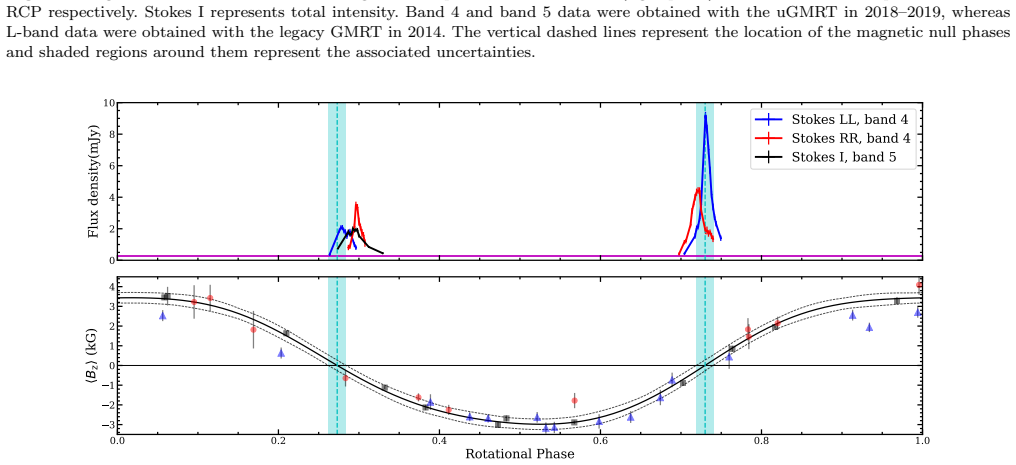
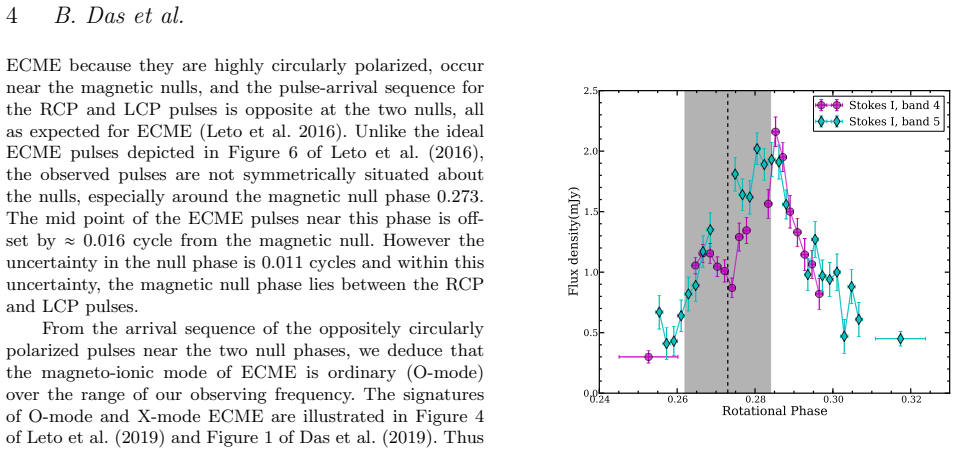
The central claim is that HD 35298 shows coherent radio emission at 550-750 MHz and 1060-1460 MHz, concentrated in rotational phase windows around the nulls of its longitudinal magnetic field. In band 4, both circular polarizations flare near each null, with the LCP/RCP arrival order reversing between nulls. Comparing this order with the phasing of the field curve locates the emitting hemisphere and identifies the mode as ordinary mode (O-mode), implying a plasma-frequency to gyro-frequency ratio greater than about 0.3-0.35 and an electron density above $5\times10^8\,\mathrm{cm}^{-3}$ at the emission site, at a height of roughly $2.6\,R_*$. Band 5 total intensity also shows enhancement around the same null, confirming activity over $0.56$-$1.38$ GHz. The authors conclude that this is the fifth such main-sequence star and argue that the recent rate of discovery points to ECME being a common phenomenon among magnetic A/B stars in the right range of physical parameters.
Load-bearing premise
The flux enhancements are intrinsic to HD 35298 and not artifacts of the per-timeslice self-calibration, which assumes the stellar flux is steady over each 5-minute slice and that gain solutions are stable across slices.
Editorial extensions
If this is right
- If the interpretation is right, HD 35298 becomes the fifth main-sequence magnetic B-type star known to exhibit ECME, extending the phenomenon to a star with a 1.85-day rotation period and a distance of about 371 pc.
- The opposite LCP/RCP arrival order at the two nulls is a geometric probe of the magnetosphere: it locates the emitting hemisphere and constrains the emission mode to O-mode.
- O-mode at 565-726 MHz implies a dense emission region, with electron density above $5\times10^8\,\mathrm{cm}^{-3}$ at roughly $2.6$ stellar radii.
- The detection in both band 4 and band 5 shows ECME operates over at least 0.56-1.38 GHz for this star, while the earlier L-band non-detection points to pulse-strength variability between epochs.
- The recent discovery of four of the five known cases suggests ECME may be common among magnetic A/B stars, and targeted low-frequency observations around magnetic nulls should find more examples.
Reading between the lines
- A direct test follows from the paper's logic: if ECME is beamed perpendicular to the field, a well-sampled lightcurve across a full rotation should show pulses only in narrow phase windows around both nulls; detecting comparable pulses at intermediate phases would falsify that beaming picture.
- The LCP/RCP arrival-order reversal is a clean diagnostic for other magnetic B stars with known $\langle B_z\rangle$ curves, turning single-epoch radio monitoring into a way to identify the emitting hemisphere.
- The inferred electron density lower limit of about $5\times10^8\,\mathrm{cm}^{-3}$ is high for a simple radiatively driven wind; if confirmed, it may require additional plasma sources, such as magnetospheric confinement, rather than a purely wind-fed magnetosphere.
- If ECME is genuinely common among magnetic A/B stars, then the current small sample likely reflects selection effects, and a systematic survey of such stars below 2 GHz around their magnetic nulls could yield a much larger population.
Signed reviews
Editorial analysis
A structured set of objections, weighed in public.
Referee Report
Summary. This Letter reports uGMRT observations of the Bp star HD 35298 near the two rotational phases at which the longitudinal magnetic field changes sign. In band 4 (550–750 MHz) the authors detect enhanced flux in both circular polarizations near both magnetic nulls, with the LCP/RCP arrival order reversed at the two nulls; in band 5 (1060–1460 MHz) they detect a total-intensity enhancement near one null. They interpret the emission as electron cyclotron maser emission (ECME), infer that the magneto-ionic mode is the ordinary mode, derive a lower limit on the plasma density at the emission region, and argue that HD 35298 is the fifth main-sequence magnetic B-type star showing ECME.
Significance. If the detection and the polarization sequence are robust, this is a valuable addition to the small sample of magnetic A/B stars with coherent radio emission. HD 35298 would extend the ECME sample to slower rotation and larger distance, and the frequency coverage from 0.56 to 1.38 GHz with a simultaneous density estimate provides useful constraints for magnetospheric models. The paper is generally careful in comparing with earlier ECME objects and in acknowledging the limitations of the self-calibration strategy. However, the central claim depends on the reliability of per-timeslice self-calibrated lightcurves, and the manuscript does not yet provide the quantitative checks needed to exclude calibration artifacts, particularly for the circular-polarization arrival sequence that anchors the mode and density interpretation.
major comments (3)
- [Section 3 and Figure 1] The per-timeslice self-calibration procedure is load-bearing but is not accompanied by any demonstration that the antenna gain solutions are stable or that the target variability is not absorbed into the gain model. Because the field is devoid of bright sources, amplitude self-calibration has a known degeneracy between slowly time-variable gains and time-variable source flux, as the authors themselves note. The paper shows no error bars on the lightcurves, no comparison of adjacent 5-minute gain solutions, and no check against a faint off-axis source. Please add quantitative diagnostics: scatter of per-slice amplitude gains, ratios of adjacent-slice solutions, comparison of lightcurves obtained with and without per-slice self-calibration, or a bootstrap estimate of the flux uncertainties. This is needed to secure the 10 mJy null-phase pulses and, more importantly, the relative phasing of the LL and RR lightcurves.
- [Section 4.1] The opposite arrival sequence of LCP and RCP pulses near the two magnetic nulls is the key evidence for the O-mode interpretation and for the inferred density lower limit (νp/νB > 0.3–0.35 and ne > 5×10^8 cm^-3). If the per-slice gain solutions for the two circular polarizations are not tied to a common, stable amplitude scale, the reported ~70% circular polarization and the arrival order could be altered. The manuscript should either provide a robustness test that the LL/RR ordering is stable under reasonable changes in the calibration scheme, or explicitly soften the mode and density claims to reflect the current uncertainty.
- [Section 4.2 and Figure 1] The band 5 total-intensity enhancement is presented without circular-polarization information and without error bars, and its interpretation as ECME rests entirely on the phase coincidence with the null. The phase coincidence is suggestive, but because the band 5 lightcurve is not calibrated in the same self-calibration framework as the band 4 data, the same gain-stability concern applies. A quantitative statement of the per-point flux uncertainty and detection significance for the band 5 enhancement should be added.
minor comments (5)
- [Section 2 and Figure 2] The basal flux adopted from Linsky et al. (1992) is a 6-cm (5 GHz) measurement made at an unknown rotational phase, and it is plotted in Figure 2 as a horizontal line without any uncertainty. The text justifies this assumption, but the absence of an error bar on the plotted baseline and the mismatch in frequency should be stated more prominently.
- [Figures 1–3] None of the lightcurves in Figures 1–3 shows error bars or an rms level. Even if the errors are smaller than the plotted symbols, this should be stated explicitly, together with the adopted noise estimator.
- [Section 3] There are a few typographical issues: 'bandwith' should be 'bandwidth', and the pipeline reference 'Ishwara-Chandra et al. in preparation' and 'ankflag (A. Bera & S. Mondal 2019, in preparation)' would be easier to evaluate if the authors specify what the pipeline does for amplitude versus phase self-calibration.
- [Section 4.1] The phrase 'mid point' should be 'midpoint', and the sentence explaining the null-phase uncertainty would be clearer if the numerical offset of 0.016 cycles were accompanied by an explicit statement of whether this offset is significant compared with the time sampling of the lightcurves.
- [Section 5] The statement that 'all five ECME stars are relatively rapid rotators' is somewhat at odds with HD 35298's 1.85-day period; the authors partially address this by noting observational selection, but the sentence would benefit from a direct caveat that 'rapid' here is relative to the general magnetic B-star population.
Circularity Check
No circularity: the ECME interpretation matches new observations to independently published theory; no fitted parameter is renamed as a prediction.
full rationale
This is an observational discovery paper. The claimed result—that HD 35298 shows ECME—is supported by new uGMRT lightcurves showing flux density enhancements, high circular polarization, and opposite LCP/RCP arrival sequences near the two magnetic nulls. Nothing in the paper defines a result in terms of another quantity measured in the same paper; no fitted parameter is subsequently renamed as a prediction. The ephemeris and magnetic-field curve are taken from Shultz et al. (2018), and stellar parameters from Shultz et al. (2019, submitted); these are independent prior measurements used as inputs, not consequences of the radio lightcurves. The O-mode identification is compared with published model signatures (Leto et al. 2016, 2019; Das et al. 2019), and the inferred density lower limit follows from a standard ECME cut-off condition (Sharma & Vlahos 1984; Melrose et al. 1984) applied to the observed frequency and inferred gyro-frequency—a forward application of an external theoretical relation. The self-citations to Shultz et al. and Das et al. are not load-bearing in the sense of a uniqueness theorem or an ansatz smuggled in by citation; the same model-signature expectations are attributed to external groups as well. Section 3 contains an acknowledged data-reduction limitation: because the field lacks bright sources, each 5-minute timeslice was self-calibrated independently, assuming the target flux is steady over that interval. That is a legitimate systematic concern about the reality of the pulses, but it is not circular: the conclusion does not presuppose itself through this assumption. Therefore, no circular step can be exhibited, and the honest finding is score 0.
Assumptions & free parameters
free parameters (1)
- Basal gyrosynchrotron flux density =
0.28 mJy
assumptions (4)
- domain assumption The large-scale magnetic field of HD 35298 is well approximated by an oblique dipole
- domain assumption The 1992 6 cm flux density represents the baseline gyrosynchrotron emission at 550-750 MHz
- domain assumption ECME mode selection depends on nu_p/nu_B with transition at 0.3-0.35, and emission is at the fundamental harmonic
- domain assumption Self-calibration per 5-minute timeslice yields accurate absolute flux densities in a field without bright sources
Cite this review
Pith. "Pith review of The fifth main sequence magnetic B-type star showing coherent radio emission: is this really a rare phenomenon?." pith.science (2026). https://pith.science/paper/YC6SP5BZ
@misc{pith2026190809110,
  author       = {Pith},
  title        = {Pith review of: The fifth main sequence magnetic B-type star showing coherent radio emission: is this really a rare phenomenon?},
  year         = {2026},
  howpublished = {\url{https://pith.science/paper/YC6SP5BZ}},
  note         = {Machine review of arXiv:1908.09110}
}
read the original abstract
We report the discovery of intense, highly directional radio emission from the Bp star HD 35298, which we interpret as the consequence of Electron Cyclotron Maser Emission (ECME). The star was observed with the Giant Metrewave Radio Telescope near the rotational phases of both magnetic nulls in band 4 (550-750 MHz) and one of the nulls in band 5 (1060-1460 MHz). In band 4, we observed flux density enhancement in both circular polarizations near both magnetic nulls. The sequences of arrival of the left and right circularly polarized pulses are opposite near the two nulls. In band 5, we did not have circular polarization information and hence measured only the total intensity lightcurve, which also shows enhancement around the magnetic null. The observed sequence of the circular polarization signs in band 4, compared with the longitudinal magnetic field curve, is able to locate the hemisphere from which ECME arises. This observational evidence supports the scenario of ECME in the ordinary mode, arising in a magnetosphere shaped like an oblique dipole. HD 35298 is the most slowly rotating and most distant main sequence magnetic star from which ECME has been observed.
Figures

Forward citations
Cited by 1 Pith paper
-
First monitoring campaign of a Main-sequence Radio Pulse emitter: the case of CU Vir
A six-month, 36-epoch radio campaign on CU Vir shows the leading pulse fluctuates more than the trailing pulse, reveals arrival-phase jitter, and refines the rotation period to 0.5206882 days.
Reference graph
Works this paper leans on
-
[1]
Andre, P., Montmerle, T., Feigelson, E. D., Stine, P. C., & Klein, K.-L. 1988, ApJ, 335, 940
work page 1988
-
[2]
Chandra, P., Wade, G. A., Sundqvist, J. O., et al. 2015, MNRAS, 452, 1245
work page 2015
-
[3]
Ciatti, F., & Bernacca, P. L. 1971, A&A, 11, 485
work page 1971
-
[4]
Das, B., Chandra, P., & Wade, G. A. 2018, MNRAS, 474, L61
work page 2018
- [5]
-
[6]
Drake, S. A., Abbott, D. C., Bastian, T. S., et al. 1987, ApJ, 322, 902 Gaia Collaboration, Brown, A. G. A., Vallenari, A., et al. 2018, A&A, 616, A1
work page 1987
-
[7]
Glagolevskij, Y. V. 2010, Astrophysics, 53, 536 MNRAS 000, 1–6 (2019) 6 B. Das et al
work page 2019
- [8]
Show all 44 references
-
[9]
2007, ApJ, 663, L25
Hallinan, G., Bourke, S., Lane, C., et al. 2007, ApJ, 663, L25
2007
-
[10]
G., et al
Hallinan, G., Antonova, A., Doyle, J. G., et al. 2008, ApJ, 684, 644
2008
-
[11]
P., Cotter, G., et al
Hallinan, G., Littlefair, S. P., Cotter, G., et al. 2015, Nature, 523, 568
2015
-
[12]
M., Hallinan, G., Pineda, J
Kao, M. M., Hallinan, G., Pineda, J. S., et al. 2016, ApJ, 818, 24
2016
-
[13]
2006, A&A, 450, 763
Kochukhov, O., & Bagnulo, S. 2006, A&A, 450, 763
2006
-
[14]
Kochukhov, O., L¨uftinger, T., Neiner, C., Alecian, E., & MiMeS Collaboration 2014, A&A, 565, A83
2014
-
[15]
D., et al
Kochukhov, O., Silvester, J., Bailey, J. D., et al. 2017, A&A, 605, A13
2017
-
[16]
D., Bagnulo, S., Andretta, V., et al
Landstreet, J. D., Bagnulo, S., Andretta, V., et al. 2007, A&A, 470, 685
2007
-
[17]
R., Kaplan, D
Lenc, E., Murphy, T., Lynch, C. R., Kaplan, D. L., & Zhang, S. N. 2018, MNRAS, 478, 2835
2018
-
[18]
2004, A&A, 423, 1095
Leone, F., Trigilio, C., Neri, R., et al. 2004, A&A, 423, 1095
2004
-
[19]
S., Umana, G., & Leone, F
Leto, P., Trigilio, C., Buemi, C. S., Umana, G., & Leone, F. 2006, A&A, 458, 831
2006
-
[20]
S., Leone, F., & Umana, G
Leto, P., Trigilio, C., Buemi, C. S., Leone, F., & Umana, G. 2012, MNRAS, 423, 1766
2012
-
[21]
S., et al
Leto, P., Trigilio, C., Buemi, C. S., et al. 2016, MNRAS, 459, 1159
2016
-
[22]
2017, MNRAS, 467, 2820
Leto, P., Trigilio, C., Oskinova, L., et al. 2017, MNRAS, 467, 2820
2017
-
[23]
M., et al
Leto, P., Trigilio, C., Oskinova, L. M., et al. 2018, MNRAS, 476, 562
2018
-
[24]
M., et al
Leto, P., Trigilio, C., Oskinova, L. M., et al. 2019, MNRAS, 482, L4
2019
-
[25]
L., Drake, S
Linsky, J. L., Drake, S. A., & Bastian T. S. 1992, ApJ, 393, 341
1992
-
[26]
K., Bray, J
Lo, K. K., Bray, J. D., Hobbs, G., et al. 2012, MNRAS, 421, 3316
2012
-
[27]
P., Waters, B., Schiebel, D., Young, W., & Golap, K
McMullin, J. P., Waters, B., Schiebel, D., Young, W., & Golap, K. 2007, Astronomical Data Analysis Software and Systems XVI, 376, 127
2007
-
[28]
B., & Dulk, G
Melrose, D. B., & Dulk, G. A. 1982, ApJ, 259, 844
1982
-
[29]
B., Hewitt, R
Melrose, D. B., Hewitt, R. G., & Dulk, G. A. 1984, J. Geo- phys. Res., 89, 897
1984
-
[30]
2003, ApJ, 583, 451
Mohanty, S., & Basri, G. 2003, ApJ, 583, 451
2003
-
[31]
P., Wade, G
Petit, V., Owocki, S. P., Wade, G. A., et al. 2013, MNRAS, 429, 398
2013
-
[32]
2002, A&A, 381, 736
Piskunov, N., & Kochukhov, O. 2002, A&A, 381, 736
2002
-
[33]
2010, MNRAS, 408, L99
Ravi, V., Hobbs, G., Wickramasinghe, D., et al. 2010, MNRAS, 408, L99
2010
-
[34]
2006, A&A, 448, 293
Stelzer, B., Micela, G., Flaccomio, E., et al. 2006, A&A, 448, 293
2006
-
[35]
R., Vlahos, L., & Papadopoulos, K
Sharma, R. R., Vlahos, L., & Papadopoulos, K. 1982, A&A, 112, 377
1982
-
[36]
R., & Vlahos, L
Sharma, R. R., & Vlahos, L. 1984, ApJ, 280, 405
1984
-
[37]
E., Wade, G
Shultz, M. E., Wade, G. A., Rivinius, T., et al. 2018, MNRAS, 475, 5144
2018
-
[38]
E., Wade, G
Shultz, M. E., Wade, G. A., Rivinius, T., et al. 2019, MNRAS, 485, 1508
2019
-
[39]
Treumann, R. A. 2006, A&ARv, 13, 229
2006
-
[40]
2000, A&A, 362, 281
Trigilio, C., Leto, P., Leone, F., Umana, G., & Buemi, C. 2000, A&A, 362, 281
2000
-
[41]
2004, A&A, 418, 593
Trigilio, C., Leto, P., Umana, G., Leone, F., & Buemi, C.S. 2004, A&A, 418, 593
2004
-
[42]
2008, MNRAS, 384, 1437
Trigilio, C., Leto, P., Umana, G., Buemi, C.S., & Leone, F. 2008, MNRAS, 384, 1437
2008
-
[43]
2011, ApJ, 739, L10
Trigilio, C., Leto, P., Umana, G., Buemi, C.S., & Leone, F. 2011, ApJ, 739, L10
2011
-
[44]
Yakunin, I. A. 2013, Astrophysical Bulletin, 68, 214 This paper has been typeset from a T EX/LATEX file prepared by the author. MNRAS 000, 1–6 (2019)
2019
Reviewed August 14, 2026 · model on record in the stance chip above.
Discussion (0). Continue with ORCID to comment.