Design criteria for a beam-driven resonant passive transverse deflector for longitudinal beam diagnostics
Pith reviewed 2026-06-25 21:55 UTC · model grok-4.3
The pith
A beam-driven resonant passive transverse deflector achieves about 33 fs temporal resolution for longitudinal beam diagnostics without external RF power.
A machine-rendered reading of the paper's core claim, the machinery that carries it, and where it could break.
Core claim
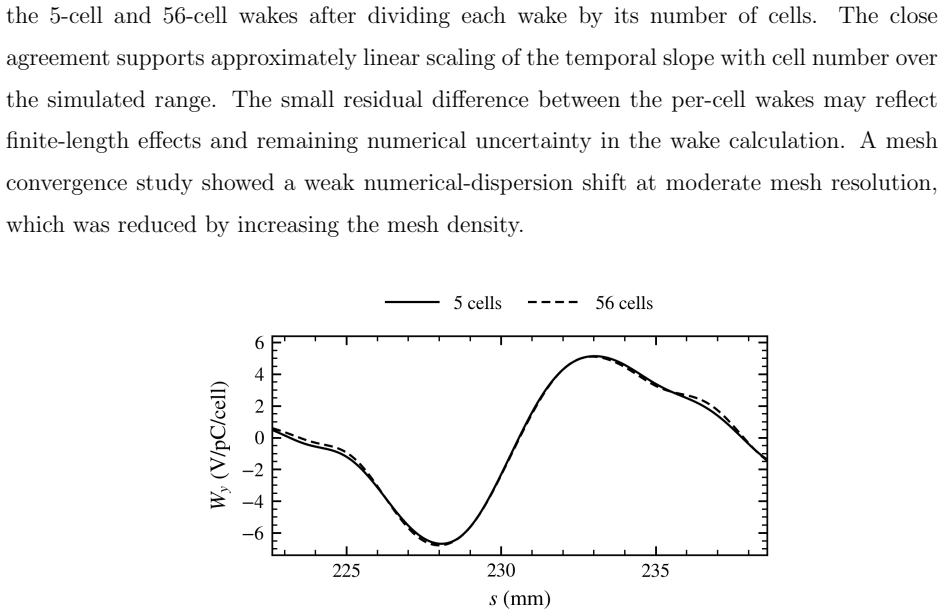
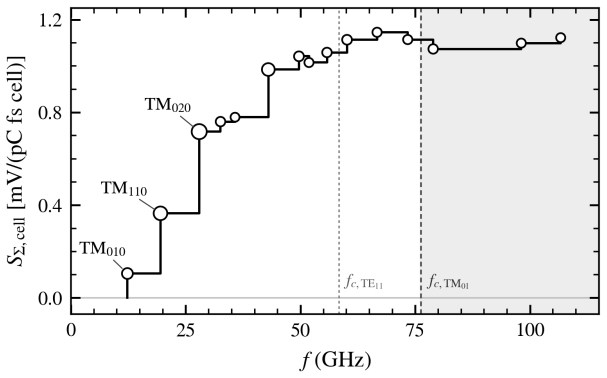
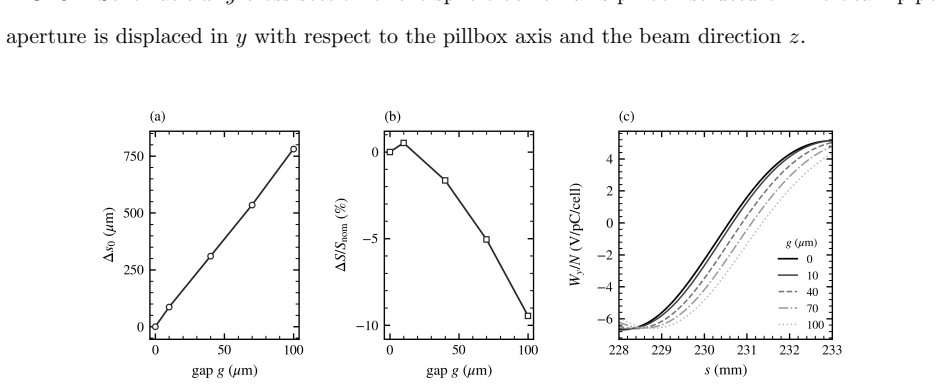
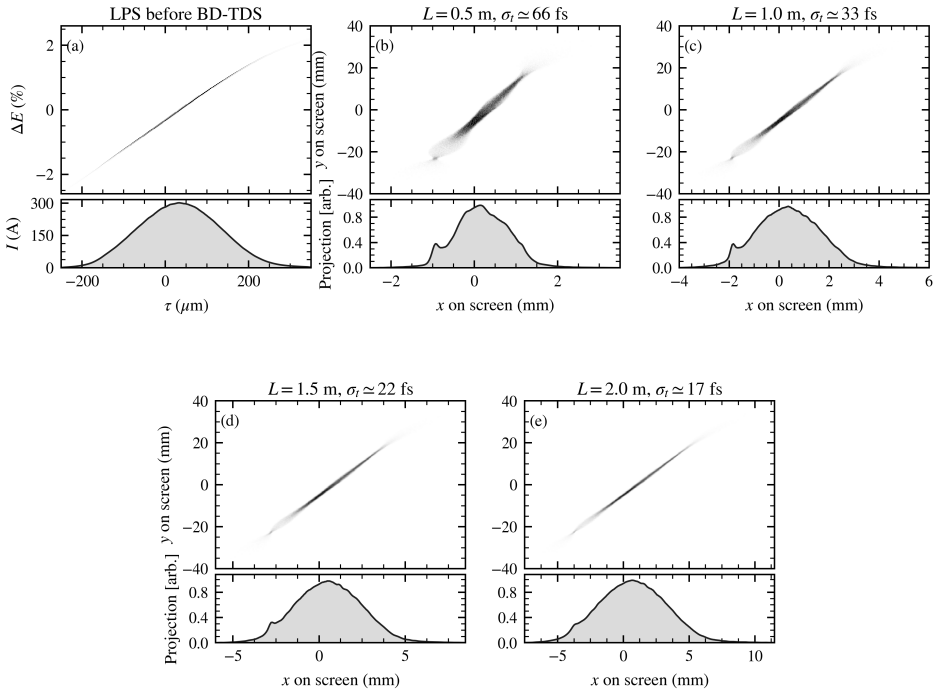
The selected geometry produces a multi-mode transverse kick dominated by TM-like modes with the drive-bunch-induced transverse wake potential zero crossing at s0 = 230.6 mm and per-cell temporal slope Scell = 1.186 mV/(pC fs cell). A compact 1 m structure operated with a 250 pC drive bunch and 700 MeV witness beam yields an estimated temporal resolution of about 33 fs.
What carries the argument
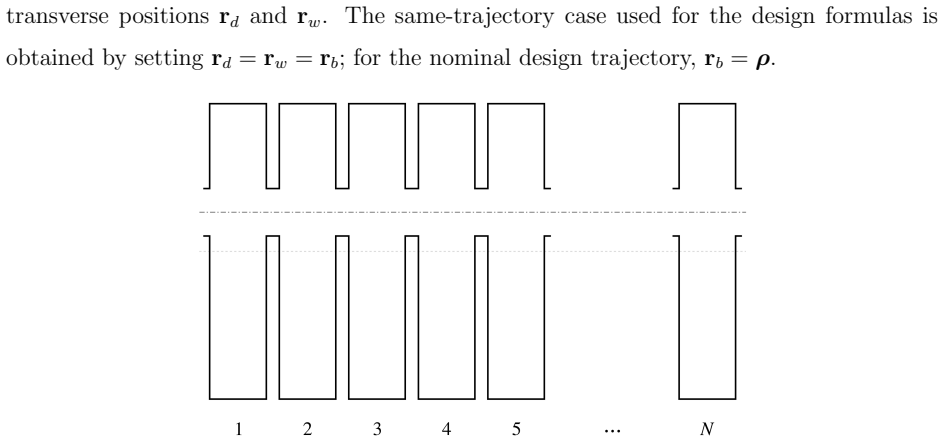
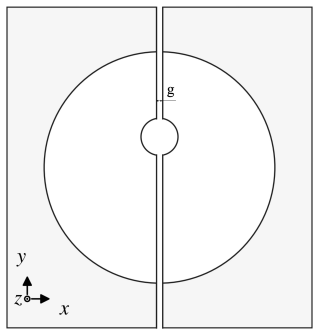
An off-axis periodic copper structure that excites long-range wakefields from a drive bunch to produce a high temporal slope in the transverse kick experienced by a witness bunch near the wake zero crossing.
Load-bearing premise
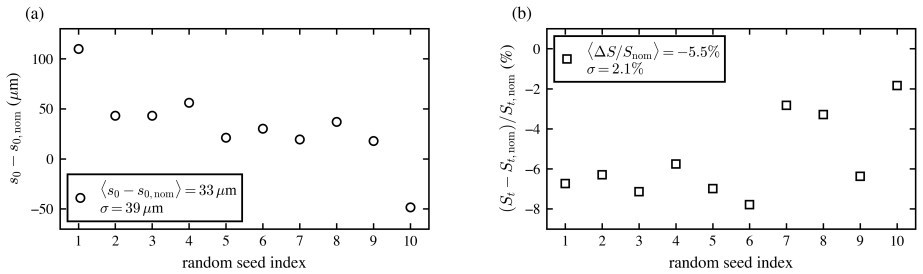
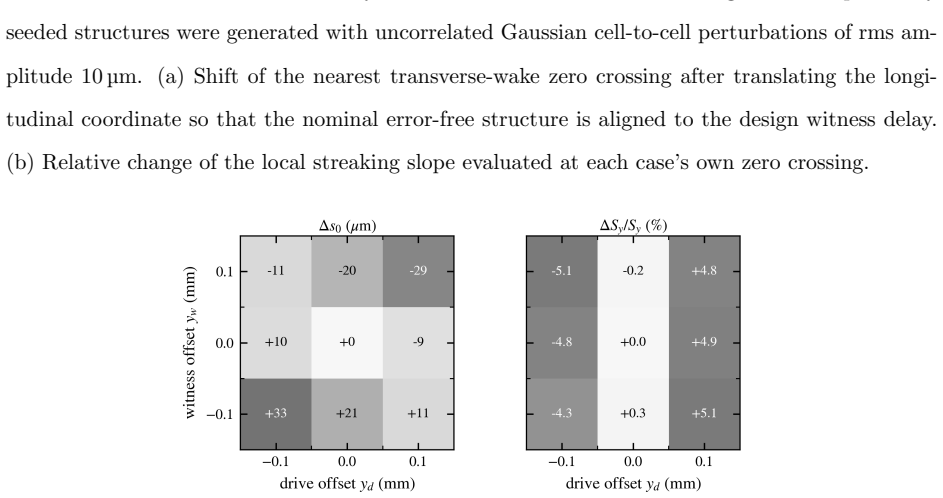
Time-domain wake simulations and frequency-domain decomposition accurately predict the multi-mode transverse kick and zero-crossing location under real beam conditions including mechanical tolerances and orbit offsets.
What would settle it
Measurement of the actual transverse deflection versus drive-witness delay on a prototype or installed structure to check whether the zero crossing occurs at 230.6 mm and the slope matches 1.186 mV per pC fs per cell.
Figures
read the original abstract
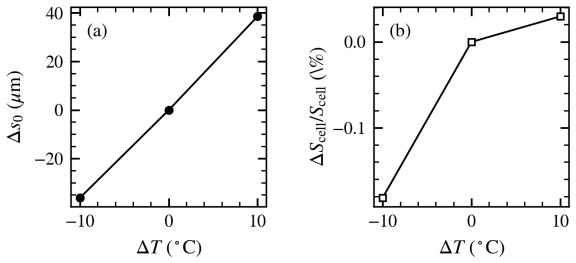
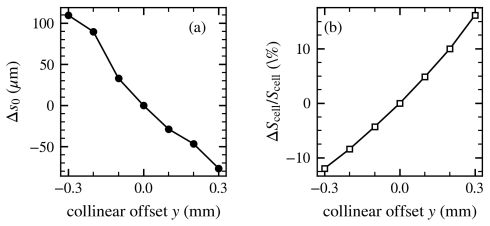
Conventional radio-frequency (rf) transverse deflecting structures provide high-resolution longitudinal beam diagnostics, but require externally generated high-power rf, waveguide distribution, synchronization and input coupling at the operating frequency. We propose design criteria for a beam-driven resonant passive transverse deflector that does not require an external rf source. A leading drive bunch excites long-range wakefields in an off-axis periodic copper structure and a delayed witness bunch experiences the transverse wake near a zero crossing. The concept is based on the large temporal slope available from high-frequency wake components. A structure designed for installation after the second bunch compressor in the three-bunch-compressor layout of the European XFEL is optimized to place the zero crossing of the drive-bunch-induced transverse wake potential approximately one rf-bucket spacing of the 1.3 GHz linac, behind the drive bunch. The selected geometry produces a multi-mode transverse kick dominated by TM-like modes. We use time-domain wake simulations, frequency-domain decomposition, cell-number scaling, mechanical-tolerance scans, orbit-offset studies and uniform thermal scaling to determine the operating point and its sensitivity. For this geometry, the zero crossing occurs at s0 = 230.6 mm, with a per-cell temporal slope of Scell = 1.186 mV/(pC fs cell). For a compact 1 m structure operated with a 250 pC drive bunch and a 700 MeV witness beam, the estimated temporal resolution is about 33 fs.
Editorial analysis
A structured set of objections, weighed in public.
Referee Report
Summary. The manuscript proposes design criteria for a compact beam-driven resonant passive transverse deflector that uses long-range wakefields excited by a leading drive bunch to provide a transverse kick to a delayed witness bunch near a zero crossing, enabling longitudinal beam diagnostics without external RF power. The structure is optimized for installation after the second bunch compressor in the European XFEL three-bunch-compressor layout; time-domain wake simulations combined with frequency-domain decomposition, cell scaling, tolerance scans, orbit-offset studies, and thermal scaling are used to locate the zero crossing at s0 = 230.6 mm with per-cell slope Scell = 1.186 mV/(pC fs cell), yielding an estimated 33 fs temporal resolution for a 1 m structure driven by a 250 pC bunch and a 700 MeV witness beam.
Significance. If the simulation results hold under real beam conditions, the approach offers a compact, synchronization-free alternative to conventional RF deflectors by exploiting high-frequency multi-mode wake components. The manuscript provides credit for its systematic use of multiple complementary methods (time-domain wakes, modal decomposition, mechanical-tolerance and orbit-offset scans, and uniform thermal scaling) to map operating-point sensitivity, which strengthens the design-criteria contribution.
major comments (2)
- [Abstract] Abstract: the 33 fs resolution estimate is obtained by scaling the simulated drive-bunch wake (250 pC) to the 700 MeV witness beam; this scaling rests on the unverified assumption that the time-domain wake code plus frequency-domain decomposition correctly locate the multi-mode zero crossing (s0 = 230.6 mm) and extract Scell = 1.186 mV/(pC fs cell) even after mechanical tolerances and orbit offsets are applied. No mesh-convergence study, comparison to an independent solver, or analytic TM-mode summation is reported to bound numerical dispersion or truncation errors at the cancellation point.
- [Abstract] Abstract: the central performance numbers (s0, Scell, and the resulting 33 fs resolution) are direct outputs of the wake simulations rather than reductions from closed-form expressions; without reported error bars, sensitivity to numerical parameters, or cross-validation against measurements, the precision of the quoted resolution cannot be assessed and remains load-bearing for the design claim.
Simulated Author's Rebuttal
We thank the referee for the constructive comments highlighting the need for stronger numerical validation of the wake simulations. We address each major comment below and will revise the manuscript to incorporate additional checks where feasible.
read point-by-point responses
-
Referee: [Abstract] Abstract: the 33 fs resolution estimate is obtained by scaling the simulated drive-bunch wake (250 pC) to the 700 MeV witness beam; this scaling rests on the unverified assumption that the time-domain wake code plus frequency-domain decomposition correctly locate the multi-mode zero crossing (s0 = 230.6 mm) and extract Scell = 1.186 mV/(pC fs cell) even after mechanical tolerances and orbit offsets are applied. No mesh-convergence study, comparison to an independent solver, or analytic TM-mode summation is reported to bound numerical dispersion or truncation errors at the cancellation point.
Authors: We agree that bounding numerical errors at the zero-crossing cancellation point is important. The manuscript already combines time-domain wake simulations with frequency-domain decomposition to identify contributing modes and assess sensitivity via tolerance and orbit scans. In the revised version we will add a mesh-convergence study and a comparison of key wake quantities against an independent frequency-domain electromagnetic solver. A full analytic TM-mode summation for the off-axis periodic geometry is not practical within the scope of this design study; the frequency-domain decomposition of the simulated wakes already provides the modal content used to locate the operating point. revision: partial
-
Referee: [Abstract] Abstract: the central performance numbers (s0, Scell, and the resulting 33 fs resolution) are direct outputs of the wake simulations rather than reductions from closed-form expressions; without reported error bars, sensitivity to numerical parameters, or cross-validation against measurements, the precision of the quoted resolution cannot be assessed and remains load-bearing for the design claim.
Authors: The quoted values are simulation outputs, and the manuscript already reports sensitivity through mechanical-tolerance scans, orbit-offset studies, and thermal scaling. We will add in revision an explicit assessment of how s0 and Scell vary with numerical parameters (mesh density and time step). Cross-validation against beam measurements is not possible at the present design stage, as the structure has not been fabricated or tested. revision: partial
- Cross-validation of the simulation results against experimental measurements, as this is a design study for a device that has not yet been built or tested.
Circularity Check
No circularity: wake parameters from independent EM simulations
full rationale
The paper obtains s0, Scell and the 33 fs resolution directly from time-domain wake simulations plus frequency-domain decomposition applied to the chosen geometry. These are external numerical outputs of the solver on the structure, not reductions of fitted parameters defined by the same equations, not self-citation chains, and not ansatzes smuggled via prior work. The scaling to beam energy and bunch charge is a straightforward linear calculation with no redefinition of inputs as outputs. The derivation chain is therefore self-contained.
Axiom & Free-Parameter Ledger
Reference graph
Works this paper leans on
-
[1]
W. K. H. Panofsky and W. A. Wenzel, Some considerations concerning the transverse deflec- tion of charged particles in radio-frequency fields, Review of Scientific Instruments27, 967 (1956). 22
1956
-
[2]
Floettmann and V
K. Floettmann and V. V. Paramonov, Beam dynamics in transverse deflecting RF structures, Physical Review Special Topics – Accelerators and Beams17, 024001 (2014)
2014
-
[3]
R¨ ohrs, C
M. R¨ ohrs, C. Gerth, H. Schlarb, B. Schmidt, and P. Schm¨ user, Time-resolved electron beam phase space tomography at a soft X-ray free-electron laser, Physical Review Special Topics – Accelerators and Beams12, 050704 (2009)
2009
-
[4]
Y. Ding, C. Behrens, P. Emma, J. Frisch, Z. Huang, H. Loos, P. Krejcik, and M.-H. Wang, Femtosecond X-ray pulse temporal characterization in free-electron lasers using a transverse deflector, Physical Review Special Topics – Accelerators and Beams14, 120701 (2011)
2011
-
[5]
V. A. Dolgashev, G. Bowden, Y. Ding, P. Emma, P. Krejcik, J. Lewandowski, C. Limborg, M. Litos, J. Wang, and D. Xiang, Design and application of multimegawatt X-band deflectors for femtosecond electron beam diagnostics, Physical Review Special Topics – Accelerators and Beams17, 102801 (2014)
2014
-
[6]
Behrens, F.-J
C. Behrens, F.-J. Decker, Y. Ding, V. A. Dolgashev, J. Frisch, Z. Huang, P. Krejcik, H. Loos, A. Lutman, T. J. Maxwell, J. Turner, J. Wang, M.-H. Wang, J. Welch, and J. Wu, Few- femtosecond time-resolved measurements of X-ray free-electron lasers, Nature Communica- tions5, 3762 (2014)
2014
-
[7]
Craievichet al., Novel X-band transverse deflection structure with variable polarization, Physical Review Accelerators and Beams23, 112001 (2020)
P. Craievichet al., Novel X-band transverse deflection structure with variable polarization, Physical Review Accelerators and Beams23, 112001 (2020)
2020
-
[8]
Marchettiet al., Experimental demonstration of novel beam characterization using a po- larizable X-band transverse deflection structure, Scientific Reports11, 3560 (2021)
B. Marchettiet al., Experimental demonstration of novel beam characterization using a po- larizable X-band transverse deflection structure, Scientific Reports11, 3560 (2021)
2021
-
[9]
P. Gonz´ alez Caminalet al., Beam-based commissioning of a novel X-band transverse deflection structure with variable polarization, Physical Review Accelerators and Beams27, 032801 (2024)
2024
-
[10]
E. Prat, Z. Geng, C. Kittel, A. Malyzhenkov, F. Marcellini, S. Reiche, T. Schietinger, and P. Craievich, Attosecond time-resolved measurements of electron and photon beams with a variable polarization X-band radiofrequency deflector at an X-ray free-electron laser, Advanced Photonics7, 026002 (2025)
2025
-
[11]
S. Tomin, D. Bazyl, W. Decking, and I. Zagorodnov, Beam-driven transverse deflecting struc- ture for femtosecond electron-beam diagnostics (2026), arXiv:2605.13752 [physics.acc-ph]
Pith/arXiv arXiv 2026
-
[12]
K. L. F. Bane and G. Stupakov, Corrugated pipe as a beam dechirper, Nuclear Instruments and Methods in Physics Research Section A690, 106–110 (2012). 23
2012
-
[13]
Bettoni, P
S. Bettoni, P. Craievich, A. A. Lutman, and M. Pedrozzi, Temporal profile measurements of relativistic electron bunch based on wakefield generation, Physical Review Accelerators and Beams19, 021304 (2016)
2016
-
[14]
J. Seok, D. S. Doran, J. B. Rosenzweig, G. Andonian, A. Murokh, and M. Fedurin, Use of a corrugated beam pipe as a passive deflector for bunch length measurements, Physical Review Accelerators and Beams21, 022801 (2018)
2018
-
[15]
Dijkstal, A
P. Dijkstal, A. Malyzhenkov, P. Craievich, E. Ferrari, R. Ganter, S. Reiche, T. Schietinger, P. Jurani´ c, and E. Prat, Self-synchronized and cost-effective time-resolved measurements at x-ray free-electron lasers with femtosecond resolution, Physical Review Research4, 013017 (2022)
2022
-
[16]
Dijkstal, W
P. Dijkstal, W. Qin, and S. Tomin, Longitudinal phase space diagnostics with a nonmovable corrugated passive wakefield streaker, Physical Review Accelerators and Beams27, 050702 (2024)
2024
-
[17]
Dornmair, C
I. Dornmair, C. B. Schroeder, K. Floettmann, B. Marchetti, and A. R. Maier, Plasma-driven ultrashort bunch diagnostics, Physical Review Accelerators and Beams19, 062801 (2016)
2016
-
[18]
C. A. Lindstrøm, E. Adli, J. M. Allen, W. An, C. Beekman, C. I. Clarke, C. E. Clayton, S. Corde, A. Doche, J. Frederico, S. J. Gessner, S. Z. Green, M. J. Hogan, C. Joshi, M. Litos, W. Lu, K. A. Marsh, W. B. Mori, B. D. O’Shea, N. Vafaei-Najafabadi, and V. Yakimenko, Measurement of transverse wakefields induced by a misaligned positron bunch in a hollow c...
2018
-
[19]
V. A. Dolgashev, P. Emma, M. Dal Forno, A. Novokhatski, and S. Weathersby, Attosec- ond diagnostics of multi-gev electron beams using w-band deflectors, inProceedings of FEIS- 2: Femtosecond Electron Imaging and Spectroscopy(Lansing/East Lansing, Michigan, 2015) conference presentation
2015
-
[20]
Dal Forno, V
M. Dal Forno, V. A. Dolgashev, G. Bowden, C. I. Clarke, M. J. Hogan, D. McCormick, A. Novokhatski, B. Spataro, S. Weathersby, and S. G. Tantawi, Experimental measurements of rf breakdowns and deflecting gradients in mm-wave metallic accelerating structures, Physical Review Accelerators and Beams19, 051302 (2016)
2016
-
[21]
A. W. Chao,Physics of Collective Beam Instabilities in High Energy Accelerators(Wiley, New York, 1993)
1993
-
[22]
B. W. Zotter and S. A. Kheifets,Impedances and Wakes in High-Energy Particle Accelerators 24 (World Scientific, Singapore, 1998)
1998
-
[23]
Stupakov, Wake and impedance (2018), lecture notes
G. Stupakov, Wake and impedance (2018), lecture notes
2018
-
[24]
Dassault Syst` emes, CST Studio Suite: Electromagnetic field simulation software,https:// www.3ds.com/products/simulia/cst-studio-suite
-
[25]
Weiland, A discretization method for the solution of Maxwell’s equations for six-component fields, Electronics and Communications31, 116 (1977)
T. Weiland, A discretization method for the solution of Maxwell’s equations for six-component fields, Electronics and Communications31, 116 (1977)
1977
-
[26]
Deckinget al., A mhz-repetition-rate hard x-ray free-electron laser driven by a supercon- ducting linear accelerator, Nature Photonics14, 391 (2020)
W. Deckinget al., A mhz-repetition-rate hard x-ray free-electron laser driven by a supercon- ducting linear accelerator, Nature Photonics14, 391 (2020). 25
2020
discussion (0)
Sign in with ORCID, Apple, or X to comment. Anyone can read and Pith papers without signing in.