REVIEW 4 major objections 5 minor 50 references
Bulk and surface dominated phenomena and the formation of pentagonal structures in 2-D strongly coupled finite dust clusters
T0 review · 4 major / 5 minor · reviewed 2026-08-10 · deepseek-v4-flash
Pith's one-line read In 2D dust clusters, every new ring is announced by a fivefold core.
desk verdict Systematic and useful MD survey of pentagon-before-shell motifs in 2D dust clusters, but the 'always' claim is contradicted by the paper's own non-radial confinement results. read the letter →
The pith
A machine-rendered reading of the paper's core claim, the machinery that carries it, and where it could break.
The reading
What carries the argument
The load-bearing object is the shell-counting configuration $(n_0,n_1,n_2,\dots)$ of a multi-ringed Yukawa cluster, together with the recurrence rule that a new shell is born as a five-particle core and then becomes $(1,5,\dots)$ before outer shells fill. The mechanism is geometric and energetic: for six mutually repelling particles under a central confining potential, the arrangement with one particle at the center and five around it, $(1,5)$, fits inside a smaller radius than six particles on one ring, $(0,6)$, and is the lower-energy state. Because particles are added from the center outward, every shell-addition threshold must first pass through the compact fivefold core, which produces the observed pentagonal precursors in pairs or triplets of successive particle numbers.
What would settle it
Run the same simulations but initialize each particle number from a deliberately non-pentagonal core, such as a hexagonal or square inner shell, and check whether a new outer ring can appear without a five-particle core immediately before it; or compute the total potential energies of the (0,6) and (1,5) configurations for $\kappa=1$ and $\kappa=2$ under radial confinement. If (0,6) is ever the lower-energy state, the geometric argument for the pentagon precursor fails.
Extended reading notes
Core claim
The central claim, stated in the abstract, is that the formation of an additional ring in a two-dimensional dust cluster is always preceded by a five-particle core with pentagonal symmetry. In the configuration notation where the entries are particle counts in successive shells, the sequence runs (0,5), then (1,5), then (5,10), then (1,5,10), then (5,11,14), then (1,5,11,14), and so on: a pentagon forms in the innermost shell, a center particle is inserted, and then outer shells fill until the next threshold. The authors explain this through a center-outward filling rule together with the preference of the (1,5) arrangement over (0,6) for six mutually repelling particles, which is both more compact and lower in potential energy under radial confinement. They verify the association for square, pentagonal, and hexagonal confinement boundaries and for screening parameter $\kappa=1$ and $\kappa=2$, noting that some pentagonal configurations are missed for non-radial boundaries even though the pentagonal structures that do form appear at shell-addition thresholds. The cluster dynamics are governed by the surface-to-bulk ratio $N_s/N_B$: surface-dominated clusters show inter-shell rotation, bulk-dominated clusters show rigid oscillations, and a mesoscale transition region appears near $N_T \approx 33$ to $47$.
Load-bearing premise
The rule depends on the assumption that each particle number's equilibrated snapshot is the true ground state and that stepping the particle number one at a time missed no intermediate shell-addition configuration; if any observed pentagon is a metastable transient, the 'always' claim could be an artifact of the simulation protocol.
Editorial extensions
If this is right
- Shell-addition thresholds in 2D Yukawa clusters can be organized by a pentagon-first recurrence: $(5,\dots) \to (1,5,\dots) \to$ filled shells, so the special particle counts in Table I follow from one compact-core rule.
- The surface-to-bulk ratio $N_s/N_B$ acts as a dynamical control parameter: surface-dominated clusters show inter-shell rotation, bulk-dominated clusters show rigid oscillations, making the crossover a finite-size effect rather than a material property.
- Because the pentagon precursor appears under radial, square, pentagonal, and hexagonal confinement and for two screening strengths, the rule is likely generic to centrally confined repulsive particles in two dimensions, not unique to Yukawa interactions.
- For stronger screening ($\kappa=2$), confinement geometry matters more: in square boundaries the pentagonal precursors are mostly suppressed, while in pentagonal boundaries the whole cluster adopts pentagonal packing once it is large enough.
- The pentagon-first sequence gives an ordering principle for enumerating stable multi-ring configurations: no shell is added without passing through a fivefold core, so configuration space can be organized around that milestone.
Reading between the lines
- If the mechanism is purely geometric, the pentagon-before-new-shell rule should also appear in other centrally confined repulsive 2D systems, such as colloidal clusters, trapped ions, and vortex arrays, and it could be tested there without plasma physics.
- The recurrence suggests a generative algorithm: starting from $(1,5)$, one can enumerate candidate ground states for arbitrary particle number by filling shells outward, allowing a check of whether every stable multi-ring configuration is reachable by pentagon-first insertion.
- A useful next test is to extend the simulations beyond 100 particles to see whether the pentagon-first recurrence continues at larger shell numbers or breaks down when bulk effects dominate strongly.
- The authors' connection to ultracold neutral plasmas suggests the fivefold core may be a common intermediate motif in strongly coupled systems whenever a central perturbation reorganizes the cluster.
Editorial analysis
A structured set of objections, weighed in public.
Referee Report
Summary. The manuscript reports two-dimensional molecular dynamics simulations of Yukawa-interacting dust clusters with particle numbers N_T from 1 to 100, under different transverse confinement geometries (radial, square, pentagonal, hexagonal) and two screening parameters (κ = 1 and 2). The authors identify a transition from intershell rotation to rigid rotation, which they correlate with the ratio of surface particles to bulk particles, N_s/N_B. They further claim that the addition of a new shell or ring is always preceded by the appearance of a pentagonally symmetric structure in the cluster core, and they list configurations such as (0,5), (1,5), (5,10), and (5,11,14) as examples. The paper also reports a single-frequency rigid-oscillation mode for N_T = 47 via Fourier analysis of the average angular displacement.
Significance. If the universal pentagon-precedes-shell rule held, it would be a striking size-dependent organizational principle for finite two-dimensional Yukawa clusters and would merit publication. The systematic N-by-N scan up to N_T = 100 and the quantitative Fourier evidence for the N_T = 47 rigid mode are useful contributions, and the geometric rationalization through the (1,5) vs (0,6) preference is plausible and testable. The main weakness is that the universality claim is stronger than the presented data, and the detection of pentagonal structures is not quantitatively defined. With a more carefully scoped claim and an objective detection criterion, the core observation would be a valid and interesting result.
major comments (4)
- [Abstract and Section IV.A] The abstract states that 'the formation of an additional ring is always preceded by structures with a pentagonal symmetry in the core,' and Section IV states that 'whenever a new shell gets added, the pentagonal structures precede the same.' This universal claim is directly contradicted by Section IV.A, which reports that for square, pentagonal, and hexagonal boundaries 'the pentagonal structure formation gets missed even when a new ring adds up.' Either the abstract and Section IV must be restricted to radial confinement, or the missed cases must be reconciled with the 'always' wording. As written, the central claim is internally inconsistent.
- [Section IV and Fig. 8] No quantitative definition of a 'pentagonal structure' or an objective detection criterion is given. The configurations in Tables I-III are labeled by visual inspection of particle coordinates, and Fig. 7/8 use colored markers for presence or absence, but the reader cannot determine what degree of symmetry counts as pentagonal or how distorted configurations are classified. Without such a criterion, the claims 'pentagonal structure forms' and 'pentagonal structure gets missed' are not falsifiable from the presented data.
- [Tables I-III and Section IV] The tables list only the particle numbers for which pentagonal structures are observed; they do not list the full shell-addition sequence for every N_T in the scanned range. Therefore the statements 'whenever a new shell gets added, the pentagonal structures precede the same' and 'in some cases ... the pentagonal structure formation gets missed' cannot be verified from the tables alone. A complete table or figure showing, for each N_T, whether a shell was added and whether a pentagonal core was present is needed to support the claimed deterministic sequence.
- [Section II and Section IV] The simulations use a Nose-Hoover thermostat to reach T = 208 K, but no information is provided about equilibration time, number of independent initial conditions, or comparison of final states to potential-energy-minimized ground states. Since the pentagon-before-shell rule is read as a deterministic sequence, the possibility that some listed configurations are metastable states or kinetic traps must be addressed. At minimum, the authors should show that the reported configurations do not depend on equilibration protocol or initial random seeds.
minor comments (5)
- [Section III, text near Fig. 2] The text states that 'the feature of intershell rotation is observed definitely when the ratio N_s/N_T ≥ 1,' but N_s/N_T cannot be greater than or equal to 1 for N_T > 0; this should read N_s/N_B ≥ 1, consistent with the preceding sentence about dominant surface particles.
- [Figures 7 and 8] The green markers and yellow crosses in Fig. 7 and Fig. 8 are small and overlap with the plotted curve and labels, making it difficult to read the exact N_T values for which pentagonal structures appear or are missed. Larger markers or an annotated list would improve clarity.
- [Section IV.B and Tables II-III] Table III shows that for κ = 2, the pentagonal structures in square confinement are limited to N_p = 5 and 16, yet the text says the shape of confinement plays an important role. It would be helpful to state explicitly how the pentagon-formation rule should be modified for square boundaries at κ = 2, since the current wording is ambiguous about whether the rule is expected to hold.
- [References and related work] The paper relies on refs [30], [31], and [37] for the two-ring dynamics, the (1,5) energy preference, and the appearance of pentagons in ultracold plasma simulations. The relationship between these prior results and the present work should be stated more clearly, especially which aspects are genuinely new versus extended from previous studies by the same group.
- [Throughout] There are occasional typographical issues, such as the spacing in 'pe ntagonal' in the title line and the unusual rendering of 'Y ukawa' in the text; a careful proofreading pass is recommended.
Circularity Check
No significant circularity: pentagon-before-shell claim is read from new simulations; only minor non-load-bearing self-citations appear.
full rationale
The central claim that a new ring is preceded by a pentagonal core is an observational result obtained from the authors' own LAMMPS molecular dynamics runs (Section II) and reported in Table I and Figs. 7-8. No parameter is fitted to the shell-addition sequence, and no target quantity is defined in terms of the conclusion; the configurations with pentagonal cores are identified directly from the equilibrated particle positions. The cited prior work (refs. [30], [31], [36], [37]) is used for background (two-ring behavior, (1,5) energy preference, ultracold-regime pentagons), and the (1,5) preference is also argued geometrically in Section IV, so the self-citations are not load-bearing for the pentagon-before-shell observation. There is therefore no equation that reduces to another by construction and no fitted input renamed as a prediction. One caveat is Section IV.A, which states that for square, pentagonal and hexagonal boundaries 'the pentagonal structure formation gets missed even when a new ring adds up,' in tension with the abstract's 'always preceded' wording; this is an internal-consistency/falsifiability concern, not circularity. Overall the derivation chain is self-contained, with at most a minor, non-load-bearing self-citation.
Assumptions & free parameters
free parameters (1)
- Confining potential strength K
assumptions (4)
- domain assumption Charged dust particles interact via the Yukawa pair potential with a fixed screening length and are confined by external fields in 2D.
- domain assumption Nose-Hoover thermostat at T=208K drives the system to equilibrium configurations that represent global energy minima.
- domain assumption Particles are added from the center outward, and a new shell appears only after core occupancy is complete.
- domain assumption For fixed lattice spacing, the (1,5) arrangement occupies a smaller confining radius than the (0,6) arrangement.
Cite this review
Pith. "Pith review of Bulk and surface dominated phenomena and the formation of pentagonal structures in 2-D strongly coupled finite dust clusters." pith.science (2026). https://pith.science/paper/YDGNFIP4
@misc{pith2026250100412,
  author       = {Pith},
  title        = {Pith review of: Bulk and surface dominated phenomena and the formation of pentagonal structures in 2-D strongly coupled finite dust clusters},
  year         = {2026},
  howpublished = {\url{https://pith.science/paper/YDGNFIP4}},
  note         = {Machine review of arXiv:2501.00412}
}
read the original abstract
This paper explores the prevalence of size-dependent aspects in the context of dust clusters with the help of Molecular Dynamics (MD) simulations in two dimensions. The transition from macroscale (identified by the dominance of the number of dust particles in bulk) to microscale (where the number of particles on the surface dominates) is explored systematically. The dust particles organize in a multi-ringed structure under transverse confinement. The ring size and the number of rings increase with increasing number of dust particles. Interestingly, the formation of an additional ring is always preceded by structures with a pentagonal symmetry in the core. A detailed study of this formation has been investigated under various symmetries of the boundary condition and different values of the shielding potential.
Figures


Figures from the paper (6 more)


Reference graph
Works this paper leans on
-
[1]
Subplots (a), (b), and (c) show the trajectory of 13 total number of par - ticles ( NT ), whereas subplots (d), (e), and (f) represent the trajectory of 100 total number of particles ( NT ) in the cluster. The initial configuration for 13 and 100 number of particles a t a particular time is shown by subplots (a) and (d), respectively. The color variation f...
work page 2000
-
[2]
P . Hartmann, Z. Donko, P . M. Bakshi, G. J. Kalman, and S. Kyrkos, IEEE transactions on plasma science 35, 332 (2007)
work page 2007
-
[3]
G. E. Morfill and A. V . Ivlev, Reviews of modern physics 81, 1353 (2009)
work page 2009
- [4]
- [5]
-
[6]
Y . Feng, J. Goree, and B. Liu, Physical review letters 105, 10 025002 (2010)
work page 2010
- [7]
-
[8]
It is also summarised in Table II for different con- finement boundaries
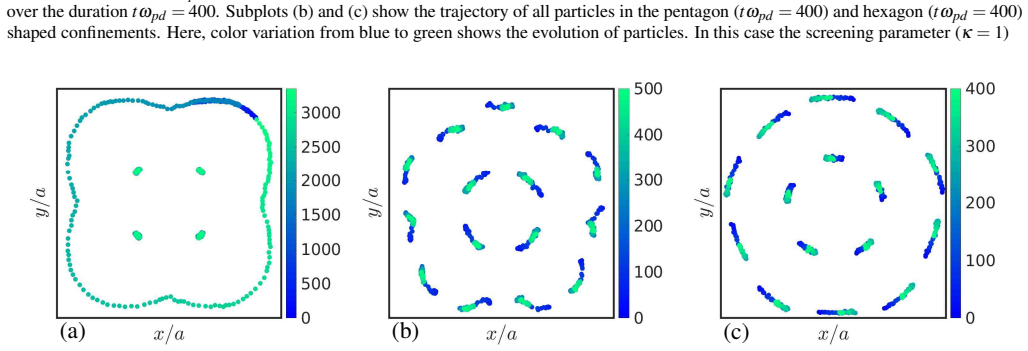
The green-colored spherical marker represents the formation of pentagonal structures corresp ond- ing to that NT , whereas the yellow cross symbol shows the missed pentagonal structures as earlier obtained in radial con- finement. It is also summarised in Table II for different con- finement boundaries. It is clear that in these cases too the formation of a...
Show all 50 references
-
[9]
Y . Feng, J. Goree, and B. Liu, Physical Review E 85, 066402 (2012)
2012
-
[10]
Singh Dharodi, S
V . Singh Dharodi, S. Kumar Tiwari, and A. Das, Physics of Plasmas 21 (2014)
2014
-
[11]
Nosenko, S
V . Nosenko, S. Zhdanov, A. Ivlev, G. Morfill, J. Goree, and A. Piel, Physical review letters 100, 025003 (2008)
2008
-
[12]
Nunomura, D
S. Nunomura, D. Samsonov, S. Zhdanov, and G. Morfill, Phys- ical review letters 95, 025003 (2005)
2005
-
[13]
Liu and J
B. Liu and J. Goree, Physical review letters 100, 055003 (2008)
2008
-
[14]
Merlino, A
R. Merlino, A. Barkan, C. Thompson, and N. D’angelo, Physics of Plasmas 5, 1607 (1998)
1998
-
[15]
S. K. Tiwari, A. Das, D. Angom, B. G. Patel, and P . Kaw, Physics of Plasmas 19 (2012)
2012
-
[16]
Das and P
A. Das and P . Kaw, Physics of Plasmas 21 (2014)
2014
-
[17]
V . S. Dharodi, B. Patel, and A. Das, Journal of Plasma Physics 88, 905880103 (2022)
2022
-
[18]
V eeresha, A
B. V eeresha, A. Das, and A. Sen, Physics of plasmas 12 (2005)
2005
-
[19]
Kumar, B
S. Kumar, B. Patel, and A. Das, Physics of Plasmas 25 (2018)
2018
-
[20]
A. Das, S. K. Tiwari, P . Kaw, and A. Sen, Physics of Plasmas 21 (2014)
2014
-
[21]
Kumar, S
S. Kumar, S. K. Tiwari, and A. Das, Physics of Plasmas 24 (2017)
2017
-
[22]
Kaw and A
P . Kaw and A. Sen, Physics of Plasmas 5, 3552 (1998)
1998
-
[23]
Kaw, Physics of Plasmas8, 1870 (2001)
P . Kaw, Physics of Plasmas8, 1870 (2001)
2001
-
[24]
Ivlev and G
A. Ivlev and G. Morfill, Physical Review E 63, 016409 (2000)
2000
-
[25]
H. M. Thomas and G. E. Morfill, Nature 379, 806 (1996)
1996
-
[26]
Melzer, A
A. Melzer, A. Homann, and A. Piel, Physical Review E 53, 2757 (1996)
1996
-
[27]
Melzer, V
A. Melzer, V . Schweigert, I. Schweigert, A. Homann, S. Peters, and A. Piel, Physical Review E 54, R46 (1996)
1996
-
[28]
Maity and A
S. Maity and A. Das, Physics of Plasmas 26 (2019)
2019
-
[29]
Schweigert, I
V . Schweigert, I. Schweigert, A. Melzer, A. Homann, and A. Piel, Physical review letters 80, 5345 (1998)
1998
-
[30]
Teng, M.-C
L.-W. Teng, M.-C. Chang, Y .-P . Tseng, and I. Lin, Physical review letters 103, 245005 (2009)
2009
-
[31]
Maity, A
S. Maity, A. Das, S. Kumar, and S. K. Tiwari, Physics of Plas- mas 25 (2018)
2018
-
[32]
Maity, P
S. Maity, P . Deshwal, M. Yadav, and A. Das, Physical Review E 102, 023213 (2020)
2020
-
[33]
Deshwal, M
P . Deshwal, M. Yadav, C. Prasad, S. Sridev, Y . Ahuja, S. Maity, and A. Das, Chaos: An Interdisciplinary Journal of Nonlinea r Science 32 (2022)
2022
-
[34]
Robicheaux and J
F. Robicheaux and J. D. Hanson, Physical review letters 88, 055002 (2002)
2002
-
[35]
T. Pohl, T. Pattard, and J. M. Rost, Physical Review A 70, 033416 (2004)
2004
-
[36]
S. Laha, P . Gupta, C. Simien, H. Gao, J. Castro, T. Pohl, and T. Killian, Physical review letters 99, 155001 (2007)
2007
-
[37]
Killian, M
T. Killian, M. Lim, S. Kulin, R. Dumke, S. Bergeson, and S. Rolston, Physical review letters 86, 3759 (2001)
2001
-
[38]
Yadav, P
M. Yadav, P . Deshwal, S. Maity, and A. Das, Physical Review E 107, 055214 (2023)
2023
-
[39]
Yadav, A
M. Yadav, A. S. Katariya, A. Sharma, and A. Das, Physica D: Nonlinear Phenomena 469, 134326 (2024)
2024
-
[40]
V an Horn, Science 252, 384 (1991)
H. V an Horn, Science 252, 384 (1991)
1991
-
[41]
Plimpton, Journal of computational physics 117, 1 (1995)
S. Plimpton, Journal of computational physics 117, 1 (1995)
1995
-
[42]
Nosenko and J
V . Nosenko and J. Goree, Physical review letters 93, 155004 (2004)
2004
-
[43]
P . K. Shukla and A. Mamun, Introduction to dusty plasma physics (CRC press, 2015)
2015
-
[44]
Nosé, Molecular physics 52, 255 (1984)
S. Nosé, Molecular physics 52, 255 (1984)
1984
-
[45]
W. G. Hoover, Phys. Rev. A 31, 1695 (1985)
1985
-
[46]
D. L. Caspar and E. Fontano, Proceedings of the National Academy of Sciences 93, 14271 (1996)
1996
-
[47]
H. L. Zhuang, Computational Materials Science 159, 448 (2019)
2019
-
[48]
R. Ding, D. Schattschneider, and T. Zamfirescu, Discrete Mat h- ematics 221, 113 (2000)
2000
-
[49]
Marcone, W
J. Marcone, W. Chaâbani, C. Goldmann, M. Impéror-Clerc, D. Constantin, and C. Hamon, Nano Letters 23, 1337 (2023)
2023
-
[50]
Cerisier, Physics of Fluids A: Fluid Dynamics3, 2061 (1991)
P . Cerisier, Physics of Fluids A: Fluid Dynamics3, 2061 (1991)
1991
Reviewed August 10, 2026 · model on record in the stance chip above.
Discussion (0). Continue with ORCID to comment.