REVIEW 3 major objections 6 minor 83 references
Accretion-Induced Collapse of Dark Matter Admixed White Dwarfs -- I: Formation of Low-mass Neutron Stars
T0 review · 3 major / 6 minor · reviewed 2026-08-14 · deepseek-v4-flash
Pith's one-line read The paper argues that a compact dark matter core embedded in a white dwarf can alter accretion-induced collapse enough to form neutron stars with masses down to about 1.0 solar masses.
desk verdict First dynamical collapse simulation of DM-admixed white dwarfs, with a plausible central trend, but the static DM core approximation is load-bearing and contradicted by the paper's own Figure 5. read the letter →
The pith
A machine-rendered reading of the paper's core claim, the machinery that carries it, and where it could break.
The reading
What carries the argument
The load-bearing object is a white dwarf in hydrostatic equilibrium built from two fluids: ordinary baryonic matter described by the SFHo, HShen, or LS220 equation of state, and a compact dark matter core modeled as an ideal degenerate Fermi gas of 1 GeV particles. The dark matter is not evolved dynamically; it enters only as a static source of gravity in an approximate Tolman-Oppenheimer-Volkoff gravity solver, while collapse is triggered by a parameterized electron-capture prescription that lowers the electron fraction and pressure. The mechanism that reduces the neutron star mass is that the dark matter's gravity hollows out and redistributes the baryonic density profile, making the inner electron-capture region smaller and slowing infall, so a smaller baryonic core compresses to nuclear density and forms the proto-neutron star.
What would settle it
Run the same initial models in a two-fluid hydrodynamic simulation in which the dark matter core is evolved with its own pressure and gravity instead of being held fixed; if the 0.06-solar-mass model still collapses, or if proto-neutron star mass no longer falls monotonically with dark matter mass, the central claim is refuted.
Extended reading notes
Core claim
The central claim is that the mass of a neutron star formed by accretion-induced collapse is set not only by the white dwarf's baryonic structure but also by how much dark matter sits in its core. For a fixed initial central baryon density, adding a static, compact dark matter core of up to 0.05 solar masses progressively slows the collapse and lowers the proto-neutron star mass from roughly 1.35 down to about 1.0 solar masses; with 0.06 solar masses of dark matter the white dwarf fails to collapse. The paper identifies the low-mass pulsar J0453+1559 as a candidate product of this channel, requiring at most about 0.02 solar masses of admixed dark matter in its progenitor, and argues that the trend is stable under changes to the equation of state, initial temperature profile, electron-capture scheme, and the choice of Newtonian versus approximate general-relativistic gravity. The dark matter is modeled as an ideal degenerate Fermi gas of 1 GeV particles and is held fixed as a gravitational source while only baryonic matter moves.
Load-bearing premise
The central trend rests on treating the dark matter core as a static gravitational anchor while baryonic matter collapses; if the core responds dynamically during the collapse, the simulated neutron star masses and the inferred dark matter content of J0453+1559 would change.
Editorial extensions
If this is right
- A white dwarf containing roughly 0.01 to 0.02 solar masses of dark matter can collapse to a neutron star near the mass of the low-mass pulsar J0453+1559.
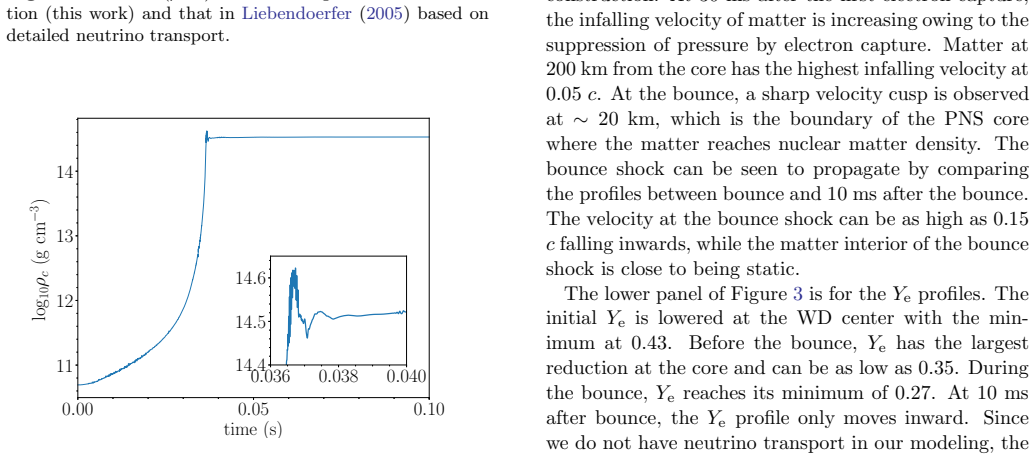
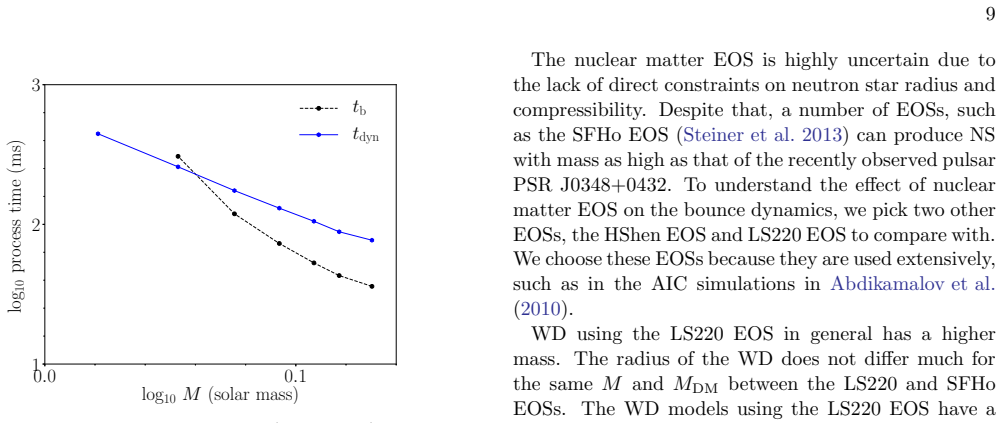
- Dark matter mass of about 0.05 solar masses delays bounce from tens to hundreds of milliseconds, and about 0.06 solar masses prevents collapse altogether.
- The mass-lowering trend persists for two nuclear equations of state, two initial temperature profiles, two electron-capture parametrizations, and for both Newtonian and approximate general-relativistic gravity, with changes at the ten percent level.
- Because accretion-induced collapse ejects little mass, the proto-neutron star mass is a good proxy for the final neutron star mass, so the predicted low masses should survive to the present day.
Reading between the lines
- A two-fluid simulation that lets the dark matter core move and contract would test the static-core approximation; the paper itself identifies a brief phase when baryonic and dark matter densities are comparable, so the final masses could shift if the core responds during that phase.
- The same mechanism could alter other white-dwarf outcomes: a dark matter core that lowers the Chandrasekhar mass would also weaken Type Ia supernova explosions, potentially connecting the low-mass neutron star population to observed underluminous supernovae.
- If this channel operates, low-mass neutron stars should be more common in dark-matter-rich environments, and their binary mergers would contribute a distinct low-mass component to gravitational-wave source populations.
Signed reviews
Editorial analysis
A structured set of objections, weighed in public.
Referee Report
Summary. The paper investigates whether accretion-induced collapse (AIC) of a white dwarf containing a compact dark-matter core can produce low-mass neutron stars. Using one-dimensional hydrodynamics with the SFHo, LS220, and HShen equations of state, a TOV-type gravity solver, and a parametrized electron-capture scheme, the authors construct hydrostatic initial models with a fixed central baryon density and admixed degenerate Fermi-gas dark matter masses up to 0.06 solar masses. They find that increasing the dark matter mass delays collapse (bounce time growing from about 40 ms to about 300 ms), lowers the maximum central density, and reduces the proto-neutron-star mass, while a model with 0.06 solar masses of dark matter fails to collapse. They compare the resulting gravitational masses with low-mass pulsars and conclude that J0453+1559 can be explained by an initial white dwarf containing roughly 0.01 to 0.02 solar masses of dark matter.
Significance. If correct, this is an interesting and timely mechanism for populating the low-mass neutron-star branch below 1.2 solar masses, complementing electron-capture supernova channels. The paper appears to be the first hydrodynamic AIC calculation with an admixed dark-matter core, and it includes useful robustness checks spanning two nuclear equations of state, two electron-capture parameterizations, a temperature profile comparison, a Newtonian-gravity comparison, and a resolution test. The qualitative trend, namely that more dark matter gives a slower collapse and a lower proto-neutron-star mass, is consistent across those variations. The quantitative application to J0453+1559, however, rests on the static-dark-matter-core approximation and on mass definitions that are not fully transparent.
major comments (3)
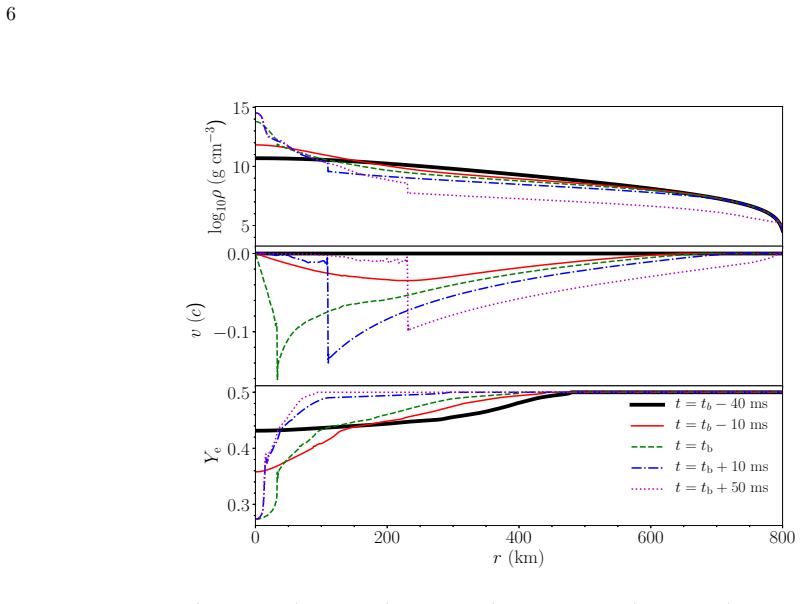
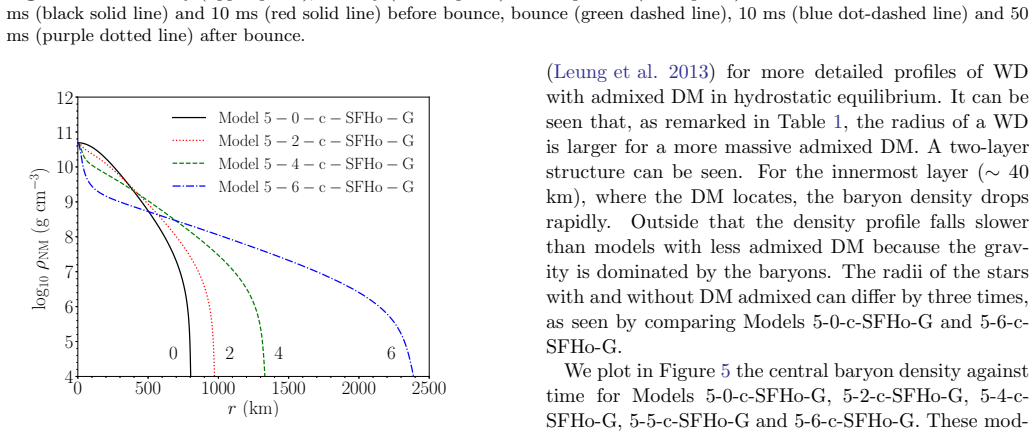
- [Section 2.1, Fig. 5, Table 1] The claim that baryonic and dark matter densities are comparable for only '<10^-4 s' is not supported by the paper's own data. For the benchmark model the central baryon density rises from about 5e10 to about 3e14 g/cc over roughly 40 ms, crossing the dark matter central densities listed in Table 1 (2.6e11 to 3.1e12 g/cc) over several milliseconds, and for the slow-collapse 5-5 model this interval is longer. The dark matter core dynamical time, sqrt(R_DM^3/G M_DM), is roughly 3 to 7 ms for R_DM around 40 km and M_DM = 0.01 to 0.06 solar masses, which is comparable to the infall and bounce phases. Because Eq. (5) feeds a fixed dark matter distribution into the gravity solver, any contraction or rearrangement of the dark matter core during the collapse would change the bounce time, the maximum density, and the proto-neutron-star mass that are later matched to observations. The static-core approximation is therefore load-bearing and requires either a dynamical dark matter treatment or a quantitative estimate of the error it introduces.
- [Table 1 and Fig. 11] The proto-neutron-star mass MNS is defined in the table header but is never listed in the table, so the central quantitative claim that proto-neutron-star masses drop to about 1.0 solar masses cannot be checked from the tabulated models. In addition, Section 4.1 applies Eq. (11) to 'the total mass' M of the initial model to obtain the gravitational mass plotted in Fig. 11, but M includes the dark matter mass and is not the baryonic mass of the nascent neutron star. The conversion should instead be applied to the baryonic mass of the proto-neutron star, or the use of the initial total mass should be explicitly justified, and the resulting Mgrav values should be tabulated together with MNS.
- [Section 2.3 and Section 3.3.3] The default electron-capture relation Ybar_e(rho) is taken from the no-dark-matter benchmark model and then applied to all dark-matter-admixed runs. Because the dark matter changes the collapse trajectory and the thermal structure, the assumption that the capture history is unchanged should be tested, for example by recomputing the collapse with an alternative capture law derived from a dark-matter-modified background or by demonstrating explicitly that the Liebendoerfer05 scheme gives the same proto-neutron-star mass trend. Without this check, the quantitative MNS versus M_DM relation used for J0453+1559 is not fully independent of the no-dark-matter benchmark input.
minor comments (6)
- [Section 2.3, Eq. (7)] The definition dYe/dt = (Ybar_e - Ye)/delta_t looks like a numerical relaxation rather than a physical rate; please clarify the limiting behavior and whether delta_t is the hydrodynamic timestep.
- [Table 1] The table header lists MNS among the masses, but the table columns do not include MNS; either add the missing column or remove MNS from the header description.
- [Section 3.2, Eq. (10)] The fit tb = 1090 M^{-12} lacks error bars and a stated fitting range, and the units of the coefficient should be specified explicitly.
- [Section 4.1, Fig. 11] The phrase 'progenitor gravitational mass' is confusing because the figure is compared with final neutron-star masses; please define Mgrav explicitly in the text and caption.
- [Throughout] There are occasional typos and informal phrases, such as 'baronyic' in Section 4.2 and 'very very short duration' in Section 2.1, which should be cleaned up.
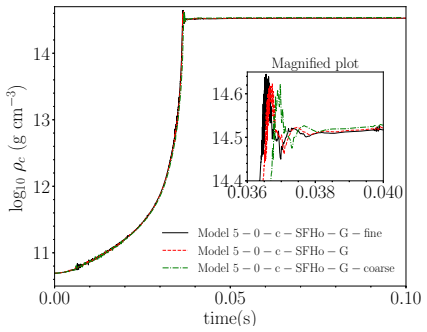
- [Fig. 5 and Fig. 6] The legend entries '0 2 4 5 6' are cryptic; using the model names or explicit M_DM values would make the figures much easier to read.
Circularity Check
No circular derivation: PNS masses and collapse delays are hydrodynamically computed outputs; DM mass is a free model parameter, not a fitted target.
full rationale
The paper's central result—that increasing admixed DM mass delays collapse and lowers the proto-neutron-star mass—is obtained from spherically symmetric hydrodynamics simulations with specified EOS, electron-capture parametrization, and hydrostatic initial models. The PNS mass is an output of the collapse calculation, not an input or a fitted quantity. The Ybar_e(rho) relation is calibrated on a no-DM GR1D benchmark and then applied to DM runs, but that is an input-physics approximation rather than a fitted prediction, and the paper checks it against the independent Liebendoerfer (2005) scheme; the qualitative trend survives that check, so the central claim does not reduce to the calibration. The comparison to J0453+1559 uses M_DM as a model parameter constrained by the observed mass, which is standard parameter inference rather than a circular 'prediction' of that mass. The main caveat is the static-DM-core approximation (Section 2.1): the DM is held fixed while baryons collapse, justified by a claimed <10^-4 s overlap that appears inconsistent with the collapse timescales in Figure 5 and Table 1. That is a physical robustness concern about the validity of the approximation, not a circularity of the derivation chain, and it does not make the PNS masses equal to inputs by construction. No load-bearing self-citation chain, imported uniqueness theorem, or ansatz-smuggled-by-citation was found; prior Leung et al. work provides background and initial-profile context, while the dynamical result is newly computed here and benchmarked against external codes (GR1D), EOSs, and the Liebendoerfer electron-capture scheme.
Assumptions & free parameters
free parameters (2)
- Admixed dark matter mass M_DM =
0.01 to 0.06 Msun; 0.02 Msun inferred for J0453+1559
- Dark matter particle mass m_DM =
1 GeV
assumptions (6)
- domain assumption Initial white dwarf with admixed dark matter is in hydrostatic equilibrium (Eqs. 1-3).
- domain assumption Dark matter behaves as an ideal degenerate Fermi gas with no self-annihilation.
- domain assumption Electron capture rate is a function of baryon density only through Ybar_e(rho), applied uniformly across the star.
- ad hoc to paper Dark matter core is static and does not dynamically respond to the baryonic collapse.
- domain assumption Spherical symmetry is adequate for the collapse and bounce dynamics.
- standard math The modified TOV gravity of Marek et al. (2006) approximates general relativity adequately.
Cite this review
Pith. "Pith review of Accretion-Induced Collapse of Dark Matter Admixed White Dwarfs -- I: Formation of Low-mass Neutron Stars." pith.science (2026). https://pith.science/paper/YDQHOLTC
@misc{pith2026190805102,
  author       = {Pith},
  title        = {Pith review of: Accretion-Induced Collapse of Dark Matter Admixed White Dwarfs -- I: Formation of Low-mass Neutron Stars},
  year         = {2026},
  howpublished = {\url{https://pith.science/paper/YDQHOLTC}},
  note         = {Machine review of arXiv:1908.05102}
}
abstract
Recently observed pulsars with masses $\sim 1.1 ~M_{\odot}$ challenge the conventional neutron star (NS) formation path by core-collapse supernova (CCSN). Using spherically symmetric hydrodynamics simulations, we follow the collapse of a massive white dwarf (WD) core triggered by electron capture, until the formation of a proto-NS (PNS). For initial WD models with the same central density, we study the effects of a static, compact dark matter (DM) admixed core on the collapse and bounce dynamics and mass of the PNS, with DM mass $\sim 0.01 ~M_{\odot}$. We show that increasing the admixed DM mass generally leads to slower collapse and smaller PNS mass, down to about 1.0 $M_{\odot}$. Our results suggest that the accretion-induced collapse of dark matter admixed white dwarfs can produce low-mass neutron stars, such as the observed low-mass pulsar J0453+1559, which cannot be obtained by conventional NS formation path by CCSN.
Figures

Figures from the paper (7 more)




Reference graph
Works this paper leans on
-
[1]
P., Abbott, R., Abbott, T
Abbott, B. P., Abbott, R., Abbott, T. D., et al. 2018, PhRvL, 121, 231103
2018
-
[2]
B., Ott, C
Abdikamalov, E. B., Ott, C. D., Rezzolla, L., et al. 2010, PhRvD, 81, 044012
2010
-
[3]
2015, Eur
Addazi, A., Berezhiani, Z., Bernabei, R., et al. 2015, Eur. Phys. J. C, 75, 400
2015
-
[4]
Akerib, D. S., Araujo, H. M., Bai, X., et al. 2013, PhRvL, 112, 091303 —. 2016, PhRvL, 116, 161302
work page 2013
-
[5]
Akerib, D. S., Alsum, S., Ara´ ujo, H. M., et al. 2018, PhRvD, 98, 062005
work page 2018
-
[6]
Antoniadis, J., Freire, P. C. C., Wex, N., et al. 2013, Science, 340, 448
2013
-
[7]
Aprile, E., Aalbers, J., Agostini, F., et al. 2016, PhRvD, 94 , 122001 —. 2017, PhRvL, 108, 101101
work page 2016
-
[8]
Aprile, E., Agostini, F., Alfonsi, M., et al. 2014, PhRvD, 90, 062009 12
work page 2014
Show all 83 references
-
[9]
2009, PhRvL, 105, 131302
Aprile, E., Arisaka, K., Arneodo, F., et al. 2009, PhRvL, 105, 131302
2009
-
[10]
2019, PhRvL, 122, 071301
Aprile, E., Aalbers, J., Agostini, F., et al. 2019, PhRvL, 122, 071301
2019
-
[11]
1987, ApJ, 320, 304
Baron, E., Cooperstein, J., Kahana, S., & Nomoto, K. 1987, ApJ, 320, 304
1987
-
[12]
C., & Delepine, D
Barranco, J., Monteverde, A. C., & Delepine, D. 2013, PhRvD, 87, 103011
2013
-
[13]
2008, MNRAS, 391, 942
Baumgardt, H., & Mieske, S. 2008, MNRAS, 391, 942
2008
-
[14]
2008, Eur
Bernabei, R., Belli, P., Cappella, F., et al. 2008, Eur. Phys . J., C56, 333 —. 2014, Nucl. Instru. and Methods in Phys. Research A, 742, 177
2008
-
[15]
2013, Int
Bernabei, R., Belli, P., D’Angelo, S., et al. 2013, Int. J. Mod. Phys. A, 28, 1330022
2013
-
[16]
2018, Classical and Quantum Gravity, 35, 234002
Bezares, M., & Palenzuela, C. 2018, Classical and Quantum Gravity, 35, 234002
2018
-
[17]
2015, PhRvL, 115, 111301
Brito, R., Cardoso, V., & Okawa, H. 2015, PhRvL, 115, 111301
2015
-
[18]
2019, MNRAS, 485, 2153
Burrows, A., Radice, D., & Vartanyan, D. 2019, MNRAS, 485, 2153
2019
-
[19]
1976, A&A, 46, 229
Canal, R., & Schatzman, E. 1976, A&A, 46, 229
1976
-
[20]
2009, ApJ, 705, 135 —
Casanellas, J., & Lopes, I. 2009, ApJ, 705, 135 —. 2011, ApJ, 733, L51 Cerme˜ no, M., P´ erez-Garc ´ ıa, M. A., & Lineros, R. A. 2018, ApJ, 863, 157
2009
-
[21]
2011, Physics Letters B, 695, 19
Ciarcelluti, P., & Sandin, F. 2011, Physics Letters B, 695, 19
2011
-
[22]
Clough, K., Dietrich, T., & Niemeyer, J. C. 2018, PhRvD, 98, 083020
2018
-
[23]
D., Quataert, E., et al
Darbha, S., Metzger, B. D., Quataert, E., et al. 2010, MNRAS, 409, 846
2010
-
[24]
2007, ApJ, 669, 585
Dessart, L., Burrows, A., Livne, E., et al. 2007, ApJ, 669, 585
2007
-
[25]
2006, ApJ, 644, 1063
Dessart, L., Burrows, A., Ott, C., et al. 2006, ApJ, 644, 1063
2006
-
[26]
I., & Pethick, C
Epstein, R. I., & Pethick, C. J. 1981, ApJ, 243, 1003
1981
-
[27]
Feng, J. L. 2010, ARA&A, 48, 495
2010
-
[28]
D., Stairs, I
Ferdman, R. D., Stairs, I. H., Kramer, M., et al. 2014, MNRAS, 443, 2183
2014
-
[29]
Foot, R., Lew, H., & Volkas, R. R. 1991, Physics Letters B, 272, 67
1991
-
[30]
T., Kahlhoefer, F., March-Russell, J., et al
Frandsen, M. T., Kahlhoefer, F., March-Russell, J., et al. 2011, PhRvD, 84, 041301
2011
-
[31]
T., & Sarkar, S
Frandsen, M. T., & Sarkar, S. 2010, PhRvL, 105, 011301
2010
-
[32]
2008, ApJ, 685, L101
Freese, K., Bodenheimer, P., Spolyar, D., & Gondolo, P. 2008, ApJ, 685, L101
2008
-
[33]
2016, Reports on Progress in Physics, 79, 066902
Freese, K., Rindler-Daller, T., Spolyar, D., & Valluri, M. 2016, Reports on Progress in Physics, 79, 066902
2016
-
[34]
2009, New J
Freese, K., Spolyar, D., Bodenheimer, P., & Gondolo, P. 2009, New J. Phys., 11, 105014
2009
-
[35]
Freire, P. C. C., & Tauris, T. M. 2014, MNRAS, 438, L86
2014
-
[36]
D., & Nielsen, H
Froggatt, C. D., & Nielsen, H. B. 2015, Phys. Lett. A, 30, 1550195
2015
-
[37]
Fuller, J., & Ott, C. D. 2015, MNRAS, 450, L71
2015
-
[38]
1989, PhRvD, 40, 3221
Goldman, I., & Nussinov, S. 1989, PhRvD, 40, 3221
1989
-
[39]
W., Rajendran, S., & Varela, J
Graham, P. W., Rajendran, S., & Varela, J. 2015, PhRvD, 92, 063007
2015
-
[40]
J., Zentner, A
Hurst, T. J., Zentner, A. R., Natarajan, A., & Badenes, C. 2015, PhRvD, 91, 103514
2015
-
[41]
2015, PhRvD, 91, 023008
Iwazaki, A. 2015, PhRvD, 91, 023008
2015
-
[42]
L., Dunkley, J., et al
Jarosik, N., Bennett, C. L., Dunkley, J., et al. 2011, ApJS, 192, 14
2011
-
[43]
2008, PhRvD, 77, 023006
Kouvaris, C. 2008, PhRvD, 77, 023006
2008
-
[44]
Kouvaris, C., & Nielsen, N. G. 2015, PhRvD, 92, 075016
2015
-
[45]
M., & Douglas Swesty, F
Lattimer, J. M., & Douglas Swesty, F. 1991, Nuclear Physics A, 535, 331
1991
-
[46]
M., & Prakash, M
Lattimer, J. M., & Prakash, M. 2001, ApJ, 550, 426
2001
-
[47]
2011, PhRvD, 84, 107301 —
Leung, S.-C., Chu, M.-C., & Lin, L.-M. 2011, PhRvD, 84, 107301 —. 2012, PhRvD, 85, 103528 —. 2015a, ApJ, 812, 110 —. 2015b, MNRAS, 454, 1238
2011
-
[48]
2013, PhRvD, 87, 123506
Leung, S.-C., Chu, M.-C., Lin, L.-M., & Wong, K.-W. 2013, PhRvD, 87, 123506
2013
-
[49]
2017, Mem
Leung, S.-C., & Nomoto, K. 2017, Mem. della Soc. Astron. Ital., 88, 266
2017
-
[50]
2018, ApJ, 861, 143 —
Leung, S.-C., & Nomoto, K. 2018, ApJ, 861, 143 —. 2019, PASA, 36, e006
2018
-
[51]
2005, ApJ, 633, 1042
Liebendoerfer, M. 2005, ApJ, 633, 1042
2005
-
[52]
S., Freire, P
Lynch, R. S., Freire, P. C. C., Ransom, S. M., & Jacoby, B. A. 2012, ApJ, 745, 109
2012
-
[53]
G., Stovall, K., Freire, P
Martinez, J. G., Stovall, K., Freire, P. C. C., et al. 2015, ApJ, 812, 143
2015
-
[54]
2007, Nature, 445, 286
Massey, R., Rhodes, J., Ellis, R., et al. 2007, Nature, 445, 286
2007
-
[55]
Mayle, R., & Wilson, J. R. 1988, ApJ, 334, 909
1988
- [56]
-
[57]
V., & Wai, L
Moskalenko, I. V., & Wai, L. L. 2007, ApJ, 659, L29
2007
-
[58]
Narain, G., Schaffner-Bielich, J., & Mishustin, I. N. 2006, PhRvD, 74, 063003 N¨ attil¨ a, J., Steiner, A. W., Kajava, J. J. E., Suleimanov, V. F., & Poutanen, J. 2016, A&A, 591, A25
2006
-
[59]
1991, ApJ, 367, L19 13
Nomoto, K., & Kondo, Y. 1991, ApJ, 367, L19 13
1991
-
[60]
1982, ApJ, 257, 780 O’Connor, E., & Ott, C
Nomoto, K., Thielemann, F.-K., & Yokoi, K. 1982, ApJ, 257, 780 O’Connor, E., & Ott, C. D. 2010, Classical and Quantum Gravity, 27, 114103 Okun’, L. B. 2007, Physics Uspekhi, 50, 380
1982
-
[61]
D., & Quinn, H
Peccei, R. D., & Quinn, H. R. 1977, PhRvL, 38, 1440
1977
-
[62]
1999, ApJ, 517, 565
Perlmutter, S., Aldering, G., Goldhaber, G., et al. 1999, ApJ, 517, 565
1999
-
[63]
2016, PhRvD, 94, 103004
Raby, S. 2016, PhRvD, 94, 103004
2016
-
[64]
2018, International Journal of Modern Physics D, 27, 1950002
Rezaei, Z. 2018, International Journal of Modern Physics D, 27, 1950002
2018
-
[65]
G., Filippenko, A
Riess, A. G., Filippenko, A. V., Challis, P., et al. 1998, ApJ, 116, 1009
1998
-
[66]
2007, MNRAS, 378, 41
Salucci, P., Lapi, A., Tonini, C., et al. 2007, MNRAS, 378, 41
2007
-
[67]
2010, Astropart
Sandin, F., & Ciarcelluti, P. 2010, Astropart. Phys., 32, 27 8
2010
-
[68]
2010, ApJ, 719, 722
Schwab, J., Podsaidlowski, P., & Rappaport, S. 2010, ApJ, 719, 722
2010
-
[69]
2015, MNRAS, 453, 1910
Schwab, J., Quataert, E., & Bildsten, L. 2015, MNRAS, 453, 1910
2015
-
[70]
2009, MNRAS, 394, 82
Scott, P., Fairbairn, M., & Edsjo, J. 2009, MNRAS, 394, 82
2009
-
[71]
1998, Nucl
Shen, H., Toki, H., Oyamatsu, K., & Sumiyoshi, K. 1998, Nucl. Phys. A, 637, 435
1998
-
[72]
2011, ApJS, 197, 20
Shen, H., Toki, H., Oyamatsu, K., & Sumiyoshi, K. 2011, ApJS, 197, 20
2011
-
[73]
2009, ApJ, 705, 1031
Spolyar, D., Bodenheimer, P., Freese, K., & Gondolo, P. 2009, ApJ, 705, 1031
2009
-
[74]
2005, MNRAS, 364, 1005
Springel, V. 2005, MNRAS, 364, 1005
2005
-
[75]
Springel, V., White, S. D. M., Jenkins, A., et al. 2005, Nature, 435, 629
2005
-
[76]
W., Hempel, M., & Fischer, T
Steiner, A. W., Hempel, M., & Fischer, T. 2013, ApJ, 774, 17
2013
-
[77]
2016, ApJ, 821, 38
Janka, H.-T. 2016, ApJ, 821, 38
2016
-
[78]
2018, MNRAS, 481, 3305
Takahashi, K. 2018, MNRAS, 481, 3305
2018
-
[79]
2013, ApJ, 771, 28
Takahashi, K., Yoshida, T., Umeda, H., et al. 2013, ApJ, 771, 28
2013
-
[80]
2015, PhRvD, 92, 123002
Tolos, L., & Schaffner-Bielich, J. 2015, PhRvD, 92, 123002
2015
-
[81]
E., & Baron, E
Woosley, S. E., & Baron, E. 1992, ApJ, 391, 228
1992
-
[82]
Yi, I., & Blackman, E. G. 1998, ApJ, 494, L163
1998
-
[83]
R., & Hearin, A
Zentner, A. R., & Hearin, A. P. 2011, PhRvD, 84, 101302 14
2011
Reviewed August 14, 2026 · model on record in the stance chip above.
Discussion (0). Continue with ORCID to comment.