REVIEW 3 major objections 5 minor 21 references
Timing-Based Search for Magnetic Monopoles with the NOvA Detector on the Surface
T0 review · 3 major / 5 minor · reviewed 2026-08-05 · deepseek-v4-flash
Pith's one-line read After 2,743 live days, the NOvA detector found no slow magnetic monopoles and set the first flux limit for monopole masses below 10^10 GeV.
desk verdict A clean null result with a new exclusion limit in an unexplored mass-speed region; the only real soft spot is the unquantified dE/dx model systematic. read the letter →
The pith
A machine-rendered reading of the paper's core claim, the machinery that carries it, and where it could break.
The reading
What carries the argument
The timing-based trigger plus offline straight-slow-track selection. NOvA's data-driven trigger continuously digitizes each scintillator cell at 2 MHz and retains pairs of hits within 2 µs in neighboring planes that define a 3D position near the detector surface; track seeds with a 2D speed between 10^-4.4 and 10^-2.3 β are then checked for hits lying on a 20-cell-wide road with no large gaps, writing out events containing a candidate slow track. Offline, the Hough transform reconstructs straight lines in the remaining hits, and six selection requirements — hit counts, plane counts, length, speed, straightness (r^2_min), and time-gap fraction (f_max) — separate a genuine monopole from cosmic
What would settle it
A measurement of NOvA's liquid scintillator response to a slow (beta ~ 10^-3), singly charged, heavily ionizing particle — e.g., a slow heavy-ion beam through a detector cell or a tagged slow cosmic-ray coincidence — that shows the light yield is substantially below 90% of the Geant4 dE/dx value would invalidate the efficiency estimate and therefore the flux limit; conversely, a future candidate event with a straight, slow track passing all six selections would overturn the null result.
Extended reading notes
Core claim
The paper establishes that in a 2.37×10^8 second (2,743-day) exposure of the NOvA Far Detector, no event passes the selection criteria designed to identify a magnetic monopole: a straight track with at least 20 hits in each of two views, crossing at least 10 planes, with a reconstructed length of at least 10 m, a speed below 0.01 c, a linear-correlation coefficient r^2_min ≥ 0.95, and a largest-time-gap fraction f_max ≤ 0.2. With an overall trigger-plus-analysis efficiency of 81% for beta = 10^-3 monopoles that cross at least 10 m of the detector, the null observation translates to a 90% C.L. upper limit on the monopole flux of 8×10^-16 cm^-2 s^-1 sr^-1 for 6×10^-4 < beta < 5×10^-3 and mass
Load-bearing premise
The quoted limit assumes the simulated energy-loss model — a single Dirac unit of charge depositing 90% of the nominal Geant4 dE/dx in straight tracks with no stopping — matches how a real slow monopole lights up the detector; if a real monopole deposits less light, the trigger and selections would miss it and the limit would be too strong.
Editorial extensions
If this is right
- For monopole masses above 10^9 GeV and speeds between 6×10^-4 and 5×10^-3 c, the cosmic-ray monopole flux is now bounded by 8×10^-16 cm^-2 s^-1 sr^-1 at 90% C.L., the first limit to cover this low-mass slow-speed region.
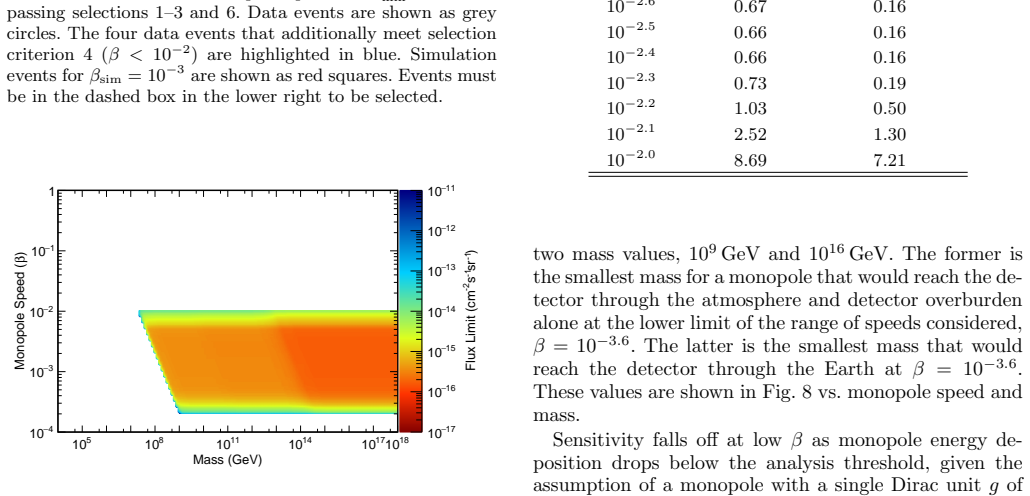
- The 90% C.L. upper limit for the 10^9 GeV mass threshold is roughly 2–8×10^-15 cm^-2 s^-1 sr^-1 across the full 10^-3.6 to 10^-2 β range, worsening at the edges where energy deposition falls below threshold or the trigger acceptance drops.
- Since the detector continues to take data, the same trigger and selection can extend this limit to lower flux values with more live time, roughly inversely with exposure.
- The analysis shows the dominant background — two speed-of-light muons faking a slow track — is suppressed with an estimated probability below 10^-6 over the full run, so the null observation is not limited by background confusion.
Reading between the lines
- If the energy-loss model used here is too optimistic, the real limit could be weaker: a slow monopole that scintillates at, say, half the assumed rate would fall below the trigger's hit threshold at the low-β end, so the quoted 8×10^-16 limit would not bound such particles. The detector gain increase mentioned in the paper relative to the 95-day run partially mitigates this, but the model remains
- The same technique could be applied to the NOvA Near Detector or other surface liquid-scintillator arrays; with a comparable overburden and readout, they could cross-check this limit and, if operated for longer, push it below 10^-16.
- The timing-based approach avoids assuming proton-decay catalysis or ultrarelativistic monopoles, so it complements IceCube's and ANTARES' limits in the same speed range; combining the two bounds could constrain the monopole flux more strongly than either alone, especially if the low-mass window is populated by a relic monopole component.
- A dedicated slow-ion calibration source (e.g., a slowly moving radioactive source or a heavy-ion beam in a cell) could directly measure the scintillator's response at beta ~ 10^-3 and turn the efficiency's weakest assumption into a measured quantity.
Editorial analysis
A structured set of objections, weighed in public.
Referee Report
Summary. The paper reports a search for a slow cosmic-ray magnetic-monopole component using the NOvA Far Detector over a 2743-live-day exposure. Simulated monopoles with a single Dirac charge and Groom dE/dx (scaled to 90% of the Geant4 value) are overlaid on zero-bias data to define trigger and offline efficiencies. A timing-based trigger and offline selections on track speed, straightness (r2_min), and time-gap fraction (f_max) yield zero candidate events. The 90% C.L. flux upper limit is quoted as 8e-16 cm^-2 s^-1 sr^-1 for 6e-4 < beta < 5e-3 and mass > 1e9 GeV, with a separate 4pi-coverage limit for m > 1e16 GeV. Backgrounds from coincident two-muon events are studied and estimated to be negligible.
Significance. If the quoted limit is robust, the result is valuable: it provides the best constraint around beta ~ 1e-3 for monopoles below 1e10 GeV, a region not covered by MACRO, SLIM, or IceCube. The analysis has several genuine strengths: a pre-unblinding check on a small excluded sample, Monte Carlo overlay on zero-bias data rather than pure simulation, a dedicated two-muon background study, and an explicit livetime correction. No parameters are fitted to the observed candidate distribution. The main caveat is that the conversion from a null observation to a flux limit hinges on an assumed energy-loss model with no propagated systematic; the paper must quantify that sensitivity before the central number can be taken at face value. The novelty wording also needs to be calibrated with respect to the earlier 95-day NOvA search [12].
major comments (3)
- [Sec. II and Sec. VI] The quoted flux limit is computed from Phi90 = 2.3/L with L = Omega*epsilon*A*t (Sec. VI), and epsilon is taken from the simulation described in Sec. II. That simulation assumes a single Dirac charge and Groom dE/dx in Geant4, scaled to 90% of nominal; no uncertainty is propagated for this model, and no independent low-beta energy-loss implementation is compared. Sec. VII states that sensitivity falls off at low beta as deposition drops below threshold, so epsilon is steep near the lower edge of the claimed window. A downward shift in the assumed dE/dx would move that edge upward and weaken the limit. Please add a quantitative systematic (e.g., varying the normalization and comparing implementations) and report epsilon per beta point with its uncertainty.
- [Abstract, Sec. I, Sec. VII] The abstract and conclusion describe the low-mass region as 'previously unexplored,' but Ref. [12] is a previous NOvA search using this same detector and analysis concept with a 95-live-day exposure. The present work is an important extension in exposure and updated analysis, but it should be positioned as a substantially improved constraint, not as the first exploration of this speed-mass region. Please revise the novelty statements or explicitly quantify the improvement relative to [12].
- [Sec. III and Sec. VI] The three running periods in Sec. III have different trigger configuration parameters, and period III checks every track seed rather than every fourth. Section VI quotes a single 81% overall efficiency and a single 92.92% livetime correction. If the acceptance changes with period or with the detector gain increase, the exposure integral should use a live-time-weighted period-averaged efficiency. Please state whether the Monte Carlo overlay reproduced each period's zero-bias conditions and give per-period efficiencies or a quantitative demonstration that variations are negligible.
minor comments (5)
- [Sec. V] The dedicated two-muon background simulation is reported only as 'all rejected' with a Poisson estimate <1e-6. Please state the number of generated muon pairs and the corresponding statistical coverage; this would make the background statement reproducible.
- [Sec. VI] The relationship between 'good data for 2.55e8 s' and the corrected live time 2.37e8 s should be stated in one place; currently the 92.92% trigger livetime efficiency appears only in the surrounding text. A single explicit equation or sentence would remove ambiguity.
- [Sec. VI] The 1pi vs 4pi coverage scenarios differ by a factor of about four in the limits, but the text does not define why partial coverage is 1pi rather than a full downward hemisphere. A short geometric explanation of the 1pi solid angle would clarify the mass-dependent acceptance.
- [Fig. 8] The axis labels in Fig. 8 are garbled in the provided text ('5 108 1011 ... Mass (GeV)'), presumably a typesetting artifact. The final version should ensure the math rendering is correct and legible.
- [Sec. II] Please clarify whether '90% of the nominal Geant4 dE/dx value' applies to energy deposit or to detected light, and whether the same scaling is used for all beta values and all cells. This will make the simulation description self-contained rather than requiring the reader to retrieve [12].
Circularity Check
No circular reduction; flux limit rests on external dE/dx physics and observed null data. Score reflects non-load-bearing self-citation to prior NOvA analysis, not circularity.
full rationale
The derivation chain is: (i) external physics inputs—Groom's dE/dx parameterization [6] and Geant4—set the energy deposition; (ii) the NOvA trigger and offline selection, fully described in Secs. III and IV, convert that to detection efficiency; (iii) the 2743-live-day null observation (Sec. VI) yields the upper limit via Φ_90 = 2.3/L with L = ΩεAt. No parameter is fitted to the observed candidates: the 90% dE/dx scale factor and the hand-chosen cuts are stated assumptions, not outputs matched to data. The citations to prior NOvA papers [12,14,15] supply implementation details (previous simulation setup, acceptance description, technical design), but the physics input is external (Groom, Geant4), and the central limit is not used to define those inputs. The skeptic's concern about the low-β dE/dx normalization and lack of a propagated systematic is a model/statistical systematic risk, not a circular reduction: the quoted limit is conditional on the stated energy-loss model, and no equation makes the limit equal to the 90% scale or to any fitted parameter. Thus there is no circular step; the score reflects the presence of a self-citation [12] that is relevant to the simulation but not load-bearing in a circular sense.
Assumptions & free parameters
free parameters (4)
- dE/dx scale factor =
0.9
- r2_min selection threshold =
0.95
- f_max selection threshold =
0.2
- Reconstructed speed upper cut =
0.01
assumptions (5)
- domain assumption Monopoles carry a single Dirac unit of magnetic charge g and lose energy according to the model of Groom [6] as implemented in Geant4.
- domain assumption Monopoles travel in straight lines and do not stop inside the detector.
- domain assumption The incident monopole flux is isotropic over the detector's acceptance.
- domain assumption The NOvA detector response simulation and zero-bias data overlay correctly model trigger and reconstruction efficiency.
- domain assumption The remaining background after all selections is negligible.
Cite this review
Pith. "Pith review of Timing-Based Search for Magnetic Monopoles with the NOvA Detector on the Surface." pith.science (2026). https://pith.science/paper/YDSAWPQH
@misc{pith2026260803888,
  author       = {Pith},
  title        = {Pith review of: Timing-Based Search for Magnetic Monopoles with the NOvA Detector on the Surface},
  year         = {2026},
  howpublished = {\url{https://pith.science/paper/YDSAWPQH}},
  note         = {Machine review of arXiv:2608.03888}
}
abstract
We report a search for a magnetic monopole component of the cosmic-ray flux in a 2743-live-day exposure of the NOvA experiment's Far Detector, a 14 kt segmented liquid scintillator detector designed primarily to observe GeV-scale electron neutrinos. No events consistent with monopoles were observed, setting an upper limit on the flux of $8\times 10^{-16}~\mathrm{cm^{-2}s^{-1}sr^{-1}}$ at 90% C.L. for monopole speed $6\times 10^{-4} < \beta < 5\times 10^{-3}$ and mass greater than $10^{9}$ GeV. Because of NOvA's small overburden of 3 meters-water equivalent, this constraint covers a previously unexplored low-mass region.
Figures


Figures from the paper (4 more)



Reference graph
Works this paper leans on
-
[12]
M. A. Aceroet al.(NOvA), Phys. Rev. D103, 012007 (2021), arXiv:2009.04867 [hep-ex]
arXiv 2021
-
[1]
P. A. M. Dirac, Proc. Roy. Soc. Lond.A133, 60 (1931)
work page 1931
-
[2]
Tanabashiet al.(Particle Data Group), Phys
M. Tanabashiet al.(Particle Data Group), Phys. Rev. D98, 030001 (2018)
2018
-
[3]
’t Hooft, Nucl
G. ’t Hooft, Nucl. Phys. B79, 276 (1974)
1974
-
[4]
A. M. Polyakov, JETP Lett.20, 194 (1974)
1974
-
[5]
T. W. Kephart and Q. Shafi, Phys. Lett.B520, 313 (2001), arXiv:hep-ph/0105237 [hep-ph]
work page Pith review arXiv 2001
-
[6]
D. E. Groom, Phys. Rept.140, 323 (1986)
work page 1986
-
[7]
M. Ambrosioet al.(MACRO), Eur. Phys. J.C25, 511 (2002), arXiv:hep-ex/0207020 [hep-ex]
arXiv 2002
Show all 21 references
-
[8]
Balestraet al., Eur
S. Balestraet al., Eur. Phys. J.C55, 57 (2008), arXiv:0801.4913 [hep-ex]
2008 arXiv
-
[9]
Acharyaet al.(MoEDAL), J
B. Acharyaet al.(MoEDAL), J. High Energy Phys. 67(2016), 10.1007/JHEP08(2016)067, arXiv:1604.06645 [hep-ex]
2016 arXiv
-
[10]
Acharyaet al.(MoEDAL), Phys
B. Acharyaet al.(MoEDAL), Phys. Rev. Lett.123, 021802 (2019)
2019
-
[11]
Acharyaet al.(MoEDAL), Phys
B. Acharyaet al.(MoEDAL), Phys. Rev. Lett.133, 071803 (2024)
2024
-
[13]
Aceroet al.(NOvA), Phys
M. Aceroet al.(NOvA), Phys. Rev. Lett.123, 151803 (2019), arXiv:1906.04907 [hep-ex]
2019 arXiv
-
[14]
Abubakaret al.(NOvA), Phys
S. Abubakaret al.(NOvA), Phys. Rev. D113, 112014 (2026), arXiv:2512.20294 [hep-ex]
2026 arXiv
-
[15]
The NOvA technical design report,
D. S. Ayreset al.(NOvA), “The NOvA technical design report,” FERMILAB-DESIGN-2007-01 (2007)
2007
-
[16]
Normanet al.,Proceedings, 21st International Confer- ence on Computing in High Energy and Nuclear Physics (CHEP 2015): Okinawa, Japan, April 13-17, 2015, J
A. Normanet al.,Proceedings, 21st International Confer- ence on Computing in High Energy and Nuclear Physics (CHEP 2015): Okinawa, Japan, April 13-17, 2015, J. Phys. Conf. Ser.664, 082041 (2015)
2015
-
[17]
M. A. Aceroet al.(NOvA), JCAP10, 014 (2020), arXiv:2005.07155 [physics.ins-det]
2020 arXiv
-
[18]
Method and means for recognizing complex patterns,
P. Hough, “Method and means for recognizing complex patterns,” U.S. Patent No. 3,069,654 (1962)
1962
-
[19]
Abbasiet al.(IceCube), Phys
R. Abbasiet al.(IceCube), Phys. Rev.D87, 022001 (2013), arXiv:1208.4861 [astro-ph.HE]
2013 arXiv
-
[20]
M. G. Aartsenet al.(IceCube), Eur. Phys. J.C74, 2938 (2014), [Erratum: Eur. Phys. J.C79, no. 2, 124 (2019)], arXiv:1402.3460 [astro-ph.CO]
2014 arXiv
-
[21]
D. P. Hogan, D. Z. Besson, J. P. Ralston, I. Kravchenko, and D. Seckel, Phys. Rev.D78, 075031 (2008), arXiv:0806.2129 [astro-ph]
2008 arXiv
Reviewed August 5, 2026 · model on record in the stance chip above.
Discussion (0). Sign in to comment.