REVIEW 4 major objections 5 minor 55 references
Deep Learning-Enabled Supercritical Flame Simulation at Detailed Chemistry and Real-Fluid Accuracy Towards Trillion-Cell Scale
T0 review · 4 major / 5 minor · reviewed 2026-08-05 · deepseek-v4-flash
Pith's one-line read Restructured DeepFlame simulates supercritical LOX/CH4 combustion up to 618 billion cells, with reported peak rates of 1.18 EFlop/s in mixed precision, making 100-plus-injector rocket engine combustion practical.
desk verdict Credible exascale scaling result for supercritical reactive flow, but the accuracy claims outrun the validation. read the letter →
The pith
A machine-rendered reading of the paper's core claim, the machinery that carries it, and where it could break.
The reading
What carries the argument
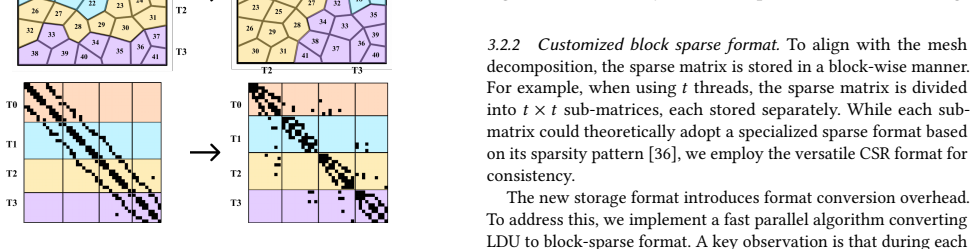
Two neural networks carry the physics: ODENet, trained to replace the stiff chemical-source ODE integration, and PRNet, trained to predict Peng-Robinson real-fluid density and transport properties. Around them, four mechanisms carry the scale-up: (1) a two-level decomposition that cuts the mesh into MPI processes and then into SCOTCH-partitioned thread regions, making off-diagonal nonzeros fall from 16.24% to 1.63% in the rocket geometry; (2) a block-sparse PDE solver with renumbering that gives each thread a private diagonal block and avoids write conflicts; (3) mixed-FP16 DNN inference with a tabulated GeLU activation to bypass transcendental-function bottlenecks; (4) runtime mesh refineme
What would settle it
Evaluate ODENet and PRNet directly against the stiff ODE and Peng-Robinson reference on state points spanning the rocket-chamber operating envelope (pressures up to 20 MPa, temperatures above 3000 K, all species mass fractions); if any regime shows surrogate errors far exceeding the reported ~1.5% or errors that accumulate over time, the claim of retained physical accuracy fails. Alternatively, run a small reactive TGV case with the optimized code and with the original solver long enough to compare 3D statistics—turbulent kinetic energy decay, species/pdf fields—rather than a single temperatur
Extended reading notes
Core claim
On the paper's own terms, the discovery is that the barrier to supercritical flame simulation at realistic scales is now mostly computational organization, not physical modeling. By keeping the chemistry and real-fluid surrogates fixed and instead reworking how unstructured cells are distributed, stored, and solved, the authors push detailed-chemistry, real-fluid combustion from millions of cells to 618 billion cells on Sunway and 154 billion cells on Fugaku. The optimized DeepFlame reaches 1.18 EFlop/s (21.8% of peak) in mixed-precision and 438.9 PFlop/s (32.3%) in FP32 on Sunway, and correspondingly 316.5 PFlop/s and 186.5 PFlop/s on Fugaku, with weak-scaling efficiency above 92% and stron
Load-bearing premise
The accuracy of the whole exercise rests on the two pre-trained neural networks (ODENet for chemistry and PRNet for real-fluid properties) continuing to match their reference ODE and Peng-Robinson calculations inside a 20 MPa, above-3000 K rocket chamber, but the paper validates them only on a 1D temperature profile from the Taylor-Green benchmark.
Editorial extensions
If this is right
- Supercritical LOX/CH4 rocket chamber simulations with more than 100 injectors become practical on current exascale systems.
- Time-to-solution for detailed-chemistry, real-fluid flames drops by roughly four orders of magnitude, so routine engineering design loops become feasible.
- Mixed-precision DNN inference cuts memory traffic and speeds linear layers without losing the reported ~1.5% accuracy, so half precision can be used more broadly in reactive-flow solvers.
- The I/O techniques remove the million-file and terabyte-read bottlenecks that previously blocked unstructured-mesh CFD at trillion-cell scale.
- Weak scaling above 92% out to 98,304 Sunway nodes and 73,728 Fugaku nodes suggests the same code can approach a true trillion-cell run with more memory or nodes.
Reading between the lines
- The accuracy evidence is one 1D temperature profile on the TGV case; a stronger check would compare 3D statistics, such as turbulent spectra and species distributions, against the reference solver on a small rocket-chamber sector.
- The same two-level partition-plus-block-sparse-solver structure should transfer to any unstructured finite-volume code; the paper demonstrates it only for combustion.
- For cross-machine comparison, time-to-solution per degree of freedom is a cleaner metric than raw PFlop/s, since the FLOP counts cover only the two main compute kernels.
- If surrogate accuracy persists at the rocket operating envelope (20 MPa, above 3000 K), the same workflow could be retrained for other propellants or transcritical CO2 cycles by replacing ODENet and PRNet.
Editorial analysis
A structured set of objections, weighed in public.
Referee Report
Summary. DeepFlame is an OpenFOAM-based reactive-flow solver that uses two neural-network surrogates, ODENet for chemical source terms and PRNet for Peng-Robinson real-fluid properties. The paper reports a set of optimizations—two-level MPI+thread decomposition, a mesh-decomposition-aware sparse PDE solver, mixed-precision DNN inference with tabulated GeLU, and parallel I/O—that enable supercritical LOX/CH4 TGV simulations with up to 618 billion cells on Sunway and 154 billion cells on Fugaku. The reported peak throughput is 438.9 PFlop/s (FP32) and 1.18 EFlop/s (mixed-FP16) on Sunway, and 186.5/316.5 PFlop/s on Fugaku. A 21-billion-cell unstructured rocket chamber case with 127 injectors and a 16.2-billion-cell load-balancing test are also presented. Accuracy is checked by comparing a 1D temperature profile from the TGV benchmark against a conventional ODE solver, with maximum relative errors of 1.49% (FP32) and 1.51% (mixed-FP16).
Significance. If the reported performance and accuracy hold, the work is a substantial advance: it moves supercritical reactive-flow simulation with detailed chemistry and real-fluid transport from millions of cells to hundreds of billions of cells, and it demonstrates a path toward full rocket-chamber simulations. The paper contains useful engineering contributions, including step-by-step speedup breakdowns (Fig. 11), consistent weak- and strong-scaling measurements (Figs. 13–14), and a direct comparison to an ODE reference (Fig. 10), so the main performance result is not circularly dependent on prior neural-network papers. The central weakness is that the scientific accuracy claim is validated only on a low-temperature TGV case, not at the rocket operating envelope where the headlined capability is claimed.
major comments (4)
- [§4.1 and §5.1, Fig. 10, Table 2] The accuracy evidence is limited to a 1D temperature profile from the TGV benchmark at 10 MPa with initial temperatures of 150 K (O2) and 300 K (CH4). The rocket engine case described in §4.1 operates at pressures up to 20 MPa and temperatures above 3000 K. No species mass fractions, density, viscosity, or thermal-diffusivity errors are reported at those states, and no pointwise or statistical 3D validation is given. Since ODENet/PRNet are neural surrogates, unseen thermodynamic states could produce large errors. Please add quantitative surrogate-error validation at representative rocket conditions, or explicitly restrict the 'detailed chemistry and real-fluid accuracy' claim to the validated regime.
- [§4.3] The headline FLOP rates are based on 'effective FLOPs' counted only during neural-network inference and sparse linear-algebra solving, and the text states this is 'less than the actual FLOPs executed' by the full code. The abstract and conclusion report 1.18 EFlop/s and percentages of peak as though they were directly measured machine throughput. Because the count is self-reported and no hardware counters, benchmark artifacts, or reproducibility scripts are provided, the FLOP rates are not independently verifiable and are not directly comparable with Table 1 entries. Please report both effective and measured FLOPs (or clearly label the reported numbers as effective throughout), and release the counting/benchmark methodology.
- [§3.2.3] The claim that the 1.63% off-diagonal nonzeros can be 'safely neglected' in Gauss-Seidel smoothing, with '<0.1% residual increase per iteration', is asserted without supporting convergence data. No residual histories, iteration counts, or solution comparisons with and without the neglect are shown. Because this approximation is inside the linear solver used for every reported simulation, it should be demonstrated on the actual TGV and rocket meshes, including the effect on final flow quantities rather than only the per-iteration residual.
- [§4.1 and §5.5] The weak-scaling TGV tests increase the domain size by doubling L while keeping u0 and mesh spacing fixed, which changes the Reynolds number and the characteristic flow time across scaling points. If this is intended only as a performance benchmark, the paper should state explicitly that the physical problem changes; otherwise the near-perfect weak-scaling efficiency could be seen as masking a regime change. The rocket weak-scaling test uses sector-based domain growth; please clarify whether the thermodynamic and chemical state is held identical across sectors.
minor comments (5)
- [Fig. 10 caption] 'DeepFrame' appears to be a typo for 'DeepFlame'.
- [§5.2.3] The stated workload percentages for DNN and PDE solving do not sum to 100 with an explicit 'Other' term; please clarify what the percentages refer to and where the remaining time is allocated.
- [§2] The phrase 'simple idea-gas situations' should be 'ideal-gas situations'.
- [§4.3] The definition of 'peak performance' uses total FLOPs divided by loop time, but it is not clear whether the FLOP count is per time step and how the time step is averaged across the 100 reported steps. Please define the counting window explicitly.
- [General] There is no data/code availability statement or artifact DOI. For a performance paper of this scale, even a minimal artifact description would improve reproducibility.
Circularity Check
No significant circularity — the headline claims are measured performance results, and the surrogate accuracy is supported by direct comparison to an ODE reference plus external prior validations.
full rationale
The paper is primarily a performance-engineering contribution. The central claims—PFlop/s, time-to-solution, and cell counts—are measured quantities obtained from wall-clock timing and counted effective FLOPs (Sec. 4.3), not derived from a fitted parameter or an assumed result. The surrogate models ODENet and PRNet are inherited from earlier DeepFlame work, and the paper states: 'We have shown in Refs. [9, 28, 29, 50] that DeepFlame with the ODENet and PRNet models can accurately capture such multi-physical phenomena.' This is a self-citation, but it points to separate published validations, and the paper also provides an in-paper accuracy check against the Cantara ODE reference (Fig. 10, Table 2), reporting maximum relative errors of 1.49% and 1.51%. That comparison is direct evidence, not a circular reduction. The limitation that this validation is only a 1D TGV temperature profile and does not sample the 20 MPa / >3000 K rocket envelope is a scientific robustness concern, not a circularity: it does not make any result equivalent to its input by construction. No fitted parameter is renamed as a prediction, no uniqueness theorem is imported from the authors' prior work, and no ansatz is smuggled in solely via citation. Therefore no circular step is identified.
Assumptions & free parameters
free parameters (2)
- ODENet/PRNet trained weights =
not listed in manuscript
- GeLU tabulation grid =
range [-3,3], interval 0.01, 2nd-order interpolation
assumptions (3)
- domain assumption ODENet and PRNet surrogates reproduce detailed chemistry and real-fluid properties to acceptable error across the simulated regime.
- ad hoc to paper Neglecting the residual 1.63% off-diagonal nonzeros in Gauss-Seidel smoothing does not change convergence or stability (<0.1% residual increase).
- domain assumption The effective FLOPs count used for PFlop/s is a meaningful measure of achieved performance.
Cite this review
Pith. "Pith review of Deep Learning-Enabled Supercritical Flame Simulation at Detailed Chemistry and Real-Fluid Accuracy Towards Trillion-Cell Scale." pith.science (2026). https://pith.science/paper/YFSWPA7J
@misc{pith2026250818969,
  author       = {Pith},
  title        = {Pith review of: Deep Learning-Enabled Supercritical Flame Simulation at Detailed Chemistry and Real-Fluid Accuracy Towards Trillion-Cell Scale},
  year         = {2026},
  howpublished = {\url{https://pith.science/paper/YFSWPA7J}},
  note         = {Machine review of arXiv:2508.18969}
}
read the original abstract
For decades, supercritical flame simulations incorporating detailed chemistry and real-fluid transport have been limited to millions of cells, constraining the resolved spatial and temporal scales of the physical system. We optimize the supercritical flame simulation software DeepFlame -- which incorporates deep neural networks while retaining the real-fluid mechanical and chemical accuracy -- from three perspectives: parallel computing, computational efficiency, and I/O performance. Our highly optimized DeepFlame achieves supercritical liquid oxygen/methane (LOX/\ce{CH4}) turbulent combustion simulation of up to 618 and 154 billion cells with unprecedented time-to-solution, attaining 439/1186 and 187/316 PFlop/s (32.3\%/21.8\% and 37.4\%/31.8\% of the peak) in FP32/mixed-FP16 precision on Sunway (98,304 nodes) and Fugaku (73,728 nodes) supercomputers, respectively. This computational capability surpasses existing capacities by three orders of magnitude, enabling the first practical simulation of rocket engine combustion with >100 LOX/\ce{CH4} injectors. This breakthrough establishes high-fidelity supercritical flame modeling as a critical design tool for next-generation rocket propulsion and ultra-high energy density systems.
Figures


Figures from the paper (8 more)




Reference graph
Works this paper leans on
- [1]
-
[2]
Abouelmagd Abdelsamie, Gordon Fru, Timo Oster, Felix Dietzsch, Gábor Janiga, and Dominique Thévenin. 2016. Towards direct numerical simulations of low- Mach number turbulent reacting and two-phase flows using immersed boundaries. Computers & Fluids 131 (2016), 123–141
work page 2016
-
[3]
Abouelmagd Abdelsamie, Ghislain Lartigue, Christos E Frouzakis, and Dominique Thevenin. 2021. The Taylor–Green vortex as a benchmark for high-fidelity combustion simulations using low-Mach solvers. Computers & Fluids 223 (2021), 104935
work page 2021
-
[4]
Frouzakis, and Do- minique Thévenin
Abouelmagd Abdelsamie, Ghislain Lartigue, Christos E. Frouzakis, and Do- minique Thévenin. 2021. The Taylor–Green vortex as a benchmark for high- fidelity combustion simulations using low-Mach solvers. Comput. Fluids 223 (2021), 104935
work page 2021
-
[5]
Adams, Steven Benson, Jed Brown, Peter Brune, Kris Buschelman, Emil M
Satish Balay, Shrirang Abhyankar, Mark F. Adams, Steven Benson, Jed Brown, Peter Brune, Kris Buschelman, Emil M. Constantinescu, Lisandro Dalcin, Alp Dener, Victor Eijkhout, Jacob Faibussowitsch, William D. Gropp, Václav Hapla, Tobin Isaac, Pierre Jolivet, Dmitry Karpeev, Dinesh Kaushik, Matthew G. Knepley, Fande Kong, Scott Kruger, Dave A. May, Lois Curf...
work page 2025
-
[6]
Josette Bellan. 2000. Supercritical (and subcritical) fluid behavior and modeling: drops, streams, shear and mixing layers, jets and sprays. Progress in energy and combustion science 26, 4-6 (2000), 329–366
work page 2000
-
[7]
Pierre Boivin, Muhammad Tayyab, and Song Zhao. 2021. Benchmarking a lattice- Boltzmann solver for reactive flows: Is the method worth the effort for combus- tion? Physics of Fluids 33, 7 (2021)
work page 2021
-
[8]
Tom Brown, Benjamin Mann, Nick Ryder, Melanie Subbiah, Jared D Kaplan, Prafulla Dhariwal, Arvind Neelakantan, Pranav Shyam, Girish Sastry, Amanda Askell, et al. 2020. Language models are few-shot learners. Advances in neural information processing systems 33 (2020), 1877–1901
2020
Show all 55 references
-
[9]
Yuqing Cai, Ruixin Yang, Han Li, Jiayang Xu, Ke Xiao, Zhi X Chen, and Hu Wang
-
[10]
Jacqueline H Chen, Alok Choudhary, Bronis De Supinski, Matthew DeVries, Evatt R Hawkes, Scott Klasky, Wei-Keng Liao, Kwan-Liu Ma, John Mellor- Crummey, Norbert Podhorszki, et al. 2009. Terascale direct numerical simulations of turbulent combustion using S3D.Computational Scien...
2009
-
[11]
Wai Tong Chung, Aashwin Ananda Mishra, and Matthias Ihme. 2022. Inter- pretable data-driven methods for subgrid-scale closure in LES for transcritical LOX/GCH4 combustion. Combustion and Flame 239 (2022), 111758
2022
-
[12]
Marc T Henry de Frahan, Lucas Esclapez, Jon Rood, Nicholas Wimer, Paul Mul- lowney, Bruce A Perry, Landon D Owen, Hariswaran Sitaraman, Shashank Yel- lapantula, Malik Hassanaly, et al. 2024. The Pele Simulation Suite for Reacting Flows at Exascale. Technical Report. Oak Ridge ...
2024
-
[13]
Jacob Devlin, Ming-Wei Chang, Kenton Lee, and Kristina Toutanova. 2018. Bert: Pre-training of deep bidirectional transformers for language understanding.arXiv preprint arXiv:1810.04805 (2018)
2018 arXiv
-
[14]
Tianjie Ding, Thomas Readshaw, Stelios Rigopoulos, and WP Jones. 2021. Ma- chine learning tabulation of thermochemistry in turbulent combustion: An ap- proach based on hybrid flamelet/random data and multiple multilayer percep- trons. Combustion and Flame 231 (2021), 111493
2021
-
[15]
Pascale Domingo and Luc Vervisch. 2023. Recent developments in DNS of turbulent combustion. Proceedings of the Combustion Institute 39, 2 (2023), 2055– 2076
2023
-
[16]
Irvin Glassman, Richard A Yetter, and Nick G Glumac. 2014. Combustion. Aca- demic press
2014
-
[17]
Zhuoqiang Guo, Denghui Lu, Yujin Yan, Siyu Hu, Rongrong Liu, Guangming Tan, Ninghui Sun, Wanrun Jiang, Lijun Liu, Yixiao Chen, et al. 2022. Extending the limit of molecular dynamics with ab initio accuracy to 10 billion atoms. In Proceedings of the 27th ACM SIGPLAN Symposium o...
2022
-
[18]
Umut Guven and Guillaume Ribert. 2019. Impact of non-ideal transport modeling on supercritical flow simulation. Proceedings of the Combustion Institute 37, 3 (2019), 3255–3262
2019
-
[19]
Evatt R Hawkes, Obulesu Chatakonda, Hemanth Kolla, Alan R Kerstein, and Jacqueline H Chen. 2012. A petascale direct numerical simulation study of the modelling of flame wrinkling for large-eddy simulations in intense turbulence. Combustion and flame 159, 8 (2012), 2690–2703
2012
-
[20]
Marc T Henry de Frahan, Jon S Rood, Marc S Day, Hariswaran Sitaraman, Shashank Yellapantula, Bruce A Perry, Ray W Grout, Ann Almgren, Weiqun Zhang, John B Bell, et al . 2023. PeleC: An adaptive mesh refinement solver for compressible reacting flows. The International Journal o...
2023
-
[21]
Matthias Ihme, Wai Tong Chung, and Aashwin Ananda Mishra. 2022. Combustion machine learning: Principles, progress and prospects. Progress in Energy and Combustion Science 91 (2022), 101010
2022
-
[22]
Hrvoje Jasak, Aleksandar Jemcov, Zeljko Tukovic, et al. 2007. OpenFOAM: A C++ library for complex physics simulations. In International workshop on coupled methods in numerical dynamics , Vol. 1000. 1–20
2007
-
[23]
Weile Jia, Han Wang, Mohan Chen, Denghui Lu, Lin Lin, Roberto Car, E Weinan, and Linfeng Zhang. 2020. Pushing the Limit of Molecular Dynamics with Ab Initio Accuracy to 100 Million Atoms with Machine Learning. In SC20: International Conference for High Performance Computing, N...
2020 arXiv
-
[24]
Lluís Jofre and Javier Urzay. 2021. Transcritical diffuse-interface hydrodynamics of propellants in high-pressure combustors of chemical propulsion systems. Progress in Energy and Combustion Science 82 (2021), 100877. SC ’25, November 16–21, 2025, St Louis, MO, USA Zhuoqiang G...
2021
-
[25]
Katharina Kohse-Höinghaus. 2021. Combustion in the future: The importance of chemistry. Proceedings of the Combustion Institute 38, 1 (2021), 1–56
2021
-
[26]
Tianfeng Lu and Chung K Law. 2009. Toward accommodating realistic fuel chemistry in large-scale computations. Progress in Energy and Combustion Science 35, 2 (2009), 192–215
2009
-
[27]
Peter C Ma, Yu Lv, and Matthias Ihme. 2017. An entropy-stable hybrid scheme for simulations of transcritical real-fluid flows. J. Comput. Phys. 340 (2017), 330–357
2017
-
[28]
Runze Mao, Minqi Lin, Yan Zhang, Tianhan Zhang, Zhi-Qin John Xu, and Zhi X. Chen. 2023. DeepFlame: A deep learning empowered open-source platform for reacting flow simulations. Computer Physics Communications 291 (2023), 108842. doi:10.1016/j.cpc.2023.108842
2023
-
[29]
Runze Mao, Min Zhang, Yingrui Wang, Han Li, Jiayang Xu, Xinyu Dong, Yan Zhang, and Zhi X Chen. 2024. An integrated framework for accelerating reactive flow simulation using GPU and machine learning models. Proceedings of the Combustion Institute 40, 1-4 (2024), 105512
2024
-
[30]
Petro Junior Milan, Jean-Pierre Hickey, Xingjian Wang, and Vigor Yang. 2021. Deep-learning accelerated calculation of real-fluid properties in numerical simu- lation of complex flowfields. J. Comput. Phys. 444 (2021), 110567
2021
-
[31]
Daniel Mira, Eduardo J Pérez-Sánchez, Ricard Borrell, and Guillaume Houzeaux
-
[32]
Florian Monnier and Guillaume Ribert. 2022. Simulation of high-pressure methane-oxygen combustion with a new reduced chemical mechanism. Combus- tion and Flame 235 (2022), 111735
2022
-
[33]
Florian Monnier and Guillaume Ribert. 2023. Numerical simulations of supercrit- ical CH4/O2 flame propagation in inhomogeneous mixtures following ignition. Proceedings of the Combustion Institute 39, 2 (2023), 2747–2755
2023
-
[34]
Florian Monnier and Guillaume Ribert. 2023. Numerical simulations of supercrit- ical CH4/O2 flame propagation in inhomogeneous mixtures following ignition. Proc. Combust. Inst 39, 2 (2023), 2747–2755
2023
-
[35]
Vincent Moureau, P Domingo, and Luc Vervisch. 2011. From large-eddy sim- ulation to direct numerical simulation of a lean premixed swirl flame: Filtered laminar flame-pdf modeling. Combustion and Flame 158, 7 (2011), 1340–1357
2011
-
[36]
Yuyao Niu, Zhengyang Lu, Meichen Dong, Zhou Jin, Weifeng Liu, and Guangming Tan. 2021. Tilespmv: A tiled algorithm for sparse matrix-vector multiplication on gpus. In 2021 IEEE International Parallel and Distributed Processing Symposium (IPDPS). IEEE, 68–78
2021
-
[37]
Joseph C Oefelein. 2005. Thermophysical characteristics of shear-coaxial LOX– H2 flames at supercritical pressure. Proceedings of the Combustion Institute 30, 2 (2005), 2929–2937
2005
-
[38]
François Pellegrini and Jean Roman. 1996. Scotch: A software package for static mapping by dual recursive bipartitioning of process and architecture graphs. In High-Performance Computing and Networking: International Conference and Exhibition HPCN EUROPE 1996 Brussels, Belgium...
1996
-
[39]
Sergio Pirozzoli and Tapan K Sengupta. 2019. High-Performance Computing of Big Data for Turbulence and Combustion . Vol. 592. Springer
2019
-
[40]
T. Poinsot. 2017. Prediction and control of combustion instabilities in real engines. Proceedings of the Combustion Institute 36, 1 (2017), 1–28. doi:10.1016/j.proci.2016. 05.007
2017 doi
-
[41]
Alexei Y Poludnenko, Jessica Chambers, Kareem Ahmed, Vadim N Gamezo, and Brian D Taylor. 2019. A unified mechanism for unconfined deflagration-to- detonation transition in terrestrial chemical systems and type Ia supernovae. Science 366, 6465 (2019), eaau7365
2019
-
[42]
Maziar Raissi, Paris Perdikaris, and George E Karniadakis. 2019. Physics-informed neural networks: A deep learning framework for solving forward and inverse problems involving nonlinear partial differential equations. Journal of Computa- tional physics 378 (2019), 686–707
2019
-
[43]
Anthony M Ruiz, Guilhem Lacaze, Joseph C Oefelein, Raphaeë Mari, Bénédicte Cuenot, Laurent Selle, and Thierry Poinsot. 2016. Numerical benchmark for high-Reynolds-number supercritical flows with large density gradients. Aiaa Journal 54, 5 (2016), 1445–1460
2016
-
[44]
Manabu Saito, Jiangkuan Xing, Jun Nagao, and Ryoichi Kurose. 2023. Data-driven simulation of ammonia combustion using neural ordinary differential equations (NODE). Applications in Energy and Combustion Science 16 (2023), 100196
2023
-
[45]
Mitsuhisa Sato, Yutaka Ishikawa, Hirofumi Tomita, Yuetsu Kodama, Tetsuya Odajima, Miwako Tsuji, Hisashi Yashiro, Masaki Aoki, Naoyuki Shida, Ikuo Miyoshi, et al . 2020. Co-design for a64fx manycore processor and” fugaku”. In SC20: International Conference for High Performance ...
2020
-
[46]
Thomas Schmitt, Yoann Méry, Matthieu Boileau, and Sebastien Candel. 2011. Large-eddy simulation of oxygen/methane flames under transcritical conditions. Proceedings of the Combustion Institute 33, 1 (2011), 1383–1390
2011
-
[47]
AG Tomboulides, JCY Lee, and SA Orszag. 1997. Numerical simulation of low Mach number reactive flows. Journal of Scientific Computing 12 (1997), 139–167
1997
-
[48]
Zhijian J Wang, Krzysztof Fidkowski, Rémi Abgrall, Francesco Bassi, Doru Caraeni, Andrew Cary, Herman Deconinck, Ralf Hartmann, Koen Hillewaert, Hung T Huynh, et al. 2013. High-order CFD methods: current status and perspec- tive. International Journal for Numerical Methods in ...
2013
-
[49]
Wikipedia contributors. 2024. SpaceXRaptor — Wikipedia, The Free Encyclopedia. https://en.wikipedia.org/wiki/SpaceX_Raptor. [Online; accessed 7-April-2024]
2024
-
[50]
Jiayang Xu, Yifan Xu, Zifeng Weng, Yuqing Cai, Runze Mao, Ruixin Yang, and Zhi X. Chen. 2023. Detailed simulation of LOX/GCH4 flame- vortex interaction in supercritical Taylor-Green flows with machine learning. arXiv:2312.04830 [physics.flu-dyn]
2023 arXiv
-
[51]
Vigor Yang. 2000. Modeling of supercritical vaporization, mixing, and combustion processes in liquid-fueled propulsion systems. Proceedings of the Combustion Institute 28, 1 (2000), 925–942
2000
-
[52]
Min Zhang, Runze Mao, Han Li, Zhenhua An, and Zhi X Chen. 2024. Graphics processing unit/artificial neural network-accelerated large-eddy simulation of swirling premixed flames. Physics of Fluids 36, 5 (2024)
2024
-
[54]
Thorsten Zirwes, Marvin Sontheimer, Feichi Zhang, Abouelmagd Abdelsamie, Francisco E Hernández Pérez, Oliver T Stein, Hong G Im, Andreas Kronenburg, and Henning Bockhorn. 2023. Assessment of numerical accuracy and parallel performance of OpenFOAM and its reacting flow extensio...
2023
-
[2023]
Pro- ceedings of the Combustion Institute 39, 4 (2023), 5091–5125
HPC-enabling technologies for high-fidelity combustion simulations. Pro- ceedings of the Combustion Institute 39, 4 (2023), 5091–5125
2023
-
[2025]
Aerospace Science and Technology (2025), 110034
Efficient machine learning method for supercritical combustion: Predicting real-fluid properties and chemical ODEs. Aerospace Science and Technology (2025), 110034
2025
Reviewed August 5, 2026 · model on record in the stance chip above.
Discussion (0). Sign in to comment.