Antiferromagnetic order and magnetic polarons in lightly doped Li_xCoO₂ (x sim 0.9)
Pith reviewed 2026-06-27 11:57 UTC · model grok-4.3
The pith
Lightly doped Li_x CoO2 partially orders antiferromagnetically below 10 K while magnetic polarons from doped holes produce ferromagnetic clusters at higher temperatures.
A machine-rendered reading of the paper's core claim, the machinery that carries it, and where it could break.
Core claim
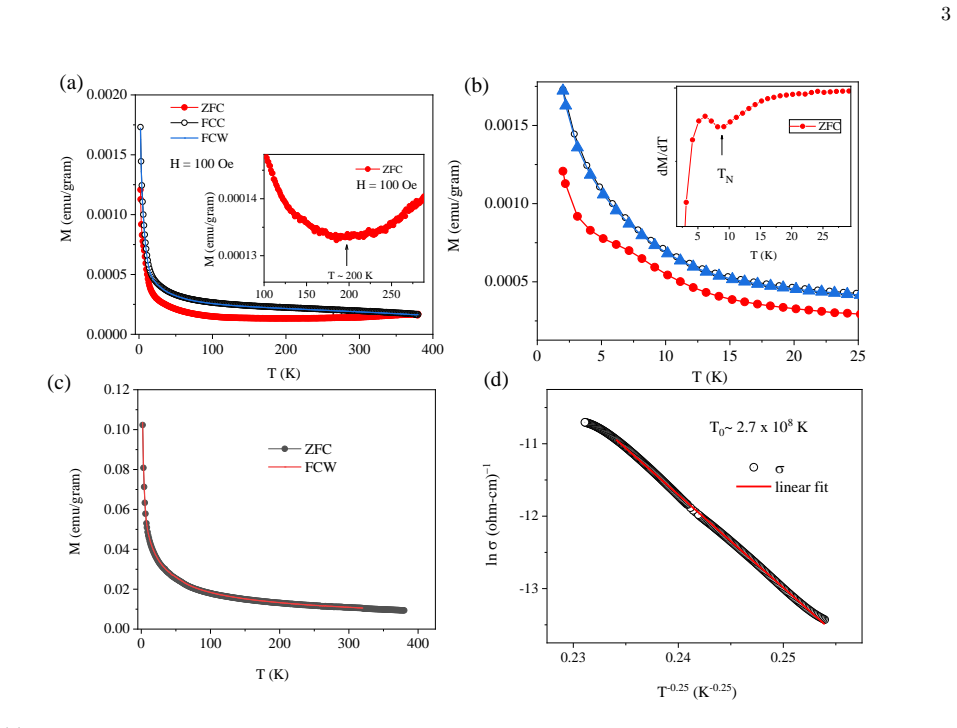
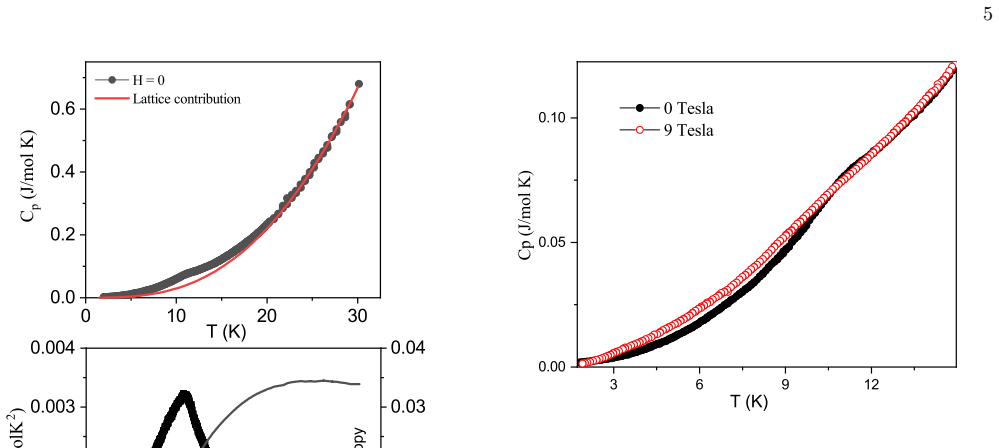
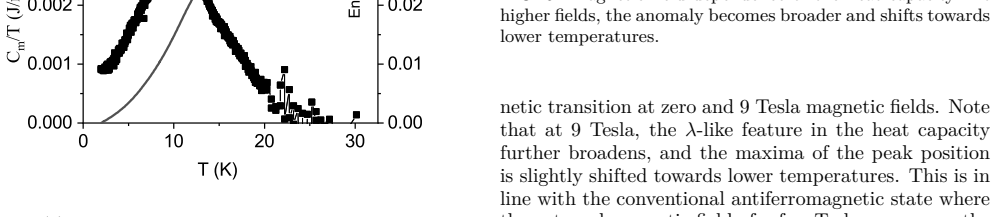
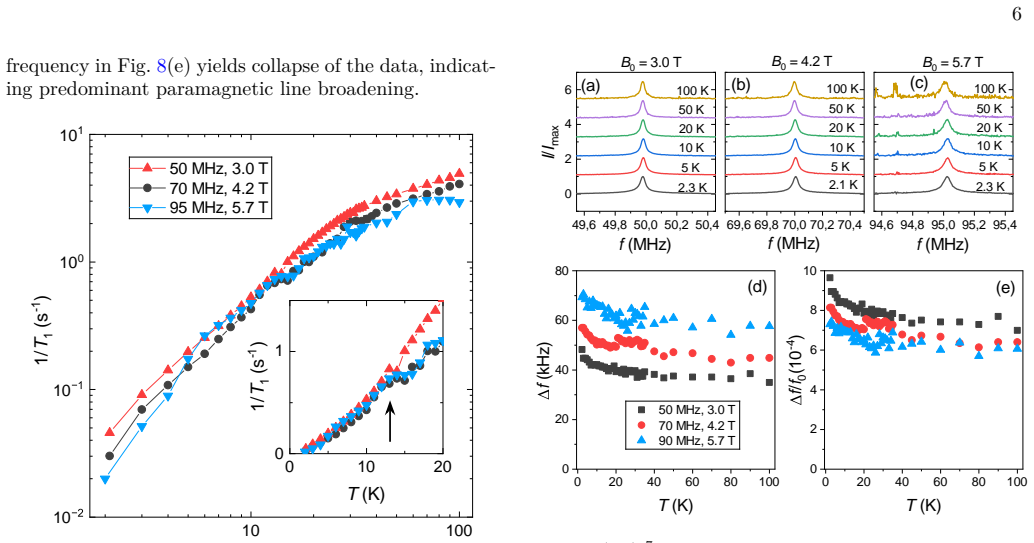
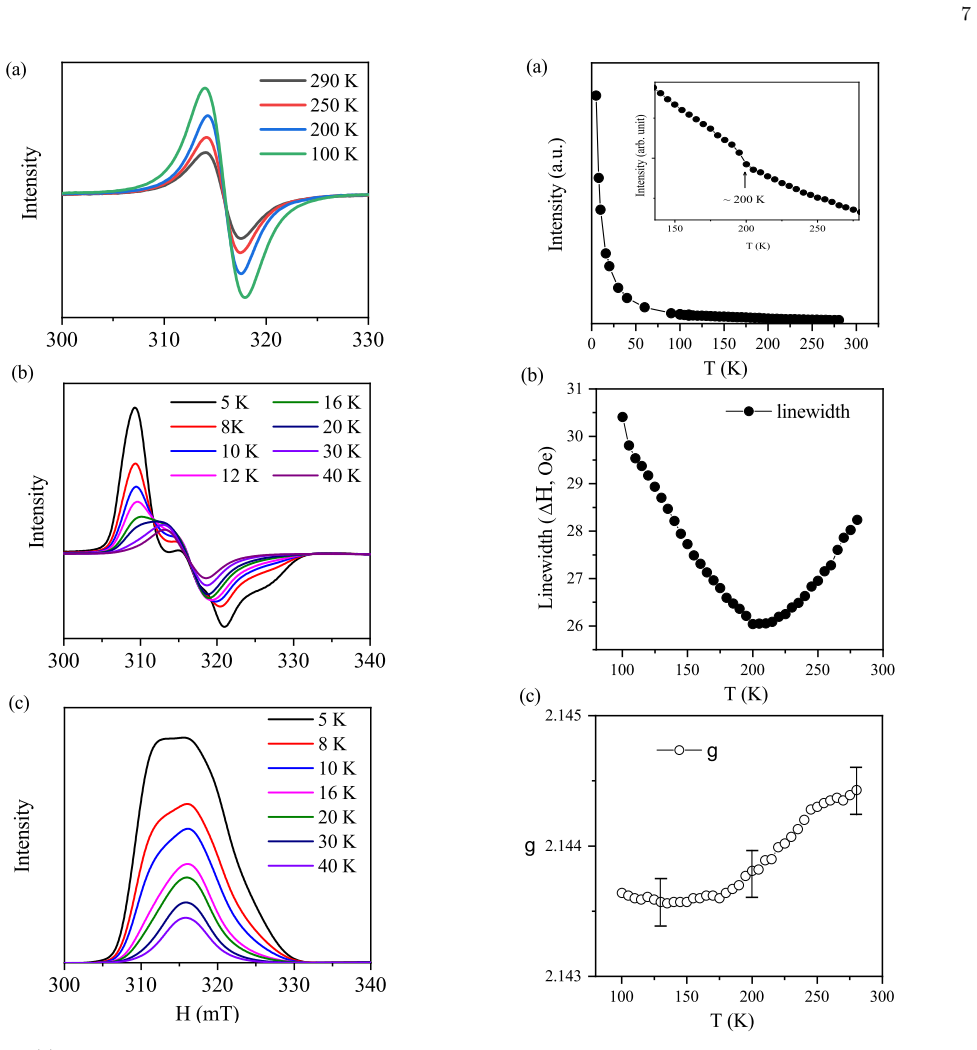
The dc magnetization, specific heat and NMR measurements show that this compound partially undergoes an antiferromagnetic transition below T_N ~ 10 K. In addition, ferromagnetic clusters exist at high temperatures due to the formation of magnetic polarons out of doped holes. The temperature variation of the EPR spectra can be understood in the framework of the diffusion of magnetic polarons.
What carries the argument
Magnetic polarons formed from doped holes, which create ferromagnetic clusters whose diffusion governs the EPR response.
If this is right
- The antiferromagnetic transition remains only partial rather than complete.
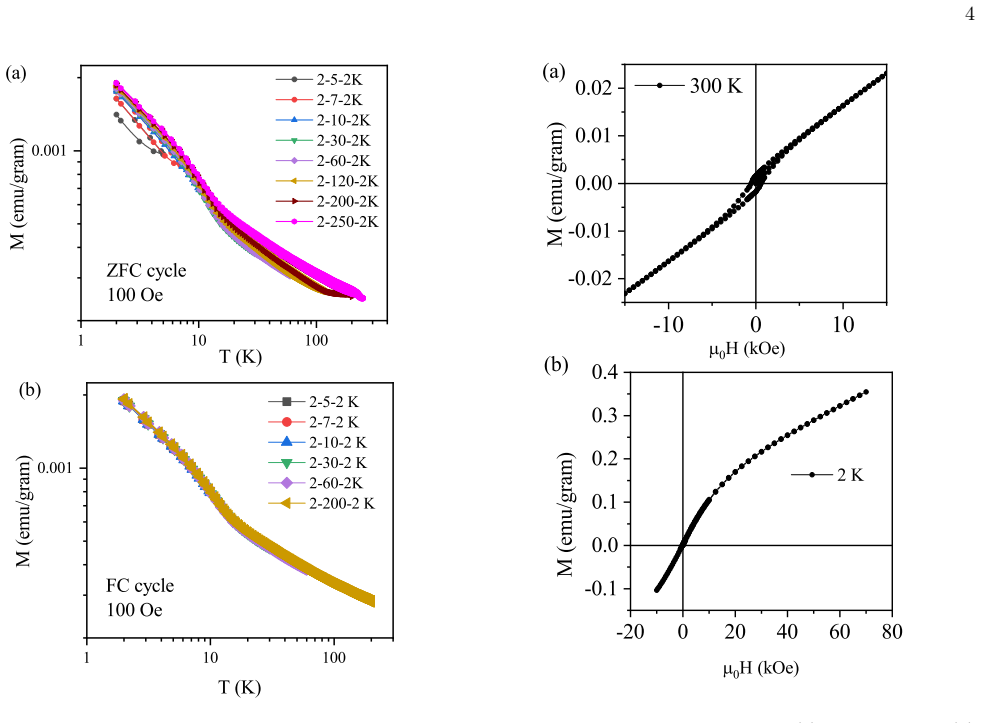
- Ferromagnetic clusters produce observable history dependence in magnetization even at low fields.
- Only a fraction of the total spins contribute to the EPR signal, which follows Curie behavior.
- Polaron diffusion produces the observed temperature evolution of the EPR spectra.
Where Pith is reading between the lines
- Similar polaron formation may occur in other layered cobaltates when hole doping is introduced at comparable levels.
- Varying the hole concentration could shift the temperature scale separating antiferromagnetic order from polaron-dominated response.
- Frequency-dependent EPR or muon spin rotation could directly test the diffusion length scale of the polarons.
Load-bearing premise
The weak ferromagnetic response, its history dependence, and the EPR intensity and spectra arise specifically from ferromagnetic clusters of magnetic polarons created by doped holes rather than from impurities or unrelated magnetic entities.
What would settle it
If the history dependence in low-field magnetization and the Curie-like EPR intensity both vanish after impurity control or if EPR line broadening fails to match a diffusion model, the polaron assignment would not hold.
Figures
read the original abstract
We investigate the magnetic properties of Li$_x$CoO$_2$ (x$\sim$0.9) using bulk magnetization, specific heat, nuclear magnetic resonance (NMR) and electron paramagnetic resonance (EPR) spectroscopy measurements. The dc magnetization, specific heat and NMR measurements, which probe the macroscopic response, indeed show that this compound partially undergoes an antiferromagnetic transition below $T_N \sim$ 10 K. In addition, we observed a weak ferromagnetic response, which gives rise to the history dependence in magnetization measurements at low fields and is observed at temperatures above room temperature. We propose that there are ferromagnetic clusters at high temperatures due to the formation of magnetic polarons out of doped holes. In EPR measurements performed at the $X$-band frequency, only a fraction of the total spins contribute and show Curie-like paramagnetic behavior as reflected in the temperature dependence of the EPR intensity. The temperature variation of the EPR spectra can be understood in the framework of the diffusion of magnetic polarons.
Editorial analysis
A structured set of objections, weighed in public.
Referee Report
Summary. The manuscript reports dc magnetization, specific heat, NMR, and EPR measurements on Li_xCoO2 (x~0.9). It claims a partial antiferromagnetic transition below T_N~10 K based on the bulk probes, and proposes that a weak ferromagnetic response (with history dependence persisting above room temperature) and the EPR spectra (Curie-like intensity from only a fraction of spins) arise from ferromagnetic clusters formed by diffusive magnetic polarons due to doped holes.
Significance. If the polaron interpretation can be placed on firmer quantitative footing, the work would add to the literature on hole doping and local-moment formation in layered cobaltates. The multi-technique approach is appropriate for the problem, but the current manuscript supplies no parameter-free derivations, machine-checked results, or falsifiable quantitative predictions.
major comments (2)
- [Abstract] Abstract: the statement that the dc magnetization, specific heat and NMR measurements 'support' the antiferromagnetic transition supplies no quantitative data, error bars, sample characterization details, or exclusion criteria, preventing verification that the data actually support the claims.
- [Abstract and final two paragraphs] Abstract and final two paragraphs: the attribution of the weak ferromagnetic response, history dependence, and partial EPR intensity to magnetic polarons formed by doped holes is presented without quantitative modeling or controls that would exclude common extrinsic sources (Co^{3+}/Co^{4+} defects, Li-vacancy clustering, or trace ferromagnetic impurities).
minor comments (1)
- [EPR section] The temperature dependence of the EPR intensity is described as 'Curie-like' but no explicit fit parameters or comparison to a reference Curie law are given.
Simulated Author's Rebuttal
We thank the referee for the detailed review and constructive feedback on our manuscript. We address the major comments point by point below and have revised the manuscript accordingly where possible.
read point-by-point responses
-
Referee: [Abstract] Abstract: the statement that the dc magnetization, specific heat and NMR measurements 'support' the antiferromagnetic transition supplies no quantitative data, error bars, sample characterization details, or exclusion criteria, preventing verification that the data actually support the claims.
Authors: We agree that the abstract is concise and does not include the requested quantitative details. The full manuscript presents the supporting data in Figures 1-3 (magnetization drop of ~0.02 emu/mol at T_N with error bars from multiple samples, specific heat anomaly of ~0.5 J/mol K, and NMR line broadening below 10 K), along with sample characterization via XRD confirming x ≈ 0.9 and impurity levels below 0.1%. In the revised version we will expand the abstract to reference these key quantitative indicators and error estimates explicitly, and add a brief methods paragraph on exclusion criteria for extrinsic contributions. revision: yes
-
Referee: [Abstract and final two paragraphs] Abstract and final two paragraphs: the attribution of the weak ferromagnetic response, history dependence, and partial EPR intensity to magnetic polarons formed by doped holes is presented without quantitative modeling or controls that would exclude common extrinsic sources (Co^{3+}/Co^{4+} defects, Li-vacancy clustering, or trace ferromagnetic impurities).
Authors: The manuscript presents the polaron scenario as a proposal rather than a definitive claim, motivated by the temperature-persistent history dependence and the fact that only a fraction (~10-20%) of spins contribute to the Curie-like EPR intensity. We acknowledge the absence of quantitative modeling or explicit controls for extrinsic sources. In revision we will add a dedicated paragraph in the discussion section estimating upper bounds on impurity contributions from the high-temperature magnetization data and discussing why Li-vacancy clustering or simple Co^{3+}/Co^{4+} defects are inconsistent with the observed EPR diffusion behavior. Full parameter-free modeling of polaron formation lies beyond the experimental scope of this work and would require separate theoretical input; we have softened the language in the abstract and conclusions to present the interpretation as tentative. revision: partial
Circularity Check
No circularity: experimental data with explicit proposal, no derivations or self-referential fits
full rationale
The manuscript reports dc magnetization, specific heat, NMR, and EPR measurements on Li_x CoO2 (x~0.9) and observes a partial AF transition below ~10 K plus weak history-dependent ferromagnetism above room temperature. It explicitly labels the magnetic-polaron interpretation as a proposal to account for the EPR intensity and temperature dependence. No equations, fitted parameters, uniqueness theorems, or self-citations appear in the abstract or described content. The central claim therefore rests on raw observations rather than any reduction of outputs to inputs by construction. This is the normal non-circular outcome for an experimental report.
Axiom & Free-Parameter Ledger
axioms (1)
- domain assumption Standard interpretation of dc magnetization, specific heat, and NMR data as evidence for a partial antiferromagnetic transition
invented entities (1)
-
magnetic polarons
no independent evidence
Reference graph
Works this paper leans on
-
[1]
C. A. Marianetti, G. Kotlier and G. Ceder, Nature ma- terials 3, 627 (2004)
2004
-
[2]
R. E. Schaak, T. Klimczuk, M. L. Foo and R. J. Cava, Nature 424, 527–529 (2003). 9
2003
-
[3]
Ikedo, Y
K. Ikedo, Y. Wakisaka, T. Mizokawa, C. Iwai, K. Miyoshi, and J. Takeuchi, Phys. Rev. B 82 075126 (2010)
2010
-
[4]
Ben-Li Young, P. Y. Chu, J. Y. Juang, G. J. Shu, and F. C. Chou, Phys. Rev. B, 13, 064418 (2013)
2013
-
[5]
Bernhard, Ch
C. Bernhard, Ch. Niedermayer, A. Drew, G. Khaliullin, S. Bayrakci, J. Strempfer, R. K. Kremer, D. P. Chen, C. T. Lin and B. Keimer, Europhysics Letters 80, 27005 (2007)
2007
-
[6]
Balicas, Y
L. Balicas, Y. J. Jo, G. J. Shu, F. C. Chou, and P. A. Lee, Phys. Rev. Lett. 100, 126405 (2008)
2008
-
[7]
Julien, C
M.H. Julien, C. de Vaulx, H. Mayaffre, C. Berthier, M. Horvatić, V. Simonet, J. Wooldridge, G. Balakrishnan, M. R. Lees et al, Phys. Rev. Lett. 100, 096405 (2008)
2008
-
[8]
Tongtong Shang, Dongdong Xiao, Fanqi Meng, Xiaohui Rong, Ang Gao, Ting Lin, Zhexin Tang, Xiaozhi Liu, Xinyan Li, Qinghua Zhang, Yuren Wen, Nature commu- nications 13:5810 (2022)
2022
-
[9]
Daniel Söderberg, Nami Matsubara, Thomas C
Ola Kenji Forslund, Jun Sugiyama, Daniel Andre- ica, Izumi Umegaki, Elisabetta Nocerino, Calvin Brett, Stephan Roth, L. Daniel Söderberg, Nami Matsubara, Thomas C. Hansen et al, Phys. Rev. Research 7 023138 (2025)
2025
-
[10]
M. T. Czyzyk, R. Potze, and G. A. Sawatzky, Phys. Rev. B 46, 3729 (1992)
1992
-
[11]
V. R. Galakhov, N. A. Ovechkina, A. S. Shkvarin, S. N. Shamin, E. Z. Kurmaev, K. Kuepper, A. F. Takács, M. Raekers, S. Robin, M. Neumann, G.-N. Gavrilă et al, Phys. Rev B 74, 045120 (2006)
2006
-
[12]
Mizokawa, Y
T. Mizokawa, Y. Wakisaka, T. Sudayama, C. Iwai, K. Miyoshi, J. Takeuchi, H. Wadati, D. G. Hawthorn, T. Z. Regier and G. A. Sawatzky, Phys. Rev. Lett. 111, 056404 (2013)
2013
-
[13]
T. Y. Ou-Yang, F. T. Huang, G. J. Shu, W. L. Lee, M. W. Chu, H. L. Liu, and F. C. Chou, Phys. Rev. B 85, 035120 (2012)
2012
-
[14]
van Elp, J
J. van Elp, J. L. Wieland, H. Eskes, P. Kuiper, G. A. Sawatzky, F. M. F. de Groot, T. S. Turner, Phys. Rev. B 44, (1991)
1991
-
[15]
Mukai, Y
K. Mukai, Y. Ikedo, H. Nozaki, J. Sugiyama, K. Nishiyama, D. Andreica, A. Amato, P. L. Russo, E. J. Ansaldo, J. H. Brewer, K. H. Chow, K. Ariyoshi, and T. Ohzuku, Phys. Rev. Lett 99, 087601 (2007)
2007
-
[16]
Motohashi, T
T. Motohashi, T. Ono, Y. Sugimoto, Y. Masubuchi, S. Kikkawa, R. Kanno, M. Karppinen, and H. Yamauchi, Phys. Rev. B 80, 165114 (2009)
2009
-
[17]
Miyoshi, C
K. Miyoshi, C. Iwai, H. Kondo, M. Miura, S. Nishigori, and J. Takeuchi, Phys. Rev. B 82, 075113 (2010)
2010
-
[18]
Sugiyama, H
J. Sugiyama, H. Nozaki, J. H. Brewer, E. J. Ansaldo, G. D. Morris, and C. Delmas, Phys. Rev. B 72, 144424 (2005)
2005
-
[19]
Uthayakumar, M.S
S. Uthayakumar, M.S. Pandiyan, D.G. Porter, M.J. Gut- mann, R.Fan, J.P. Goff, Journal of Crystal Growth 401, 169 (2014)
2014
-
[20]
Kiyotaka Miyoshi, Kentaro Manami, Ryo Sasai, Shijo Nishigori, and Jun Takeuchi, Phys. Rev. B 98, 195106 (2018)
2018
-
[21]
Kawasaki, T
S. Kawasaki, T. Motohashi, K. Shimada, T. Ono, R. Kanno, M. Karppinen, H. Yamauchi, and Guo-qing Zheng, Phys. Rev. B 79, 220514(R)(2009)
2009
-
[22]
First princi- ples study on small polaron and Li diffusion in layered LiCoO2
S. Ahn, J. Kim, B. Kim and S. Kim, “First princi- ples study on small polaron and Li diffusion in layered LiCoO2”, Phys. Chem. Chem. Phys. 25, 27848 (2023)
2023
-
[23]
Formation of long- range spin distortions by a bound magnetic polaron
S. L. Ogarkov and M. Yu. Kagan, A. O. Sboychakov, A. L. Rakhmanov, and K. I. Kugel, “ Formation of long- range spin distortions by a bound magnetic polaron”, Phys. Rev. B 74, 014436 (2006)
2006
-
[24]
Magnetic Phase Separation in La1−xSrxCoO3 by 59Co Nuclear Magnetic Resonance
P. L. Kuhns, M. J. R. Hoch, W.G. Moulton, A. P. Reyes, J.Wu, and C. Leighton, “Magnetic Phase Separation in La1−xSrxCoO3 by 59Co Nuclear Magnetic Resonance”, Phys. Rev. Lett. 91, 127202 (2003)
2003
-
[25]
Nano- magnetic Droplets and Implications to Orbital Ordering in La 1−xSrxCoO3
D. Phelan, Despina Louca, S. Rosenkranz, S.-H. Lee, Y. Qiu, P. J. Chupas, R. Osborn, H. Zheng, J. F. Mitchell, J. R. D. Copley, J. L. Sarrao, and Y. Moritomo, “ Nano- magnetic Droplets and Implications to Orbital Ordering in La 1−xSrxCoO3” Phys. Rev. Lett. 96, 027201 (2006)
2006
-
[26]
Intrinsic EPR in La 2−xSrxCuO4: Mani- festation of three-spin polarons
B. I. Kochelaev, J. Sichelschmidt, B. Elschner, W. Lemor, and A. Loidl, “Intrinsic EPR in La 2−xSrxCuO4: Mani- festation of three-spin polarons”, Phys. Rev. Lett. 79, 4247 (1997)
1997
-
[27]
Devitrification of the low temperature magnetic-glass state in Gd 5Ge4
S. B. Roy, M. K. Chattopadhyay, A. Banerjee, P. Chad- dah, J. D. Moore, G. K. Perkins, L. F. Cohen, K. A. Gschneidner, Jr., and V. K. Pecharsky, “Devitrification of the low temperature magnetic-glass state in Gd 5Ge4”, Phys. Rev. B 75, 184410 (2007)
2007
-
[28]
Possible glass-like random singlet magnetic state in 1T-TaS 2
Sudip Pal, Kranti Kumar, Rohit Sharma, A Banerjee, S B Roy, Je-Geun Park, A K Nigam and Sang-Wook Cheong, “Possible glass-like random singlet magnetic state in 1T-TaS 2”, J. Phys.: Condens. Matter 32 035601 (2020)
2020
-
[29]
Non-equilibrium magnetic response of canonical spin glass and magnetic glass
Sudip Pal, Kranti Kumar, A Banerjee, SB Roy, AK Nigam, “Non-equilibrium magnetic response of canonical spin glass and magnetic glass” Journal of Phys. Condens. Matter 33 025801 (2021)
2021
-
[30]
Non-trivial mag- netism in multiferroic compound at high magnetic fields: A case study of YMn 2 O5
Sudip Pal, Kranti Kumar, A. Banerjee, “Non-trivial mag- netism in multiferroic compound at high magnetic fields: A case study of YMn 2 O5”, Physica B: Condensed Mat- ter, 716 (2025)
2025
-
[31]
7Li NMR study on Li+ ionic diffusion and phase transition in Li xCoO2
Koichi Nakamura, Hideki Ohno, Kazuhiro Oka- mura, Yoshitaka Michihiro, Toshihiro Moriga, Ichiro Nakabayashi, Tatsuo Kanashiro, “7Li NMR study on Li+ ionic diffusion and phase transition in Li xCoO2”, Solid State Ionics, 177, 821 (2006)
2006
-
[32]
Strøm, Sylvain Bertaina, Andrej Pustogow, Reinhard K
Sudip Pal, Petr Dolezal, Scott A. Strøm, Sylvain Bertaina, Andrej Pustogow, Reinhard K. Kremer, Mar- tin Dressel, and Pascal Puphal, Phys. Rev. Research 6, 033027 (2024)
2024
-
[33]
H. D. Yang, H. L. Tsay, C. R. Shih, T. H. Meen, Y. C. Chen, Phys. Rev. B 52, 15099 (1995)
1995
-
[34]
Sudip Pal, Björn Miksch, Hans-Albrecht Krug von Nidda, Anastasia Bauernfeind, Marc Scheffler, Yukihoro Yoshida, Gunzi Saito, Atsushi Kawamoto, Cécile Méz- ière, Narcis A varvari, John A Schlueter, Andrej Pusto- gow, Martin Dressel, Phys. Rev. B (2025)
2025
-
[35]
Giblin, Jun Sugiyama, Phys
Kazuhiko Mukai, Yoshifumi Aoki, Daniel Andreica, Alex Amato, Isao Watanabe, Sean R. Giblin, Jun Sugiyama, Phys. Rev. B 89, 094406 (2014)
2014
-
[36]
Sichelschmidt, B
J. Sichelschmidt, B. Elschner, and A. Loidl, B. I. Kochelaev, Phys. Rev. B 51, 9199 (1995)
1995
-
[37]
Sichelschmidt, B
J. Sichelschmidt, B. Elschner, A. Loidl, Physica B (1997)
1997
-
[38]
Polaron Mo- tional narrowing of Electron Spin Resonance in Organic Field-Effect Transistors
H. Matsui, T. Hasegawa and Y. Tokura, “Polaron Mo- tional narrowing of Electron Spin Resonance in Organic Field-Effect Transistors”, Phys. Rev. Lett. 100, 126601 (2008)
2008
-
[39]
EPR Evidence of Jahn-Teller Polaron Forma- tion in La 1−xCaxMnO3+y
A. Shengelaya, Guo-meng Zhao, H. Keller, and K.A. Müller, “EPR Evidence of Jahn-Teller Polaron Forma- tion in La 1−xCaxMnO3+y”, Phys. Rev. Lett. 27, 5296 10 (1996)
1996
-
[40]
EPR in La 1−xCaxMnO3: Re- laxation and bottleneck
A. Shengelaya, Guo-meng Zhao, H. Keller, and K. A. Müller, B. I. Kochelaev, “EPR in La 1−xCaxMnO3: Re- laxation and bottleneck”, Phys. Rev. B (2000)
2000
-
[41]
Menetrier, I
M. Menetrier, I. Saadoune, S. Levasseur and C. Delmas, J. Mater. Chem., 1999, 9, 1135–1140
1999
-
[42]
Senarıis-Rodrıiguez, J.B
M.A. Senarıis-Rodrıiguez, J.B. Goodenough, Journal of Solid State Chemistry, 118, 323 (1995)
1995
-
[43]
Phelan, Despina Louca, K
D. Phelan, Despina Louca, K. Kamazawa, S. H. Lee, S. N. Ancona, S. Rosenkranz, Y. Motome, M. F. Hundley, J. F. Mitchell, and Y. Moritomo, Phys. Rev. Lett. 97, 235501 (2006)
2006
-
[44]
Podlesnyak, M
A. Podlesnyak, M. Russina, A. Furrer, A. Alfonsov, E. Vavilova, V. Kataev, B. Buchner, Th. Strassle, E. Pom- jakushina, K. Conder, and D. I. Khomskii, Phys. Rev. Lett. 101, 247603 (2008)
2008
-
[45]
Kataev, A
V. Kataev, A. Alfonsov, E. Vavilova, A. Podlesnyak, D. I. Khomskii and B. Buchner, Journal of Physics: Confer- ence Series 200, 012080 (2010)
2010
-
[46]
Podlesnyak, G
A. Podlesnyak, G. Ehlers, M. Frontzek, A. S. Sefat, A. Furrer, Th. Strassle, E. Pomjakushina, K. Conder, F. Demmel, and D. I. Khomskii, Phys. Rev. B, 83, 134430 (2011)
2011
-
[47]
V. J. Emery and G. Reiter, Phys. Rev. B 38, 4547 (1988)
1988
-
[48]
B. I. Kochelaev, A. M. Safina, A. Shenglaya, H. Keller and K. A. Muller, and K. Konder, Modern Physics Let- ters B 17, 415 (2003)
2003
-
[49]
Large low- symmetry polarons of the high-Tc copper oxides: forma- tion, mobility and ordering
Gennadi I. Bersuker, John B. Goodenough, “Large low- symmetry polarons of the high-Tc copper oxides: forma- tion, mobility and ordering”, Physica C: Superconduc- tivity 274, 267 (1997)
1997
discussion (0)
Sign in with ORCID, Apple, or X to comment. Anyone can read and Pith papers without signing in.