REVIEW 2 major objections 5 minor 2 cited by
A large, chemically enriched, neutral gas reservoir in a galaxy at z = 6.782
T0 review · 2 major / 5 minor · reviewed 2026-08-07 · deepseek-v4-flash
Pith's one-line read This paper argues that the host galaxy of GRB 240218A at $z=6.782$ holds the largest neutral hydrogen reservoir yet measured for a GRB host at $z\gtrsim6$, with $\log(N(\mathrm{HI})/\mathrm{cm^{-2}})=22.5\pm0.3$, and a metal content…
desk verdict First detailed neutral-gas chemistry at z>6.5, but the headline N_HI needs a proper systematic from the fixed IGM neutral fraction. read the letter →
The pith
A machine-rendered reading of the paper's core claim, the machinery that carries it, and where it could break.
The reading
What carries the argument
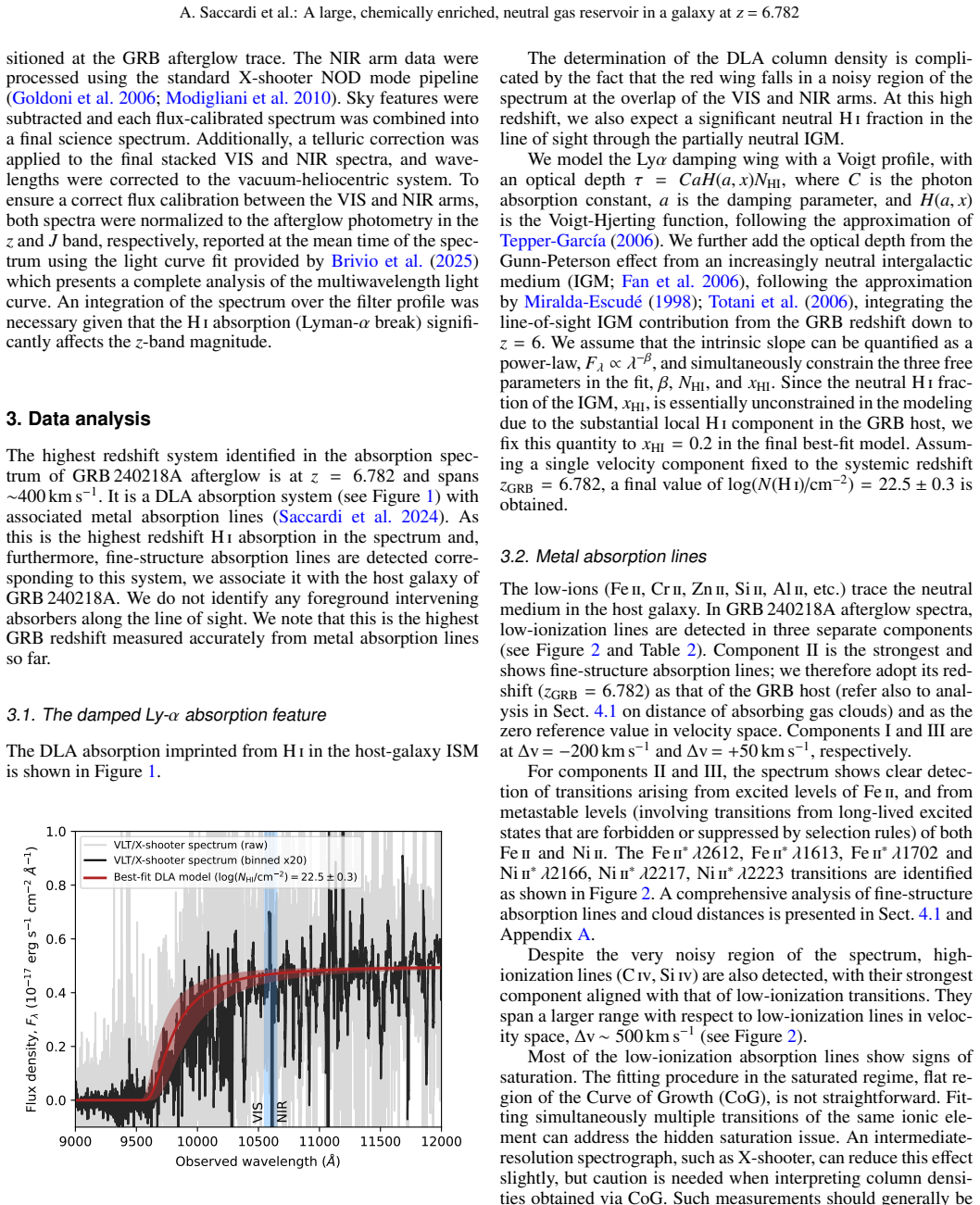
The argument is carried by absorption-line spectroscopy of the GRB afterglow. The neutral hydrogen column comes from fitting the damped Lyman-$\alpha$ (DLA) damping wing with a Voigt profile, to which a Gunn-Peterson contribution from the intergalactic medium is added; the metal column densities come from curve-of-growth and Voigt-profile fits to Zn II, Cr II, Fe II, Si II, and Al II lines. Because many lines are saturated, the fits yield lower limits or measurements that must be treated cautiously. Fine-structure and metastable lines of Fe II and Ni II are fed into a UV-pumping photo-excitation model to estimate the distance of the absorbing clouds from the burst, and a depletion-fitting method using refractory indices separates dust depletion from nucleosynthetic abundance patterns.
What would settle it
Re-fit the same X-shooter Ly$\alpha$ wing with the intergalactic neutral fraction left free or set to values near 0 and 1; if $\log(N(\mathrm{HI})/\mathrm{cm^{-2}})$ drops below about $22.2$ in a plausible fit, the record-column and $[\mathrm{Zn/H}]>-0.8$ claims fail. A second check is to observe the host galaxy after the afterglow fades with JWST or ALMA and measure an independent oxygen-based metallicity from emission lines; an oxygen abundance well below the value implied by $[\mathrm{M/H}]_{\mathrm{tot}}=-0.5$ would contradict the claim of rapid enrichment.
Extended reading notes
Core claim
The central claim, stated on the paper's own terms, is that the host galaxy of GRB 240218A at $z=6.782$ was already a massive, chemically evolved system at cosmic dawn. Its neutral hydrogen column density $\log(N(\mathrm{HI})/\mathrm{cm^{-2}})=22.5\pm0.3$ is the highest ever measured for a GRB host at $z\gtrsim6$, and the detection of strong Zn II absorption gives $[\mathrm{Zn/H}]>-0.8$. Taking the column densities at face value despite saturation, the paper derives strong dust depletion ($[\mathrm{Zn/Fe}]_{\mathrm{fit}}=1.1\pm0.4$), a dust-corrected metallicity $[\mathrm{M/H}]_{\mathrm{tot}}=-0.5\pm0.4$, and a dust-to-metal ratio $DTM=0.5\pm0.1$ similar to the Milky Way. Fine-structure lines place the closest absorbing clouds at about $620$ pc from the burst. The authors conclude that large neutral hydrogen reservoirs and rapid metal and dust build-up were likely common features of galaxies within the first billion years.
Load-bearing premise
The analysis fixes the neutral hydrogen fraction of intergalactic space at $x_{\mathrm{HI}}=0.2$ because the spectrum cannot constrain it; if the true value differs, the inferred hydrogen column density and every metallicity derived from it shift beyond the quoted uncertainty.
Editorial extensions
If this is right
- If the measurement stands, some galaxies had already built up neutral gas columns comparable to the highest seen by JWST at $z>8$ by the time the Universe was 800 million years old.
- Metals and dust can accumulate quickly in early galaxies: the dust-corrected metallicity $[\mathrm{M/H}]_{\mathrm{tot}}=-0.5\pm0.4$ and Milky-Way-like dust-to-metal ratio imply substantial enrichment within the first billion years.
- Because GRB selection is independent of host luminosity and stellar mass, such enriched neutral gas may be common in faint early galaxies, not only in the bright ones JWST readily detects.
- Fine-structure absorption lines can measure absorber distances at $z>6.5$, giving a new probe of where dense, enriched gas sits relative to star-forming regions during reionization.
- Ground-based afterglow spectroscopy can supply chemical abundances of neutral gas at the same epoch where JWST measures ionized gas, making the two views complementary.
Reading between the lines
- I infer that GRB-selected galaxies may carry a substantial share of the metal budget in the reionization epoch, since they are found independently of luminosity; JWST follow-up of this host after the afterglow fades could test that directly.
- I infer that if metal-rich neutral gas is typical, dust obscuration could bias high-redshift GRB afterglow samples against the most dust-heavy hosts, meaning the true early metallicity distribution could be even more enriched than observed.
- The aluminum overabundance, also seen in two other $z\sim6$ GRB hosts, points to enrichment by very massive rotating stars; searching for correlated nitrogen or sodium anomalies in future $z>6$ GRB spectra would test that interpretation.
- Combining fine-structure cloud distances with the high neutral hydrogen column could map where dense, enriched gas sits relative to star-forming sites, giving a direct observational handle on feedback and gas accretion at cosmic dawn.
Signed reviews
Editorial analysis
A structured set of objections, weighed in public.
Referee Report
Summary. GRB 240218A at z=6.782 was observed with VLT/X-shooter about 26 hours after the burst. The paper reports a damped Ly-alpha system with log(N(HI)/cm^-2)=22.5+/-0.3, a rich set of low-ionization, high-ionization, and fine-structure metal lines, and uses these data to derive an observed metallicity [Zn/H]>-0.8, a dust-depletion-corrected metallicity [M/H]_tot=-0.5+/-0.4, a dust-to-metal ratio DTM=0.5+/-0.1, and an absorbing-cloud distance d_II=620(+230,-140) pc. The authors argue that this is the first detailed chemical characterization of neutral gas in a galaxy at z>6.5 and that the high HI column, metal content, and dust depletion indicate rapid enrichment in the early Universe.
Significance. If the headline measurements are robust, this is an important result: it would be the highest neutral hydrogen column density measured for a GRB host at z>6, and it would provide a rare absorption-line view of the ISM of a galaxy during reionization, complementary to JWST/ALMA emission-line studies. The paper is careful in several respects: it treats the main metallicity claim as a lower limit where saturation is a concern, it cross-checks Voigt-profile fits with a curve-of-growth analysis, and it uses standard, well-established techniques. The main weakness is that the central N(HI) value is conditional on an assumed IGM neutral fraction whose systematic effect is not propagated into the quoted uncertainty, so the numerical precision of the headline claim is not yet established.
major comments (2)
- [Section 3.1] The quoted log(N(HI)/cm^-2)=22.5+/-0.3 is obtained after fixing the IGM neutral fraction to x_HI=0.2, and the text states that x_HI is 'essentially unconstrained in the modeling' because of the substantial local HI component. At z=6.782, the observed Ly-alpha damping wing is the sum of the host DLA and the Gunn-Peterson damping wing from the partially neutral IGM between z=6 and z=6.782; the two contributions are broad and shallow, so N(HI) and x_HI are strongly degenerate. The quoted +/-0.3 dex is therefore a statistical uncertainty at fixed x_HI and does not include the dominant systematic. The authors should refit with x_HI varied over a plausible range (for example 0.0, 0.1, 0.5, with reference to current constraints) and report how N(HI), [Zn/H], and the 'highest at z>6' comparison shift. Without this, the headline numerical claim is conditional on an unquantified assumption.
- [Section 4.2 and Table 3] The dust-depletion analysis treats the Fe II, Cr II, and Zn II column densities as measurements (shown in square brackets in Table 3), even though the text repeatedly states that these lines are saturated or blended and should be regarded as lower limits. The resulting quantities ([M/H]_tot=-0.5+/-0.4, [Zn/Fe]_fit=1.1+/-0.4, DTM=0.5+/-0.1, A_V,depl~5) are presented in the abstract and conclusions without the same caveat that accompanies the lower-limit metallicity. The authors should either propagate saturation-related systematics into these derived values or present them explicitly as illustrative values obtained under an assumption, while keeping the robust lower-limit metallicity as the headline result. As written, the paper's strongest conclusions about dust depletion and rapid enrichment rely on measurements that the authors themselves flag as unsafe at face value.
minor comments (5)
- [Table 2] The square brackets in Table 2 denote values obtained by treating lower limits as measurements, but this convention is not defined in the table caption or in the main text; it should be stated explicitly.
- [Table 3] Table 3 appears to give total column densities summed over absorption components, but it does not say so; the relation to the component-by-component values in Table 2 should be clarified.
- [Figure 5] The comparison between [M/H] from GRB absorption lines and 12+log(O/H) from JWST emission lines should be described more cautiously, because the two observables probe different gas phases (neutral versus ionized) and different abundance indicators.
- [Section 4.2] The quoted uncertainty of DTM=0.5+/-0.1 appears surprisingly small in view of the +/-0.4 uncertainty on [M/H]_tot; the error propagation should be explained or the uncertainty revised.
- [Section 5] The statement that this is 'the first time that strong absorption lines of metals, such as those of Zn II, have been observed at high redshift' should be qualified: strong Zn II absorption has been seen in quasar DLAs at high redshift, so the novelty claim should be limited to GRB host galaxies or explicitly compared with the QSO-DLA literature.
Circularity Check
No circularity: the paper reports independent measurements and uses external calibrations; the fixed IGM neutral fraction is an acknowledged systematic, not a circular input.
full rationale
The derivation chain is self-contained against external data and calibrations. The neutral hydrogen column density is determined by fitting the observed Ly-alpha damping wing with a Voigt profile (Tepper-Garcia 2006) plus an IGM Gunn-Peterson contribution, with the IGM neutral fraction fixed at x_HI=0.2 because it is unconstrained. That is a stated modeling assumption, not a quantity defined in terms of the target result, so it does not make the N(HI) measurement circular. The metallicity [Zn/H]>-0.8 follows from the measured Zn II lower limit and the fitted N(HI) using Asplund et al. (2021) solar abundances; no fitted parameter is renamed as a prediction. The depletion-corrected metallicity and dust-to-metal ratio are derived via the empirical De Cia et al. (2016, 2021) method and Konstantopoulou et al. (2024) calibrations, which are published, externally testable frameworks rather than assumptions that encode the paper's conclusions. Self-citations to Saccardi et al. (2023), Brivio et al. (2025), and related work supply companion data, reduction tools, or previously published methods; they are not load-bearing in a way that forces the headline claims. The acknowledged saturation issues and the degeneracy between N_HI and x_HI are robustness/systematic uncertainties, not circular reasoning. Therefore no circular step can be exhibited from the paper's equations or self-citation chain.
Assumptions & free parameters
free parameters (1)
- x_HI (IGM neutral hydrogen fraction) =
0.2
assumptions (5)
- domain assumption The z=6.782 absorption system is the GRB host galaxy, not an intervening system
- domain assumption Gas excitation is dominated by UV pumping from the GRB afterglow rather than collisions
- domain assumption The intrinsic afterglow continuum is a power law F_lambda proportional to lambda^(-beta)
- domain assumption The dust-depletion pattern follows the linear relation and refractory indices of De Cia et al. and Konstantopoulou et al.
- standard math Standard Lambda-CDM cosmology with Planck 2016 parameters
Cite this review
Pith. "Pith review of A large, chemically enriched, neutral gas reservoir in a galaxy at z = 6.782." pith.science (2026). https://pith.science/paper/YFVZUBG4
@misc{pith2026250604340,
  author       = {Pith},
  title        = {Pith review of: A large, chemically enriched, neutral gas reservoir in a galaxy at z = 6.782},
  year         = {2026},
  howpublished = {\url{https://pith.science/paper/YFVZUBG4}},
  note         = {Machine review of arXiv:2506.04340}
}
abstract
The chemical characterization of galaxies in the first billion years after the Big Bang is one of the central goals of current astrophysics. Optical/near-infrared spectroscopy of long gamma-ray bursts (GRBs) have been heralded as an effective diagnostic to probe the interstellar medium of their host galaxies and their metal and dust content, up to the highest redshift. An opportunity to fulfill this expectation was provided by the recent blast triggered by the Neil Gehrels Swift Observatory of GRB 240218A at redshift z=6.782. We study a high-redshift galaxy selected in a complementary way with respect to flux-limited surveys, not depending on galaxy luminosity and stellar mass. We present the VLT/X-shooter spectrum of its afterglow enabling the detection of neutral-hydrogen, low-ionization, high-ionization and fine-structure absorption lines. We determine the metallicity, kinematics and chemical abundance pattern, providing the first detailed characterization of the neutral gas of a galaxy at z>6.5. From the analysis of fine-structure lines we estimate the distance of the closest gas clouds as $d_{II}=620^{+230}_{-140}$ pc. We determine a high neutral hydrogen column density, $\log(N(HI)/cm^{-2})=22.5\pm0.3$, which is the highest one at z>6 determined so far for a GRB host galaxy, as well as a surprisingly high metal column density, $\log(N(ZnII)/cm^{-2})>14.3$. The observed metallicity of the host galaxy system is [Zn/H]>-0.8. We find evidence of a high amount of dust depletion and of aluminum overabundance, although a number of transitions are saturated. The high hydrogen column density, metal abundances and dust depletion in the neutral gas align with those of the ionized gas of very high-redshift galaxies unveiled by ALMA and JWST, testifying that a rapid build up of metals and dust, and massive neutral hydrogen reservoirs seem to be common features of galaxies in the early Universe.
Figures


Figures from the paper (3 more)


Forward citations
Cited by 2 Pith papers
-
Trading oxygen for iron II. Oxygen- versus iron-dependent cosmic star formation history
Most cosmic star formation occurred in gas with non-solar O/Fe; the cosmic mean [Fe/H] lags [O/H] by up to ~0.5 dex.
-
SVOM GRB 250314A at z $\simeq$ 7.3: an exploding star in the era of reionization
SVOM discovered the long gamma-ray burst GRB 250314A, whose near-infrared spectrum shows a Lyman-alpha break at redshift about 7.3, one of the few such bursts known during the reionization era.
Reference graph
Works this paper leans on
-
[1]
, " * write output.state after.block = add.period write newline
ENTRY address archiveprefix author booktitle chapter edition editor howpublished institution eprint journal key month note number organization pages publisher school series title type volume year label extra.label sort.label short.list INTEGERS output.state before.all mid.sentence after.sentence after.block FUNCTION init.state.consts #0 'before.all := #1 ...
-
[2]
write newline
" write newline "" before.all 'output.state := FUNCTION n.dashify 't := "" t empty not t #1 #1 substring "-" = t #1 #2 substring "--" = not "--" * t #2 global.max substring 't := t #1 #1 substring "-" = "-" * t #2 global.max substring 't := while if t #1 #1 substring * t #2 global.max substring 't := if while FUNCTION word.in bbl.in " " * FUNCTION format....
-
[3]
2018, Advances in Space Research, 62, 191
Amati , L., O'Brien , P., G \"o tz , D., et al. 2018, Advances in Space Research, 62, 191
2018
-
[4]
M., & Grevesse , N
Asplund , M., Amarsi , A. M., & Grevesse , N. 2021, , 653, A141
2021
-
[5]
D., Barbier , L
Barthelmy , S. D., Barbier , L. M., Cummings , J. R., et al. 2005, , 120, 143
2005
-
[6]
2019, , 623, A43
Bolmer , J., Ledoux , C., Wiseman , P., et al. 2019, , 623, A43
2019
-
[7]
2025, , 695, A239
Brivio , R., Campana , S., Covino , S., et al. 2025, , 695, A239
2025
-
[8]
J., Saxena , A., Cameron , A
Bunker , A. J., Saxena , A., Cameron , A. J., et al. 2023, , 677, A88
2023
Show all 116 references
-
[9]
N., Hill , J
Burrows , D. N., Hill , J. E., Nousek , J. A., et al. 2005, , 120, 165
2005
-
[10]
2022, Nature Astronomy, 6, 1101
Campana , S., Ghirlanda , G., Salvaterra , R., et al. 2022, Nature Astronomy, 6, 1101
2022
-
[11]
2017, Advances in Astronomy, 2017, 8929054
Cano , Z., Wang , S.-Q., Dai , Z.-G., & Wu , X.-F. 2017, Advances in Astronomy, 2017, 8929054
2017
-
[12]
2025, , 696, A87
Carniani , S., D'Eugenio , F., Ji , X., et al. 2025, , 696, A87
2025
-
[13]
2024, , 972, 143
Castellano , M., Napolitano , L., Fontana , A., et al. 2024, , 972, 143
2024
-
[14]
B., et al
Chornock , R., Berger , E., Fox , D. B., et al. 2013, , 774, 26
2013
-
[15]
J., Fox , D
Cucchiara , A., Levan , A. J., Fox , D. B., et al. 2011, , 736, 7
2011
-
[16]
2020, in Society of Photo-Optical Instrumentation Engineers (SPIE) Conference Series, Vol
Cupani , G., D'Odorico , V., Cristiani , S., et al. 2020, in Society of Photo-Optical Instrumentation Engineers (SPIE) Conference Series, Vol. 11452, Society of Photo-Optical Instrumentation Engineers (SPIE) Conference Series, 114521U
2020
-
[17]
2024, , 684, A75
Curti , M., Maiolino , R., Curtis-Lake , E., et al. 2024, , 684, A75
2024
-
[18]
2025, , 697, A89
Curti , M., Witstok , J., Jakobsen , P., et al. 2025, , 697, A89
2025
-
[19]
2024, GRB Coordinates Network, 35747, 1
D'Avanzo , P., Ferro , M., Brivio , R., et al. 2024, GRB Coordinates Network, 35747, 1
2024
-
[20]
B., Fox , A
De Cia , A., Jenkins , E. B., Fox , A. J., et al. 2021, , 597, 206
2021
-
[21]
2016, , 596, A97
De Cia , A., Ledoux , C., Mattsson , L., et al. 2016, , 596, A97
2016
-
[22]
2018, , 611, A76
De Cia , A., Ledoux , C., Petitjean , P., & Savaglio , S. 2018, , 611, A76
2018
-
[23]
De Cia , A., Ledoux , C., Savaglio , S., Schady , P., & Vreeswijk , P. M. 2013, , 560, A88
2013
-
[24]
2024, , 683, A216
De Cia , A., Roman-Duval , J., Konstantopoulou , C., et al. 2024, , 683, A216
2024
-
[25]
de Ugarte Postigo , A., Fynbo , J. P. U., Th \"o ne , C. C., et al. 2012, , 548, A11
2012
-
[26]
J., et al
de Wet , S., Izzo , L., Groot , P. J., et al. 2023, , 677, A32
2023
-
[27]
2011, , 418, 680
D'Elia , V., Campana , S., Covino , S., et al. 2011, , 418, 680
2011
-
[28]
2009 a , , 694, 332
D'Elia , V., Fiore , F., Perna , R., et al. 2009 a , , 694, 332
2009
-
[29]
2009 b , , 503, 437
D'Elia , V., Fiore , F., Perna , R., et al. 2009 b , , 503, 437
2009
-
[30]
D'Elia , V., Fynbo , J. P. U., Covino , S., et al. 2010, , 523, A36
2010
-
[31]
D'Elia , V., Fynbo , J. P. U., Goldoni , P., et al. 2014, , 564, A38
2014
-
[32]
X., D'Odorico , S., Calura , F., & Matteucci , F
Dessauges-Zavadsky , M., Prochaska , J. X., D'Odorico , S., Calura , F., & Matteucci , F. 2006, , 445, 93
2006
-
[33]
2024, , 689, A152
D'Eugenio , F., Maiolino , R., Carniani , S., et al. 2024, , 689, A152
2024
-
[34]
S., Christensen , L., et al
D'Odorico , V., Bolton , J. S., Christensen , L., et al. 2024, Experimental Astronomy, 58, 21
2024
-
[35]
A., Goad , M
Evans , P. A., Goad , M. R., Osborne , J. P., Beardmore , A. P., & Swift-XRT Team. 2024, GRB Coordinates Network, 36166, 1
2024
-
[36]
L., & Keating , B
Fan , X., Carilli , C. L., & Keating , B. 2006, , 44, 415
2006
-
[37]
M., Vejlgaard , S., van der Horst , A
Fausey , H. M., Vejlgaard , S., van der Horst , A. J., et al. 2025, , 536, 2839
2025
-
[38]
W., Lang , D., & Goodman , J
Foreman-Mackey , D., Hogg , D. W., Lang , D., & Goodman , J. 2013, , 125, 306
2013
-
[39]
S., Levan , A
Fruchter , A. S., Levan , A. J., Strolger , L., et al. 2006, , 441, 463
2006
-
[40]
2004, , 611, 1005
Gehrels , N., Chincarini , G., Giommi , P., et al. 2004, , 611, 1005
2004
-
[41]
& Razzaque , S
Gehrels , N. & Razzaque , S. 2013, Frontiers of Physics, 8, 661
2013
-
[42]
2015, , 448, 2514
Ghirlanda , G., Salvaterra , R., Ghisellini , G., et al. 2015, , 448, 2514
2015
-
[43]
2006, in Society of Photo-Optical Instrumentation Engineers (SPIE) Conference Series, Vol
Goldoni , P., Royer , F., Fran c ois , P., et al. 2006, in Society of Photo-Optical Instrumentation Engineers (SPIE) Conference Series, Vol. 6269
2006
-
[44]
N., D'Eugenio , F., Jakobsen , P., et al
Hainline , K. N., D'Eugenio , F., Jakobsen , P., et al. 2024, , 976, 160
2024
-
[45]
E., Malesani , D., Fynbo , J
Hartoog , O. E., Malesani , D., Fynbo , J. P. U., et al. 2015, , 580, A139
2015
-
[46]
E., Wiersema , K., Vreeswijk , P
Hartoog , O. E., Wiersema , K., Vreeswijk , P. M., et al. 2013, , 430, 2739
2013
-
[47]
E., Bolmer , J., Ledoux , C., et al
Heintz , K. E., Bolmer , J., Ledoux , C., et al. 2019, , 629, A131
2019
-
[48]
E., Brammer , G
Heintz , K. E., Brammer , G. B., Gim \'e nez-Arteaga , C., et al. 2023 a , Nature Astronomy, 7, 1517
2023
-
[49]
E., Brammer , G
Heintz , K. E., Brammer , G. B., Watson , D., et al. 2025, , 693, A60
2025
-
[50]
E., De Cia , A., Th \"o ne , C
Heintz , K. E., De Cia , A., Th \"o ne , C. C., et al. 2023 b , , 679, A91
2023
-
[51]
E., Watson , D., Brammer , G., et al
Heintz , K. E., Watson , D., Brammer , G., et al. 2024, Science, 384, 890
2024
-
[52]
2012, , 756, 187
Hjorth , J., Malesani , D., Jakobsson , P., et al. 2012, , 756, 187
2012
-
[53]
2003, , 423, 847
Hjorth , J., Sollerman , J., M ller , P., et al. 2003, , 423, 847
2003
-
[54]
M., Tyson , J
Ivezi \'c , Z ., Kahn , S. M., Tyson , J. A., et al. 2019, , 873, 111
2019
-
[55]
A., White , N
Kann , D. A., White , N. E., Ghirlanda , G., et al. 2024, , 686, A56
2024
-
[56]
2006, , 440, 184
Kawai , N., Kosugi , G., Aoki , K., et al. 2006, , 440, 184
2006
-
[57]
2024, , 681, A64
Konstantopoulou , C., De Cia , A., Ledoux , C., et al. 2024, , 681, A64
2024
-
[58]
K., De Cia , A., Heintz , K
Krogager , J. K., De Cia , A., Heintz , K. E., et al. 2024, , 535, 561
2024
-
[59]
2023, , 957, 39
Langeroodi , D., Hjorth , J., Chen , W., et al. 2023, , 957, 39
2023
-
[60]
Laskar , T., Pe \ n a , C., Schroeder , G., & Alexander , K. D. 2024, GRB Coordinates Network, 35878, 1
2024
-
[61]
M., Smette , A., et al
Ledoux , C., Vreeswijk , P. M., Smette , A., et al. 2009, , 506, 661
2009
-
[62]
2019, , 490, 1425
Li , Q., Narayanan , D., & Dav \'e , R. 2019, , 490, 1425
2019
-
[63]
& Dickinson , M
Madau , P. & Dickinson , M. 2014, , 52, 415
2014
-
[64]
Malesani , D. B. 2024, GRB Coordinates Network, 35749, 1
2024
-
[65]
2024, in Society of Photo-Optical Instrumentation Engineers (SPIE) Conference Series, Vol
Marconi , A., Abreu , M., Adibekyan , V., et al. 2024, in Society of Photo-Optical Instrumentation Engineers (SPIE) Conference Series, Vol. 13096, Ground-based and Airborne Instrumentation for Astronomy X, ed. J. J. Bryant , K. Motohara , & J. R. D. Vernet , 1309613
2024
-
[66]
1998, , 501, 15
Miralda-Escud \'e , J. 1998, , 501, 15
1998
-
[67]
2010, in , Vol
Modigliani , A., Goldoni , P., Royer , F., et al. 2010, in , Vol. 7737, Observatory Operations: Strategies, Processes, and Systems III, 773728
2010
-
[68]
2023, , 269, 33
Nakajima , K., Ouchi , M., Isobe , Y., et al. 2023, , 269, 33
2023
-
[69]
L., Parsotan , T
Page , K. L., Parsotan , T. M., Siegel , M. H., & Neil Gehrels Swift Observatory Team . 2024, GRB Coordinates Network, 35742, 1
2024
-
[70]
& Howk , J
P \'e roux , C. & Howk , J. C. 2020, , 58, 363
2020
-
[71]
2022, Experimental Astronomy, 54, 23
Piro , L., Ahlers , M., Coleiro , A., et al. 2022, Experimental Astronomy, 54, 23
2022
-
[72]
Planck Collaboration , Ade , P. A. R., Aghanim , N., et al. 2016, , 594, A13
2016
-
[73]
2007, , 470, 179
Prantzos , N., Charbonnel , C., & Iliadis , C. 2007, , 470, 179
2007
-
[74]
Prochaska , J. X. 2006, , 650, 272
2006
-
[75]
X., Chen , H.-W., & Bloom , J
Prochaska , J. X., Chen , H.-W., & Bloom , J. S. 2006, , 648, 95
2006
-
[76]
X., Dessauges-Zavadsky , M., Ramirez-Ruiz , E., & Chen , H.-W
Prochaska , J. X., Dessauges-Zavadsky , M., Ramirez-Ruiz , E., & Chen , H.-W. 2008, , 685, 344
2008
-
[77]
2024, , 690, A35
Pugliese , G., Saccardi , A., D'Elia , V., et al. 2024, , 690, A35
2024
-
[78]
K., et al
Ramburuth-Hurt , T., De Cia , A., Krogager , J. K., et al. 2023, , 672, A68
2023
-
[79]
2024, , 976, 193
Roberts-Borsani , G., Treu , T., Shapley , A., et al. 2024, , 976, 193
2024
-
[80]
Roming , P. W. A., Kennedy , T. E., Mason , K. O., et al. 2005, , 120, 95
2005
-
[81]
D., Kann , D
Rossi , A., Frederiks , D. D., Kann , D. A., et al. 2022, , 665, A125
2022
-
[82]
2024, GRB Coordinates Network, 35762, 1
Rossi , A., Maiorano , E., Stratta , G., D'Avanzo , P., & CIBO Collaboration . 2024, GRB Coordinates Network, 35762, 1
2024
-
[83]
B., Palmerio , J
Saccardi , A., Malesani , D. B., Palmerio , J. T., et al. 2024, GRB Coordinates Network, 35756, 1
2024
-
[84]
D., De Cia , A., et al
Saccardi , A., Vergani , S. D., De Cia , A., et al. 2023, , 671, A84
2023
-
[85]
2009, , 461, 1258
Salvaterra , R., Della Valle , M., Campana , S., et al. 2009, , 461, 1258
2009
-
[86]
2025, , 695, A23
Salvestrini , F., Feruglio , C., Tripodi , R., et al. 2025, , 695, A23
2025
-
[87]
M., Christensen , L., et al
Schady , P., Yates , R. M., Christensen , L., et al. 2024, , 529, 2807
2024
-
[88]
2018, in Society of Photo-Optical Instrumentation Engineers (SPIE) Conference Series, Vol
Schipani , P., Campana , S., Claudi , R., et al. 2018, in Society of Photo-Optical Instrumentation Engineers (SPIE) Conference Series, Vol. 10702, Ground-based and Airborne Instrumentation for Astronomy VII, ed. C. J. Evans , L. Simard , & H. Takami , 107020F
2018
-
[89]
Schroeder , G., Pe \ n a , C., Laskar , T., & Alexander , K. D. 2024, GRB Coordinates Network, 35794, 1
2024
-
[90]
2019, , 623, A92
Selsing , J., Malesani , D., Goldoni , P., et al. 2019, , 623, A92
2019
-
[91]
E., Kr \"u hler , T., et al
Sparre , M., Hartoog , O. E., Kr \"u hler , T., et al. 2014, , 785, 150
2014
-
[92]
1998, Physical Processes in the Interstellar Medium
Spitzer , L. 1998, Physical Processes in the Interstellar Medium
1998
-
[93]
R., Fox , D
Tanvir , N. R., Fox , D. B., Levan , A. J., et al. 2009, , 461, 1254
2009
-
[94]
R., Fynbo , J
Tanvir , N. R., Fynbo , J. P. U., de Ugarte Postigo , A., et al. 2019, , 483, 5380
2019
-
[95]
R., Le Floc'h , E., Christensen , L., et al
Tanvir , N. R., Le Floc'h , E., Christensen , L., et al. 2021, Experimental Astronomy, 52, 219
2021
-
[96]
2006, , 369, 2025
Tepper-Garc \' a , T. 2006, , 369, 2025
2006
-
[97]
L., Ricci , R., Bruni , G., et al
Thakur , A. L., Ricci , R., Bruni , G., et al. 2024, GRB Coordinates Network, 35866, 1
2024
-
[98]
C., Fynbo , J
Th \"o ne , C. C., Fynbo , J. P. U., Goldoni , P., et al. 2013, , 428, 3590
2013
-
[99]
2014, , 66, 63
Totani , T., Aoki , K., Hattori , T., et al. 2014, , 66, 63
2014
-
[100]
2006, , 58, 485
Totani , T., Kawai , N., Kosugi , G., et al. 2006, , 58, 485
2006
-
[101]
2024, , 689, A220
Tripodi , R., Feruglio , C., Fiore , F., et al. 2024, , 689, A220
2024
-
[102]
2023, , 946, L45
Tripodi , R., Feruglio , C., Kemper , F., et al. 2023, , 946, L45
2023
-
[103]
2024, , 971, 124
Umeda , H., Ouchi , M., Nakajima , K., et al. 2024, , 971, 124
2024
-
[104]
2011, , 536, A105
Vernet , J., Dekker , H., D'Odorico , S., et al. 2011, , 536, A105
2011
-
[105]
M., Ledoux , C., De Cia , A., & Smette , A
Vreeswijk , P. M., Ledoux , C., De Cia , A., & Smette , A. 2012, Memorie della Societa Astronomica Italiana Supplementi, 21, 14
2012
-
[106]
M., Ledoux , C., Raassen , A
Vreeswijk , P. M., Ledoux , C., Raassen , A. J. J., et al. 2013, , 549, A22
2013
-
[107]
M., Ledoux , C., Smette , A., et al
Vreeswijk , P. M., Ledoux , C., Smette , A., et al. 2007, , 468, 83
2007
-
[108]
K., et al
Watson , D., Christensen , L., Knudsen , K. K., et al. 2015, , 519, 327
2015
-
[109]
Watson , D., Fynbo , J. P. U., Ledoux , C., et al. 2006, , 652, 1011
2006
-
[110]
2016, ArXiv:1610.06892 [ [arXiv] 1610.06892 ]
Wei , J., Cordier , B., Antier , S., et al. 2016, ArXiv:1610.06892 [ [arXiv] 1610.06892 ]
2016 arXiv
-
[111]
A., Schady , P., et al
Wiseman , P., Perley , D. A., Schady , P., et al. 2017, , 607, A107
2017
-
[112]
2025, , 639, 897
Witstok , J., Jakobsen , P., Maiolino , R., et al. 2025, , 639, 897
2025
-
[113]
Woosley , S. E. & Bloom , J. S. 2006, , 44, 507
2006
-
[114]
M., P \'e roux , C., & Nelson , D
Yates , R. M., P \'e roux , C., & Nelson , D. 2021, , 508, 3535
2021
-
[115]
2022, in Handbook of X-ray and Gamma-ray Astrophysics, ed
Yuan , W., Zhang , C., Chen , Y., & Ling , Z. 2022, in Handbook of X-ray and Gamma-ray Astrophysics, ed. C. Bambi & A. Sangangelo , 86
2022
-
[116]
2015, arXiv e-prints, arXiv:1506.07735
Yuan , W., Zhang , C., Feng , H., et al. 2015, arXiv e-prints, arXiv:1506.07735
2015 arXiv
Reviewed August 7, 2026 · model on record in the stance chip above.
Discussion (0). Continue with ORCID to comment.