REVIEW 3 major objections 4 minor
Adaptive Econometric Inference under Unknown Dependence: Contrast-Local Validity
T0 review · 3 major / 4 minor · reviewed 2026-08-02 · deepseek-v4-flash
Pith's one-line read Dependence structures in econometric residuals can be learned as a low-dimensional profile, and profile-guided inference is asymptotically equivalent to an oracle that knows the true geometry.
desk verdict A genuinely new geometric diagnostic for dependence learning, with a load-bearing gap between the factor projection theory and its heuristic implementation — worth refereeing but in need of serious work. read the letter →
The pith
A machine-rendered reading of the paper's core claim, the machinery that carries it, and where it could break.
The reading
What carries the argument
The machinery is the geometric projection of an empirical dependence operator Γ̂_n onto three closed covariance classes in the Hilbert space of symmetric matrices under the Frobenius inner product: the cluster class S_C (support constrained by a cluster-support matrix), the factor class S_F(r) (low-rank plus diagonal, PSD), and the sparse class S_S (at most k_n nonzero off-diagonal entries). For each class, the projection P_d(Γ̂_n) minimizes Frobenius distance; the similarity scores S_d = ||P_d(Γ̂_n)||_F^2 are normalized to give ω. Identification hinges on the off-diagonal tangent spaces T^off_d and their principal angles: positive angles yield local identification (Theorem 1), zero angles y
What would settle it
Run the alternating-projection factor algorithm on the same simulated factor design from several random initializations and from the diagonal-truncation initialization at a moderate sample size where the eigenvalue gap is small; if the resulting ω̂ values differ substantially, the profile is not well-defined and the oracle-equivalence claim fails. A second check: construct a design where the cluster and sparse geometries have overlapping supports (e.g., small clusters and large sparsity budget), compute the principal angle, and verify that classification consistency still holds; the paper's si
Extended reading notes
Core claim
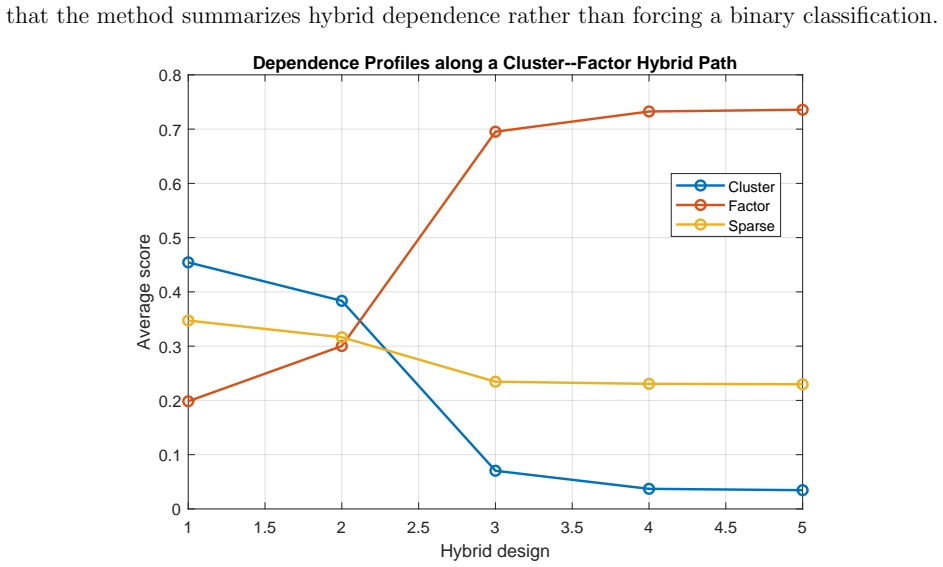
The paper's central claim is that the dependence architecture underlying econometric residuals can be summarized by a low-dimensional profile ω = (ω_C, ω_F, ω_S) of normalized squared Frobenius projections of an empirical dependence operator onto cluster, factor, and sparse covariance geometries. Under a principal-angle separation condition on the off-diagonal parts of the tangent spaces, the profile is locally identified and its estimator is consistent and asymptotically normal. When a dominant geometry exists with positive separation margin, the estimated dominant geometry is consistent and the profile-guided variance estimator is asymptotically equivalent to an infeasible oracle that know
Load-bearing premise
The asymptotic results rely on the population projections P_d, especially the factor projection onto the nonconvex class S_F(r), being locally unique and Hadamard differentiable at Γ_0; the paper's own alternating-projection algorithm converges to a stationary point that need not be the global minimizer, so if the algorithm lands on a different stationary point, the estimated profile need not be consistent and oracle adaptivity would not follow.
Editorial extensions
If this is right
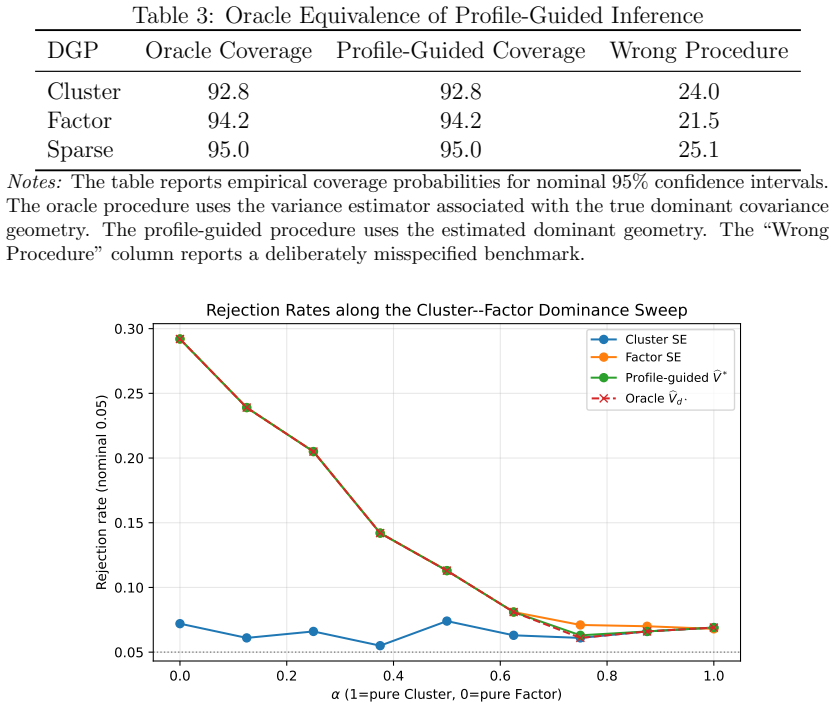
- Researchers can choose between cluster-robust, factor-adjusted, and sparse-dependence procedures based on the data rather than a maintained assumption, with first-order behavior matching an oracle (Theorem 7).
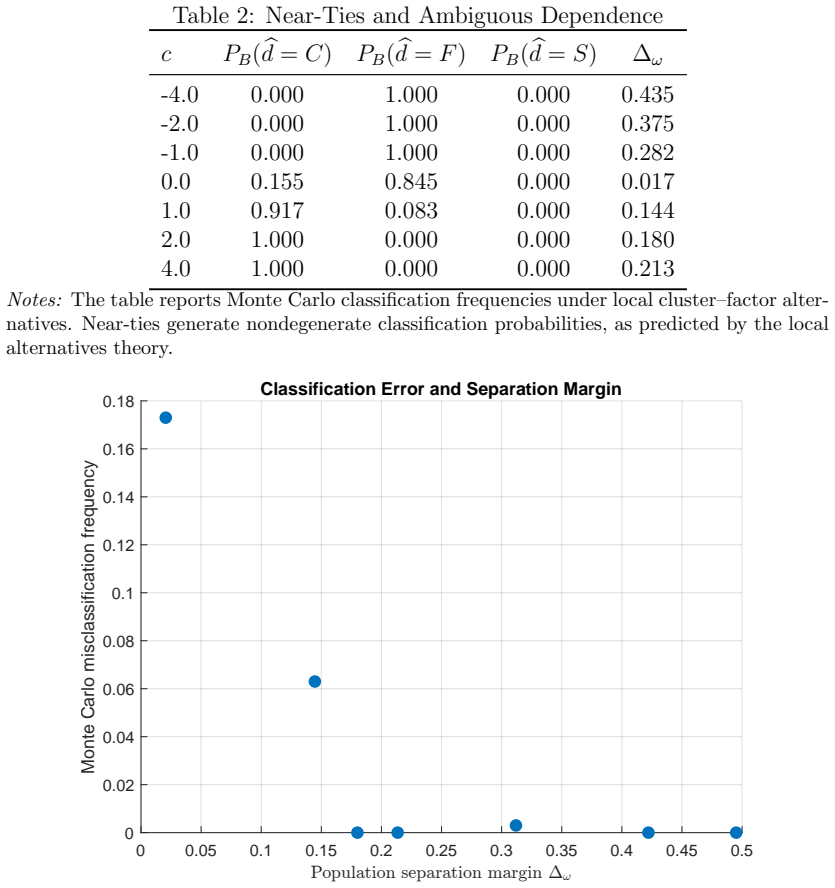
- Near-ties in the profile are a signal of structural ambiguity; the recommended practice is to report inference from multiple procedures rather than force a single classification.
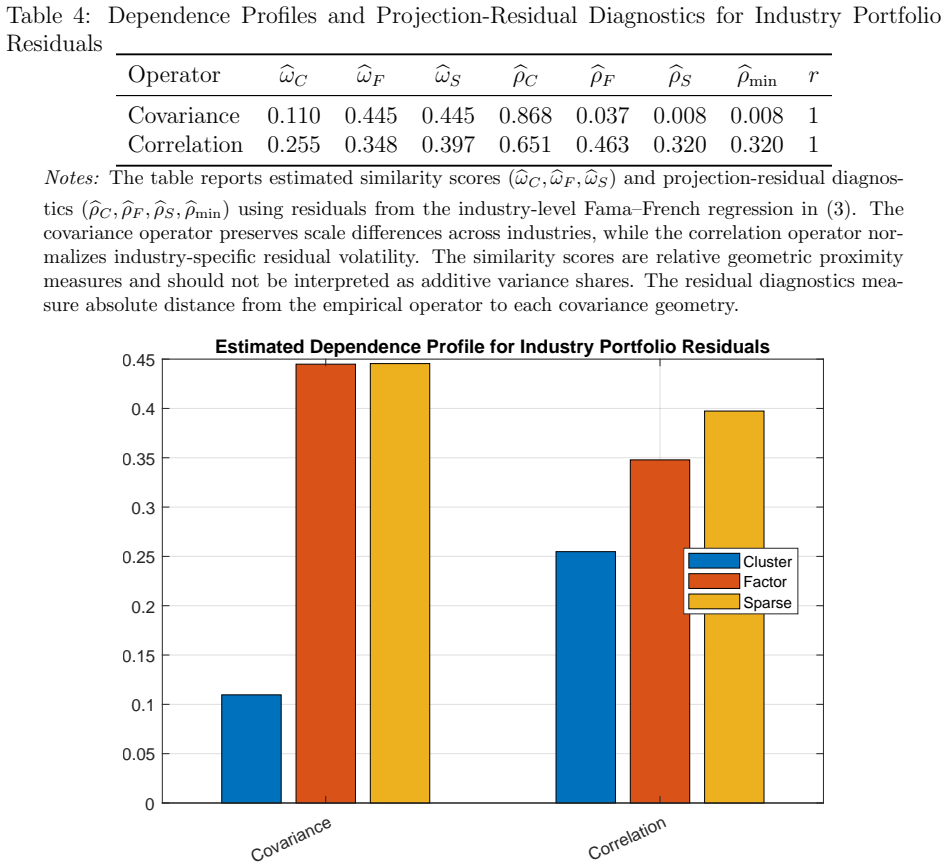
- Projection-residual diagnostics provide an absolute check: a large minimum residual indicates the covariance dictionary is misspecified, and profile scores should be interpreted with caution.
- The framework is dictionary-general: any closed covariance class satisfying projection regularity (spatial, network, long-run) can be plugged in, extending the same identification and adaptivity logic.
- The profile-weighted variance estimator V̂_avg = Σ_d ω̂_d V̂_d is a natural model-averaging extension, though its efficiency theory is left for future work.
Reading between the lines
- The paper's own empirical illustration shows the dependence profile differs between covariance and correlation operators, which implies that scale choices for the dependence operator carry information; a natural extension would be to develop an operator-selection or sensitivity procedure around this scale dependence.
- Because Theorem 2 identifies an impossibility region, follow-up work could characterize the rate at which geometries become distinguishable as the overlap angle grows, giving a sample-size-adjusted margin for classification.
- The algorithmic gap between the population factor projection and the alternating-projection fixed point suggests a testable robustness prescription: report profile estimates under multiple factor initializations, and flag cases where the profile is initialization-dependent.
- The framework's oracle-adaptivity result implies that in large samples, profile-guided inference should dominate any fixed robust procedure in terms of coverage accuracy regardless of the true geometry, a claim that could be checked in a multi-design Monte Carlo study.
Editorial analysis
A structured set of objections, weighed in public.
Referee Report
Summary. This paper develops a geometric framework for learning the dependence structure of an econometric disturbance vector. Candidate structures—cluster, factor, and sparse—are represented as closed subsets (covariance geometries) of the Hilbert space of symmetric matrices, and an estimable dependence operator Γ̂_n is projected onto each class. The normalized squared Frobenius norms of these projections form a 'dependence profile' ω=(ω_C,ω_F,ω_S). The paper claims local identification of ω under a principal-angle separation condition (Thm 1), a first-order indistinguishability theorem when tangent spaces overlap (Thm 2), consistency and asymptotic normality (Thms 3–4), classification consistency with finite-sample bounds (Prop 2, Thms 5–6), and oracle adaptivity of profile-guided inference (Thm 7, Cor 2). The main applied payoff is that one can select a dependence-robust variance estimator in a data-driven way and match an infeasible oracle that knows the dominant geometry in advance. Simulations and an empirical illustration with Fama–French industry portfolios support the framework.
Significance. The geometric formulation is a useful addition to the econometric toolkit: it makes dependence-structure learning an estimation problem rather than a maintained assumption, and the impossibility result (Thm 2) is a clean formalization of ambiguity. The paper also provides explicit finite-sample classification bounds (Prop 2), a transparent projection-residual diagnostic, and a replication package. If the consistency results were shown for the object actually computed, the profile would be a practical diagnostic with clear interpretation. However, the current manuscript stops short of proving that the implemented estimator satisfies the theoretical conditions, and the 'oracle adaptivity' result is largely a restatement of classification consistency. These gaps are fixable, but they are central to the paper's main claim.
major comments (3)
- [Online Appendix B.1; Lemma 4; Theorem 3] The factor projection actually computed is not the object for which consistency is proved. Online Appendix B.1 states that the alternating-projection algorithm converges to a stationary point that 'need not be the global minimizer P_F(bΓ_n)' except when bΓ_n is sufficiently close to a regular factor point. But Lemma 4 and Theorem 3 require max_d ||bP_d − P_d,0|| = o_p(1) for each geometry, and Theorems 5 and 7 build on that. If the algorithm returns a different stationary point, bP_F is not P_F(bΓ_n), so the theoretical consistency, asymptotic normality, and oracle-equivalence results do not apply to the computed object. Since Sections 8 and 9 use this heuristic, the reported coverage probabilities and profiles are not covered by the theorems. The authors should either prove convergence to the global minimizer with probability tending to one under the maintained assumptions (e.g., initia
- [Table E.2; Assumption 1; Theorems 1, 3, 4] The paper's own simulation evidence violates the principal-angle identification condition. Table E.2 reports θ(T_off_C, T_off_S) = 0° in every design, so Assumption 1 fails for the cluster–sparse pair. Yet Theorems 1, 3, and 4 are stated under Assumption 1, and Theorem 5 relies on Theorem 3. Section E.6 acknowledges the violation and then proceeds to use those same designs to support the profile-recovery and classification conclusions. This creates a mismatch between the formal sufficient condition and the evidence. The authors should state which results hold under the weaker condition of a positive separation margin Δω alone, or modify the theorems/simulations so that the reported evidence directly validates the claimed conditions.
- [Theorem 7; Section 7.4] The 'oracle' in Theorem 7 is defined internally as d* = argmax_d ω_d, the population argmax of the profile itself. On the event {b̂d = d*} the equality bV* = bV_d* holds exactly, and P(b̂d = d*) → 1 by Theorem 5. Thus bV* − bV_d* = o_p(1) is essentially a restatement of classification consistency, not an adaptivity result with respect to an external risk or inferential loss. Moreover, no condition links ω-dominance to which variance estimator is actually valid or efficient for the inferential target. The phrase 'infeasible oracle that knows the dominant covariance geometry in advance' is therefore stronger than what is proved. I recommend redefining the oracle in terms of the inferential loss used in Section 7.4, or softening the claim to 'consistent procedure selection given a fixed dictionary'.
minor comments (4)
- [Section 9.5; Table 6] The text says the covariance operator has factor and sparse scores exactly tied at 0.445, but Table 6 reports b̂Δω = 0.001 for the covariance operator. If the scores are tied, the margin should be 0. Please reconcile.
- [Online Appendix D.2, Lemma D.7] In the factor-geometry paragraph, the proof states 'at Σ_F ∈ M_r the residual Σ_F − P_F(Σ_F) = D_F'; but if Σ_F ∈ S_F(r), then P_F(Σ_F) = Σ_F and the residual is zero. The sentence appears to refer to projection onto the fixed-rank manifold rather than onto S_F(r). The derivative result is standard, but the argument needs correction.
- [Online Appendix B.1, Step 3] The positive-semidefinite shift adds the same constant to all diagonal entries when the minimum eigenvalue is negative, which changes the Frobenius objective. The text says the shift 'leaves the objective unchanged when no shift is needed'; explain why the shift is a valid constrained projection or how it affects the convergence claims.
- [Section 4.2] There is a typo 'Proposition 1 hlds' in the statement of Proposition 1. Also, the proof of Proposition 1 uses continuity of the projection at Γ0, which requires the regularity conditions from Lemma D.13; this should be stated in the proposition.
Circularity Check
Oracle adaptivity is largely definitional: the infeasible oracle is defined as knowing d* = argmax ω_d, the same functional the profile estimates, so Theorem 7 restates classification consistency.
-
self definitional
[Section 7.4, Theorem 7; dominant geometry defined in Section 6.4, eq. (2)]
"Let d ⋆ = arg max_{d∈D} ω_d denote the dominant covariance geometry... Define bd = arg max_{d∈D} bω_d, bV ⋆ = bV_bd. Then bV ⋆ − bV_d⋆ = o_p(1). Consequently, bV ⋆ p − → V_d⋆. Thus, the profile-guided variance estimator is asymptotically equivalent to the infeasible oracle estimator that knows the dominant covariance geometry in advance."
The oracle is not an independent benchmark: knowing the 'dominant covariance geometry' means knowing d* = arg max_d ω_d, which is a functional of the population dependence profile ω_0 that bω is constructed to estimate. Theorem 7 therefore follows by combining Theorem 5 (P(bd=d*)→1) with the definitional identity bV* = bV_d* on the event {bd=d*}. The asymptotic equivalence is built into the definitions—the profile-guided selection and the oracle select the same geometry whenever classification succeeds. The substantive content is classification consistency, not an independent demonstration that the selected geometry is optimal for inference.
full rationale
The paper's estimation and classification theory is otherwise self-contained: ω is a defined functional of the empirical dependence operator, and Theorems 1–6 establish identification, normality, and classification under stated assumptions without fitting any parameter to a target and then 'predicting' that target. There are no load-bearing self-citations. The main circularity concern is the headline oracle-adaptivity claim: the infeasible oracle knows d* = arg max ω_d, and the profile-guided estimator uses bd = arg max bω_d, so Theorem 7 is essentially Theorem 5 restated as 'estimated argmax tracks population argmax'; on the correct-classification event the two variance estimators coincide by construction. This is a definitional reduction rather than an empirical fit, so it warrants a moderate score rather than a high one. The paper itself flags non-circular limitations that should be weighed separately: the diagonal subspace is common to all geometries (Online Appendix A.1), the cluster–sparse principal angle is 0° in the simulation designs so Assumption 1 fails (Online Appendix E.6), and the factor alternating-projection algorithm 'need not be the global minimizer P_F(bΓ_n)' (Online Appendix B.1), so the implemented profile may not be the theoretical projection. These gaps affect external validity but are not circularity, and I do not count them in the score.
Assumptions & free parameters
free parameters (5)
- sparsity budget k_n =
0.01·n² in simulations (625); threshold in empirical
- factor rank r =
1 in empirical (eigenvalue-ratio); true rank in simulations
- residual threshold δ =
n.s.
- alternating-projection tolerances =
n.s.
- near-tie calibration σ_a² =
≈5.49
assumptions (10)
- domain assumption Assumption 1: principal-angle separation θ(T_i^off, T_j^off) ≥ θ_0 > 0 for all i≠j
- domain assumption Assumption 2: sparse projection regularity (distinct k_n-th and (k_n+1)-th largest off-diagonal entries)
- standard math Assumption 3: local asymptotic normality (LAN)
- domain assumption Assumption 4: consistency of empirical dependence operator
- domain assumption Assumption 5: asymptotic linearity of dependence operator
- domain assumption Assumption 6: consistent covariance estimation
- domain assumption Assumption 7: unique dominant geometry (separation margin Δ_ω > 0)
- domain assumption Regularity of covariance classes: closedness, prox-regularity, local uniqueness of projections
- domain assumption Cone property of covariance classes
- standard math Finite-dimensional Hilbert space H of symmetric matrices with Frobenius inner product
invented entities (2)
-
Dependence profile ω = (ω_C, ω_F, ω_S)
independent evidence
-
Procedure confidence index κ = (1 - ρ_min) Δ_ω
independent evidence
Cite this review
Pith. "Pith review of Adaptive Econometric Inference under Unknown Dependence: Contrast-Local Validity." pith.science (2026). https://pith.science/paper/YG2BM6LW
@misc{pith2026260622555,
  author       = {Pith},
  title        = {Pith review of: Adaptive Econometric Inference under Unknown Dependence: Contrast-Local Validity},
  year         = {2026},
  howpublished = {\url{https://pith.science/paper/YG2BM6LW}},
  note         = {Machine review of arXiv:2606.22555}
}
read the original abstract
Empirical conclusions can depend on how researchers model dependence when constructing standard errors. We develop contrast-local validity, which asks whether a covariance restriction is accurate for the particular coefficient or weighted contrast being reported, even when the restriction is globally misspecified. The method tests target-specific covariance contamination, compares numerically certified structured corrections with an unrestricted benchmark, and adapts inference to the economic target. In a separate growing-block benchmark, valid structure achieves an optimal faster rate for estimating the target variance, while any globally misspecified covariance approximation must fail for some contrast. In a Fama--French calibration where validity is imposed, the feasible selector preserves nominal coverage and reduces variance-estimation root mean squared error by 39 percent. A publicly available FHFA house-price application illustrates target-specific verdicts across regional exposures. Detectability and coverage-risk analyses show when non-rejection is informative and when unrestricted inference should remain primary.
Figures
Figures from the paper (1 more)
Reviewed August 2, 2026 · model on record in the stance chip above.
Discussion (0). Continue with ORCID to comment.