An extension of Lambertson method to horizontally asymmetric Beam Position Monitors
Pith reviewed 2026-06-30 00:21 UTC · model grok-4.3
The pith
The Lambertson method can be extended to measure electrical center offsets in horizontally asymmetric beam position monitors.
A machine-rendered reading of the paper's core claim, the machinery that carries it, and where it could break.
Core claim
We present our extension of the Lambertson method to BPMs that are asymmetric in the horizontal direction, and we apply it to such BPMs in the ALS Upgrade project at Lawrence Berkeley National Laboratory.
What carries the argument
The extended Lambertson method modified for horizontal asymmetry in BPMs, which measures the electrical center offset due to pickup button imperfections.
Load-bearing premise
The core measurement principle of the classical Lambertson method remains valid after modification for horizontal asymmetry without introducing unaccounted systematic errors from the asymmetry itself.
What would settle it
A direct comparison showing that the extended method produces different offset values than expected from the symmetric case in a controlled asymmetric BPM setup would indicate the extension introduces errors.
Figures

read the original abstract
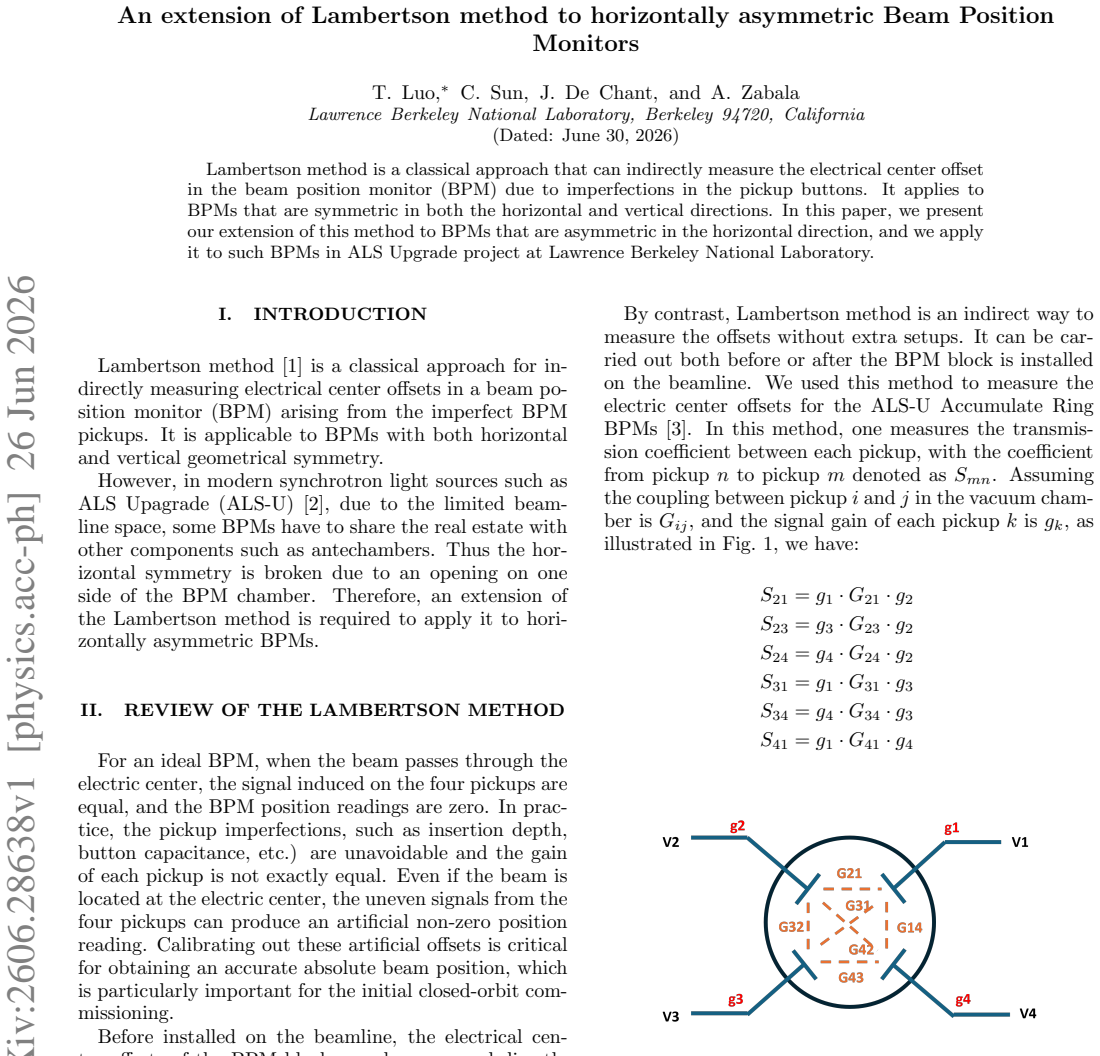
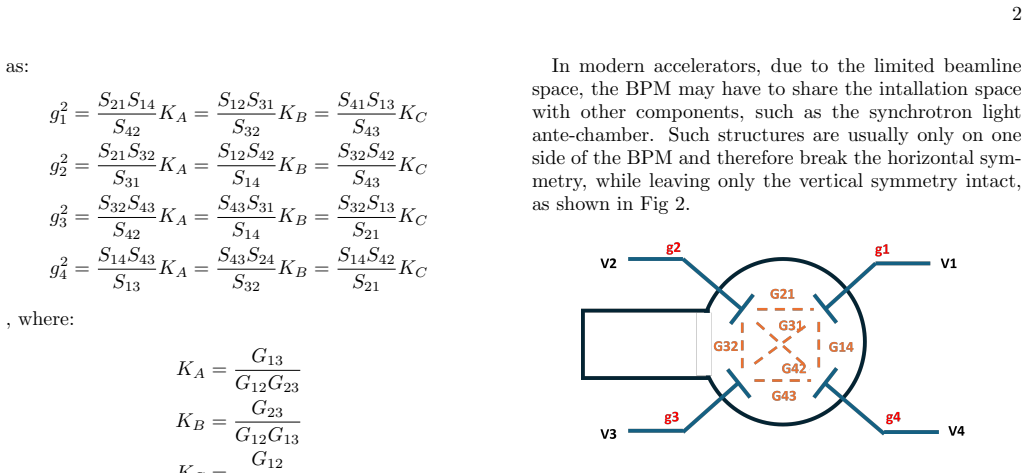
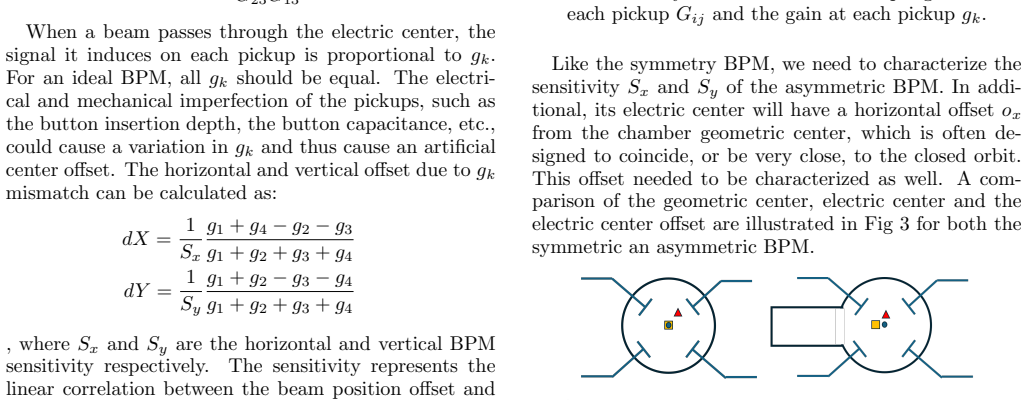
Lambertson method is a classical approach that can indirectly measure the electrical center offset in the beam position monitor (BPM) due to imperfections in the pickup buttons. It applies to BPMs that are symmetric in both the horizontal and vertical directions. In this paper, we present our extension of this method to BPMs that are asymmetric in the horizontal direction, and we apply it to such BPMs in ALS Upgrade project at Lawrence Berkeley National Laboratory.
Editorial analysis
A structured set of objections, weighed in public.
Referee Report
Summary. The manuscript claims to extend the classical Lambertson method—which measures electrical center offsets in symmetric BPMs due to pickup button imperfections—to BPMs that are asymmetric in the horizontal direction, and states that the extension is applied to BPMs in the ALS Upgrade project at Lawrence Berkeley National Laboratory.
Significance. If a correct and validated extension were provided, it could enable offset calibration for horizontally asymmetric BPMs used in modern accelerator projects, addressing a practical limitation of the original method. The current manuscript supplies no such derivation, equations, validation data, or error analysis, so no assessment of significance is possible.
major comments (1)
- No equations, derivation, or validation data are present in the manuscript (which consists solely of the abstract). The central claim that the extension preserves the validity of the Lambertson measurement principle for horizontal asymmetry therefore cannot be evaluated for internal consistency or systematic errors.
Simulated Author's Rebuttal
We thank the referee for their review. We acknowledge that the provided manuscript consists solely of the abstract and therefore lacks the detailed technical content needed for evaluation.
read point-by-point responses
-
Referee: No equations, derivation, or validation data are present in the manuscript (which consists solely of the abstract). The central claim that the extension preserves the validity of the Lambertson measurement principle for horizontal asymmetry therefore cannot be evaluated for internal consistency or systematic errors.
Authors: We agree with this assessment. The current version is limited to the abstract, which states the intent to present the extension and its application to ALS Upgrade BPMs but provides no supporting material. In the revised manuscript we will include the full derivation of the horizontally asymmetric extension, the modified equations, the application to the ALS Upgrade BPMs, validation data, and error analysis so that the preservation of the Lambertson principle and any systematic effects can be evaluated. revision: yes
Circularity Check
No derivation chain present; abstract announces extension without equations or steps
full rationale
The document supplies only an abstract that states the existence of an extension to the Lambertson method for horizontally asymmetric BPMs and its application to the ALS Upgrade. No equations, modified measurement principles, validation procedures, or derivation steps are given. Without any load-bearing technical content, none of the enumerated circularity patterns (self-definitional, fitted-input prediction, self-citation chains, etc.) can be exhibited by direct quotation and reduction. The paper is therefore self-contained against external benchmarks at the level of detail provided, yielding a score of 0.
Axiom & Free-Parameter Ledger
Reference graph
Works this paper leans on
-
[1]
Determine the sensitivityS x andS y, and the elec- tric center relative to the geometric centero x for a BPM with perfect pickups, as described in Sec.III
-
[2]
Simulate the transmission coefficients for this BPM and calculate theη
-
[3]
Introduce the pickup gain errors by inserting or re- cessing the pickups
-
[4]
From the beam-induced signal on each pickupP i, one can calculate its frequency spectrum through Fourier transform
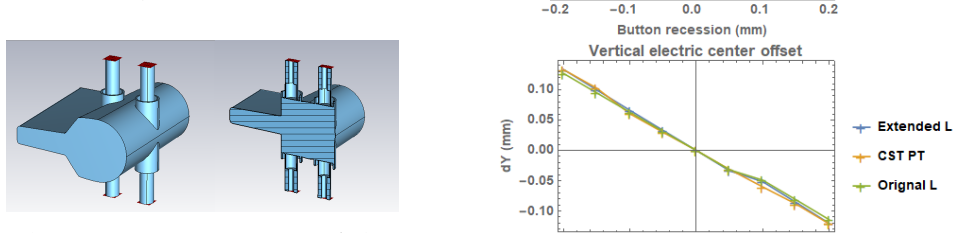
Simulate a beam passing through the geometric center of this imperfect BPM in CST Particle Studio. From the beam-induced signal on each pickupP i, one can calculate its frequency spectrum through Fourier transform. In this spectrum, the signal strength at 500 MHz isF i. The electric cen- ter offsets caused by pickup errors are calculated as: dXP T = 1 Sx ...
-
[5]
FromS ij andη, deriveg i and calculate the center offsetsdX EL anddY EL by the extended Lambertson (EL) method
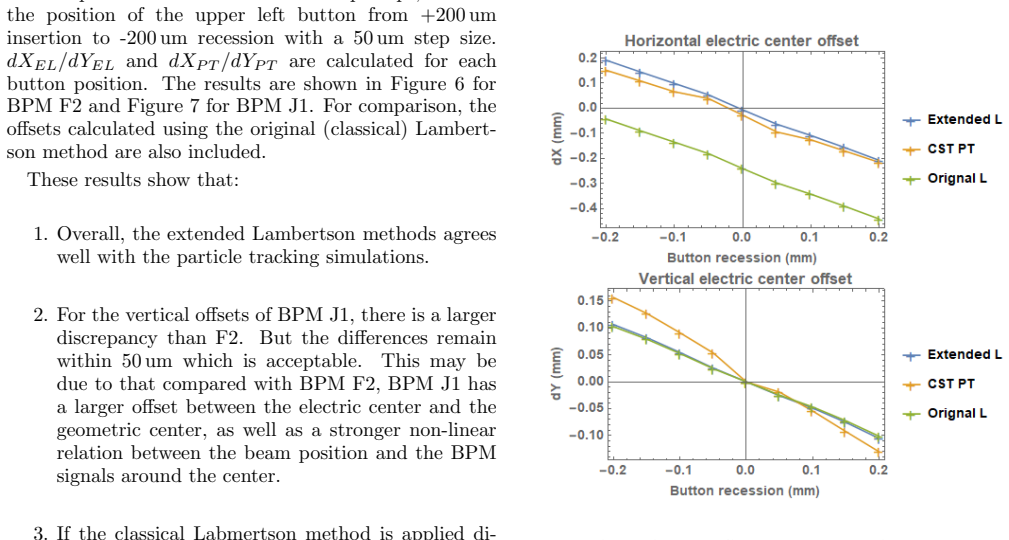
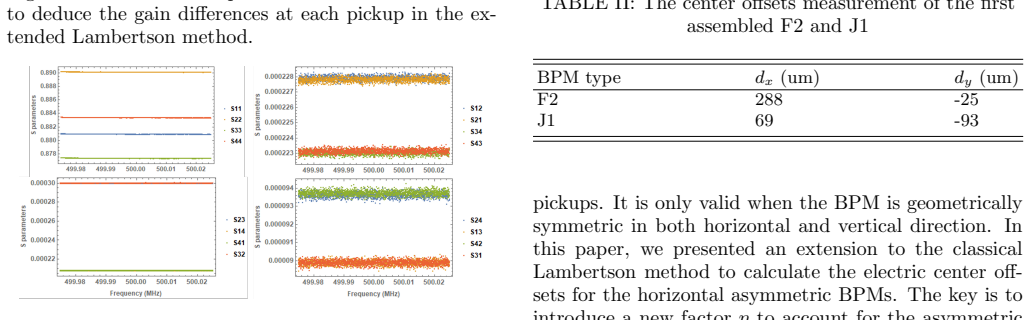
For the same imperfect BPM, simulate the trans- mission coefficientS ij through each pickup pairs. FromS ij andη, deriveg i and calculate the center offsetsdX EL anddY EL by the extended Lambertson (EL) method. Agreement between dXEL/dYEL anddX P T/dYP T validates the ex- tended Lambertson method. Two ALS-U Storage Ring BPMs, labeled as type F2 and J1, ar...
-
[6]
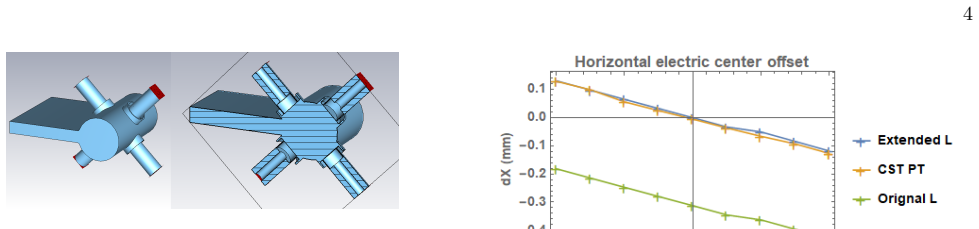
Overall, the extended Lambertson methods agrees well with the particle tracking simulations
-
[7]
But the differences remain within 50 um which is acceptable
For the vertical offsets of BPM J1, there is a larger discrepancy than F2. But the differences remain within 50 um which is acceptable. This may be due to that compared with BPM F2, BPM J1 has a larger offset between the electric center and the geometric center, as well as a stronger non-linear relation between the beam position and the BPM signals around...
-
[8]
It still works for the verti- cal offset because vertical symmetry is preserved
If the classical Labmertson method is applied di- rectly without the factorη, there will be a large horizontal offset error. It still works for the verti- cal offset because vertical symmetry is preserved. TABLE I: The sensitivities and horizontal offset for ALS-U BPM F2 and J1 BPM typeS x (%/mm)S y (%/mm)o x (um)η F2 15.3 15.0 149 0.83 J1 12.1 15.8 -379 ...
-
[9]
G. R. Lambertson,Calibration of Position Electrodes Us- ing External Measurements, Tech. Rep. LSAP Note-5 (Lawrence BerkeleyLaborator, May 1987)
1987
-
[10]
Steieret al., Design Progress of ALS-U, the Soft X- ray Diffraction Limited Upgrade of the Advanced Light Source, in10th International Particle Accelerator Confer- ence(2019) p
C. Steieret al., Design Progress of ALS-U, the Soft X- ray Diffraction Limited Upgrade of the Advanced Light Source, in10th International Particle Accelerator Confer- ence(2019) p. TUPGW097
2019
-
[11]
Luoet al., Electromagnetic bench testing of ALS Up- grade beam monitor buttons and assemblies, inProc
T. Luoet al., Electromagnetic bench testing of ALS Up- grade beam monitor buttons and assemblies, inProc. IPAC’24, IPAC’24 - 15th International Particle Accelera- tor Conference No. 15 (2024) pp. 2365–2367
2024
-
[12]
Dassault Syst` emes, CST Studio Suite,https://3ds.com
discussion (0)
Sign in with ORCID, Apple, or X to comment. Anyone can read and Pith papers without signing in.