Reducing Building Heat Demand Through Intelligent Control: A Comparative Simulation Study
Pith reviewed 2026-06-26 22:48 UTC · model grok-4.3
The pith
A comfort-oriented MPC for building heating achieves lower total heat consumption than one minimizing heating power.
A machine-rendered reading of the paper's core claim, the machinery that carries it, and where it could break.
Core claim
Two MPC strategies were implemented with a simplified RC model derived from synthetic data generated by an ISO 52016-1 building model. The comfort-oriented controller, which emphasizes indoor temperature tracking, achieved lower total heat consumption than the controller minimizing quadratic heating power. Both strategies satisfied comfort and system constraints, but produced different energy use and temperature variation patterns. The results indicate that the formulation of the objective function determines heating demand outcomes.
What carries the argument
Two MPC strategies that differ solely in their optimization objective: one minimizing quadratic heating power and the other prioritizing thermal comfort through temperature tracking, both using the same simplified RC internal model.
If this is right
- Both MPC strategies maintain indoor comfort and respect system constraints over the simulation period.
- The choice of objective function in MPC directly affects total heating energy consumption.
- High comfort levels can be maintained while achieving lower heating demand without modifying the building envelope.
- Objective function design is a key factor in achieving energy reductions through intelligent heating control.
Where Pith is reading between the lines
- Control systems could default to comfort tracking objectives to achieve energy savings if the pattern holds across buildings.
- The approach might apply to other building types if the RC model can be re-parametrized from local data.
- Real-world deployment would need to test whether the simulated energy difference persists under variable weather and occupancy.
- Comparing these MPC variants to conventional heating-curve controllers could quantify additional savings beyond the two strategies studied.
Load-bearing premise
The simplified resistance-capacitance model parametrized from synthetic ISO 52016-1 data accurately represents the building's thermal dynamics for use as the internal model in the MPC strategies.
What would settle it
Running both controllers on a physical building with direct measurements of heat consumption and indoor temperatures over multiple days to check if the comfort-oriented strategy still uses less total heat.
Figures
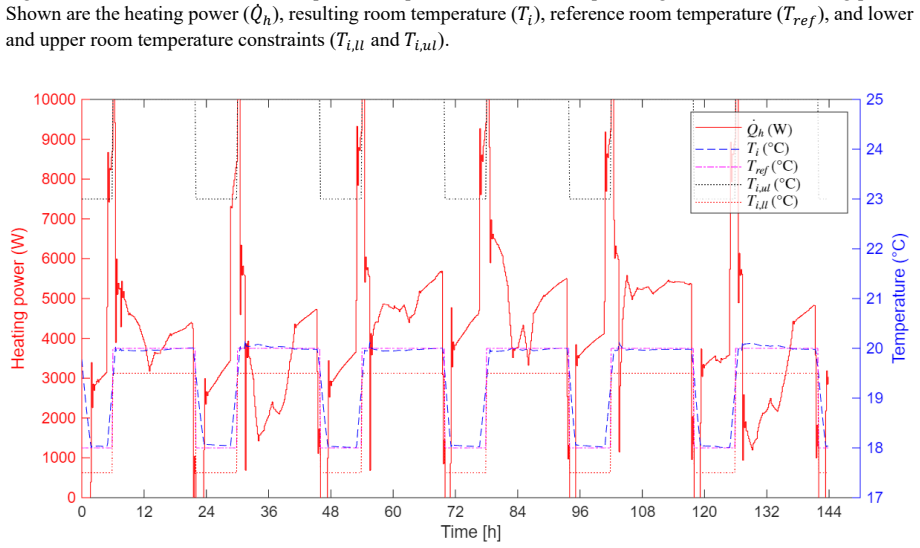
read the original abstract
Space heating remains the dominant energy consumer in buildings. While structural retrofitting can substantially reduce demand, it is often costly and time-intensive. As an alternative, this study investigates the potential of intelligent heating control strategies to reduce heat consumption with lower investment and faster implementation. Previous studies have shown that replacing conventional heating-curve-based controllers with model predictive controllers (MPCs) can reduce heating energy demand. Whereas most studies compare MPC to conventional control, this work evaluates two MPC strategies with different control objectives and quantifies their impact on indoor temperature tracking and heating demand. A virtual residential building model was developed in Python based on ISO 52016-1 to generate synthetic measurement data. A simplified resistance-capacitance (RC) model was parametrised using this dataset and used as the internal model for two MPC strategies implemented in MATLAB. The strategies differ only in their optimisation objective: one minimises quadratic heating power, while the other prioritises indoor temperature tracking for thermal comfort. Simulations over six days show that both strategies satisfy comfort and system constraints, but differ in energy use and temperature variation. The comfort-oriented controller achieves lower total heat consumption than the controller minimising heating power, which is attributed to the penalisation of high heating rates in the quadratic objective function. The results demonstrate the importance of objective function formulation in MPC design and show that high comfort levels can be maintained while achieving lower heating demand without structural modifications to the building envelope.
Editorial analysis
A structured set of objections, weighed in public.
Referee Report
Summary. The paper develops a virtual residential building model based on ISO 52016-1 to generate synthetic data for parametrizing a simplified RC model, which serves as the internal model for two MPC strategies implemented in MATLAB. The strategies differ only in objective: one minimizes quadratic heating power and the other prioritizes indoor temperature tracking. Six-day closed-loop simulations show both satisfy comfort and system constraints, but the comfort-oriented controller achieves lower total heat consumption, attributed to penalization of high heating rates in the quadratic objective.
Significance. If the simulation setup uses the RC model consistently for both prediction and plant dynamics, the work illustrates how objective-function design in MPC can yield lower heating demand while preserving comfort, without envelope modifications. The use of a standard ISO model for synthetic data generation supports reproducibility of the parametrization step.
major comments (1)
- [Abstract / Methods] Abstract and simulation-setup description: the manuscript does not identify whether the reported closed-loop trajectories are generated with the high-fidelity ISO 52016-1 model or the RC approximation as the plant. This is load-bearing for the central claim, because an energy difference obtained under perfect model match (RC as both predictor and plant) is an artifact of the objective choice and does not address applicability to real buildings where mismatch occurs.
minor comments (2)
- The abstract states that the RC model was 'parametrised using this dataset' but provides no numerical values for the thermal resistances and capacitances, nor the fitting procedure or validation metrics against the ISO data.
- No explicit statement of the disturbance profiles, initial conditions, or exact constraint bounds used in the six-day simulations.
Simulated Author's Rebuttal
We thank the referee for the constructive feedback on our manuscript. We address the major comment below and will revise the paper to improve clarity on the simulation setup.
read point-by-point responses
-
Referee: [Abstract / Methods] Abstract and simulation-setup description: the manuscript does not identify whether the reported closed-loop trajectories are generated with the high-fidelity ISO 52016-1 model or the RC approximation as the plant. This is load-bearing for the central claim, because an energy difference obtained under perfect model match (RC as both predictor and plant) is an artifact of the objective choice and does not address applicability to real buildings where mismatch occurs.
Authors: We agree that the manuscript should explicitly state the plant model used for the closed-loop simulations. The study employs the parametrized RC model as both the internal MPC model and the plant dynamics, with the ISO 52016-1 model used only to generate the synthetic data for RC parametrization. We will revise the abstract and methods sections to make this clear. The simulation is intentionally a perfect-match case to isolate the impact of objective-function choice on energy use and comfort; this is a standard approach in comparative MPC studies to establish baseline behavior before addressing mismatch. While the referee correctly notes that real buildings introduce mismatch, the manuscript's claim concerns the importance of objective formulation within a consistent simulation framework, which remains valid and informative for MPC design. revision: yes
Circularity Check
No circularity: results from independent forward simulations of distinct MPC objectives
full rationale
The paper generates synthetic data once from the ISO 52016-1 model solely to parametrize the RC internal model, then runs closed-loop simulations of two MPCs that differ only in their objective functions. The reported lower heat consumption for the comfort-oriented controller is produced by executing those distinct optimizations over the six-day horizon; it does not reduce by construction to any fitted parameter, self-definition, or self-citation chain. The derivation chain consists of standard model-predictive control steps whose outputs are falsifiable simulation trajectories rather than tautological restatements of inputs.
Axiom & Free-Parameter Ledger
free parameters (1)
- RC model thermal resistances and capacitances
axioms (1)
- domain assumption The simplified RC model sufficiently approximates the building thermal dynamics for MPC optimization purposes
Reference graph
Works this paper leans on
-
[1]
INTRODUCTION Buildings account for approximately 40% of global final energy consumption, with a large portion attributable to space heating and cooling [1]. Hydronic heating systems have traditionally been regulated by simple weather-compensation controllers (heating curve controllers) that adjust the heat supply based solely on the current outdoor ambien...
-
[2]
internal plant model
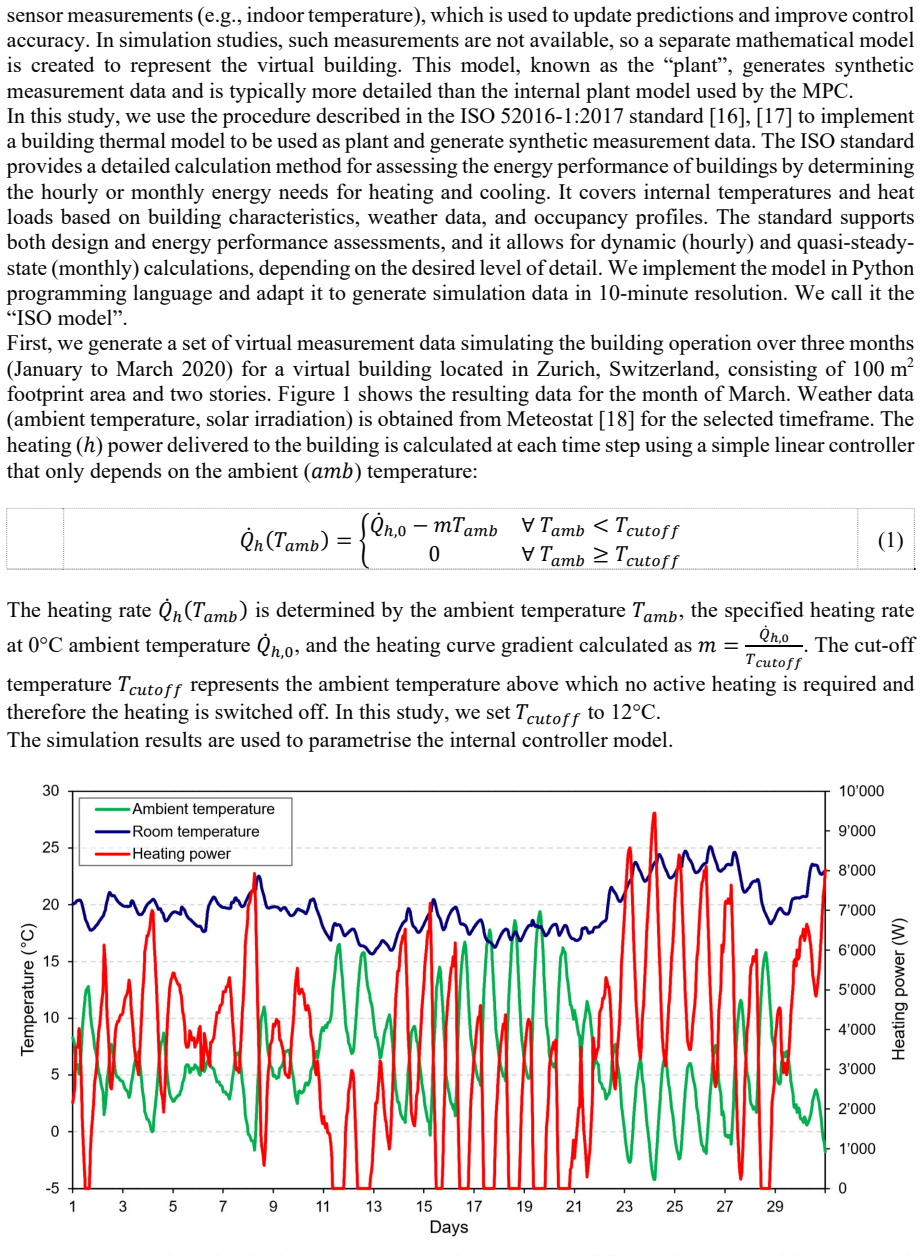
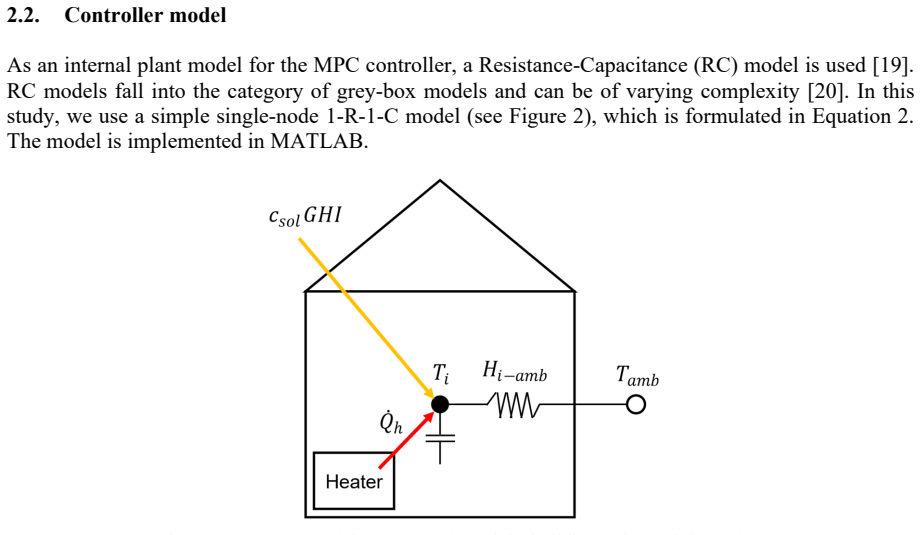
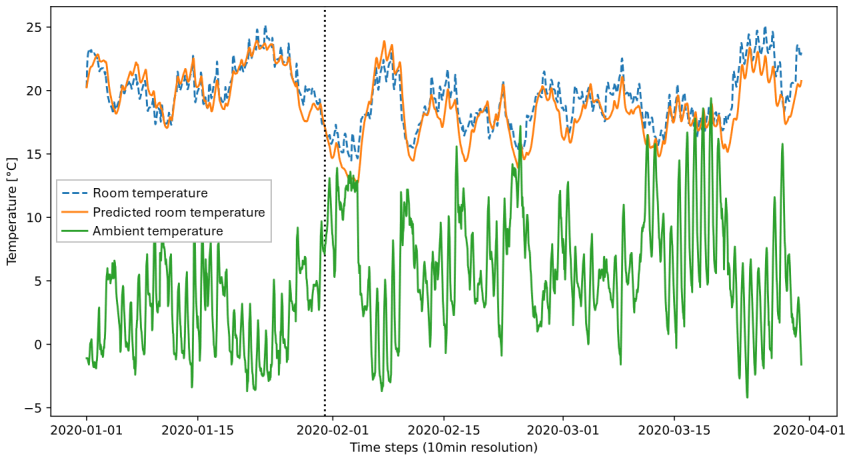
METHODOLOGY 2.1. Virtual building When applying model predictive control (MPC) to a building heating system, the controller relies on a mathematical model of the building's thermal dynamics, referred to as the “internal plant model”. This model is used to predict the building’s thermal r esponse over a future time horizon and determine the corresponding o...
2017
-
[3]
The results di ffer between the two simulations in terms of heating energy consumed, maximum heating power, and achieved room temperature deviations (Table 1)
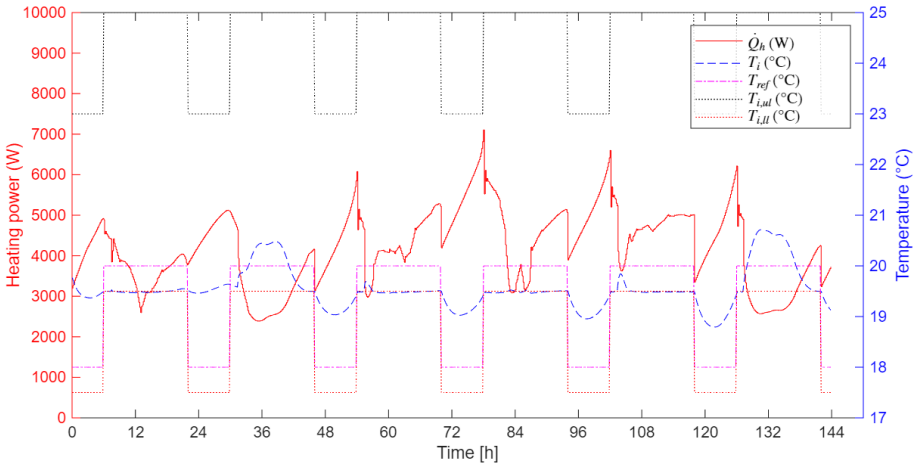
RESULTS Apart from differing objectives, both simulations (A and B) are subject to th e same input parameters and constraints. The results di ffer between the two simulations in terms of heating energy consumed, maximum heating power, and achieved room temperature deviations (Table 1). Simulation A tries to minimise the heating power and results in a maxi...
-
[4]
It is observed that all the defined constraints (heating power li mits, temperature limits) can be met under the given ambient conditions
DISCUSSION AND CONCLUSIONS In this study, we compare two MPC controller s with different optimi sation objectives in a simulation study: one optimising fo r minimised heating power (A) a nd the other for thermal comfort (B). It is observed that all the defined constraints (heating power li mits, temperature limits) can be met under the given ambient condi...
-
[5]
In this context, the authors bear sole responsibility for th e conclusions and the results presented in this publication
ACKNOWLEDGEMENTS The research presented in this article was supported by InnoSuisse (grant:101.2 24 IP-EE) and by the Swiss Federal Office of Energy as part of the SW EET EDGE and PATHFNDR consortium. In this context, the authors bear sole responsibility for th e conclusions and the results presented in this publication
-
[6]
International Energy Agency IEA, ‘Building Energy Performance Metrics - Supporting Energy Efficiency Progress in Major Economies’, France, 2015
2015
-
[7]
H. Hajian, K. Ahmed, and J. Kurnitski, ‘Dynami c heating control measured and simulated effects on power reduction, energy and indoor air temperat ure in an old apartment building with district heating’, Energy and Buildings , vol. 268, p. 112174, Aug. 2022, doi: 10.1016/j.enbuild.2022.112174
-
[8]
J. Drgo ňa et al. , ‘All you need to know about model predictive control for buildings’, Annual Reviews in Control, vol. 50, pp. 190–232, 2020, doi: 10.1016/j.arcontrol.2020.09.001
-
[9]
P. H. Shaikh, N. B. M. Nor, P. Nallagownden, I. Elamvazuthi, and T. Ibrahim, ‘A review on optimized control systems for building energy a nd comfort management of smart sustainable buildings’, Renewable and Sustainable Energy Reviews , vol. 34, pp. 409–429, June 2014, doi: 10.1016/j.rser.2014.03.027
-
[10]
F. Bünning et al., ‘Physics-informed linear regression is competitive with two Machine Learning methods in residential building MPC’, Applied Energy , vol. 310, p. 118491, Mar. 2022, doi: 10.1016/j.apenergy.2021.118491. 9
-
[11]
T. Hilliard, L. Swan, and Z. Qin, ‘Experimental implementation of whole building MPC with zone based thermal comfort adjustments’, Building and Environment, vol. 125, pp. 326–338, Nov. 2017, doi: 10.1016/j.buildenv.2017.09.003
-
[12]
R. Eini and S. Abdelwahed, ‘Learning-based M odel Predictive Control for Smart Building Thermal Management’, in 2019 IEEE 16th International Conference on Smart Cities: Improving Quality of Life Using ICT & IoT and AI (HONET-ICT) , Charlotte, NC, USA: IEEE, Oct. 2019, pp. 038–042. doi: 10.1109/HONET.2019.8908098
-
[13]
K. Bamdad, N. Mohammadzadeh, M. Cholette, and S. Perera, ‘Model Predictive Control for Energy Optimization of HVAC Systems Using EnergyPlus and ACO Algorithm’, Buildings, vol. 13, no. 12, p. 3084, Dec. 2023, doi: 10.3390/buildings13123084
-
[14]
D. Wang, Y. Chen, W. Wang, C. Gao, and Z. Wang, ‘Field test of Model Predictive Control in residential buildings for utility cost savings’, Energy and Buildings, vol. 288, p. 113026, June 2023, doi: 10.1016/j.enbuild.2023.113026
-
[15]
R. Z. Freire, G. H. C. Oliveira, and N. Mendes, ‘Predictive controllers for thermal comfort optimization and energy savings’, Energy and Buildings, vol. 40, no. 7, pp. 1353–1365, Jan. 2008, doi: 10.1016/j.enbuild.2007.12.007
-
[16]
Cigler, J
J. Cigler, J. Siroky, M. Korda, and C. N. J ones, ‘On the Selection of the Most Appropriate MPC Problem Formulation for Buildings’, presented at the 11th REHVA world congress CLIMA, 2013
2013
-
[17]
J. Široký, F. Oldewurtel, J. Cigler, and S. Prívara, ‘Experimental analysis of model predictive control for an energy efficient building heating system’, Applied Energy, vol. 88, no. 9, pp. 3079– 3087, Sept. 2011, doi: 10.1016/j.apenergy.2011.03.009
-
[18]
Z. Qi, N. Zhou, X. Feng, and S. Abdolho sseinzadeh, ‘Optimizing space heating efficiency in sustainable building design a multi criteria deci sion making approach with model predictive control’, Sci Rep, vol. 15, no. 1, p. 27743, July 2025, doi: 10.1038/s41598-025-13325-4
-
[19]
S. Huang et al. , ‘Unveiling overlooked aspects of model predictive control for building air conditioning systems’, Journal of Building Performance Simulation , vol. 17, no. 4, pp. 510–525, July 2024, doi: 10.1080/19401493.2024.2346831
-
[20]
F. Ghawash, E. Blanco Viñuela, and B. Sc hofield, ‘Energy Consumption Optimisation by Using Advanced Control Algorithms’, p. 8 pages, 1.081 MB, Nov. 2023, doi: 10.18429/JACOW- ICALEPCS2023-MO3AO06
-
[21]
International Organization for Standardization, ISO 52016-1:2017: Energy performance of buildings - Energy needs for heating and cooli ng, internal temperatures and sensible and latent heat loads - Part 1: Calculation procedures
2017
-
[22]
ISO/TR 52016-2:2017), 2017
International Organization for Standardization, Energy performance of buildings – energy needs for heating and cooling, internal temperatures and sensible and latent heat loads – Part 2: Explanation and justification of ISO 52016-1 and ISO 52017-1 (ISO Standard No. ISO/TR 52016-2:2017), 2017
2017
-
[23]
C. S. Lamprecht, ‘Meteostat Python’. Accessed: Oct. 10, 2023. [Online]. Available: https://github.com/meteostat/meteostat-python/tree/master
2023
-
[24]
H. Madsen and J. Holst, ‘Estimation of continuous-time models for the heat dynamics of a building’, Energy and Buildings, vol. 22, no. 1, pp. 67–79, Mar. 1995, doi: 10.1016/0378-7788(94)00904-X
-
[25]
P. Bacher and H. Madsen, ‘Identifying suitable models for the heat dynamics of buildings’, Energy and Buildings, vol. 43, no. 7, pp. 1511–1522, July 2011, doi: 10.1016/j.enbuild.2011.02.005
-
[26]
MathWorks, MATLAB - Model Predictive Control Toolbox. (2025). The MathWorks, Inc., Natick, MA, United States. [Online]. Available: https://ch.mathworks.com/help/mpc/
2025
discussion (0)
Sign in with ORCID, Apple, or X to comment. Anyone can read and Pith papers without signing in.