REVIEW 4 major objections 4 minor 86 references
A Comprehensive Multiwavelength Study of the OH Megamaser galaxy IRAS 09320+6134
T0 review · 4 major / 4 minor · reviewed 2026-08-06 · deepseek-v4-flash
Pith's one-line read The ionized gas in IRAS 09320+6134 is a rotating disk plus an AGN-driven outflow whose kinetic efficiency is far below the level needed to quench star formation.
desk verdict Qualitative case for an AGN-driven outflow in IRAS09320 is solid; the energetic numbers need a robustness check before being used. read the letter →
The pith
A machine-rendered reading of the paper's core claim, the machinery that carries it, and where it could break.
The reading
What carries the argument
The load-bearing machinery is the two-Gaussian decomposition of every emission-line profile: a narrow component assigned to the disk and a broad component assigned to a single AGN-driven outflow. On top of that decomposition, the paper calculates the outflow energetics with the recombination recipe $M_o = m_p L_{\mathrm{H}\alpha}/(N_e j_{\mathrm{H}\alpha}(T))$, the mass outflow rate $\dot{M}_o = M_o V_{\mathrm{out}} / r$, and the kinetic power $\dot{E}_{\mathrm{out}} = \frac{1}{2}\dot{M}_o (V_{\mathrm{out}}^2 + 3\sigma_{\mathrm{out}}^2)$, together with the kinemetry method used to fit circular rotation to the narrow-component velocity field. The quantity that carries the argument is the kinetic efficiency $\epsilon = \dot{E}_{\mathrm{out}}/L_{\mathrm{bol}}$, which is compared with the ~0.5% coupling threshold drawn from simulations.
What would settle it
A higher-spectral-resolution or higher-signal-to-noise map that resolves the broad component into two or more distinct velocity peaks, or that detects a redshifted far-side outflow lobe, would directly contradict the single-outflow hypothesis; alternatively, an independent measurement of the outflow electron density that departs from the adopted 2160 cm$^{-3}$ would rescale the mass outflow rate and the kinetic efficiency.
Extended reading notes
Core claim
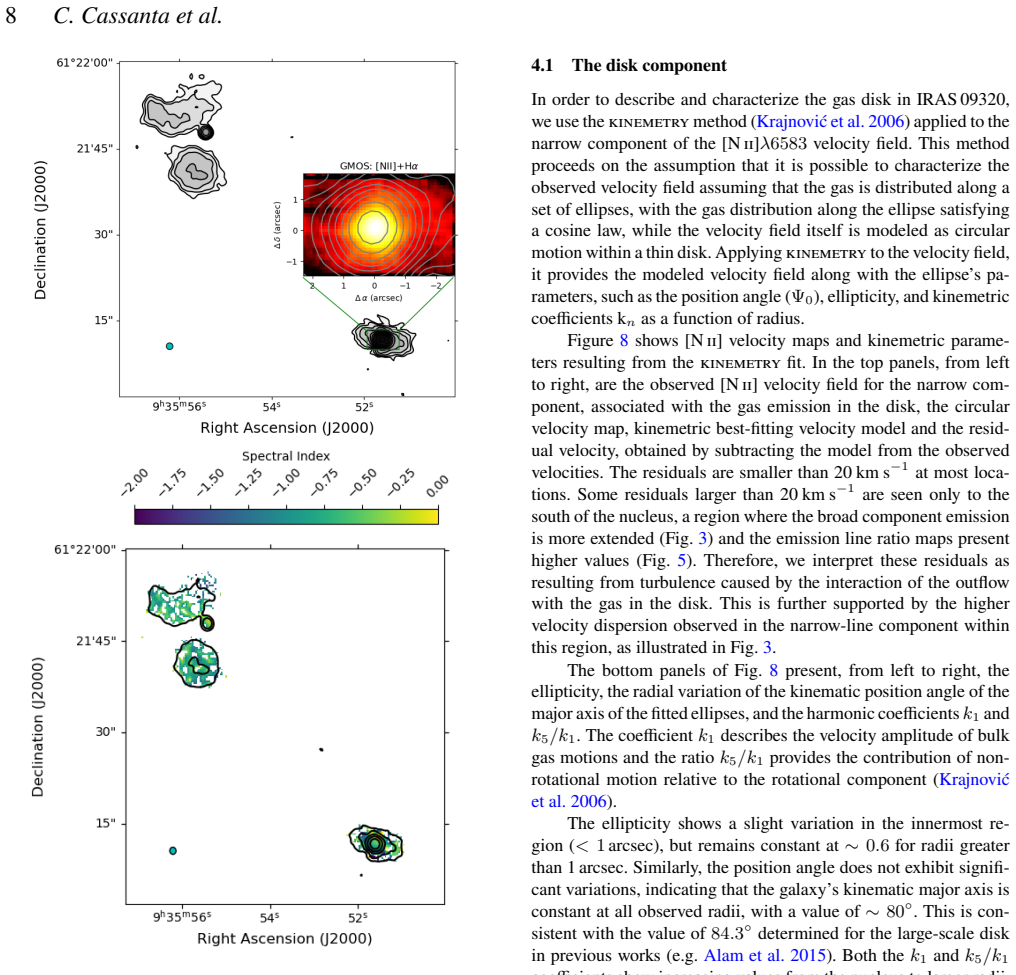
IRAS 09320+6134 is a late-stage merger whose ionized gas within the central ~2 kpc is described by two Gaussian components in every bright emission line. The narrow component, with velocity dispersions below 200 km s$^{-1}$, follows a rotation model whose kinematic position angle agrees with the large-scale disk orientation, and the ratio of non-circular to circular motion stays near 0.04. The broad component, with dispersions between 500 and 650 km s$^{-1}$, is entirely blueshifted with bulk velocities up to about 500 km s$^{-1}$, which the paper interprets as the near side of an AGN-driven outflow. From the extinction-corrected H$\alpha$ luminosity and a median electron density of 2160 cm$^{-3}$, the paper derives an ionized-gas mass of $1.01 \times 10^5\,M_\odot$, a mass outflow rate of $0.122 \pm 0.026\,M_\odot\,\mathrm{yr}^{-1}$, and a kinetic power of $5.1 \times 10^{40}$ erg s$^{-1}$. Comparing this power with a bolometric luminosity of $1.8 \times 10^{44}$ erg s$^{-1}$ estimated from [O III] yields a kinetic efficiency of about $2.8 \times 10^{-4}$. Emission-line ratio diagrams (BPT and WHAN) place both components in the AGN region, and the radio core, with its spectral index of $-0.62$ and brightness temperature of $6.5 \times 10^5$ K, adds an independent AGN signature, with the extended emission resembling that of radio-quiet quasars.
Load-bearing premise
The outflow interpretation rests on assuming that each emission-line profile is exactly two Gaussian components, with the broad one being a single AGN-driven outflow; if the broad component actually contains multiple kinematic components, or comes from a scattered wind or jet-cocoon instead, the derived radius, velocity, mass outflow rate, and kinetic efficiency would all change.
Editorial extensions
If this is right
- The narrow-component velocity field is consistent with rotation in a plane aligned with the large-scale disk, so the inner gas kinematics are rotation-dominated at radii beyond the outflow region.
- Both the disk gas and the outflowing gas are photoionized by the AGN rather than by circumnuclear star formation.
- The outflow kinetic efficiency of about $2.8 \times 10^{-4}$ falls roughly two orders of magnitude below the ~0.5% coupling that simulations require for efficient star-formation suppression, so kinetic feedback from this AGN cannot quench the host by itself.
- If the same low kinetic efficiencies hold across the other OH megamaser galaxies studied, the OHM/AGN phase may redistribute gas inside the central few kiloparsecs rather than expel it, with radiative AGN feedback contributing the main suppression.
- The radio morphology of a core with two-sided emission resembling radio-quiet quasars adds independent evidence for an active nucleus in a late-stage merger.
Reading between the lines
- The single-outflow interpretation is the most fragile step; higher-spectral-resolution data that split the broad component into separate velocity peaks would turn the reported outflow mass and rate into upper limits on a coherent outflow.
- Because the outflow is seen only in blueshift, an assumed symmetric biconical geometry would double the mass outflow rate, although the paper models a one-sided near-side cone.
- If the outflow electron density were closer to the disk value of ~200 cm$^{-3}$ rather than the adopted 2160 cm$^{-3}$, the derived outflow mass and rate would be roughly ten times larger, bringing the kinetic efficiency closer to, but still below, the 0.5% threshold.
- The seven-galaxy sample pattern (AGN-dominant ionization in advanced mergers, outflows in four of seven objects, all with sub-threshold kinetic efficiencies) suggests the OH megamaser phase marks the onset of AGN feedback that has not yet become dynamically dominant; that hypothesis could be tested by comparing this sample with non-masing (U)LIRGs at similar merger stages.
Editorial analysis
A structured set of objections, weighed in public.
Referee Report
Summary. The paper presents a multiwavelength study of the OH megamaser galaxy IRAS09320+6134 (UGC 5101) using GMOS-IFU spectroscopy, HST ACS imaging, and VLA L-band radio continuum data. The central result is that the ionized gas within the inner ~2 kpc consists of two kinematic components: a narrow component (sigma <= 200 km/s) well described by a rotating disk, and a broad, entirely blueshifted component (sigma ~ 500-650 km/s) interpreted as a single AGN-driven outflow. From the broad Halpha luminosity, [S II] electron density, and assumed outflow radius and velocity, the authors derive an ionized gas mass of M_o = (1.01 +/- 0.21) x 10^5 M_sun, a mass outflow rate of Mdot_o = 0.122 +/- 0.026 M_sun/yr, a kinetic power of Eout = (5.1 +/- 0.1) x 10^40 erg/s, and a kinetic efficiency relative to the AGN bolometric luminosity of epsilon ~ 2.8 x 10^-4. BPT and WHAN diagnostics and the radio core spectral index and brightness temperature are used to conclude that an AGN dominates the gas ionization in both components and likely drives the outflow, which is too weak to quench the host galaxy on kinetic grounds alone.
Significance. If the two-component decomposition and the single-outflow interpretation are correct, the paper provides a direct, quantitative case study of an OH megamaser galaxy in a late-stage merger: AGN photoionization dominates both the disk and outflow gas, and the ionized outflow kinetic efficiency is far below the ~0.5% threshold used in cosmological simulations. The study is strengthened by the public availability of the data, the kinemetry modeling with residuals below 20 km/s for the disk component, the quantitative radio spectral index and brightness temperature measurements, and the placement of the result on a compiled sample of more than 600 galaxies. The main weakness is that the outflow mass and energy estimates rest on the adopted two-Gaussian hypothesis and on several systematic assumptions whose uncertainties are not propagated; in addition, the extinction correction as written appears internally inconsistent. These issues are fixable within the manuscript's scope, but they currently leave the quantitative outflow properties less certain than the quoted 1-sigma errors imply.
major comments (4)
- [Section 2.4, Eq. (5)] The decomposition into exactly two Gaussians is an adopted hypothesis rather than a tested model. The Gauss-Hermite fit motivates the need for more than one component but it does not establish that exactly two Gaussians are sufficient or that the broad component is a single coherent outflow. This matters numerically because in Eq. (5) the 3*sigma^2 term contributes about 81% of Eout for sigma = 600 km/s (3*600^2 divided by 500^2 + 3*600^2 = 0.81). If the broad component blends kinematically distinct gas, or if it arises from a disk wind or jet-cocoon rather than a single large-scale outflow, Mdot, Eout, and epsilon would change by order unity or more. Please report fit residuals and a model comparison (one-, two-, and three-Gaussian or non-parametric profile fits) for representative spaxels, and quantify how the derived outflow quantities change under alternative decompositions.
- [Appendix A and Fig. A1] The broad [O III] component has sigma ~ 250 km/s and blueshifted velocities up to about -800 km/s, while the broad Halpha, [N II], and [S II] components have sigma ~ 500-650 km/s and velocities near -500 km/s. This line-dependent difference is not discussed in the paper. It suggests either that the broad component is not the same gas in all lines, or that the two-Gaussian fit behaves differently for weak lines. Since the outflow mass and energy are derived from Halpha and [N II] alone, please quantify whether the [O III] kinematics are consistent with the adopted single-outflow model or require an additional kinematic component.
- [Section 4.2, Eqs. (3)-(4)] The extinction correction is internally inconsistent. The observed broad Halpha luminosity is L_Halpha = (2.9 +/- 0.12) x 10^39 erg/s and the quoted extinction-corrected value is (8.7 +/- 0.6) x 10^40 erg/s, a factor of 30. With A_V = 4.5 mag and the Cardelli et al. (1989) extinction law (R_V = 3.1), the extinction at Halpha is approximately 5.9 mag, corresponding to a correction factor of about 235; even if A_V were mistakenly applied at Halpha, the factor would be about 63. Please clarify what A_V represents, recompute the corrected Halpha luminosity accordingly, and propagate the corrected value into M_o, Mdot_o, and Eout.
- [Section 4.2, Eqs. (4)-(5) and Section 3.4] The uncertainties quoted for Mdot_o and Eout reflect only flux and measurement errors. The systematic uncertainties in the assumed electron temperature (15000 K), the ad hoc outflow radius r = 0.5 arcsec (roughly half of the FWHM of the broad-component flux distribution), the unknown projection and geometry of V_out, and the bolometric correction L_bol = 3500 L_[O III] are not propagated. Since the kinetic efficiency epsilon is the paper's key physical conclusion, please provide a systematic error budget or show explicitly that epsilon remains below 0.005 for a plausible range of these parameters, such as T_e = 10^4-2 x 10^4 K, r = 0.3-1.0 arcsec, and inclination corrections to V_out.
minor comments (4)
- [Section 3.1] There is a typo in the sentence 'We chose this specific line because it is the strongest one observed in the nuclear region of of IRAS09320' - 'of of' should be 'of'.
- [Section 4.2] In the phrase 'the recipe to determine the mass outflow rate, i.g., the ratio', 'i.g.' should be 'i.e.'.
- [Abstract and Figure 1 captions] The Halpha + [N II] wavelength notation appears as 'λλ 6548, 84' in the abstract and in some figure captions; this should be 'λλ 6548, 6584' for clarity and consistency with the rest of the text.
- [Section 3.3 and Figure 3] The broad-component velocity map shows a slight gradient that is interpreted as outflow-disk interaction, but this interpretation would be strengthened by showing the narrow-component velocity residuals from the kinemetry model on the same scale and discussing the possible contribution of beam smearing to the nuclear sigma increase in the narrow component.
Circularity Check
No material circularity: the outflow mass and kinetic efficiency are computed from measured luminosities, densities, and velocities via standard textbook relations; the two-component decomposition is an explicitly adopted assumption, and self-citations in the sample comparison are contextual rather than load-bearing.
full rationale
The paper's central derivation chain is: (i) fit two Gaussian components per emission line (Section 2.4); (ii) measure broad-component Halpha luminosity, [S II] electron density, velocity, and dispersion (Sections 3.3-3.4); (iii) compute ionized-gas mass using standard recombination/emissivity relations (Eqs. 1-3, after Osterbrock & Ferland 2006); (iv) estimate the mass outflow rate from Mdot = M_o V_out / r (Eq. 4); (v) obtain kinetic power from Eq. 5 and compare with L_bol inferred from [O III] using an external relation (Heckman et al. 2005). No fitted parameter is renamed as a prediction, and no equation is used to predict a quantity that was itself used to set a free parameter. The identification of the broad component as an outflow is an explicit interpretive assumption, stated in Section 2.4: 'We have adopted the usual hypothesis that the narrow component represents the gas emission in the disk, while the broad component represents non-circular motions, associated to outflows.' This is a modeling premise, not a derived result; the mass/energy estimates are conditional on it but are not circular. The AGN classification relies on external BPT/WHAN diagnostics (Kewley et al. 2001; Kauffmann et al. 2003; Schawinski et al. 2007; Cid Fernandes et al. 2011), independent of the kinematics. Self-citations appear in the series comparison (Sales et al. 2015, 2019; Hekatelyne et al. 2018a,b, 2020, 2024; Riffel et al. 2021c) and for the outflow recipe, but the recipe is restated in the paper and is a textbook relation, so these citations are not load-bearing. The kinemetry disk model is a fit to the narrow-component velocity field, and the small residuals are used only as qualitative evidence, not as an independent prediction. The internal tension in Appendix A (broad [O III] sigma ~250 km/s versus broad Halpha/[S II] sigma 500-650 km/s) is a physical-interpretation caveat about the single-outflow decomposition, but it is not circularity. Overall, the paper is self-contained against external benchmarks, and the central claim does not reduce to its inputs by construction.
Assumptions & free parameters
free parameters (4)
- Electron temperature Te =
15000 K
- Outflow radius r =
424 pc (0.5 arcsec)
- Bolometric conversion factor =
3500
- Visual extinction AV =
4.5 +/- 0.8 mag
assumptions (5)
- domain assumption Distance to IRAS09320 of 175 Mpc from z=0.03937 assuming H0=67.8 km/s/Mpc.
- domain assumption Theoretical [N II] lambda6583/6548 ratio fixed at 3.06 during fitting.
- domain assumption Case B Halpha emissivity j_Halpha = 3.3534e-25 erg cm^3 s^-1 and the mass-outflow recipe of Hekatelyne et al. (2024).
- domain assumption BPT and WHAN diagnostic boundaries (Kewley et al. 2001; Kauffmann et al. 2003; Schawinski et al. 2007; Cid Fernandes et al. 2011).
- domain assumption AGN bolometric luminosity estimated as Lbol = 3500 L[OIII] (Heckman et al. 2005).
Cite this review
Pith. "Pith review of A Comprehensive Multiwavelength Study of the OH Megamaser galaxy IRAS 09320+6134." pith.science (2026). https://pith.science/paper/YGSQMXY3
@misc{pith2026250621838,
  author       = {Pith},
  title        = {Pith review of: A Comprehensive Multiwavelength Study of the OH Megamaser galaxy IRAS 09320+6134},
  year         = {2026},
  howpublished = {\url{https://pith.science/paper/YGSQMXY3}},
  note         = {Machine review of arXiv:2506.21838}
}
abstract
We present a multiwavelength study of the gas distribution, kinematics and excitation of the OH megamaser galaxy IRAS 09320+6134 (UGC 5101) using Gemini Multi-Object Spectrograph Integral Field Unit, Hubble Space Telescope, and Very Large Array observations. The HST ACS F814W i-band and H$\alpha$ + [N II] $\lambda\lambda$ 6548,84 narrow-band images indicate that this galaxy is a late-stage merger. The ionized gas emission in the inner $\sim$ 2 kpc radius, traced by the GMOS data, is consistent with two kinematic components: (i) a rotating disk, observed as a narrow component in the emission-line profiles, with velocity dispersion of $\sigma$ $\leq$ 200 km s$^{-1}$, and (ii) an outflow, traced by a broad component in the emission-line profiles, with $\sigma\geq$ 500 km s$^{-1}$. The disk component is well reproduced by a model of rotation in a plane with similar orientation to that of the large-scale galaxy disk. The outflow component presents bulk velocities of up to -500 km s$^{-1}$ and corresponds to a mass outflow rate of $\dot{M}_o = 0.122 \pm 0.026 M_{\odot}$ yr$^{-1}$. Emission-line ratio diagrams indicate that the gas excitation is mainly due to an active galactic nucleus, likely the driver of the outflow. The VLA radio image reveals a dominant radio core with two-sided emission along the NE-SW direction. The radio core's spectral index and brightness temperature indicate AGN emission, with the extended emission resembling both in morphology and spectral index the emission observed in radio-quiet quasars. Combined with previous similar studies of other OHM galaxies, the present work supports that this phase is linked to the triggering of an AGN, that seems to occur in the final stages of a merger.
Figures


Figures from the paper (6 more)


Reference graph
Works this paper leans on
-
[1]
write newline
" write newline "" before.all 'output.state := FUNCTION fin.entry write newline FUNCTION new.block output.state before.all = 'skip after.block 'output.state := if FUNCTION new.sentence output.state after.block = 'skip output.state before.all = 'skip after.sentence 'output.state := if if FUNCTION not #0 #1 if FUNCTION and 'skip pop #0 if FUNCTION or pop #1...
-
[2]
Alam S., et al., 2015, @doi [ ] 10.1088/0067-0049/219/1/12 , https://ui.adsabs.harvard.edu/abs/2015ApJS..219...12A 219, 12
-
[3]
Allington-Smith J., et al., 2002, @doi [ ] 10.1086/341712 , https://ui.adsabs.harvard.edu/abs/2002PASP..114..892A 114, 892
doi:10.1086/341712 2002
-
[4]
Almeida I., Nemmen R., Riffel R. A., 2023, @doi [ ] 10.1093/mnras/stad2673 , https://ui.adsabs.harvard.edu/abs/2023MNRAS.526..217A 526, 217
-
[5]
Ayubinia A., Xue Y., Nguyen Le H. A., Zou F., Wang S., He Z., Kilerci E., 2023, @doi [ ] 10.3847/1538-4357/accf18 , https://ui.adsabs.harvard.edu/abs/2023ApJ...951....7A 951, 7
-
[6]
Baan W. A., Salzer J. J., LeWinter R. D., 1998, @doi [ ] 10.1086/306504 , https://ui.adsabs.harvard.edu/abs/1998ApJ...509..633B 509, 633
-
[7]
Baldwin J. A., Phillips M. M., Terlevich R., 1981, @doi [ ] 10.1086/130766 , https://ui.adsabs.harvard.edu/abs/1981PASP...93....5B 93, 5
doi:10.1086/130766 1981
-
[8]
Berton M., et al., 2018, @doi [ ] 10.1051/0004-6361/201832612 , https://ui.adsabs.harvard.edu/abs/2018A&A...614A..87B 614, A87
Show all 86 references
-
[9]
Binette L., et al., 2024, @doi [ ] 10.1051/0004-6361/202245754 , https://ui.adsabs.harvard.edu/abs/2024A&A...684A..53B 684, A53
2024 doi
-
[10]
S., 1995, PhD thesis, New Mexico Institute of Mining and Technology
Briggs D. S., 1995, PhD thesis, New Mexico Institute of Mining and Technology
1995
-
[11]
A., Clayton G
Cardelli J. A., Clayton G. C., Mathis J. S., 1989, @doi [ ] 10.1086/167900 , https://ui.adsabs.harvard.edu/abs/1989ApJ...345..245C 345, 245
1989 doi
-
[12]
Cid Fernandes R., Stasi \'n ska G., Mateus A., Vale Asari N., 2011, @doi [ ] 10.1111/j.1365-2966.2011.18244.x , https://ui.adsabs.harvard.edu/abs/2011MNRAS.413.1687C 413, 1687
2011
-
[13]
Dall'Agnol de Oliveira B., et al., 2021, @doi [ ] 10.1093/mnras/stab1067 , https://ui.adsabs.harvard.edu/abs/2021MNRAS.504.3890D 504, 3890
2021 doi
-
[14]
M., Baan W
Darling J., 2007, in Chapman J. M., Baan W. A., eds, Vol. 242, Astrophysical Masers and their Environments. pp 417--426, @doi 10.1017/S1743921307013531
2007 doi
-
[15]
Davies R., et al., 2020, @doi [Monthly Notices of the Royal Astronomical Society] 10.1093/mnras/staa2413 , 498, 4150
2020 doi
-
[16]
Di Matteo T., Springel V., Hernquist L., 2005, @doi [ ] 10.1038/nature03335 , https://ui.adsabs.harvard.edu/abs/2005Natur.433..604D 433, 604
2005 doi
-
[17]
Dors O. L. J., Arellano-C \'o rdova K. Z., Cardaci M. V., H \"a gele G. F., 2017, @doi [ ] 10.1093/mnrasl/slx036 , https://ui.adsabs.harvard.edu/abs/2017MNRAS.468L.113D 468, L113
2017 doi
-
[18]
Dubois Y., et al., 2014, @doi [ ] 10.1093/mnras/stu1227 , https://ui.adsabs.harvard.edu/abs/2014MNRAS.444.1453D 444, 1453
2014 doi
-
[19]
L., Takeuchi T
Fiorenza S. L., Takeuchi T. T., Ma ek K. E., Liu C. T., 2014, @doi [ ] 10.1088/0004-637X/784/2/140 , https://ui.adsabs.harvard.edu/abs/2014ApJ...784..140F 784, 140
2014 doi
-
[20]
Glowacki M., et al., 2022, @doi [ ] 10.3847/2041-8213/ac63b0 , https://ui.adsabs.harvard.edu/abs/2022ApJ...931L...7G 931, L7
2022 doi
-
[21]
C., V \'e ron-Cetty M
Gon c alves A. C., V \'e ron-Cetty M. P., V \'e ron P., 1999, @doi [ ] 10.1051/aas:1999183 , https://ui.adsabs.harvard.edu/abs/1999A&AS..135..437G 135, 437
1999 doi
-
[22]
M., Ramos Almeida C., 2024, @doi [Galaxies] 10.3390/galaxies12020017 , https://ui.adsabs.harvard.edu/abs/2024Galax..12...17H 12, 17
Harrison C. M., Ramos Almeida C., 2024, @doi [Galaxies] 10.3390/galaxies12020017 , https://ui.adsabs.harvard.edu/abs/2024Galax..12...17H 12, 17
2024 doi
-
[23]
M., Costa T., Tadhunter C
Harrison C. M., Costa T., Tadhunter C. N., Fl \"u tsch A., Kakkad D., Perna M., Vietri G., 2018, @doi [Nature Astronomy] 10.1038/s41550-018-0403-6 , https://ui.adsabs.harvard.edu/abs/2018NatAs...2..198H 2, 198
2018 doi
-
[24]
M., Ptak A., Hornschemeier A., Kauffmann G., 2005, @doi [ ] 10.1086/491665 , https://ui.adsabs.harvard.edu/abs/2005ApJ...634..161H 634, 161
Heckman T. M., Ptak A., Hornschemeier A., Kauffmann G., 2005, @doi [ ] 10.1086/491665 , https://ui.adsabs.harvard.edu/abs/2005ApJ...634..161H 634, 161
2005 doi
-
[25]
Hekatelyne C., et al., 2018a, @doi [ ] 10.1093/mnras/stx3100 , https://ui.adsabs.harvard.edu/abs/2018MNRAS.474.5319H 474, 5319
-
[26]
Hekatelyne C., et al., 2018b, @doi [ ] 10.1093/mnras/sty1606 , https://ui.adsabs.harvard.edu/abs/2018MNRAS.479.3966H 479, 3966
-
[27]
A., Storchi-Bergmann T., Kharb P., Robinson A., Sales D., Cassanta C
Hekatelyne C., Riffel R. A., Storchi-Bergmann T., Kharb P., Robinson A., Sales D., Cassanta C. M., 2020, @doi [ ] 10.1093/mnras/staa2479 , https://ui.adsabs.harvard.edu/abs/2020MNRAS.498.2632H 498, 2632
2020 doi
-
[28]
A., Kharb P., Cassanta C
Hekatelyne C., Storchi-Bergmann T., Riffel R. A., Kharb P., Cassanta C. M., Robinson A., Sales D. A., 2024, @doi [ ] 10.1093/mnras/stad3963 , https://ui.adsabs.harvard.edu/abs/2024MNRAS.52710844H 527, 10844
2024 doi
-
[29]
Hermosa Mu \ n oz L., et al., 2024, @doi [ ] 10.1051/0004-6361/202347675 , https://ui.adsabs.harvard.edu/abs/2024A&A...683A..43H 683, A43
2024 doi
-
[30]
M., et al., 2021, @doi [ ] 10.1051/0004-6361/202040019 , https://ui.adsabs.harvard.edu/abs/2021A&A...647A.193H 647, A193
Hess K. M., et al., 2021, @doi [ ] 10.1051/0004-6361/202040019 , https://ui.adsabs.harvard.edu/abs/2021A&A...647A.193H 647, A193
2021 doi
-
[31]
M., J rgensen I., Allington-Smith J
Hook I. M., J rgensen I., Allington-Smith J. R., Davies R. L., Metcalfe N., Murowinski R. G., Crampton D., 2004, @doi [ ] 10.1086/383624 , https://ui.adsabs.harvard.edu/abs/2004PASP..116..425H 116, 425
2004 doi
-
[32]
G., Walterbos R
Hoopes C. G., Walterbos R. A. M., Rand R. J., 1999, @doi [ ] 10.1086/307670 , https://ui.adsabs.harvard.edu/abs/1999ApJ...522..669H 522, 669
1999 doi
-
[33]
F., Elvis M., 2010, @doi [ ] 10.1111/j.1365-2966.2009.15643.x , https://ui.adsabs.harvard.edu/abs/2010MNRAS.401....7H 401, 7
Hopkins P. F., Elvis M., 2010, @doi [ ] 10.1111/j.1365-2966.2009.15643.x , https://ui.adsabs.harvard.edu/abs/2010MNRAS.401....7H 401, 7
2010
-
[34]
G., Wu X.-B., Han J
Hou L. G., Wu X.-B., Han J. L., 2009, @doi [ ] 10.1088/0004-637X/704/1/789 , https://ui.adsabs.harvard.edu/abs/2009ApJ...704..789H 704, 789
2009 doi
-
[35]
G., Han J
Hou L. G., Han J. L., Kong M. Z., Wu X.-B., 2011, @doi [ ] 10.1088/0004-637X/732/2/72 , https://ui.adsabs.harvard.edu/abs/2011ApJ...732...72H 732, 72
2011 doi
-
[36]
Huang Y., Zhang J., Liu W., Xu J., 2018, @doi [Journal of Astrophysics and Astronomy] 10.1007/s12036-018-9524-7 , https://ui.adsabs.harvard.edu/abs/2018JApA...39...34H 39, 34
2018 doi
-
[37]
Imanishi M., Terashima Y., Anabuki N., Nakagawa T., 2003, @doi [ ] 10.1086/379503 , https://ui.adsabs.harvard.edu/abs/2003ApJ...596L.167I 596, L167
2003 doi
-
[38]
A., 2005, @doi [Astrophysics] 10.1007/s10511-005-0011-x , https://ui.adsabs.harvard.edu/abs/2005Ap.....48...99K 48, 99
Kandalyan R. A., 2005, @doi [Astrophysics] 10.1007/s10511-005-0011-x , https://ui.adsabs.harvard.edu/abs/2005Ap.....48...99K 48, 99
2005 doi
-
[39]
D., Karachentseva V
Karachentsev I. D., Karachentseva V. E., Huchtmeier W. K., 2006, @doi [ ] 10.1051/0004-6361:20054497 , https://ui.adsabs.harvard.edu/abs/2006A&A...451..817K 451, 817
2006 doi
-
[40]
Kauffmann G., et al., 2003, @doi [ ] 10.1111/j.1365-2966.2003.07154.x , https://ui.adsabs.harvard.edu/abs/2003MNRAS.346.1055K 346, 1055
2003
-
[41]
J., Dopita M
Kewley L. J., Dopita M. A., Sutherland R. S., Heisler C. A., Trevena J., 2001, @doi [ ] 10.1086/321545 , https://ui.adsabs.harvard.edu/abs/2001ApJ...556..121K 556, 121
2001 doi
-
[42]
P., Baum S
Kharb P., O'Dea C. P., Baum S. A., Colbert E. J. M., Xu C., 2006, @doi [ ] 10.1086/507945 , https://ui.adsabs.harvard.edu/abs/2006ApJ...652..177K 652, 177
2006 doi
-
[43]
C., Veilleux S., Sanders D
Kim D. C., Veilleux S., Sanders D. B., 1998, @doi [ ] 10.1086/306409 , https://ui.adsabs.harvard.edu/abs/1998ApJ...508..627K 508, 627
1998 doi
-
[44]
T., Copin Y., 2006, @doi [ ] 10.1111/j.1365-2966.2005.09902.x , https://ui.adsabs.harvard.edu/abs/2006MNRAS.366..787K 366, 787
Krajnovi \'c D., Cappellari M., de Zeeuw P. T., Copin Y., 2006, @doi [ ] 10.1111/j.1365-2966.2005.09902.x , https://ui.adsabs.harvard.edu/abs/2006MNRAS.366..787K 366, 787
2006
-
[45]
Y., 2005, @doi [ ] 10.1146/annurev.astro.41.011802.094927 , https://ui.adsabs.harvard.edu/abs/2005ARA&A..43..625L 43, 625
Lo K. Y., 2005, @doi [ ] 10.1146/annurev.astro.41.011802.094927 , https://ui.adsabs.harvard.edu/abs/2005ARA&A..43..625L 43, 625
2005 arXiv
-
[46]
J., Lonsdale C
Lonsdale C. J., Lonsdale C. J., Smith H. E., Diamond P. J., 2003, @doi [ ] 10.1086/375778 , https://ui.adsabs.harvard.edu/abs/2003ApJ...592..804L 592, 804
2003 doi
-
[47]
J., Farrah D., Smith H
Lonsdale C. J., Farrah D., Smith H. E., 2006, in Mason J. W., ed., , Astrophysics Update 2. Springer, Berlin, Heidelberg, p. 285, @doi 10.1007/3-540-30313-8_9
2006 doi
-
[48]
Lucatelli G., et al., 2024, @doi [ ] 10.1093/mnras/stae744 , https://ui.adsabs.harvard.edu/abs/2024MNRAS.529.4468L 529, 4468
2024 doi
-
[49]
A., 2015, @doi [ ] 10.1051/0004-6361/201323152 , https://ui.adsabs.harvard.edu/abs/2015A&A...573A..42L 573, A42
Luridiana V., Morisset C., Shaw R. A., 2015, @doi [ ] 10.1051/0004-6361/201323152 , https://ui.adsabs.harvard.edu/abs/2015A&A...573A..42L 573, A42
2015 doi
-
[50]
Mart \' nez-Paredes M., et al., 2015, @doi [ ] 10.1093/mnras/stv2134 , https://ui.adsabs.harvard.edu/abs/2015MNRAS.454.3577M 454, 3577
2015 doi
-
[51]
Morganti R., et al., 2006, @doi [ ] 10.1111/j.1365-2966.2006.10681.x , https://ui.adsabs.harvard.edu/abs/2006MNRAS.371..157M 371, 157
2006
-
[52]
Netzer H., et al., 2007, @doi [ ] 10.1086/520716 , https://ui.adsabs.harvard.edu/abs/2007ApJ...666..806N 666, 806
2007 doi
-
[53]
S., Ostriker J
Novak G. S., Ostriker J. P., Ciotti L., 2011, @doi [ ] 10.1088/0004-637X/737/1/26 , https://ui.adsabs.harvard.edu/abs/2011ApJ...737...26N 737, 26
2011 doi
-
[54]
Oda S., Tanimoto A., Ueda Y., Imanishi M., Terashima Y., Ricci C., 2017, @doi [ ] 10.3847/1538-4357/835/2/179 , https://ui.adsabs.harvard.edu/abs/2017ApJ...835..179O 835, 179
2017 doi
-
[55]
E., Ferland G
Osterbrock D. E., Ferland G. J., 2006, Astrophysics of gaseous nebulae and active galactic nuclei . University Science Books, Mill Valley
2006
-
[56]
J., 2011, @doi [ ] 10.1051/0004-6361/201117104 , https://ui.adsabs.harvard.edu/abs/2011A&A...532A..71R 532, A71
Rau U., Cornwell T. J., 2011, @doi [ ] 10.1051/0004-6361/201117104 , https://ui.adsabs.harvard.edu/abs/2011A&A...532A..71R 532, A71
2011 doi
-
[57]
Revalski M., et al., 2022, @doi [ ] 10.3847/1538-4357/ac5f3d , https://ui.adsabs.harvard.edu/abs/2022ApJ...930...14R 930, 14
2022 doi
-
[58]
J., Faucher-Gigu \`e re C.-A., 2018, @doi [ ] 10.1093/mnras/sty1285 , https://ui.adsabs.harvard.edu/abs/2018MNRAS.478.3100R 478, 3100
Richings A. J., Faucher-Gigu \`e re C.-A., 2018, @doi [ ] 10.1093/mnras/sty1285 , https://ui.adsabs.harvard.edu/abs/2018MNRAS.478.3100R 478, 3100
2018 doi
-
[59]
A., et al., 2021a, @doi [ ] 10.1093/mnrasl/slaa194 , https://ui.adsabs.harvard.edu/abs/2021MNRAS.501L..54R 501, L54
Riffel R. A., et al., 2021a, @doi [ ] 10.1093/mnrasl/slaa194 , https://ui.adsabs.harvard.edu/abs/2021MNRAS.501L..54R 501, L54
-
[60]
Riffel R., et al., 2021b, @doi [ ] 10.1093/mnras/staa3907 , https://ui.adsabs.harvard.edu/abs/2021MNRAS.501.4064R 501, 4064
-
[61]
A., et al., 2021c, @doi [ ] 10.1093/mnras/stab998 , https://ui.adsabs.harvard.edu/abs/2021MNRAS.504.3265R 504, 3265
Riffel R. A., et al., 2021c, @doi [ ] 10.1093/mnras/stab998 , https://ui.adsabs.harvard.edu/abs/2021MNRAS.504.3265R 504, 3265
-
[62]
A., Riffel R., Storchi-Bergmann T., Costa-Souza J
Riffel R. A., Riffel R., Storchi-Bergmann T., Costa-Souza J. H., Souza-Oliveira G. L., Bianchin M., 2024, @doi [ ] 10.1093/mnras/stae055 , https://ui.adsabs.harvard.edu/abs/2024MNRAS.528.1476R 528, 1476
2024 doi
-
[63]
380, Cosmic Masers: Proper Motion Toward the Next-Generation Large Projects
Roberts H., Darling J., 2024, in Hirota T., Imai H., Menten K., Pihlstr \"o m Y., eds, Vol. 380, Cosmic Masers: Proper Motion Toward the Next-Generation Large Projects. pp 16--20, @doi 10.1017/S1743921323002314
2024 doi
-
[64]
J., 2021, @doi [ ] 10.3847/1538-4357/abe944 , https://ui.adsabs.harvard.edu/abs/2021ApJ...911...38R 911, 38
Roberts H., Darling J., Baker A. J., 2021, @doi [ ] 10.3847/1538-4357/abe944 , https://ui.adsabs.harvard.edu/abs/2021ApJ...911...38R 911, 38
2021 doi
- [65]
-
[66]
J., 2003, @doi [ ] 10.1051/0004-6361:20030698 , https://ui.adsabs.harvard.edu/abs/2003A&A...406..505R 406, 505
Rossa J., Dettmar R. J., 2003, @doi [ ] 10.1051/0004-6361:20030698 , https://ui.adsabs.harvard.edu/abs/2003A&A...406..505R 406, 505
2003 doi
-
[67]
D., 2006, @doi [ ] 10.1086/498452 , https://ui.adsabs.harvard.edu/abs/2006AJ....131..185R 131, 185
Rothberg B., Joseph R. D., 2006, @doi [ ] 10.1086/498452 , https://ui.adsabs.harvard.edu/abs/2006AJ....131..185R 131, 185
2006 doi
-
[68]
Ruschel-Dutra D., Dall'Agnol De Oliveira B., 2020, danielrd6/ifscube v1.0 , @doi 10.5281/zenodo.3945237
2020 doi
-
[69]
Ruschel-Dutra D., et al., 2021, @doi [ ] 10.1093/mnras/stab2058 , https://ui.adsabs.harvard.edu/abs/2021MNRAS.507...74R 507, 74
2021 doi
-
[70]
A., et al., 2015, @doi [ ] 10.1088/0004-637X/799/1/25 , https://ui.adsabs.harvard.edu/abs/2015ApJ...799...25S 799, 25
Sales D. A., et al., 2015, @doi [ ] 10.1088/0004-637X/799/1/25 , https://ui.adsabs.harvard.edu/abs/2015ApJ...799...25S 799, 25
2015 doi
-
[71]
A., et al., 2019, @doi [ ] 10.1093/mnras/stz196 , https://ui.adsabs.harvard.edu/abs/2019MNRAS.486.3350S 486, 3350
Sales D. A., et al., 2019, @doi [ ] 10.1093/mnras/stz196 , https://ui.adsabs.harvard.edu/abs/2019MNRAS.486.3350S 486, 3350
2019 doi
-
[72]
B., Mirabel I
Sanders D. B., Mirabel I. F., 1996, @doi [ ] 10.1146/annurev.astro.34.1.749 , https://ui.adsabs.harvard.edu/abs/1996ARA&A..34..749S 34, 749
1996 doi
-
[73]
K., Silk J., 2007, @doi [ ] 10.1111/j.1365-2966.2007.12487.x , https://ui.adsabs.harvard.edu/abs/2007MNRAS.382.1415S 382, 1415
Schawinski K., Thomas D., Sarzi M., Maraston C., Kaviraj S., Joo S.-J., Yi S. K., Silk J., 2007, @doi [ ] 10.1111/j.1365-2966.2007.12487.x , https://ui.adsabs.harvard.edu/abs/2007MNRAS.382.1415S 382, 1415
2007
-
[74]
C., Harrison C
Silpa S., Kharb P., Ho L. C., Harrison C. M., 2023, @doi [ ] 10.3847/1538-4357/acf7c9 , https://ui.adsabs.harvard.edu/abs/2023ApJ...958...47S 958, 47
2023 doi
-
[75]
Storchi-Bergmann T., Schnorr-M \"u ller A., 2019, @doi [Nature Astronomy] 10.1038/s41550-018-0611-0 , https://ui.adsabs.harvard.edu/abs/2019NatAs...3...48S 3, 48
2019 doi
-
[76]
A., Darling J., Haynes M
Suess K. A., Darling J., Haynes M. P., Giovanelli R., 2016, @doi [ ] 10.1093/mnras/stw666 , https://ui.adsabs.harvard.edu/abs/2016MNRAS.459..220S 459, 220
2016 doi
-
[77]
L., ed., Society of Photo-Optical Instrumentation Engineers (SPIE) Conference Series Vol
Tody D., 1986, in Crawford D. L., ed., Society of Photo-Optical Instrumentation Engineers (SPIE) Conference Series Vol. 627, Instrumentation in astronomy VI. p. 733, @doi 10.1117/12.968154
1986 doi
-
[78]
U V., et al., 2012, @doi [ ] 10.1088/0067-0049/203/1/9 , https://ui.adsabs.harvard.edu/abs/2012ApJS..203....9U 203, 9
2012 doi
-
[79]
Ulivi L., et al., 2024, @doi [ ] 10.1051/0004-6361/202347436 , https://ui.adsabs.harvard.edu/abs/2024A&A...685A.122U 685, A122
2024 doi
-
[80]
C., Sanders D
Veilleux S., Kim D. C., Sanders D. B., Mazzarella J. M., Soifer B. T., 1995, @doi [ ] 10.1086/192158 , https://ui.adsabs.harvard.edu/abs/1995ApJS...98..171V 98, 171
1995 doi
-
[81]
B., Kim D
Veilleux S., Sanders D. B., Kim D. C., 1999, @doi [ ] 10.1086/307635 , https://ui.adsabs.harvard.edu/abs/1999ApJ...522..139V 522, 139
1999 doi
-
[82]
Wu Z., et al., 2023, @doi [ ] 10.1051/0004-6361/202245347 , https://ui.adsabs.harvard.edu/abs/2023A&A...669A.148W 669, A148
2023 doi
-
[83]
Xu Y., Luo Y., Kang X., Li Z., Li Z., Wang P., Libeskind N., 2025, @doi [ ] 10.3847/1538-4357/ac53ab , https://ui.adsabs.harvard.edu/abs/2022ApJ...928..100X 928, 100
2025 doi
-
[84]
S., Henkel C., Kadler M., Greenhill L
Zhang J. S., Henkel C., Kadler M., Greenhill L. J., Nagar N., Wilson A. S., Braatz J. A., 2006, @doi [ ] 10.1051/0004-6361:20054138 , https://ui.adsabs.harvard.edu/abs/2006A&A...450..933Z 450, 933
2006 doi
-
[85]
S., Wang J
Zhang J. S., Wang J. Z., Di G. X., Zhu Q. F., Guo Q., Wang J., 2014, @doi [ ] 10.1051/0004-6361/201423556 , https://ui.adsabs.harvard.edu/abs/2014A&A...570A.110Z 570, A110
2014 doi
-
[86]
G., 2001, @doi [ ] 10.1086/323894 , https://ui.adsabs.harvard.edu/abs/2001PASP..113.1420V 113, 1420
van Dokkum P. G., 2001, @doi [ ] 10.1086/323894 , https://ui.adsabs.harvard.edu/abs/2001PASP..113.1420V 113, 1420
2001 doi
Reviewed August 6, 2026 · model on record in the stance chip above.
Discussion (0). Continue with ORCID to comment.