REVIEW 3 major objections 4 minor 36 references
Weakly acyclic diagrams: A data structure for infinite-state symbolic verification
T0 review · 3 major / 4 minor · reviewed 2026-08-12 · deepseek-v4-flash
Pith's one-line read This paper introduces weakly acyclic diagrams, a generalization of OBDDs that represents infinite languages canonically while preserving the memoized dynamic-programming algorithms used in symbolic verification.
desk verdict WADs are a clean, honest extension of OBDDs to infinite weakly acyclic languages; the main caveat is an unproved monotonicity claim in the broadcast-protocol section. read the letter →
The pith
A machine-rendered reading of the paper's core claim, the machinery that carries it, and where it could break.
The reading
What carries the argument
The load-bearing object is the master automaton over an alphabet $\Sigma$: its states are all weakly acyclic languages, and reading a letter maps a language to its residual. Because weakly acyclic languages have no infinite descending chains of residuals, every WAD is a finite fragment of this automaton, and that fragment is exactly the minimal DFA for each represented language. The node table representation adds a special self pointer for the case where a residual equals the language itself; memoized recursion over residuals, plus the make procedure that collapses duplicate languages, is what carries all operations.
What would settle it
A decisive test is to apply the contraction-based pre/post algorithm to a fixed-length transducer and a weakly acyclic language whose true pre-image or post-image is known not to be weakly acyclic, such as the paper's own Figure 3 example where the result is $(a+b)^*b$. If the algorithm terminates and returns a WAD whose language differs from the exactly computed pre-image, the claimed correctness guarantee fails; on small alphabets the exact pre-image can be obtained by an independent subset construction.
Extended reading notes
Core claim
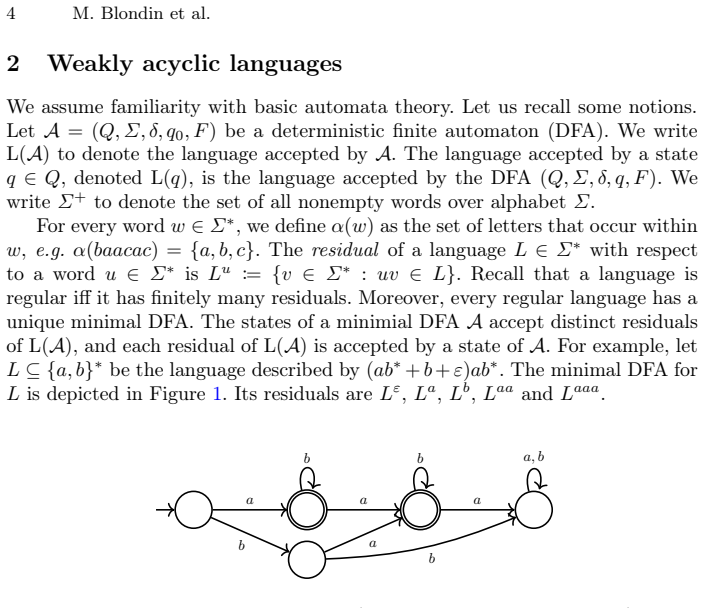
The paper's central discovery is that the algorithmic advantages of OBDDs survive when fixed-length Boolean functions are replaced by weakly acyclic regular languages, meaning languages whose minimal DFA has no cycles except self-loops. For such a language, the set of residuals is partially ordered by the transition relation and has no infinite descending chains, so the 'master automaton' whose states are all weakly acyclic languages gives a canonical minimal DFA for each one. A WAD stores finitely many such languages as a shared node table in which a transition may point to a node or to 'self', and a memoized make procedure guarantees that equal languages share one node. Complement, intersection, union, and pre/post along fixed-length relations are then computed by recursive descent through residuals, exactly in the style of OBDD algorithms; in the pre-compatible case the pre-image computation runs in polynomial time, and in general it terminates and returns a correct WAD whenever the result is weakly acyclic.
Load-bearing premise
The framework depends on the chosen encoding mapping every upward-closed set that the backward reachability algorithm ever constructs to a weakly acyclic language, and on each transition's transducer preserving weak acyclicity under pre-image.
Editorial extensions
If this is right
- Every weakly acyclic language has a unique minimal WAD representation, generalizing the canonicity of OBDDs to infinite languages.
- The standard OBDD operations—negation, conjunction, union, and relational pre/post—can be ported to infinite-state symbolic verification with the same memoization-based complexity guarantees.
- Backwards reachability for well-structured transition systems becomes a uniform WAD computation for lossy channel systems, Petri nets, and broadcast protocols, rather than requiring a purpose-built data structure for each system class.
- For regular model checking, any run that terminates with all cycle contractions being true self-loops yields a correct answer, and many textbook protocols are weakly acyclic.
- Pre-compatibility provides a polynomial-time pre-image computation for many lossy-channel-system encodings, making the infinite-state case tractable in practice.
Reading between the lines
- If weakly acyclic languages turn out to be as common in regular model checking benchmarks as the paper's experiments suggest, a unified WAD-based engine could replace several specialized symbolic backends; this is an extrapolation beyond the paper's own claims.
- The seven regular-model-checking instances where cycle contraction fires leave the weak acyclicity of the result unproven; a natural next step, not taken here, is to make that contraction step produce a certificate or fall back to exact determinization.
- The class could be widened by allowing bounded nondeterminism, following the paper's closing question about languages like $(a+b)^*b$; if such an extension kept canonical residuals it would cover more protocols.
- A stress test on parameterized families, such as the ring instances the paper reports scaling to large sizes, could reveal where the residual hierarchy grows too large and where an extrapolation-based widening would be needed.
Editorial analysis
A structured set of objections, weighed in public.
Referee Report
Summary. The paper introduces weakly acyclic diagrams (WADs), a canonical data structure for weakly acyclic languages, i.e., languages accepted by DFAs whose only cycles are self-loops. It recasts OBDDs as minimal DFAs for fixed-length languages and generalizes them to possibly infinite weakly acyclic languages. The core contributions are: (i) the master-automaton construction, giving a unique minimal WAD per language; (ii) a node-table implementation with a make procedure that maintains canonicity; (iii) OBDD-style top-down algorithms for complement, intersection, and fixed-length Pre/Post with complexity bounds; and (iv) an application to backward reachability for lossy channel systems, Petri nets, and broadcast protocols, implemented in the wadl prototype and evaluated on more than 200 instances.
Significance. If correct, WADs are a valuable addition to symbolic verification: they extend the algorithmic advantages of OBDDs to an infinite class of languages while retaining canonical minimal representations. The theoretical development is self-contained, the main correctness proofs are supplied in the appendix, and the artifact is available. The experiments, especially on lossy channel systems and Petri nets, support the claim that the generic approach is competitive with dedicated tools. The main weakness is the broadcast-protocol section, which omits the well-structured transition system order and monotonicity proof and leaves the transducer encoding of the global broadcast step informal; until those are supplied, the applicability to broadcast protocols is not fully established.
major comments (3)
- [Section 5.3 / Section 5 general recipe] The broadcast-protocol section never defines a partial order on configurations nor proves monotonicity of the transition relation. The general recipe in Section 5 relies on the assertion that 'since Pre(X) is upward-closed by monotonicity, Pre_{T_t}(enc(X)) is necessarily weakly acyclic'; for broadcast protocols this inference is not discharged. This is load-bearing because Algorithm 4's correctness (Proposition 10) assumes that the language being transformed is weakly acyclic, so the 32/38 empirical solves cannot be interpreted as soundness evidence until the missing order and monotonicity proof are supplied. Please define the order (e.g., the scattered subword order on state words), prove monotonicity for local, rendez-vous, and broadcast transitions, specify enc(↑C) for this class, and clarify whether the number of processes m is fixed or a parameter.
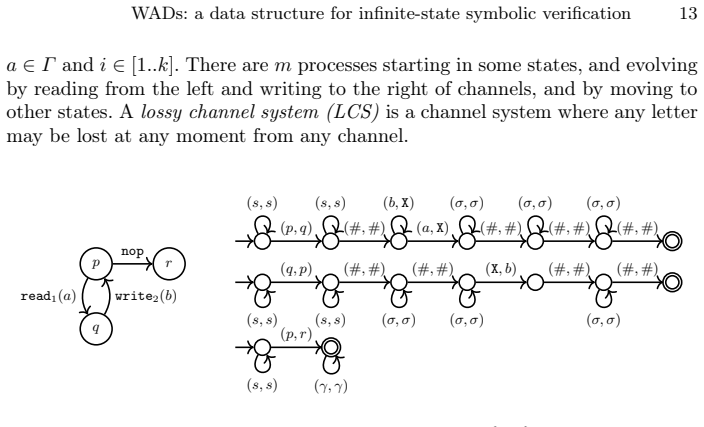
- [Section 5.3 / Figure 6] The transducer encoding for broadcast is underspecified. Broadcast has a global synchronization step ('any other process that can take c?? takes it'), while the operational semantics is given as a length-preserving transducer on words. The paper should specify how a one-pass letter-to-letter transducer guesses the sender and handles receivers that occur before the sender in the word, and it should prove that the transducer's relation coincides with the broadcast transition relation. Without this, it is not clear that Algorithm 4 is being applied to the correct relation.
- [Section 6, lossy channel systems experiments] The pre-compatibility tweak 'slightly changes the semantics' of read transitions, and the authors justify it by saying that processes in a common state are indistinguishable and in the benchmarks never share states. This is an unproven, benchmark-specific assumption; the reported comparison with BML and McScM is therefore not strictly a comparison on the original lossy-channel semantics. Please either prove the equivalence for the class of systems considered or clearly state that the comparison is for a restricted-read variant.
minor comments (4)
- [Section 2] There is a typo in 'minimial DFA' in the paragraph after Figure 1.
- [Section 4.2] The phrase 'exponential worse-case time complexity' should be 'worst-case time complexity'.
- [Section 4.3 and Section 5.3] The notation p_(a,b) assumes a total order on the alphabet Σ×Σ for indexing node successor tuples; please state that order explicitly, since the data structure definition in Section 3 only fixes an order for a one-dimensional alphabet.
- [Appendix E, Proposition 12 proof] In the monotonicity proof for read transitions, the phrase 'converts w′_i into avy′' appears to be a typo for the suffix after the first a, which is v a y′; as written the notation is confusing.
Circularity Check
No circular derivation: the WAD construction is explicit and self-contained; the only notable gap is an omitted monotonicity/order proof for broadcast protocols, which is a completeness issue, not circularity.
full rationale
The paper's central derivation is self-contained: weakly acyclic languages are defined independently (Section 2), the master automaton (Definition 1) is a representation device whose states are languages, and Proposition 4 only verifies that the recursively defined acceptance semantics agrees with the language labeling — a definitional consistency check, not an empirical prediction. The algorithms in Section 4 are proved directly: complement and intersection by structural induction on residuals (Propositions 15–18), and the Pre procedure via Propositions 8–10, which use the residual characterization of weak acyclicity (Lemma 1) rather than assuming the target result. The uniquification procedure `make` (Algorithm 1) is proved to preserve distinctness by a first-duplicate argument (Proposition 6), and no fitted parameter is renamed as a prediction. Self-citations are not load-bearing: [10] is a pointer to the same full version whose proofs appear in the appendix of this text, [20] is a textbook account of OBDD algorithms reproduced here, and [17,35] supply benchmark instances rather than the theoretical argument. External results on R-trivial languages and poNFAs (e.g., [15,29]) are cited as context, not as the mechanism that makes WADs correct. One genuine gap, flagged in the manuscript itself in the regular-model-checking experiments, is that seven instances require line 9 cycle contraction 'and hence we cannot be certain that the result is weakly acyclic' (Section 6); this is an honest limitation. Similarly, Section 5.3 introduces broadcast protocols and transducers without defining the configuration partial order or proving monotonicity, so the general statement 'since Pre(X) is upward-closed by monotonicity, Pre_{T_t}(enc(X)) is necessarily weakly acyclic' is not discharged for that class in the text and relies on the external result [21]. This is an omission/correctness risk, not circularity, because the missing order can be supplied independently (e.g., the scattered subword order) and no theorem in the paper is shown to be equivalent to its own input.
Assumptions & free parameters
assumptions (6)
- standard math Higman's lemma: the subword order on channel contents is a well-quasi-order.
- standard math Dickson's lemma: componentwise order on Petri net markings is a well-quasi-order.
- domain assumption For well-structured transition systems, upward-closed sets have finite bases and the backward reachability algorithm terminates.
- domain assumption The fixed-length transducers with X-padding and postprocessing exactly represent the transition relations of the modeled systems.
- domain assumption The partial order for broadcast protocols is the standard subword order, and the transition relation is monotone with respect to it.
- ad hoc to paper For LCS benchmarks, the restricted-read transducer tweak does not change safety verification because processes in a common state are indistinguishable and never share a state in the benchmarks.
invented entities (2)
-
Weakly acyclic diagrams (WADs)
independent evidence
-
Master automaton
Cite this review
Pith. "Pith review of Weakly acyclic diagrams: A data structure for infinite-state symbolic verification." pith.science (2026). https://pith.science/paper/YGYOD27I
@misc{pith2026241117250,
  author       = {Pith},
  title        = {Pith review of: Weakly acyclic diagrams: A data structure for infinite-state symbolic verification},
  year         = {2026},
  howpublished = {\url{https://pith.science/paper/YGYOD27I}},
  note         = {Machine review of arXiv:2411.17250}
}
read the original abstract
Ordered binary decision diagrams (OBDDs) are a fundamental data structure for the manipulation of Boolean functions, with strong applications to finite-state symbolic model checking. OBDDs allow for efficient algorithms using top-down dynamic programming. From an automata-theoretic perspective, OBDDs essentially are minimal deterministic finite automata recognizing languages whose words have a fixed length (the arity of the Boolean function). We introduce weakly acyclic diagrams (WADs), a generalization of OBDDs that maintains their algorithmic advantages, but can also represent infinite languages. We develop the theory of WADs and show that they can be used for symbolic model checking of various models of infinite-state systems.
Figures


Figures from the paper (5 more)


Reference graph
Works this paper leans on
-
[1]
International Journal on Software Tools for Technology Transfer 14(2), 109–118 (2012)
Abdulla, P.A.: Regular model checking. International Journal on Software Tools for Technology Transfer 14(2), 109–118 (2012). https://doi.org/10.1007/ S10009-011-0216-8
work page 2012
-
[2]
Abdulla, P.A.: Regular model checking: Evolution and perspectives. In: Model Checking, Synthesis, and Learning – Essays Dedicated to Bengt Jonsson on The Occasion of His 60th Birthday. Lecture Notes in Computer Science, vol. 13030, pp. 78–96. Springer (2021). https://doi.org/10.1007/978-3-030-91384-7_5
- [3]
- [4]
- [5]
- [6]
-
[7]
In: Handbook of Model Checking, pp
Abdulla, P.A., Sistla, A.P., Talupur, M.: Model checking parameterized systems. In: Handbook of Model Checking, pp. 685–725. Springer (2018). https://doi.org/ 10.1007/978-3-319-10575-8_21
-
[8]
IEEE Transactions on Computers27(6), 509– 516 (1978), https://doi.org/10.1109/TC.1978.1675141
Akers, S.: Binary decision diagrams. IEEE Transactions on Computers27(6), 509– 516 (1978), https://doi.org/10.1109/TC.1978.1675141
arXiv 1978
Show all 36 references
-
[9]
Andersen, H.R.: An introduction to binary decision diagrams (1998)
1998
- [10]
-
[11]
Formal Methods in System Design (FMSD) 14(3), 237–255 (1999)
Boigelot, B., Godefroid, P.: Symbolic verification of communication protocols with infinite state spaces using QDDs. Formal Methods in System Design (FMSD) 14(3), 237–255 (1999). https://doi.org/10.1023/A:1008719024240
1999 doi
-
[12]
Information and Computation205(2), 199–224 (2007)
Bouajjani, A., Muscholl, A., Touili, T.: Permutation rewriting and algorithmic verification. Information and Computation205(2), 199–224 (2007). https://doi. org/10.1016/J.IC.2005.11.007
2007 doi
-
[13]
IEEE Transactions on Computers35(8), 677–691 (1986)
Bryant, R.E.: Graph-based algorithms for boolean function manipulation. IEEE Transactions on Computers35(8), 677–691 (1986). https://doi.org/10.1109/TC. 1986.1676819
1986
-
[14]
In: Handbook of Model Checking, pp
Bryant, R.E.: Binary decision diagrams. In: Handbook of Model Checking, pp. 191–217. Springer (2018). https://doi.org/10.1007/978-3-319-10575-8_7
2018 doi
-
[15]
Journal of Computer and System Sciences20(1), 32–49 (1980), https://doi.org/10.1016/0022-0000(80) 90003-3
Brzozowski, J.A., Fich, F.E.: Languages ofR-trivial monoids. Journal of Computer and System Sciences20(1), 32–49 (1980), https://doi.org/10.1016/0022-0000(80) 90003-3
1980 doi
-
[16]
In: Handbook of Model Checking, pp
Chaki, S., Gurfinkel, A.: BDD-based symbolic model checking. In: Handbook of Model Checking, pp. 219–245. Springer (2018). https://doi.org/10.1007/ 978-3-319-10575-8_8 WADs: a data structure for infinite-state symbolic verification 19
2018
-
[17]
In: Proc
Czerner, P., Esparza, J., Krasotin, V., Welzel-Mohr, C.: Computing inductive in- variants of regular abstraction frameworks. In: Proc. 35th International Confer- ence on Concurrency Theory (CONCUR). LIPIcs, vol. 311, pp. 19:1–19:18 (2024). https://doi.org/10.4230/LIPICS.CONCUR...
2024
-
[18]
International Journal on Software Tools for Technology Transfer (STTT)5(2-3), 268–297 (2004)
Delzanno, G., Raskin, J., Begin, L.V.: Covering sharing trees: a compact data structure for parameterized verification. International Journal on Software Tools for Technology Transfer (STTT)5(2-3), 268–297 (2004). https://doi.org/10.1007/ S10009-003-0110-0
2004
-
[19]
Eilenberg, S.: Automata, Languages, and Machines, vol. B. Academic Press (1976)
1976
-
[20]
MIT Press (2023)
Esparza, J., Blondin, M.: Automata theory: An algorithmic approach. MIT Press (2023)
2023
-
[21]
In: Proc
Esparza, J., Finkel, A., Mayr, R.: On the verification of broadcast protocols. In: Proc. 14th Annual IEEE Symposium on Logic in Computer Science (LICS). pp. 352–359. IEEE Computer Society (1999). https://doi.org/10.1109/LICS.1999. 782630
1999 doi
-
[22]
In: Proc
Esparza, J., Ledesma-Garza, R., Majumdar, R., Meyer, P.J., Niksic, F.: An SMT- based approach to coverability analysis. In: Proc. 26th International Conference on Computer Aided Verification (CAV). pp. 603–619. Springer (2014). https://doi. org/10.1007/978-3-319-08867-9_40
2014 doi
-
[23]
https://doi.org/10.1016/ S0304-3975(00)00102-X
Finkel, A., Schnoebelen, Ph.: Well-structured transition systems everywhere! Theoretical Computer Science 256(1-2), 63–92 (2001). https://doi.org/10.1016/ S0304-3975(00)00102-X
2001
-
[24]
Ganty, P., Meuter, C., Delzanno, G., Kalyon, G., Raskin, J.F., Van Begin, L.: Symbolic data structure for sets ofk-uples. Tech. Rep. 570, Université Libre de Bruxelles, Belgium (2007)
2007
-
[25]
In: Proc
Geffroy, T., Leroux, J., Sutre, G.: Backward coverability with pruning for lossy channel systems. In: Proc. 24 th ACM SIGSOFT International Symposium on Model Checking of Software (SPIN). pp. 132–141. ACM (2017). https://doi.org/ 10.1145/3092282.3092292, The tool BML and the l...
2017
-
[26]
In: Proc
Heußner, A., Gall, T.L., Sutre, G.: Extrapolation-based path invariants for ab- straction refinement of FIFO systems. In: Proc. 16 th International on Model Checking Software (SPIN). pp. 107–124. Springer (2009). https://doi.org/10. 1007/978-3-642-02652-2_11, The tool McScM is...
2009
-
[27]
In: Proc
Heußner,A.,Gall,T.L.,Sutre,G.:McScM:Ageneralframeworkfortheverification of communicating machines. In: Proc. 18th International Conference on Tools and Algorithms for the Construction and Analysis of Systems (TACAS). pp. 478–484. Springer (2012). https://doi.org/10.1007/978-3-...
2012 doi
-
[28]
BRICS, Department of Computer Science, University of Aarhus (January 2001), notes Series NS-01-1
Klarlund, N., Møller, A.: MONA Version 1.4 User Manual. BRICS, Department of Computer Science, University of Aarhus (January 2001), notes Series NS-01-1. Available from http://www.brics.dk/mona/
2001
-
[29]
Information and Computation255, 177–192 (2017)
Krötzsch, M., Masopust, T., Thomazo, M.: Complexity of universality and related problems for partially ordered NFAs. Information and Computation255, 177–192 (2017). https://doi.org/10.1016/j.ic.2017.06.004
2017 doi
-
[30]
Logical Methods in Computer Science17(2) (2021)
Masopust, T., Krötzsch, M.: Partially ordered automata and piecewise testabil- ity. Logical Methods in Computer Science17(2) (2021). https://doi.org/10.23638/ LMCS-17(2:14)2021
2021
-
[31]
Proceedings of the IEEE 77(4), 541–580 (1989)
Murata, T.: Petri nets: Properties, analysis and applications. Proceedings of the IEEE 77(4), 541–580 (1989). https://doi.org/10.1109/5.24143 20 M. Blondin et al
1989 doi
-
[32]
North Oxford, London and Plenum (1986)
Éric Pin, J.: Varieties of formal languages. North Oxford, London and Plenum (1986)
1986
-
[33]
In: Proc
Ryzhikov, A., Wolf, P.: Monoids of upper triangular matrices over the Boolean semiring. In: Proc. 49th International Symposium on Mathematical Foundations of Computer Science (MFCS). LIPIcs, vol. 306, pp. 81:1–81:18 (2024). https://doi. org/10.4230/LIPICS.MFCS.2024.81
2024 doi
-
[34]
In: Proc
Schwentick, T., Thérien, D., Vollmer, H.: Partially-ordered two-way automata: A new characterization of DA. In: Proc. 5th International Conference on Devel- opments in Language Theory (DLT). vol. 2295, pp. 239–250. Springer (2001). https://doi.org/10.1007/3-540-46011-X_20
2001 doi
-
[35]
¬flag(q)
Welzel-Mohr, C.: Inductive Statements for Regular Transition Systems. Ph.D. the- sis, Technical University of Munich, Germany (2024), https://mediatum.ub.tum. de/1721365 WADs: a data structure for infinite-state symbolic verification 21 A Missing proofs of Section 2 Propositio...
2024
-
[347]
https://doi.org/10.1007/3-540-60218-6_25
Springer (1995). https://doi.org/10.1007/3-540-60218-6_25
1995 doi
Reviewed August 12, 2026 · model on record in the stance chip above.
Discussion (0). Continue with ORCID to comment.