REVIEW 3 major objections 6 minor 43 references
Gravitational wave emission from unstable accretion discs in tidal disruption events
T0 review · 3 major / 6 minor · reviewed 2026-08-14 · deepseek-v4-flash
Pith's one-line read Unstable accretion discs from tidal disruption events emit gravitational waves roughly one hundred times weaker than analytic point-mass estimates.
desk verdict A useful first measurement of GW strain from a PPI-unstable TDE torus, but the claimed efficiency factor rests on an unreported seeded mode and is extrapolated far beyond the one simulation. read the letter →
The pith
A machine-rendered reading of the paper's core claim, the machinery that carries it, and where it could break.
The reading
What carries the argument
The load-bearing object is the disc's mass quadrupole, built from simulated particles as $M^{kl}=\sum_a m_a x_a^k x_a^l$, whose second time derivative, computed by central differencing, feeds the two strain polarizations $h_+$ and $h_\times$ through the quadrupole formula. The physical mechanism making the quadrupole time-dependent is the Papaloizou-Pringle instability, a global non-axisymmetric hydrodynamic instability in which an $m=1$ overdensity forms in the torus and orbits at close to the Keplerian frequency, so the gravitational-wave frequency is the Keplerian frequency of the original stellar orbit. The analytic point-mass estimate applies the standard quadrupole formula to a lump of mass moving at the pericenter Keplerian velocity, and the comparison between the two routes produces the efficiency factor $\xi$ that carries the extrapolation to heavier discs.
What would settle it
Repeat the PPI simulation for 10 and 100 solar-mass tori and for $\beta=10$ and $\beta=20$, and compare the peak strain with the analytic point-mass estimate; if the suppression factor departs from $10^{-2}$ by more than a factor of a few, the extrapolated LISA detectability claim fails.
Extended reading notes
Core claim
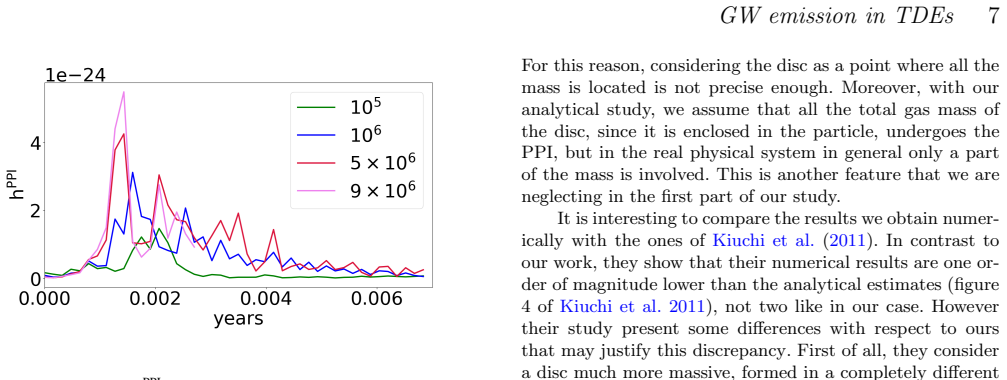
On its own terms, the central claim is that the point-mass approximation used for the stellar disruption phase badly overestimates the gravitational-wave strain from the later unstable-disc phase. For a $1\,M_\odot$ torus with $\beta=5$ around a static $10^6\,M_\odot$ black hole, the numerically derived strain peaks at about $4\times10^{-24}$ in the direction perpendicular to the stellar orbit, while the analytic point-mass estimate gives about $5\times10^{-22}$; the ratio is $\xi=h_{\rm PPI}/h\sim10^{-2}$. The paper attributes the reduction to the torus spreading out under the instability and to only part of the disc mass participating in the PPI mode. Assuming the same reduction factor holds for other penetration factors and stellar masses, the characteristic strain curves for 1, 10, and 100 solar-mass discs are shifted down by $10^{-2}$; the consequence is that only discs from deeply penetrating disruptions ($\beta$ roughly beyond 15 for 10 solar masses and 45 for 100 solar masses) rise above LISA's sensitivity curve.
Load-bearing premise
The load-bearing premise is that the suppression factor $\xi\sim10^{-2}$ measured in one $1\,M_\odot$, $\beta=5$ simulation is universal; if $\xi$ depends on disc mass, penetration factor, or the seeded perturbation's amplitude, the predicted LISA detectability for heavier discs does not follow.
Editorial extensions
If this is right
- The $1\,M_\odot$, $\beta=5$ remnant simulated here would not be detected by LISA: its characteristic strain sits below the sensitivity curve even before the numerical suppression is applied.
- If $\xi\sim10^{-2}$ applies to all masses, the 1 solar-mass case leaves LISA's reach at every $\beta$, while 10 and 100 solar-mass tori remain detectable only for deeply penetrating disruptions ($\beta\gtrsim15$ and $\beta\gtrsim45$, respectively).
- The gravitational-wave frequency stays near $10^{-3}$ to $10^{-2}\,\mathrm{Hz}$ for a $10^6\,M_\odot$ black hole, placing any detectable signal squarely in LISA's mHz band.
- The simulated strain converges by 5 million particles, so the factor-of-100 suppression is not a resolution artefact.
- The black hole contributes negligibly to the strain: its moment of inertia is between $10^{-6}$ and $10^{-4}$ times that of the disc for the masses considered.
Reading between the lines
- The paper leaves untested the universality of $\xi$: repeating the measurement for $\beta=10$ and $\beta=20$ tori and for 10 and 100 solar-mass discs would show whether the LISA detectability forecast survives.
- Since the $m=1$ mode is seeded by hand, the measured $\xi$ may depend on the seed amplitude, which is not reported; growing the instability from noise would give a physically grounded value.
- The factor-of-100 gap between point-mass and extended-disc estimates suggests that LISA search templates for TDE remnants should be built from simulated waveforms rather than rescaled point-mass signals.
- Self-gravity is neglected in the simulation; it becomes relatively more important for 100 solar-mass discs, where it could either enhance clumping and emission or change the mode structure, making the highest-mass extrapolation the least secure.
Signed reviews
Editorial analysis
A structured set of objections, weighed in public.
Referee Report
Summary. The paper investigates gravitational-wave (GW) emission from Papaloizou-Pringle unstable tori formed in tidal disruption events (TDEs). The authors first derive analytical estimates of the peak and characteristic strain using a point-mass quadrupole approximation for the stellar debris, obtaining h ~ 1e-22 beta m*^(1/3) for a 1 Msun star around a 1e6 Msun black hole, and conclude that the analytically estimated signal could exceed the LISA sensitivity curve for sufficiently large penetration factor beta. They then perform a 3D SPH simulation with the PHANTOM code of a 1 Msun, beta = 5 torus, seeding an m = 1 density perturbation to trigger the PPI. From the simulated waveforms they measure a peak strain of about 4e-24, roughly two orders of magnitude below the analytical estimate, and introduce an efficiency factor xi ~ 1e-2 that relates the numerical to the analytical strain. Assuming this xi also applies to other beta values and stellar masses, they conclude that PPI-unstable discs from deeply penetrating TDEs of 10-100 Msun stars may be detectable by LISA.
Significance. If the numerical measurement is robust, the paper provides a useful and nontrivial correction to the naive point-mass estimate: for a 1 Msun, beta = 5 torus, the expected GW strain is roughly 100 times smaller than the analytical prediction, placing the source below LISA's sensitivity. The analytical framework is clearly presented, the use of an independent SPH simulation to test the estimate is appropriate, and the paper explicitly lists important simplifications such as MRI quenching, partial mass participation in the instability, and disc spreading. The comparison between numerical and analytical strain is not circular, and the resolution test with increasing particle number is a genuine strength. However, the quantitative numerical result depends on an unreported seeded perturbation amplitude, and the extrapolation to higher-mass discs rests on the untested universality of xi. The central claim is therefore conditional rather than parameter-free, and the detectability conclusion for 10-100 Msun discs is not yet supported by the presented evidence.
major comments (3)
- [Section 4] The numerical experiment seeds the m = 1 mode by 'add[ing] m = 1 density perturbation', but the amplitude of this seed is never reported. For a rigidly rotating m = 1 density perturbation proportional to cos(phi - Omega_p t), the quadrupole integrals int delta-rho r^2 cos(2 phi) dV and int delta-rho r^2 sin(2 phi) dV vanish after azimuthal integration, so the leading-order GW emission from this mode is a second-order effect scaling as the square of the mode amplitude. Consequently, the measured efficiency xi ~ 1e-2 in Eq. (41) could be set by the chosen seed rather than by the saturation physics of the PPI, and the quoted peak strain h_PPI ~ 4e-24 is not reproducible from the information given in the paper. Please report the seed amplitude, test the dependence of the saturated mode amplitude and of xi on the seed amplitude, and clarify the relation between the seeded perturbation and the m = 1 mode found in Nealon et al. (2018).
- [Section 4.1] The extrapolation in Section 4.1, stated as 'If we assume that the same scaling factor holds also for different beta and for different stellar masses', is load-bearing for the main astrophysical conclusion in Section 6 that discs from TDEs of 10-100 Msun stars could be detectable by LISA, but it is presented as a pure assumption. xi is measured from a single simulation with M_d = 1 Msun, beta = 5, one torus geometry, and one seeded perturbation; no physical scaling argument or additional simulation is provided to justify applying the same factor to other masses, penetration factors, or disc structures. The detectability statement should either be supported by simulations at other masses and beta values, or by a physically motivated model of how xi depends on the disc parameters, or it should be explicitly downgraded to a conjecture.
- [Section 4.2] The resolution test in Fig. 4 demonstrates convergence with particle number, which is useful, but it does not directly address the two inputs on which the strain depends most strongly: the amplitude and form of the seeded m = 1 perturbation, and the time sampling of the linear growth and saturation phases. Convergence in particle number alone does not establish that the peak strain is a property of the PPI dynamics rather than of the initial conditions. A seed-amplitude study, together with a statement of the time step Delta t used in the second derivative in Eq. (40) and any smoothing applied to M_kl or to the waveform, is needed before h_PPI can be regarded as a robust numerical prediction.
minor comments (6)
- [Section 4] The phrase 'momentum of inertia' should be 'moment of inertia'.
- [Sections 3.1 and 4.1] In the text near Fig. 3, h_PPI is said to be computed from 'equation 19'; the strain is actually the quadrature sum defined in Eq. (18), so the cross-reference should be corrected.
- [Appendix A] Equations (A4) and (A5) as printed contain a dimensionally inconsistent expression, 'M_h r_1 = 10^-6 M_d r_2^2'; the intended relation is presumably M_h r_1^2 = (M_d/M_h) M_d r_2^2. Please fix the notation.
- [Section 4] The PHANTOM code is used but no code reference is provided; please cite the appropriate PHANTOM paper (e.g. Price et al. 2018) along with the specific version or settings used.
- [Figure 1] The caption states that beta increases from left to right, but it is not explicit which curve corresponds to which beta values for each mass, especially in relation to the red triangle marking the beta = 5 case. Please add the relevant beta values to the caption or legend.
- [Section 4] Equation (36) introduces the dimensionless cross-section parameter d using r_- and r_+ without defining these quantities in the text; please define them explicitly.
Circularity Check
The higher-mass LISA detectability claim is the analytic point-mass strain rescaled by an efficiency factor measured from one SPH simulation, so that prediction reduces to a calibrated prefactor.
-
fitted input called prediction
[Section 4.1, equation (41) and following paragraph]
"So for the torus formed after a TDE of a solar mass star, disrupted by a static 10^6 M_sun hole, with beta = 5, we have that xi ~ 10^-2 and so h_PPI = 10^-2 h. If we assume that the same scaling factor holds also for different beta and for different stellar masses, we can extrapolate our results by shifting down by 10^-2 the signals shown in figure 1."
The factor xi is not derived from a model; it is measured as the ratio of the numerical strain to the analytic strain for one SPH run (1 Msun, beta=5). Equation (41) then fixes h_PPI for every other configuration as xi times the analytic point-mass h. The detectability claim for 10 and 100 Msun discs is therefore the analytic estimate rescaled by a constant calibrated on a single simulation, so the higher-mass prediction is forced by this calibration rather than by an independent calculation. Since the amplitude of the seeded m=1 perturbation is not reported, xi is also not shown to be independent of the initial perturbation.
-
other
[Section 4, simulation setup]
"we set the torus in a fixed Keplerian potential and we add m = 1 density perturbation to have the PPI."
The measured strain is produced after seeding an m=1 density perturbation, but the seed amplitude is never specified. For a purely m=1 density component the quadrupole integrals over azimuth vanish at first order, so the emitted strain is second order in the mode amplitude; the numerical value of xi therefore depends on an unreported input. Treating the resulting xi as a universal efficiency factor and rescaling the analytic estimates makes the extrapolated signal an output of that unreported initial condition rather than an independent physical prediction.
full rationale
The paper's statement that the numerically measured strain for the 1 Msun, beta=5 torus is about two orders of magnitude below the analytic point-mass estimate is not circular: the SPH waveform is computed independently of the analytic formula, and that comparison is a genuine numerical result. The circularity enters only when the efficiency factor xi, measured from that single simulation as the ratio h_PPI/h, is promoted to a universal prefactor and used to rescale the analytic estimates for 10 and 100 Msun discs and for different beta. The predicted strain for those cases is then, by construction, the analytic point-mass strain multiplied by a constant calibrated on one run, so the LISA detectability conclusion for higher-mass discs is forced by that calibration rather than by a derivation. The unreported amplitude of the seeded m=1 perturbation adds a further degeneracy because the GW strain from an m=1 perturbation is a second-order effect, making the measured xi potentially dependent on an initial condition that the paper does not specify. The self-citations to Nealon et al. (2018) are not independently circular here, since the present paper repeats the simulation and observes the PPI growth itself; no imported uniqueness theorem is used to forbid alternatives. Overall, the central comparison is self-contained, but the extrapolated detectability claim reduces to a calibrated prefactor, giving partial circularity.
Assumptions & free parameters
free parameters (2)
- Seeded m=1 perturbation amplitude
- Efficiency factor xi =
~10^-2
assumptions (5)
- standard math Quadrupole formula assumptions: slow internal motion, negligible self-gravity, distant observer, TT gauge (Buonanno 2007)
- domain assumption The torus formed after the TDE is unstable to the Papaloizou-Pringle instability with dominant m=1 mode, as found by Nealon et al. (2018)
- ad hoc to paper The same efficiency factor xi applies to discs of different mass and beta
- domain assumption The PPI mode frequency equals the Keplerian frequency of the original stellar orbit at r_p
- domain assumption Magnetic fields are neglected; the PPI is assumed to operate for 20 orbits without MRI suppression
Cite this review
Pith. "Pith review of Gravitational wave emission from unstable accretion discs in tidal disruption events." pith.science (2026). https://pith.science/paper/YH5PMDQC
@misc{pith2026190802969,
  author       = {Pith},
  title        = {Pith review of: Gravitational wave emission from unstable accretion discs in tidal disruption events},
  year         = {2026},
  howpublished = {\url{https://pith.science/paper/YH5PMDQC}},
  note         = {Machine review of arXiv:1908.02969}
}
abstract
Gravitational waves can be emitted by accretion discs if they undergo instabilities that generate a time varying mass quadrupole. In this work we investigate the gravitational signal generated by a thick accretion disc of $1 M_{\odot}$ around a static super-massive black hole of $10^{6}M_{\odot}$, assumed to be formed after the tidal disruption of a solar type star. This torus has been shown to be unstable to a global non-axisymmetric hydrodynamic instability, the Papaloizou-Pringle instability, in the case where it is not already accreting and has a weak magnetic field. We start by deriving analytical estimates of the maximum amplitude of the gravitational wave signal, with the aim to establish its detectability by the Laser Interferometer Space Antenna (LISA). Then, we compare these estimates with those obtained through a numerical simulation of the torus, made with a 3D smoothed particle hydrodynamics code. Our numerical analysis shows that the measured strain is two orders of magnitude lower than the maximum value obtained analytically. However, accretion discs affected by the Papaloizou-Pringle instability may still be interesting sources for LISA, if we consider discs generated after deeply penetrating tidal disruptions of main sequence stars of higher mass.
Figures


Figures from the paper (1 more)
Reference graph
Works this paper leans on
-
[1]
Amaro-Seoane P., et al., 2017, arXiv e-prints, http://adsabs.harvard.edu/abs/2017arXiv170200786A
work page 2017
-
[2]
Anninos P., Fragile P. C., Olivier S. S., Hoffman R., Mishra B., Camarda K., 2018, , 865, 3
work page 2018
-
[3]
Bade N., Komossa S., Dahlem M., 1996, , http://adsabs.harvard.edu/abs/1996A
work page 1996
-
[4]
Blaes O. M., Glatzel W., 1986, @doi [ ] 10.1093/mnras/220.2.253 , http://adsabs.harvard.edu/abs/1986MNRAS.220..253B 220, 253
-
[5]
S., et al., 2011, @doi [ ] 10.1126/science.1207150 , 333, 203
Bloom J. S., et al., 2011, @doi [ ] 10.1126/science.1207150 , 333, 203
-
[6]
Bonnerot C., Rossi E. M., Lodato G., Price D. J., 2016, @doi [ ] 10.1093/mnras/stv2411 , http://adsabs.harvard.edu/abs/2016MNRAS.455.2253B 455, 2253
-
[7]
Bugli M., Guilet J., M \"u ller E., Del Zanna L., Bucciantini N., Montero P., 2018, , 475, 108
work page 2018
-
[8]
Buonanno A., 2007, preprint, http://adsabs.harvard.edu/abs/2007arXiv0709.4682B ( @eprint arXiv 0709.4682 )
arXiv 2007
Show all 43 references
-
[9]
S., et al., 2012, @doi [ ] 10.1088/0004-637x/753/1/77 , 753, 77
Cenko B. S., et al., 2012, @doi [ ] 10.1088/0004-637x/753/1/77 , 753, 77
2012 doi
-
[10]
World Scientific Publishing Co, pp 43--140, @doi 10.1142/9789813141766_0002
Colpi M., Sesana A., 2017, Gravitational Wave Sources in the Era of Multi-Band Gravitational Wave Astronomy . World Scientific Publishing Co, pp 43--140, @doi 10.1142/9789813141766_0002
2017 doi
-
[11]
Einstein A., 1918, Sitzungsberichte der K \"o niglich Preu ischen Akademie der Wissenschaften (Berlin), Seite 154-167
1918
-
[12]
R., Kochanek C
Evans C. R., Kochanek C. S., 1989, @doi [ ] 10.1086/185567 , http://adsabs.harvard.edu/abs/1989ApJ...346L..13E 346, L13
1989 doi
-
[13]
Gezari S., et al., 2008, @doi [ ] 10.1086/529008 , http://adsabs.harvard.edu/abs/2008ApJ...676..944G 676, 944
2008 doi
-
[14]
Gezari S., et al., 2009, @doi [ ] 10.1088/0004-637X/698/2/1367 , http://adsabs.harvard.edu/abs/2009ApJ...698.1367G 698, 1367
2009 doi
-
[15]
B., Arcavi I., 2017, @doi [ ] 10.3847/2041-8213/aaa0c2 , http://adsabs.harvard.edu/abs/2017ApJ...851L..47G 851, L47
Gezari S., Cenko S. B., Arcavi I., 2017, @doi [ ] 10.3847/2041-8213/aaa0c2 , http://adsabs.harvard.edu/abs/2017ApJ...851L..47G 851, L47
2017 doi
-
[16]
Greiner J., Schwarz R., Zharikov S., Orio M., 2000, , http://adsabs.harvard.edu/abs/2000A
2000
-
[17]
Guillochon J., Ramirez-Ruiz E., 2013, @doi [ ] 10.1088/0004-637x/767/1/25 , 767, 25
2013 doi
-
[18]
V., Bode T., Laguna P., 2012, , 749, 117
Haas R., Shcherbakov R. V., Bode T., Laguna P., 2012, , 749, 117
2012
-
[19]
J., Font J
Kiuchi K., Shibata M., Montero P. J., Font J. A., 2011, @doi [ ] 10.1103/PhysRevLett.106.251102 , http://adsabs.harvard.edu/abs/2011PhRvL.106y1102K 106, 251102
2011 doi
-
[20]
S., Meszaros P., 2004, @doi [ ] 10.1086/424684 , 615, 855
Kobayashi S., Laguna P., Phinney E. S., Meszaros P., 2004, @doi [ ] 10.1086/424684 , 615, 855
2004 doi
-
[21]
161, High Energy Processes in Accreting Black Holes
Komossa S., Bade N., 1999, in Poutanen J., Svensson R., eds, Astronomical Society of the Pacific Conference Series Vol. 161, High Energy Processes in Accreting Black Holes. p. 234 ( @eprint astro-ph/9901008 )
1999 arXiv
-
[22]
Komossa S., Greiner J., 1999, , http://adsabs.harvard.edu/abs/1999A
1999
-
[23]
Komossa S., et al., 2008, @doi [ ] 10.1086/588281 , http://adsabs.harvard.edu/abs/2008ApJ...678L..13K 678, L13
2008 doi
-
[24]
Korobkin O., Abdikamalov E., Schnetter E., Stergioulas N., Zink B., 2011, , 83
2011
-
[25]
J., et al., 2011, @doi [ ] 10.1126/science.1207143 , 333, 199
Levan A. J., et al., 2011, @doi [ ] 10.1126/science.1207143 , 333, 199
2011 doi
-
[26]
Lodato G., 2007, @doi [Nuovo Cimento Rivista Serie] 10.1393/ncr/i2007-10022-x , http://adsabs.harvard.edu/abs/2007NCimR..30..293L 30
2007 doi
-
[27]
M., 2011, @doi [ ] 10.1111/j.1365-2966.2010.17448.x , http://adsabs.harvard.edu/abs/2011MNRAS.410..359L 410, 359
Lodato G., Rossi E. M., 2011, @doi [ ] 10.1111/j.1365-2966.2010.17448.x , http://adsabs.harvard.edu/abs/2011MNRAS.410..359L 410, 359
2011
-
[28]
R., Pringle J
Lodato G., King A. R., Pringle J. E., 2009, @doi [ ] 10.1111/j.1365-2966.2008.14049.x , http://adsabs.harvard.edu/abs/2009MNRAS.392..332L 392, 332
2009
-
[29]
Volume 1: Theory and Experiments
Maggiore M., 2007, Gravitational Waves. Volume 1: Theory and Experiments. Oxford University Press
2007
-
[30]
Volume 2: Astrophysics and Cosmology
Maggiore M., 2018, Gravitational Waves. Volume 2: Astrophysics and Cosmology. OUP Oxford
2018
-
[31]
A., Galeazzi F., Montero P
Mewes V., Font J. A., Galeazzi F., Montero P. J., Stergioulas N., 2016, , 93 , 064055
2016
-
[32]
J., Cole R
Moore C. J., Cole R. H., Berry C. P. L., 2014, @doi [Classical and Quantum Gravity] 10.1088/0264-9381/32/1/015014 , 32, 015014
2014 doi
-
[33]
J., Bonnerot C., Lodato G., 2018, @doi [ ] 10.1093/mnras/stx2871 , http://adsabs.harvard.edu/abs/2018MNRAS.474.1737N 474, 1737
Nealon R., Price D. J., Bonnerot C., Lodato G., 2018, @doi [ ] 10.1093/mnras/stx2871 , http://adsabs.harvard.edu/abs/2018MNRAS.474.1737N 474, 1737
2018 doi
-
[34]
Papaloizou J. C. B., Pringle J. E., 1984, @doi [ ] 10.1093/mnras/208.4.721 , http://adsabs.harvard.edu/abs/1984MNRAS.208..721P 208, 721
1984 doi
-
[35]
S., 1989, in Morris M., ed., IAU Symposium Vol
Phinney E. S., 1989, in Morris M., ed., IAU Symposium Vol. 136, The Center of the Galaxy. p. 543
1989
-
[36]
E., King A., 2007, Astrophysical Flows
Pringle J. E., King A., 2007, Astrophysical Flows
2007
-
[37]
J., 1988, @doi [ ] 10.1038/333523a0 , http://adsabs.harvard.edu/abs/1988Natur.333..523R 333, 523
Rees M. J., 1988, @doi [ ] 10.1038/333523a0 , http://adsabs.harvard.edu/abs/1988Natur.333..523R 333, 523
1988 doi
-
[38]
R., 2009, , 695, 404
Rosswog S., Ramirez-Ruiz E., Hix W. R., 2009, , 695, 404
2009
-
[39]
pp 330--458
Thorne K., 1987, Gravitational radiation. . pp 330--458
1987
-
[40]
A., et al., 2011, @doi [ ] 10.1038/nature10366 , http://adsabs.harvard.edu/abs/2011Natur.476..425Z 476, 425
Zauderer B. A., et al., 2011, @doi [ ] 10.1038/nature10366 , http://adsabs.harvard.edu/abs/2011Natur.476..425Z 476, 425
2011 doi
-
[41]
Bade N., Komossa S., Dahlem M., 1996, , http://adsabs.harvard.edu/abs/1996A\
1996
-
[42]
Greiner J., Schwarz R., Zharikov S., Orio M., 2000, , http://adsabs.harvard.edu/abs/2000A\
2000
-
[43]
Komossa S., Greiner J., 1999, , http://adsabs.harvard.edu/abs/1999A\
1999
Reviewed August 14, 2026 · model on record in the stance chip above.
Discussion (0). Continue with ORCID to comment.