REVIEW 3 major objections 4 minor 61 references
Hierarchical clusters in neuronal populations with plasticity
T0 review · 3 major / 4 minor · reviewed 2026-08-14 · deepseek-v4-flash
Pith's one-line read This paper reports that a Hodgkin-Huxley network with symmetric spike-timing-dependent plasticity can self-organize into hierarchical frequency clusters, and that a two-variable phase-and-coupling model captures when those clusters…
desk verdict A plausible, well-illustrated computational study of STDP-driven frequency clusters in Hodgkin-Huxley neurons, with a useful reduced model; the missing simulation parameters make the quantitative comparison hard to verify but not a fatal flaw. read the letter →
The pith
A machine-rendered reading of the paper's core claim, the machinery that carries it, and where it could break.
The reading
What carries the argument
The central object is the two-cluster phenomenological model: $\dot\varphi = \omega - \sigma \sin(\varphi+\alpha)$ and $\dot\sigma = \varepsilon G(\varphi)$, where $G(\varphi) = W\big((2\pi-(\varphi \bmod 2\pi))/\bar\omega\big) + W\big((\varphi \bmod 2\pi)/\bar\omega\big)$ sums the two STDP updates per common period $T\approx 2\pi/\bar\omega$, and $W$ is the double-exponential symmetric plasticity window. The small parameter $\varepsilon$ separates the fast phase dynamics from the slow coupling adaptation. The phase portrait is organized by a saddle fixed point $(\varphi^*,\sigma^*)$; the condition $\sigma(\varphi^*) = \sigma^*$ marks the boundary between fusion and stable coexistence, and the paper uses it to map which plasticity windows $W$ produce stable clusters.
What would settle it
Track the projected phase difference $\varphi_{\mathrm{HH}}$ and mean inter-cluster coupling $\sigma_{\mathrm{HH}}$ in the full network near the predicted fusion boundary and check the reduced model's condition $\sigma(\varphi^*) < \sigma^*$ for stable clusters; a surviving cluster with $\sigma(\varphi^*) > \sigma^*$, or a fusing pair with $\sigma(\varphi^*) < \sigma^*$, would refute the mechanism.
Extended reading notes
Core claim
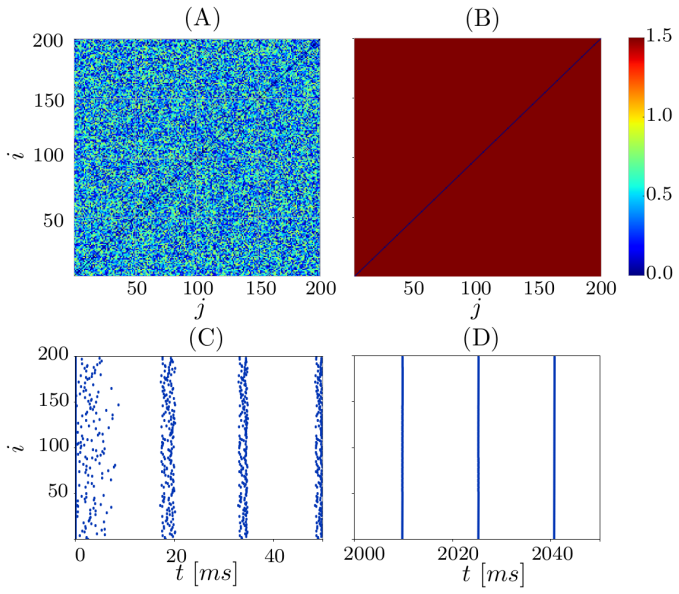
The paper claims that a network of identical Hodgkin-Huxley neurons with symmetric spike-timing-dependent plasticity does not settle into a single fate: depending on initial conditions and plasticity parameters, it can reach full synchrony or a hierarchical cluster state in which each group fires at its own frequency and the largest group fires slowest. The stabilization of these clusters is controlled by the slow adaptation of inter-cluster synaptic weights. When two clusters come into phase, their mutual coupling is potentiated, but if their frequency difference is large enough the in-phase episode is brief and the subsequent out-of-phase interval depresses the inter-cluster weights back toward zero, keeping the clusters apart. The paper reduces this to the two-dimensional system $\dot\varphi = \omega-\sigma\sin(\varphi+\alpha)$, $\dot\sigma = \varepsilon G(\varphi)$ and shows that the same phase portraits—fusion, coexistence of synchrony with stable clusters, and full decoupling—appear in the full network when its cluster phases and mean inter-cluster coupling are projected onto the $(\varphi,\sigma)$ plane. It also shows that the mean synaptic activity of the two-cluster state is modulated on a timescale of seconds, about two orders of magnitude slower than the tens-of-milliseconds firing periods, which the authors connect to slow LFP, EEG, and BOLD oscillations.
Load-bearing premise
The load-bearing assumption is that during the brief moments when two clusters align, their spiking periods are close enough to a single common value that the plasticity update can be written as a fixed function of their phase difference alone; if the periods diverge during those episodes, the predicted boundary between stable and fusing clusters may not carry over from the reduced model to the full network.
Editorial extensions
If this is right
- Stable frequency clusters require sufficiently different cluster sizes; similar-sized clusters fuse into global synchrony.
- The population mean field of a two-cluster state is amplitude-modulated on a timescale set by the cluster frequency difference (about 2.5 seconds in the example), two orders of magnitude slower than the roughly 15-millisecond firing period.
- There is a coexistence regime in which complete synchrony and stable clusters are both attractors, so initial conditions or perturbations determine which state is reached.
- For plasticity windows with $c_d \geq c_p$ and $\tau_d \geq \tau_p$, the update function $G(\varphi)$ is non-positive everywhere and the network decouples instead of clustering.
- Weak random synaptic input preserves clusters, while stronger input destroys the smaller clusters first, meaning cluster stability is size-dependent.
Reading between the lines
- A natural extension is to test the same slow-fast phase-and-coupling reduction in other conductance-based spiking models; the mechanism should survive as long as within-cluster synchrony and weak inter-cluster coupling hold.
- The hierarchical size distribution implies a discrete set of reachable cluster partitions; mapping which initial conditions lead to which partition would treat the network as a multi-stable encoder of its own history.
- The model predicts a sharp experimental signature: blocking the potentiation of inter-cluster synapses during in-phase episodes should remove the slow mean-field modulation while leaving tonic firing intact, distinguishing this mechanism from slow-bursting generators.
Signed reviews
Editorial analysis
A structured set of objections, weighed in public.
Referee Report
Summary. The paper reports numerical observations of frequency clustering in a Hodgkin-Huxley network with symmetric spike timing-dependent plasticity (STDP). Depending on initial conditions, the network either fully synchronizes or splits into a few clusters that are synchronized internally at different frequencies and are hierarchical in size; the mean synaptic activity then exhibits slow amplitude modulations on a timescale much longer than individual spiking. The authors propose a two-dimensional phenomenological model for two clusters, with phase difference phi and mean inter-cluster coupling sigma, in which the coupling evolves as sigma_dot = epsilon G(phi), where G is derived from the symmetric plasticity function W. They analyze the phase portraits of this reduced model, compare them with the HH simulations, and use the model to predict regions in the (cp, cd) plane of the plasticity function where stable clusters, full synchronization, or full decoupling occur.
Significance. If correct, the paper offers a concrete and physiologically plausible mechanism by which a population of tonically firing neurons with adaptive synapses can generate slow modulations of the population mean field, relevant to LFP/EEG/BOLD observations. The two-cluster reduction is attractive because it reduces a high-dimensional spiking network to a planar system with an explicit design criterion for plasticity rules that produce clusters. The paper gives credit to the approximate nature of the reduction and supports the main phenomenon with several numerical realizations and a robustness test under random inputs. However, the quantitative correspondence claimed in Fig. 13 is not yet fully established because the averaging step used to derive G is not validated for the reported detuning, and because key parameter values (delta, omega, and sometimes epsilon) are not reported.
major comments (3)
- [Model derivation (Eqs. (8)-(9))] The derivation of sigma_dot = epsilon G(phi) assumes that, for a fixed phase difference phi, the two inter-cluster spike intervals per cycle are DeltaT and T-DeltaT with DeltaT approximately (phi mod 2pi)/omega_bar. For clusters with different frequencies, the phase difference at successive spike encounters advances by about 2pi omega/omega_bar, so the actual sequence of intervals follows a circle map and the average STDP update over a beat cycle is not generally equal to (delta omega_bar / 2pi) G(phi). The error is of order (omega/omega_bar) times the slope of W, which is largest near phi=0 where W is steep and where the decision between cluster fusion and separation is made. Because the paper does not report the effective frequency mismatch omega of the HH two-cluster states underlying Figs. 12-13, the claimed correspondence between the reduced-model boundary in Fig. 13(A) and the HH results in Fig. 13(B) is not yet quantitatively verified.
- [Simulation parameters (Eq. (2); Figs. 12-13)] The STDP update size delta in Eq. (2) is never specified, and the frequency mismatch omega used for the reduced model is not given in the captions of Figs. 12 and 13; the Fig. 11 captions state omega = 0.037 kHz, omega = 0.06 kHz, and epsilon = 0.08, but Fig. 13 does not state whether the same values were used. The reduced-model fixed point and the stability criterion sigma(phi*) = sigma* depend on omega through alpha = asin(omega/sigma_max), and the value of sigma(phi*) obtained by integrating system (10)-(11) from (-phi*,0) depends on epsilon. Without these parameter values, the simulations cannot be reproduced and the comparison in Fig. 13 cannot be checked.
- [Criteria for the emergence of clusters (Fig. 13(B))] The HH classification labels a parameter set as stable-two-clusters if the clusters 'stay apart after the simulation time 3000 ms.' Earlier in the paper, the smaller cluster is reported to reach its final state only at t approximately 17000 for another realization, so a 3000 ms cutoff may misclassify slowly fusing clusters as stable. The authors should justify this threshold or report that the classification is unchanged for longer simulation times.
minor comments (4)
- [Properties of the model (paragraph after Eq. (11))] The nullcline labels appear to be swapped: from the equations, G(phi)=0 gives the sigma-nullcline as the vertical lines phi = phi* and phi = -phi*, while sigma = omega/sin(phi+alpha) is the phi-nullcline; the text states the opposite.
- [Fig. 13 caption] Please state the values of omega, epsilon, delta, and sigma_max used for panel (A), and the precise numerical protocol used for panel (B), including the integration time and how the final state was classified.
- [Fig. 11 caption] The entry 'omega approximately 0.455 Hz' appears to be in different units from the other entries in the same caption, which are given in kHz; please correct the units.
- [Results, 'Numerical observation'] The term 'hierarchical in size' is used descriptively; a short sentence defining the sense in which the cluster structure is hierarchical (e.g., each newly formed cluster is markedly smaller than the preceding one) would improve precision.
Circularity Check
No significant circularity: G(phi) is derived from the STDP rule W by an explicit common-period approximation, and the cluster-stability condition is an internal model criterion compared with direct HH simulations.
full rationale
The central derivation chain is not circular. The phenomenological model's coupling update is obtained by explicit averaging: for a phase difference phi and common period T=2*pi/omega_bar, the two per-period STDP updates sum to (delta*omega_bar/2*pi)G(phi), with G defined directly in terms of the plasticity function W (Eqs. (8)-(9)). This is a modeling approximation, not a restatement of the clustering outcome. The phase equation sigma_dot = epsilon G(phi) and the bounded sigma evolution (Eqs. (10)-(11)) are then analyzed internally; the stability boundary sigma(phi*)<sigma* is a consequence of the model's nullclines and saddle-manifold geometry, not of any fitted target. The comparison with the Hodgkin-Huxley network in Fig. 13(A)-(B) sweeps the plasticity parameters (cp, cd) and compares the model's qualitative regime boundary with direct HH simulations; no parameter of the model is reported as fitted to the HH outcomes in that figure. The paper's own caveat that 'depending on the frequency difference between the clusters, the set of parameters allowing stable cluster states may change its size' is an honest sensitivity limitation, not a circular reduction. Self-citations [37,38,39] provide background on hierarchical clustering in adaptive phase-oscillator networks and on prior spiking-neuron cluster observations, but they are not used as a uniqueness theorem or as the load-bearing justification of the present derivation. The ansatz F(phi)=sigma sin(phi+alpha) is explicitly declared as a first-Fourier-harmonic simplification, and alpha is chosen to place the synchronized state at sigma=sigma_max; this is a stated modeling choice rather than a hidden reuse of the target result. No equation-level equivalence or fitted-variable-as-prediction step was found, so the paper is self-contained against its own HH benchmark and should receive a low circularity score.
Assumptions & free parameters
free parameters (3)
- delta (STDP update size) =
not stated
- omega (frequency mismatch in reduced model) =
e.g., 0.037 kHz and 0.06 kHz in Fig. 11; not specified in Fig. 13(A)
- epsilon (adaptation rate in reduced model) =
0.08 in Fig. 11; not specified in Fig. 13(A)
assumptions (5)
- ad hoc to paper Phase reduction applies to the weakly coupled HH clusters, reducing each cluster to a single phase oscillator with interaction function F(phi)=sigma sin(phi+alpha).
- domain assumption Cluster spiking is approximately periodic with common period T about 2*pi/omega_bar, so the averaged STDP update per unit time is delta*omega_bar/(2*pi) G(phi).
- domain assumption The coupling sigma is proportional to the mean inter-cluster coupling and evolves slowly (epsilon small, timescale separation).
- ad hoc to paper The synchronized cluster state has phase difference phi=0, fixing alpha = asin(omega/sigma_max).
- standard math Isochrons and weak-coupling phase dynamics exist for the HH neuron (Guckenheimer, Winfree, Pikovsky et al.).
Cite this review
Pith. "Pith review of Hierarchical clusters in neuronal populations with plasticity." pith.science (2026). https://pith.science/paper/YHXJONJV
@misc{pith2026190804103,
  author       = {Pith},
  title        = {Pith review of: Hierarchical clusters in neuronal populations with plasticity},
  year         = {2026},
  howpublished = {\url{https://pith.science/paper/YHXJONJV}},
  note         = {Machine review of arXiv:1908.04103}
}
read the original abstract
We report the phenomenon of frequency clustering in a network of Hodgkin-Huxley neurons with spike timing-dependent plasticity. The clustering leads to a splitting of a neural population into a few groups synchronized at different frequencies. In this regime, the amplitude of the mean field undergoes low-frequency modulations, which may contribute to the mechanism of the emergence of slow oscillations of neural activity observed in spectral power of local field potentials or electroencephalographic signals at high frequencies. In addition to numerical simulations of such multi-clusters, we investigate the mechanisms of the observed phenomena using the simplest case of two clusters. In particular, we propose a phenomenological model which describes the dynamics of two clusters taking into account the adaptation of coupling weights. We also determine the set of plasticity functions (update rules), which lead to multi-clustering.
Figures


Figures from the paper (10 more)




Reference graph
Works this paper leans on
-
[1]
Malleability of Spike-Timing-Dependent Plasticity at the CA3-CA1 Synapse
Wittenberg GM, Wang SSH. Malleability of Spike-Timing-Dependent Plasticity at the CA3-CA1 Synapse. J Neurosci. 2006;26(24):6610–6617. doi:10.1523/JNEUROSCI.5388-05.2006
-
[2]
Spike-timing-dependent plasticity: common themes and divergent vistas
Kepecs A, van Rossum MCW, Song S, Tagner J. Spike-timing-dependent plasticity: common themes and divergent vistas. Biol Cybern. 2002;87:446– 458
work page 2002
-
[3]
Electrophysiological signatures of resting state networks in the hu- man brain
Mantini D, Perrucci MG, Del Gratta C, Romani GL, Corbetta M. Electrophysiological signatures of resting state networks in the hu- man brain. Proc Natl Acad Sci U S A. 2007;104(32):13170–13175. doi:10.1073/pnas.0700668104
-
[4]
Magri C, Schridde U, Murayama Y, Panzeri S, Logothetis NK. The Am- plitude and Timing of the BOLD Signal Reflects the Relationship be- tween Local Field Potential Power at Different Frequencies. J Neurosci. 2012;32(4):1395–1407. doi:10.1523/JNEUROSCI.3985-11.2012. 20
-
[5]
Intrinsic and Task-Evoked Network Architectures of the Human Brain
Cole MW, Bassett DS, Power JD, Braver TS, Petersen SE. Intrinsic and Task-Evoked Network Architectures of the Human Brain. Neuron. 2014;83(1):238–251. doi:10.1016/j.neuron.2014.05.014
-
[6]
Functional Connectiv- ity’s Degenerate View of Brain Computation
Marrelec G, Messe A, Giron A, Rudrauf D. Functional Connectiv- ity’s Degenerate View of Brain Computation. PLoS Comput Biol. 2016;12(10):e1005031. doi:10.1371/journal.pcbi.1005031
-
[7]
Correspondence Between Evoked and Intrinsic Functional Brain Network Configurations
Bolt T, Nomi JS, Rubinov M, Uddin LQ. Correspondence Between Evoked and Intrinsic Functional Brain Network Configurations. Hum Brain Mapp. 2017;38(4):1992–2007. doi:10.1002/hbm.23500
-
[8]
Zhou Y, Friston KJ, Zeidman P, Chen J, Li S, Razi A. The Hierar- chical Organization of the Default, Dorsal Attention and Salience Net- works in Adolescents and Young Adults. Cereb Cortex. 2018;28(2):726–737. doi:10.1093/cercor/bhx307
Show all 61 references
-
[9]
Competitive and co- operative dynamics of large-scale brain functional networks supporting recollection
Fornito A, Harrison BJ, Zalesky A, Simons JS. Competitive and co- operative dynamics of large-scale brain functional networks supporting recollection. Proc Natl Acad Sci U S A. 2012;109(31):12788–12793. doi:10.1073/pnas.1204185109
2012 doi
-
[10]
Principal components of functional connectivity: A new approach to study dynamic brain connectivity during rest
Leonardi N, Richiardi J, Gschwind M, Simioni S, Annoni JM, Schluep M, et al. Principal components of functional connectivity: A new approach to study dynamic brain connectivity during rest. Neuroimage. 2013;83:937–
2013
-
[11]
Tracking Whole-Brain Connectivity Dynamics in the Resting State
Allen EA, Damaraju E, Plis SM, Erhardt EB, Eichele T, Calhoun VD. Tracking Whole-Brain Connectivity Dynamics in the Resting State. Cereb Cortex. 2014;24(3):663–676. doi:10.1093/cercor/bhs352
2014 doi
-
[12]
Dynamic functional connectivity analysis reveals transient states of dysconnectivity in schizophrenia
Damaraju E, Allen EA, Belger A, Ford JM, McEwen S, Mathalon DH, et al. Dynamic functional connectivity analysis reveals transient states of dysconnectivity in schizophrenia. Neuroimage-clinical. 2014;5:298–308. doi:10.1016/j.nicl.2014.07.003
2014 doi
-
[13]
Neural Synchrony in Brain Disorders: Relevance for Cognitive Dysfunctions and Pathophysiology
Uhlhaas PJ, Singer W. Neural Synchrony in Brain Disorders: Relevance for Cognitive Dysfunctions and Pathophysiology. Neuron. 2006;52(1):155 –
2006
-
[14]
Neuronal dynamics: From single neurons to networks and models of cognition; 2014
Gerstner W, Kistler WM, Naud R, Paninski L. Neuronal dynamics: From single neurons to networks and models of cognition; 2014
2014
-
[15]
The organization of behavior: A neuropsychological approach
Hebb DO. The organization of behavior: A neuropsychological approach. John Wiley & Sons; 1949
1949
-
[16]
Long-term synaptic potentia- tion
Brown T, Chapman P, Kairiss E, Keenan C. Long-term synaptic potentia- tion. Science (80- ). 1988;242(4879):724–728. doi:10.1126/science.2903551. 21
1988 doi
-
[17]
A synaptic model of memory: long- term potentiation in the hippocampus
Bliss TVP, Collingridge GL. A synaptic model of memory: long- term potentiation in the hippocampus. Nature. 1993;361(6407):31–39. doi:10.1038/361031a0
1993 doi
-
[18]
A neuronal learning rule for sub-millisecond temporal coding
Gerstner W, Kempter R, van Hemmen JL, Wagner H. A neuronal learning rule for sub-millisecond temporal coding. Nature. 1996;383(6595):76–78. doi:10.1038/383076a0
1996 doi
-
[19]
Regulation of Synaptic Efficacy by Coincidence of Post- synaptic APs and EPSPs
Markram H. Regulation of Synaptic Efficacy by Coincidence of Post- synaptic APs and EPSPs. Science (80- ). 1997;275(5297):213–215. doi:10.1126/science.275.5297.213
1997 doi
-
[20]
Synaptic Modifications in Cultured Hippocam- pal Neurons: Dependence on Spike Timing, Synaptic Strength, and Postsynaptic Cell Type
Bi Gq, Poo Mm. Synaptic Modifications in Cultured Hippocam- pal Neurons: Dependence on Spike Timing, Synaptic Strength, and Postsynaptic Cell Type. J Neurosci. 1998;18(24):10464–10472. doi:10.1523/JNEUROSCI.18-24-10464.1998
1998
-
[21]
Synaptic plasticity: Taming the beast
Abbott LF, Nelson SB. Synaptic plasticity: Taming the beast. Nat Neu- rosci. 2000;3(11s):1178–1183. doi:10.1038/81453
2000 doi
-
[22]
Synaptic Modification by Correlated Activity: Hebb’s Postulate Revisited
Bi Gq, Poo Mm. Synaptic Modification by Correlated Activity: Hebb’s Postulate Revisited. Annu Rev Neurosci. 2001;24(1):139–166. doi:10.1146/annurev.neuro.24.1.139
2001 doi
-
[23]
Synaptic organizations and dynamical properties of weakly connected neural oscillators II
Hoppensteadt FC, Izhikevich EM. Synaptic organizations and dynamical properties of weakly connected neural oscillators II. Learning phase infor- mation. Biol Cybern. 1996;75(2):129–135. doi:10.1007/s004220050280
1996 doi
-
[24]
Plasticity and learning in a net- work of coupled phase oscillators
Seliger P, Young SC, Tsimring LS. Plasticity and learning in a net- work of coupled phase oscillators. Phys Rev E. 2002;65(4):041906. doi:10.1103/PhysRevE.65.041906
2002 doi
-
[25]
Connectivity reflects cod- ing: a model of voltage-based STDP with homeostasis
Clopath C, B¨ using L, Vasilaki E, Gerstner W. Connectivity reflects cod- ing: a model of voltage-based STDP with homeostasis. Nat Neurosci. 2010;13(3):344–352. doi:10.1038/nn.2479
2010 doi
-
[26]
Unlearning tinnitus-related cerebral synchrony with acoustic coordinated reset stimulation: theoretical concept and mod- elling
Tass PA, Popovych OV. Unlearning tinnitus-related cerebral synchrony with acoustic coordinated reset stimulation: theoretical concept and mod- elling. Biol Cybern. 2012;106:27–36. doi:10.1007/s00422-012-0479-5
2012 doi
-
[27]
Long-term anti-kindling effects of desynchronizing brain stimulation: a theoretical study
Tass PA, Majtanik M. Long-term anti-kindling effects of desynchronizing brain stimulation: a theoretical study. Biol Cybern. 2006;94(1):58–66
2006
-
[28]
Self-organized noise resistance of oscillatory neural networks with spike timing-dependent plasticity
Popovych O, Yanchuk S, Tass PAPA. Self-organized noise resistance of oscillatory neural networks with spike timing-dependent plasticity. Sci Rep. 2013;3(1):2926. doi:10.1038/srep02926
2013 doi
-
[29]
Noise-enhanced cou- pling between two oscillators with long-term plasticity
L¨ ucken L, Popovych OV, Tass PA, Yanchuk S. Noise-enhanced cou- pling between two oscillators with long-term plasticity. Phys Rev E. 2016;93(3):032210. doi:10.1103/PhysRevE.93.032210. 22
2016 doi
-
[30]
Multi-scale detection of hierarchical community architecture in struc- tural and functional brain networks
Ashourvan A, Telesford QK, Verstynen T, Vettel JM, Bassett DS. Multi-scale detection of hierarchical community architecture in struc- tural and functional brain networks. PLOS ONE. 2019;14(5):1–36. doi:10.1371/journal.pone.0215520
2019 doi
-
[31]
Hierarchical Organization of Human Corti- cal Networks in Health and Schizophrenia
Bassett DS, Bullmore E, Verchinski BA, Mattay VS, Weinberger DR, Meyer-Lindenberg A. Hierarchical Organization of Human Corti- cal Networks in Health and Schizophrenia. Journal of Neuroscience. 2008;28(37):9239–9248. doi:10.1523/JNEUROSCI.1929-08.2008
2008 doi
-
[32]
Efficient Physical Embedding of Topologically Complex Information Processing Networks in Brains and Computer Circuits
Bassett DS, Greenfield DL, Meyer-Lindenberg A, Weinberger DR, Moore SW, Bullmore ET. Efficient Physical Embedding of Topologically Complex Information Processing Networks in Brains and Computer Circuits. PLOS Computational Biology. 2010;6(4):1–14. doi:10.1371/journal.pcbi.1000748
2010 doi
-
[33]
The modular organization of human anatomical brain networks: Accounting for the cost of wiring
Betzel RF, Medaglia JD, Papadopoulos L, Baum GL, Gur R, Gur R, et al. The modular organization of human anatomical brain networks: Accounting for the cost of wiring. Network Neuroscience. 2017;1(1):42–68. doi:10.1162/NETN a 00002
2017 doi
-
[34]
Resolving Anatomical and Functional Structure in Human Brain Organization: Identifying Mesoscale Organization in Weighted Network Representations
Lohse C, Bassett DS, Lim KO, Carlson JM. Resolving Anatomical and Functional Structure in Human Brain Organization: Identifying Mesoscale Organization in Weighted Network Representations. PLOS Computational Biology. 2014;10(10):1–17. doi:10.1371/journal.pcbi.1003712
2014 doi
-
[35]
Self-organized network of phase oscillators cou- pled by activity-dependent interactions
Aoki T, Aoyagi T. Self-organized network of phase oscillators cou- pled by activity-dependent interactions. Phys Rev E. 2011;84(6):66109. doi:10.1103/PhysRevE.84.066109
2011 doi
-
[36]
Self-organized emergence of multilayer structure and chimera states in dynamical networks with adaptive couplings
Kasatkin DV, Yanchuk S, Sch¨ oll E, Nekorkin VI. Self-organized emergence of multilayer structure and chimera states in dynamical networks with adaptive couplings. Phys Rev E. 2017;96(6):062211. doi:10.1103/PhysRevE.96.062211
2017 doi
-
[37]
Multi-clusters in networks of adaptively coupled phase oscillators networks
Berner R, Sch¨ oll E, Yanchuk S. Multi-clusters in networks of adaptively coupled phase oscillators networks. SIAM J Appl Dyn Syst (to appear)
-
[38]
Hierarchical frequency clusters in adaptive networks of phase oscillators
Berner R, Fialkowski J, Kasatkin D, Nekorkin V, Yanchuk S, Sch¨ oll E. Hierarchical frequency clusters in adaptive networks of phase oscillators. Chaos (to appear)
-
[39]
The Spacing Principle for Un- learning Abnormal Neuronal Synchrony
Popovych OV, Xenakis MN, Tass PA. The Spacing Principle for Un- learning Abnormal Neuronal Synchrony. PLoS One. 2015;10(2):e0117205. doi:10.1371/journal.pone.0117205
2015 doi
-
[40]
Very Slow EEG Fluctua- tions Predict the Dynamics of Stimulus Detection and Oscillation Am- plitudes in Humans
Monto S, Palva S, Voipio J, Palva JM. Very Slow EEG Fluctua- tions Predict the Dynamics of Stimulus Detection and Oscillation Am- plitudes in Humans. Journal of Neuroscience. 2008;28(33):8268–8272. doi:10.1523/JNEUROSCI.1910-08.2008. 23
2008 doi
-
[41]
Slow modulations of high-frequency activity (40-140 Hz) discriminate preictal changes in human focal epilepsy
Alvarado-Rojas C, Valderrama M, Fouad A, Ihle M, Teixeira C, Sales F, et al. Slow modulations of high-frequency activity (40-140 Hz) discriminate preictal changes in human focal epilepsy. Scientific reports. 2014;4:4545. doi:10.1038/srep04545
2014 doi
-
[42]
Mul- tistability in the Kuramoto model with synaptic plasticity
Maistrenko YL, Lysyansky B, Hauptmann C, Burylko O, Tass PA. Mul- tistability in the Kuramoto model with synaptic plasticity. Phys Rev E. 2007;75(6):066207. Nonlinearity 2016;29(5):1468–1486
2007
-
[43]
Interplay between a phase response curve and spike-timing-dependent plasticity leading to wireless clustering
Cateau H, Kitano K, Fukai T. Interplay between a phase response curve and spike-timing-dependent plasticity leading to wireless clustering. Phys Rev E. 2008;77(5):051909. doi:10.1103/PhysRevE.77.051909
2008 doi
-
[44]
A quantitative description of membrane current and its application to conduction and excitation in nerve
Hodgkin A, Huxley A. A quantitative description of membrane current and its application to conduction and excitation in nerve. Bull Math Biol. 1990;52(1-2):25–71. doi:10.1016/S0092-8240(05)80004-7
1990 doi
-
[45]
Phase Dynamics for Weakly Cou- pled Hodgkin-Huxley Neurons
Hansel D, Mato G, Meunier C. Phase Dynamics for Weakly Cou- pled Hodgkin-Huxley Neurons. Europhys Lett. 1993;23(5):367–372. doi:10.1209/0295-5075/23/5/011
1993 doi
-
[46]
Weakly Connected Neural Networks
Hoppensteadt FC, Izhikevich EM. Weakly Connected Neural Networks. Springer-Verlag, New York; 1997
1997
-
[47]
Synchronization.{A} Universal Con- cept in Nonlinear Sciences
Pikovsky A, Rosenblum M, Kurths J. Synchronization.{A} Universal Con- cept in Nonlinear Sciences. Cambridge University Press; 2001
2001
-
[48]
Isochrons and phaseless sets
Guckenheimer J. Isochrons and phaseless sets. J Math Biol. 1975;1(3):259–
1975
-
[49]
The Geometry of Biological Time
Winfree AT. The Geometry of Biological Time. vol. 12. Springer
-
[50]
Competitive Hebbian learning through spike-timing-dependent synapticplasticity
Song S, Miller KD, Abbott LF. Competitive Hebbian learning through spike-timing-dependent synapticplasticity. Nat Neurosci. 2000;3(9):919–
2000
-
[51]
Equilibrium Properties of Tempo- rally Asymmetric Hebbian Plasticity
Rubin J, Lee DD, Sompolinsky H. Equilibrium Properties of Tempo- rally Asymmetric Hebbian Plasticity. Phys Rev Lett. 2001;86(2):364–367. doi:10.1103/PhysRevLett.86.364
2001 doi
-
[52]
Key role of coupling, delay, and noise in resting brain fluctuations
Deco G, Jirsa V, McIntosh AR, Sporns O, Kotter R. Key role of coupling, delay, and noise in resting brain fluctuations. Proc Natl Acad Sci U S A. 2009;106(25):10302–10307. doi:10.1073/pnas.0901831106
2009 doi
-
[53]
Resting-State Temporal Synchronization Networks Emerge from Connectivity Topology and Heterogeneity
Ponce-Alvarez A, Deco G, Hagmann P, Romani GL, Mantini D, Cor- betta M. Resting-State Temporal Synchronization Networks Emerge from Connectivity Topology and Heterogeneity. PLoS Comput Biol. 2015;11(2):UNSP e1004100. doi:10.1371/journal.pcbi.1004100. 24
2015 doi
-
[54]
Model of thalamo- cortical slow-wave sleep oscillations and transitions to activated states
Bazhenov M, Timofeev I, Steriade M, Sejnowski TJ. Model of thalamo- cortical slow-wave sleep oscillations and transitions to activated states. J Neurosci. 2002;22(19):8691–8704
2002
-
[55]
Cellular and network mechanisms of slow oscillatory activity (¡ 1 Hz) and wave propa- gations in a cortical network model
Compte A, Sanchez-Vives MV, McCormick DA, Wang XJ. Cellular and network mechanisms of slow oscillatory activity (¡ 1 Hz) and wave propa- gations in a cortical network model. J Neurophysiol. 2003;89(5):2707–2725. doi:10.1152/jn.00845.2002
2003
-
[56]
Weak chimeras in minimal networks of coupled phase oscillators
Ashwin P, Burylko O. Weak chimeras in minimal networks of coupled phase oscillators. Chaos 2015;25(1):13106
2015
-
[57]
Chaotic weak chimeras and their persistence in cou- pled populations of phase oscillators
Bick C, Ashwin P. Chaotic weak chimeras and their persistence in cou- pled populations of phase oscillators. Nonlinearity 2016;29(5):1468–1486. doi:10.1088/0951-7715/29/5/1468 25
2016 doi
-
[168]
doi:https://doi.org/10.1016/j.neuron.2006.09.020
2006 doi
-
[273]
doi:10.1007/BF01273747
-
[950]
doi:10.1016/j.neuroimage.2013.07.019
2013 doi
-
[2001]
Available from: http://link.springer.com/10.1007/ 978-1-4757-3484-3
Reviewed August 14, 2026 · model on record in the stance chip above.
Discussion (0). Continue with ORCID to comment.