Production of Nuclear Battery β⁻ Emitters Driven by Fusion Neutrons
Pith reviewed 2026-05-21 07:58 UTC · model grok-4.3
The pith
D-T fusion neutrons can produce over one ton of 147Pm per gigawatt thermal year while breeding tritium for nuclear batteries.
A machine-rendered reading of the paper's core claim, the machinery that carries it, and where it could break.
Core claim
By modeling the irradiation of feedstocks with 14 MeV D-T fusion neutrons, the paper establishes that tritium self-sufficient tokamak blanket designs can simultaneously produce over one ton of 147Pm per gigawatt thermal year of operation, equivalent to approximately one billion curies per year of 147Pm, while closing the tritium fuel cycle.
What carries the argument
OpenMC neutron transport simulations of an enriched 148Nd blanket that achieves tritium self-sufficiency while converting the feedstock into 147Pm via neutron activation.
If this is right
- Radioisotope production rates increase by many orders of magnitude relative to present methods.
- Hundreds to over one thousand kilograms of high-specific-activity radioisotope can be obtained per gigawatt thermal year.
- Over one ton of 147Pm, or about one billion curies per year, can be produced from a single gigawatt thermal fusion system.
- Similar scalable output is possible for 63Ni, 39Ar, and 137Cs with appropriate feedstocks.
Where Pith is reading between the lines
- Future fusion power plants could add large-scale radioisotope manufacturing as a co-product alongside electricity.
- Broader testing of blanket compositions could target additional beta emitters beyond the four candidates identified.
- High-volume supply might reduce costs enough to expand nuclear battery use in remote power or long-life sensors.
- Practical extraction and purification steps for the activated materials would be required before deployment.
Load-bearing premise
The OpenMC neutron transport model accurately captures production rates, neutron spectrum, and material activation in a real tokamak blanket without major unmodeled losses, impurities, or engineering constraints on tritium breeding ratio.
What would settle it
An experimental irradiation test with a D-T neutron source on enriched 148Nd that yields substantially less 147Pm than the simulated one ton per gigawatt-year equivalent.
Figures



read the original abstract
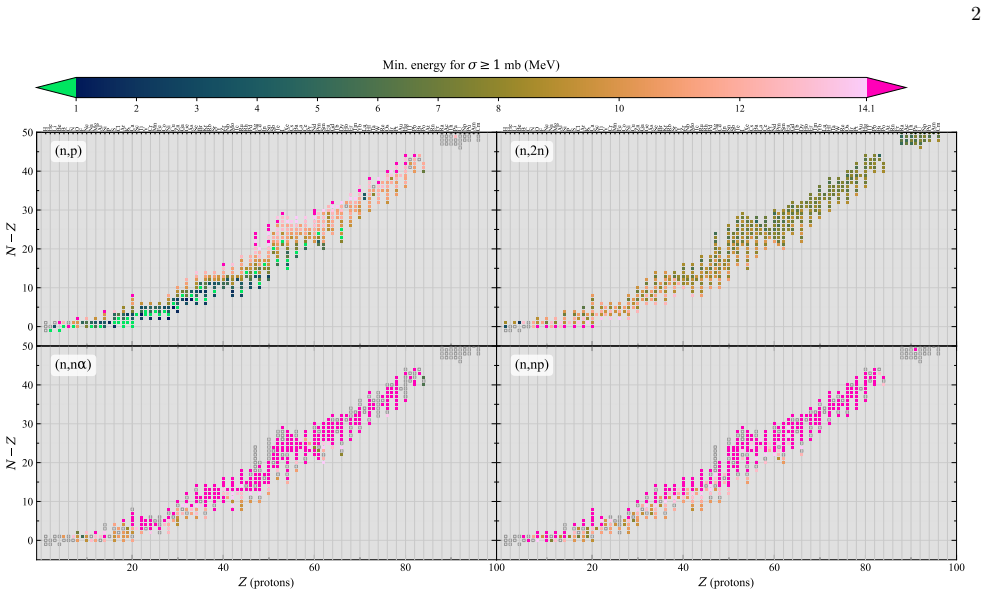
Nuclear batteries require radioisotopes with specific combinations of half-life, decay mode, and radiation properties, yet most candidate fuels lack scalable production routes. We show how the future availability of deuterium-tritium (D-T) fusion neutrons could enable manufacturing nuclear battery radioisotopes at many orders of magnitude higher rate than at present. We assess the capability of 14 MeV D-T fusion neutrons to produce nuclear battery radioisotopes by simulating feedstock material irradiation with neutrons. Promising radioisotope candidates include ${}^{147}$Pm, ${}^{63}$Ni, ${}^{39}$Ar, and ${}^{137}$Cs. Some feedstocks allow a radioisotope to be produced at scale while also closing the tritium fuel cycle, resulting in hundreds to over one thousand kilograms of high specific activity radioisotope per gigawatt thermal year of D-T fusion irradiation. We perform OpenMC simulations of an enriched ${}^{148}$Nd blanket for a tokamak, demonstrating that tritium self-sufficient designs can produce over one ton of ${}^{147}$Pm per gigawatt thermal year, equivalent to $\sim$one billion Curies per year of ${}^{147}$Pm. Operation of such a blanket would represent an unprecedented increase of nuclear battery radioisotope production capability.
Editorial analysis
A structured set of objections, weighed in public.
Referee Report
Summary. The manuscript proposes using 14 MeV D-T fusion neutrons to produce radioisotopes for nuclear batteries at rates orders of magnitude higher than current methods. OpenMC Monte Carlo simulations of feedstock irradiation identify promising candidates including 147Pm, 63Ni, 39Ar, and 137Cs. The central result is that an enriched 148Nd blanket in a tokamak can simultaneously achieve tritium self-sufficiency (TBR ≥ 1) and produce over one ton of 147Pm per gigawatt thermal year, equivalent to ~1 billion Curies annually, via the 148Nd(n,2n)147Nd pathway followed by β-decay.
Significance. If the quantitative yields hold, the work identifies a high-impact dual-use application for fusion blankets that could address chronic shortages of high-specific-activity β- emitters while closing the tritium fuel cycle. The integration of isotope production with TBR calculations is a strength, and the use of standard external nuclear data libraries with OpenMC provides a reproducible computational framework. The claimed production scale represents a potentially transformative increase in capability for nuclear battery technologies.
major comments (2)
- [§3] §3 (blanket model description): the OpenMC simulation of the enriched 148Nd blanket assumes idealized uniform flux and simplified geometry without explicit treatment of 3-D tokamak streaming paths, spectrum softening from moderators/coolants, or parasitic absorptions in structural materials; these omissions directly affect the (n,2n) reaction rate on 148Nd and the net TBR, making the >1 ton 147Pm/GWth-yr claim load-bearing on unvalidated assumptions.
- [Results section] Results section (yield and TBR tabulations): no uncertainty quantification, Monte Carlo statistical errors, or sensitivity analysis to the free parameters '148Nd enrichment fraction' and 'neutron flux and irradiation time' is reported; without these, it is impossible to determine whether the headline one-ton and TBR≥1 numbers remain robust under realistic variations or nuclear-data uncertainties.
minor comments (2)
- [Abstract] Abstract: the phrasing 'hundreds to over one thousand kilograms' is inconsistent with the specific 'over one ton' claim; align the wording for clarity.
- [Results section] Notation: the conversion from mass yield to Curie activity for 147Pm should include the explicit specific-activity formula or reference to avoid ambiguity in the ~one billion Curies figure.
Simulated Author's Rebuttal
We thank the referee for their constructive and detailed review of our manuscript. The comments highlight important aspects of model fidelity and statistical robustness that we have addressed through targeted revisions and clarifications. We respond to each major comment below.
read point-by-point responses
-
Referee: [§3] §3 (blanket model description): the OpenMC simulation of the enriched 148Nd blanket assumes idealized uniform flux and simplified geometry without explicit treatment of 3-D tokamak streaming paths, spectrum softening from moderators/coolants, or parasitic absorptions in structural materials; these omissions directly affect the (n,2n) reaction rate on 148Nd and the net TBR, making the >1 ton 147Pm/GWth-yr claim load-bearing on unvalidated assumptions.
Authors: We agree that the blanket model in §3 employs a simplified geometry and uniform flux assumption to enable computationally tractable scoping of the dual-use tritium breeding and isotope production concept. These choices isolate the contribution of the 148Nd(n,2n)147Nd pathway under idealized conditions representative of a high-flux D-T environment. We have revised §3 to explicitly list these modeling assumptions and added a dedicated paragraph in the Discussion section that qualitatively assesses the expected impact of 3-D streaming, coolant moderation, and structural parasitic absorption, drawing on published tokamak blanket studies. The reported >1 ton figure is presented as an upper-bound estimate achievable with optimized blanket design; the TBR ≥1 result holds within the simplified model and provides a starting point for more detailed engineering. We believe this framing accurately reflects the scope of the present work while acknowledging the limitations. revision: partial
-
Referee: [Results section] Results section (yield and TBR tabulations): no uncertainty quantification, Monte Carlo statistical errors, or sensitivity analysis to the free parameters '148Nd enrichment fraction' and 'neutron flux and irradiation time' is reported; without these, it is impossible to determine whether the headline one-ton and TBR≥1 numbers remain robust under realistic variations or nuclear-data uncertainties.
Authors: We acknowledge that the original Results section lacked explicit uncertainty quantification and sensitivity analysis. In the revised manuscript we have added the Monte Carlo statistical uncertainties reported by OpenMC (typically 2–4 % for the relevant tallies) directly to the yield and TBR tables. We have also included a new sensitivity study that varies 148Nd enrichment from 60 % to 100 % and irradiation time from 1 to 5 years at fixed flux. The production rate remains above 800 kg/GWth-yr and TBR stays ≥1.0 for enrichments ≥70 %. Nuclear-data uncertainties are now discussed with reference to the ENDF/B-VIII.0 library employed. These additions demonstrate that the headline claims are robust within the explored parameter space. revision: yes
Circularity Check
No significant circularity: yields from external Monte Carlo neutronics
full rationale
The paper's central results follow from OpenMC Monte Carlo neutron transport simulations that compute reaction rates, neutron spectra, and tritium breeding ratios using standard external nuclear data libraries. These are forward-model predictions under specified blanket geometry and materials; the one-ton 147Pm per GWth-yr figure and TBR ≥ 1 condition are direct simulation outputs rather than quantities fitted to the same data or defined in terms of themselves. No self-citation chains, ansatzes smuggled via prior work, or renaming of known results appear as load-bearing steps. The derivation remains self-contained against external benchmarks and falsifiable independent of the present claims.
Axiom & Free-Parameter Ledger
free parameters (2)
- 148Nd enrichment fraction
- Neutron flux and irradiation time
axioms (2)
- standard math Standard evaluated nuclear data libraries accurately represent 14 MeV neutron reactions on the chosen feedstocks.
- domain assumption A tokamak blanket geometry can achieve a tritium breeding ratio of at least 1.0 while allowing high isotope extraction.
Lean theorems connected to this paper
-
IndisputableMonolith/Foundation/RealityFromDistinction.leanreality_from_one_distinction unclear?
unclearRelation between the paper passage and the cited Recognition theorem.
We perform OpenMC simulations of an enriched 148Nd blanket for a tokamak, demonstrating that tritium self-sufficient designs can produce over one ton of 147Pm per gigawatt thermal year
-
IndisputableMonolith/Cost/FunctionalEquation.leanwashburn_uniqueness_aczel unclear?
unclearRelation between the paper passage and the cited Recognition theorem.
freact = 52.1% for 148Nd(n,2n)147Nd → 147Pm chain
What do these tags mean?
- matches
- The paper's claim is directly supported by a theorem in the formal canon.
- supports
- The theorem supports part of the paper's argument, but the paper may add assumptions or extra steps.
- extends
- The paper goes beyond the formal theorem; the theorem is a base layer rather than the whole result.
- uses
- The paper appears to rely on the theorem as machinery.
- contradicts
- The paper's claim conflicts with a theorem or certificate in the canon.
- unclear
- Pith found a possible connection, but the passage is too broad, indirect, or ambiguous to say the theorem truly supports the claim.
Reference graph
Works this paper leans on
-
[1]
M. A. Prelas, C. L. Weaver, M. L. Watermann, E. D. Lukosi, R. J. Schott, and D. A. Wisber. A review of nuclear batteries.Prog. Nucl. Energy, 75:117–148, 2014. URLhttps://doi.org/10.1016/j.pnucene.2014.04. 007
-
[2]
Beta- voltaic power sources.Physics today, 65(12):35–38, 2012
Larry C Olsen, Peter Cabauy, and Bret J Elkind. Beta- voltaic power sources.Physics today, 65(12):35–38, 2012
work page 2012
-
[3]
RC O’brien, RM Ambrosi, NP Bannister, SD Howe, and Helen V Atkinson. Safe radioisotope thermoelectric gen- erators and heat sources for space applications.Journal of Nuclear Materials, 377(3):506–521, 2008
work page 2008
-
[4]
J Seth Dustin and Robert A Borrelli. Assessment of alternative radionuclides for use in a radioisotope ther- moelectric generator.Nuclear Engineering and Design, 385:111475, 2021
work page 2021
-
[5]
AA Krasnov and SA Legotin. Advances in the devel- opment of betavoltaic power sources (a review).In- struments and Experimental Techniques, 63(4):437–452, 2020
work page 2020
-
[6]
Thermophotovoltaic efficiency of 40%
Alina LaPotin, Kevin L Schulte, Myles A Steiner, Kyle Buznitsky, Colin C Kelsall, Daniel J Friedman, Eric J Tervo, Ryan M France, Michelle R Young, Andrew Rohskopf, et al. Thermophotovoltaic efficiency of 40%. Nature, 604(7905):287–291, 2022
work page 2022
-
[7]
Xiaoyu Wang, Yuncheng Han, Jiachen Zhang, Ziwei Li, Taosheng Li, Xueyan Zhao, and Yican Wu. The design of a direct charge nuclear battery with high energy con- version efficiency.Applied Radiation and Isotopes, 148: 147–151, 2019
work page 2019
-
[8]
Gary H Rinehart. Design characteristics and fabrication of radioisotope heat sources for space missions.Progress in Nuclear Energy, 39(3-4):305–319, 2001
work page 2001
-
[9]
E. Cataldo and G. Paffett. Radioisotope power systems for deep space exploration. InNuclear and Emerging Technologies for Space. American Nuclear Society, 2020
work page 2020
-
[10]
J. Foust. Full-scale production of plutonium-238 still years away.SpaceNews, 2023. URLhttps://spacenew s.com/full-scale-production-of-plutonium-238-s till-years-away/
work page 2023
-
[11]
Oak Ridge National Laboratory. Pu-238 shipment quan- tity “opens the tap” for space missions, 2023. URL https://www.ornl.gov/news/pu-238-shipment-qua ntity-opens-tap-space-missions. ORNL News
work page 2023
-
[12]
National labs resume plu- tonium production for space exploration, 2023
Idaho National Laboratory. National labs resume plu- tonium production for space exploration, 2023. URLht tps://inl.gov/feature-story/national-labs-resum e-plutonium-production-for-space-exploration/. INL Feature Story
work page 2023
-
[13]
R. M. Ambrosi et al. European radioisotope thermo- electric generators (RTGs) and radioisotope heater units (RHUs) for space science and exploration.Space Sci. Rev., 215:55, 2019. URLhttps://doi.org/10.1007/s1 1214-019-0623-9
work page doi:10.1007/s1 2019
-
[14]
K. Sheridan et al. Americium and plutonium purification by extraction (the AMPPEX process): development of a new method to separate 241Am from aged plutonium dioxide for use in space power systems.J. Inorg. Nucl. Chem., 2018
work page 2018
-
[15]
S. V. Pavlov et al. An integrated closed loop flowsheet for production of highly enriched 63Ni and deposition of 63Ni coatings.Radiochemistry, 66:1023, 2024. URL https://doi.org/10.1134/S1066362224060018
- [16]
-
[17]
World’s first carbon-14 diamond battery prototype demonstrated, December 2024
University of Bristol and Arkenlight. World’s first carbon-14 diamond battery prototype demonstrated, December 2024. URLhttps://www.bristol.ac.uk/ news/2024/december/diamond-battery-media-relea se.html. Press Release
work page 2024
-
[18]
NanoTritium betavoltaic battery technol- ogy, 2024
City Labs Inc. NanoTritium betavoltaic battery technol- ogy, 2024. URLhttps://citylabs.net/products/
work page 2024
-
[19]
U.S. Department of Energy. Isotope R&D and produc- tion FY 2025 congressional justification. Technical re- port, DOE/SC, 2024. URLhttps://www.energy.gov/s ites/default/files/2024-03/FY2025-PresidentsReq uest-IRP.pdf
work page 2025
-
[20]
Experts talk on developing the isotope supply chain.Nuclear Newswire, October 2025
American Nuclear Society. Experts talk on developing the isotope supply chain.Nuclear Newswire, October 2025
work page 2025
-
[21]
A. King. The race to commercialise nuclear-powered batteries.Chemistry World, November 2024. URL https://www.chemistryworld.com/news/the-race-t o-commercialise-nuclear-powered-batteries/40205 05.article
work page 2024
-
[22]
A. Rutkowski, J. Harter, and J. Parisi. Scalable chrysopoeia via (n,2n) reactions driven by high-flux fu- sion neutrons.arXiv preprint arXiv:2507.13461, 2025
-
[23]
M. R. Gilbert et al. Neutron activation and transmuta- tion in fusion blankets.Nucl. Fusion, 64:036021, 2024
work page 2024
-
[24]
J. F. Parisi, A. Rutkowski, J. Harter, J. A. Schwartz, and S. Chen. Production of high-specific-activity radioiso- topes using high-energy fusion neutrons.arXiv preprint,
- [25]
- [26]
-
[27]
P. K. Romano, N. E. Horelik, B. R. Herman, A. G. Nelson, B. Forget, and K. Smith. OpenMC: a state- of-the-art Monte Carlo code for research and develop- ment.Ann. Nucl. Energy, 82:90–97, 2015. URLhttps: //doi.org/10.1016/j.anucene.2014.07.048
-
[28]
H Flicker, JJ Loferski, and TS Elleman. Construction of a promethium-147 atomic battery.IEEE Transactions on Electron Devices, 11(1):2–8, 1964. URLhttps://do i.org/10.1109/T-ED.1964.15271
-
[29]
Uni- versity of Illinois at Urbana-Champaign, 2010
Galina Nikolayevna Yakubova.Nuclear batteries with tritium and promethium-147 radioactive sources. Uni- versity of Illinois at Urbana-Champaign, 2010. 10
work page 2010
-
[30]
A Kavetskiy, G Yakubova, SM Yousaf, K Bower, JD Robertson, and A Garnov. Efficiency of pm-147 di- rect charge radioisotope battery.Applied Radiation and Isotopes, 69(5):744–748, 2011
work page 2011
-
[31]
Preliminary design of betavoltaic battery using co-60 and pm-147 with gaas substrate
A Waris, Y Kusumawati, AS Alfarobi, IK Aji, and K Basar. Preliminary design of betavoltaic battery using co-60 and pm-147 with gaas substrate. InAIP Confer- ence Proceedings, volume 1719, page 030053. AIP Pub- lishing LLC, 2016
work page 2016
-
[32]
Reactor production of promethium-147.Applied Radiation and Isotopes, 144: 54–63, 2019
Kathleen Broderick, Rita Lusk, James Hinderer, Justin Griswold, Rose Boll, Marc Garland, Lawrence Heil- bronn, and Saed Mirzadeh. Reactor production of promethium-147.Applied Radiation and Isotopes, 144: 54–63, 2019. URLhttps://doi.org/10.1016/j.apra diso.2018.10.025
-
[33]
Wladimir Jurewitsch, Frederick P. Boody, Wladimir E. Fortov, and Reinhard Hoepfl. Super-compact radionu- clide battery useful for spacecraft contains radionuclide dust particles suspended in a gas or plasma, 7 1998. URL https://patents.google.com/patent/DE19833648A1. Application number DE1998133648. Priority date 1997- 09-01. Status: Withdrawn
work page 1998
-
[34]
Zhiheng Xu, Yunpeng Liu, and Xiaobin Tang. Radi- oluminescent nuclear battery technology development for space exploration.Advances in Astronautics Sci- ence and Technology, 3(2):125–131, 2020. URLhttps: //doi.org/10.1007/s42423-020-00067-w
-
[35]
XiaoBin Tang, Ding Ding, YunPeng Liu, and Da Chen. Optimization design and analysis of si-63ni betavoltaic battery.Science China Technological Sciences, 55(4): 990–996, 2012. URLhttps://doi.org/10.1007/s114 31-012-4752-6
-
[36]
Model of ni-63 battery with realistic pin structure.Journal of applied physics, 118(10):105101, 2015
Charles E Munson, Muhammad Arif, Jeremy Streque, Sofiane Belahsene, Anthony Martinez, Abderrahim Ramdane, Youssef El Gmili, Jean-Paul Salvestrini, Paul L Voss, and Abdallah Ougazzaden. Model of ni-63 battery with realistic pin structure.Journal of applied physics, 118(10):105101, 2015. URLhttps: //doi.org/10.1063/1.4930870
-
[37]
M. Abdou et al. Physics and technology considerations for the deuterium-tritium fuel cycle and conditions for tritium fuel self sufficiency.Nucl. Fusion, 61:013001,
-
[38]
URLhttps://doi.org/10.1088/1741- 4326/ abbf35
-
[39]
Iso- mer triggering via nuclear excitation by electron capture
Adriana P´ alffy, J¨ org Evers, and Christoph H Keitel. Iso- mer triggering via nuclear excitation by electron capture. Physical review letters, 99(17):172502, 2007
work page 2007
-
[40]
Constraints on the decay of ta 180 m.Physical Review Letters, 131(15):152501, 2023
IJ Arnquist, FT Avignone III, AS Barabash, CJ Barton, KH Bhimani, E Blalock, B Bos, M Busch, M Buuck, TS Caldwell, et al. Constraints on the decay of ta 180 m.Physical Review Letters, 131(15):152501, 2023
work page 2023
-
[41]
B Ding, CX Jia, S Guo, XH Zhou, YB Wu, FF Zeng, JG Wang, YH Qiang, SW Xu, YD Fang, et al. Isomer depletion of mo 93 m triggered by inelastic nuclear scat- tering rather than nuclear excitation by electron capture. Physical Review Letters, 136(5):052502, 2026
work page 2026
- [42]
-
[43]
D. A. Brown, M. B. Chadwick, R. Capote, A. C. Kahler, A. Trkov, M. W. Herman, A. A. Sonzogni, Y. Danon, A. D. Carlson, M. Dunn, D. L. Smith, G. M. Hale, G. Arbanas, R. Arcilla, C. R. Bates, B. Beck, B. Becker, F. Brown, R. J. Casperson, J. Conlin, D. E. Cullen, M.-A. Descalle, R. Firestone, T. Gaines, K. H. Guber, A. I. Hawari, J. Holmes, T. D. Johnson, T...
-
[44]
U.S. Nuclear Regulatory Commission. Staff require- ments – SECY-23-0001 – options for advancing the Com- mission’s strategy for the regulation of fusion energy sys- tems. ADAMS Accession No. ML23103A099, April 2023. URLhttps://www.nrc.gov/docs/ML2310/ML23103A09 9.pdf
work page 2023
-
[45]
U.S. Nuclear Regulatory Commission. Rules of general applicability to domestic licensing of byproduct material. Title 10, Code of Federal Regulations, Part 30, 2024. URLhttps://www.nrc.gov/reading-rm/doc-collect ions/cfr/part030/
work page 2024
-
[46]
U.S. Nuclear Regulatory Commission. Licensing re- quirements for land disposal of radioactive waste. Title 10, Code of Federal Regulations, Part 61, 2024. URL https://www.nrc.gov/reading-rm/doc-collections /cfr/part061/
work page 2024
-
[47]
U.S. Nuclear Regulatory Commission. Waste classifica- tion. Title 10, Code of Federal Regulations, Part 61.55,
-
[48]
URLhttps://www.nrc.gov/reading-rm/doc-c ollections/cfr/part061/part061-0055.html
-
[49]
U.S. Department of Energy. DOE Order 435.1 – radioac- tive waste management. Chg 2, Office of Environmental Management, 2021. URLhttps://www.directives.d oe.gov/directives-documents/400-series/0435.1-B Order-chg2-PgChg
work page 2021
-
[50]
U.S. Nuclear Regulatory Commission. Specific domestic licenses to manufacture or transfer certain items con- taining byproduct material. Title 10, Code of Federal Regulations, Part 32, 2024. URLhttps://www.nrc.go v/reading-rm/doc-collections/cfr/part032/
work page 2024
-
[51]
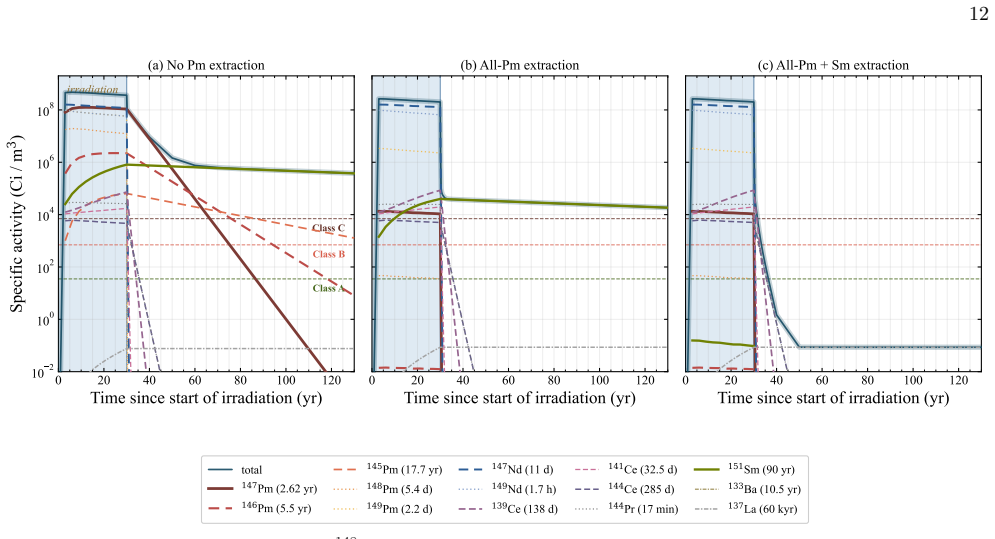
Alessandra Boschi, Licia Uccelli, and Petra Martini. A picture of modern tc-99m radiopharmaceuticals: Pro- duction, chemistry, and applications in molecular imag- ing.Applied Sciences, 9(12):2526, 2019. Appendix A: Depletion simulation with Pm + Sm extraction The OpenMC depletion simulation described in this appendix removes both Pm and Sm continuously fr...
work page 2019
discussion (0)
Sign in with ORCID, Apple, or X to comment. Anyone can read and Pith papers without signing in.