REVIEW 3 major objections 4 minor 26 references
Computational homogenization of parabolic equations with memory effects for a periodic heterogeneous medium
T0 review · 3 major / 4 minor · reviewed 2026-08-07 · deepseek-v4-flash
Pith's one-line read A spectral cell problem converts the nonlocal homogenized diffusion equation with memory into a local extended system, solvable at near-parabolic cost with unconditional stability.
desk verdict A competent, honestly framed computational framework for memory-effect homogenization; the unquantified delta-tail approximation is the one load-bearing gap, and the paper itself admits it. read the letter →
The pith
A machine-rendered reading of the paper's core claim, the machinery that carries it, and where it could break.
The reading
What carries the argument
The load-bearing object is the exponential-sum representation $\chi(t)=\sum_{k=1}^\infty a_k e^{-\lambda_k t}$, with $\lambda_k$ and $\varphi_k$ the eigenpairs of (3.1)-(3.2) and $a_k=|Y_1|^{-1}(1,\varphi_k)_2^2\lambda_k>0$. This representation turns the convolution into a small system of ordinary differential equations for auxiliary fields $v_k$, and the discarded tail is collapsed into $r_m\delta(t)$ through the identity (3.9). The numerical march then uses a two-level weighted scheme with $\sigma\ge1/2$; its stability proof is the energy estimate (4.13), which matches the differential-level bound (3.8).
What would settle it
Fix a small period $\varepsilon$, solve the fully resolved two-scale problem (2.1)-(2.3) on a grid fine enough to resolve the inclusions, and compare with the homogenized extended-system solution as $m$ grows and the cell mesh refines; if the difference does not shrink toward zero at early times, the delta-tail heuristic is carrying uncontrolled error.
Extended reading notes
Core claim
The central claim is that the nonlocal homogenized problem (2.5), whose kernel $\chi(t)$ is defined through a nonstationary cell problem, can be replaced by the local extended system (3.14)-(3.15) driven by the first $m$ eigenpairs of the Dirichlet spectral problem on the weakly conducting inclusion. The kernel tail is folded into a coefficient $r_m$ multiplying a delta function, so the correction term is local in time. The paper proves the discrete energy estimate (4.13) for the weighted two-level scheme with $\sigma\ge1/2$, and shows in a two-dimensional test that coefficient filtering keeps only a fraction of the eigenmodes, with the effective diffusion tensor computed separately by a standard cell problem.
Load-bearing premise
The argument depends on replacing the truncated kernel tail by a delta contribution of strength $r_m$ inside the convolution, a step for which the paper provides no error bound and which it concedes is inaccurate at small times.
Editorial extensions
If this is right
- The weighted two-level scheme (4.9)-(4.12) is unconditionally stable for $\sigma\ge1/2$, giving the discrete bound (4.13) that mirrors the continuous stability estimate.
- Each time step requires one standard elliptic solve for $y^{n+1}$ plus explicit updates of the auxiliary fields $w_k^{n+1}$, so the total cost is only modestly higher than solving a local parabolic problem.
- The memory kernel needs only a small number of exponentials in practice, since coefficients below a threshold $\epsilon$ can be filtered out with small effect on the kernel at $t=0$.
- The effective diffusion tensor and the memory kernel are obtained from separate cell problems, so the extended macroscale solver can be reused for different microstructures without reworking the time-stepping.
- Because the high-frequency kernel tail is absorbed into the local term $r_m\delta(t)$, no history of the macroscale solution needs to be stored.
Reading between the lines
- The same exponential-sum plus delta-tail strategy should apply to any positive-definite memory kernel with a complete spectral expansion on the cell; the paper demonstrates it for a two-component elliptic inclusion but the derivation is structural.
- An error bound for the delta-tail approximation would turn the heuristic into a provable method; the paper explicitly leaves the estimation of the tail term open.
- A direct comparison with fully resolved simulations for a small but finite period $\varepsilon$ would test the practical accuracy of the homogenized extended system, which the paper does not provide.
- The number $m$ of retained modes could be chosen adaptively in time or space, since the kernel's effective support shrinks on short time scales.
Editorial analysis
A structured set of objections, weighed in public.
Referee Report
Summary. The paper proposes a computational strategy for homogenizing a parabolic diffusion equation in a periodic two-component medium with weakly conducting inclusions, where the macroscopic model is the Volterra integro-differential equation (2.5). The memory kernel is written as an exponential sum via the eigenpairs of the spectral problem (3.1)-(3.2) on the inclusion; a truncated sum is retained and the tail is replaced by a delta-function term (3.9)-(3.10). The nonlocal equation is then reformulated as the local extended system (3.14)-(3.15) with m auxiliary fields, discretized by piecewise linear finite elements and two-level time schemes (4.9)-(4.12). The paper proves unconditional stability for σ ≥ 1/2 and illustrates the approach with a two-dimensional numerical example.
Significance. The local reformulation and the exponential-sum representation are natural ideas and, if accompanied by a rigorous control of the tail approximation, would provide an efficient way to compute memory effects in high-contrast periodic media. The stability estimate for the discrete scheme is a useful contribution. The main weakness is that the central modeling step—the replacement of the truncated kernel tail by an instantaneous delta contribution—is not backed by an error estimate or a numerical reference comparison, and the paper's own remarks flag this as unresolved.
major comments (3)
- [Section 3.3, Eqs. (3.9)-(3.10)] The approximation eχ_m(t) ≈ r_m δ(t) inside the convolution of (3.10) is the step that turns the exact homogenized problem (2.5) into the computable equation (3.10), but no bound is given for the resulting error. The paper states in §3.3 that 'Special attention should be paid to estimating the influence of eχ_m(t)' and in §5.3 that 'significant errors are expected for small t'. The stability estimate (4.13) applies to the already approximated local system, not to the difference between its solution and the solution of (2.5). Since Table 4 reports r_m ≈ 0.0218 for m(ε)=30, the delta term is not negligible, and without a quantitative tail-error estimate or a numerical comparison with a reference solution the advertised accuracy is unsupported.
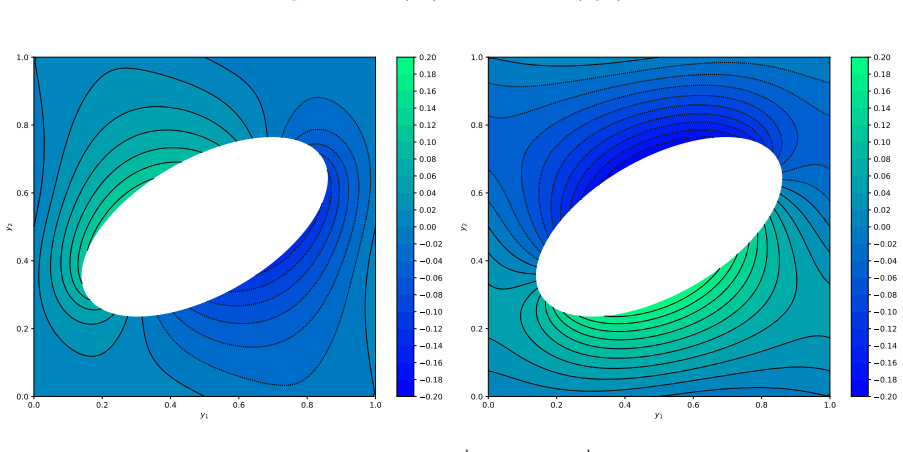
- [Section 5.4] The numerical section does not validate the homogenized solution against the exact solution of (2.5) with the untruncated kernel, nor against a direct fine-scale computation of (2.1)-(2.3). Figures 13 and the cross-section plots only compare results for different values of m(ε); hence they show that the local reformulation is implementable, but not that it converges to the correct macroscopic solution.
- [Theorem 2 proof, after Eq. (4.15)] In the inequality displayed after Eq. (4.15), the terms (D∇y^{n+1}, D∇y^{n+1}) and (D∇y^n, D∇y^n) should read (D∇y^{n+1}, ∇y^{n+1}) and (D∇y^n, ∇y^n); as written the expression is dimensionally inconsistent and does not equal the energy norm used in (4.13). The omitted positive terms from the left-hand side should also be indicated explicitly when passing to the inequality.
minor comments (4)
- [Eqs. (4.16)-(4.17)] The notation (f^n_k, z) and (f^n, z) mixes the finite-element functionals with vectors; write f^n_k and f^n as elements of the dual space or define them via the Riesz representatives to avoid confusion.
- [Table 4] The two rows labeled m(ε) and m are confusing; clarify the distinction between the retained number of exponentials and the spectral index used in the tail coefficient r_m.
- [Reference [5]] The word 'AsYmptotic' in the reference title should be 'Asymptotic'.
- [Section 5.3] The phrase 'm = 100 in approximation (4.3)' conflicts with the earlier use of m as the number of retained terms; use a different symbol, such as M_baseline, for the total number of computed eigenvalues.
Circularity Check
No significant circularity; the only self-citations are re-derived in the text and are not load-bearing.
full rationale
The derivation chain is self-contained. The homogenized integro-differential model (2.5) is taken from external work [6,7]; the memory kernel is computed from the cell spectral problem (3.1)-(3.2), giving the exact exponential expansion (3.5) with positive coefficients (3.6). The nonlocal-to-local transformation is re-derived in Eqs. (3.10), (3.14), (3.15) rather than merely cited, so the citations [10,11] are not load-bearing. The delta-tail approximation e_chi_m(t) ≈ r_m delta(t) with r_m from (3.9) is an explicit unproven heuristic; because r_m is computed from the same spectral expansion and is not fitted to macro data, it is a consistency/error-estimate concern, not circularity. The stability estimates (3.18) and (4.13) are proved for the local approximate problem and are independent of that heuristic. Numerical experiments compare variants m(epsilon)=0,5,10,30 of the same approximation family, which can show sensitivity but does not constitute a fitted prediction. Overall, no step reduces by definition to its inputs; the paper earns at most a non-load-bearing self-citation score.
Assumptions & free parameters
free parameters (3)
- Kernel filtering threshold epsilon =
1e-5
- Baseline eigenpair count m =
100
- Test discretization parameters (tau, h, sigma) =
tau = 1e-4, h = 0.01, sigma = 1
assumptions (4)
- domain assumption The homogenized integro-differential model (2.5) with kernel (2.15) is the correct delta-to-zero limit of (2.1)-(2.4) when delta ~ epsilon^2.
- standard math Spectral expansion (3.4) represents psi in the orthonormal eigenbasis of the Dirichlet Laplacian on Y2, and the Parseval identity is used in (3.9).
- ad hoc to paper The kernel tail is replaced by a delta contribution, e_chi_m(t) approx r_m delta(t), inside the convolution in (3.10).
- standard math Positive-definiteness of the kernel (3.7) and the Halanay criterion [22] justify the a priori estimate (3.8).
Cite this review
Pith. "Pith review of Computational homogenization of parabolic equations with memory effects for a periodic heterogeneous medium." pith.science (2026). https://pith.science/paper/YIOQSSE7
@misc{pith2026250607111,
  author       = {Pith},
  title        = {Pith review of: Computational homogenization of parabolic equations with memory effects for a periodic heterogeneous medium},
  year         = {2026},
  howpublished = {\url{https://pith.science/paper/YIOQSSE7}},
  note         = {Machine review of arXiv:2506.07111}
}
read the original abstract
In homogenization theory, mathematical models at the macro level are constructed based on the solution of auxiliary cell problems at the micro level within a single periodicity cell. These problems are formulated using asymptotic expansions of the solution with respect to a small parameter, which represents the characteristic size of spatial heterogeneity. When studying diffusion equations with contrasting coefficients, special attention is given to nonlocal models with weakly conducting inclusions. In this case, macro-level processes are described by integro-differential equations, where the difference kernel is determined by the solution of a nonstationary cell problem. The main contribution of this work is the development of a computational framework for the homogenization of nonstationary processes, accounting for memory effects. The effective diffusion tensor is computed using a standard numerical procedure based on finite element discretization in space. The memory kernel is approximated by a sum of exponentials obtained from solving a partial spectral problem on the periodicity cell. The nonlocal macro-level problem is transformed into a local one, where memory effects are incorporated through the solution of auxiliary nonstationary problems. Standard two-level time discretization schemes are employed, and unconditional stability of the discrete solutions is proved in appropriate norms. Key aspects of the proposed computational homogenization technique are illustrated by solving a two-dimensional model problem.
Figures


Figures from the paper (10 more)


Reference graph
Works this paper leans on
-
[1]
Y. Efendiev, T. Y. Hou, Multiscale Finite Element Methods: Theory and Applications, Springer Science & Business Media, 2009
work page 2009
-
[2]
G. A. Pavliotis, A. Stuart, Multiscale Methods: Averaging and Homogenization, Springer Science & Business Media, 2008
work page 2008
-
[3]
Steinhauser, Computational Multiscale Modeling of Fluids and Solids, Springer, 2017
M. Steinhauser, Computational Multiscale Modeling of Fluids and Solids, Springer, 2017
work page 2017
-
[4]
N. S. Bakhvalov, G. Panasenko, Homogenisation: Averaging Processes in Periodic Media: Mathematical Problems in the Mechanics of Composite Materials, Springer Science & Business Media, 2012
work page 2012
-
[5]
A. Bensoussan, J.-L. Lions, G. Papanicolaou, AsYmptotic Analysis for Periodic Structures, American Mathematical Soc., 2011
work page 2011
-
[6]
G. V. Sandrakov, Homogenization of parabolic equations with contrasting coefficients, Izv. Math. 63 (5) (1999) 1015–1061
work page 1999
-
[7]
G. V. Sandrakov, V. V. Semenov, Homogenized models with memory effect for heterogeneous periodic media, Journal of Optimization, Differential Equations and Their Applications 30 (2) (2022) 1–18
work page 2022
-
[8]
C. Chen, T. Shih, Finite Element Methods for Integrodifferential Equations, World Scientific, Singapore, 1998
work page 1998
Show all 26 references
-
[9]
Linz, Analytical and Numerical Methods for Volterra Equations, SIAM, 1985
P. Linz, Analytical and Numerical Methods for Volterra Equations, SIAM, 1985
1985
-
[10]
P. N. Vabishchevich, Numerical solution of the Cauchy problem for Volterra integrodifferential equations with difference kernels, Applied Numerical Mathematics 174 (2022) 177–190
2022
-
[11]
P. N. Vabishchevich, Approximate solution of the Cauchy problem for a first-order integrodifferential equation with solution derivative memory, Journal of Computational and Applied Mathematics 422 (2023) 114887
2023
-
[12]
Braess, Nonlinear Approximation Theory, Springer, Berlin, Heidelberg, 1986
D. Braess, Nonlinear Approximation Theory, Springer, Berlin, Heidelberg, 1986
1986
-
[13]
Beylkin, L
G. Beylkin, L. Monz´ on, On approximation of functions by exponential sums, Applied and Computational Harmonic Analysis 19 (1) (2005) 17–48
2005
-
[14]
Hornung (Ed.), Homogenization and Porous Media, Springer Science & Business Media, 1997
U. Hornung (Ed.), Homogenization and Porous Media, Springer Science & Business Media, 1997
1997
-
[15]
Knabner, L
P. Knabner, L. Angermann, Numerical Methods for Elliptic and Parabolic Partial Differential Equations, Springer, New York, 2003
2003
-
[16]
Quarteroni, A
A. Quarteroni, A. Valli, Numerical Approximation of Partial Differential Equations, Springer-Verlag, Berlin, 1994
1994
-
[17]
U. M. Ascher, Numerical Methods for Evolutionary Differential Equations, Society for Industrial and Applied Mathematics, 2008
2008
-
[18]
A. A. Samarskii, The Theory of Difference Schemes, Marcel Dekker, New York, 2001
2001
-
[19]
McLean, V
W. McLean, V. Thom´ ee, Numerical solution of an evolution equation with a positive-type memory term, The ANZIAM Journal 35 (1) (1993) 23–70
1993
-
[20]
McLean, V
W. McLean, V. Thom´ ee, L. B. Wahlbin, Discretization with variable time steps of an evolution equation with a positive- type memory term, Journal of Computational and Applied Mathematics 69 (1) (1996) 49–69
1996
-
[21]
L. C. Evans, Partial Differential Equations, American Mathematical Society, 2010
2010
-
[22]
Halanay, On the asymptotic behavior of the solutions of an integro-differential equation, Journal of Mathematical Analysis and Applications 10 (2) (1965) 319–324
A. Halanay, On the asymptotic behavior of the solutions of an integro-differential equation, Journal of Mathematical Analysis and Applications 10 (2) (1965) 319–324
1965
-
[23]
Saad, Numerical Methods for Large Eigenvalue Problems: Revised Edition, SIAM, 2011
Y. Saad, Numerical Methods for Large Eigenvalue Problems: Revised Edition, SIAM, 2011. 18
2011
-
[24]
A. A. Samarskii, P. P. Matus, P. N. Vabishchevich, Difference Schemes with Operator Factors, Kluwer Academic, Dor- drecht, 2002
2002
-
[25]
Geuzaine, J.-F
C. Geuzaine, J.-F. Remacle, Gmsh: A 3-D finite element mesh generator with built-in pre-and post-processing facilities, International journal for numerical methods in engineering 79 (11) (2009) 1309–1331
2009
-
[26]
Alnæs, J
M. Alnæs, J. Blechta, J. Hake, A. Johansson, B. Kehlet, A. Logg, C. Richardson, J. Ring, M. E. Rognes, G. N. Wells, The FEniCS project version 1.5, Archive of numerical software 3 (100). 19
Reviewed August 7, 2026 · model on record in the stance chip above.
Discussion (0). Continue with ORCID to comment.