LLMs and Optical Networks: A Symbiotic Relationship
Pith reviewed 2026-06-30 03:41 UTC · model grok-4.3
The pith
Massive LLMs require geo-distributed training that depends on specific optical enablers such as WAN-aware CCL algorithms, ZR+ pluggables, and hollow core fibers, while LLMs in turn support autonomous optical network management.
A machine-rendered reading of the paper's core claim, the machinery that carries it, and where it could break.
Core claim
Massive LLMs require geo-distributed training, which demands advanced optical transport capabilities that require new key technical enablers, as WAN-aware CCL algorithms, ZR+ pluggables, and Hollow Core Fibers. Conversely, LLMs also enable new forms of autonomous network management.
What carries the argument
The symbiotic relationship in which LLM geo-distributed training drives optical transport upgrades and LLMs provide the basis for automated optical network control.
If this is right
- Optical network operators will need to deploy WAN-aware collective communication algorithms to support large-scale LLM workloads.
- ZR+ pluggables and hollow core fibers will become standard requirements in long-haul links serving distributed training clusters.
- LLM-based control loops will be integrated into optical network management systems for autonomous operation.
Where Pith is reading between the lines
- Data-center architects may need to co-locate training clusters with new fiber routes rather than relying solely on existing metro and long-haul infrastructure.
- The same LLM capabilities used for network autonomy could also be tested for real-time traffic prediction in optical networks.
- If the listed enablers prove insufficient, the paper's logic implies that further optical innovations will be required before geo-distributed training scales.
Load-bearing premise
WAN-aware CCL algorithms, ZR+ pluggables, and hollow core fibers are the necessary and key enablers for geo-distributed LLM training.
What would settle it
A working geo-distributed LLM training system that achieves comparable performance and cost without any of the three listed optical enablers would falsify the central claim.
Figures

read the original abstract
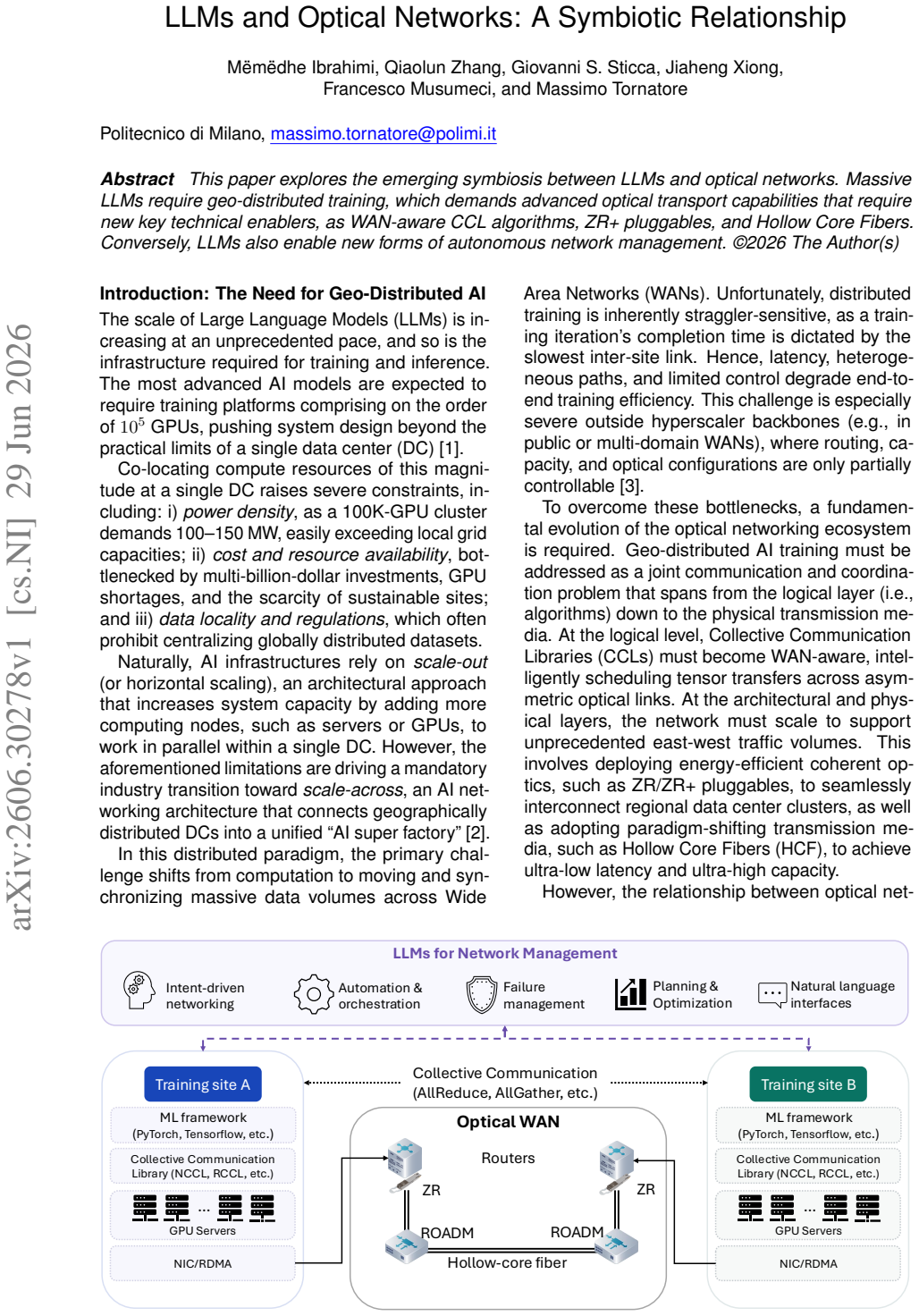
This paper explores the emerging symbiosis between LLMs and optical networks. Massive LLMs require geo-distributed training, which demands advanced optical transport capabilities that require new key technical enablers, as WAN-aware CCL algorithms, ZR+ pluggables, and Hollow Core Fibers. Conversely, LLMs also enable new forms of autonomous network management.
Editorial analysis
A structured set of objections, weighed in public.
Referee Report
Summary. The paper explores the emerging symbiosis between LLMs and optical networks. It states that massive LLMs require geo-distributed training, which demands advanced optical transport capabilities enabled by new key technical enablers such as WAN-aware CCL algorithms, ZR+ pluggables, and Hollow Core Fibers. Conversely, LLMs enable new forms of autonomous network management.
Significance. The topic addresses a timely intersection between large-scale AI infrastructure needs and optical networking technologies. If developed with concrete technical analysis or case studies, the framing could help identify research directions for geo-distributed training and LLM-driven network operations. The current manuscript, however, offers only a high-level positioning statement without supporting evidence, derivations, or detailed discussion.
minor comments (1)
- [Abstract] Abstract, sentence 2: the phrasing 'as WAN-aware CCL algorithms' is grammatically incomplete and should be revised to 'such as WAN-aware CCL algorithms' for clarity.
Simulated Author's Rebuttal
We thank the referee for recognizing the timeliness of the topic. The manuscript is a concise positioning statement intended to frame the mutual dependencies between LLMs and optical networks. Below we address the primary concern regarding depth.
read point-by-point responses
-
Referee: The current manuscript, however, offers only a high-level positioning statement without supporting evidence, derivations, or detailed discussion.
Authors: We agree the paper is high-level by design, as it aims to identify the intersection and key enablers (WAN-aware CCL, ZR+ pluggables, Hollow Core Fibers) rather than provide exhaustive derivations or case studies. This framing can still guide research directions. We will expand the revised version with additional technical context and references on the optical requirements for geo-distributed training to address the request for more substance. revision: yes
Circularity Check
No significant circularity
full rationale
The paper is an exploratory survey-style discussion of symbiosis between LLMs and optical networks. It contains no equations, derivations, fitted parameters, or formal claims whose validity depends on a self-referential step. The statement that geo-distributed training 'requires' specific enablers functions as positioning within the narrative rather than a load-bearing premise that is then 'derived' or 'predicted' from itself. No self-citation chains, ansatzes, or renamings of known results are present that reduce any result to its own inputs.
Axiom & Free-Parameter Ledger
Reference graph
Works this paper leans on
-
[1]
Beyond a single AI cluster: A survey of decentralized llm training
H. Dong et al., “Beyond a single AI cluster: A survey of decentralized llm training”,arXiv preprint arXiv:2503.11023, 2025
arXiv 2025
-
[2]
How to connect distributed data centers into large AI factories with scale-across networking
T. Allison. “How to connect distributed data centers into large AI factories with scale-across networking”, NVIDIA Technical Blog, Accessed: Apr. 29, 2026. [Online]. Avail- able: https://developer.nvidia.com/blog/how-to- connect- distributed- data- centers- into- large- ai-factories-with-scale-across-networking/
2026
-
[3]
Problem statement: In- formation sharing of optical impairments in monitor- ing of multi-domain all-optical paths
S. Xu, Y . Hirota, and Y . Awaji, “Problem statement: In- formation sharing of optical impairments in monitor- ing of multi-domain all-optical paths”, IETF, Internet- Draft draft-xu-ccamp-impairment-info-sharing-problem- 00, Mar. 2026
2026
-
[4]
Rethinking machine learning collective communication as a multi-commodity flow problem
X. Liu et al., “Rethinking machine learning collective communication as a multi-commodity flow problem”, in Proceedings of the ACM SIGCOMM 2024 Conference, ACM, 2024, pp. 16–37
2024
-
[5]
Efficient Direct-Connect topologies for collective communications
L. Zhao et al., “Efficient Direct-Connect topologies for collective communications”, in22nd USENIX Sympo- sium on Networked Systems Design and Implementa- tion (NSDI 25), Philadelphia, PA: USENIX Association, 2025, pp. 705–737
2025
-
[6]
SyCCL: Exploiting symmetry for efficient collective communication scheduling
J. Cao et al., “SyCCL: Exploiting symmetry for efficient collective communication scheduling”, inProceedings of the ACM SIGCOMM 2025 Conference, ACM, 2025, pp. 645–662
2025
-
[7]
Accelerating geo-distributed machine learn- ing with network-aware adaptive tree and auxiliary route
Z. Li et al., “Accelerating geo-distributed machine learn- ing with network-aware adaptive tree and auxiliary route”,IEEE/ACM Transactions on Networking, vol. 32, no. 5, pp. 4238–4253, 2024
2024
-
[8]
GeoPipe: A geo-distributed LLM training framework with enhanced pipeline parallelism in a lossless RDMA- enabled datacenter optical transport network
J. Dai, X. Wang, K. Fang, Z. Y ang, Y . Ji, and J. Zhang, “GeoPipe: A geo-distributed LLM training framework with enhanced pipeline parallelism in a lossless RDMA- enabled datacenter optical transport network”, inACP 2025, IEEE, 2025, pp. 1–6
2025
-
[9]
Multipath collective communication beyond scale-up networks in gpu clouds
Y . Xu et al., “Multipath collective communication beyond scale-up networks in gpu clouds”, inProceedings of the 21st European Conference on Computer Systems, 2026, pp. 564–585
2026
-
[10]
[Online]
NVIDIA,NVIDIA collective communications library (NCCL), 2017. [Online]. Available: https://developer. nvidia.com/nccl
2017
-
[11]
SCALE-CCL: A scalable collective com- munication library for wide-area distributed training
J. Xiong et al., “SCALE-CCL: A scalable collective com- munication library for wide-area distributed training”, in Proceedings of the 1st Workshop on Inter-networking Challenges for AI, ACM, 2025, pp. 21–27
2025
-
[12]
Coordinating CCL re-optimization and WAN reconfiguration for cross-regional AI acceleration
J. Xiong et al., “Coordinating CCL re-optimization and WAN reconfiguration for cross-regional AI acceleration”, inIEEE/IFIP Network Operations and Management Symposium (NOMS) 2026, 2026
2026
-
[13]
B4: Experience with a globally-deployed software defined wan
S. Jain et al., “B4: Experience with a globally-deployed software defined wan”,ACM SIGCOMM Computer Com- munication Review, vol. 43, no. 4, pp. 3–14, 2013
2013
-
[14]
The road to sdn: An intellectual history of programmable networks
N. Feamster, J. Rexford, and E. Zegura, “The road to sdn: An intellectual history of programmable networks”, ACM SIGCOMM Computer Communication Review, vol. 44, no. 2, pp. 87–98, 2014
2014
-
[15]
Achieving high utilization with software-driven WAN
C.-Y . Hong et al., “Achieving high utilization with software-driven WAN”, inProceedings of the ACM SIG- COMM 2013, ACM, 2013, pp. 15–26
2013
-
[16]
Q. Zhang, A. Morea, P . Layec, M. Ibrahimi, F . Musumeci, and M. Tornatore, “Power-consumption analysis for dif- ferent IPoWDM network architectures with zr/zr+ and long-haul muxponders”,Journal of Optical Communica- tions and Networking, vol. 16, no. 12, pp. 1189–1203, 2024.DOI:10.1364/JOCN.531536
-
[17]
S.02.07 workshop 14: Optical networks and ai: Do we need a brand-new infrastructure for AI, and can AI help run it?
G. Rizzelli, “S.02.07 workshop 14: Optical networks and ai: Do we need a brand-new infrastructure for AI, and can AI help run it?”, inECOC 2025, 2025
2025
-
[18]
Hollow core dnanf optical fiber with <0.11 db/km loss
Y . Chen et al., “Hollow core dnanf optical fiber with <0.11 db/km loss”, inOptical Fiber Communication Conference (OFC) 2024, Optica Publishing Group, 2024, Th4A.8.DOI: 10.1364/OFC.2024.Th4A.8 [Online]. Avail- able: https://opg.optica.org/abstract.cfm?URI= OFC-2024-Th4A.8
-
[19]
Low intermodal interference and low loss hollow core fibers
P . Li et al., “Low intermodal interference and low loss hollow core fibers”, inOptical Fiber Communication Con- ference (OFC) 2026, Optica Publishing Group, 2026, M2J.1
2026
-
[20]
Hollow-core-fiber placement in latency- constrained metro networks with edgedcs
G. S. Sticca, M. Ibrahimi, N. Di Cicco, F . Musumeci, and M. Tornatore, “Hollow-core-fiber placement in latency- constrained metro networks with edgedcs”, in2024 Op- tical Fiber Communications Conference and Exhibition (OFC), 2024, pp. 1–3
2024
-
[21]
Hollow-core fibers for latency-constrained and low-cost edge data center networks
G. S. Sticca, M. Ibrahimi, F . Musumeci, N. Di Cicco, and M. Tornatore, “Hollow-core fibers for latency-constrained and low-cost edge data center networks”,IEEE Trans- actions on Network and Service Management, vol. 23, pp. 443–455, 2026.DOI: 10.1109/TNSM.2025.3625391
-
[22]
Hollow core fiber as a long-term solution for capacity scaling in optical networks
G. S. Sticca, M. Ibrahimi, N. D. Cicco, F . Musumeci, and M. Tornatore, “Hollow core fiber as a long-term solution for capacity scaling in optical networks”, 2025, M3F .3. DOI:10.1364/OFC.2025.M3F.3
-
[23]
On high-power optical amplification in hollow core fibers for energy efficiency and network throughput maximization
G. Sticca, M. Ibrahimi, N. Di Cicco, F . Musumeci, and M. Tornatore, “On high-power optical amplification in hollow core fibers for energy efficiency and network throughput maximization”, inECOC 2024, 2024, pp. 1010–1013
2024
-
[24]
Open implementation of a large lan- guage model pipeline for automated configuration of software-defined optical networks
N. Di Cicco, M. Ibrahimi, S. Troia, F . Musumeci, and M. Tornatore, “Open implementation of a large lan- guage model pipeline for automated configuration of software-defined optical networks”, inECOC 2024, 2024, pp. 1591–1594
2024
-
[25]
The case for a dnanf 1 pb/s trans-atlantic submarine cable
A. Jafari et al., “LLM assistant for TAPI context and client code translation”, in2025 European Conference on Optical Communications (ECOC), 2025, pp. 1–4.DOI: 10.1109/ECOC66593.2025.11263212
-
[26]
Data sovereign LLM-assisted automa- tion platform for open optical and packet transport net- works
B. Shariati et al., “Data sovereign LLM-assisted automa- tion platform for open optical and packet transport net- works”, inIEEE ICMLCN 2025, 2025, pp. 1–6.DOI: 10. 1109/ICMLCN64995.2025.11140539
arXiv 2025
-
[27]
Multi-agent design for LLM-assisted network management
H. Zaid, P . Safari, B. Shariati, A. Jafari, M. Balanici, and J. K. Fischer, “Multi-agent design for LLM-assisted network management”, inOFC 2025, 2025, pp. 1–3
2025
-
[28]
C. Sun et al., “Experimental demonstration of local AI- agents for lifecycle management and control automation of optical networks”,Journal of Optical Communications and Networking, vol. 17, no. 8, pp. C82–C92, 2025.DOI: 10.1364/JOCN.550286
-
[29]
Q. Qiu et al., “Expertise-guided LLM agent for au- tonomous optical power optimization in field-deployed optical networks”,Journal of Optical Communications and Networking, vol. 18, no. 5, pp. 481–491, 2026.DOI: 10.1364/JOCN.588873
-
[30]
X. Liu, Y . Zhang, Q. Qiu, Y . Cheng, W. Hu, and Q. Zhuge, “Field trial of an llm-powered AI agent for autonomous optical networks: A full-lifecycle demonstration”,Jour- nal of Optical Communications and Networking, vol. 18, no. 5, A179–A190, 2026.DOI:10.1364/JOCN.575402
-
[31]
Y . Wang et al., “Graph structure-enhanced large lan- guage model for optical network fault diagnosis: An ex- plainable alarm root cause localization approach”,IEEE Internet of Things Journal, vol. 12, no. 15, pp. 31 493– 31 510, 2025.DOI:10.1109/JIOT.2025.3573056
discussion (0)
Sign in with ORCID, Apple, or X to comment. Anyone can read and Pith papers without signing in.