REVIEW 3 major objections 5 minor 29 references
Nonlinear Rossby wave-wave and wave-mean flow theory for long term Solar cycle modulations
T0 review · 3 major / 5 minor · reviewed 2026-08-14 · deepseek-v4-flash
Pith's one-line read Precession resonance among tachocline MHD Rossby wave triads can produce the Sun's century-scale cycle modulations and Maunder-like quiet states.
desk verdict Careful, honest five-wave MHD Rossby model showing precession resonance can produce Gleissberg- and Maunder-like modulations, but with no physical calibration of the tuned amplitude scale, the solar connection stays a plausible conjecture rather than a demonstrated explanation. read the letter →
The pith
A machine-rendered reading of the paper's core claim, the machinery that carries it, and where it could break.
The reading
What carries the argument
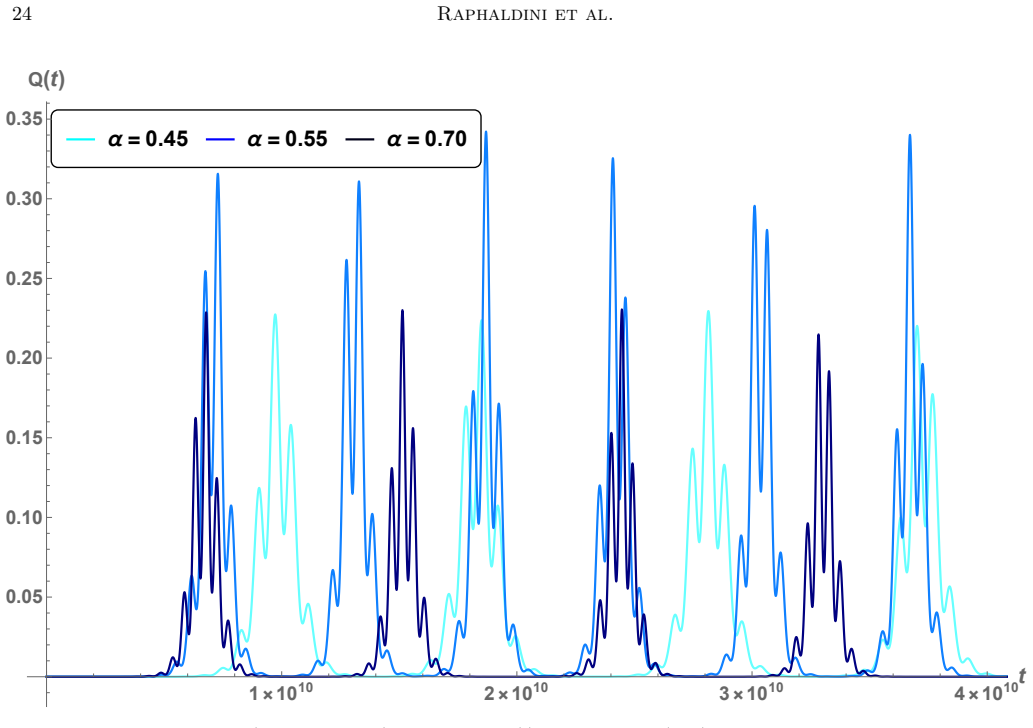
The central object is the precession resonance: a resonance between the linear frequency mismatch $\Delta\omega$ of one wave triad and the nonlinear frequency of the amplitude oscillation of an adjacent triad, which allows strong energy transfer between triads even when the triads are not linearly resonant. It is implemented in a five-wave system, two triads coupled through a shared mode 3, whose complex amplitudes follow equations (28)-(32), and it is quantified by the energy-transfer efficiency $E(\alpha)$, which peaks at 34% at the amplitude scale $\alpha = 0.55$. The Manley-Rowe invariant $I$ supplies the amplitude-period law $T(I) \propto 1/\sqrt{I}$; the mode (0,2), with zero frequency and zero zonal wavenumber, represents the differential rotation and acquires energy from the waves in this regime.
What would settle it
Estimate the dimensionless amplitudes of the relevant tachocline modes from helioseismic inversions of torsional oscillations or from magnetic Rossby-wave signatures in sunspot and butterfly-diagram data, and check whether they fall near $\alpha \approx 0.55$; if they are far below the weakly-nonlinear threshold, the precession resonance cannot lock and the predicted ~120-250-year modulations and Maunder-like states would not occur in the representative five-mode system.
Extended reading notes
Core claim
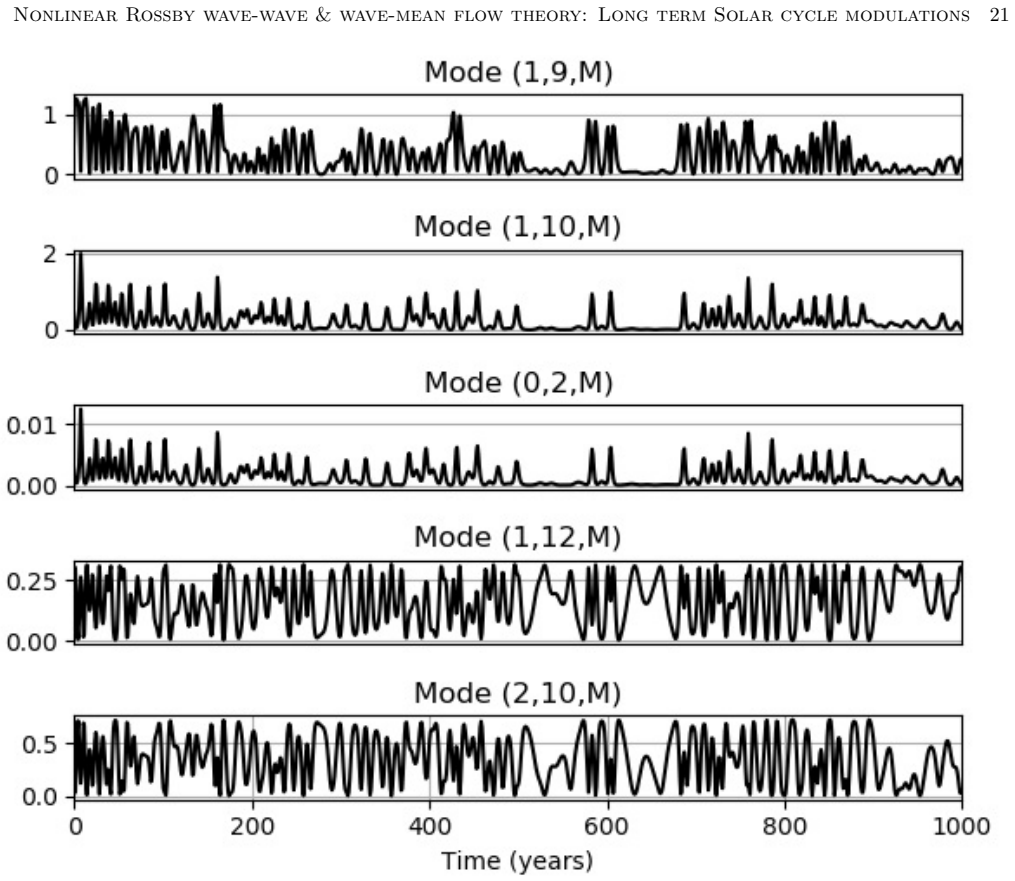
The central discovery is that the precession resonance mechanism, previously identified for generic nonlinear wave systems, operates for MHD Rossby waves on a sphere in the solar tachocline, and in that regime transfers energy between two coupled triads strongly enough to modulate the 11-year beat on century timescales. For the representative five-mode system (triad a: spherical harmonics (0,2), (1,10), (1,9); triad b: (1,9), (1,12), (2,10)), the frequency mismatch of triad a locks to the nonlinear amplitude-oscillation frequency of triad b. The energy time series then shows a ~10-year carrier wave modulated on ~120-130-year scales in the conservative case, and a broadened ~7-9-year carrier with ~230-year modulation plus multi-decade suppressed epochs when forcing and dissipation are added. The inverse relation between wave amplitude and the intra-triad period follows from the Manley-Rowe invariant, $T(I)\propto I^{-1/2}$, which the authors identify with Waldmeier's law of the solar cycle.
Load-bearing premise
The load-bearing premise is that the real tachocline MHD Rossby-wave amplitudes sit inside the precession-resonance window, specifically near the tuned scale $\alpha = 0.55$ where the model's energy-transfer efficiency peaks at 34%; the paper asserts this regime is attainable without quantitative observational or dynamo-model support.
Editorial extensions
If this is right
- Century-scale modulations of the solar cycle (Gleissberg-type periods of roughly 120-250 years) emerge deterministically from wave-wave and wave-mean-flow coupling, without invoking stochastic alpha fluctuations.
- Waldmeier's law becomes a consequence of wave-energy conservation: stronger wave activity shortens the nonlinear exchange period, so taller cycles are naturally shorter.
- Differential-rotation variations should be roughly in anti-phase with the main activity cycle, consistent with observed negative correlations between zonal-flow changes and solar activity.
- Decades-long grand-minimum-like states arise naturally in the forced-dissipative regime, with their duration sensitive to the strength of the divergence forcing.
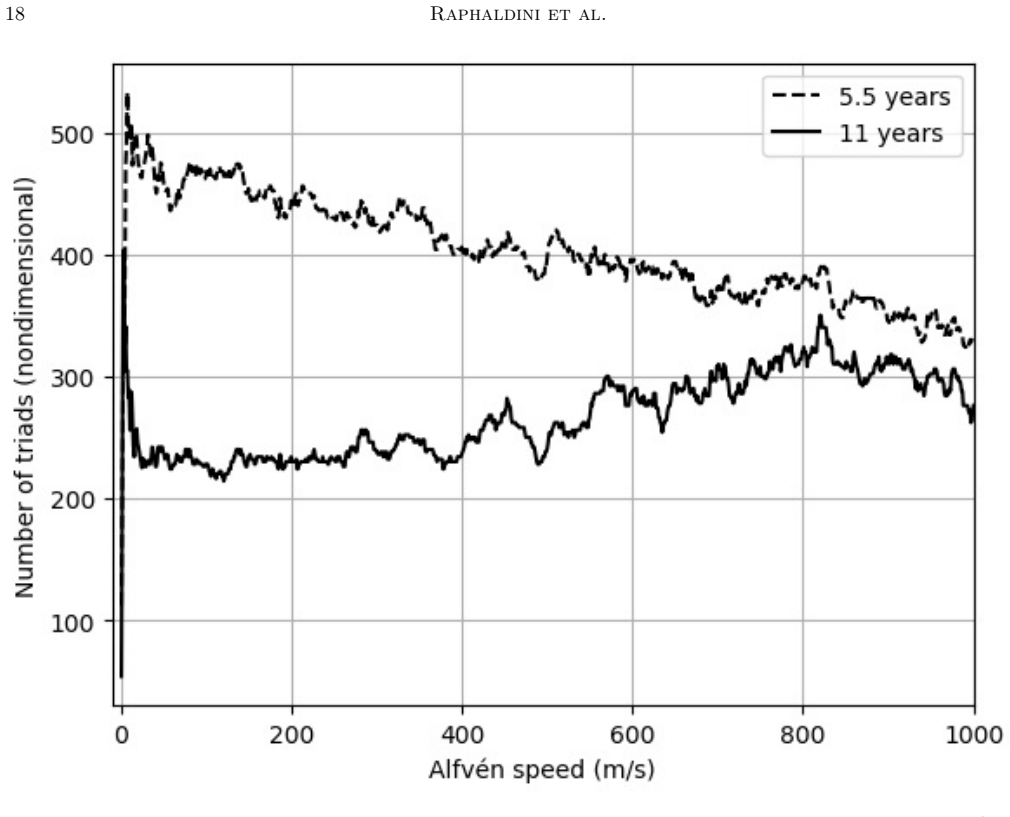
- Hundreds of tachocline triads have frequency mismatches compatible with harmonics of the 22-year magnetic cycle, so the mechanism does not depend on one specially chosen mode set.
Reading between the lines
- A natural next step is to couple many triads into a full resonant-cluster network and check whether the observed 100-, 220-, and 1000-year modulation periods emerge simultaneously from one amplitude distribution; the present five-wave model produces only selected periods.
- The model's quantitative Waldmeier relation ($T \propto 1/\sqrt{I}$) could be fitted to long sunspot-number records; a mismatch in the fitted slope would discriminate this mechanism from stochastic dynamo models, which do not predict a specific amplitude-period exponent.
- Because precession resonance is a generic property of quadratic wave systems, the same beat-and-quiescence phenomenology should appear in other planetary or laboratory Rossby-wave and drift-wave settings, where it could be tested under controlled conditions.
- If the forcing level $f_3$ controls the duration of suppressed states, then in the real Sun the strength of convective or baroclinic forcing near the tachocline would regulate the occurrence of grand minima, making the mechanism testable through correlations between tachocline wave activity and historical minima.
Editorial analysis
A structured set of objections, weighed in public.
Referee Report
Summary. The paper proposes that the precession resonance mechanism of Bustamante et al. (2014), applied to MHD Rossby waves in the solar tachocline, can produce long-period modulations of the ~11-year Schwabe cycle and an inverse amplitude-period relation reminiscent of Waldmeier's law. After linearizing the MHD barotropic vorticity equations and deriving nonlinear coupling coefficients, the authors search for Rossby-Haurwitz triads containing a zonal mode and a frequency mismatch near harmonics of the 22-year cycle. They select one representative five-wave configuration of two triads coupled through a common mode, integrate the amplitude equations numerically in conservative and forced-dissipative cases, and report ~10-year energy oscillations modulated on centennial timescales, a 120-250-year spectral peak, Maunder-minimum-like low-activity episodes, and an inverse amplitude-period relation. The mathematical machinery is presented in appendices: coupling coefficients, Manley-Rowe invariants, modulational instability, and precession resonance efficiency E(α).
Significance. The paper is valuable as a concrete nonlinear-mechanism proposal for long-term solar cycle variability. Its strengths include explicit derivation of the five-wave model from the MHD equations, publication of the coupling coefficients and initial conditions, machine-checkable numerical integrations, and a sharp prediction that the efficiency of inter-triad energy transfer is peaked in an intermediate amplitude regime. If the connection between the dimensionless amplitude scale α and actual tachocline Rossby wave amplitudes can be established, the mechanism would offer a dynamical explanation for Gleissberg-like modulations and for Waldmeier's law without invoking stochastic alpha fluctuations. However, as it stands the solar-physics relevance is conditional: the central result is obtained at a single tuned amplitude, and the paper does not yet demonstrate that real tachocline modes live in that window. The Waldmeier-law claim is also more qualitative than the abstract suggests.
major comments (3)
- [§3, Appendix C, Fig. 10] The precession-resonance results are obtained exclusively at the tuned scale parameter α=0.55 (initial dimensionless amplitudes |Λ3|,|Λ4|,|Λ5|≈10^-8), and the efficiency curve is narrow: E(0.45)=0.23, E(0.55)=0.34, E(0.70)=0.23. The manuscript asserts in Section 3 that the relevant amplitudes 'can be quite small and therefore attainable in real situations' but provides no physical calibration: it never converts Λ to a velocity or magnetic-field perturbation, nor does it compare with observed or modeled tachocline wave amplitudes. Because the authors themselves identify the amplitude regime as a prerequisite of the mechanism, this missing link is load-bearing; please provide an estimate of the implied physical amplitudes or explicitly reframe the paper as a proof-of-concept.
- [§4, Eq. (38)] The forced-dissipative results rest on an ad hoc forcing: the prescribed divergence field has the same spatial structure as Mode 3 and resonates with it, giving a constant coefficient f3. No physical derivation or numerical value for f3 is given, and the statement that the duration of Maunder-like epochs 'is highly dependent on the magnitude of the divergence forcing' is supported only by 'figures not shown.' This weakens the claim that the simulations resemble the observed grand-minimum states; please report the value of f3 and a parameter study.
- [§5, Figs. 3-4] The Waldmeier-law claim is based on the Hilbert-transform instantaneous frequency of a single mode in a single simulation. The manuscript does not quantify the amplitude-period anti-correlation across the many cycles (e.g., correlation coefficient, regression slope) or compare it with the empirically known Waldmeier relationship. The qualitative statement that frequency increases during high amplitudes is suggestive but not yet a demonstration of consistency with Waldmeier's law; please provide a quantitative measure or soften the claim.
minor comments (5)
- [Appendix C, Eq. (C38)] The equation for dΛ4/dt is written with Λ*5 Λ3, whereas Section 3 Eq. (31) has Λ5 Λ*3; the complex conjugation is inconsistent and should be corrected for reproducibility.
- [Fig. 1 caption] The expression for the Alfvén speed is written as VA = B0/(μ0ρ), which is dimensionally incorrect; it should be B0/√(μ0ρ).
- [Appendix B, Eqs. (B30)-(B33)] The elliptic integral K(μ) is written with 1/√(1 - μ sin θ); the standard complete elliptic integral of the first kind uses 1/√(1 - μ sin²θ). Also, the definitions of T and cosα in (B32)-(B33) appear to be identical, which is likely a transcription error; please check against Bustamante and Kartashova (2011).
- [Table 1 caption] The caption lists '1/Δωa = 5.72248 yrs' and '1/Δωb = 15.2326 yrs' while the text refers to 'frequency mismatch of around 5.5 years' and 'order of 15 years'; please state explicitly whether these numbers are 1/Δω or the periods 2π/Δω.
- [§4, Eqs. (36)-(40)] The numerical values of the damping coefficients di computed from Eq. (41) are not reported; please list them so that the forced-dissipative integrations can be reproduced.
Circularity Check
The ~11-year cycle is built into the model through triad selection and tuned amplitude α=0.55; the longer modulation is emergent, so the circularity is partial.
-
fitted input called prediction
[Section 2.2 (triad search condition), Section 3 (initial amplitudes), Table 1 caption (frequency mismatches)]
"we have sought triads whose linear frequency mismatch among the modes is close to one of the harmonics of the main solar cycle frequency, that is, ω1+ω2−ω3∼jπ/22yr−1,j = 1, 2, 3.... ... In this integration, the initial mode amplitudes of Triad b are set to match the precession resonance regime, in which the characteristic frequency of amplitude modulation of this triad exhibits a 2:1 resonance with the eigenfrequency mismatch of Triad a."
The reported spectral peak at about 10 years is not an emergent prediction: triad a is selected on the basis that its eigenfrequency mismatch has period 5.72248 yr (a harmonic of the 22-yr solar magnetic cycle), and the amplitude scale α is tuned so that triad b's nonlinear modulation frequency is in 2:1 resonance with that mismatch. The ~11-yr Schwabe-cycle timescale is therefore inserted through the triad-selection condition plus the amplitude-tuning search (α=0.55), and the main spectral peak in Fig. 3 restates that input resonance.
full rationale
The central numerical demonstration is not fully circular: the precession-resonance mechanism, although originally proposed in co-authored work (Bustamante et al. 2014), is independently implemented and verified here by computing Lyapunov growth rates and the efficiency scan E(α); the Manley-Rowe inverse period-amplitude relation used for the Waldmeier-law comparison is a mathematical consequence of the three-wave equations, not a quantity fitted to solar data; and the long modulation periods (~130 yr and ~230 yr in the conservative and forced-damped runs) emerge from numerical integration rather than being prescribed. However, the ~11-yr 'main cycle' that is modulated is imposed by construction: the triads are explicitly sought so that their frequency mismatch matches harmonics of the 22-yr solar cycle, and the initial amplitudes are tuned to put triad b in 2:1 precession resonance with that mismatch. Thus the paper's key 'demonstration' of long-term modulations of an 11-yr cycle takes the 11-yr timescale as an input and shows that a tuned five-wave system in a special amplitude window can modulate it. This is a legitimate mechanism study, but it is a partial circularity because one of the main reported outputs (the ~10-yr spectral peak) reduces by construction to the selection/tuning criteria. The unsupported physical-amplitude link (α=0.55 vs observed tachocline wave amplitudes) is a correctness risk rather than circularity, and the self-citations to Bustamante et al. and Bustamante & Kartashova are backed by in-paper demonstrations and external publication, so they do not raise the score further.
Assumptions & free parameters
free parameters (4)
- Alfvén wave speed VA (background toroidal magnetic field amplitude B0) =
Not reported for the representative triad; the eigenfrequencies in Table 1 imply a value selected so that frequency…
- Amplitude scale parameter alpha =
0.55 (peak of efficiency E(alpha)=34%)
- Forcing coefficient f3 =
Not reported
- Relative initial mode amplitudes and phases =
Lambda4(0)=10^-2 Lambda3(0), Lambda5(0)=1.5 Lambda3(0) in the modulational-instability run; random uniform phases in…
assumptions (6)
- domain assumption The solar tachocline dynamics can be represented by the barotropic MHD vorticity equations (1)-(2), derived by discarding divergent terms from MHD shallow water equations or as a high-equivalent-depth asymptotic limit of quasi-geostrophic MHD (Section 2.1).
- domain assumption The nonlinear dynamics relevant to solar cycle modulations is captured by a five-wave truncation consisting of two triads coupled through mode 3 (Section 3, Table 1).
- domain assumption The zonal mode (0,2) represents the solar differential rotation and its energy exchange with the waves is relevant to the observed anti-correlation between cycle amplitude and differential rotation.
- domain assumption The precession resonance mechanism of Bustamante et al. (2014) applies to the MHD Rossby wave system with the same dynamics as the general three-wave systems analyzed there.
- ad hoc to paper The prescribed divergence forcing in the forced-dissipative case has the same spatial structure as Mode 3 and resonates with it, yielding a constant forcing coefficient f3 (Section 4).
- standard math Spherical harmonics orthogonality, Wigner 3j symbols, Manley-Rowe invariants, and integrability of three-wave equations.
Cite this review
Pith. "Pith review of Nonlinear Rossby wave-wave and wave-mean flow theory for long term Solar cycle modulations." pith.science (2026). https://pith.science/paper/YMVKLTDG
@misc{pith2026190807056,
  author       = {Pith},
  title        = {Pith review of: Nonlinear Rossby wave-wave and wave-mean flow theory for long term Solar cycle modulations},
  year         = {2026},
  howpublished = {\url{https://pith.science/paper/YMVKLTDG}},
  note         = {Machine review of arXiv:1908.07056}
}
abstract
The Schwabe cycle of solar activity exhibits modulations and frequency fluctuations on slow time scales of centuries and millennia. Plausible physical explanations for the cause of these long-term variations of the solar cycle are still elusive, with possible theories including stochasticity of alpha effect and fluctuations of the differential rotation. It has been suggested recently in the literature that there exists a possible relation between the spatio-temporal structure of Solar cycle and the nonlinear dynamics of magnetohydrodynamic Rossby waves at the solar tachocline, including both wave-wave and wave-mean flow interactions. Here we extend the nonlinear theory of MHD Rossby waves presented in a previous article to take into account long term modulation effects due to a recently discovered mechanism that allows significant energy transfers throughout different wave triads: the precession resonance mechanism. We have found a large number of Rossby-Haurwitz wave triads whose frequency mismatches are compatible with the solar cycle frequency. Consequently, by analyzing the reduced dynamics of two triads coupled by a single mode (five-wave system), we have demonstrated that in the amplitude regime in which precession resonance occurs, the energy transfer throughout the system yields significant long-term modulations on the main $\sim 11$yr period associated with intra-triad energy exchanges. We further show that such modulations display an inverse relationship between the characteristic wave amplitude and the period of intra-triad energy exchanges, which is consistent with the Waldmeier's law for the solar cycle. In the presence of a constant forcing and dissipation, the five-wave system in the precession resonance regime exhibits irregular amplitude fluctuations with some periods resembling the Grand Minimum states.
Figures


Figures from the paper (7 more)




Reference graph
Works this paper leans on
-
[1]
!1A Qa
thebibliography [1] 20pt to REFERENCES 6pt =0pt 10pt plus 3pt =0pt =0pt =1pt plus 1pt =0pt =0pt -12pt =13pt plus 1pt =20pt =13pt plus 1pt \@M =10000 =-1.0em =0pt =0pt 0pt =0pt =1.0em @enumiv\@empty 10000 10000 `\.\@m \@noitemerr \@latex@warning Empty `thebibliography' environment \@ifnextchar \@reference \@latexerr Missing key on reference command Each re...
2019
-
[2]
Benettin, G., Galgani, L., Strelcyn, J. M. (1976). Kolmogorov entropy and numerical experiments. Physical Review A, 14(6), 2338
work page 1976
-
[3]
Resonance clustering in wave turbulent regimes: integrable dynamics
Bustamante, Miguel D., and Elena Kartashova. "Resonance clustering in wave turbulent regimes: integrable dynamics." Communications in Computational Physics 10.5 (2011): 1211-1240
work page 2011
-
[4]
D, Quinn, B, Lucas, D, 2014 Phys
Bustamante, M. D, Quinn, B, Lucas, D, 2014 Phys. Rev. Letters 113 (8), 084502
work page 2014
-
[5]
Amplitude-phase synchronization at the onset of permanent spatiotemporal chaos
Chian, Abraham C-L., et al. "Amplitude-phase synchronization at the onset of permanent spatiotemporal chaos." Physical review letters 104.25 (2010): 254102
work page 2010
-
[6]
Connaughton, Colm P. et al. Modulational instability of Rossby and drift waves and generation of zonal jets. Journal of Fluid Mechanics, v. 654, p. 207-231, 2010
work page 2010
-
[7]
DynamicalSystems. jl: A Julia software library for chaos and nonlinear dynamics
Datseris, George. "DynamicalSystems. jl: A Julia software library for chaos and nonlinear dynamics." Journal of Open Source Software 3.23 (2018): 598
work page 2018
-
[8]
Constraints on the Applicability of an Interface Dynamo to the Sun
Dikpati, Mausumi, et al. "Constraints on the Applicability of an Interface Dynamo to the Sun." The Astrophysical Journal 631 (2005): 631, 647
work page 2005
Show all 29 references
-
[9]
Role of Interaction between Magnetic Rossby Waves and Tachocline Differential Rotation in Producing Solar Seasons
Dikpati, Mausumi, et al. "Role of Interaction between Magnetic Rossby Waves and Tachocline Differential Rotation in Producing Solar Seasons." The Astrophysical Journal 853.2 (2018): 144
2018
-
[10]
Evaluation of Spectral Versus Grid Methods of Hemispheric Numerical Weather Prediction
Ellsaesser, H. W. "Evaluation of Spectral Versus Grid Methods of Hemispheric Numerical Weather Prediction" J. Appl. Meteor., 5, 246
-
[11]
Gilman P. A. 1969 SoPh 8 316G
1969
-
[12]
Gilman P. A. 1969 SoPh 9 3G
1969
-
[13]
Magnetohydrodynamic “shallow water
Gilman, Peter A. "Magnetohydrodynamic “shallow water” equations for the solar tachocline." The Astrophysical Journal Letters 544.1 (2000): L79
2000
-
[14]
Gilman P. A. and Dikpati M. 2014 Apj 787, 60
2014
-
[15]
Eds Hughes, D, Rosner, R., Weiss, N., Cambridge University Press, 2007
Gough, D., in Solar Tachocline. Eds Hughes, D, Rosner, R., Weiss, N., Cambridge University Press, 2007
2007
-
[16]
Ordinary Differential Equations, John Wiley & Sons, Inc., New York, 1969
Hale J.K. Ordinary Differential Equations, John Wiley & Sons, Inc., New York, 1969
1969
-
[17]
J., Karoly, D
Hoskins, B. J., Karoly, D. J. 1981, J. Atmos. Sci., 38, 1179
1981
-
[18]
N, Spherical Harmonics and Tensors for Classical Field Theory, Wiley-Blackwell, 1985
Jones, M. N, Spherical Harmonics and Tensors for Classical Field Theory, Wiley-Blackwell, 1985
1985
-
[19]
1993 A&A 272, 321
Hoyng, P. 1993 A&A 272, 321
1993
-
[20]
Wings of the butterfly: Sunspot groups for 1826–2015
Leussu, R., et al. "Wings of the butterfly: Sunspot groups for 1826–2015." Astronomy & Astrophysics 599 (2017): A131. NBR 6023
2017
-
[21]
Sokoloff and I.G
Pipin, V.V., D.D. Sokoloff and I.G. Usoskin 2012 Astron. Astrophys. 542, A26
2012
-
[22]
2015 Apj 799, 78
Raphaldini, B., Raupp, C.F.M. 2015 Apj 799, 78
2015
-
[23]
2017 Living Rev
Usoskin, I.G. 2017 Living Rev. Sol. Phys. 14, 3
2017
-
[24]
1936, Astron
Waldmeier, M. 1936, Astron. Nachrichr. 259, 267
1936
-
[25]
Welch, P. D. 1936, IEE Transactions on Audio and Electroacoustics, 70, 73
1936
-
[26]
L'vov, and Gregory Falkovich
Zakharov, Vladimir E., Victor S. L'vov, and Gregory Falkovich. Kolmogorov spectra of turbulence I: Wave turbulence. Springer Science & Business Media, 2012
2012
-
[27]
Rossby waves in “shallow water
Zaqarashvili, T. V., et al. "Rossby waves in “shallow water” magnetohydrodynamics." Astronomy & Astrophysics 470.3 (2007): 815-820
2007
-
[28]
Remarks on rotating shallow-water magnetohydrodynamics
Zeitlin, V. "Remarks on rotating shallow-water magnetohydrodynamics." Nonlinear Processes in Geophysics 20.5 (2013): 893-898
2013
-
[29]
Mursula, and I
Zhang, L., K. Mursula, and I. Usoskin 2015 Astron. Astrophys. Lett 575, L2
2015
Reviewed August 14, 2026 · model on record in the stance chip above.
Discussion (0). Continue with ORCID to comment.