Matrix structure and convergence behaviour of the matched eigenfunction method for computing heave wave forces on generalized concentric bodies
Pith reviewed 2026-05-20 01:45 UTC · model grok-4.3
The pith
The matched eigenfunction expansion method computes heave wave forces on slanted concentric cylinders within 5 percent of boundary element results using matrices two orders of magnitude smaller.
A machine-rendered reading of the paper's core claim, the machinery that carries it, and where it could break.
Core claim
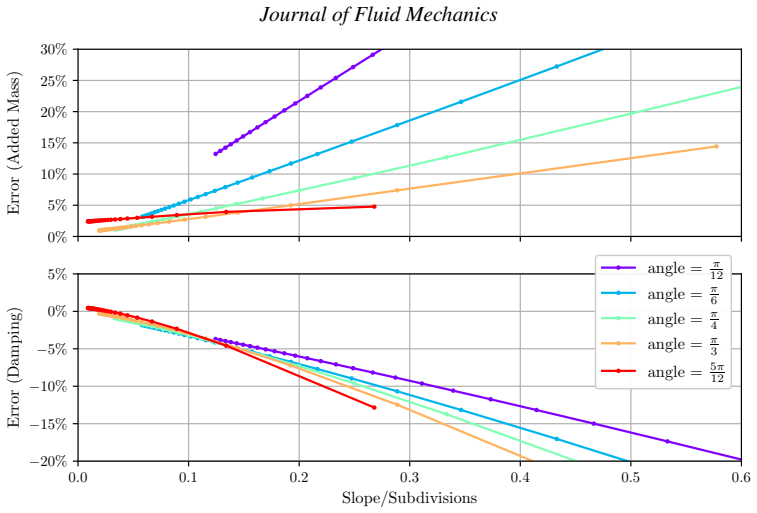
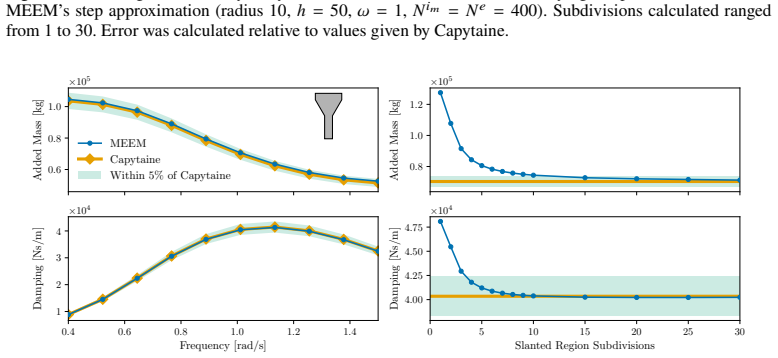
The central claim is that the matched eigenfunction expansion method supplies a single framework for an arbitrary number of fixed or heaving surface-piercing annular cylinders with continuous and radially monotonic profiles; numerical experiments then show that this framework approximates hydrodynamic coefficients of slanted geometries to within 5 percent of Capytaine even at 15 degrees from vertical, while reaching 2 percent convergence an order of magnitude faster than Capytaine and with a matrix size two orders of magnitude smaller.
What carries the argument
The block matrix structure obtained by dividing the fluid domain into annular regions and matching eigenfunction expansions of the velocity potential at each interface, which organizes the linear system solved for the added mass, radiation damping, and excitation coefficients.
If this is right
- Hydrodynamic coefficients for a broad range of continuous radially monotonic shapes become computable with far less effort than boundary element methods.
- Optimization loops that iterate over many offshore structure geometries become practical because each evaluation finishes an order of magnitude sooner.
- Both fixed and heaving surface-piercing bodies can be treated inside the same matching procedure.
- Convergence rates are now documented for slanted profiles, giving users a clear rule of thumb for choosing matrix size.
Where Pith is reading between the lines
- The compact matrix size could let the method run inside larger coupled simulations that include multiple structures or time-varying waves.
- A hybrid scheme that switches to boundary element methods only near sharp features might extend the approach to bodies that violate the monotonic-profile assumption.
- Insights into the block structure may suggest similar semi-analytical reductions for related problems such as diffraction by arrays of cylinders or motion in irregular waves.
Load-bearing premise
The body profiles must stay continuous and radially monotonic so that the eigenfunction expansions in neighboring annular regions can be matched directly without extra interface conditions or geometric approximations.
What would settle it
A direct numerical comparison on a body whose profile contains a radial discontinuity or reversal would show whether the hydrodynamic coefficients diverge sharply from a high-resolution boundary element reference solution.
Figures




read the original abstract
Structural survival of offshore structures is crucial for the growing marine economy. Calculating the added mass, radiation damping, and excitation coefficients to quantify wave loads with the traditional boundary element method (BEM) presents a computational bottleneck. The matched eigenfunction expansion method (MEEM), a long-known but rarely-used alternative, offers computational benefits due to its semi-analytical nature. However, previous work fails to directly compare its accuracy and computational performance with BEM, leaving the extent of its utility unknown. Furthermore, the geometry-dependent convergence for cylindrical and slanted geometries has not yet been documented, making the method's practicality for general geometries unclear. This paper presents a unifying MEEM framework for modeling an arbitrary number of fixed or heaving surface-piercing annular cylinders with continuous and radially-monotonic body profiles, and explores the method's block matrix structure, convergence behavior, ability to accurately approximate slanted geometries, and computational advantages over the BEM solver Capytaine. The numerical experiments show that MEEM can compute hydrodynamic coefficients of slanted geometries within 5% of Capytaine, even for angles as steep as 15 degrees from vertical. Finally, MEEM can achieve 2% convergence of its hydrodynamic coefficients an order of magnitude faster than Capytaine with a matrix size two orders of magnitude smaller, making it a computationally effective alternative to traditional BEM solvers. These contributions enable hydrodynamic analysis of a broad range of shapes with increased speed and confidence, paving the way for future optimization studies to yield improved designs.
Editorial analysis
A structured set of objections, weighed in public.
Referee Report
Summary. The manuscript develops a unifying matched eigenfunction expansion method (MEEM) framework for an arbitrary number of fixed or heaving surface-piercing annular cylinders possessing continuous and radially-monotonic body profiles. It analyzes the resulting block-matrix structure, documents geometry-dependent convergence for both cylindrical and slanted cases, demonstrates approximation of slanted geometries, and reports computational comparisons against the BEM solver Capytaine, claiming 5% agreement on hydrodynamic coefficients for slants up to 15° from vertical together with order-of-magnitude speed-ups at 2% convergence using matrices two orders of magnitude smaller.
Significance. If the accuracy and performance claims survive clarification of the geometric-proxy issue, the work supplies a semi-analytical, matrix-structured alternative to BEM that could materially accelerate hydrodynamic-coefficient evaluation for generalized offshore geometries and thereby support subsequent optimization studies.
major comments (2)
- [Numerical experiments / slanted-geometry results] Numerical experiments (results section on slanted geometries): the headline claim that MEEM reproduces Capytaine coefficients within 5% for 15° slants rests on replacing the true linear slant with a continuous radially-monotonic profile for the MEEM computation. It is not stated whether the Capytaine reference solutions are obtained on the identical monotonic proxy or on the exact slanted geometry; without this clarification the reported tolerance conflates profile-approximation error with MEEM truncation and interface-matching error, weakening attribution of the observed accuracy to the method itself.
- [Convergence behavior and performance comparison] Convergence and performance subsection: the statements that 2% convergence is reached an order of magnitude faster with a matrix two orders of magnitude smaller lack explicit truncation criteria (number of retained eigenfunctions per region), definition of matrix size (total unknowns versus per-annulus blocks), Capytaine mesh resolution and convergence tolerance, and precise error-bar construction. These omissions make the quantitative speed-up claims difficult to reproduce or compare directly.
minor comments (2)
- [Abstract] Abstract: the phrase 'generalized concentric bodies' is immediately qualified by the continuous radially-monotonic restriction; a single clarifying sentence would prevent readers from over-generalizing the scope.
- [Throughout] Notation: ensure that the block-matrix partitioning and the matching conditions at vertical interfaces are denoted consistently between the theoretical derivation and the numerical implementation sections.
Simulated Author's Rebuttal
We thank the referee for the careful reading and constructive comments, which help strengthen the clarity and reproducibility of the work. We address each major comment below and will incorporate revisions to resolve the identified ambiguities.
read point-by-point responses
-
Referee: Numerical experiments (results section on slanted geometries): the headline claim that MEEM reproduces Capytaine coefficients within 5% for 15° slants rests on replacing the true linear slant with a continuous radially-monotonic profile for the MEEM computation. It is not stated whether the Capytaine reference solutions are obtained on the identical monotonic proxy or on the exact slanted geometry; without this clarification the reported tolerance conflates profile-approximation error with MEEM truncation and interface-matching error, weakening attribution of the observed accuracy to the method itself.
Authors: We agree that explicit clarification is required. In the numerical experiments, Capytaine reference solutions were computed on the exact linear-slant geometry, while MEEM was applied to a continuous radially-monotonic profile chosen to approximate the slant. The reported 5% agreement therefore represents the combined effect of profile approximation and MEEM truncation/interface-matching error. Because the manuscript positions MEEM as a method for monotonic profiles that can approximate slanted bodies, this comparison is intentional; however, we will revise the text to state the distinction unambiguously so that readers can correctly attribute the observed accuracy. revision: yes
-
Referee: Convergence and performance subsection: the statements that 2% convergence is reached an order of magnitude faster with a matrix two orders of magnitude smaller lack explicit truncation criteria (number of retained eigenfunctions per region), definition of matrix size (total unknowns versus per-annulus blocks), Capytaine mesh resolution and convergence tolerance, and precise error-bar construction. These omissions make the quantitative speed-up claims difficult to reproduce or compare directly.
Authors: We accept that the current presentation lacks sufficient detail for direct reproduction. In the revised manuscript we will add: (i) the truncation criterion (number of retained eigenfunctions retained in each fluid region), (ii) an explicit definition of matrix size as the total number of unknowns in the assembled block system, (iii) the Capytaine mesh density and solver tolerance employed for the reference solutions, and (iv) the precise procedure used to construct the error bars shown in the convergence plots. These additions will allow readers to verify the reported order-of-magnitude speed-up at 2% convergence. revision: yes
Circularity Check
No significant circularity; quantitative claims rest on external Capytaine benchmarks
full rationale
The paper defines a MEEM framework for continuous radially-monotonic annular bodies, derives the block-matrix structure and interface matching conditions from standard eigenfunction expansions in annular regions, and validates all accuracy (within 5% for 15° slants) and convergence (2% with order-of-magnitude speed-up) claims through direct numerical comparison to the independent Capytaine BEM solver. No fitted parameters are renamed as predictions, no self-citation chain is load-bearing for the central results, and the monotonic-profile assumption is stated explicitly as a modeling precondition rather than derived from the outputs. The derivation chain is therefore self-contained against external benchmarks.
Axiom & Free-Parameter Ledger
axioms (1)
- domain assumption The velocity potential in each fluid region can be expanded in a complete set of eigenfunctions that satisfy the linearized free-surface and bottom boundary conditions.
Lean theorems connected to this paper
-
IndisputableMonolith/Cost/FunctionalEquation.leanwashburn_uniqueness_aczel unclear?
unclearRelation between the paper passage and the cited Recognition theorem.
Convergence … modeled as a power-law envelope ϵ ≈ (N_im / β_im )^−α_im (Fig. 6).
What do these tags mean?
- matches
- The paper's claim is directly supported by a theorem in the formal canon.
- supports
- The theorem supports part of the paper's argument, but the paper may add assumptions or extra steps.
- extends
- The paper goes beyond the formal theorem; the theorem is a base layer rather than the whole result.
- uses
- The paper appears to rely on the theorem as machinery.
- contradicts
- The paper's claim conflicts with a theorem or certificate in the canon.
- unclear
- Pith found a possible connection, but the passage is too broad, indirect, or ambiguous to say the theorem truly supports the claim.
discussion (0)
Sign in with ORCID, Apple, or X to comment. Anyone can read and Pith papers without signing in.