REVIEW 3 major objections 5 minor 9 cited by
Altermagnetism in modified Lieb lattice Hubbard model
T0 review · 3 major / 5 minor · reviewed 2026-08-11 · deepseek-v4-flash
Pith's one-line read This paper establishes that a modified Lieb lattice Hubbard model, with repulsion only on the transition-metal sublattices, hosts altermagnetic Mott insulators at electron densities n=2 and n=4, with d-wave spin splitting, and that doping…
desk verdict Solid numerical study of interaction-driven altermagnetism on the Lieb lattice, but the n=2 claim rests on fine-tuned parameters and a figure error; still worth refereeing. read the letter →
The pith
A machine-rendered reading of the paper's core claim, the machinery that carries it, and where it could break.
The reading
What carries the argument
The central object is the modified Lieb lattice Hubbard Hamiltonian H = t1 Σ_{⟨i,j⟩,σ} c†_{i,σ} c_{j,σ} + t2 Σ_{⟨⟨i,j⟩⟩,σ} c†_{i,σ} c_{j,σ} + U Σ_{i∈{B,C}} n_{i,↑} n_{i,↓} + εA Σ_{i∈A} n_i, with U only on the B and C sublattices that host magnetic atoms, while the A sublattice is non-magnetic. The argument is carried by unrestricted Hartree-Fock calculations that test multiple magnetic unit cells and initial conditions, corroborated by exact diagonalization on 12- and 18-site clusters, and by an effective spin-1/2 checkerboard Heisenberg model whose spin-wave spectra reproduce the altermagnetic splitting.
What would settle it
Solving the same Hubbard model with a finite Coulomb repulsion U_A on the A sublattice (for example U_A = U) and checking whether the staggered magnetization and the d-wave spin splitting at n=2 persist; if they vanish, the central n=2 claim is falsified. The paper's own Fig. 3(a) indicates that at εA=0 the n=2 altermagnet is absent, so varying U_A or εA is the direct test.
Extended reading notes
Core claim
For the Lieb lattice with Hubbard U on sublattices B and C only, and with an onsite energy εA on sublattice A, the paper finds collinear antiferromagnetic states with zero net magnetization and d_{$x^{2}$-$y^{2}$}-wave spin-split bands at average electron densities n=2 and n=4, over broad ranges of U and next-nearest-neighbor hopping t2. These are identified as altermagnetic Mott insulators. Doping them produces metallic states with d-wave spin splitting, including quasi-one-dimensional electron pockets when electron-doping the n=2 insulator with εA large. The paper also constructs an effective spin-1/2 Heisenberg model on a checkerboard lattice and shows that its magnon spectra exhibit the same altermagnetic splitting.
Load-bearing premise
The model assumes that the A sublattice (oxygen sites) has no Hubbard repulsion and, for the n=2 altermagnet, that its onsite energy is very large, so the A sites act as a passive reservoir; if real oxygen orbitals have a comparable U_A or a smaller εA, the n=2 altermagnetic insulator does not survive.
Editorial extensions
If this is right
- The n=2 and n=4 altermagnetic Mott insulators are stable against quantum fluctuations, as the exact diagonalization results show staggered magnetization in regions where Hartree-Fock predicts the altermagnet.
- The altermagnetic band splitting is d_{x^2-y^2}-wave with nodal lines along k_x = ±k_y, protected by the C4 rotational symmetry, which makes the splitting observable with angle-resolved photoemission.
- Doping the n=2 insulator with electrons and U > εA produces altermagnetic metals with quasi-one-dimensional Fermi-surface pockets, which can be detected by quantum oscillations or ARPES.
- The effective spin model predicts that the sublattice-resolved dynamical spin structure factor shows altermagnetic magnon splitting, measurable by inelastic neutron scattering.
- The results apply to quasi-2D oxychalcogenides with the anti-CuO2 structure and d1 electronic configuration, providing a minimal model for their altermagnetic behavior.
Reading between the lines
- The n=2 altermagnetic phase depends on the A sites being effectively non-interacting (U_A ≈ 0) and on a large εA; if real oxygen p orbitals carry a comparable Hubbard U, the n=2 phase is likely suppressed, so the model is most securely applied to systems where the A sublattice is genuinely itinerant and weakly correlated.
- The altermagnetic metals found here might be a platform for correlation-driven superconductivity, since doped Mott insulators on bipartite lattices are known to host pairing instabilities; the paper mentions this as a future direction but does not compute it.
- The quasi-one-dimensional electron pockets in the electron-doped n=2 altermagnet suggest that transport and spin-splitting will be strongly anisotropic, which could be tested by measuring resistivity or ARPES along the x and y directions.
- The Hartree-Fock tendency to overestimate ferromagnetic order, noted in the text, implies that the altermagnetic metal phase may actually occupy a larger portion of the phase diagram than shown.
Signed reviews
Editorial analysis
A structured set of objections, weighed in public.
Referee Report
Summary. The manuscript studies the Hubbard model (Eq. 1) on the Lieb lattice with Coulomb repulsion U restricted to the B and C sublattices, as a minimal model of the anti-CuO2 layers of quasi-2D oxychalcogenides. Using unrestricted Hartree-Fock on 12x12 systems with multiple magnetic unit cells and random initial conditions, together with exact diagonalization on 12- and 18-site clusters, the authors map t2-U phase diagrams at fillings n=2 and 4, identify collinear altermagnetic insulating regions with d-wave spin splitting, construct an effective checkerboard Heisenberg model whose magnon spectra show sublattice-resolved splitting, and report altermagnetic metallic phases upon doping away from n=2 and n=4.
Significance. If correct, the paper would provide one of the first unbiased interacting-model demonstrations of d-wave altermagnetism in a realistic lattice geometry, with concrete and falsifiable predictions: spin-split electron bands with d_{x^2-y^2} symmetry, sublattice-resolved magnon splitting observable by neutron scattering, and quasi-1D altermagnetic Fermi surfaces upon doping. The numerical cross-checks are a genuine strength: the Hartree-Fock calculations are unrestricted rather than ansatz-based, and the ED results provide correlated-system input. The main qualification is that the n=2 altermagnet is established only in a special parameter regime, namely epsilon_A=10|t1| and U_A=0, so the material-relevance claim in the conclusions is broader than the evidence currently supports.
major comments (3)
- [Eq. (1), Fig. 3(a), Conclusions] The n=2 altermagnetic Mott insulator is demonstrated only for epsilon_A=10|t1| and with zero Coulomb repulsion on the A sublattice. The paper's own Fig. 3(a) shows that at epsilon_A=0 the n=2 ground state is a vortex or block state with no altermagnet, and no microscopic estimate is provided for epsilon_A or for the oxygen-like A-site Coulomb repulsion. Since real oxychalcogenides have finite Coulomb repulsion on oxygen 2p orbitals and moderate charge-transfer energies, the conclusion that the model 'establishes the presence of altermagnetic Mott insulators' at n=2 in this material class overreaches. Please provide a quantitative estimate of epsilon_A and U_A, or a calculation with finite U_A, and if that is not possible, restrict the material-level claim to n=4 and present n=2 as a conditional model prediction.
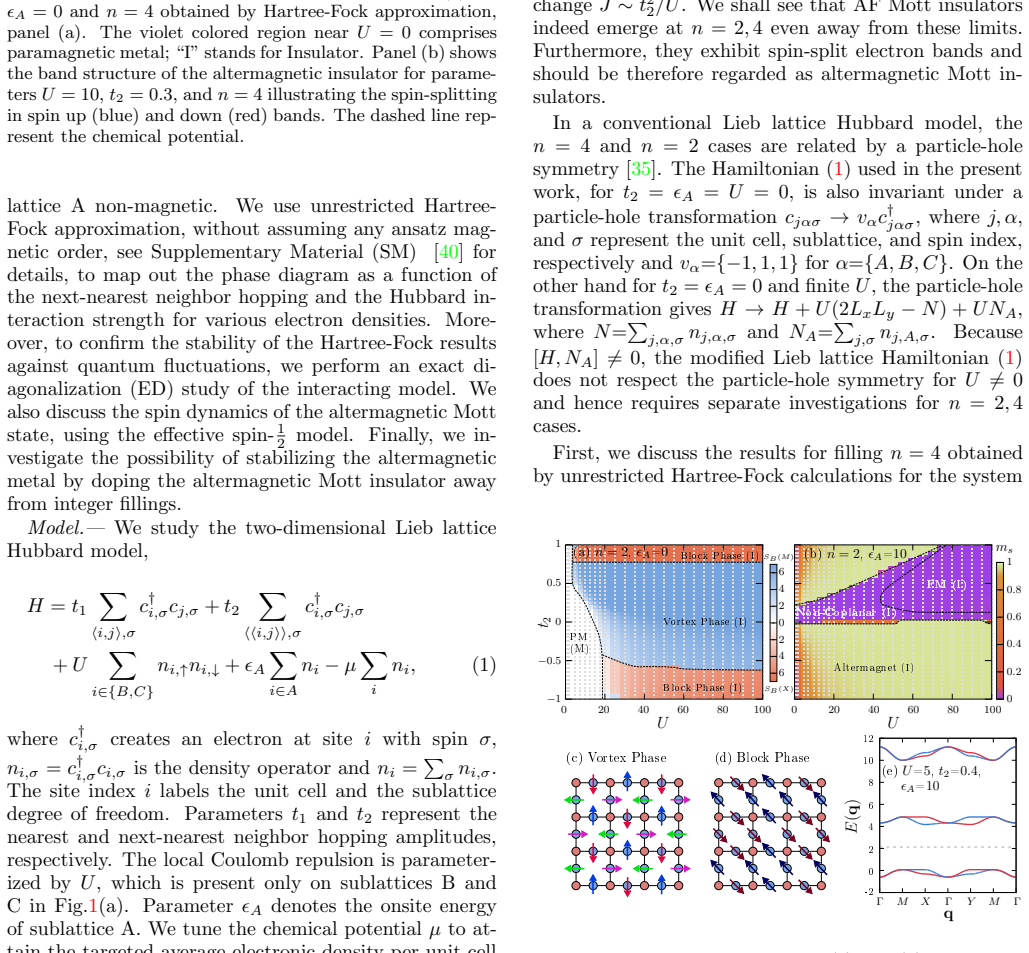
- [Fig. 3(b) and Fig. 3(e)] The representative band structure in Fig. 3(e) is computed at U=5, t2=0.4, epsilon_A=10, which lies in the t2>0 part of the phase diagram. According to Fig. 3(b) and the accompanying text, for t2>0 the ground state is either a non-coplanar insulator at weak and intermediate U or a saturated ferromagnet at large U, not the altermagnet. Either the phase diagram labels are incorrect or the band structure in Fig. 3(e) is not representative of the altermagnetic phase; this inconsistency must be corrected before the d-wave spin splitting shown in Fig. 3(e) can be used as evidence for the central claim.
- [Fig. 4(d) and Fig. 4(f)] The exact-diagonalization support for the n=2 altermagnet is obtained on a 12-site (2x2) cluster with periodic boundary conditions, and the momentum-resolved spin splitting delta_updown(k) is computed with a symmetry-breaking Zeeman field of 0.05 added on one corner site. This is a standard finite-size probe, but it is not an independent confirmation of spontaneous altermagnetic order: the same fine-tuned parameter set (epsilon_A=10, U_A=0) is used, and the authors explicitly acknowledge that the competing valence-bond-solid state cannot be ruled out on larger systems. Please clarify what the ED results add beyond showing collinear AF correlations, and consider a larger-scale calculation (for example DMRG or variational Monte Carlo) to substantiate the n=2 claim.
minor comments (5)
- [Supplementary material] The supplemental material is referenced only as '[40] Supplementary link', a placeholder; a permanent link or an appendix is needed for the reader to verify the Hartree-Fock, ED, and spin-wave details.
- [Main text and references] There are several typographical and formatting errors: 'arrises' in the section on altermagnetic metal by doping, 'Physl Rev. Lett.' in Ref. [29], and 'subalttice' in SM Section III.
- [Fig. 4(d) caption] The color scale label 'm_s tilde' in Fig. 4(d) is not defined in the caption; please specify that it is the ED staggered magnetization defined in the text.
- [SM Section IV] The estimates of J2/J1 are order-of-magnitude only, and the main text should state explicitly that the spin-model results are qualitative because J2/J1 is not derived quantitatively from the Hubbard parameters for the specific altermagnetic phases.
- [Fig. 2(a) and Fig. 3(b)] The non-coplanar magnetic state is discussed only in the SM; a one-sentence definition in the main text would help readers interpret the 'Non-Coplanar (I)' regions in the phase diagrams.
Circularity Check
No significant circularity: the altermagnetic phases are energy-minimized outputs of an unbiased Hubbard study, not identities built into the inputs.
full rationale
The paper's derivation chain contains no step in which the central claim is defined in terms of its own output, no fitted parameter is renamed as a prediction, and no load-bearing argument rests on a self-citation. Eq. (1) is a Hubbard model with U restricted to sublattices B/C and an adjustable A-site level; the n=2 and n=4 fillings are set by chemical potential, and the altermagnetic states are obtained by unrestricted Hartree-Fock with multiple magnetic unit cells and random initial conditions, plus ED on 12- and 18-site clusters. The d-wave spin splitting is read off the resulting band structures (Figs. 2b, 3e) and spectral functions (Fig. 4f), not imposed by the ansatz. The effective spin model Eq. (4) treats J2/J1 as an input, but the magnon splitting is a computed spectral property of that model (Fig. 5), with perturbative estimates in the SM indicating J2 > J1 in strong coupling; the magnon result is not used to define the Hubbard result. The main vulnerability—absence of U on the A sublattice and the large epsilon_A = 10|t1| used for n=2—is a domain-of-validity/material-modeling limitation, explicitly acknowledged in the note added ('The crucial difference in our model is the absence of Coulomb repulsion on sublattice A'), not a circular reduction. The possible inconsistency of the representative point in Fig. 3(e) relative to Fig. 3(b) is a correctness/verification issue, not circularity. The only self-citation (Ref. [9], in the context of future topological superconductivity studies) is not load-bearing. Score 0.
Assumptions & free parameters
free parameters (3)
- epsilon_A (A-sublattice onsite energy) =
10|t1| for n=2; 0 for n=4
- J2/J1 exchange ratio in the effective spin model =
greater than 1.07 (J1=1)
- LSWT magnon bandwidth rescaling factor =
1.35
assumptions (3)
- domain assumption The A sublattice has negligible Hubbard repulsion (U_A=0) and acts as a passive charge reservoir with onsite energy epsilon_A.
- domain assumption The strong-coupling limit maps the half-filled B and C sublattices to a spin-1/2 Heisenberg model with only J1 and J2 exchanges (Eq. (4)), with J1 generated by fourth-order t1 processes.
- domain assumption Exact diagonalization on 12-site and 18-site clusters with a small pinning Zeeman field represents the thermodynamic-limit behavior of the ordered phases.
invented entities (1)
-
None
Cite this review
Pith. "Pith review of Altermagnetism in modified Lieb lattice Hubbard model." pith.science (2026). https://pith.science/paper/YO4SZWFR
@misc{pith2026241216421,
  author       = {Pith},
  title        = {Pith review of: Altermagnetism in modified Lieb lattice Hubbard model},
  year         = {2026},
  howpublished = {\url{https://pith.science/paper/YO4SZWFR}},
  note         = {Machine review of arXiv:2412.16421}
}
abstract
We study the emergence of altermagnetism from repulsive interactions for electrons on the Lieb lattice as a model of quasi-2D oxychalcogenides with the so-called "anti-CuO$_{2}$" lattice structure. A comprehensive study of the Lieb lattice Hubbard model, using unrestricted Hartree-Fock and exact diagonalization techniques, establishes the presence of spin-${1\over 2}$ altermagnetic Mott insulating ground state for average electron densities of 2 and 4 per unit cell. Both phases show the characteristic spin splitting in the electron bands as well as in the magnon bands, as indicated by solutions of an effective spin-${1\over 2}$ Heisenberg model that we construct. We also provide evidence for altermagnetic metal formation in the electron- and hole-doped Mott state, giving rise to Fermi surfaces with $d_{x^{2}-y^{2}}$-wave spin splitting and quasi-one-dimensional characteristics.
Figures


Figures from the paper (3 more)


Forward citations
Cited by 9 Pith papers
-
Emergent altermagnetism at surfaces of antiferromagnets: full symmetry classification and material identification
Surface termination of collinear antiferromagnets can induce altermagnetic surface states, systematically classified here and identified in 140+ MAGNDATA materials.
-
Interaction enhanced altermagnet in the Hatsugai-Kohmoto model
In the Hatsugai-Kohmoto altermagnet, interactions suppress double occupancy at a critical U_c and produce a log-divergent spin-flip peak at the lower gap edge.
-
Orbital altermagnetism on the kagome lattice and possible application to $A$V$_3$Sb$_5$
On an odd-sublattice kagome lattice, non-uniform collinear orbital moments from CDW/loop-current order can form a d-wave altermagnet with spin-split bands, as possibly realized in AV3Sb5.
-
Quantum critical scaling of altermagnetism
Starting from a microscopic Lieb-lattice model, the authors derive the nonlinear sigma model for altermagnetism, show its distinguishing Berry-phase term is perturbatively irrelevant in 2+1 dimensions, and compute the...
-
Aging in a two-dimensional swarmalator crystal with delayed interactions
In a delayed 2D swarmalator crystal, aging anneals five-fold and seven-fold defects via merging and boundary escape, and a low-delay fluidized surface layer enables near-total defect elimination.
-
A Comprehensive Study on A$_2$PdH$_2$: From Ambient to High Pressure
The abstract claims Tc up to 4.7 K in high-pressure Li2PdH2 and surveys the A2PdH2 family, but the manuscript body is a different paper on altermagnets, making the claimed results unverifiable in this submission.
-
Enhancement of d-wave Pairing in Strongly Correlated Altermagnet
Spin-dependent hopping anisotropy weakens antiferromagnetism and enhances d-wave pairing correlations in a strongly correlated altermagnetic Hubbard model.
-
Correlated electrons in flat bands: Concepts and Developments
A review of the theoretical foundations and material realizations of correlated electrons in flat bands, with emphasis on Lieb and Kagome lattices and numerical methods.
-
Symmetry, microscopy and spectroscopy signatures of altermagnetism
A review of the symmetry, microscopic origin, and detection of altermagnetism, a collinear magnetic phase with alternating spin polarization in momentum space.
Reference graph
Works this paper leans on
-
[1]
Hayami, Y
S. Hayami, Y. Yanagi, and H. Kusunose, J. Phys. Soc. Jpn. 88, 123702 (2019)
2019
-
[2]
ˇSmejkal, R
L. ˇSmejkal, R. Gonz´ alez-Hern´ andez, T. Jungwirth, and J. Sinova, Sci. Adv. 6, eaaz8809 (2020)
2020
-
[3]
L.-D. Yuan, Z. Wang, J.-W. Luo, E. I. Rashba, and A. Zunger, Phys. Rev. B 102, 014422 (2020)
2020
-
[4]
I. I. Mazin, K. Koepernik, M. D. Johannes, R. Gonz´ alez- Hern´ andez, and L.ˇSmejkal , Proc. Natl. Acad. Sci. U.S.A. 118, e2108924118 (2021)
work page 2021
-
[5]
ˇSmejkal, J
L. ˇSmejkal, J. Sinova, and T. Jungwirth, Phys. Rev. X12, 031042 (2022)
2022
-
[6]
ˇSmejkal, J
L. ˇSmejkal, J. Sinova, and T. Jungwirth, Phys. Rev. X12, 040501 (2022)
2022
-
[7]
Li and C.-C
Y.-X. Li and C.-C. Liu, Phys. Rev. B 108, 205410 (2023)
2023
-
[8]
Zhu, Z.-Y
D. Zhu, Z.-Y. Zhuang, Z. Wu, and Z. Yan, Phys. Rev. B 108, 184505 (2023)
2023
Show all 51 references
-
[9]
T. F. Heung and M. Franz, arXiv:2411.17964
-
[10]
Ding et al.,Phys
J. Ding et al.,Phys. Rev. Lett. 133, 206401 (2024)
2024
- [11]
- [12]
-
[13]
Krempask´ y et al., Nature626, 517-522 (2024)
J. Krempask´ y et al., Nature626, 517-522 (2024)
2024
-
[14]
Lee et al., Phys
S. Lee et al., Phys. Rev. Lett. 132, 036702 (2024)
2024
-
[15]
Osumi et al., Phys
T. Osumi et al., Phys. Rev. B 109, 115102 (2024)
2024
-
[16]
Liu et al., Phys
J. Liu et al., Phys. Rev. Lett. 133, 176401 (2024)
2024
-
[17]
Keßler et al., npj Spintronics 2, Article number: 50 (2024)
P. Keßler et al., npj Spintronics 2, Article number: 50 (2024)
2024
-
[18]
Mazin, R.-Gonz´ alez-Hern´ andez, L
I. Mazin, R.-Gonz´ alez-Hern´ andez, L. ˇSmejkal, arXiv:2309.02355 (2023)
2023 arXiv
-
[19]
N. Ni, E. Climent-Pascual, S. Jia, Q. Huang, and R. J. Cava, Phys. Rev. B 82, 214419 (2010)
2010
- [20]
-
[21]
Y. Fuwa, T. Endo, M. Wakeshima, Y. Hinatsu, K. 1 Ohoyama, J. Am. Chem. Soc., 132, 18020-18022 (2010)
2010
-
[22]
Freelon et al., Phys
B. Freelon et al., Phys. Rev. B 99, 024109 (2019)
2019
-
[23]
L. L. Zhao, S. Wu, J. K. Wang, J. P. Hodges, C. Broholm, and E. Morosan, Phys. Rev. B 87, 020406(R) (2013)
2013
- [24]
-
[25]
Zhang et al., arXiv:2407.19555
F. Zhang et al., arXiv:2407.19555
-
[26]
Brekke, A
B. Brekke, A. Brataas, and A. Sudbø, Phys. Rev. B 108, 224421 (2023)
2023
-
[27]
D. S. Antonenko, R. M. Fernandes, and J. W. F. Vender- bos , arXiv:2402.10201
-
[28]
T. A. Maier and S. Okamoto, Phys. Rev. B 108, L100402 (2023)
2023
-
[29]
V. Leeb, A. Mook, L. ˇSmejkal, and J. Knolle, Physl Rev. Lett. 132, 236701 (2024)
2024
-
[30]
P. Das, V. Leeb, J. Knolle, and M. Knap, Phys. Rev. Lett 132, 263402(2024)
2024
-
[31]
M. Roig, A. Kreisel, Y. Yu, B. M. Andersen, and D. F. Agterberg, Phys. Rev. B 110, 144412 (2024)
2024
-
[32]
Ferrari and R
F. Ferrari and R. Valenti, Phys. Rev. B 110, 205140 (2024)
2024
-
[33]
L. D. Re, arXiv:2408.14288
- [34]
-
[35]
J. D. Gouveia and R. Dias, J. Magn. Magn. Mater. 382, 312 (2015)
2015
-
[36]
Sindzingre, J.-B
P. Sindzingre, J.-B. Fouet, and C. Lhuillier, Phys. Rev. B 66, 174424 (2002)
2002
-
[37]
Chan, Y.-J
Y.-H. Chan, Y.-J. Han, and L.-M. Duan, Phys. Rev. B 84, 224407 (2011)
2011
-
[38]
Moukouri, Phys
S. Moukouri, Phys. Rev. B 77, 052408 (2008)
2008
-
[39]
R. F. Bishop, P. H. Y. Li, D. J. J. Farnell, J. Richter, and C. E. Campbell, Phys. Rev. B 85, 205122 (2012)
2012
-
[41]
P. A. Igoshev, M. A. Timirgazin, A. A. Katanin, A. K. Arzhnikov, and V. Yu. Irkhin, Phys. Rev. B 81, 094407 (2010)
2010
-
[42]
Xu, C.-C
J. Xu, C.-C. Chang, E. J Walter and S. Zhang, J. Phys. Condens. Matter 23, 505601 (2011)
2011
-
[43]
Samajdar and R
R. Samajdar and R. N. Bhatt, Phys. Rev. B 109, 235128 (2024)
2024
-
[44]
Samajdar and R
R. Samajdar and R. N. Bhatt, Phys. Rev. A 110, L021303 (2024)
2024
-
[45]
Hanisch, B
T. Hanisch, B. Kleine, A. Ritzl, E. M.-Hartmann, Ann. Phys. 507, 303–328 (1995)
1995
-
[46]
V. Bach, E. H. Lieb, M. V. Travaglia, Rev. Math. Phys. 18, 519–543 (2006)
2006
-
[47]
B. S. Shastry, H. R. Krishnamurthy, and P. W. Anderson, Phys. Rev. B 41, 2375 (1990)
1990
-
[48]
Yajima, K
T. Yajima, K. Nakano, F. Takeiri, T. Ono, Y. Hosokoshi, Y. Matsushita, J. Hester, Y. Kobayashi, and H. Kageyama, J. Phys. Soc. Jpn. 81, 103706 (2012)
2012
-
[49]
Yan and Z.-Y
X.-W. Yan and Z.-Y. Lu J. Phys. Condens. Matter 25, 365501 (2013)
2013
-
[50]
Dagotto, Rev
E. Dagotto, Rev. Mod. Phys. 66, 763 (1994)
1994
-
[51]
D¨ urrnagel, H
M. D¨ urrnagel, H. Hohmann, A. Maity, J. Seufert, M. Klett, L. Klebl, and R. Thomale, arXiv:2412.14251. SUPPLEMENT AR Y INFORMA TIONfor Altermagnetism in modified Lieb lattice Hubbard model by N. Kaushal and M. Franz I. Details of unrestricted Hartree-F ock technique In this s...
-
[52]
E. R. Gagliano and C. A. Balseiro, Phys. Rev. Lett. 59, 2999 (1987)
1987
Reviewed August 11, 2026 · model on record in the stance chip above.
Discussion (0). Continue with ORCID to comment.