REVIEW 3 major objections 5 minor 29 references
SSC: A Verifiable Structured Representation for Bimanual Manipulation Labelling
T0 review · 3 major / 5 minor · reviewed 2026-08-07 · deepseek-v4-flash
Pith's one-line read Subtask labels can be made automatically verifiable by pairing each action with a scene-graph after-state and checking four state-transition invariants.
desk verdict Useful structured subtask representation, but the 'verifiable' guarantee is overstated because the shipped checker silently overwrites state in a known edge case; the paper deserves a serious referee but needs a qualified claim and released code. read the letter →
The pith
A machine-rendered reading of the paper's core claim, the machinery that carries it, and where it could break.
The reading
What carries the argument
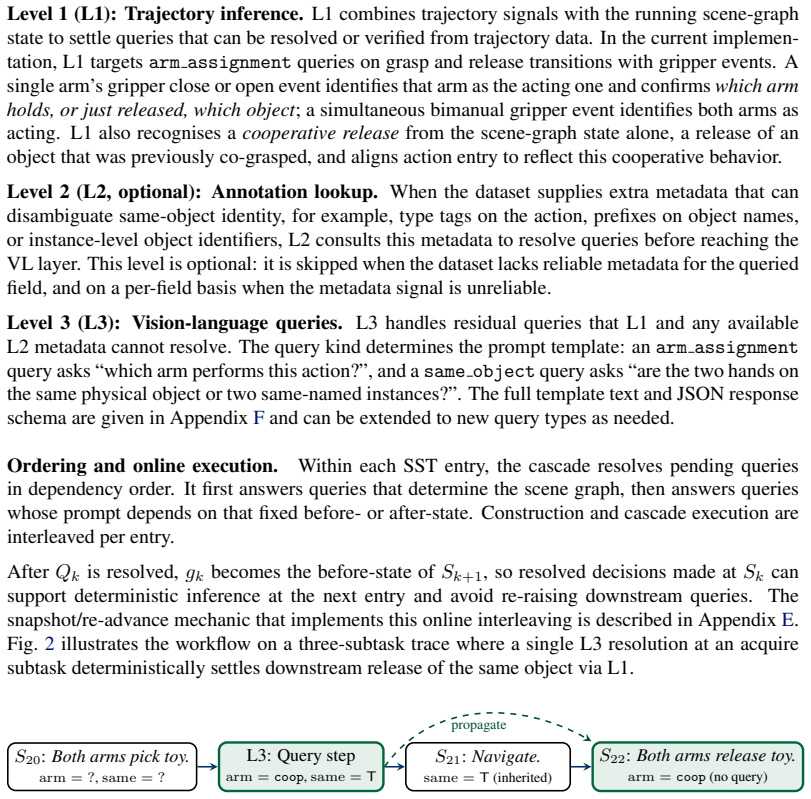
The central object is the Structured Subtask Template (SST): a record pairing grammatical action fields with an after-state scene graph, so each subtask interval carries enough state information to validate itself. The scene-graph state space has exactly seven configurations of two hands holding zero, one, or two objects, including a cooperative co-grasp and an unresolved same-named-object state. Four state-transition invariants (I1–I4: hold/release symmetry, object-identity continuity, gripper-event–window alignment, and bimanual hand-over legality) operate on the resulting state trajectory and flag violations as anomalies. A three-level resolution cascade — trajectory inference first, optional annotation lookup second, vision-language queries last — fills in underspecified fields such as arm assignment and same-object identity, and the resolved after-state of one entry propagates into the next entry's inferences.
What would settle it
A concrete way to test the claim: take a labelled demonstration and find a subtask whose interval contains two sequential stateful actions by the same arm (for example, a single 'open door' label covering grasp, pull, and release) or a hold with no gripper-close event, and check whether the pipeline splits the interval or raises a named anomaly. If such a case is silently accepted or coerced into one SST entry without an anomaly, the consistency guarantee fails as stated.
Extended reading notes
Core claim
On its own terms, the paper's central claim is that subtask labelling can be made verifiable by representing a demonstration as a state-transition system: a chain of Structured Subtask Templates, each recording the action's grammatical decomposition (arm, action type, verb, object, conditions), whether the base moved, and a scene-graph snapshot of which object each hand holds after the action. Because each entry carries this after-state, the whole chain can be checked against four invariants — hold/release symmetry, object-identity continuity, gripper-event alignment with the annotated frame window, and bimanual hand-over legality — and any violation is reported as an anomaly. The paper further claims that residual ambiguities (which arm acted, whether two same-named objects are one physical instance) can be resolved by a three-level cascade from trajectory inference to annotation lookup to vision-language queries, and that on the benchmark case study 13 vision-language models serve as competent verifiers on the hard subset while the consistency checker surfaces annotation faults and out-of-scope behaviours that per-action accuracy alone would miss.
Load-bearing premise
The load-bearing premise is that each subtask interval contains at most one stateful action per arm, and that every object acquire or release is realized by a detectable gripper open or close event, so multi-phase actions like 'open door' (grasp, pull, release) and gripper-less holding fall outside the framework's scope.
Editorial extensions
If this is right
- Subtask annotations can be checked automatically against the state trajectory, with violations reported as named anomalies instead of being silently overwritten.
- Vision-language models can act as tier-three verifiers, with the strongest single model scoring 86.2 percent on the 138-cell hard subset and provider-diverse trios reaching about 89 percent.
- When structured annotation metadata is available, the verifier's accuracy rises substantially (the strongest model gains about 9.4 percentage points on the same hard cells), so the representation can exploit whatever metadata a dataset already has.
- Because the template composes directly into natural language, the same representation serves machine-readable audit and human-readable transcripts from one format.
- Paired with a temporal segmentation front end, the pipeline could extend from verifying existing subtask labels to producing and verifying them on datasets with no annotations.
Reading between the lines
- The invariant-checking idea should transfer to other manipulation state alphabets — tool-held states, object poses, multi-object grasps — by swapping the seven-configuration transition tables for the new alphabet's tables.
- A stricter implementation that emits the acquire-on-occupied-arm anomaly before any overwrite, as the paper's known gaps suggest, would make the 'flag rather than overwrite' contract externally testable.
- Because the hardest cells concentrate on coordinated open/close/push of large containers, verifier improvement effort is best spent on that specific bimanual pattern rather than on general prompt tuning.
- The mode-dependent accuracy swings suggest ensemble design should mix models strong in visual reasoning with models strong in accepting metadata, since the two strengths are not the same.
Editorial analysis
A structured set of objections, weighed in public.
Referee Report
Summary. The paper proposes the Structured Subtask Chain (SSC), a state-transition representation for bimanual manipulation subtask labels. Each entry (SST) stores core action components, flexible conditions, a base-motion field, and an after-state scene graph. The authors build a three-stage pipeline: SST construction, a three-level resolution cascade (L1 trajectory inference, L2 annotation lookup, L3 VL queries), and a consistency checker that validates chains against four state-transition invariants. They instantiate the pipeline on BEHAVIOR-1K over 50 tasks, 3 episodes, and 2,357 action cells, evaluate 13 VL models as verifiers, and report per-model accuracy, a 138-cell hard subset analysis, ensemble results, and 31 anomalies flagged by the checker.
Significance. If the central claims were fully established, SSC would be a valuable bridge between free-form language labels and rigid templates: it provides a machine-readable scene-graph state, explicit transition tables (Appendices C and D), and a concrete mechanism for surfacing annotation faults such as misaligned gripper events (Table 3). The paper is unusually transparent: it lists assumptions A1-A6 with relaxation paths, enumerates known implementation gaps (Appendix D.3), acknowledges run-to-run variability in model selection (Appendix G), and reports zero failed runs across 3,900 model executions. These strengths make the representation and the experimental protocol reproducible and the failure modes discussable. However, the paper's central verifiability guarantee is contradicted by its own acknowledged implementation gap (g1), and the hard-subset evaluation is partially circular for 10 of the 13 evaluated models. Both issues are load-bearing for the main claims and require substantive revision.
major comments (3)
- [Sec. 4.4, Appendix D.3(g1)] The unqualified claim that 'any violation is flagged as an anomaly rather than silently overwritten' is false for the shipped implementation. Appendix D.3 explicitly records g1: an acquire targeting an arm that already holds an object silently overwrites the held object instead of raising an A3/A5 anomaly. This is precisely a violation of the invariant set the checker is supposed to enforce, because Appendix C's acquire tables contain no row whose before-state has the target arm already occupied. The abstract and conclusion repeat the same unqualified 'flagged rather than silently coerced' language, so the contradiction is not confined to a minor implementation detail: it undermines the paper's core verifiability claim. The anomaly count of 31/2,357 (Sec. 5.5) is therefore only a lower bound on invariant violations, and silent overwrites can corrupt the running scene graph and cascade into missed or spurious I1/I3 flags in later entries. The paper must either implement the missing anomaly before overwriting, or scope the Sec. 4.4 guarantee to 'violations covered by the transition tables' and separately quantify how many of the 2,357 cells trigger the g1 path.
- [Sec. 5.1, Appendix G] The hard-subset evaluation is partially circular for 10 of the 13 evaluated models. The 138-cell VL trimmed-hard subset is defined as cells where the original 10-model panel disagrees, and the reference label is the panel majority, with a human override only when the panel majority is visibly wrong (Sec. 5.1). Ten of the thirteen models in Table 2 belong to that panel, so their accuracy on the hard subset is not an independent measurement: a model that agrees with the panel majority will be counted as correct unless the video clearly contradicts the majority. The human-override step provides some grounding, but it only corrects a subset of cells, leaving most reference labels derived from the evaluated models' own votes. To fix this, the authors should either report accuracy on cells with human-only labels (the 4 retained-ambiguity cells are a start, but too few), use leave-one-out reference construction where each model is scored against a panel that excludes its own vote, or clearly separate the three non-panel models (gpt55, gem31p, gem35f) whose scores are not affected by this circularity. As reported, the hard-subset leaderboard in Table 2 and the ensemble results in Sec. 5.4 may contain an optimistic bias for the panel members.
- [Sec. 5.5, Table 3] The headline '31 anomalies' conflates two distinct categories that should be reported separately. Of the 31 cells, 21 are explicitly out-of-scope cases: task 0024 contributes 12 annotation-timing flags because hugging involves no gripper-close event (violating assumption A1, so I3 fires by design), and tasks 0030, 0038, 0039 contribute 9 not-released-at-end flags because the episode ends with a cooperative hold (violating assumption A2, so I1 fires by design). These are not evidence that the checker discovered annotation faults; they are confirmations that the framework's assumption boundary is active. Only the remaining 10 cells (tasks 0002, 0026, 0033, 0034, 0036) are genuine annotation faults. The conclusion's statement that the checker 'independently surfaces out-of-scope behaviours and annotation faults' is defensible, but the aggregate '31 action cells flagged as anomalies' in Sec. 5.5 should be decomposed into 'out-of-scope assumption violations' versus 'annotation faults' wherever it is cited as evidence of the checker's utility.
minor comments (5)
- [Introduction] The word 'autimatically' in the first paragraph is a typo for 'automatically'.
- [Related Work] The word 'oragnize' in the paragraph on manipulation datasets is a typo for 'organize'.
- [Appendix D.2] The sentence 'Violations of asuumptions A1–A5' contains a typo: 'asuumptions' should be 'assumptions'.
- [Table 2 and Appendix G] The per-model accuracy values in Table 2 are reported without confidence intervals, despite Appendix G documenting run-to-run variability of individual models on the same cells (e.g., claude-sonnet-4.6 had 8.5% VL-only standard deviation). Given that the top six models in the hard column lie within about 3 percentage points of each other, bootstrap confidence intervals or a simple variance estimate are needed to support any claim that one model outperforms another, including the statement that 'single-model selection is unlikely to be the dominant lever'.
- [Appendix A and Sec. 5.1] The paper refers to the reference implementation as living in 'src/sst.py' but provides no repository link or code/data release. Given that the anomaly count of 31/2,357 and the reported state trajectories depend on implementation details such as the gripper-event detector and the snapshot/re-advance mechanic, an artifact link is important for auditability, especially because Appendix D.3 already documents three known contract-implementation gaps.
Circularity Check
Hard-tier benchmark is partly self-defined by the evaluated panel; the core SSC derivation is otherwise self-contained, though the verifiability guarantee is weakened by a known implementation gap.
-
self definitional
[Sec. 5.1 (Reference annotation / VL trimmed-hard), Sec. 5.2 (Table 2), Appendix G (hard-cell anchoring)]
"A panel of VL models evaluates the cell and casts one vote per model on the cell's arm and same-object assignment; the majority answer across the panel is recorded as a candidate label. (ii) A human reviewer inspects every candidate against the recorded video and overrides it when the panel majority disagrees with the visible action. ... Within this reference we define the VL trimmed-hard subset of 138 cells, comprising 134 panel-disagreement cells from (i) and 4 retained-ambiguity cells from (ii). The hard-cell definitions of Sec."
The 138-cell 'hard tier' is not an externally defined difficulty label: it is the set of cells on which the evaluated panel disagrees (134 cells) plus cells exhibiting run-to-run instability from the same models (4 cells). Ten of the 13 models whose Hard/138 accuracy appears in Table 2 are the very models whose votes constitute that panel, so each is scored on a test set it helped select; the three later-added flagships are scored on the same self-selected cells rather than on an independent hard tier. The human override does fix the reference labels, so per-cell correctness still has external content, but the subset composition — the claim that these cells are 'hard' for the evaluated models — is constructed from the models' own responses.
full rationale
The core SSC derivation is not circular: the state-transition representation, SST construction, the three-level cascade, and the I1–I4 consistency checks are defined independently of the results they produce; the transition tables are a specification, and the anomaly counts are computed from GT annotations and gripper events rather than from fitted outputs. Self-citations [9], [10], and [28] are background references and not load-bearing. One evaluation step is partially self-referential: the 138-cell trimmed-hard subset is anchored to the original 10-model panel, and 10 of the 13 models whose hard-tier accuracy is reported are members of that panel, so the hard tier is selected using the models under evaluation. The human-override reference labels provide external grounding for per-cell correctness, so the accuracy numbers are not fabricated, but the 'hardness' designation is partly a self-construction. Separately, the Sec. 4.4 claim that violations are 'flagged rather than silently overwritten' is contradicted by Appendix D.3(g1), which admits that acquire-onto-occupied-arm silently overwrites state; this is a correctness/consistency defect, not a circularity, and should be weighed under correctness risk rather than raising the circularity score further.
Assumptions & free parameters
free parameters (3)
- per-cell solve definition =
majority of 3 independent runs
- gripper event detection criterion =
sign-flip between non-zero command values
- base-motion classification smoothing =
not specified in paper
assumptions (8)
- domain assumption A1: Grasp-only holding
- domain assumption A2: Empty start and end states
- domain assumption A3: One object per arm
- domain assumption A4: Binary gripper open versus closed
- domain assumption A5: Action-state coupling
- domain assumption A6: Contact is stateless
- domain assumption At most one stateful action per arm per interval
- domain assumption Reference SSC is ground truth
Cite this review
Pith. "Pith review of SSC: A Verifiable Structured Representation for Bimanual Manipulation Labelling." pith.science (2026). https://pith.science/paper/YOUXS5DW
@misc{pith2026260804425,
  author       = {Pith},
  title        = {Pith review of: SSC: A Verifiable Structured Representation for Bimanual Manipulation Labelling},
  year         = {2026},
  howpublished = {\url{https://pith.science/paper/YOUXS5DW}},
  note         = {Machine review of arXiv:2608.04425}
}
read the original abstract
Subtask labels decompose a long-horizon manipulation demonstration into shorter semantic segments for policy training and evaluation. Natural language descriptions are easy to read, but their linguistic variability makes automatic verification difficult. Rigid template formats, such as BEHAVIOR-1K's skill_annotation, are linguistically over-segmented, hindering both readability and annotation consistency. We propose the Structured Subtask Chain (SSC), a state-transition representation that bridges these extremes. A demonstration is a sequence of Structured Subtask Template (SST) entries. Each SST stores core action components (subject, predicate, object), flexible conditions (adverbial modifiers such as spatial or instrumental phrases), a base-motion field separate from arm actions, and an after-state scene graph. Built on this format, SSC supports three vision-language assisted functions: rendering SSTs as natural language, checking the assembled chain against four state-transition rules, and completing underspecified fields through a query resolution cascade. We instantiate the pipeline on BEHAVIOR-1K (50 tasks, 3 episodes per task, 2,357 annotated action cells) for logic verification and content completion, evaluating 13 selected state-of-the-art VL models as candidate verifiers and reporting labelling anomalies.
Figures


Figures from the paper (1 more)

Reference graph
Works this paper leans on
-
[1]
P. Intelligence, B. Ai, A. Amin, R. Aniceto, A. Balakrishna, G. Balke, K. Black, G. Bokinsky, S. Cao, T. Charbonnier, et al.π 0.7: A steerable generalist robotic foundation model with emergent capabilities.arXiv preprint arXiv:2604.15483, 2026
arXiv 2026
-
[2]
W. Wu, F. Lu, Y . Wang, S. Yang, S. Liu, F. Wang, Q. Zhu, H. Sun, Y . Wang, S. Ma, et al. A pragmatic vla foundation model.arXiv preprint arXiv:2601.18692, 2026
arXiv 2026
- [3]
-
[4]
C. Li, R. Zhang, J. Wong, C. Gokmen, S. Srivastava, R. Mart ´ın-Mart´ın, C. Wang, G. Levine, M. Lingelbach, J. Sun, et al. Behavior-1k: A benchmark for embodied ai with 1,000 everyday activities and realistic simulation. InConference on Robot Learning, pages 80–93. PMLR, 2023
2023
- [5]
-
[6]
I. Larchenko, G. Zarin, and A. Karnatak. Task adaptation of vision-language-action model: 1st place solution for the 2025 behavior challenge, 2025. URLhttps://arxiv.org/abs/ 2512.06951
arXiv 2025
-
[7]
X. Ma, S. Patidar, I. Haughton, and S. James. Hierarchical Diffusion Policy for Kinematics- Aware Multi-Task Robotic Manipulation. InIEEE/CVF Conference on Computer Vision and Pattern Recognition, pages 18081–18090, 2024
work page 2024
-
[8]
Z. Xian, N. Gkanatsios, T. Gervet, T.-W. Ke, and K. Fragkiadaki. ChainedDiffuser: Unifying Trajectory Diffusion and Keypose Prediction for Robotic Manipulation. InConference on Robot Learning, 2023
work page 2023
Show all 29 references
-
[9]
D. Yu, H. Xu, Y . Chen, Y . Ren, and J. Pan. Bikc: Keypose-conditioned consistency policy for bimanual robotic manipulation.arXiv preprint arXiv:2406.10093, 2024
2024 arXiv
-
[10]
H. Xu, Y . Chen, D. Yu, Y . Ren, and J. Pan. Bikc+: Bimanual hierarchical imitation with keypose-conditioned coordination-aware consistency policies.IEEE Transactions on Automa- tion Science and Engineering, 23:1064–1079, 2025
2025
-
[11]
James, Z
S. James, Z. Ma, D. R. Arrojo, and A. J. Davison. RLBench: The robot learning benchmark and learning environment.IEEE Robotics and Automation Letters, 5(2):3019–3026, 2020. doi:10.1109/LRA.2020.2974707. URLhttps://arxiv.org/abs/1909.12271
2020
-
[12]
T. Mu, Z. Ling, F. Xiang, D. Yang, X. Li, S. Tao, Z. Huang, Z. Jia, and H. Su. ManiSkill: Generalizable manipulation skill benchmark with large-scale demonstrations. InProceedings of the Neural Information Processing Systems Track on Datasets and Benchmarks, 2021. URL https://...
2021 arXiv
-
[13]
H.-S. Fang, H. Fang, Z. Tang, J. Liu, J. Wang, H. Zhu, and C. Lu. RH20T: A comprehensive robotic dataset for learning diverse skills in one-shot. InIEEE International Conference on Robotics and Automation, pages 653–660, 2024. doi:10.1109/ICRA57147.2024.10611615. URLhttps://ar...
2024
-
[14]
K. Wu, C. Hou, J. Liu, Z. Che, X. Ju, Z. Yang, M. Li, et al. RoboMIND: Benchmark on multi-embodiment intelligence normative data for robot manipulation. InRobotics: Science and Systems, 2025. URLhttps://arxiv.org/abs/2412.13877. 9
2025 arXiv
-
[15]
Kuehne, A
H. Kuehne, A. Arslan, and T. Serre. The language of actions: Recovering the syntax and se- mantics of goal-directed human activities. InProceedings of the IEEE conference on computer vision and pattern recognition, pages 780–787, 2014
2014
-
[16]
X. Zhan, L. Yang, Y . Zhao, K. Mao, H. Xu, Z. Lin, K. Li, and C. Lu. Oakink2: A dataset of bimanual hands-object manipulation in complex task completion. InProceedings of the IEEE/CVF Conference on Computer Vision and Pattern Recognition, pages 445–456, 2024
2024
-
[17]
Carmona and H
D. Carmona and H. Yu. Bicap: A novel bi-modal dataset of daily living dual-arm manipulation actions.The International Journal of Robotics Research, 44(6):891–907, 2025
2025
-
[18]
Shridhar, J
M. Shridhar, J. Thomason, D. Gordon, Y . Bisk, W. Han, R. Mottaghi, L. Zettlemoyer, and D. Fox. ALFRED: A benchmark for interpreting grounded instructions for everyday tasks. InProceedings of the IEEE/CVF Conference on Computer Vision and Pattern Recogni- tion, pages 10740–107...
2020
-
[19]
Padmakumar, J
A. Padmakumar, J. Thomason, A. Shrivastava, P. Lange, A. Narayan-Chen, S. Gella, R. Pi- ramuthu, G. Tur, and D. Hakkani-Tur. TEACh: Task-driven embodied agents that chat. In Proceedings of the AAAI Conference on Artificial Intelligence, volume 36, pages 2017–2025,
2017
-
[20]
T. Xiao, H. Chan, P. Sermanet, A. Wahid, A. Brohan, K. Hausman, S. Levine, and J. Tomp- son. Robotic skill acquisition via instruction augmentation with vision-language models. InRobotics: Science and Systems, 2023. URLhttps://instructionaugmentation. github.io/
2023
-
[21]
Kuramshin, O
A. Kuramshin, O. Aslan, C. Neary, and G. Berseth. Task robustness via re-labelling vision- action robot data. InWorkshop on Making Sense of Data in Robotics: Composition, Curation, and Interpretability at Scale at CoRL 2025
2025
-
[22]
L. Kou, F. Ni, Y . Zheng, P. Han, J. Liu, H. Cui, R. Liu, and J. Hao. RoboAnnotatorX: A comprehensive and universal annotation framework for accurate understanding of long- horizon robot demonstration. InProceedings of the IEEE/CVF International Conference on Computer Vision, ...
2025
-
[23]
L. Kou, F. Ni, Y . Zheng, J. Liu, Y . Yuan, Z. Dong, and J. Hao. KISA: A unified keyframe identifier and skill annotator for long-horizon robotics demonstrations. InProceedings of the 41st International Conference on Machine Learning, 2024. URLhttps://openreview. net/pdf?id=oCI9gHocws
2024
-
[24]
Y . A. Farha and J. Gall. Ms-tcn: Multi-stage temporal convolutional network for action seg- mentation. InProceedings of the IEEE/CVF conference on computer vision and pattern recog- nition, pages 3575–3584, 2019
2019
-
[25]
Wang and S
T. Wang and S. Todorovic. Timestamp query transformer for temporal action segmentation. In Proceedings of the IEEE/CVF Winter Conference on Applications of Computer Vision, pages 5016–5025, 2026
2026
-
[26]
G. Ding, F. Sener, and A. Yao. Temporal action segmentation: An analysis of modern tech- niques.IEEE Transactions on Pattern Analysis and Machine Intelligence, 46(2):1011–1030, 2023. 10
2023
-
[27]
Stanovcic, D
S. Stanovcic, D. Sliwowski, and D. Lee. ATLAS: An annotation tool for long-horizon robotic action segmentation.arXiv preprint arXiv:2604.26637, 2026. URLhttps://arxiv.org/ abs/2604.26637
2026 arXiv
-
[28]
left" |
S. Hao, Y . Gu, H. Ma, J. Hong, Z. Wang, D. Wang, and Z. Hu. Reasoning with language model is planning with world model. InProceedings of the 2023 Conference on Empirical Methods in Natural Language Processing, pages 8154–8173, 2023. 11 A SSC Data Schema The five core record t...
2023
-
[2022]
URLhttps://ojs.aaai.org/index.php/AAAI/ article/view/20097
doi:10.1609/aaai.v36i2.20097. URLhttps://ojs.aaai.org/index.php/AAAI/ article/view/20097
Reviewed August 7, 2026 · model on record in the stance chip above.
Discussion (0). Sign in to comment.