REVIEW 4 major objections 5 minor 66 references
My Favorite Streamer is an LLM: Discovering, Bonding, and Co-Creating in AI VTuber Fandom
T0 review · 4 major / 5 minor · reviewed 2026-08-15 · deepseek-v4-flash
Pith's one-line read Fans of AI VTubers co-author the stream: they are drawn by unpredictability, bonded by shared emotional moments, and pay to steer the AI's next move in real time.
desk verdict First real study of AI VTuber fandom with a solid qualitative core and one internally inconsistent economic-resilience claim that needs fixing. read the letter →
The pith
A machine-rendered reading of the paper's core claim, the machinery that carries it, and where it could break.
The reading
What carries the argument
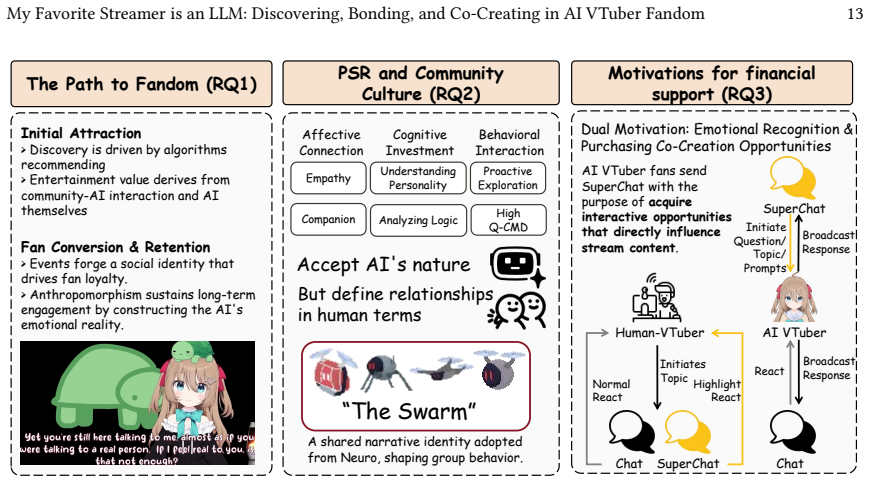
The mechanism that carries the argument is the interaction loop between live chat and the language model, escalated by paid prompts, together with a shifted standard of authenticity. Chat creates an always-on feedback loop, and SuperChat prices the right to condition the model's next action; the paper calls this 'real-time co-performance commodification.' The other half of the machinery is 'transparent parasociality': because Neuro-sama has no Nakanohito, fans can treat persona coherence as structurally secured, and the paper recasts authenticity as sustained consistency of the persona over time. The log analysis against two human VTubers supplies the behavioral evidence: inverted chat-category ratios, a higher payment conversion rate (1.59% versus 1.18% and 0.83%), and lower cross-stream income inequality.
What would settle it
Analyze a second, independently developed AI VTuber with a different persona: if its SuperChats are not majority Proactive, or if its income Gini across streams approaches the human VTuber range (above 0.35), the paper's claims that AI VTuber payment is paid co-creation and that this yields resilient income would fail. A within-platform comparison of a random sample of AI and human VTuber channels could settle the claim generically.
Extended reading notes
Core claim
The central discovery is that AI VTuber fandom is anchored in active co-creation rather than passive spectatorship, and that this reshapes both parasocial attachment and money. In Neuro-sama's chat, questions and commands are the largest message category (26% Q-CMD, edging out generic reactions), and 85% of her SuperChats are Proactive, steering the stream into new topics, while the two comparable human VTubers receive a majority of Reactive SuperChats that comment on what already happened. The study names this configuration 'real-time co-performance commodification': platforms turn the audience's capacity to shape model outputs into a tradable privilege. At the same time it identifies 'transparent parasociality' and 'consistency as authenticity': fans mostly know Neuro-sama is a technical project (72%) yet frame the relationship as friendship or care for an 'electronic daughter', and they treat the absence of a Nakanohito, the human performer behind a traditional VTuber's avatar, as a guarantee that the persona will not slip. That combination yields a more stable income structure, with a SuperChat income Gini coefficient of 0.24 across Neuro-sama's streams versus 0.35 and 0.41 for the human VTuber comparators.
Load-bearing premise
The study assumes that Neuro-sama's English-speaking Twitch community, particularly the self-selected fans who answered recruitment calls and accepted Neuro-sama-branded compensation, stands in for AI VTuber fandom generally.
Editorial extensions
If this is right
- If SuperChats function as content-steering tools, AI VTubers can expect higher payment conversion rates than emotional-reward-driven streams, because each payment carries a functional return: a visible response.
- If authenticity is consistency rather than humanness, then the main economic and reputational risk for an AI VTuber is persona drift or an out-of-character breakdown, not the absence of human likeness.
- If co-creation is the core appeal, then prioritizing paid prompts over free chat risks eroding the communal, low-barrier feedback loop that generates the entertainment in the first place.
- If collective emotional events convert casual viewers into loyal 'protectors', special streams can be deliberate loyalty mechanisms, and they carry a duty to guard against over-attachment.
- If income is less event-dependent for AI VTubers, their monetization is structurally more resilient than human VTuber monetization, which still depends on topical or emotionally charged spikes.
Reading between the lines
- If consistency-as-authenticity generalizes, deliberately stable AI personas may support parasocial attachment comparable to or stronger than human streamers precisely because they cannot break character; a testable prediction is that measured parasocial intensity tracks persona-stability cues rather than human-likeness cues.
- The paid-steering finding implies a governance choice for platforms: how much of the right to shape an AI stream should be rationed by money? This can be studied by comparing engagement inequality before and after a platform introduces paid-prompt features.
- Because the evidence comes from one English-language Twitch community, the most direct extension is to check whether the Proactive SuperChat majority and low income Gini replicate in other AI VTuber communities on other platforms, languages, and persona designs.
- The reversal of SuperChat from recognition to control suggests a broader shift from attention economies to engagement economies, where payment buys a handle on content generation rather than a spotlight around pre-existing content.
Signed reviews
Editorial analysis
A structured set of objections, weighed in public.
Referee Report
Summary. The paper reports a three-phase qualitative study of the Neuro-sama fan community: a survey (n=334), semi-structured interviews (n=12), and an analysis of Twitch chat and SuperChat logs for Neuro-sama and two human VTuber control channels (Filian, Camila). The central claims are that AI VTuber fandom is anchored in co-creation: fans are attracted by unpredictable community-AI interaction, bond through collective emotional events and anthropomorphic projection, sustain attachment through persona consistency, and financially support the streamer not merely as appreciation but as a way to purchase real-time influence over stream content. The paper further argues that this monetization model is more 'resilient' than human VTuber economies, evidenced by a lower SuperChat income Gini coefficient, and theorizes this as 'real-time co-performance commodification' and 'consistency-as-authenticity.'
Significance. If the claims hold, this is the first systematic empirical account of a fully AI-driven VTuber fandom, and it offers a genuinely novel theoretical contribution to HCI and media studies by reconceptualizing authenticity and parasociality for non-human performers. The triangulated design—survey, interviews, and interaction logs—is a strength, and the paper is commendably transparent in providing survey instruments, interview codebooks, and LLM prompt templates in the appendices. The study also makes falsifiable, behaviorally grounded claims (e.g., the inversion of Q-CMD versus R-GEN chat categories, the dominance of Proactive SuperChats, and the Gini-based stability comparison), which is a significant step beyond purely self-report research. However, the central economic claim is undermined by an internal inconsistency in how the Gini coefficient is computed, and the scope of several generalizations needs to be recalibrated to the evidence presented.
major comments (4)
- [§4.3.2 and §3.3.1] The resilient-economy claim is internally inconsistent. Section 4.3.2 states that Neuro-sama's SuperChat income is 'highly stable' and 'more resilient' because its Gini coefficient (0.24) is far lower than human VTubers' (0.35 and 0.41). But Section 3.3.1 says the analyzed streams were 'manually vetted to ensure it was a typical Just Chatting broadcast, free of special events or external controversies,' and Section 4.3.1 reports that 68% of fan payments occur during special occasions. Excluding special events removes exactly the spikes that determine overall income stability, so the computed Gini describes a hand-selected set of baseline streams, not the resilience of the fan economy. The comparison with human VTubers does not test the claim that AI fandom is less event-dependent, because their event-driven spikes are excluded by the same vetting. The authors should either recompute the stability metrics over all streams (including special events) or explicitly reframe the claim as describing only baseline-stream concentration, and should reconcile the survey statistic with the log-based result.
- [§3.3.3 and Table 4] The Proactive/Reactive SuperChat classification, which is load-bearing for the dual-motivation claim, is validated on only 50 SuperChats (3.58% of the dataset) and by a single author, with no inter-rater reliability statistic reported. Additionally, the prompt template in Appendix E allows for 'BOTH' and 'UNCLEAR' outcomes, but the findings in Section 4.3.1 report only binary Proactive/Reactive percentages, leaving unclear how those ambiguous categories were handled or whether they occurred. The authors should report the full distribution, provide a second human coder and a kappa statistic, and clarify how 'BOTH' and 'UNCLEAR' cases were resolved.
- [§3.1.1 and §5.4] The paper's scope claims are broader than the evidence supports. Recruitment for both the survey and the interviews was channeled through Neuro-sama-specific fan groups, and compensation (a Neuro-sama plush toy or a Neuro-sama Twitch subscription) was deliberately chosen to attract dedicated fans; the interview pool is described as 'mostly deeply engaged fans.' The abstract and several findings sections speak of 'AI VTuber fandom' without qualification, yet the data are single-case (Neuro-sama) and Twitch/English-only. Section 5.4 does acknowledge these limitations, but the framing in Sections 1, 4, and 5 repeatedly generalizes beyond the case. I recommend softening the generalizations throughout or explicitly presenting this as a single-case study that generates hypotheses for future comparative work.
- [§4.3.2 and Eq. (3)] The Gini comparison rests on very small samples (eight Neuro-sama streams, eight Camila streams, and six Filian streams), and no variance or sensitivity analysis is reported. With n=8, a single exceptional stream can move the coefficient substantially, and the conclusion that 0.24 is 'far lower' than 0.35/0.41 is presented without confidence intervals or a statistical test. At minimum, the authors should report per-stream SuperChat totals, show the robustness of the Gini to dropping each stream, and temper the strength of the comparative claim accordingly.
minor comments (5)
- [§3.1.3] The Cronbach's alpha values (0.69, 0.71, 0.76) are reported for each PSI dimension, but the overall alpha of 0.72 is described as an average of the three dimension alphas; this is not the standard way to report scale reliability, and averaging alpha coefficients can obscure differences. Please report the reliability of the combined scale or justify the averaging.
- [§3.3.1 and Table 2] The stream counts differ across the three channels (8, 8, 6) with comparable total hours, but it is unclear how many unique streams each count represents and whether the selection was balanced by stream length or by number of streams; a brief clarification would improve comparability.
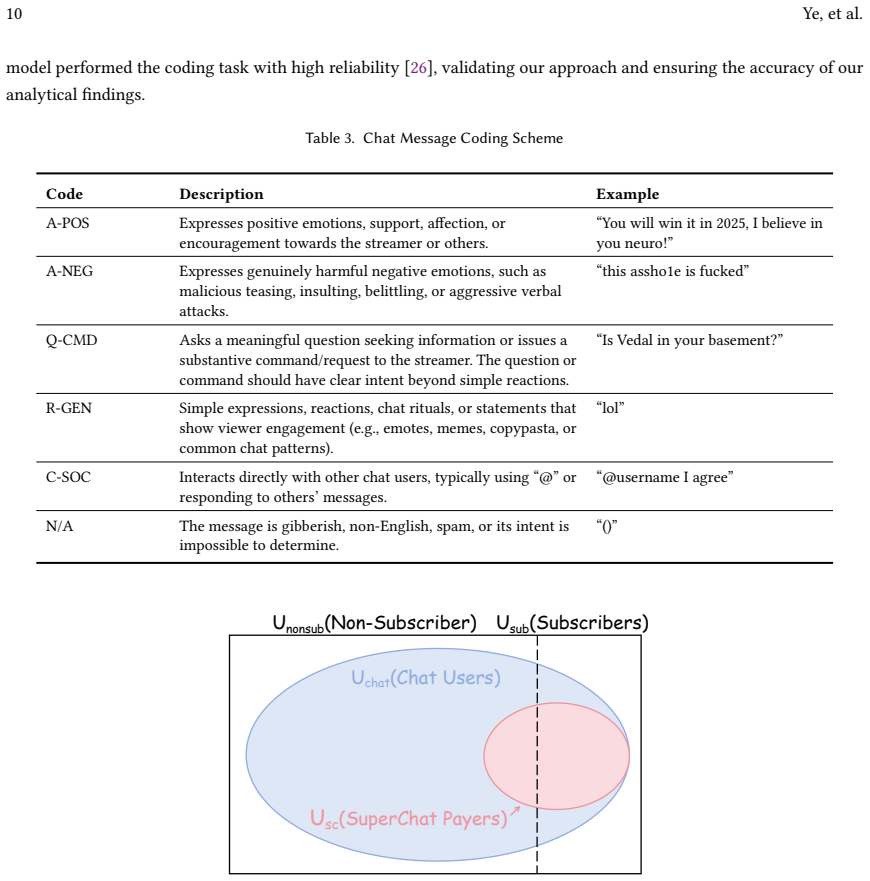
- [§4.2.1 and Figure 3] Figure 3 defines the user sets U_sub, U_nonsub, U_chat, and U_sc, but the Venn diagram is not discussed in the text beyond the definitions; it would be helpful to state how the sets overlap in the actual data (e.g., what fraction of payers are subscribers) since the PCC comparison in §4.3.2 relies on this distinction.
- [§4.1.1] The survey allowed multiple selections for discovery channels, yet the percentages (96%, 17%, 7%) are presented without noting that they are not mutually exclusive; a brief note that respondents could choose multiple options would prevent misreading.
- [Appendix E] The two prompt templates are useful, but the SuperChat coding prompt instructs the model that the SuperChat is read aloud by the streamer and to pay attention to the voice; the paper should report how the model's use of audio versus on-screen text was validated, since the validation set of 50 may not cover this multimodal aspect.
Circularity Check
No significant circularity: findings are triangulated empirical results, not derivations from their own premises.
full rationale
This is an empirical qualitative study, not a formal derivation chain. There are no fitted parameters being relabeled as predictions, no uniqueness theorem imported from the authors' prior work, and no load-bearing self-citations: the cited PSI scales, thematic-analysis methods, and Twitch income-inequality work are external to the authors. The central findings—unpredictable community-AI interaction attracting viewers, collective events building loyalty, persona consistency anchoring authenticity, and SuperChats functioning as paid co-creation—are supported by survey percentages, interview quotes, and log-based metrics. The 85% Proactive SuperChat statistic is an LLM-assisted code with a reported human-validation check on 50 instances, so the co-creation conclusion is an empirical inference from classified message content, not an identity between the category definition and the finding. The paper itself acknowledges the single-case and English-Twitch scope in Section 5.4, which is a generalizability limitation rather than a circularity. The apparent tension between the 68% special-occasion payment rate and the baseline-stream Gini estimate is an internal-validity concern about how well the comparison supports the 'resilient economy' claim, but it is not a case of a result reducing to its own inputs. Overall, the derivation chain is self-contained with respect to circularity: the evidence and the conclusions are distinct, and no step requires assuming the conclusion to produce the finding.
Assumptions & free parameters
assumptions (4)
- domain assumption Neuro-sama is a fully autonomous AI VTuber with no human performer (Nakanohito) behind the persona.
- domain assumption Self-reported survey and interview responses accurately reflect participants' true motivations and feelings.
- domain assumption LLM-based coding with human spot checks is an acceptable substitute for full human coding of large chat logs.
- domain assumption Twitch interaction logs from about 20 hours per streamer are representative of each channel's economic and interaction patterns.
Cite this review
Pith. "Pith review of My Favorite Streamer is an LLM: Discovering, Bonding, and Co-Creating in AI VTuber Fandom." pith.science (2026). https://pith.science/paper/YP7TGA6Q
@misc{pith2026250910427,
  author       = {Pith},
  title        = {Pith review of: My Favorite Streamer is an LLM: Discovering, Bonding, and Co-Creating in AI VTuber Fandom},
  year         = {2026},
  howpublished = {\url{https://pith.science/paper/YP7TGA6Q}},
  note         = {Machine review of arXiv:2509.10427}
}
read the original abstract
AI VTubers, where the performer is not human but algorithmically generated, introduce a new context for fandom. While human VTubers have been substantially studied for their cultural appeal, parasocial dynamics, and community economies, little is known about how audiences engage with their AI counterparts. To address this gap, we present a qualitative study of Neuro-sama, the most prominent AI VTuber. Our findings show that engagement is anchored in active co-creation: audiences are drawn by the AI's unpredictable yet entertaining interactions, cement loyalty through collective emotional events that trigger anthropomorphic projection, and sustain attachment via the AI's consistent persona. Financial support emerges not as a reward for performance but as a participatory mechanism for shaping livestream content, establishing a resilient fan economy built on ongoing interaction. These dynamics reveal how AI Vtuber fandom reshapes fan-creator relationships and offer implications for designing transparent and sustainable AI-mediated communities.
Figures


Figures from the paper (4 more)


Reference graph
Works this paper leans on
-
[1]
Natale Amato, Berardina De Carolis, Francesco de Gioia, Corrado Loglisci, Giuseppe Palestra, and Mario Nicola Venezia. 2024. Can an AI-driven VTuber engage people? The KawAIi Case Study. InSOCIALIZE 2024, CEUR Workshop Proceedings
work page 2024
-
[2]
Virginia Braun and Victoria Clarke. 2006. Using thematic analysis in psychology.Qualitative research in psychology3, 2 (2006), 77–101
2006
-
[3]
Liudmila Bredikhina and Agnès Giard. 2022. Becoming a virtual cutie: digital cross-dressing in Japan.Convergence28, 6 (2022), 1643–1661
work page 2022
-
[4]
Yaping Chang, Han Wang, and Zhenjiang Guo. 2025. Artificial intelligence in live streaming: How can virtual streamers bring more sales?Journal of Retailing and Consumer Services84 (2025), 104247
work page 2025
-
[5]
Hongquan Chen, Bingjia Shao, Xuemei Yang, Weiyao Kang, and Wenfang Fan. 2024. Avatars in live streaming commerce: the influence of anthropomorphism on consumers’ willingness to accept virtual live streamers.Computers in Human Behavior156 (2024), 108216
work page 2024
-
[6]
Xi Chen, Siva Shankar Ramasamy, and Bibi She. 2024. Digital human technology in the application of live streaming in social media.Radioelectronic and Computer Systems2024, 4 (2024), 34–45
work page 2024
-
[7]
Robert Chew, John Bollenbacher, Michael Wenger, Jessica Speer, and Annice Kim. 2023. LLM-Assisted Content Analysis: Using Large Language Models to Support Deductive Coding. arXiv:2306.14924 [cs.CL] https://arxiv.org/abs/2306.14924
arXiv 2023
-
[8]
P Chinchilla and Jihyun Kim. 2024. Vtuber for streamers: Exploring the role of social presence in the visual representation of streamers. Communication Studies75, 6 (2024), 844–860
work page 2024
Show all 66 references
-
[9]
Jacob Cohen. 1960. A coefficient of agreement for nominal scales.Educational and psychological measurement20, 1 (1960), 37–46
1960
-
[10]
Elisabetta Costa. 2018. Affordances-in-practice: An ethnographic critique of social media logic and context collapse.New Media & Society20, 10 (2018), 3641–3656. arXiv:https://doi.org/10.1177/1461444818756290 doi:10.1177/1461444818756290 PMID: 30581356
2018 doi
-
[11]
Stuart Cunningham and David Craig. 2019. Creator Governance in Social Media Entertainment.Social Media + Society5, 4 (2019), 2056305119883428. arXiv:https://doi.org/10.1177/2056305119883428 doi:10.1177/2056305119883428
2019 doi
-
[12]
2015.Mediated Authenticity: How the Media Constructs Reality
Gunn Enli. 2015.Mediated Authenticity: How the Media Constructs Reality. doi:10.3726/978-1-4539-1458-8
2015 doi
-
[13]
Nicholas Epley, Adam Waytz, and John T Cacioppo. 2007. On seeing human: a three-factor theory of anthropomorphism.Psychological review114, 4 (2007), 864
2007
-
[14]
Yuanyue Feng, Xiaona Li, and Rongkai Zhang. 2022. Does an AI streamer have feelings? The influence of the positive emotions of AI streamer on consumers’ purchase intention. (2022)
2022
-
[15]
2024.How to conduct surveys: A step-by-step guide
Arlene Fink. 2024.How to conduct surveys: A step-by-step guide. SAGE publications
2024
-
[16]
Christian Fuchs. 2014. Digital prosumption labour on social media in the context of the capitalist regime of time.Time & Society23, 1 (2014), 97–123. 22 Ye, et al
2014
-
[17]
Fengsen Gao, Chengjie Dai, Ke Fang, Yunxuan Li, Ji Li, and Wai Kin (Victor) Chan. 2024. Build Belonging and Trust Proactively: A Humanized Intelligent Streamer Assistant with Personality, Emotion and Memory. InHCI International 2023 – Late Breaking Posters, Constantine Stephan...
2024
-
[18]
Michael A. Hogg. 2016.Social Identity Theory. Springer International Publishing, Cham, 3–17. doi:10.1007/978-3-319-29869-6_1
2016 doi
-
[19]
Chenyu Hou, Gaoxia Zhu, Juan Zheng, Lishan Zhang, Xiaoshan Huang, Tianlong Zhong, Shan Li, Hanxiang Du, and Chin Lee Ker. 2024. Prompt- based and Fine-tuned GPT Models for Context-Dependent and -Independent Deductive Coding in Social Annotation. InProceedings of the 14th Learn...
2024
-
[20]
Antoine Houssard, Federico Pilati, Maria Tartari, Pier Luigi Sacco, and Riccardo Gallotti. 2023. Monetization in online streaming platforms: an exploration of inequalities in Twitch. tv.Scientific Reports13, 1 (2023), 1103
2023
-
[21]
Hai-hua Hu and Fang Ma. 2023. Human-like bots are not humans: The weakness of sensory language for virtual streamers in livestream commerce. Journal of Retailing and Consumer Services75 (2023), 103541
2023
-
[22]
Henry Jenkins and Mark Deuze. 2008. Convergence culture. 5–12 pages
2008
-
[23]
Kan Jiang, Meilian Qin, Dejun Deng, and Dailan Zhou. 2025. Smile or Not Smile: The Effect of Virtual Influencers’ Emotional Expression on Brand Authenticity, Purchase Intention and Follow Intention.Journal of Consumer Behaviour24, 2 (2025), 962–981
2025
-
[24]
Daye Kim, Sebin Lee, Yoonseo Jun, Yujin Shin, and Jungjin Lee. 2025. VTuber’s Atelier: The Design Space, Challenges, and Opportunities for VTubing. InProceedings of the 2025 CHI Conference on Human Factors in Computing Systems (CHI ’25). Association for Computing Machinery, Ne...
2025
-
[25]
2016.A.I.Channel
Kizuna AI. 2016.A.I.Channel. YouTube. https://www.youtube.com/channel/UC4YaOt1yT-ZeyB0OmxHgolA Virtual YouTuber channel launched in 2016
2016
-
[26]
J Richard Landis and Gary G Koch. 1977. The measurement of observer agreement for categorical data.biometrics(1977), 159–174
1977
-
[27]
Can’t believe I’m crying over an anime girl
Ken Jen Lee, PiaoHong Wang, and Zhicong Lu. 2025. "Can’t believe I’m crying over an anime girl": Public Parasocial Grieving and Coping Towards VTuber Graduation and Termination. InProceedings of the 2025 CHI Conference on Human Factors in Computing Systems (CHI ’25). Associati...
2025
-
[28]
Ju. T’aime
Sebin Lee and Jungjin Lee. 2023. “Ju. T’aime” my idol, my streamer: A case study on fandom experience as audiences and creators of VTuber concert.IEEE Access11 (2023), 31125–31142
2023
-
[29]
Robert I Lerman and Shlomo Yitzhaki. 1984. A note on the calculation and interpretation of the Gini index.Economics Letters15, 3-4 (1984), 363–368
1984
-
[30]
Yijin Li. 2023. Why does Gen Z watch virtual streaming VTube anime videos with avatars on Twitch?Online Media and Global Communication2, 3 (2023), 379–403
2023
-
[31]
Yi Li and Yunjun Guo. 2021. Virtual gifting and danmaku: What motivates people to interact in game live streaming?Telematics and Informatics62 (2021), 101624
2021
-
[32]
Yihua Li, Yuqian Sun, Ying Xu, and Jihong Yu. 2023. Blibug: AI Vtuber Based on Bilibili Danmuku Interaction. InProceedings of the 15th Conference on Creativity and Cognition. 387–390
2023
-
[33]
Hui Lin. 2025. ‘Let’s purchase coloured live chat messages’: the impact of user engagement with Super Chat on YouTube.Information, Communication & Society28, 9 (2025), 1608–1626. arXiv:https://doi.org/10.1080/1369118X.2024.2442407 doi:10.1080/1369118X.2024.2442407
2025
-
[34]
Hao Liu, Peilin Zhang, Hongqing Cheng, Najmul Hasan, and Raymond Chiong. 2025. Impact of AI-generated virtual streamer interaction on consumer purchase intention: A focus on social presence and perceived value.Journal of Retailing and Consumer Services85 (2025), 104290
2025
-
[35]
Zhicong Lu, Chenxinran Shen, Jiannan Li, Hong Shen, and Daniel Wigdor. 2021. More Kawaii than a Real-Person Live Streamer: Understanding How the Otaku Community Engages with and Perceives Virtual YouTubers. InProceedings of the 2021 CHI Conference on Human Factors in Computing...
2021
-
[36]
Zhicong Lu, Haijun Xia, Seongkook Heo, and Daniel Wigdor. 2018. You Watch, You Give, and You Engage: A Study of Live Streaming Practices in China. InProceedings of the 2018 CHI Conference on Human Factors in Computing Systems(Montreal QC, Canada)(CHI ’18). Association for Comp...
2018
-
[37]
David B Nieborg and Thomas Poell. 2018. The platformization of cultural production: Theorizing the contingent cultural commodity.New media & society20, 11 (2018), 4275–4292
2018
-
[38]
Yuhong Peng, Yedi Wang, Jingpeng Li, and Qiang Yang. 2024. Impact of AI-oriented live-streaming E-commerce service failures on consumer disengagement—empirical evidence from China.Journal of Theoretical and Applied Electronic Commerce Research19, 2 (2024), 1580–1598
2024
-
[39]
Schweidel, and Alina Sorescu
Renana Peres, Martin Schreier, David A. Schweidel, and Alina Sorescu. 2024. The creator economy: An introduction and a call for scholarly research. International Journal of Research in Marketing41, 3 (2024), 403–410. doi:10.1016/j.ijresmar.2024.07.005
2024 doi
-
[40]
Noah Renella. 2023. Machine learning models for assisting twitch streamers.URL: https://scholarworks. calstate. edu/downloads/vx021n95n(2023)
2023
-
[41]
Ailton Ribeiro, Murilo Arouca, Ana Amorim, Maria Pestana, and Vaninha Vieira. 2024. Towards Inclusive Avatars: A Study on Self-Representation in Virtual Environments. InAnais do XIX Simpósio Brasileiro de Sistemas Colaborativos(Salvador/BA). SBC, Porto Alegre, RS, Brasil, 13–2...
2024
-
[42]
Patricia Rohrbacher and Deepti Mishra. 2024. VTubing and Its Potential for the Streaming and Design Community: An Austrian Perspective. In Social Computing and Social Media, Adela Coman and Simona Vasilache (Eds.). Springer Nature Switzerland, Cham, 222–233
2024
-
[43]
Arleen Salles, Kathinka Evers, and Michele Farisco. 2020. Anthropomorphism in AI.AJOB neuroscience11, 2 (2020), 88–95. My Favorite Streamer is an LLM: Discovering, Bonding, and Co-Creating in AI VTuber Fandom 23
2020
-
[44]
Lana El Sanyoura and Ashton Anderson. 2022. Quantifying the Creator Economy: A Large-Scale Analysis of Patreon.Proceedings of the International AAAI Conference on Web and Social Media16, 1 (May 2022), 829–840. doi:10.1609/icwsm.v16i1.19338
2022 doi
-
[45]
Holger Schramm and Tilo Hartmann. 2008. The PSI-Process Scales. A new measure to assess the intensity and breadth of parasocial processes. (2008)
2008
-
[46]
Jan-Philipp Stein, Priska Linda Breves, and Nora Anders. 2024. Parasocial interactions with real and virtual influencers: The role of perceived similarity and human-likeness.New Media & Society26, 6 (2024), 3433–3453
2024
-
[47]
Vincent Joyan Sutandijo and Nunung Nurul Qomariyah. 2023. Artificial intelligence based automatic live stream chat machine translator.Procedia Computer Science227 (2023), 454–463
2023
-
[48]
Robert H Tai, Lillian R Bentley, Xin Xia, Jason M Sitt, Sarah C Fankhauser, Ana M Chicas-Mosier, and Barnas G Monteith. 2024. An examination of the use of large language models to aid analysis of textual data.International Journal of Qualitative Methods23 (2024), 16094069241231168
2024
-
[49]
Mohsen Tavakol and Reg Dennick. 2011. Making sense of Cronbach’s alpha.International journal of medical education2 (2011), 53
2011
-
[50]
Tiziana Terranova. 2012. Free labor. InDigital labor. Routledge, 33–57
2012
-
[51]
VTuber Database
User Local. 2022.Virtual Talent Popularity Ranking "VTuber Database" Celebrates its 4th Anniversary. https://www.userlocal.jp/press/20221129vt/
2022
-
[52]
2025.VTuber Ranking
User Local. 2025.VTuber Ranking. https://virtual-youtuber.userlocal.jp/document/ranking
2025
-
[53]
2024.The VTuber A wards 2024 Winners
VTuber Awards. 2024.The VTuber A wards 2024 Winners. The VTuber Awards. https://www.thevtuberawards.com/winners/2024 Neuro-sama recognized among prominent VTubers in the 2024 VTuber Awards
2024
-
[54]
Qian Wan and Zhicong Lu. 2024. Investigating vtubing as a reconstruction of streamer self-presentation: Identity, performance, and gender. Proceedings of the ACM on human-computer interaction8, CSCW1 (2024), 1–22
2024
-
[55]
Lingli Wang, Yumei He, Ni Huang, De Liu, Xunhua Guo, and Guoqing Chen. 2023. The role of AI assistants in livestream selling: Evidence from a randomized field experiment.University of Miami Business School Research Paper4365103 (2023)
2023
-
[56]
Xinru Wang, Hannah Kim, Sajjadur Rahman, Kushan Mitra, and Zhengjie Miao. 2024. Human-LLM Collaborative Annotation Through Effective Verification of LLM Labels. InProceedings of the 2024 CHI Conference on Human Factors in Computing Systems(Honolulu, HI, USA)(CHI ’24). Associat...
2024
-
[57]
Yiluo Wei and Gareth Tyson. 2025. Virtual Stars, Real Fans: Understanding the VTuber Ecosystem. InProceedings of the ACM on Web Conference 2025(Sydney NSW, Australia)(WWW ’25). Association for Computing Machinery, New York, NY, USA, 2352–2365. doi:10.1145/3696410.3714803
2025
-
[58]
Vera Liao, Rania Abdelghani, and Pierre-Yves Oudeyer
Ziang Xiao, Xingdi Yuan, Q. Vera Liao, Rania Abdelghani, and Pierre-Yves Oudeyer. 2023. Supporting Qualitative Analysis with Large Language Models: Combining Codebook with GPT-3 for Deductive Coding. InCompanion Proceedings of the 28th International Conference on Intelligent U...
2023 doi
-
[59]
Bin Xu, Omkar Dastane, Eugene Cheng-Xi Aw, and Suchita Jha. 2025. The future of live-streaming commerce: understanding the role of AI-powered virtual streamers.Asia Pacific Journal of Marketing and Logistics37, 5 (2025), 1175–1196
2025
-
[60]
Si-han Xu. 2021. The Research on Applying Artificial Intelligence Technology to Virtual YouTuber. In2021 IEEE International Conference on Robotics, Automation and Artificial Intelligence (RAAI). 10–14. doi:10.1109/RAAI52226.2021.9507778
2021
-
[61]
Rui Yan, Zhen Tang, and Dewen Liu. 2025. Can virtual streamers replace human streamers? The interactive effect of streamer type and product type on purchase intention.Marketing Intelligence & Planning43, 2 (2025), 297–322
2025
-
[62]
Haixia Yuan, Kevin Lü, and Wenting Fang. 2025. Machines vs. humans: The evolving role of artificial intelligence in livestreaming e-commerce. Journal of Business Research188 (2025), 115077
2025
-
[63]
Superchat
Jinming Zhan and Nan Zhang. 2023. Exploring the Impact of Virtual Anchor Features and Live Content on Viewers’ Willingness to Pay for “Superchat” in Live Entertainment Scenarios.Highlights in Business, Economics and Management6 (2023), 189–205
2023
-
[64]
Xianfeng Zhang, Yuxue Shi, Ting Li, Yuxian Guan, and Xinlei Cui. 2024. How do virtual AI streamers influence viewers’ livestream shopping behavior? The effects of persuasive factors and the mediating role of arousal.Information Systems Frontiers26, 5 (2024), 1803–1834
2024
-
[65]
Ruijing Zhao, Brian Diep, Jiaxin Pei, Dongwook Yoon, David Jurgens, and Jian Zhu. 2025. Who Reaps All the Superchats? A Large-Scale Analysis of Income Inequality in Virtual YouTuber Livestreaming. InProceedings of the 2025 CHI Conference on Human Factors in Computing Systems (...
2025
-
[66]
human behind the curtain
Yu-Peng Zhu, Lina Xin, Huimin Wang, and Han-Woo Park. 2025. Effects of AI virtual anchors on brand image and loyalty: Insights from perceived value theory and SEM-ANN analysis.Systems13, 2 (2025), 79. A Survey Content In this section, we present the full content of our survey....
2025
Reviewed August 15, 2026 · model on record in the stance chip above.
Discussion (0). Continue with ORCID to comment.