REVIEW 4 major objections 5 minor 66 references
On the triple-star origin of the planetary nebula Sh 2-71
T0 review · 4 major / 5 minor · reviewed 2026-08-14 · deepseek-v4-flash
Pith's one-line read This paper claims that Sh 2-71 originated from a triple-star system that broke apart, leaving binary A and star B on an unbound trajectory.
desk verdict A plausible but unproven triple-breakup scenario for Sh 2-71; worth a review, but the association of star B with the nebula is the load-bearing assumption. read the letter →
The pith
A machine-rendered reading of the paper's core claim, the machinery that carries it, and where it could break.
The reading
What carries the argument
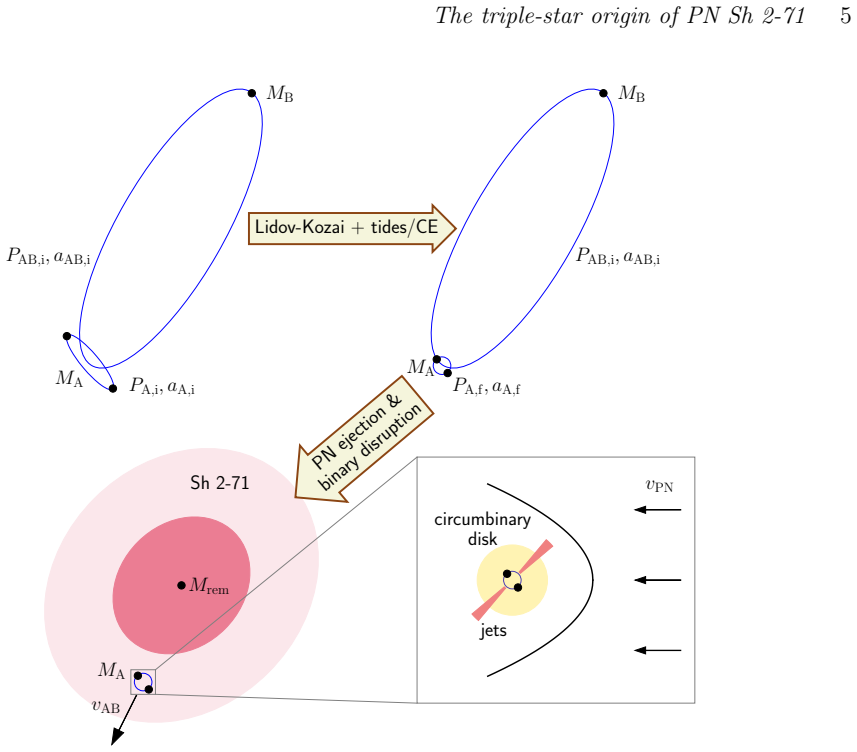
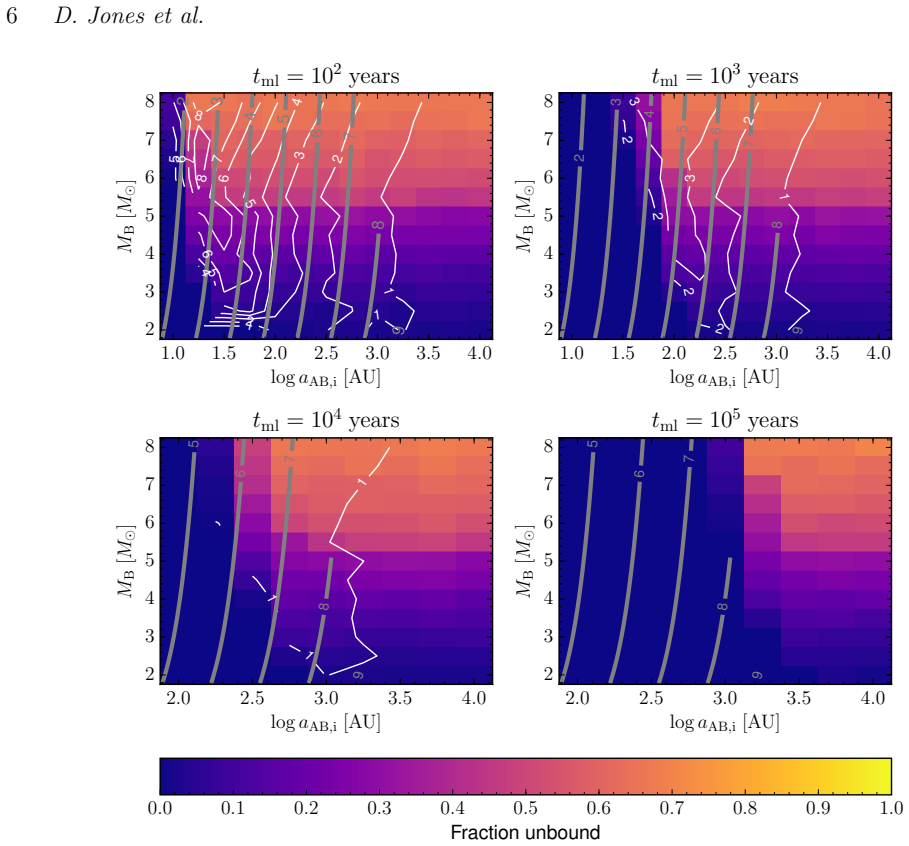
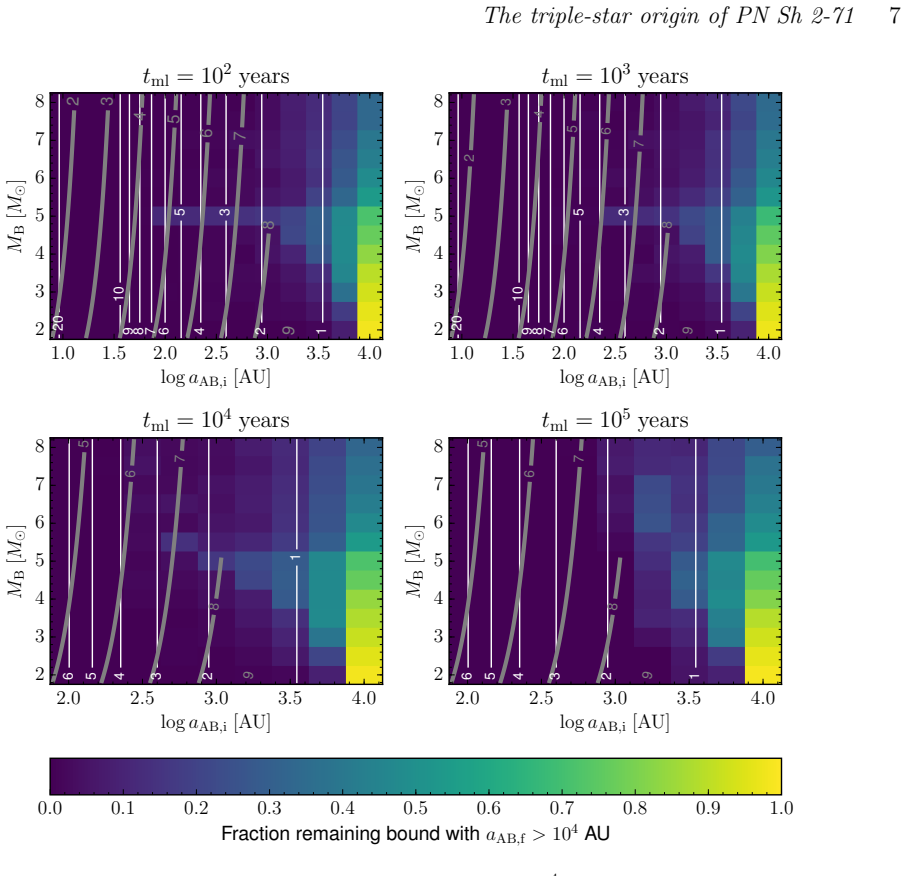
The central object is the proposed former hierarchical triple: binary A (a $\sim 2.6\,M_\odot$ B8V star with a low-mass companion in a few-day orbit) and the outer star B, initially about $5\,M_\odot$ and separated by roughly 440 AU. The mechanism that carries the argument is the combination of Lidov-Kozai cycles, where the outer companion periodically drives the inner binary's eccentricity up and shrinks its orbit through tides or common-envelope mass transfer, and mass-loss-driven breakup, where B losing more than half its mass over a time shorter than its orbital period leaves A and B flying apart at a few km s$^{-1}$. Direct numerical integrations of the mass-losing two-body problem map which combinations of initial mass, separation, eccentricity, and mass-loss timescale produce an unbound pair consistent with the observed relative velocity. Bondi-Hoyle accretion of the expanding nebular shell onto binary A is then used to explain the newly found east-west emission knots as fast ejecta launched at roughly the binary's orbital velocity.
What would settle it
A precise parallax and radial velocity for star B would settle the claim: if B's distance is not roughly 1.6 kpc, if its spectrum is not that of a hot post-AGB remnant, or if its radial velocity differs by more than a few km s$^{-1}$ from the nebula's systemic velocity, the proposed triple breakup cannot be the origin of Sh 2-71.
Extended reading notes
Core claim
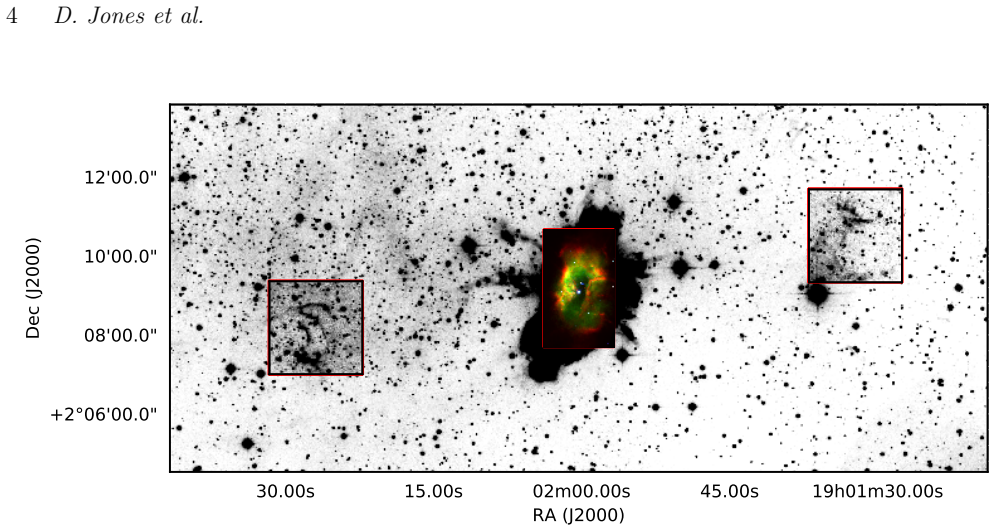
The central claim is that Sh 2-71 was produced by a hierarchical triple that has since broken apart. Binary A (a $\sim 2.6\,M_\odot$ B8V star plus a low-mass companion in a few-day orbit) and star B were initially bound at a separation of order $a_{\mathrm{AB},i}\sim 440$ AU, with B initially about $5\,M_\odot$. The paper argues that Lidov-Kozai oscillations driven by B shrank A's inner orbit until tides or common-envelope mass transfer created the current short-period binary with its precessing disc. Star B then ascended the AGB, shed its envelope to form the nebula, and the loss of more than half the total system mass disrupted the A-B orbit. Numerical integrations of the mass-losing two-body problem show that breakup requires a mass-loss timescale shorter than about $10^4$ years and produces relative velocities of a few km s$^{-1}$, consistent with the observed positions once the PN expansion velocity ($v_{\mathrm{PN}}\approx 16$ km s$^{-1}$) is used to estimate the breakup speed. The two extended emission regions discovered here, lying about five times farther from the center than the visible PN shell, are interpreted as material accelerated near binary A's orbital velocity ($\sim 180$ km s$^{-1}$) and decelerated by the interstellar medium.
Load-bearing premise
Star B is the likely nebular progenitor located at roughly binary A's distance of 1.6 kpc; it has no parallax, no published spectrum, and no radial-velocity tie to the nebula, so if it is actually a foreground or background star the triple history collapses.
Editorial extensions
If this is right
- If the triple scenario is correct, binary A and star B are not gravitationally bound today; more precise astrometry should show a mutual velocity above the bound-orbit ceiling of roughly $0.8$ km s$^{-1}$, plausibly a few km s$^{-1}$.
- Star B should be a hot post-AGB remnant of about $1\,M_\odot$ descended from a $\sim 5\,M_\odot$ progenitor, matching the VPHAS+ colours and the temperature required to ionize the nebula.
- The east-west emission knots should be fossil ejecta from the mass-loss and disc interaction, older and farther from the center than the main shell, with kinematics tracing acceleration near binary A.
- Sh 2-71 would join a very short list of planetary nebulae whose morphology and binary properties are best explained by triple-star dynamics rather than single-binary shaping.
- Future astrometry and spectroscopy of star B should decide the case: a parallax placing B at A's distance, a post-AGB spectrum, and a radial velocity close to the nebula's systemic velocity are all required.
Reading between the lines
- If Sh 2-71 is indeed a broken triple, other morphologically irregular planetary nebulae with misaligned or precessing inner discs may be hiding similar wide, now-unbound companions; systematically comparing central-star proper motions with nebular expansion could reveal the population.
- The Bondi-Hoyle accretion picture makes a checkable chemical prediction: any surviving circumbinary disc around A that originated from captured AGB material should show abundance or excitation patterns inherited from B's envelope rather than from the components of A.
- A broader consequence is that some hot companions seen near planetary nebulae may be the ejected tertiary of a disrupted triple; long-baseline astrometry could distinguish those from chance alignments.
Signed reviews
Editorial analysis
A structured set of objections, weighed in public.
Referee Report
Summary. The paper proposes that the planetary nebula Sh 2-71 was formed through the evolution of a hierarchical triple system that has since broken apart. The two previously known central objects—the B8V binary A and the faint blue star B—are argued to be the remnants of a triple in which the initially more massive star B drove Lidov-Kozai cycles that shrank binary A to its current configuration, then lost its envelope to form the nebula, and eventually became unbound from A via that mass loss. The authors report newly discovered extended emission regions east and west of the nebula and interpret them as possible fossil ejecta from this history. They support the scenario with analytic estimates (Sec. 3.1), numerical integrations with Rebound (Sec. 3.2), and consistency checks using Gaia proper motions, VPHAS+ photometry of star B compared with a 5 Msun post-AGB track, and the relative geometry of A, B, and the nebular shell (Sec. 3.3). They conclude that Sh 2-71 is currently one of the best candidates for planetary nebula formation influenced by triple-star interactions, while acknowledging that improved Gaia astrometry and spectroscopy of B are the ultimate tests.
Significance. If the proposed scenario is correct, Sh 2-71 would add a second, dynamically influential triple central-star system to a sample of one, strengthening the case that triples are a real channel for PN formation and shaping. The paper is valuable for highlighting a specific, testable system: numerical integrations of binary breakup under mass loss are clearly described and reproducible, the VPHAS+ photometric match to a published 5 Msun post-AGB track is a parameter-free consistency check, and the bound/unbound criterion in Eq. (4) provides a crisp discriminant for future astrometry. The discovery of the extended emission regions is an observational contribution independent of the triple model. The main weakness is not internal inconsistency but the reliance on the unproven association of star B with the nebula; the paper itself concedes this in Sec. 4. Because the scenario is explicit and falsifiable with forthcoming Gaia data and spectroscopy, the work is a legitimate and useful contribution even if the current evidence is circumstantial.
major comments (4)
- [Sec. 3, opening paragraph; Sec. 3.3; Sec. 4] The scenario rests on the assertion, stated in the first line of Sec. 3, that star B is the '(likely) nebular progenitor.' This is load-bearing: the mass-loss integrations in Sec. 3.2, the relative-velocity estimate in Sec. 3.3, and the photometric comparison with the 5 Msun post-AGB track in Sec. 3.3 all assume B is at the same distance as binary A and the PN. Star B has no measured parallax, no published spectrum, and no radial-velocity tie to the nebula; the proper-motion difference of 2.3 ± 1.4 mas yr-1 is only meaningful at A's distance. If B is a foreground or background star, the triple history loses its ionizing source and the breakup scenario collapses to an unconstrained coincidence. The paper acknowledges this in Sec. 4, but the conclusion nevertheless states that Sh 2-71 is 'one of the best candidates.' I recommend that the conclusion be explicitly conditional on the association of B with the nebula, and that the authors state what observations (e.g., spectroscopy or future Gaia astrometry of B) would confirm or refute the association. As written, the central claim overstates the support provided by the data.
- [Sec. 3.3, paragraph beginning 'There is an alternative way...'] The geometric estimate vAB ≈ 4 km s-1 is derived from the statement that binary A is 'roughly quarter-way between star B and the nearest wall of the nebula,' implying the breakup velocity is one quarter of the PN expansion velocity. This argument is qualitative and has no stated uncertainty; it assumes that the projected position of A directly tracks the breakup velocity, which is not justified given projection effects, possible deceleration, and the unknown time since breakup. The bound/unbound test in Eq. (4) and the conclusions drawn from Figs. 4-5 depend on this value: for the observed minimum separation r > 1.2 × 10^4 AU, the relative velocity must exceed only 0.8 km s-1 for the system to be unbound, and the formal proper-motion difference of 18 ± 11 km s-1 is consistent with a range that includes velocities below this threshold. The claim that A and B are 'very likely' on a hyperbolic trajectory should be softened to reflect the roughness of the velocity estimate and the large astrometric uncertainties.
- [Sec. 2, first and last paragraphs] The newly discovered extended emission regions are detected only through a broadband Hα+[Nii] filter, and the paper correctly notes that it is unclear whether the knots are Hα-bright, [Nii]-bright, or both. There is no spectroscopic confirmation that these filaments belong to Sh 2-71; they could be unrelated foreground or background emission superimposed on the H ii region. The conclusion that they are 'indeed related' to Sh 2-71 is based on rough symmetry and position angle alignment, but the PA of the knots (about 100°) differs from the PA connecting B to A (about 136°) by 36°, which is a rather loose alignment. Since these features are used in Sec. 3.4 as potential fossil ejecta supporting the triple scenario, their association with the nebula should be treated as tentative and the discussion should explicitly state that a spectroscopic follow-up is required before they can be used as evidence.
- [Sec. 3.1, Eq. (3)] The Lidov-Kozai timescale estimate in Eq. (3) is evaluated for an assumed initial period PA,i = 100 days, which is described as 'rather arbitrary.' The conclusion that tLK is shorter than the main-sequence lifetime of a 5 Msun star depends on this choice; rescaling PA,i to, say, 1000 days would increase tLK by a factor of 10, still below 100 Myr, but for wider inner binaries the conclusion could weaken. This is not a fatal issue because the authors explicitly allow rescaling, but the text should clarify that the constraint on PA,i is not derived from observations and that the Lidov-Kozai efficiency is not independently established.
minor comments (5)
- [Sec. 3.1, Eq. (1)] In Eq. (1), the notation aAB,i is introduced as the semi-major axis, but the text later uses aAB,i and aAB,f interchangeably in places; please use a consistent notation for initial and final values.
- [Sec. 2, Figure 2] In the caption of Figure 2, the phrase 'to demonstrate the the full extent' contains a duplicated article; please correct this typo.
- [Sec. 3.3, Table 1] The caption of Table 1 lists VPHAS+ bands u', g', r', i', but the text in Sec. 3.3 refers to 'VPHAS+ photometry' without specifying that these are from DR2; please state the data release explicitly in the table caption or text.
- [Sec. 3.4] The symbol r_BHL is defined but not collected in a table; for readability, please define all symbols in a glossary or in the first occurrence of each equation.
- [References] The reference 'Mikulášek et al. 2005' appears as 'Ap&SS, 296, 465' but the journal abbreviation is unusual; please verify the standard abbreviation (Astrophysics and Space Science) and the page range.
Circularity Check
No significant circularity: the breakup scenario is tested with independent observables rather than fitted into existence.
full rationale
The paper's central scenario (Sec. 3) rests on the assumed identification of star B as the nebular progenitor (Sec. 3: 'the faint, (likely) nebular progenitor, star B') and on a fiducial initial mass MB ~ 5 Msun (Sec. 3.1: 'we assume that MB ~ 5 M⊙'). These are input assumptions with stated uncertainty, not quantities derived from the target conclusion. The bound/unbound test in Eq. (4) uses the measured projected separation (r >= 1.2e4 AU), the adopted remnant mass, and the velocity estimate vAB ~ 4 km/s; vAB is obtained in Sec. 3.3 from the observed fractional position of A between B and the nebular wall and the measured PN expansion velocity, not by requiring an unbound outcome. The VPHAS+ photometry of B is compared with a published 5-Msun post-AGB track (Vassiliadis & Wood 1994) with independently adopted distance and reddening, so it is a consistency check rather than a fit to the hypothesis. The numerical integrations (Sec. 3.2) scan a grid of masses 2-8 Msun, semi-major axes, eccentricities, and mass-loss timescales, reporting disruption fractions and post-breakup velocity distributions rather than tuning parameters to force breakup. Self-citations (e.g., Mikulášek et al. 2005, 2007; Pejcha et al. 2013; Jones et al. 2010; Jones & Boffin 2017) appear only as background references and are not load-bearing uniqueness theorems. The paper explicitly labels its test 'circumstantial' (Sec. 4: 'the (somewhat circumstantial) tests') and identifies improved Gaia astrometry and spectroscopy as the decisive future checks, which is appropriate. The lack of a parallax or spectrum for B is a genuine assumption risk, but it is an observational limitation, not a circular derivation.
Assumptions & free parameters
free parameters (3)
- vAB (post-breakup relative velocity of A and B) =
~4 km/s
- MB (initial mass of star B) =
~5 Msun
- PA,i (initial inner binary period of A) =
100 days (illustrative)
assumptions (4)
- domain assumption Star B is the nebular progenitor and is at the same distance as binary A.
- domain assumption The newly discovered extended emission features are physically associated with Sh 2-71.
- domain assumption Mass loss from B is isotropic and the A-B binary can be modeled as two point masses.
- domain assumption The 5 Msun Vassiliadis & Wood post-AGB track, blackbody assumption, E(B-V)=0.64, and Cardelli reddening law are adequate for star B.
Cite this review
Pith. "Pith review of On the triple-star origin of the planetary nebula Sh 2-71." pith.science (2026). https://pith.science/paper/YPIE2377
@misc{pith2026190804582,
  author       = {Pith},
  title        = {Pith review of: On the triple-star origin of the planetary nebula Sh 2-71},
  year         = {2026},
  howpublished = {\url{https://pith.science/paper/YPIE2377}},
  note         = {Machine review of arXiv:1908.04582}
}
read the original abstract
Recent studies have indicated that triple star systems may play a role in the formation of an appreciable number of planetary nebulae, however only one triple central star is known to date (and that system is likely too wide to have had much influence on the evolution of its component stars). Here, we consider the possibility that Sh 2-71 was formed by a triple system which has since broken apart. We present the discovery of two regions of emission, seemingly aligned with the proposed tertiary orbit (i.e. in line with the axis formed by the two candidate central star systems previously considered in the literature). We also perform a few simple tests of the plausibility of the triple hypothesis based on the observed properties (coordinates, radial velocities, distances and proper motions) of the stars observed close to the projected centre of the nebula, adding further support through numerical integrations of binary orbits responding to mass loss. Although a number of open questions remain, we conclude that Sh 2-71 is currently one of the best candidates for planetary nebula formation influenced by triple-star interactions.
Figures

Figures from the paper (2 more)
Reference graph
Works this paper leans on
-
[1]
write newline
" write newline "" before.all 'output.state := FUNCTION fin.entry write newline FUNCTION new.block output.state before.all = 'skip after.block 'output.state := if FUNCTION new.sentence output.state after.block = 'skip output.state before.all = 'skip after.sentence 'output.state := if if FUNCTION not #0 #1 if FUNCTION and 'skip pop #0 if FUNCTION or pop #1...
-
[2]
Adam C., Mugrauer M., 2014, @doi [MNRAS] 10.1093/mnras/stu1677 , http://adsabs.harvard.edu/abs/2014MNRAS.444.3459A 444, 3459
-
[3]
Akashi M., Soker N., 2017, @doi [MNRAS] 10.1093/mnras/stx1058 , http://adsabs.harvard.edu/abs/2017MNRAS.469.3296A 469, 3296
-
[4]
H., 1996, @doi [ ] 10.1086/310200 , http://adsabs.harvard.edu/abs/1996ApJ...467L..77A 467, L77
Artymowicz P., Lubow S. H., 1996, @doi [ ] 10.1086/310200 , http://adsabs.harvard.edu/abs/1996ApJ...467L..77A 467, L77
doi:10.1086/310200 1996
-
[5]
Astropy Collaboration et al., 2013, @doi [A&A] 10.1051/0004-6361/201322068 , http://adsabs.harvard.edu/abs/2013A
-
[6]
Bailer-Jones C. A. L., Rybizki J., Fouesneau M., Mantelet G., Andrae R., 2018, @doi [ ] 10.3847/1538-3881/aacb21 , https://ui.adsabs.harvard.edu/abs/2018AJ....156...58B 156, 58
-
[7]
Bear E., Soker N., 2017, @doi [ApJL] 10.3847/2041-8213/aa611c , http://adsabs.harvard.edu/abs/2017ApJ...837L..10B 837, L10
-
[8]
Boffin H. M. J., et al., 2018, @doi [A&A] 10.1051/0004-6361/201833693 , http://adsabs.harvard.edu/abs/2018A
Show all 66 references
-
[9]
Bohigas J., 2001, RevMexAA, http://adsabs.harvard.edu/abs/2001RMxAA..37..237B 37, 237
2001
-
[10]
E., 1976, @doi [PASP] 10.1086/129923 , https://ui.adsabs.harvard.edu/abs/1976PASP...88..192B 88, 192
Bond H. E., 1976, @doi [PASP] 10.1086/129923 , https://ui.adsabs.harvard.edu/abs/1976PASP...88..192B 88, 192
1976 doi
-
[11]
E., O'Brien M
Bond H. E., O'Brien M. S., Sion E. M., Mullan D. J., Exter K., Pollacco D. L., Webbink R. F., 2002, in Tout C. A., van Hamme W., eds, Astronomical Society of the Pacific Conference Series Vol. 279, Exotic Stars as Challenges to Evolution. p. 239
2002
-
[12]
A., Clayton G
Cardelli J. A., Clayton G. C., Mathis J. S., 1989, @doi [ApJ] 10.1086/167900 , http://adsabs.harvard.edu/abs/1989ApJ...345..245C 345, 245
1989 doi
-
[13]
C., 1976, A&ASS, http://adsabs.harvard.edu/abs/1976A
Chopinet M., Lortet-Zuckermann M. C., 1976, A&ASS, http://adsabs.harvard.edu/abs/1976A
1976
-
[14]
E., Sipior M
Ciardullo R., Bond H. E., Sipior M. S., Fullton L. K., Zhang C. Y., Schaefer K. G., 1999, @doi [AJ] 10.1086/300940 , https://ui.adsabs.harvard.edu/abs/1999AJ....118..488C 118, 488
1999 doi
-
[15]
E., et al., 2014, @doi [MNRAS] 10.1093/mnras/stu394 , http://adsabs.harvard.edu/abs/2014MNRAS.440.2036D 440, 2036
Drew J. E., et al., 2014, @doi [MNRAS] 10.1093/mnras/stu394 , http://adsabs.harvard.edu/abs/2014MNRAS.440.2036D 440, 2036
2014 doi
-
[16]
Cambridge University Press
Eggleton P., 2006, Evolutionary Processes in Binary and Multiple Stars . Cambridge University Press
2006
-
[17]
E., Stassun K
Exter K., Bond H. E., Stassun K. G., Smalley B., Maxted P. F. L., Pollacco D. L., 2010, @doi [AJ] 10.1088/0004-6256/140/5/1414 , http://adsabs.harvard.edu/abs/2010AJ....140.1414E 140, 1414
2010 doi
-
[18]
Fabrycky D., Tremaine S., 2007, @doi [ ] 10.1086/521702 , https://ui.adsabs.harvard.edu/abs/2007ApJ...669.1298F 669, 1298
2007 doi
-
[19]
A., Hirata C
Fang X., Thompson T. A., Hirata C. M., 2018, @doi [ ] 10.1093/mnras/sty472 , https://ui.adsabs.harvard.edu/abs/2018MNRAS.476.4234F 476, 4234
2018 doi
-
[20]
A., 1999, @doi [PASP] 10.1086/316370 , http://adsabs.harvard.edu/abs/1999PASP..111..719F 111, 719
Feibelman W. A., 1999, @doi [PASP] 10.1086/316370 , http://adsabs.harvard.edu/abs/1999PASP..111..719F 111, 719
1999 doi
-
[21]
J., Parker Q
Frew D. J., Parker Q. A., 2007, in Asymmetrical Planetary Nebulae IV. pp 475--482
2007
-
[22]
J., Parker Q
Frew D. J., Parker Q. A., Boji c i \'c I. S., 2016, @doi [MNRAS] 10.1093/mnras/stv1516 , http://adsabs.harvard.edu/abs/2016MNRAS.455.1459F 455, 1459
2016 doi
-
[23]
Gaia Collaboration et al., 2016, @doi [A&A] 10.1051/0004-6361/201629512 , http://adsabs.harvard.edu/abs/2016A
2016 doi
-
[24]
S., 2018, @doi [ ] 10.1093/mnras/sty985 , https://ui.adsabs.harvard.edu/abs/2018MNRAS.478..620H 478, 620
Hamers A. S., 2018, @doi [ ] 10.1093/mnras/sty985 , https://ui.adsabs.harvard.edu/abs/2018MNRAS.478..620H 478, 620
2018 doi
-
[25]
S., Dosopoulou F., 2019, @doi [ ] 10.3847/1538-4357/ab001d , https://ui.adsabs.harvard.edu/abs/2019ApJ...872..119H 872, 119
Hamers A. S., Dosopoulou F., 2019, @doi [ ] 10.3847/1538-4357/ab001d , https://ui.adsabs.harvard.edu/abs/2019ApJ...872..119H 872, 119
2019 doi
-
[26]
S., Pols O
Hamers A. S., Pols O. R., Claeys J. S. W., Nelemans G., 2013, @doi [ ] 10.1093/mnras/stt046 , https://ui.adsabs.harvard.edu/abs/2013MNRAS.430.2262H 430, 2262
2013 doi
-
[27]
Han Z., Podsiadlowski P., Maxted P. F. L., Marsh T. R., Ivanova N., 2002, @doi [ ] 10.1046/j.1365-8711.2002.05752.x , https://ui.adsabs.harvard.edu/abs/2002MNRAS.336..449H 336, 449
2002
-
[28]
Han Z., Podsiadlowski P., Maxted P. F. L., Marsh T. R., 2003, @doi [ ] 10.1046/j.1365-8711.2003.06451.x , https://ui.adsabs.harvard.edu/abs/2003MNRAS.341..669H 341, 669
2003
-
[29]
Hillel S., Schreier R., Soker N., 2017, @doi [MNRAS] 10.1093/mnras/stx1822 , http://adsabs.harvard.edu/abs/2017MNRAS.471.3456H 471, 3456
2017 doi
-
[30]
C., Jones D., De Marco O., Bond H
Hillwig T. C., Jones D., De Marco O., Bond H. E., Margheim S., Frew D., 2016, @doi [ApJ] 10.3847/0004-637X/832/2/125 , http://adsabs.harvard.edu/abs/2016ApJ...832..125H 832, 125
2016 doi
-
[31]
G., Ciardi A., Hartigan P., Lebedev S
Huarte-Espinosa M., Frank A., Blackman E. G., Ciardi A., Hartigan P., Lebedev S. V., Chittenden J. P., 2012, @doi [ApJ] 10.1088/0004-637X/757/1/66 , https://ui.adsabs.harvard.edu/abs/2012ApJ...757...66H 757, 66
2012 doi
-
[32]
Jones D., Boffin H. M. J., 2017a, @doi [Nature Astronomy] 10.1038/s41550-017-0117 , http://adsabs.harvard.edu/abs/2017NatAs...1E.117J 1, 0117
-
[33]
Jones D., Boffin H. M. J., 2017b, @doi [MNRAS] 10.1093/mnras/stw3191 , http://adsabs.harvard.edu/abs/2017MNRAS.466.2034J 466, 2034
-
[34]
L., Pollacco D
Jones D., Lloyd M., Mitchell D. L., Pollacco D. L., O'Brien T. J., Vaytet N. M. H., 2010, @doi [MNRAS] 10.1111/j.1365-2966.2009.15650.x , http://adsabs.harvard.edu/abs/2010MNRAS.401..405J 401, 405
2010
-
[35]
Justham S., Podsiadlowski P., Han Z., 2011, @doi [ ] 10.1111/j.1365-2966.2010.17497.x , https://ui.adsabs.harvard.edu/abs/2011MNRAS.410..984J 410, 984
2011
-
[36]
B., Jacoby G
Kaler J. B., Jacoby G. H., 1989, @doi [ApJ] 10.1086/167957 , http://adsabs.harvard.edu/abs/1989ApJ...345..871K 345, 871
1989 doi
-
[37]
Kohoutek L., 1979, Information Bulletin on Variable Stars, 1672
1979
-
[38]
A., Clark F
Kuchar T. A., Clark F. O., 1997, @doi [ApJ] 10.1086/304697 , https://ui.adsabs.harvard.edu/abs/1997ApJ...488..224K 488, 224
1997 doi
-
[39]
X., Naoz S., 2019, @doi [ ] 10.1093/mnras/stz036 , https://ui.adsabs.harvard.edu/abs/2019MNRAS.484.1506L 484, 1506
Lu C. X., Naoz S., 2019, @doi [ ] 10.1093/mnras/stz036 , https://ui.adsabs.harvard.edu/abs/2019MNRAS.484.1506L 484, 1506
2019 doi
-
[40]
B., 2014, @doi [ApJ] 10.1088/0004-637X/794/2/122 , http://adsabs.harvard.edu/abs/2014ApJ...794..122M 794, 122
Michaely E., Perets H. B., 2014, @doi [ApJ] 10.1088/0004-637X/794/2/122 , http://adsabs.harvard.edu/abs/2014ApJ...794..122M 794, 122
2014 doi
-
[41]
B., 2019, @doi [ ] 10.1093/mnras/stz352 , https://ui.adsabs.harvard.edu/abs/2019MNRAS.484.4711M 484, 4711
Michaely E., Perets H. B., 2019, @doi [ ] 10.1093/mnras/stz352 , https://ui.adsabs.harvard.edu/abs/2019MNRAS.484.4711M 484, 4711
2019 doi
-
[42]
Mikul \'a s ek Z., Kohoutek L., Zejda M., Pejcha O., 2005, @doi [Ap&SS] 10.1007/s10509-005-4884-2 , http://adsabs.harvard.edu/abs/2005Ap
2005 doi
-
[43]
A., Errico L., 2007, in Okazaki A
Mikul \'a s ek Z., Skopal A., Zejda M., Pejcha O., Kohoutek L., Motl D., Vittone A. A., Errico L., 2007, in Okazaki A. T., Owocki S. P., Stefl S., eds, Astronomical Society of the Pacific Conference Series Vol. 361, Active OB-Stars: Laboratories for Stellare and Circumstellar ...
2007 arXiv
-
[44]
Minkowski R., 1946, @doi [Publications of the Astronomical Society of the Pacific] 10.1086/125855 , https://ui.adsabs.harvard.edu/\#abs/1946PASP...58..305M 58, 305
1946 doi
-
[45]
L., Pollacco D., O'Brien T
Mitchell D. L., Pollacco D., O'Brien T. J., Bryce M., L \'o pez J. A., Meaburn J., Vaytet N. M. H., 2007, @doi [MNRAS] 10.1111/j.1365-2966.2006.11251.x , https://ui.adsabs.harvard.edu/abs/2007MNRAS.374.1404M 374, 1404
2007
-
[46]
A., 2015, @doi [MNRAS] 10.1093/mnras/stv983 , http://adsabs.harvard.edu/abs/2015MNRAS.451..870M 451, 870
Mo c nik T., Lloyd M., Pollacco D., Street R. A., 2015, @doi [MNRAS] 10.1093/mnras/stv983 , http://adsabs.harvard.edu/abs/2015MNRAS.451..870M 451, 870
2015 doi
-
[47]
J., Miranda R., Lai D., 2019, @doi [ ] 10.3847/1538-4357/aaf867 , https://ui.adsabs.harvard.edu/abs/2019ApJ...871...84M 871, 84
Mu \ n oz D. J., Miranda R., Lai D., 2019, @doi [ ] 10.3847/1538-4357/aaf867 , https://ui.adsabs.harvard.edu/abs/2019ApJ...871...84M 871, 84
2019 doi
-
[48]
Naoz S., 2016, @doi [ ] 10.1146/annurev-astro-081915-023315 , http://adsabs.harvard.edu/abs/2016ARA
2016 doi
-
[49]
C., 2014, @doi [ ] 10.1088/0004-637X/793/2/137 , https://ui.adsabs.harvard.edu/abs/2014ApJ...793..137N 793, 137
Naoz S., Fabrycky D. C., 2014, @doi [ ] 10.1088/0004-637X/793/2/137 , https://ui.adsabs.harvard.edu/abs/2014ApJ...793..137N 793, 137
2014 doi
-
[50]
M., Shappee B
Pejcha O., Antognini J. M., Shappee B. J., Thompson T. A., 2013, @doi [ ] 10.1093/mnras/stt1281 , https://ui.adsabs.harvard.edu/abs/2013MNRAS.435..943P 435, 943
2013 doi
-
[51]
B., Kratter K
Perets H. B., Kratter K. M., 2012, @doi [ApJ] 10.1088/0004-637X/760/2/99 , http://adsabs.harvard.edu/abs/2012ApJ...760...99P 760, 99
2012 doi
-
[52]
P., 2005, @doi [MNRAS] 10.1111/j.1365-2966.2005.09174.x , https://ui.adsabs.harvard.edu/abs/2005MNRAS.361..283P 361, 283
Phillips J. P., 2005, @doi [MNRAS] 10.1111/j.1365-2966.2005.09174.x , https://ui.adsabs.harvard.edu/abs/2005MNRAS.361..283P 361, 283
2005
-
[53]
Preite-Martinez A., Acker A., Koeppen J., Stenholm B., 1989, A&AS, http://cdsads.u-strasbg.fr/abs/1989A
1989
-
[54]
Raghavan D., et al., 2010, @doi [ApJS] 10.1088/0067-0049/190/1/1 , http://adsabs.harvard.edu/abs/2010ApJS..190....1R 190, 1
2010 doi
-
[55]
Rein H., Liu S.-F., 2012, @doi [ ] 10.1051/0004-6361/201118085 , https://ui.adsabs.harvard.edu/abs/2012A
2012 doi
-
[56]
Rein H., Tamayo D., 2015, @doi [ ] 10.1093/mnras/stv1257 , https://ui.adsabs.harvard.edu/abs/2015MNRAS.452..376R 452, 376
2015 doi
-
[57]
STScI development Team 2018, synphot: Synthetic photometry using Astropy , Astrophysics Source Code Library ( @eprint ascl 1811.001 )
2018
-
[58]
Sabbadin F., 1984, A&AS, http://adsabs.harvard.edu/abs/1984A
1984
-
[59]
J., Thompson T
Shappee B. J., Thompson T. A., 2013, @doi [ ] 10.1088/0004-637X/766/1/64 , https://ui.adsabs.harvard.edu/abs/2013ApJ...766...64S 766, 64
2013 doi
-
[60]
Sharpless S., 1959, @doi [The Astrophysical Journal Supplement Series] 10.1086/190049 , https://ui.adsabs.harvard.edu/\#abs/1959ApJS....4..257S 4, 257
1959 doi
-
[61]
Soker N., 2004, @doi [MNRAS] 10.1111/j.1365-2966.2004.07731.x , http://adsabs.harvard.edu/abs/2004MNRAS.350.1366S 350, 1366
2004
-
[62]
Soker N., 2016, @doi [MNRAS] 10.1093/mnras/stv2384 , http://adsabs.harvard.edu/abs/2016MNRAS.455.1584S 455, 1584
2016 doi
-
[63]
A., Walsh J
Szyszka C., Zijlstra A. A., Walsh J. R., 2011, @doi [MNRAS] 10.1111/j.1365-2966.2011.19087.x , https://ui.adsabs.harvard.edu/abs/2011MNRAS.416..715S 416, 715
2011
-
[64]
A., 2011, @doi [ ] 10.1088/0004-637X/741/2/82 , https://ui.adsabs.harvard.edu/abs/2011ApJ...741...82T 741, 82
Thompson T. A., 2011, @doi [ ] 10.1088/0004-637X/741/2/82 , https://ui.adsabs.harvard.edu/abs/2011ApJ...741...82T 741, 82
2011 doi
-
[65]
J., Brissenden R
Tody D., 1993, in Hanisch R. J., Brissenden R. J. V., Barnes J., eds, Astronomical Society of the Pacific Conference Series Vol. 52, Astronomical Data Analysis Software and Systems II. p. 173
1993
-
[66]
R., 1994, @doi [ApJS] 10.1086/191962 , http://adsabs.harvard.edu/abs/1994ApJS...92..125V 92, 125
Vassiliadis E., Wood P. R., 1994, @doi [ApJS] 10.1086/191962 , http://adsabs.harvard.edu/abs/1994ApJS...92..125V 92, 125
1994 doi
Reviewed August 14, 2026 · model on record in the stance chip above.
Discussion (0). Continue with ORCID to comment.