REVIEW 4 major objections 5 minor 35 references
Modeling the Impact of Misinformation Dynamics on Antimicrobial Resistance
T0 review · 4 major / 5 minor · reviewed 2026-08-07 · deepseek-v4-flash
Pith's one-line read This paper argues that coupling a two-strain fake-news model to antimicrobial resistance variables produces thresholds that decide when misinformation persists and resistance grows, so controlling misinformation should reduce resistance.
desk verdict Coupling a fake-news compartment model to two resistance equations is new, but the analysis is broken and the model's own equilibrium contradicts the advertised conclusion. read the letter →
The pith
A machine-rendered reading of the paper's core claim, the machinery that carries it, and where it could break.
The reading
What carries the argument
The central object is the eight-compartment delayed system (1), (15), (16). Six compartments describe exposure to and belief in two strains of antibiotic misinformation—susceptible, active, believer in strain 1, believer in strain 2, skeptic of strain 1, skeptic of strain 2—using saturating (Holling Type II) incidence and five time delays; two additional variables track inappropriate antibiotic consumption x8 and resistance prevalence x7, with x7 growing from x8 through a saturating, logistic-type term and falling with skeptic numbers. The argument is carried by stability analysis of these equilibria: a Lyapunov-Krasovskii functional establishes global stability of E1 under the three product conditions, and a rank-one perturbation argument from [2] is used to factor the characteristic equation at E2 into lower-order delay equations whose zeros determine stability. This factorization is the mechanism that turns the 6x6 and 8x8 linearizations into tractable threshold conditions.
What would settle it
At the simulated equilibrium E2 = (0.5, 1590.742559, 49.864465, 16.465254, 5.205975, 3.888413) with the table's parameters, compute the Jacobian entries a31 and a41 and compare them with the diagonal entries of the block in equation (8); if either coupling is not small in the sense required by [2], then equation (9) is not a valid proxy for equation (8) and E2's stability is not established by the paper's argument. Re-running the five-delay simulation while tracking these entries would settle the claim.
Extended reading notes
Core claim
The paper argues that the dynamics of antibiotic misinformation and antimicrobial resistance can be captured in one eight-dimensional delay differential system, and that the system's equilibria carry the public-health message. For the misinformation-free equilibrium E1, it claims global asymptotic stability under the parameter conditions Λβ3<μ², Λβ4<μ², and Λη<μ², shown through a Lyapunov-Krasovskii functional. For the endemic equilibrium E2 where both misinformation strains persist, it claims stability for all delays, obtained by a rank-one perturbation argument from [2] that lets the characteristic equation factor into independent blocks. The appended resistance equations make x7 rise with inappropriate use x8 and fall with the number of skeptics x5+x6, so at a stable misinformation equilibrium the resistance level is tied to the believers-versus-skeptics balance. The paper's stated conclusion is that controlling misinformation can effectively reduce antimicrobial resistance development.
Load-bearing premise
The load-bearing premise is that at the equilibrium where both misinformation strains persist, two coupling strengths in the linearized system are small enough for the rank-one perturbation argument of reference [2] to apply; the paper never verifies this smallness for the equilibrium or for the simulated parameter values.
Editorial extensions
If this is right
- If the three conditions Λβ3<μ², Λβ4<μ², and Λη<μ² hold, the misinformation-free equilibrium is globally stable, so both misinformation strains die out and the believers that drive inappropriate antibiotic use disappear.
- If the endemic equilibrium E2 is stable, both misinformation strains persist at positive levels and inappropriate antibiotic use stays positive, so resistance can develop and persist even while skeptics are present.
- Because resistance prevalence increases with believers and decreases with skeptics, the model predicts that growing the skeptic/fact-checking population is a direct lever for lowering resistance.
- The simulated instability of the single-strain equilibria E3 and E4 implies that suppressing only one misinformation strain is not enough; both strains must be addressed together.
- The thresholds identify measurable campaign targets: driving the transmission rates β3,β4 and contact rate η below μ²/Λ should move the system toward the misinformation-free state.
Reading between the lines
- The stability of E2 is conditional on a small-coupling assumption that the paper does not verify; if the Jacobian entries a31 and a41 at the simulated E2 are not small, the factored equation (9) may not represent the true characteristic equation, so the 'stable for all delays' claim should be treated as conditional.
- The title page states that this is a preliminary version and that an extended version with numerical results is forthcoming; until then, the simulation figures are illustrative and the quantitative claims should be read with that caveat.
- A natural next step is to convert the threshold inequalities into intervention targets, estimating how much η or β3,β4 must fall for a given population to cross into the misinformation-free region, which the paper does not do.
- The resistance subsystem feeds back into misinformation only through the σ term in x8; allowing current resistance levels to change belief-adoption rates would be a testable modification that could alter the thresholds.
Editorial analysis
A structured set of objections, weighed in public.
Referee Report
Summary. The manuscript extends a six-compartment, two-strain delay-differential-equation model of fake-news spreading by appending two ordinary differential equations for antimicrobial resistance prevalence (x7) and inappropriate antibiotic consumption (x8). It claims to establish stability of the misinformation-free equilibrium E1 and of an interior equilibrium E2, to identify thresholds for misinformation persistence and resistance development, and to conclude that controlling misinformation reduces antimicrobial resistance. Numerical simulations of the six-compartment system are presented in Figures 1–7.
Significance. If the analysis were correct, the paper would contribute a useful framework for linking behavioral dynamics of misinformation with biological dynamics of antimicrobial resistance, a genuinely important public-health topic. The construction of the coupled system is a reasonable modeling step, and the use of Lyapunov–Krasovskii functionals and characteristic equations is appropriate in direction. However, the central claim is not established: the appended RAM equations are never analyzed, and a direct equilibrium computation shows that the misinformation-free state supports a locally stable maximum-resistance equilibrium. The stability arguments for E1 and E2 contain mathematical errors and unverified assumptions, and the numerics contradict the paper's own conditions. The potential significance is therefore not realized in the submitted manuscript.
major comments (4)
- [3.1 (Eqs. (15)–(16))] The RAM subsystem (15)–(16) is appended but never subjected to equilibrium, stability, or threshold analysis; the simulations in Section 4 and Figures 1–7 show only x1–x6. Consequently, the abstract's promise of 'critical thresholds that determine ... how resistance develops' is not fulfilled. More seriously, the model contradicts the paper's own conclusion: at the misinformation-free equilibrium E1 (x3=x4=x5=x6=0, x1=Λ/μ), equations (15)–(16) admit the resistance-endemic equilibrium x7=Rmax=1, x8=σΛRmax/(μ μA)=4000 with Table 1 parameters, and the 2x2 Jacobian there has eigenvalues approximately −0.1496 and −0.05, so this maximal-resistance state is locally stable. The model thus predicts maximum resistance when misinformation is perfectly controlled, directly contradicting the Conclusion's claim that controlling misinformation can effectively reduce resistance development.
- [3, Eqs. (8)–(9)] The stability proof for E2 replaces the characteristic determinant (8) by (9), setting a31=a41=0, and invokes a rank-one perturbation theorem from reference [2] on the grounds that these entries are 'small.' The paper never computes a31 and a41 at E2, never states the precise conditions of the theorem, and never verifies them for the parameter values in Table 1. Since a31 and a41 are nonzero partial derivatives of the x3 and x4 equations with respect to x1, the smallness assumption is not automatic; without verification, the factorization into (10)–(11) is not a valid proxy for (8) and the stability conclusion for E2 collapses.
- [2, Lyapunov derivative] The Lyapunov–Krasovskii calculation for E1 contains algebraic errors that invalidate the negativity claim. The first term should be (1−x1*/x1)(Λ−μx1) = −μ(x1−x1*)²/x1, but the paper writes −μ(x1*−x1)/x1. The β3 and β4 terms do not combine as claimed: (1−x1/x1*)β3x1x3/(1+α3x1+ε3x3) plus β3x1x3/(...) gives β3x1²x3/(x1*(...)), not β3x1*x3/(...). The η terms yield ηx1*x2 + η(x1−x1*)x2τ1 − μx2, and the middle term is dropped although it can be positive when x1>x1*. Thus the inequality (7) is not derived, and the global asymptotic stability conclusion for E1 is unsupported.
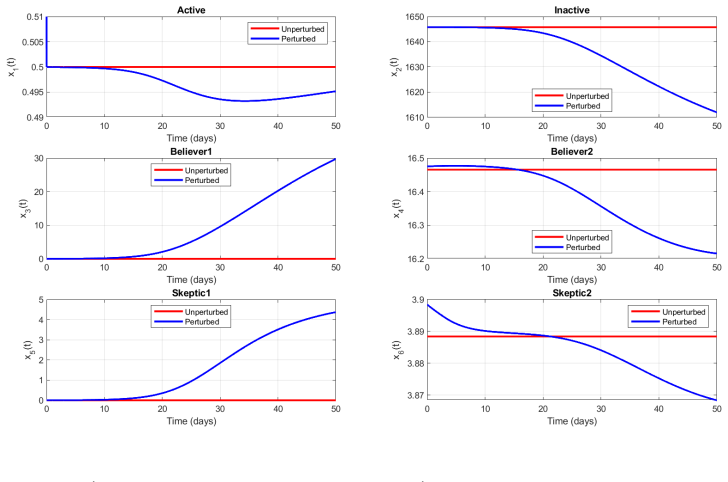
- [4, Table 1 and Figures 1–2] The numerical results are internally inconsistent and contradict the analytical conditions. Table 1 gives Λ/μ=2000, but Figure 1 lists E1=(1666.67,0,...). For E2, Figure 2 reports x1*=0.5 whereas the paper's own formula x1*=μ/η=0.25 under Table 1. The caption of Figure 2 asserts stability for all τ≥0, but the paper's Routh–Hurwitz condition for the no-delay case, 2μ²>x2*, is violated by orders of magnitude (0.005>1590.74 is false), and no alternative stability proof for these parameter values is supplied. These inconsistencies remove the numerical support for the theoretical claims.
minor comments (5)
- [Abstract] The abbreviation RAM for antimicrobial resistance is nonstandard; AMR is the usual acronym, and the body frequently spells out 'antimicrobial resistance' instead of using the abbreviation.
- [Section 2] The section begins with a stray 'I' and contains typographical errors, including 'wherex∗1 = Λ µ without any relation' and missing punctuation after the definition of E1.
- [Section 3] After deriving equation (12), the text says 'separating the real and imaginary parts in (11)', but the trigonometric system that follows is obtained from equation (10)/(12), not from the determinant (11).
- [References] References [17] and [31] are placeholders ('Title, Journal Name, year') and must be completed before submission.
- [Figures 5 and 6] The captions of Figures 5 and 6 are identical and list the same equilibrium vector for E5 and E6, which appears to be a copy-paste error.
Circularity Check
No definitional circularity: the RAM equations are appended but never analyzed, and the one load-bearing self-citation is an external theorem whose hypotheses are unverified, not a fitted or self-defined target.
full rationale
The paper contains no fitted-parameter-then-prediction loop: no data are introduced, no parameter is estimated from a subset and then "predicted," and the extended model's equilibria are not defined in terms of the quantities the paper claims to derive. The stability analysis of E1 and E2 is internal to the six-compartment misinformation model; the two appended RAM equations (15)-(16) are never subjected to equilibrium, threshold, or stability analysis, so the abstract/conclusion claim that "controlling misinformation can effectively reduce antimicrobial resistance development" is unsupported rather than derived. This is a correctness gap, not a circular reduction. The one genuine self-citation is the rank-one perturbation argument from [2] (Badralexi, Bordei, and Halanay, with Halanay as co-author here) used in Section 3 to replace characteristic equation (8) by (9). This is load-bearing for the E2 stability statement within the misinformation model, but it is an external theorem, not a definitional equivalence; the smallness condition on a31 and a41 is asserted, not verified, which again is a mathematical rigor issue rather than circularity. Separately, a direct check at the misinformation-free equilibrium with the stated parameters gives x7=Rmax and x8=σΛRmax/(μ μA)=4000 with stable Jacobian eigenvalues, contradicting the advertised policy conclusion; this is an empirical/mathematical failure within the model's own premises, not a circular derivation. Overall, the derivation does not reduce to its inputs: the RAM variables are essentially decoupled inputs whose dynamics are never used in the stability theorems. Score 2 reflects the minor load-bearing self-citation; it does not reflect a fitted or self-definitional target.
Assumptions & free parameters
free parameters (15)
- Λ =
100
- µ =
0.05
- η =
0.20
- β3 =
0.30
- β4 =
0.20
- α_R =
0.15
- K =
10
- Rmax =
1
- δ_R =
0.10
- β1 =
0.20
- β2 =
0.15
- γ1 =
0.10
- γ2 =
0.08
- µ_A =
0.05
- σ =
0.10
assumptions (4)
- domain assumption The six-compartment fake news model is well-posed and its equilibria computations are correct.
- ad hoc to paper The rank-one perturbation theorem from [2] applies to equation (8) with a31 and a41 sufficiently small.
- domain assumption The variable x7 (percentage resistance, 0-100%) obeys the same logistic differential equation as a density.
- standard math Standard stability theorems (Lyapunov-Krasovskii, Routh-Hurwitz) are valid for this system.
Cite this review
Pith. "Pith review of Modeling the Impact of Misinformation Dynamics on Antimicrobial Resistance." pith.science (2026). https://pith.science/paper/YQVEOSKR
@misc{pith2026250521540,
  author       = {Pith},
  title        = {Pith review of: Modeling the Impact of Misinformation Dynamics on Antimicrobial Resistance},
  year         = {2026},
  howpublished = {\url{https://pith.science/paper/YQVEOSKR}},
  note         = {Machine review of arXiv:2505.21540}
}
read the original abstract
Antimicrobial Resistance (RAM) poses a significant threat to global public health, making important medicines less useful. While the medical and biological reasons behind RAM are well studied, we still don't know enough about how false health information affects people's actions, which can speed up RAM. This study presents a new mathematical model to investigate the complex interplay between the spread of misinformation and the dynamics of RAM. We adapt a multi-strain fake news model, including distinct population compartments representing individuals susceptible to, believing in, or skeptical of various ideas related to antibiotic use. The model considers multiple "strains" of misinformation, such as the wrong belief that antibiotics are effective for viral infections or not trusting medical advice regarding prudent antibiotic prescription. Time delays are integrated to reflect the latency in information processing, behavioral change, and the manifestation of resistance. Through stability analysis and numerical simulations, this research aims to identify critical factors and parameters that influence the propagation of harmful beliefs and their consequent impact on behaviors contributing to RAM. The findings could help develop public health campaigns to reduce the negative impact of misinformation on fighting antimicrobial resistance.
Figures


Figures from the paper (4 more)


Reference graph
Works this paper leans on
-
[2]
Badralexi, I., Bordei, A.M., and Halanay, A., Rank-one perturbations and stability of some equilibrium points in a complex model of cells evolution in leukemia,U.P.B. Sci. Bull., Series A, 80(3):3–14, 2018
work page 2018
-
[17]
Khyar, et al., Title,Journal Name, year
-
[31]
Wang, L., Title,Journal Name, year
-
[1]
Austin, D. J. and Anderson, R. M., Studies of antibiotic resistance within the patient, hospitals and the community using simple mathematical models,Philosophical Transactions of the Royal Society of London. Series B: Biological Sciences, 354(1384):721–738, 1999
work page 1999
-
[3]
Bellman, R. and Cooke, K. L., Differential-Difference Equations,Academic Press, 1963
work page 1963
-
[4]
Beretta, E. and Kuang, Y., Geometric stability switch criteria in delay differential systems with delay dependent parameters,SIAM Journal on Mathematical Analysis, 33(5):1144–1165, 2002
work page 2002
-
[5]
and Grossman, Z., Discrete delay, distribution delay and stability switches,J.Math
Cooke, K. and Grossman, Z., Discrete delay, distribution delay and stability switches,J.Math. Anal. Appl., 86:592–627, 1982
work page 1982
-
[6]
Chan, M. P. S., Jones, C. R., Hall Jamieson, K., and Albarrac ´ ın, D., Debunking: A meta- analysis of the psychological efficacy of messages countering misinformation,Psychological Science, 28(11):1531–1546, 2017
work page 2017
Show all 35 references
-
[7]
Daley, D. J. and Kendall, D. G., Stochastic rumours,Journal of the Institute of Mathematics and Its Applications, 1:42–55, 1965
1965
-
[8]
Engelborghs, K., Luzyanina, T., and Roose, D., Numerical bifurcation analysis of delay dif- ferential equations using DDE-Biftool,ACM Transactions on Mathematical Software (TOMS), 28(1):1–21, 2002
2002
-
[9]
Feng, S., Feng, Z., Ling, C., Chang, C., and Feng, Z., Prediction on the epidemic trend of COVID-19 in the United States based on a generalized fractional-order SEIR model,arXiv preprint arXiv:2004.12541, 2020
2004 arXiv
-
[10]
Fridman, E., Introduction to Time-Delay Systems: Analysis and Control,Birkh¨ auser, 2014. 12
2014
-
[11]
A., Modelling the influence of human behaviour on the spread of infectious diseases: a review,Journal of the Royal Society Interface, 7(50):1247–1256, 2010
Funk, S., Salath´ e, M., and Jansen, V. A., Modelling the influence of human behaviour on the spread of infectious diseases: a review,Journal of the Royal Society Interface, 7(50):1247–1256, 2010
2010
-
[12]
et al., Control strategies in rumor propagation,Applied Mathematical Modelling, 2021
Ghosh, S. et al., Control strategies in rumor propagation,Applied Mathematical Modelling, 2021
2021
-
[13]
Greenhalgh, D., Liang, Y., and Mao, X., An SIRS epidemic model and endemic equilibria: The impact of information on the dynamics,Mathematical Methods in the Applied Sciences, 38(11):2354–2372, 2015
2015
-
[14]
Hale, J. K. and Lunel, S. M. V., Introduction to Functional Differential Equations,Springer- Verlag, New York, 1993
1993
-
[15]
W., The mathematics of infectious diseases,SIAM Review, 42(4):599–653, 2000
Hethcote, H. W., The mathematics of infectious diseases,SIAM Review, 42(4):599–653, 2000
2000
-
[16]
H., Moore, L
Holmes, A. H., Moore, L. S., Sundsfjord, A., Steinbakk, M., Regmi, S., Karkey, A., Guerin, P. J., and Piddock, L. J., Understanding the mechanisms and drivers of antimicrobial resistance, The Lancet, 387(10014):176–187, 2016
2016
-
[18]
Z., Cassell, J., Recker, M., and Simon, P
Kiss, I. Z., Cassell, J., Recker, M., and Simon, P. L., The impact of information transmission on epidemic outbreaks,Mathematical Biosciences, 225(1):1–10, 2010
2010
-
[19]
et al., Delay differential equations in rumor spreading models,Nonlinear Dynamics, 2015
Laarabi, H. et al., Delay differential equations in rumor spreading models,Nonlinear Dynamics, 2015
2015
-
[20]
Lazer, D. M. J. et al., The science of fake news,Science, 359(6380):1094–1096, 2018
2018
-
[21]
and Levin, B
Lipsitch, M. and Levin, B. R., The population dynamics of antimicrobial chemotherapy,An- timicrobial Agents and Chemotherapy, 44(3):701–711, 2000
2000
-
[22]
Liu, R., Wu, J., and Zhu, H., Media/psychological impact on multiple outbreaks of emerging infectious diseases,Computational and Mathematical Methods in Medicine, 2016
2016
-
[23]
M., Jayabalasingham, B., Seidman, J
Niewiadomska, A. M., Jayabalasingham, B., Seidman, J. C., Willem, L., Grenfell, B., Spiro, D., and Viboud, C., Population-level mathematical modeling of antimicrobial resistance: A systematic review,BMC Medicine, 17(1):81, 2019
2019
-
[24]
O’Neill, J., Tackling drug-resistant infections globally: Final report and recommendations, Review on Antimicrobial Resistance, 2016
2016
-
[25]
G., Fighting misinformation on social media using crowd- sourced judgments of news source quality,Proceedings of the National Academy of Sciences, 116(7):2521–2526, 2019
Pennycook, G., and Rand, D. G., Fighting misinformation on social media using crowd- sourced judgments of news source quality,Proceedings of the National Academy of Sciences, 116(7):2521–2526, 2019
2019
-
[26]
and Zou, X., Global dynamics of a two-strain disease model with latency and saturating incidence rate,Canadian Applied Mathematics Quarterly, 20(1), 2012
Rahman, A. and Zou, X., Global dynamics of a two-strain disease model with latency and saturating incidence rate,Canadian Applied Mathematics Quarterly, 20(1), 2012
2012
-
[27]
H., Foxman, B., Marrs, C
Spicknall, I. H., Foxman, B., Marrs, C. F., and Eisenberg, J. N., A modeling framework for the evolution and spread of antibiotic resistance: Literature review and model categorization, American Journal of Epidemiology, 178(4):508–520, 2013. 13
2013
-
[28]
Sun, Y., Song, S., and Sun, C., Dynamics analysis of an epidemic model with awareness and media coverage,Journal of Biological Dynamics, 15(1):1–22, 2021
2021
-
[29]
and Watmough, J., Reproduction numbers and sub-threshold endemic equilibria for compartmental models of disease transmission,Mathematical Biosciences, 180(1- 2):29–48, 2002
Van den Driessche, P. and Watmough, J., Reproduction numbers and sub-threshold endemic equilibria for compartmental models of disease transmission,Mathematical Biosciences, 180(1- 2):29–48, 2002
2002
-
[30]
Vosoughi, S., Roy, D., and Aral, S., The spread of true and false news online,Science, 359(6380):1146–1151, 2018
2018
-
[32]
A., Wu, Z
Wang, Z., Andrews, M. A., Wu, Z. X., Wang, L., and Bauch, C. T., Dynamics of misinformation and competing information on social networks: A dynamical systems perspective,IEEE Access, 7:45800–45814, 2019
2019
-
[33]
Wang, Y., and Zhao, S., Global dynamics of a time-delayed SEIR epidemic model with nonlinear incidence rate,Mathematical Biosciences and Engineering, 19(1):538–553, 2022
2022
-
[34]
Wang, X., Kottegoda, C., Shan, C., and Huang, Q., Oscillations and coexistence generated by discrete delays in a two-species competition model,Discrete and Continuous Dynamical Systems - Series B, 29(4):1798–1814, 2024
2024
-
[35]
Zhao, L., Cui, H., Qiu, X., Wang, X., and Wang, J., SIHR rumor spreading model in social networks,Physica A: Statistical Mechanics and its Applications, 392(4):995–1003, 2013. 14
2013
Reviewed August 7, 2026 · model on record in the stance chip above.
Discussion (0). Continue with ORCID to comment.