REVIEW 3 major objections 4 minor 13 references
Information-Theoretical Measures for Developmental Cell-Fate Proportioning Processes
T0 review · 3 major / 4 minor · reviewed 2026-08-07 · deepseek-v4-flash
Pith's one-line read Counting statistics can be lifted to estimate reproducibility entropy, and the simulated embryo model scores far below the ideal benchmark.
desk verdict The counting-space mapping and W_REP are sound and worth keeping, but the uniform lift forces S_PAT = S_SCF, so PI = 0 by construction; the headline claim that the ITWT system is far from optimal is an artifact of the approximation. read the letter →
The pith
A machine-rendered reading of the paper's core claim, the machinery that carries it, and where it could break.
The reading
What carries the argument
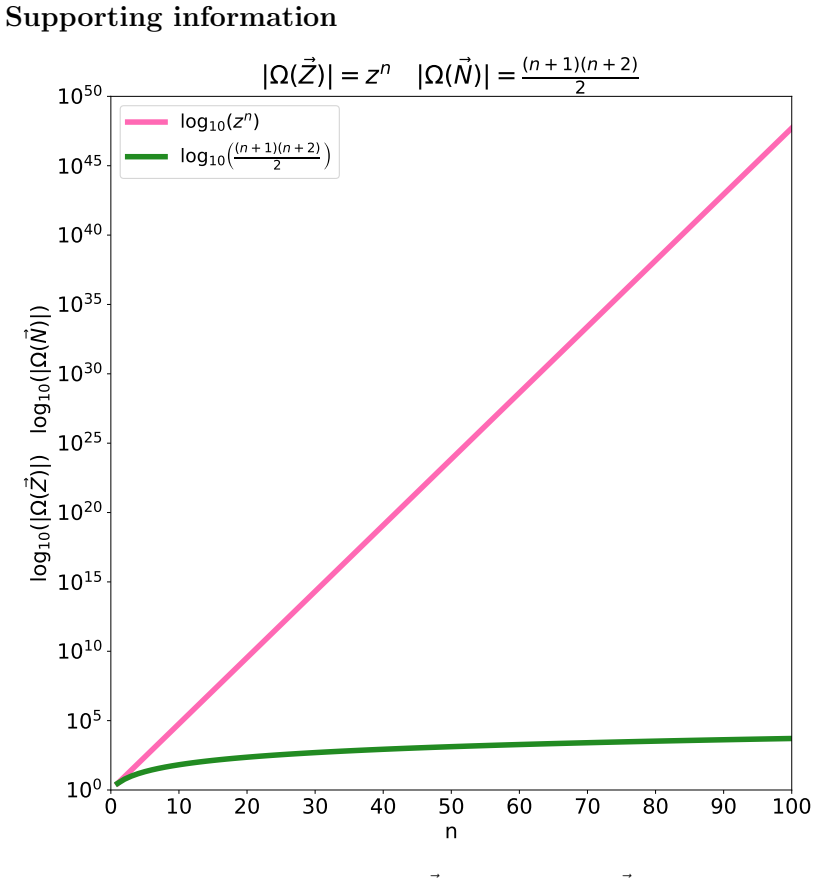
The load-bearing object is the pseudo-inverse transform $M$ (Definition 0.12), a map from a fate-count vector $\vec n$ to the set of all patterning vectors $\vec z$ with $T(\vec z)=\vec n$, equipped with the rule that the patterns in that set are equiprobable. Its cardinality is the multinomial coefficient $n!/(n_1!\cdots n_z!)$, which lets counting-space probabilities be spread uniformly over pattern space, turning the intractable sum over $z^n$ patterns into a sum over the $(n+1)(n+2)/2$ count vectors. Combined with perfect counting reproducibility, the same lift defines the ideal patterning space that serves as the benchmark, and the alternative $W_{\mathrm{REP}}$ is the Shannon entropy of the counting distribution itself, normalized by $n$.
What would settle it
Compute $\mathrm{PI}=S_{\mathrm{PAT}}-S_{\mathrm{SCF}}$ directly from the ITWT simulation patterns, using each cell's actual position rather than the uniform lift; if per-position fate probabilities differ across positions, $\mathrm{PI}$ will be positive and the low utility estimate will be shown to have missed real spatial structure.
Extended reading notes
Core claim
The central claim is that $S_{\mathrm{REP}}$ can be estimated from low-dimensional counting statistics through the pseudo-inverse transform $M$ (Definition 0.12), which assigns equal probability to every patterning vector $\vec z$ whose count vector satisfies $T(\vec z)=\vec n$; the size of each such set is the multinomial coefficient $n!/(n_1!\cdots n_z!)$. Under this uniform lift, an ideal proportioning process has zero positional information ($\mathrm{PI}=0$ always), so its utility $U$ equals its correlational information and decreases monotonically with the number of cells $n$. For the simulated ITWT system the three entropies $S_{\mathrm{PAT}}$, $S_{\mathrm{SCF}}$, and $S_{\mathrm{REP}}$ stay nearly equal across all embryo sizes, making the empirical utility very small and leading the authors to conclude that the current view of optimal behavior for cell-fate proportioning is incomplete. The paper also introduces a count-space entropy $W_{\mathrm{REP}}$ that improves (decreases) with $n$ and agrees with earlier findings that the ITWT system proportioning is accurate and precise.
Load-bearing premise
All cell-fate patterns with the same fate counts are treated as equally probable, so the lifting of counting statistics to pattern probabilities assumes away any dependence of fate on cell position.
Editorial extensions
If this is right
- For a pure proportioning process, $\mathrm{PI}=0$ identically, so self-organization utility reduces to correlational information and falls monotonically as the number of cells grows.
- The ITWT simulation's empirical utility of about 0.001 to 0.007 bits is only a fifth of the ideal value, so under this measure the simulated embryo is far from optimally self-organized.
- The counting-space entropy $W_{\mathrm{REP}}$ decreases with system size and matches the reproducibility reported in earlier simulation studies, giving a cheap diagnostic when patterning data are unavailable.
- The same counting-to-patterning lift applies to any proportioning process, experimental or simulated, because it needs only observed frequencies of fate-count vectors.
Reading between the lines
- Editorial inference: the uniform lift forces the single-cell fate distribution to be position-independent, so the reported near-zero positional information is built into the assumption rather than measured from the simulation's spatial structure.
- Editorial inference: if the ITWT simulation contains real spatial correlations in fate decisions, computing $\mathrm{PI}$ directly from single-cell marginals would yield a positive value, and the true utility could be substantially larger than 0.001 to 0.007 bits.
- Editorial inference: the same approach could be applied to experimental embryos by counting fates per embryo, giving cross-species or cross-condition comparisons of self-organization scores.
- Editorial inference: because $W_{\mathrm{REP}}$ discards spatial arrangement, it and the full utility measure answer different questions, so one should not be read as a substitute for the other.
Editorial analysis
A structured set of objections, weighed in public.
Referee Report
Summary. The paper develops a mathematical strategy to estimate the reproducibility entropy S_REP of a cell-fate patterning ensemble from the lower-dimensional counting space. The strategy relies on a pseudo-inverse transformation M (Definition 0.12) that assigns equal probability to all patterning vectors sharing the same count vector. The authors derive closed-form expressions for the ideal cell-fate proportioning process (Propositions 0.1–0.7), apply the strategy to a spatially resolved simulation of EPI/PRE proportioning (the ITWT system), and report that the empirical utility is very low (0.001–0.007 bits), concluding that the system is far from optimal. They also propose a counting-space reproducibility entropy W_REP and show that it decreases with n, consistent with earlier findings in [8].
Significance. The combinatorial derivations in Propositions 0.1–0.7 are correct and the W_REP measure is a useful, tractable quantity for comparing count reproducibility across systems. However, the central empirical claim depends on the uniform lift, which destroys all spatial correlations: under M, S_PAT = S_SCF and PI = 0 identically, so the reported low utility is an artifact of the assumption, not a measured property of the simulation. The paper's contribution is therefore methodological, with a clear limitation that is not adequately flagged in the interpretation. The authors are careful to state the uniformity assumption explicitly, which is a strength, but they do not validate it against the spatially resolved simulation data, and the biological conclusions about optimality are not supported by the current analysis.
major comments (3)
- [Definition 0.12 and Fig 2] The uniform lift in Definition 0.12 makes P(Z=j, N=i) independent of position i, because all patterns with the same count vector are equiprobable. By Definitions 0.6 and 0.7, this forces E_S_PAT = E_S_SCF and hence E_PI = 0 identically for the empirical estimates in Fig 2. The reported near-zero positional information is therefore a direct consequence of the assumption, not a measurement of the ITWT simulation's spatial structure. Moreover, if the lift were applied consistently, PI would be exactly zero; the non-vanishing empirical PI shown in the Fig 2 inset suggests a numerical artifact or an undocumented deviation from the construction, which needs clarification. The utility values in Fig 2[D] are conditional on the exchangeability assumption, so the claim that the system is 'nowhere near optimal' is not supported. The authors should either compute the three entropies directly from the simulation's pattern ensemble (feasible for small n) or present the results as bounds derived under a stated prior.
- [Discussion, p. 18] The assertion that 'the current view of optimal behavior for cell-fate proportioning processes is incomplete' rests on the discrepancy between the low empirical utility and the high accuracy and precision reported in [8]. Since the low utility follows from the maximum-entropy lift (which can only overestimate S_REP given the count probabilities), the discrepancy is an artifact of the estimation method, not evidence about optimality. A concrete test would be to compare the lifted pattern distribution against the actual pattern distribution of the ITWT simulation for small n (e.g., n = 5) and report the true S_REP. If the lift is rejected, the biological conclusion should be withdrawn or substantially qualified.
- [Propositions 0.2–0.7 and Fig 3] The ideal process is itself defined using the same uniform lift (Definition 0.12), so both the ideal and empirical utilities are computed under exchangeable pattern distributions. The reported ratio of empirical to ideal utility (about 1/5) therefore reflects only the spread of the counting distribution relative to the delta distribution at the ideal count vector, not any spatial patterning performance. This framing should be stated explicitly throughout the paper and in the interpretation of Figs 2 and 3, and the wording 'self-organization potential' should be revised to indicate that the measure is conditional on the exchangeability prior.
minor comments (4)
- [Definition 0.17] In the paragraph following Definition 0.17, the text says 'max(SREP)' where it should say 'max(WREP)' when referring to the maximum of the counting-space entropy; this typo should be corrected.
- [Notation, p. 3] The use of '∨' and '∧' for logical OR and AND is unconventional and may confuse readers; standard notation (e.g., 'or' and 'and') is recommended in definitions.
- [Data Availability] The statement that 'All code files will be available from a GitHub repository' is not sufficient for review; a permanent repository link or an explicit statement of availability upon request should be provided.
- [Figs 2 and 3] The superscript labels 'E' on quantities such as E_SPAT, E_SSCF, and E_SREP are not defined in the figure captions; they should be defined in the captions or in the main text (they appear to denote 'empirical').
Circularity Check
No significant circularity: the uniform lift is an explicit assumption used for SREP estimation, not a hidden derivation of the empirical PI.
full rationale
No circular step is established from the text. The pseudo-inverse M in Definition 0.12 does make the lifted pattern distribution exchangeable, so any ensemble generated by M would have S_PAT = S_SCF and PI = 0 by Definitions 0.6 and 0.7. However, the paper's procedure indicates that M is used specifically to estimate the reproducibility entropy: "For each ICM size, to compute the empirical reproducibility entropy, we created a list of all the realizable elements of the respective (sample) counting space, estimating their probabilities based on the observed counting vectors. Following this estimation of the counting probability space, we applied Definition 0.12 (pseudo-inverse transform M) for assigning probability estimates to patterning vector sets, thus obtaining an approximation of the respective patterning probability space." The empirical S_PAT and S_SCF are compared alongside S_REP, but the paper does not state that they were computed from the M-lift; direct estimation from the spatially resolved simulation is the natural reading, and the reported empirical PI is described as small but nonzero ("S_PAT ..., S_SCF ..., and S_REP ... are almost equal," and the utility "never fully vanishes"), which would be exactly zero rather than merely almost equal if the lift had been used for those quantities. The ideal result PI = 0 is a transparent consequence of Definition 0.14, which defines the ideal patterning space by combining the uniform lift with perfect counting reproducibility; deriving it in Propositions 0.2-0.4 is a definitional unpacking, not a hidden equivalence. The uniform lift is an acknowledged modeling assumption that could bias S_REP and hence U, but an untested or potentially biased assumption is a validity concern, not circularity. Reliance on the authors' prior simulation study [8] is ordinary reuse of one's own data and does not reduce the present derivation to a self-citation chain. The central mapping method is mathematically self-contained, and the empirical claims are not shown to be identical to the input assumptions by construction.
Assumptions & free parameters
free parameters (2)
- Ideal cell-fate proportions (EPI, PRE) =
EPI 2/5, PRE 3/5, UND 0
- Multinomial proportions for artificial baseline =
Observed simulation proportions at each time
assumptions (4)
- ad hoc to paper All cell-fate patterning vectors with the same counting vector are equiprobable (uniform lift, Definition 0.12).
- domain assumption The cell index N is uniformly distributed over cells (Definitions 0.3 and 0.4).
- standard math Shannon entropy and standard combinatorial identities.
- domain assumption For the ITWT system, the ideal proportions are (UND, EPI, PRE) = (0, 2/5, 3/5).
Cite this review
Pith. "Pith review of Information-Theoretical Measures for Developmental Cell-Fate Proportioning Processes." pith.science (2026). https://pith.science/paper/YTJRLXA5
@misc{pith2026250523659,
  author       = {Pith},
  title        = {Pith review of: Information-Theoretical Measures for Developmental Cell-Fate Proportioning Processes},
  year         = {2026},
  howpublished = {\url{https://pith.science/paper/YTJRLXA5}},
  note         = {Machine review of arXiv:2505.23659}
}
read the original abstract
Self-organization is a fundamental process of complex biological systems, particularly during the early stages of development. In the mammalian embryo, blastocyst formation exemplifies a self-organized system, involving the correct spatio-temporal segregation of three distinct cell fates: trophectoderm (TE), epiblast (EPI), and primitive endoderm (PRE). Despite the significance of this class of processes, quantifying the information content of self-organizing patterning systems remains challenging due to the complexity and the qualitative diversity of developmental mechanisms. In this study, we applied a recently proposed information-theoretical framework which quantifies the self-organization potential of cell-fate patterning systems, employing a utility function that integrates (local) positional information and (global) correlational information extracted from developmental pattern ensembles. Specifically, we examined a stochastic and spatially resolved simulation model of EPI-PRE lineage proportioning, evaluating its information content across various simulation scenarios with different numbers of system cells. To overcome the computational challenges hindering the application of this novel framework, we developed a mathematical strategy that indirectly maps the low-dimensional cell-fate counting probability space to the high-dimensional cell-fate patterning probability space, enabling the estimation of self-organization potential for general cell-fate proportioning processes. Overall, this novel information-theoretical framework provides a promising, universal approach for quantifying self-organization in developmental biology. By formalizing measures of self-organization, the employed quantification framework offers a valuable tool for uncovering insights into the underlying principles of cell-fate specification and the emergence of complexity in early developmental systems.
Figures


Figures from the paper (6 more)




Reference graph
Works this paper leans on
-
[8]
Ramirez Sierra MA, Sokolowski TR. AI-powered simulation-based inference of a gen- uinely spatial-stochastic gene regulation model of early mouse embryogenesis. PLOS Computational Biology. 2024;20(11):e1012473. doi:10.1371/journal.pcbi.1012473
-
[1]
Information content and optimization of self-organized developmen- tal systems
Br¨ uckner DB, Tkaˇ cik G. Information content and optimization of self-organized developmen- tal systems. Proceedings of the National Academy of Sciences. 2024;121(23):e2322326121. doi:10.1073/pnas.2322326121
-
[2]
Common principles of early mammalian embryo self-organisation
P lusa B, Piliszek A. Common principles of early mammalian embryo self-organisation. Development. 2020;147(dev183079). doi:10.1242/dev.183079
-
[3]
Local cellular interactions during the self-organization of stem cells
Schr¨ oter C, Stapornwongkul KS, Trivedi V. Local cellular interactions during the self-organization of stem cells. Current Opinion in Cell Biology. 2023;85:102261. doi:10.1016/j.ceb.2023.102261
arXiv 2023
-
[4]
Principles of Self-Organization of the Mammalian Embryo
Zhu M, Zernicka-Goetz M. Principles of Self-Organization of the Mammalian Embryo. Cell. 2020;183(6):1467–1478. doi:10.1016/j.cell.2020.11.003
-
[5]
From embryos to embryoids: How external signals and self-organization drive embryonic development
Morales JS, Raspopovic J, Marcon L. From embryos to embryoids: How external signals and self-organization drive embryonic development. Stem Cell Reports. 2021;16(5):1039–1050. doi:10.1016/j.stemcr.2021.03.026
-
[6]
Understanding the cell: Future views of structural biology
Beck M, Covino R, H¨ anelt I, M¨ uller-McNicoll M. Understanding the cell: Future views of structural biology. Cell. 2024;187(3):545–562. doi:10.1016/j.cell.2023.12.017
-
[7]
Ryan AQ, Chan CJ, Graner F, Hiiragi T. Lumen Expansion Facilitates Epiblast-Primitive Endoderm Fate Specification during Mouse Blastocyst Formation. Developmental Cell. 2019;51(6):684–697.e4. doi:10.1016/j.devcel.2019.10.011
Show all 13 references
-
[9]
Decoding of position in the developing neural tube from antiparallel morphogen gradients
Zagorski M, Tabata Y, Brandenberg N, Lutolf MP, Tkaˇ cik G, Bollenbach T, et al. Decoding of position in the developing neural tube from antiparallel morphogen gradients. Science. 2017;356(6345):1379–1383. doi:10.1126/science.aam5887
2017 doi
-
[10]
The many bits of positional information
Tkaˇ cik G, Gregor T. The many bits of positional information. Development. 2021;148(dev176065). doi:10.1242/dev.176065. September 10, 2025 19/25
2021 doi
-
[11]
Latent space of a small genetic network: Geometry of dynamics and information
Seyboldt R, Lavoie J, Henry A, Vanaret J, Petkova MD, Gregor T, et al. Latent space of a small genetic network: Geometry of dynamics and information. Proceedings of the National Academy of Sciences. 2022;119(26):e2113651119. doi:10.1073/pnas.2113651119
2022 doi
-
[12]
Deriving a genetic regulatory network from an optimization principle; 2023
Sokolowski TR, Gregor T, Bialek W, Tkaˇ cik G. Deriving a genetic regulatory network from an optimization principle; 2023. Available from:http://arxiv.org/abs/2302.05680
2023 arXiv
-
[13]
Center for Multiscale Modelling in Life Sciences
Ramirez Sierra MA, Sokolowski TR. Comparing AI versus optimization workflows for simulation-based inference of spatial-stochastic systems. Machine Learning: Science and Technology. 2025;6(1):010502. doi:10.1088/2632-2153/ada0a3. September 10, 2025 20/25 Acknowledgments The suc...
2025 doi
Reviewed August 7, 2026 · model on record in the stance chip above.
Discussion (0). Sign in to comment.