REVIEW 3 major objections 6 minor 96 references
An LBT view of the co-rotating group of galaxies around NGC 2750: Deep imaging and new satellite candidates
T0 review · 3 major / 6 minor · reviewed 2026-08-15 · deepseek-v4-flash
Pith's one-line read Deep imaging discovers six new dwarf galaxy candidates around NGC 2750 and reinforces a flattened, bright-satellite-rich system while leaving its co-rotation unconfirmed.
desk verdict A careful, honest deep-imaging survey that delivers a useful dwarf-candidate catalog, but its strongest quantitative claim (the bright-satellite excess) is not robust to the distance ambiguity the paper itself documents. read the letter →
The pith
A machine-rendered reading of the paper's core claim, the machinery that carries it, and where it could break.
The reading
What carries the argument
The load-bearing mechanism is deep low-surface-brightness imaging: a dithering pattern with steps of about the host's diameter allows the science frames themselves to serve as flat fields, and co-addition of 30 dithered 180 s LBT exposures reaches a 3$\sigma$ limit of 30.6 mag arcsec$^{-2}$ in $r$. Candidate dwarfs are then characterised by S\'ersic-profile fits and placed on $M_V$--$\mu_V(0)$--$R_e$ scaling relations against known dwarfs, which is the paper's main membership heuristic. Two quantitative engines follow: a Bayesian linear rotation model $V_{\rm rot} = k R_i \cos(\theta - \theta_i)$ with no intrinsic dispersion for the kinematic test, and a satellite-count comparison within the assumed virial radius (150 kpc) against ELVES hosts and 650 isolated TNG50 analogues selected by baryonic mass.
What would settle it
Spectroscopic redshifts of the seven candidates would settle the co-rotation claim: one outer candidate with a velocity opposite the known trend pushes the correlation's $p$-value above 0.05, while random velocities for the two innermost candidates usually preserve it. A reliable distance to NGC 2750 (for example from resolved stars or a better inclination-corrected Tully-Fisher measurement) would settle the luminosity-function claim, since at 20 Mpc the satellites would be about 1.6 mag fainter and the bright excess would largely disappear.
Extended reading notes
Core claim
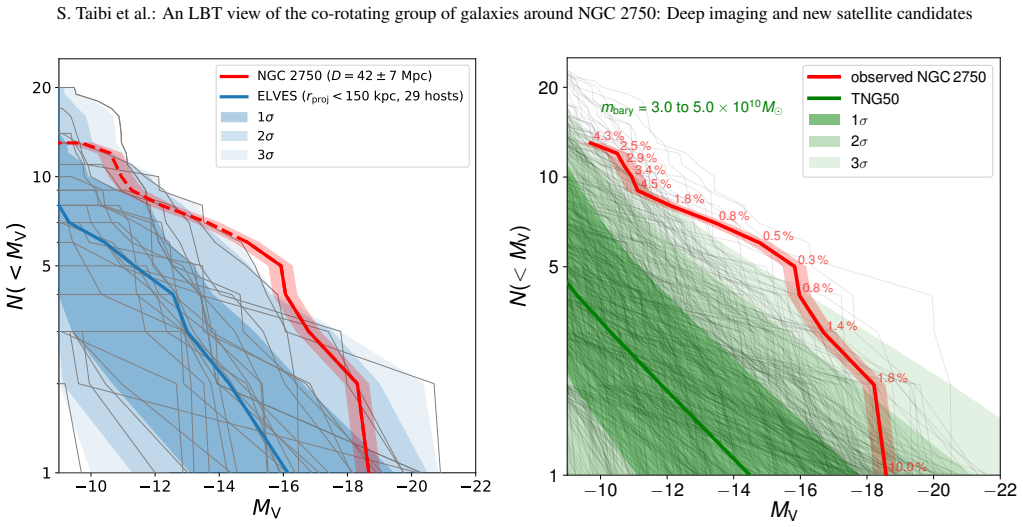
On the paper's own terms, deep $g$- and $r$-band imaging with the Large Binocular Telescope reaches $\mu_r \sim 31$ mag arcsec$^{-2}$ and reveals six previously unknown low-surface-brightness dwarf galaxy candidates around NGC 2750, one of which has properties consistent with an ultra-diffuse galaxy ($R_e \sim 30''$, central surface brightness $\mu_V(0) \sim 28$ mag arcsec$^{-2}$) and may alternatively be a dwarf being tidally destroyed. The candidates, combined with the known satellites, yield a projected distribution with minor-to-major axis ratio $b/a = 0.67 \pm 0.12$, a moderate flattening that supports and sharpens the earlier measurement. The luminosity function shows an excess of bright satellites near $M_V \sim -15$: among TNG50 analogues matched in baryonic mass and isolation, only $\sim 0.5\%$ have as many satellites at that luminosity, and among ELVES hosts only NGC 1023 is comparable. The co-rotating signal reported earlier is retained in the sense that the best-fitting kinematic axis ($k = 32 \pm 8$ km s$^{-1}$ arcmin$^{-1}$, $\theta_k = 10^\circ \pm 20^\circ$) agrees with the spatial axis, but it is not confirmed, because assigning even one of the outer candidates a velocity opposite the trend would push the correlation's $p$-value above 0.05.
Load-bearing premise
The load-bearing premise is the assumed group distance of $42 \pm 7$ Mpc, taken from the Hubble flow rather than a reliable host measurement, because every physical conclusion—absolute magnitudes, effective radii, the ultra-diffuse classification, the virial-radius comparison, and the luminosity-function excess—scales with it.
Editorial extensions
If this is right
- The flattening persists with the new candidates ($b/a = 0.67 \pm 0.12$) and is consistent with, though less extreme than, the projected planes seen around the Milky Way and M31.
- The luminosity-function excess at $M_V \sim -15$ places NGC 2750 above nearly all ELVES hosts and 99.5% of TNG50 analogues, strengthening the 'too many satellites' tension.
- A spectroscopic campaign targeting the innermost candidates can test the co-rotation, while the faint outer candidates are the most discriminating but hardest to observe with current facilities.
- Tidal features around NGC 2750, together with the absence of a massive stellar halo, favour past interactions with satellites over a recent major merger as the origin of any coherent motion.
- If the ultra-diffuse galaxy candidate is real, it sits at the faint end of known UDGs and may be a tidally disrupting dwarf similar to Antlia II.
Reading between the lines
- If a better distance places NGC 2750 closer than 42 Mpc, all absolute magnitudes shift fainter by about 1.6 mag at 20 Mpc, which would weaken the bright-satellite excess; a larger distance would make the excess more extreme.
- Membership of the faint candidates is untested; contamination by background dwarfs could remove part of the flattening and the luminosity excess, so deep spectroscopy of even a few candidates is the fastest way to tighten the claims.
- The resemblance of the ultra-diffuse candidate to Antlia II suggests a testable tidal-stripping scenario: deep imaging for globular clusters or tidal tails around the candidate would discriminate between a genuine UDG and a disrupted dwarf.
- If the bright-satellite excess holds, applying the same deep-imaging and counting protocol to a larger sample of isolated spirals would show whether NGC 2750 is an outlier or the first of a population that cosmological simulations systematically underpredict.
Signed reviews
Editorial analysis
A structured set of objections, weighed in public.
Referee Report
Summary. This manuscript presents deep LBT g- and r-band imaging of a roughly 35' x 30' field around NGC 2750. The authors use a standard reduction pipeline with a self-flat-field strategy, calibrate the photometry to SDSS, model and subtract the scattered light from a bright foreground star, and report tidal features around the host. They identify six new candidate dwarf galaxies, including one ultra-diffuse-galaxy candidate, and they measure structural and photometric parameters for all candidates. Adopting a fiducial group distance of 42 ± 7 Mpc from the Hubble flow, they argue that the candidates follow local dwarf scaling relations, that the projected satellite distribution is moderately flattened (b/a = 0.67 ± 0.12), and that the NGC 2750 luminosity function shows an excess of bright satellites relative to ELVES hosts and TNG50 analogues, with only about 0.5% of analogues having as many satellites near M_V ≈ -15. They also re-examine the previously reported co-rotation signal and conclude that it is retained but not confirmed, since the new candidates could enhance or destroy it depending on their radial velocities.
Significance. If the assumed distance and group memberships are correct, this system is a valuable addition to the small set of candidate co-rotating satellite planes and to the growing observational evidence for an excess of bright satellites relative to cosmological simulations. The observational work itself is solid and useful: the reduction is standard and documented, the photometric calibration against SDSS is described with zero-point uncertainties, and the Sersic fits are reported with parameter errors. The authors are also appropriately cautious in several places, especially in Section 5.4, where they emphasize that the kinematic correlation is provisional pending spectroscopy. The main quantitative claim, however, rests on a distance that the paper itself shows to be poorly constrained, so the significance of the claimed cosmological tension is not yet firmly established.
major comments (3)
- [Sections 3 and 5.3, Fig. 5] The claimed bright-satellite excess is not robust to the distance uncertainty. Section 3 reports host Tully-Fisher estimates ranging from 9 to 39 Mpc and a satellite-derived group average of 46 ± 7 Mpc, with one satellite (D4) giving 16 Mpc, while the adopted fiducial value is 42 ± 7 Mpc. The comparison in Fig. 5 uses a fixed absolute-magnitude window near M_V = -14.9 and a fixed projected radius of 150 kpc, both of which scale with the assumed distance. If the true distance were, for example, 20 Mpc, the known satellites would be roughly 1.6 mag fainter in M_V and the survey would cover a much smaller physical radius; the claimed excess could weaken or disappear. The authors should quantify how the luminosity-function comparison and the flattening measurement change over the full allowed distance range, or provide an independent distance constraint, before drawing cosmological conclusions.
- [Section 5.4 and Fig. 6] The flattening analysis and the luminosity-function comparison treat all six DGCs as satellites, but none has a confirmed membership. The authors acknowledge that the candidates are not spectroscopically confirmed, yet they do not provide a statistical background-contamination estimate. A simple estimate using counts of similar faint, extended sources in the same field would help show whether the apparent flattening and the bright-end excess could be produced by unrelated background galaxies. This is particularly important because the uncertain candidates DGC2, DGC3, and DGC5 are explicitly flagged as having ambiguous morphology in Table 2.
- [Section 4.3 and 5.2] The classification of the western overdensity as an ultra-diffuse galaxy candidate depends directly on the distance through the effective radius, since the UDG criterion R_e > 1.5 kpc is applied to R_e ≈ 30 arcsec at 42 Mpc. At the lower end of the reported Tully-Fisher distance range, R_e would fall below 1.5 kpc and the object would no longer satisfy the UDG criterion. The discussion in Section 5.2 should therefore state explicitly which distance values are compatible with the UDG classification and which are not, rather than presenting the classification under the single fiducial distance.
minor comments (6)
- [Abstract and Section 2.2] The abstract states a depth of about 31 mag arcsec^-2 in r, while Section 2.2 reports a 3σ surface-brightness limit of 30.6 mag arcsec^-2 in r; these values should be reconciled in a single place.
- [Table 1] The table lists D1, D2, D3, D4, and D6 but no D5, and the naming is not consistent with Paudel et al. (2021) as presented in Fig. A.1; the authors should clarify which object corresponds to D5 or state why it is omitted.
- [Section 4.3] The text states Re ~ 30 arcsec for the UDGC, while Table 3 gives Re,g = 35.9 ± 1.78 arcsec and Re,r = 31.0 ± 1.61 arcsec; the text should quote the measured values with uncertainties to avoid inconsistency.
- [Section 3] The phrase 'viral radius' should be 'virial radius.'
- [Fig. 5] The percentages listed along the lower part of the right panel (10.0%, 1.8%, 1.4%, etc.) are not explained in the caption or text; the authors should state what these values represent.
- [Table 1] The table gives coordinates in degrees but does not explicitly state the equinox or the reference catalog for the coordinates; this should be stated once, for example as J2000.
Circularity Check
No significant circularity: the new LBT imaging results, external benchmark comparisons, and stated assumptions are self-contained; the distance and membership caveats are acknowledged input assumptions rather than fitted predictions.
full rationale
No circular reasoning is present. The paper's central results—six new dwarf galaxy candidates, one UDG candidate, a projected flattening of b/a = 0.67 ± 0.12, and an excess of bright satellites—rest on new LBT g- and r-band imaging that was photometrically calibrated against SDSS DR18 (Sect. 2.2) and compared with external surveys and simulations (ELVES, SAGA, LIGHTS, and TNG50; Sect. 5.3). The luminosity-function excess is a count of observed satellites evaluated against externally defined completeness limits and simulated analogues; no fitted parameter is relabeled as a prediction. The kinematic gradient in Sect. 5.4 is fit to the same radial-velocity data but is used descriptively, and the paper explicitly states that the inclusion of unconfirmed candidates could either enhance or destroy the previously reported co-rotation signal. The fiducial distance of 42 ± 7 Mpc is adopted from the Hubble flow and is stated as an assumption (Sect. 3); the paper openly reports the wide spread of Tully-Fisher estimates (9–39 Mpc for the host, 36–53 Mpc for individual satellites, with D4 giving 16 Mpc) and does not present a distance derived from the new data as an independent prediction. The unconfirmed membership of the DGCs is likewise explicitly acknowledged (Sect. 5.4). Self-citations (e.g., Taibi et al. 2018 for the kinematic fitting method; Müller et al. 2024b and Kanehisa et al. 2024 for similar too-many-satellites claims) are methodological or contextual and are not load-bearing uniqueness arguments; the benchmark comparisons are external. The paper's own caveats about distance and membership are robustness limitations on input assumptions, not circular derivations, so the honest finding is a score of 0.
Assumptions & free parameters
free parameters (1)
- Fiducial group distance D =
42 +/- 7 Mpc
assumptions (5)
- domain assumption The NGC 2750 system and the new dwarf candidates lie at the same distance of 42 +/- 7 Mpc.
- domain assumption The newly detected DGCs are physically associated with NGC 2750 rather than background galaxies.
- domain assumption Intrinsic axial ratio q0 from Roychowdhury et al. (2013) and the Kourkchi et al. (2020) Tully-Fisher calibration correctly convert observed HI widths into distances.
- domain assumption The ELVES, SAGA, and LIGHTS samples are adequate completeness-matched benchmarks, and the TNG50 analogue selection (baryonic mass 3.0-5.0e10 Msun, isolation, random orientation) represents a fair cosmological comparison.
- domain assumption Assumed stellar mass-to-light ratio 1-1.7 and gas-to-stellar mass ratio 0.5 yield the baryonic mass estimate used for the virial radius and TNG50 selection.
Cite this review
Pith. "Pith review of An LBT view of the co-rotating group of galaxies around NGC 2750: Deep imaging and new satellite candidates." pith.science (2026). https://pith.science/paper/YTQTI3C7
@misc{pith2026250619001,
  author       = {Pith},
  title        = {Pith review of: An LBT view of the co-rotating group of galaxies around NGC 2750: Deep imaging and new satellite candidates},
  year         = {2026},
  howpublished = {\url{https://pith.science/paper/YTQTI3C7}},
  note         = {Machine review of arXiv:2506.19001}
}
read the original abstract
Some galaxies such as the Milky Way and Andromeda display coherently rotating satellite planes, posing tensions with cosmological simulations. NGC 2750 has emerged as an additional candidate system hosting a co-rotating group of galaxies. We aim to assess the presence of a coherent satellite plane around NGC 2750 by identifying new candidate dwarf galaxies and low surface brightness features. We conducted deep, wide-field photometric observations of NGC 2750 using the Large Binocular Telescope in the g- and r-bands. Standard data reduction techniques were applied to enhance the detection of low-surface-brightness features down to about 31 mag/arcsec^2 in r. Our observations led to the discovery of six new candidate dwarf galaxies, including one with properties consistent with an ultra-diffuse galaxy. We also identified tidal features around NGC 2750, indicating past interactions with nearby satellites. The spatial distribution of satellites suggests a moderate flattening, further supported by the newly identified candidates. Follow-up spectroscopic measurements will be critical in confirming or challenging the strong kinematic coherence observed previously. The luminosity function of NGC 2750 reveals an excess of bright satellites compared to similar systems, adding to the growing tension between observed satellite populations and cosmological simulations.
Figures


Figures from the paper (3 more)


Reference graph
Works this paper leans on
-
[1]
F., Argudo-Fern \'a ndez , M., et al
Almeida , A., Anderson , S. F., Argudo-Fern \'a ndez , M., et al. 2023, , 267, 44
2023
-
[2]
2020, , 491, 5101
Annibali , F., Beccari , G., Bellazzini , M., et al. 2020, , 491, 5101
2020
-
[3]
M., Lim , P
Astropy Collaboration , Price-Whelan , A. M., Lim , P. L., et al. 2022 a , , 935, 167
2022
-
[4]
M., Lim , P
Astropy Collaboration , Price-Whelan , A. M., Lim , P. L., et al. 2022 b , , 935, 167
2022
-
[5]
K., Glazebrook , K., & Driver , S
Baldry , I. K., Glazebrook , K., & Driver , S. P. 2008, , 388, 945
2008
-
[6]
J., Zaritsky , D., et al
Bennet , P., Sand , D. J., Zaritsky , D., et al. 2018, , 866, L11
2018
-
[7]
2006, in Astronomical Society of the Pacific Conference Series, Vol
Bertin , E. 2006, in Astronomical Society of the Pacific Conference Series, Vol. 351, Astronomical Data Analysis Software and Systems XV, ed. C. Gabriel , C. Arviset , D. Ponz , & S. Enrique , 112
2006
-
[8]
& Arnouts , S
Bertin , E. & Arnouts , S. 1996, , 117, 393
1996
Show all 96 references
-
[9]
2002, in Astronomical Society of the Pacific Conference Series, Vol
Bertin , E., Mellier , Y., Radovich , M., et al. 2002, in Astronomical Society of the Pacific Conference Series, Vol. 281, Astronomical Data Analysis Software and Systems XI, ed. D. A. Bohlender , D. Durand , & T. H. Handley , 228
2002
-
[10]
2020, , 498, 2138
B \' lek , M., Duc , P.-A., Cuillandre , J.-C., et al. 2020, , 498, 2138
2020
-
[11]
2018, , 614, A59
B \' lek , M., Thies , I., Kroupa , P., & Famaey , B. 2018, , 614, A59
2018
-
[12]
& Gerhard , O
Bland-Hawthorn , J. & Gerhard , O. 2016, , 54, 529
2016
-
[13]
1985, , 59, 43
Bottinelli , L., Gouguenheim , L., Paturel , G., & de Vaucouleurs , G. 1985, , 59, 43
1985
-
[14]
2023, astropy/photutils: 1.8.0
Bradley, L. 2023, astropy/photutils: 1.8.0
2023
-
[15]
Bullock , J. S. & Boylan-Kolchin , M. 2017, , 55, 343
2017
-
[16]
2019, , 485, 382
Carleton , T., Errani , R., Cooper , M., et al. 2019, , 485, 382
2019
-
[17]
G., Greene , J
Carlsten , S. G., Greene , J. E., Beaton , R. L., Danieli , S., & Greco , J. P. 2022, , 933, 47
2022
-
[18]
A., Tully , R
Chiboucas , K., Jacobs , B. A., Tully , R. B., & Karachentsev , I. D. 2013, , 146, 126
2013
-
[19]
D., & Tully , R
Chiboucas , K., Karachentsev , I. D., & Tully , R. B. 2009, , 137, 3009
2009
-
[20]
R., Ibata , R
Conn , A. R., Ibata , R. A., Lewis , G. F., et al. 2012, , 758, 11
2012
-
[21]
2023, astropy/ccdproc: 2.4.1
Craig, M., Crawford, S., Seifert, M., et al. 2023, astropy/ccdproc: 2.4.1
2023
-
[22]
2024, , 527, 9118
Crosby , E., Jerjen , H., M \"u ller , O., et al. 2024, , 527, 9118
2024
-
[23]
2012, in Astrophysics and Space Science Proceedings, Vol
Duc , P.-A. 2012, in Astrophysics and Space Science Proceedings, Vol. 28, Dwarf Galaxies: Keys to Galaxy Formation and Evolution, ed. P. Papaderos , S. Recchi , & G. Hensler , 305
2012
-
[24]
G., Sand , D
Fielder , C., Jones , M. G., Sand , D. J., et al. 2024, , 168, 212
2024
-
[25]
Gaia Collaboration , Brown , A. G. A., Vallenari , A., et al. 2021, , 649, A1
2021
-
[26]
2021, , 923, 140
Garavito-Camargo , N., Patel , E., Besla , G., et al. 2021, , 923, 140
2021
-
[27]
T., Peter , A
Garling , C. T., Peter , A. H. G., Kochanek , C. S., Sand , D. J., & Crnojevi \'c , D. 2021, , 507, 4764
2021
-
[28]
2008, , 482, 349
Giallongo , E., Ragazzoni , R., Grazian , A., et al. 2008, , 482, 349
2008
-
[29]
R., Rom \'a n , J., & Trujillo , I
Golini , G., Montes , M., Carrasco , E. R., Rom \'a n , J., & Trujillo , I. 2024, , 684, A99
2024
-
[30]
Graham , A. W. & Driver , S. P. 2005, , 22, 118
2005
-
[31]
R., Duc , P.-A., et al
Habas , R., Marleau , F. R., Duc , P.-A., et al. 2020, , 491, 1901
2020
-
[32]
R., Millman, K
Harris, C. R., Millman, K. J., van der Walt, S. J., et al. 2020, Nature, 585, 357–362
2020
-
[33]
P., Giovanelli , R., Kent , B
Haynes , M. P., Giovanelli , R., Kent , B. R., et al. 2018, , 861, 49
2018
-
[34]
R., et al
Heesters , N., Habas , R., Marleau , F. R., et al. 2021, , 654, A161
2021
-
[35]
Hunter, J. D. 2007, Computing in science & engineering, 9, 90
2007
-
[36]
A., Lewis , G
Ibata , R. A., Lewis , G. F., Conn , A. R., et al. 2013, , 493, 62
2013
-
[37]
& Akhlaghi , M
Infante-Sainz , R. & Akhlaghi , M. 2024, Research Notes of the American Astronomical Society, 8, 10
2024
-
[38]
H., Schlegel , D., et al
Ivezi \'c , Z ., Lupton , R. H., Schlegel , D., et al. 2004, Astronomische Nachrichten, 325, 583
2004
-
[39]
Jerjen , H., Binggeli , B., & Freeman , K. C. 2000, , 119, 593
2000
-
[40]
P., Koposov , S
Ji , A. P., Koposov , S. E., Li , T. S., et al. 2021, , 921, 32
2021
-
[41]
K., & Ammon , K
Jordi , K., Grebel , E. K., & Ammon , K. 2006, , 460, 339
2006
-
[42]
P., Pawlowski , M
J \'u lio , M. P., Pawlowski , M. S., Tony Sohn , S., et al. 2024, , 687, A212
2024
-
[43]
J., Pawlowski , M
Kanehisa , K. J., Pawlowski , M. S., Heesters , N., & M \"u ller , O. 2024, , 686, A280
2024
-
[44]
J., Pawlowski , M
Kanehisa , K. J., Pawlowski , M. S., & M \"u ller , O. 2023, , 524, 952
2023
-
[45]
B., Anand , G
Kourkchi , E., Tully , R. B., Anand , G. S., et al. 2020, , 896, 3
2020
-
[46]
B., Neill , J
Kourkchi , E., Tully , R. B., Neill , J. D., et al. 2019, , 884, 82
2019
-
[47]
Kroupa , P., Theis , C., & Boily , C. M. 2005, , 431, 517
2005
-
[48]
W., Mierle , K., Blanton , M., & Roweis , S
Lang , D., Hogg , D. W., Mierle , K., Blanton , M., & Roweis , S. 2010, , 139, 1782
2010
-
[49]
& Helmi , A
Li , Y.-S. & Helmi , A. 2008, , 385, 1365
2008
-
[50]
I., Hoffman , Y., Tully , R
Libeskind , N. I., Hoffman , Y., Tully , R. B., et al. 2015, , 452, 1052
2015
-
[51]
W., et al
Lim , S., C \^o t \'e , P., Peng , E. W., et al. 2020, , 899, 69
2020
-
[52]
H., et al
Mao , Y.-Y., Geha , M., Wechsler , R. H., et al. 2021, , 907, 85
2021
-
[53]
R., Habas , R., Poulain , M., et al
Marleau , F. R., Habas , R., Poulain , M., et al. 2021, , 654, A105
2021
-
[54]
2021, , 652, A48
Mart \' nez-Delgado , D., Makarov , D., Javanmardi , B., et al. 2021, , 652, A48
2021
-
[55]
& Trujillo , I
Monelli , M. & Trujillo , I. 2019, , 880, L11
2019
-
[56]
S., et al
M \"u ller , O., Heesters , N., Pawlowski , M. S., et al. 2024 a , , 683, A250
2024
-
[57]
2018 a , , 615, A105
M \"u ller , O., Jerjen , H., & Binggeli , B. 2018 a , , 615, A105
2018
-
[58]
S., Jerjen , H., & Lelli , F
M \"u ller , O., Pawlowski , M. S., Jerjen , H., & Lelli , F. 2018 b , Science, 359, 534
2018
-
[59]
S., Lelli , F., et al
M \"u ller , O., Pawlowski , M. S., Lelli , F., et al. 2021, , 645, L5
2021
-
[60]
S., Revaz , Y., et al
M \"u ller , O., Pawlowski , M. S., Revaz , Y., et al. 2024 b , , 684, L6
2024
-
[61]
2017, , 602, A119
M \"u ller , O., Scalera , R., Binggeli , B., & Jerjen , H. 2017, , 602, A119
2017
-
[62]
J., Crnojevi \'c , D., et al
Mutlu-Pakdil , B., Sand , D. J., Crnojevi \'c , D., et al. 2024, , 966, 188
2024
-
[63]
2019, Computational Astrophysics and Cosmology, 6, 2
Nelson , D., Springel , V., Pillepich , A., et al. 2019, Computational Astrophysics and Cosmology, 6, 2
2019
-
[64]
2000, , 146, 19
Paturel , G., Fang , Y., Petit , C., Garnier , R., & Rousseau , J. 2000, , 146, 19
2000
-
[65]
2021, , 917, L18
Paudel , S., Yoon , S.-J., & Smith , R. 2021, , 917, L18
2021
-
[66]
Pawlowski , M. S. 2018, Modern Physics Letters A, 33, 1830004
2018
-
[67]
Pawlowski , M. S. 2021, Galaxies, 9, 66
2021
-
[68]
S., Kroupa , P., & de Boer , K
Pawlowski , M. S., Kroupa , P., & de Boer , K. S. 2011, , 532, A118
2011
-
[69]
S., M \"u ller , O., Taibi , S., et al
Pawlowski , M. S., M \"u ller , O., Taibi , S., et al. 2024, , 688, A153
2024
-
[70]
& Granger, B
P \'e rez, F. & Granger, B. E. 2007, Computing in Science & Engineering, 9
2007
-
[71]
Planck Collaboration , Ade , P. A. R., Aghanim , N., et al. 2016, , 594, A13
2016
-
[72]
N., Karachentsev , I
Roychowdhury , S., Chengalur , J. N., Karachentsev , I. D., & Kaisina , E. I. 2013, , 436, L104
2013
-
[73]
2022, , 511, 4633
Saifollahi , T., Zaritsky , D., Trujillo , I., et al. 2022, , 511, 4633
2022
-
[74]
V., Wetzel , A., & Fattahi , A
Sales , L. V., Wetzel , A., & Fattahi , A. 2022, Nature Astronomy, 6, 897
2022
-
[75]
Schlafly , E. F. & Finkbeiner , D. P. 2011, , 737, 103
2011
-
[76]
Sersic , J. L. 1968, Atlas de Galaxias Australes
1968
-
[77]
A., Bournaud , F., & Yi , S
Smith , R., Duc , P. A., Bournaud , F., & Yi , S. K. 2016, , 818, 11
2016
-
[78]
G., Tully , R
Sorce , J. G., Tully , R. B., Courtois , H. M., et al. 2014, , 444, 527
2014
-
[79]
2008, in Society of Photo-Optical Instrumentation Engineers (SPIE) Conference Series, Vol
Speziali , R., Di Paola , A., Giallongo , E., et al. 2008, in Society of Photo-Optical Instrumentation Engineers (SPIE) Conference Series, Vol. 7014, Ground-based and Airborne Instrumentation for Astronomy II, ed. I. S. McLean & M. M. Casali , 70144T
2008
-
[80]
2018, , 618, A122
Taibi , S., Battaglia , G., Kacharov , N., et al. 2018, , 618, A122
2018
-
[81]
S., Khoperskov , S., Steinmetz , M., & Libeskind , N
Taibi , S., Pawlowski , M. S., Khoperskov , S., Steinmetz , M., & Libeskind , N. I. 2024, , 681, A73
2024
-
[82]
S., Mart \' nez , V
Tempel , E., Stoica , R. S., Mart \' nez , V. J., et al. 2014, , 438, 3465
2014
-
[83]
E., et al
Torrealba , G., Belokurov , V., Koposov , S. E., et al. 2019, , 488, 2743
2019
-
[84]
C., Brooks , A
Tremmel , M., Wright , A. C., Brooks , A. M., et al. 2020, , 497, 2786
2020
-
[85]
2021, , 654, A40
Trujillo , I., D'Onofrio , M., Zaritsky , D., et al. 2021, , 654, A40
2021
-
[86]
& Fliri , J
Trujillo , I. & Fliri , J. 2016, , 823, 123
2016
-
[87]
B., Courtois , H
Tully , R. B., Courtois , H. M., Dolphin , A. E., et al. 2013, , 146, 86
2013
-
[88]
Tully , R. B. & Fisher , J. R. 1988, Catalog of Nearby Galaxies
1988
-
[89]
B., Kourkchi , E., Courtois , H
Tully , R. B., Kourkchi , E., Courtois , H. M., et al. 2023, , 944, 94
2023
-
[90]
B., Libeskind , N
Tully , R. B., Libeskind , N. I., Karachentsev , I. D., et al. 2015, , 802, L25
2015
-
[91]
I., Pomar \`e de , D., et al
Valade , A., Libeskind , N. I., Pomar \`e de , D., et al. 2024, Nature Astronomy, 8, 1610
2024
-
[92]
G., Abraham , R., Merritt , A., et al
van Dokkum , P. G., Abraham , R., Merritt , A., et al. 2015, , 798, L45
2015
-
[93]
& Drake, F
Van Rossum, G. & Drake, F. L. 2009, Python 3 Reference Manual (Scotts Valley, CA: CreateSpace)
2009
-
[94]
2021, , 501, 2279
Vasiliev , E., Belokurov , V., & Erkal , D. 2021, , 501, 2279
2021
-
[95]
E., et al
Virtanen, P., Gommers, R., Oliphant, T. E., et al. 2020, Nature Methods, 17, 261
2020
-
[96]
2024, , 168, 69
Zaritsky , D., Golini , G., Donnerstein , R., et al. 2024, , 168, 69
2024
Reviewed August 15, 2026 · model on record in the stance chip above.
Discussion (0). Continue with ORCID to comment.