REVIEW 3 major objections 4 minor 1 cited by
High-Energy Cosmic-Ray Propagation in the Milky Way and the Associated Diffuse Gamma-Ray Emission
T0 review · 3 major / 4 minor · reviewed 2026-08-16 · deepseek-v4-flash
Pith's one-line read This thesis shows that GALPROP cosmic-ray transport models, after masking catalogued sources and adding unresolved ones, reproduce the Milky Way's diffuse gamma-ray emission from TeV to PeV energies.
desk verdict Solid thesis with two peer-reviewed papers inside; the HGPS 'agreement' claim outruns the lower-limit data, but the modelling-variation and time-variability results are genuinely useful. read the letter →
The pith
A machine-rendered reading of the paper's core claim, the machinery that carries it, and where it could break.
The reading
What carries the argument
The central object is GALPROP's numerical solution of the three-dimensional cosmic-ray transport equation, with an isotropic, homogeneous spatial diffusion coefficient $D_{xx}(R)=\beta D_0(R/4\,\mathrm{GV})^{\delta}$ plus diffusive reacceleration. This diffusion law, with the index $\delta$ fitted to local cosmic-ray spectra and taking values near 0.34 to 0.35 for the source distributions considered, is what converts assumed source, gas, radiation-field, and magnetic-field inputs into cosmic-ray densities and hence gamma-ray skymaps. The comparison machinery is a sliding-window longitudinal profile applied identically to simulated and observed maps, with the HGPS sources masked using the survey's own source model and an unresolved-source fraction added to represent what the telescope cannot resolve.
What would settle it
A decisive test would be a clean measurement of the diffuse gamma-ray spectrum between 10 TeV and 1 PeV in a region with few discrete sources, compared directly with the GALPROP prediction at the fitted $\delta\sim0.34$; if the observed flux falls outside the model's factor-of-two magnetic-field band, or shows a spectral break the model cannot produce, the claimed TeV-PeV accuracy fails.
Extended reading notes
Core claim
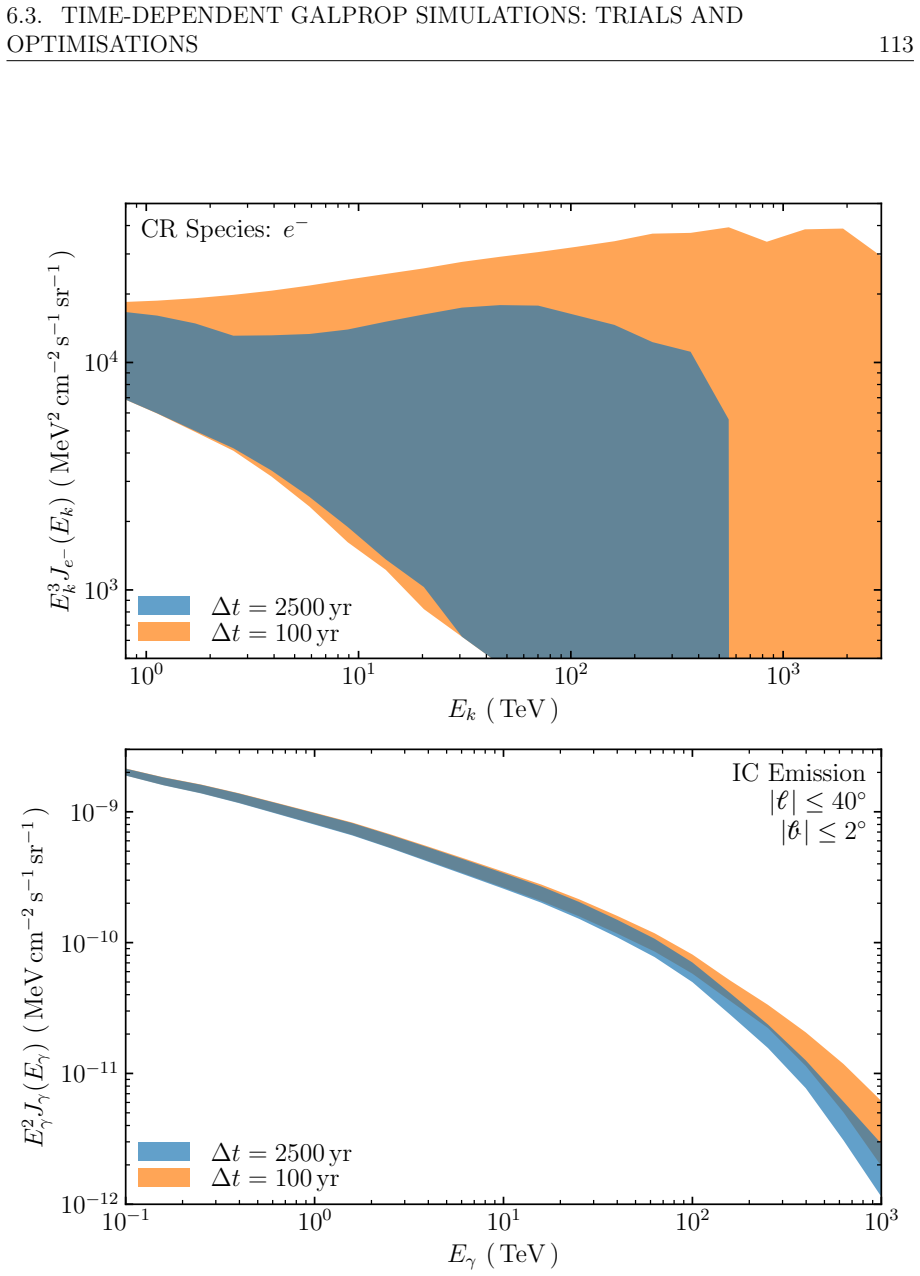
GALPROP's steady-state, diffusion-plus-reacceleration models of Galactic cosmic-ray transport, with a rigidity-dependent diffusion coefficient fitted to local cosmic-ray data, produce diffuse gamma-ray skies that are broadly compatible with the HGPS large-scale emission once catalogued sources are masked and an unresolved-source component is included. The same models match LHAASO's diffuse PeV observations, so the demonstrated accuracy extends from the GeV regime into the TeV-PeV regime. At 1 TeV, electrons contribute roughly half of the large-scale emission; above 1 TeV the choice of Galactic magnetic field model changes the predicted emission by about a factor of two; and in time-dependent runs the electron flux at Earth above 1 TeV varies by more than a factor of ten over a few million years. The proposed CTA Galactic plane survey should be sensitive enough to detect the large-scale diffuse TeV emission.
Load-bearing premise
The load-bearing premise is that cosmic-ray transport in the Milky Way is smooth and direction-independent, with a single energy-dependent diffusion coefficient that remains valid up to PeV energies.
Editorial extensions
If this is right
- GALPROP can serve as a diffuse background model for TeV-PeV gamma-ray analyses, in the same role it already plays at GeV energies for Fermi-LAT.
- Because electrons contribute about half of the 1 TeV large-scale emission, TeV source studies must account for inverse-Compton and bremsstrahlung emission, not only pion decay from hadronic interactions.
- The factor-of-two sensitivity to the Galactic magnetic field above 1 TeV means magnetic-field uncertainty is a leading limitation on diffuse TeV predictions, not just the source distribution.
- Time variability of the multi-TeV electron flux at Earth implies that single-epoch electron measurements must be interpreted cautiously.
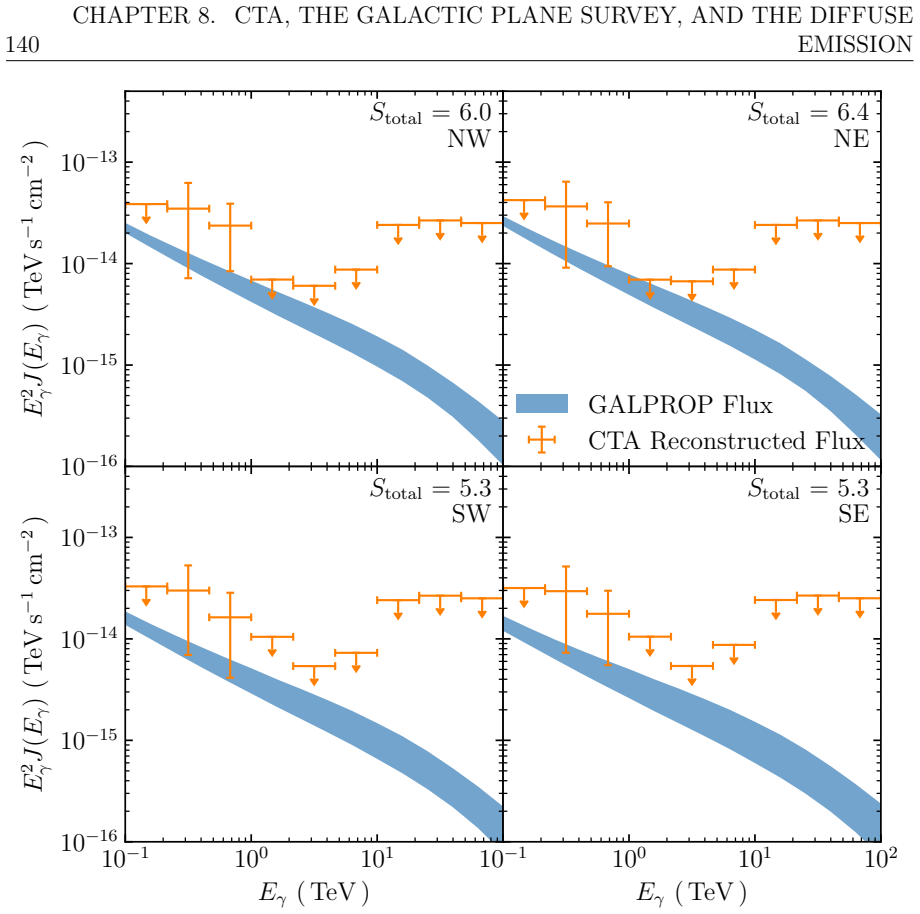
- The planned CTA Galactic plane survey will be sensitive enough to observe the large-scale diffuse TeV gamma-ray emission directly.
Reading between the lines
- The author leaves implicit that the same source-masking and sliding-window comparison could be applied to other air-shower observatories with wider sky coverage, providing a cross-check of the claimed TeV-PeV agreement at intermediate latitudes and longitudes.
- The narrow spread in fitted diffusion indices across the five source distributions suggests the TeV-PeV agreement is not strongly sensitive to the spiral-arm versus disk decomposition; a testable extension would compare the model's outer-Galaxy longitude profile to observations, where the source distribution matters most.
- If the predicted multi-TeV electron variability is real, searches for nearby, recently active cosmic-ray accelerators could target the corresponding gamma-ray hotspots on million-year timescales, a consequence the paper does not chase.
- The magnetic-field sensitivity above 1 TeV implies that future diffuse TeV surveys, combined with an independently pinned-down unresolved-source fraction, could be used to discriminate between Galactic magnetic-field models.
Signed reviews
Editorial analysis
A structured set of objections, weighed in public.
Referee Report
Summary. This thesis-style manuscript presents simulations of Galactic cosmic-ray (CR) transport with GALPROP, computing gamma-ray emission from 1 TeV to 1 PeV. Diffusion and injection parameters are fitted to local CR spectra from AMS-02 and Voyager, and the resulting predictions are compared with the H.E.S.S. Galactic plane survey (HGPS) after masking 78 catalogued sources, applying an integration beam, and adding an unresolved-source contribution. The manuscript also quantifies the modelling variation induced by choices of CR source distribution, interstellar radiation field, and Galactic magnetic field, and investigates time-dependent CR injection and the resulting variability of the TeV electron flux at Earth. The central claim is that GALPROP predictions are broadly compatible with the HGPS large-scale emission in the TeV regime and agree with LHAASO observations in the PeV regime, extending the validated energy range of GALPROP. The final chapter discusses the detectability of the diffuse Galactic emission with CTA.
Significance. If the agreement claim is established, the work would extend GALPROP's demonstrated accuracy into the TeV–PeV regime and would provide a useful reference for CTA background modelling. The manuscript has several genuine strengths: the optimisation parameters are reported in Table 2.4, the comparisons to HGPS and LHAASO use data not included in the fit (an external benchmark), the sliding-window analysis is explicitly tested for robustness to window width and spacing, and the systematic exploration of ISRF, source-distribution, GMF, and stochastic source-placement uncertainties is a useful contribution. The time-dependent study of TeV electron variability is also physically interesting. However, the support for the headline agreement claim is currently under-quantified, and the HGPS leg in particular rests on a lower-limit dataset corrected by an unresolved-source estimate that spans a factor of several.
major comments (3)
- [§3.4.1, §4.3.1–4.3.2] The HGPS comparison is the load-bearing part of the TeV agreement claim, but the observed quantity is a one-sided lower limit. Section 3.4.1 explicitly states that the adaptive-ring background method can include the large-scale gamma-ray emission in the off regions and that 'the HGPS flux can only be considered as a lower limit on the true large-scale gamma-ray emission'; Section 3.4 adds that the large-scale component was not detected at the 5σ level. After masking the 78 catalogued sources and adding an unresolved-source estimate ranging from 13% to 60% of the large-scale flux, the manuscript concludes 'broad compatibility' but reports no quantitative goodness-of-fit (no chi-square, residual RMS, or coverage fraction) for the corrected intensity profile. With a lower limit plus a factor-of-several additive correction, a model can be declared compatible over a wide range of model bias. I request a quantitative residual analysis against the corrected profile, with the full systematic band propagated, or a softened statement of the TeV agreement in the abstract and conclusion.
- [§4.3.2] The unresolved-source fraction is a dominant systematic: the text cites Steppa and Egberts (2020) at 13% and Cataldo et al. (2020) at 60% of the large-scale flux. The manuscript does not show how the GALPROP-to-HGPS comparison changes across this range, nor does it state which value is adopted for the final agreement claim. Because the add-back directly shifts the data by as much as a factor of ~1.7 between the low and high estimates, the agreement could be an artifact of the chosen value. The authors should display the sliding-window residual for at least the 13%, ~35%, and 60% cases, or explicitly justify a single adopted value and demonstrate that the conclusion is insensitive to it.
- [§2.7.1, Eq. (2.13)] The diffusion coefficient is assumed isotropic, homogeneous, and a single power law in rigidity, D(E) = beta D0 (rho/4 GV)^delta, with delta ≈ 0.34–0.35 fitted to CR spectra that are most constraining at GeV–TeV energies. The manuscript's PeV claim relies on extrapolating this parametrisation to PeV rigidities, where the gyroradius approaches the Galactic disk thickness and transport assumptions can change. The abstract asserts agreement with LHAASO, but the provided text does not quantify the constraining power of that comparison (e.g., what range of D0 and delta is excluded by the LHAASO data, or the systematic uncertainty from the assumed homogeneous isotropic diffusion). I ask the authors to state explicitly what the LHAASO comparison tests and to present the resulting allowed parameter range, or to qualify the PeV agreement claim accordingly.
minor comments (4)
- [Abstract] The phrase 'agree with observations of the diffuse gamma rays in the TeV regime by H.E.S.S.' overstates the result given the caveats in §3.4.1 and §4.3.2; a more precise wording such as 'broadly consistent with the HGPS large-scale emission after source masking and unresolved-source corrections' would match the analysis actually presented.
- [§3.4.1 / Chapter 4] The lower-limit nature of the HGPS flux is stated in §3.4.1 but is not restated when the comparison pipeline is built in Chapter 4; readers of the comparison figures in Chapter 5 may not realize the observed profile is biased low. A brief reminder sentence at the start of §4.3 would improve clarity.
- [§4.2.2] The residual from applying the telescopic beam to GALPROP can reach 10% for features smaller than 0.2°, and the text states the effect on the sliding-window profile is 'on the order of one part in ten thousand'. Showing the maximum residual over the longitudinal profile rather than a single descriptive value would make this robustness statement more transparent.
- [§2.2.4, Eqs. (2.44)–(2.47)] The cooling-distance equations mix D0 in cm^2 s^-1 with distances in parsecs and times in years without an explicit unit conversion; a brief note on the conversion factors used would prevent confusion for readers implementing these estimates.
Circularity Check
No constructional circularity: the GALPROP transport parameters are fitted to local CR spectra, while the TeV–PeV gamma-ray comparison uses independent HGPS/LHAASO data.
full rationale
The central derivation chain is not circular by construction. The diffusion coefficient, injection spectral indices, and normalisations are fitted to AMS-02 and Voyager cosmic-ray spectra at the Solar position (Section 2.7.1), and the resulting propagated CR populations are then used to predict the Galactic gamma-ray emission. The HGPS and LHAASO diffuse gamma-ray data are not used in this fit, so the comparison in the abstract is an external benchmark rather than a restatement of the input. The HGPS comparison does rely on masking catalogued sources and adding an unresolved-source contribution whose literature range is 13–60%, and the paper itself notes that the adaptive-ring background makes the public HGPS flux maps lower limits on the large-scale emission; these are important caveats that weaken the strength of the claimed agreement, but they are observational-systematic uncertainties rather than a reduction of the prediction to its inputs. The main self-citations, Marinos et al. 2023 and 2025, are papers embedded in this thesis and therefore do not provide independent support, but they are not load-bearing for the central comparison: the HGPS/LHAASO agreement is computed from the model and external sky maps, not derived from those citations. No equation or fitted parameter is renamed as a prediction, and no uniqueness or ansatz is imported solely from the authors' prior work. Thus the appropriate finding is no significant circularity, with the minor self-citation issue reflected in the non-zero end of the 0–2 band.
Assumptions & free parameters
free parameters (8)
- D_xx,0 (diffusion coefficient normalisation at 4 GV) =
4.36, 4.39, 4.55, 4.67, 4.66 x 1e28 cm^2/s (SA0 to SA100)
- delta (diffusion spectral index) =
0.354, 0.349, 0.344, 0.340, 0.339
- v_Alfven (reacceleration velocity) =
17.8, 18.2, 18.1, 19.8, 19.1 km/s
- Proton injection spectrum (J_p, eta_p0/1/2, break rigidities) =
J_p 4.096-4.394 x 1e-9, indices and breaks in Table 2.4
- Electron injection spectrum (J_e, eta_e0/1/2, break rigidities) =
J_e 3.925-4.502 x 1e-10, indices and breaks in Table 2.4
- Helium injection spectrum (eta_He0/1/2, break rigidities) =
indices and breaks in Table 2.4
- Heavy nuclei Z>=3 injection spectrum (eta_Z0/1/2, breaks) =
indices and breaks in Table 2.4
- Sliding-window analysis parameters =
-1.5 deg < b < 1.0 deg, Delta_w = 15 deg, Delta_s = 1 deg
assumptions (7)
- standard math CR transport obeys the Ginzburg-Syrovatskii diffusion equation with source, diffusion, convection, reacceleration, and loss terms.
- domain assumption The spatial diffusion coefficient is isotropic and homogeneous, with a single power-law in rigidity.
- domain assumption CR sources trace the Galactic disk and spiral arm distributions derived from pulsars and SNRs.
- domain assumption ISM gas maps from HI4PI, CO surveys, dark gas corrections, and the NE2001 HII model adequately represent the gas distribution.
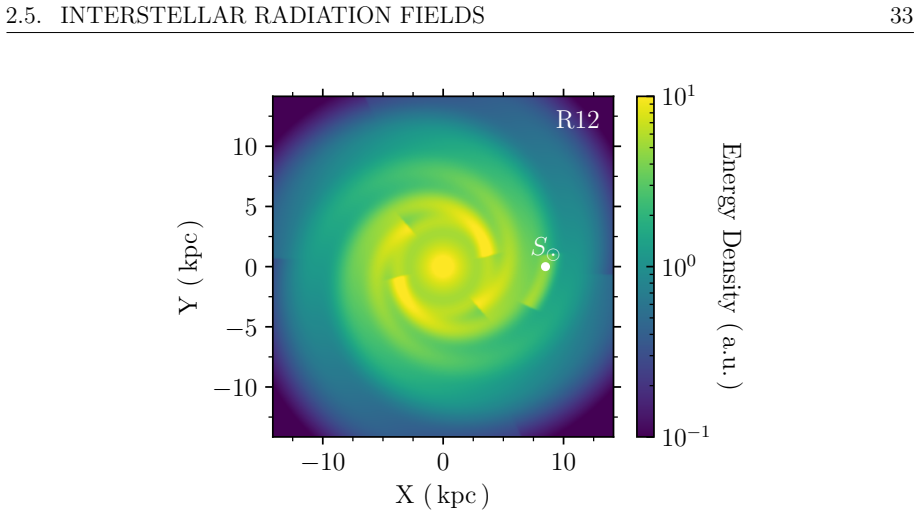
- domain assumption The F98 and R12 ISRF models bracket the true interstellar radiation field.
- domain assumption The GMF is represented by GASE or PBSS models; halo component of Pshirkov is neglected following Porter et al. 2017.
- domain assumption The unresolved source fraction in the HGPS lies in the 13-60 percent range from Steppa and Egberts 2020 and Cataldo et al. 2020.
invented entities (1)
-
none
Cite this review
Pith. "Pith review of High-Energy Cosmic-Ray Propagation in the Milky Way and the Associated Diffuse Gamma-Ray Emission." pith.science (2026). https://pith.science/paper/YTZJCKX7
@misc{pith2026250418796,
  author       = {Pith},
  title        = {Pith review of: High-Energy Cosmic-Ray Propagation in the Milky Way and the Associated Diffuse Gamma-Ray Emission},
  year         = {2026},
  howpublished = {\url{https://pith.science/paper/YTZJCKX7}},
  note         = {Machine review of arXiv:2504.18796}
}
abstract
Simulations of Galactic CR transport were performed with the software GALPROP, with the resulting gamma-ray flux calculated up to the PeV regime. The impact of altering parameters such as the number and distribution of CR sources, the distribution of infrared radiation between stars, and the distribution and strength of the Galactic magnetic field (GMF), were investigated. For the first time the modelling variation in the TeV predictions due to uncertainties in the Galactic distributions was quantified. Additionally, the modelling variation from considering a stochastic placement of the CR sources was quantified up to 1 PeV. The simulation results were compared to the most detailed Galactic TeV gamma-ray survey: the H.E.S.S. Galactic plane survey (HGPS). The GALPROP predictions were broadly compatible with the large-scale emission from the HGPS after accounting for both the catalogued sources and estimates of the unresolved source fraction. At 1 TeV the gamma-ray emission from CR electrons was found to contribute $\sim$50\% to the large-scale emission. The GMF was found to be an important modelling consideration above 1 TeV as it impacted the large-scale emission by approximately a factor of two. Additionally, the CR electron flux at Earth above 1 TeV was found to vary by over a factor of ten over a period of a few million years due. The GALPROP models were found to agree with observations of the diffuse gamma rays in the TeV regime by H.E.S.S., and the PeV regime by LHAASO, extending the demonstrated accuracy of GALPROP into the TeV--PeV regime. The results will also inform the next generation of experiments, such as the Cherenkov telescope array (CTA), on possible observation strategies and background considerations. It was also found that the proposed CTA Galactic plane survey will be sensitive enough to observe the large-scale diffuse gamma-ray emission in the TeV regime.
Figures


Figures from the paper (92 more)










Forward citations
Cited by 1 Pith paper
-
Uncertainty in Hadronic Diffuse $\gamma$-Ray Emission from the Temporal Stochasticity of Cosmic-Ray Sources
Temporal stochasticity of cosmic-ray sources causes a normalization uncertainty in the local proton flux that propagates into a hadronic gamma-ray uncertainty of 30-100%, comparable to or exceeding experimental errors...
Reference graph
Works this paper leans on
-
[1]
Observation of High-Energy Neutrinos from the Galactic Plane
Abbasi, R., M. Ackermann, J. Adams, et al. (June 2023). “Observation of High-Energy Neutrinos from the Galactic Plane”. Science 380.6652, pp. 1338–1343. Abdalla, H., A. Abramowski, F. Aharonian, et al. (Apr. 2018a). “A Search for New Supernova Remnant Shells in the Galactic Plane with H.E.S.S.” A&A 612, A8. Abdalla, H., A. Abramowski, F. Aharonian, et al....
2023
-
[3]
The Spectrum and Morphology of the Fermi Bubbles
Ackermann, M., A. Albert, W. B. Atwood, et al. (Sept. 2014). “The Spectrum and Morphology of the Fermi Bubbles”. ApJ 793.1, p
2014
-
[5]
SNR and Fluctuations in the Diffuse Galactic 𝛾-Ray Continuum
International Cosmic Ray Conference, pp. 1964–1967. Strong, A. W. and I. V. Moskalenko (Oct. 2001b). “SNR and Fluctuations in the Diffuse Galactic 𝛾-Ray Continuum”.Gamma 2001: Gamma-Ray Astrophysics. Ed. by Steven Ritz, Neil Gehrels, and Chris R. Shrader. Vol
work page 1964
-
[6]
Fermi Large Area Telescope First Source Catalog
Abdo, A. A., M. Ackermann, M. Ajello, et al. (June 2010). “Fermi Large Area Telescope First Source Catalog”. ApJS 188.2, pp. 405–436. Abdollahi, S., F. Acero, M. Ackermann, et al. (Mar. 2020). “Fermi Large Area Telescope Fourth Source Catalog”. ApJS 247.1, p
2010
-
[8]
A Joint Spectro-Imaging Analysis of the XMM-Newton and H.E.S.S. Observations of the Supernova Remnant RX J1713.7– 3946
Acero, F., J. Ballet, A. Decourchelle, et al. (Oct. 2009). “A Joint Spectro-Imaging Analysis of the XMM-Newton and H.E.S.S. Observations of the Supernova Remnant RX J1713.7– 3946”. A&A 505.1, pp. 157–167. Acero, F., A. Bamba, S. Casanova, et al. (Mar. 2013). “Gamma-Ray Signatures of Cosmic Ray Acceleration, Propagation, and Confinement in the Era of CTA”....
2018
-
[9]
Fermipy: An Open-Source Python Package for Analysis of Fermi-LAT Data
Wood, M., R. Caputo, E. Charles, et al. (July 2017). “Fermipy: An Open-Source Python Package for Analysis of Fermi-LAT Data”.35th International Cosmic Ray Conference (ICRC2017). Vol
work page 2017
-
[10]
Bremsstrahlung, Synchrotron Radi- ation, and Compton Scattering of High-Energy Electrons Traversing Dilute Gases
Blementhal, G. R. and R. J. Gould (Apr. 1970). “Bremsstrahlung, Synchrotron Radi- ation, and Compton Scattering of High-Energy Electrons Traversing Dilute Gases”. Rev. Mod. Phys. 42 (2), pp. 237–270. Bloom, Steven D. and Alan P. Marscher (Apr. 1996). “An Analysis of the Synchrotron Self-Compton Model for the Multi–Wave Band Spectra of Blazars”. ApJ 461, p
1970
-
[13]
Hill, John M. (June 2010). “The Large Binocular Telescope”. Appl. Opt. 49.16, pp. D115– D122. Hillas, A. M. (Aug. 1985). “Cerenkov Light Images of EAS Produced by Primary Gamma Rays and by Nuclei”.19th International Cosmic Ray Conference (ICRC19), Volume
work page 2010
Show all 98 references
-
[14]
Jauch, J. M. and F. Rohrlich (1976).The Theory of Photons and Electrons The Rela- tivistic Quantum Field Theory of Charged Particles with Spin One-Half. 2nd ed
1976
-
[15]
Stochastic Nature of Galactic Cosmic-Ray Sources
Evoli, Carmelo, Elena Amato, Pasquale Blasi, et al. (Dec. 2021). “Stochastic Nature of Galactic Cosmic-Ray Sources”. PhRvD 104.12, p. 123029. Evoli, Carmelo, Daniele Gaggero, Dario Grasso, et al. (Oct. 2008). “Cosmic Ray Nuclei, Antiprotons and Gamma Rays in the Galaxy: A New ...
2021
-
[16]
The Three- Dimensional Spatial Distribution of Interstellar Gas in the Milky Way: Implications for Cosmic Rays and High-Energy Gamma-Ray Emissions
Jóhannesson, Guđlaugur, T. A. Porter, and I. V. Moskalenko (Mar. 2018). “The Three- Dimensional Spatial Distribution of Interstellar Gas in the Milky Way: Implications for Cosmic Rays and High-Energy Gamma-Ray Emissions”. ApJ 856.1, p
2018
-
[18]
The Milky Way in Molecular Clouds: A New Complete CO Survey
Dame, T. M., D. Hartmann, and P. Thaddeus (Feb. 2001). “The Milky Way in Molecular Clouds: A New Complete CO Survey”. ApJ 547.2, pp. 792–813. Deil, C., R. Zanin, J. Lefaucheur, et al. (Jan. 2017). “Gammapy – A Prototype for the CTA Science Tools”.35th International Cosmic Ray ...
2001
-
[19]
Setting an Upper Limit for the Total TeV Neutrino Flux from the Disk of Our Galaxy
Vecchiotti, V., F. L. Villante, and G. Pagliaroli (Sept. 2023). “Setting an Upper Limit for the Total TeV Neutrino Flux from the Disk of Our Galaxy”. JCAP 2023.9, p
2023
-
[20]
Chemistry in Cosmic Ray Dominated Regions
Bayet, E., D. A. Williams, T. W. Hartquist, et al. (June 2011). “Chemistry in Cosmic Ray Dominated Regions”. MNRAS 414.2, pp. 1583–1591. Beck, R. (Oct. 2001). “Galactic and Extragalactic Magnetic Fields”. Space Sci. Rev. 99, pp. 243–260. Becker Tjus, Julia and Lukas Merten (Au...
1990
-
[27]
The Mopra Southern Galactic Plane CO Survey – Data Release 1
Braiding, Catherine, M. G. Burton, R. Blackwell, et al. (May 2015). “The Mopra Southern Galactic Plane CO Survey – Data Release 1”. PASA 32, e020. Braiding, Catherine, G. F. Wong, N. I. Maxted, et al. (Aug. 2018). “The Mopra Southern Galactic Plane CO Survey—Data Release 3”. P...
2015
-
[30]
Cosmic-Ray Electrons and the Diffuse Gamma-Ray Spectrum
Porter, T. A. and R. J. Protheroe (Nov. 1997). “Cosmic-Ray Electrons and the Diffuse Gamma-Ray Spectrum”. J. Phys. G 23.11, pp. 1765–1784. Porter, T. A., G. P. Rowell, G. Jóhannesson, et al. (Aug. 2018). “Galactic PeVatrons and Helping to Find Them: Effects of Galactic Absorpt...
1997
-
[31]
Stochastic Cosmic-Ray Sources and the TeV Break in the All-Electron Spectrum
Mertsch, Philipp (Nov. 2018). “Stochastic Cosmic-Ray Sources and the TeV Break in the All-Electron Spectrum”. JCAP 2018.11, p
2018
-
[33]
Cosmic-Ray Electron-Positron Spectrum from 7GeV to 2TeV with the Fermi Large Area Telescope
Abdollahi, S., M. Ackermann, M. Ajello, et al. (Apr. 2017). “Cosmic-Ray Electron-Positron Spectrum from 7GeV to 2TeV with the Fermi Large Area Telescope”. PhRvD 95.8, p. 082007. Abe, S., A. Aguasca-Cabot, I. Agudo, et al. (May 2023). “Multiwavelength Study of the Galactic PeVa...
2017
-
[37]
On the Origin of the Cosmic Radiation
Fermi, E. (Apr. 1949). “On the Origin of the Cosmic Radiation”. Phys. Rev. 75 (8), pp. 1169–1174. BIBLIOGRAPHY 169 Ferrando, P., W. R. Webber, P. Goret, et al. (Apr. 1988). “Measurement of12C, 16O, and 56Fe Charge Changing Cross Sections in Helium at High Energy, Comparison wi...
1949
-
[39]
Multiple Galactic Sources with Emission Above 56TeV Detected by HAWC
Abeysekara, A. U., A. Albert, R. Alfaro, et al. (Jan. 2020). “Multiple Galactic Sources with Emission Above 56TeV Detected by HAWC”. PhRvL 124.2. Abramowski, A., F. Acero, F. Aharonian, et al. (July 2011a). “A New SNR with TeV Shell-Type Morphology: HESS J1731–347”. A&A 531, A...
2020
-
[41]
The Trigono- metric Parallax of the Neutron Star Geminga
Faherty, Jacqueline, Frederick M. Walter, and Jay Anderson (Apr. 2007). “The Trigono- metric Parallax of the Neutron Star Geminga”. Ap&SS 308.1–4, pp. 225–230. Fang, Ke and Kohta Murase (Oct. 2021). “Multimessenger Implications of Sub-PeV Diffuse Galactic Gamma-Ray Emission”. ...
2007
-
[42]
Array Programming with NumPy
Harris, Charles R., K. Jarrod Millman, Stéfan J. van der Walt, et al. (Sept. 2020). “Array Programming with NumPy”. Nature 585.7825, pp. 357–362. Hartman, R. C., D. L. Bertsch, S. D. Bloom, et al. (July 1999). “The Third EGRET Catalog of High-Energy Gamma-Ray Sources”. ApJS 12...
1954
-
[44]
Limits on the Diffuse Gamma-Ray Background Above 10TeV with HAWC
Albert, A., R. Alfaro, C. Alvarez, et al. (Sept. 2022a). “Limits on the Diffuse Gamma-Ray Background Above 10TeV with HAWC”. arXiv e-prints, arXiv:2209.08106. Albert, A., R. Alfaro, J. C. Arteaga-Velázquez, et al. (Nov. 2022b). “Validation of Stan- dardized Data Formats and To...
2019 arXiv
-
[45]
Diffusive Propagation of Cosmic Rays from Supernova Remnants in the Galaxy. I: Spectrum and Chemical Composition
Blasi, Pasquale and Elena Amato (Jan. 2012). “Diffusive Propagation of Cosmic Rays from Supernova Remnants in the Galaxy. I: Spectrum and Chemical Composition”. JCAP 2012.1, p
2012
-
[47]
Secondary Production of Neutral pi-Mesons and the Diffuse Galactic Gamma Radiation
168 BIBLIOGRAPHY Dermer, C. D. (Mar. 1986b). “Secondary Production of Neutral pi-Mesons and the Diffuse Galactic Gamma Radiation”. A&A 157.2, pp. 223–229. Di Sciascio, G (Oct. 2016). “The LHAASO experiment: From Gamma-Ray Astronomy to Cosmic Rays”. Nucl. Part. Phys. Proc. 279–...
2016
-
[48]
Propagation of Cosmic-Ray Nucleons in the Galaxy
Strong, Andrew W. and Igor V. Moskalenko (Dec. 1998). “Propagation of Cosmic-Ray Nucleons in the Galaxy”. ApJ 509.1, pp. 212–228. Strong, Andrew W., Igor V. Moskalenko, and Vladimir S. Ptuskin (Nov. 2007). “Cosmic- Ray Propagation and Interactions in the Galaxy”. Annu. Rev. Nu...
1998
-
[50]
The TeV Gamma-Ray Luminosity of the Milky Way and the Contribution of H.E.S.S. Unresolved Sources to Very High Energy Diffuse Emission
Cataldo, M., G. Pagliaroli, V. Vecchiotti, et al. (Nov. 2020). “The TeV Gamma-Ray Luminosity of the Milky Way and the Contribution of H.E.S.S. Unresolved Sources to Very High Energy Diffuse Emission”. ApJ 904.2, p
2020
-
[54]
The Leiden/ Argentine/Bonn (LAB) Survey of Galactic HI: Final Data Release of the Combined LDS and IAR Surveys with Improved Stray-Radiation Corrections
Kalberla, P. M. W., W. B. Burton, L. Hartmann, et al. (Sept. 2005). “The Leiden/ Argentine/Bonn (LAB) Survey of Galactic HI: Final Data Release of the Combined LDS and IAR Surveys with Improved Stray-Radiation Corrections”. A&A 440.2, pp. 775–782. Kamae, Tuneyoshi, Niklas Karl...
2017
-
[55]
Cosmic-Ray Propagation in Light of the Recent Observation of Geminga
Jóhannesson, Guđlaugur, Troy A. Porter, and Igor V. Moskalenko (July 2019). “Cosmic-Ray Propagation in Light of the Recent Observation of Geminga”. ApJ 879.2, p
2019
-
[62]
Analytic Solution for Self-regulated Collective Escape of Cosmic Rays from Their Acceleration Sites
Malkov, M. A., P. H. Diamond, R. Z. Sagdeev, et al. (May 2013). “Analytic Solution for Self-regulated Collective Escape of Cosmic Rays from Their Acceleration Sites”. ApJ 768.1, p
2013
-
[64]
Design Concepts for the Cherenkov Telescope Array CTA: an Advanced Facility for Ground-Based High-Energy Gamma- Ray Astronomy
Actis, M., G. Agnetta, F. Aharonian, et al. (Dec. 2011). “Design Concepts for the Cherenkov Telescope Array CTA: an Advanced Facility for Ground-Based High-Energy Gamma- Ray Astronomy”. Exp. Astron. 32.3, pp. 193–316. Adriani, O., Y. Akaike, K. Asano, et al. (Nov. 2023). “Dire...
2011
-
[65]
Population Synthesis of Pulsar Wind Nebulae and Pulsar Halos in the Milky Way – Predicted Contributions to the Very-High-Energy Sky
Martin, Pierrick, Luigi Tibaldo, Alexandre Marcowith, et al. (Oct. 2022). “Population Synthesis of Pulsar Wind Nebulae and Pulsar Halos in the Milky Way – Predicted Contributions to the Very-High-Energy Sky”. A&A 666, A7. Martinez, M. (Mar. 2013). “Introducing the CTA Concept”...
2022
-
[66]
Interstellar Radiation Field and Dust Temperatures in the Diffuse Interstellar Medium and in Giant Molecular Clouds
Mathis, J. S., P. G. Mezger, and N. Panagia (Nov. 1983). “Interstellar Radiation Field and Dust Temperatures in the Diffuse Interstellar Medium and in Giant Molecular Clouds”. A&A 128, pp. 212–229. Maxted, Nigel I., Gavin P. Rowell, Bruce R. Dawson, et al. (May 2012). “3 to 12...
1983
-
[67]
Deciphering Residual Emissions: Time-Dependent Models for the Nonthermal Interstellar Radiation from the Milky Way
Porter, T. A., G. Jóhannesson, and I. V. Moskalenko (Dec. 2019). “Deciphering Residual Emissions: Time-Dependent Models for the Nonthermal Interstellar Radiation from the Milky Way”. ApJ 887.2, p
2019
-
[68]
Probing the Hadronic Nature of the Gamma-Ray Emission Associated with Westerlund 2
Mestre, Enrique, Emma de Oña Wilhelmi, Diego F. Torres, et al. (Aug. 2021). “Probing the Hadronic Nature of the Gamma-Ray Emission Associated with Westerlund 2”. MNRAS 505.2, pp. 2731–2740. Mestre, Enrique, Diego F. Torres, Emma de Oña Wilhelmi, et al. (Dec. 2022). “Testing So...
2021
-
[71]
ROSAT Observation of a New Supernova Remnant in the Constellation Scorpius
Pfeffermann, E. and B. Aschenbach (Feb. 1996). “ROSAT Observation of a New Supernova Remnant in the Constellation Scorpius”.Roentgenstrahlung from the Universe. Ed. by H. U. Zimmermann, J. Trümper, and H. Yorke, pp. 267–268. Popescu, C. C., R. Yang, R. J. Tuffs, et al. (Sept. ...
1996
-
[73]
A Closer Look at HESS J1837–069 Following the Pulsar Discovery
Marandon, V., A. Djannati-Atai, R. Terrier, et al. (Dec. 2008). “A Closer Look at HESS J1837–069 Following the Pulsar Discovery”.American Institute of Physics BIBLIOGRAPHY 173 Conference Series. Ed. by Felix A. Aharonian, Werner Hofmann, and Frank Rieger. Vol
2008
-
[75]
Inverse Compton Origin of the Hard X-Ray and Soft Gamma-Ray Emission from the Galactic Ridge
Porter, Troy A., Igor V. Moskalenko, Andrew W. Strong, et al. (July 2008). “Inverse Compton Origin of the Hard X-Ray and Soft Gamma-Ray Emission from the Galactic Ridge”. ApJ 682.1, pp. 400–407. Press, William H., Saul A. Teukolsky, William T. Vetterling, et al. (1992).Numeric...
1992
-
[76]
Modeling the Gamma-Ray Emission Produced by Runaway Cosmic Rays in the Environment of RX J1713.7–3946
Casanova, Sabrina, David I. Jones, Felix A. Aharonian, et al. (Oct. 2010). “Modeling the Gamma-Ray Emission Produced by Runaway Cosmic Rays in the Environment of RX J1713.7–3946”. Publ. Astron. Soc. Jpn. 62.5, pp. 1127–1134. Cataldo, M., G. Pagliaroli, V. Vecchiotti, et al. (D...
2010
-
[77]
MeasurementofUltra-High-EnergyDif- fuse Gamma-Ray Emission of the Galactic Plane from 10TeV to 1PeV with LHAASO- KM2A
Cao,Zhen,F.Aharonian,Q.An,etal.(Oct.2023).“MeasurementofUltra-High-EnergyDif- fuse Gamma-Ray Emission of the Galactic Plane from 10TeV to 1PeV with LHAASO- KM2A”. PhRvL 131.15, p. 151001. Cao, Zhen, F. Aharonian, Axikegu, et al. (Feb. 2025). “Measurement of Very-High-Energy Di...
2023
-
[78]
A New Multitracer Approach to Defining the Spiral Arm Width in the Milky Way
Vallée, Jacques P. (June 2020). “A New Multitracer Approach to Defining the Spiral Arm Width in the Milky Way”. ApJ 896.1, p
2020
-
[85]
Stochastic Problems in Physics and Astronomy
Chandrasekhar, S. (Jan. 1943). “Stochastic Problems in Physics and Astronomy”. Rev. Mod. Phys. 15.1, pp. 1–89. Chen, En-Sheng, Kun Fang, and Xiao-Jun Bi (Nov. 2024). “A New Perspective on the Diffuse Gamma-Ray Emission Excess”. Chinese Phys. C 48.11, p. 115105. BIBLIOGRAPHY 16...
1937
-
[86]
Fermi-LAT Observations of the Diffuse𝛾-Ray Emission: Implications for Cosmic Rays and the Interstellar Medium
Ackermann, M., M. Ajello, W. B. Atwood, et al. (Apr. 2012). “Fermi-LAT Observations of the Diffuse𝛾-Ray Emission: Implications for Cosmic Rays and the Interstellar Medium”. ApJ 750.1, p
2012
-
[90]
Unresolved Sources Naturally Contribute to PeV Gamma-Ray Diffuse Emission Observed by Tibet AS𝛾
Vecchiotti, V., F. Zuccarini, F. L. Villante, et al. (Mar. 2022). “Unresolved Sources Naturally Contribute to PeV Gamma-Ray Diffuse Emission Observed by Tibet AS𝛾”. ApJ 928.1, p
2022
-
[91]
Physics of Compact Nonthermal Sources. I. Theory of Radiation Processes
BIBLIOGRAPHY 171 Jones, T. W., S. L. O’Dell, and W. A. Stein (Mar. 1974). “Physics of Compact Nonthermal Sources. I. Theory of Radiation Processes”. ApJ 188, pp. 353–368. Kachelrieß, M., I. V. Moskalenko, and S. Ostapchenko (Dec. 2019). “AAfrag: Interpolation Routines for Mont...
1974
-
[92]
SciPy 1.0: Funda- mental Algorithms for Scientific Computing in Python
Virtanen, Pauli, Ralf Gommers, Travis E. Oliphant, et al. (Feb. 2020). “SciPy 1.0: Funda- mental Algorithms for Scientific Computing in Python”. Nat. Methods 17, pp. 261–
2020
-
[93]
Two-zone Diffusion of Electrons and Positrons from Geminga Explains the Positron Anomaly
Fang, Kun, Xiao-Jun Bi, Peng-Fei Yin, et al. (Aug. 2018). “Two-zone Diffusion of Electrons and Positrons from Geminga Explains the Positron Anomaly”. ApJ 863.1, p
2018
-
[94]
The Spitzer and GLIMPSE Surveys: A New View of the Milky Way
Churchwell, Ed, Brian L. Babler, Marilyn R. Meade, et al. (Mar. 2009). “The Spitzer and GLIMPSE Surveys: A New View of the Milky Way”. PASP 121.877, p
2009
-
[96]
FOREST Unbiased Galactic Plane Imaging Survey with the Nobeyama 45m Telescope (FUGIN). I. Project Overview and Initial Results
Umemoto, Tomofumi, Tetsuhiro Minamidani, Nario Kuno, et al. (Oct. 2017). “FOREST Unbiased Galactic Plane Imaging Survey with the Nobeyama 45m Telescope (FUGIN). I. Project Overview and Initial Results”. Publ. Astron. Soc. Jpn. 69.5, p
2017
-
[107]
The Mopra Southern Galactic Plane CO Survey – Data Release 4 – Complete Survey
Çubuk, K. O., M. G. Burton, C. Braiding, et al. (Sept. 2023). “The Mopra Southern Galactic Plane CO Survey – Data Release 4 – Complete Survey”. PASA 40, e047. Cummings, A. C., E. C. Stone, B. C. Heikkila, et al. (Nov. 2016). “Galactic Cosmic Rays in the Local Interstellar Medi...
2023
-
[111]
The HI/OH/Recombination Line Survey of the Inner Milky Way (THOR): Data Release 2 and HI Overview
Wang, Y., H. Beuther, M. R. Rugel, et al. (Feb. 2020). “The HI/OH/Recombination Line Survey of the Inner Milky Way (THOR): Data Release 2 and HI Overview”. A&A 634, A83. Webber, W. R. (Oct. 1998). “A New Estimate of the Local Interstellar Energy Density and Ionization Rate of ...
2020
-
[122]
Arcminute-Scale Studies of the Interstellar Gas Towards HESS J1804–216: Still an Unidentified TeV Gamma-Ray Source
Philosophi- cal Transactions of the Royal Society of London, pp. 125–162. Feijen, K., G. Rowell, S. Einecke, et al. (Dec. 2020). “Arcminute-Scale Studies of the Interstellar Gas Towards HESS J1804–216: Still an Unidentified TeV Gamma-Ray Source”. PASA
2020
-
[123]
Deriving the Global Structure of the Galactic Magnetic Field From Faraday Rotation Measures of Extragalactic Sources
Pshirkov, M. S., P. G. Tinyakov, P. P. Kronberg, et al. (Aug. 2011). “Deriving the Global Structure of the Galactic Magnetic Field From Faraday Rotation Measures of Extragalactic Sources”. ApJ 738.2, p
2011
-
[124]
Propagation Models for CR Nucleons and Electrons and Predictions of the Galactic Gamma-Ray Spectrum
Strong, A. W. and G. Youssefi (Jan. 1995). “Propagation Models for CR Nucleons and Electrons and Predictions of the Galactic Gamma-Ray Spectrum”.International Cosmic Ray Conference. Vol
1995
-
[126]
Stochastic Reacceleration of Cosmic Rays in the Interstellar Medium
Seo, E. S. and V. S. Ptuskin (Aug. 1994). “Stochastic Reacceleration of Cosmic Rays in the Interstellar Medium”. ApJ 431, p
1994
-
[136]
New Calculation of Antiproton Production by Cosmic Ray Protons and Nuclei
Kachelrieß, Michael, Igor V. Moskalenko, and Sergey S. Ostapchenko (Apr. 2015). “New Calculation of Antiproton Production by Cosmic Ray Protons and Nuclei”. ApJ 803.2, p
2015
-
[139]
A Model of the 2–35 micron Point Source Infrared Sky
Cohen, M. (May 1993). “A Model of the 2–35 micron Point Source Infrared Sky”. AJ 105, p
1993
-
[148]
High-Energy Cosmic Rays from Supernovae in Young Clusters of Massive Stars
Bykov, A. M., D. C. Ellison, M. E. Kalyashova, et al. (Dec. 2019). “High-Energy Cosmic Rays from Supernovae in Young Clusters of Massive Stars”. Rend. Lincei. Sci. Fis. Nat. 30, pp. 155–158. Bykov, Andrei M. (Nov. 2014). “Nonthermal Particles and Photons in Starburst Regions a...
2019
-
[155]
Unveiling Extensive Clouds of Dark Gas in the Solar Neighborhood
Grenier, Isabelle A., Jean-Marc Casandjian, and Régis Terrier (Feb. 2005). “Unveiling Extensive Clouds of Dark Gas in the Solar Neighborhood”. Science 307.5713, pp. 1292–
2005
-
[169]
Modelling the Galactic Very-High-Energy Gamma- Ray Source Population
Steppa, C. and K. Egberts (Nov. 2020). “Modelling the Galactic Very-High-Energy Gamma- Ray Source Population”. A&A 643, A137. Street, J. C. and E. C. Stevenson (Nov. 1937). “New Evidence for the Existence of a Particle of Mass Intermediate Between the Proton and Electron”. Phy...
2020
-
[192]
Effect of Random Nature of Cosmic-Ray Sources Supernova Remnants on Cosmic Ray Intensity Fluctuations, Anisotropy, and Electron Energy Spectrum
Ptuskin, V. S., F. C. Jones, E. S. Seo, et al. (Jan. 2006). “Effect of Random Nature of Cosmic-Ray Sources Supernova Remnants on Cosmic Ray Intensity Fluctuations, Anisotropy, and Electron Energy Spectrum”. Adv. Space Res. 37.10, pp. 1909–1912. Qiao, Bing-Qiang, Wei Liu, Meng-...
2006
-
[211]
NE2001.I. A New Model for the Galactic Distribution of Free Electrons and its Fluctuations
Cordes, J. M. and T. J. W. Lazio (July 2002). “NE2001.I. A New Model for the Galactic Distribution of Free Electrons and its Fluctuations”. arXiv e-prints, astro-ph/0207156. Cordes, J. M. and T. J. W. Lazio (Jan. 2003). “NE2001. II. Using Radio Propagation Data to Construct a ...
2002 arXiv
-
[213]
The Large-Scale Distribution of Molecular Gas in the First Galactic Quadrant
Clay, R. and B. Dawson (1997).Cosmic Bullets: High Energy Particles in Astrophysics. Frontiers of Science. St Leonards, N.S.W.: Allen & Unwin. Clemens, Dan P., David B. Sanders, and Nicholas Z. Scoville (Apr. 1988). “The Large-Scale Distribution of Molecular Gas in the First G...
1997
-
[250]
The GALPROP Cosmic-Ray Propagation and Nonthermal Emissions Framework: Release v57
BIBLIOGRAPHY 175 Porter, T. A., G. Jóhannesson, and I. V. Moskalenko (Sept. 2022). “The GALPROP Cosmic-Ray Propagation and Nonthermal Emissions Framework: Release v57”. ApJS 262.1, p
2022
-
[252]
Barashenkov, V. S. and A. Polanski (1994).Electronic Guide for Nuclear Cross-Sections: Version
1994
-
[271]
The Large Area Telescope on the Fermi Gamma-Ray Space Telescope Mission
Atwood, W. B., A. A. Abdo, M. Ackermann, et al. (June 2009). “The Large Area Telescope on the Fermi Gamma-Ray Space Telescope Mission”. ApJ 697.2, pp. 1071–1102. Auger, P., P. Ehrenfest, R. Maze, et al. (July 1939). “Extensive Cosmic-Ray Showers”. Rev. Mod. Phys. 11.3–4, pp. 2...
2009
-
[272]
Simulating Polarized Galactic Synchrotron Emission at all Frequencies. The Hammurabi Code
Waelkens, A., T. Jaffe, M. Reinecke, et al. (Feb. 2009). “Simulating Polarized Galactic Synchrotron Emission at all Frequencies. The Hammurabi Code”. A&A 495.2, pp. 697–
2009
-
[341]
Remarkable Symmetries in the Milky Way Disc’s Magnetic Field
Kronberg, P. P. and K. J. Newton-McGee (June 2011). “Remarkable Symmetries in the Milky Way Disc’s Magnetic Field”. PASA 28.2, pp. 171–176. Lagage, P. O. and C. J. Cesarsky (Sept. 1983). “The Maximum Energy of Cosmic Rays Accelerated by Supernova Shocks”. A&A 125, pp. 249–257....
2011
-
[377]
Pulsars and Local Cosmic Ray Prehistory
Lingenfelter, Richard E. (Dec. 1969). “Pulsars and Local Cosmic Ray Prehistory”. Nature 224.5225, pp. 1182–1186. Lipari, Paolo and Silvia Vernetto (Aug. 2018). “Diffuse Galactic Gamma-Ray Flux at Very High Energy”. PhRvD 98.4, p. 043003. Liu, Wei, Pierre Salati, and Xuelei Che...
1969
-
[379]
Electron-Ion Recombination on Grains and Polycyclic Aromatic Hydrocarbons
178 BIBLIOGRAPHY Weingartner, J. C. and B. T. Draine (Dec. 2001). “Electron-Ion Recombination on Grains and Polycyclic Aromatic Hydrocarbons”. ApJ 563.2, pp. 842–852. Wellisch, H. P. and D. Axen (Sept. 1996). “Total Reaction Cross Section Calculations in Proton-Nucleus Scatter...
2001
-
[445]
Can Diffusive Shock Acceleration in Supernova Remnants Account for High-Energy Galactic Cosmic Rays?
Hillas, A. M. (Apr. 2005). “Can Diffusive Shock Acceleration in Supernova Remnants Account for High-Energy Galactic Cosmic Rays?” J. Phys. G 31.5, R95–R131. Hinton, J. A. and W. Hofmann (Sept. 2009). “Teraelectronvolt Astronomy”. ARA&A 47.1, pp. 523–565. Holler, M., D. Berge, ...
2005 arXiv
-
[566]
Modelling the Galactic Magnetic Field on the Plane in Two Dimensions
Jaffe, T. R., J. P. Leahy, A. J. Banday, et al. (Jan. 2010). “Modelling the Galactic Magnetic Field on the Plane in Two Dimensions”. MNRAS 401, pp. 1013–1028. Jansson, R. and G. R. Farrar (Aug. 2012). “A New Model of the Galactic Magnetic Field”. ApJ 757.1, p
2010
-
[582]
The Displacement of the Sun from the Galactic Plane Using IRAS and FAUST Source Counts
Cohen, M. (May 1995). “The Displacement of the Sun from the Galactic Plane Using IRAS and FAUST Source Counts”. ApJ 444, p
1995
-
[587]
The GALPROP Cosmic-Ray Propagation Code
American Institute of Physics Conference Series, pp. 533–537. Strong, A. W., I. V. Moskalenko, T. A. Porter, et al. (July 2009). “The GALPROP Cosmic-Ray Propagation Code”. arXiv e-prints, arXiv:0907.0559. Strong, A. W., I. V. Moskalenko, T. A. Porter, et al. (2013).GALPROP Exp...
2013 arXiv
-
[621]
Cosmic Ray Propagation and Source Distribution
Lingenfelter, R. E. and R. Ramaty (Jan. 1971). “Cosmic Ray Propagation and Source Distribution”. 12th International Cosmic Ray Conference (ICRC12), Volume
1971
-
[657]
Inference of the Local Interstellar Spectra of Cosmic-Ray Nuclei Z≤ 28 with the GALPROP-HELMOD Framework
Boschini, M. J., S. Della Torre, M. Gervasi, et al. (Oct. 2020). “Inference of the Local Interstellar Spectra of Cosmic-Ray Nuclei Z≤ 28 with the GALPROP-HELMOD Framework”. ApJS 250.2, p
2020
-
[663]
A COBE Model of the Galactic Bar and Disk
Freudenreich, H. T. (Jan. 1998). “A COBE Model of the Galactic Bar and Disk”. ApJ 492, pp. 495–510. Fujita, Yutaka, Yutaka Ohira, and Fumio Takahara (Apr. 2010). “Slow Diffusion of Cosmic Rays Around a Supernova Remnant”. ApJL 712.2, pp. L153–L156. Funk, S., J. A. Hinton, Y. M...
1990
-
[676]
On the Rate of Core Collapse Supernovae in the Milky Way
Rozwadowska, Karolina, Francesco Vissani, and Enrico Cappellaro (Feb. 2021). “On the Rate of Core Collapse Supernovae in the Milky Way”. N. Astron. 83, p. 101498. Rybicki, George B. and Alan P. Lightman (1985).Radiative Processes in Astrophysics. John Wiley & Sons, Ltd. Sako, ...
1985
-
[705]
Pulsars and Very High-Energy Cosmic-Ray Electrons
Shen, C. S. (Dec. 1970). “Pulsars and Very High-Energy Cosmic-Ray Electrons”. ApJL 162, p. L181. Shen, C. S. and C. Y. Mao (Aug. 1971). “Anisotropy of High Energy Cosmic-Ray Electrons in the Discrete Source Model”. ApL 9, p
1970
-
[706]
A Model of the 8–25 micron Point Source Infrared Sky
Wainscoat, R. J., M. Cohen, K. Volk, et al. (Nov. 1992). “A Model of the 8–25 micron Point Source Infrared Sky”. ApJS 83, p
1992
-
[769]
Chal- lenging Cosmic-Ray Propagation with Antiprotons: Evidence for a “Fresh
American Institute of Physics Conference Series, pp. 1612–1617. Moskalenko, Igor V., Andrew W. Strong, Stepan G. Mashnik, et al. (Apr. 2003). “Chal- lenging Cosmic-Ray Propagation with Antiprotons: Evidence for a “Fresh” Nuclei Component?” ApJ 586.2, pp. 1050–1066. Moskalenko,...
2003
-
[789]
Gammapy: A Python Package for Gamma-Ray Astronomy
Donath, Axel, Régis Terrier, Quentin Remy, et al. (Oct. 2023). “Gammapy: A Python Package for Gamma-Ray Astronomy”. A&A 678, A157. Draine, B. T. and A. Li (Mar. 2007). “Infrared Emission from Interstellar Dust. IV. The Silicate-Graphite-PAH Model in the Post-Spitzer Era”. ApJ ...
2023
-
[797]
Discovery of Very High Energy Gamma-Ray Emission Coincident with Molecular Clouds in the W 28 (G6.4–0.1) Field
Aharonian, F., A. G. Akhperjanian, A. R. Bazer-Bachi, et al. (Apr. 2008b). “Discovery of Very High Energy Gamma-Ray Emission Coincident with Molecular Clouds in the W 28 (G6.4–0.1) Field”. A&A 481.2, pp. 401–410. Aharonian, F., H. Ashkar, M. Backes, et al. (Oct. 2022b). “A Dee...
2004
-
[817]
Surveys with the Cherenkov Telescope Array
Dubus, G., J. L. Contreras, S. Funk, et al. (Mar. 2013). “Surveys with the Cherenkov Telescope Array”. Astropart. Phys. 43, pp. 317–330. Dzhatdoev, Timur (Apr. 2021). “Implications of the Detection of sub-PeV Diffuse𝛾 Rays from the Galactic Disk Apart from Discrete Sources”. a...
2013 arXiv
-
[824]
Insights from LHAASO and IceCube into the Origin of the Galactic Diffuse Teraelectronvolt-Petaelectronvolt Emission
Yan, Kai, Ruo-Yu Liu, Rui Zhang, et al. (May 2024). “Insights from LHAASO and IceCube into the Origin of the Galactic Diffuse Teraelectronvolt-Petaelectronvolt Emission”. Nature Astro. 8, pp. 628–636. Yusifov, I. and I. Küçük (Aug. 2004). “Revisiting the Radial Distribution of...
2024
-
[859]
Review of Particle Physics
Zyla, P. A., R. M. Barnett, J. Beringer, et al. (Aug. 2020). “Review of Particle Physics”. Prog. Theor. Exp. Phys. 2020.8, p. 083C01
2020
-
[874]
Explaining the Extended GeV Gamma-Ray Emission Adjacent to HESS J1825–137
Collins, T., G. Rowell, A. M. W. Mitchell, et al. (June 2021). “Explaining the Extended GeV Gamma-Ray Emission Adjacent to HESS J1825–137”. MNRAS 504.2, pp. 1840–
2021
-
[923]
Extensive Air Showers and Hadronic Interactions at High Energy
Engel, R., D. Heck, and T. Pierog (Nov. 2011). “Extensive Air Showers and Hadronic Interactions at High Energy”. Annu. Rev. Nucl. Part. Sci. 61.1, pp. 467–489. Evoli, C., D. Gaggero, A. Vittino, et al. (Feb. 2017). “Cosmic-Ray Propagation with DRAGON2: I. Numerical Solver and ...
2011
-
[928]
Inverse Compton Gamma Radiation of Faint Synchrotron X-Ray Nebulae Around Pulsars
Aharonian, F. A., A. M. Atoyan, and T. Kifune (Oct. 1997). “Inverse Compton Gamma Radiation of Faint Synchrotron X-Ray Nebulae Around Pulsars”. MNRAS 291.1, pp. 162–176. Aharonian, Felix, Ruizhi Yang, and Emma de Oña Wilhelmi (Mar. 2019). “Massive Stars as Major Factories of G...
1997
-
[1085]
The Steady-State Multi- TeV Diffuse Gamma-Ray Emission Predicted with GALPROP and Prospects for the Cherenkov Telescope Array
American Institute of Physics Conference Series, pp. 320–323. Marinos, P. D., G. P. Rowell, T. A. Porter, et al. (Feb. 2023). “The Steady-State Multi- TeV Diffuse Gamma-Ray Emission Predicted with GALPROP and Prospects for the Cherenkov Telescope Array”. MNRAS 518.4, pp. 5036–...
2023
-
[1295]
HESS J1427–608: An Unusual Hard, Unbroken Gamma-Ray Spectrum in a Very Wide Energy Range
170 BIBLIOGRAPHY Grieder, P. K. F. (2010).Extensive Air Showers: High Energy Phenomena and Astrophysical Aspects, a Tutorial Reference Manual and Data Book. Springer. Guo, Xiao-Lei, Yu-Liang Xin, Neng-Hui Liao, et al. (Jan. 2017). “HESS J1427–608: An Unusual Hard, Unbroken Gam...
2010
-
[1759]
Using Interstellar Clouds to Search for Galactic PeVatrons: Gamma-Ray Signatures from Supernova Remnants
Mitchell, A. M. W., G. P. Rowell, S. Celli, et al. (May 2021). “Using Interstellar Clouds to Search for Galactic PeVatrons: Gamma-Ray Signatures from Supernova Remnants”. MNRAS 503.3, pp. 3522–3539. Miville-Deschênes, Marc-Antoine and Guilaine Lagache (Apr. 2005). “IRIS: A New...
2021
-
[1853]
The NRAO VLA Sky Survey
Condon, J. J., W. D. Cotton, E. W. Greisen, et al. (May 1998). “The NRAO VLA Sky Survey”. AJ 115.5, pp. 1693–1716. Conrad, J. and O. Reimer (Mar. 2017). “Indirect Dark Matter Searches in Gamma and Cosmic Rays”. Nature Phys. 13.3, pp. 224–231. Cordes, J. M. (Dec. 2004). “NE2001...
1998
-
[1860]
Powerful Model for the Point Source Sky: Far-Ultraviolet and Enhanced Midinfrared Performance
Cohen, M. (Feb. 1994). “Powerful Model for the Point Source Sky: Far-Ultraviolet and Enhanced Midinfrared Performance”. AJ 107, p
1994
-
[1976]
Bayesian Analysis of Cosmic Ray Propagation: Evidence against Homogeneous Diffusion
Theoretical and Mathematical Physics. Berlin, Heidelberg: Springer Berlin Heidelberg. Jóhannesson, G., R. Ruiz de Austri, A. C. Vincent, et al. (June 2016). “Bayesian Analysis of Cosmic Ray Propagation: Evidence against Homogeneous Diffusion”. ApJ 824, p
2016
-
[1989]
Calculation of the Equilibrium Antiproton Spectrum
Tan, L. C. and L. K. Ng (Feb. 1983). “Calculation of the Equilibrium Antiproton Spectrum”. J. Phys. G 9.2, pp. 227–242. Thomson, J. J. and G. P. Thomson (1933).Conduction of Electricity Through Gases. 3rd Edition. Vol. II. Cambridge, England: Cambridge University Press. Tripat...
1933
-
[1994]
Study of the Diffuse Gamma-Ray Emission from the Galactic Plane with ARGO-YBJ
Tech. rep. Dubna: Joint Inst. Nucl. Res. Bartoli, B., P. Bernardini, X. J. Bi, et al. (June 2015). “Study of the Diffuse Gamma-Ray Emission from the Galactic Plane with ARGO-YBJ”. ApJ 806.1, p
2015
-
[2836]
Discovery of Very High Energy𝛾-Ray Emission from the SNR G54.1+0.3
Acciari, V. A., E. Aliu, T. Arlen, et al. (Aug. 2010). “Discovery of Very High Energy𝛾-Ray Emission from the SNR G54.1+0.3”. ApJL 719.1, pp. L69–L73. Acciari, V. A., S. Ansoldi, L. A. Antonelli, et al. (Sept. 2020). “Studying the Nature of the Unidentified Gamma-Ray Source HES...
2010
Reviewed August 16, 2026 · model on record in the stance chip above.
Discussion (0). Continue with ORCID to comment.