Dynamics and stability of sessile drops with contact points
Pith reviewed 2026-05-24 22:36 UTC · model grok-4.3
The pith
Models of viscous drops with dynamic contact points admit global solutions that decay exponentially to a shifted equilibrium when started near balance.
A machine-rendered reading of the paper's core claim, the machinery that carries it, and where it could break.
Core claim
For the free-boundary problem describing a drop of incompressible viscous Stokes fluid on a one-dimensional flat surface under gravity, with fully dynamic contact points and angles, a scheme of a priori estimates closes to prove that initial data sufficiently close to equilibrium produces global solutions decaying exponentially fast to a shifted equilibrium.
What carries the argument
The scheme of a priori estimates for the free-boundary problem with dynamic contact points, which closes to control the solution globally and produce exponential decay.
If this is right
- Solutions starting near equilibrium remain smooth and globally defined for all future time.
- The dynamic contact points and contact angle adjust but ultimately settle exponentially.
- The equilibrium may be shifted in position or height relative to the initial data while preserving volume.
- The decay rate is controlled by the spectral properties implicit in the linearised estimates.
Where Pith is reading between the lines
- The same estimate-closing strategy might extend to the Navier-Stokes case if the extra inertial terms can be absorbed at the same order.
- Numerical schemes for drop evolution could use the exponential decay as a benchmark for long-time accuracy.
- The result suggests that contact-line instability, when it occurs, must arise from initial data far from equilibrium or from additional physical effects omitted here.
Load-bearing premise
The a priori estimates for the free-boundary problem with dynamic contact points close without further restrictions and directly give global existence plus exponential decay near equilibrium.
What would settle it
A concrete initial datum near equilibrium whose corresponding solution either ceases to exist after finite time or fails to approach any shifted equilibrium at an exponential rate.
Figures
read the original abstract
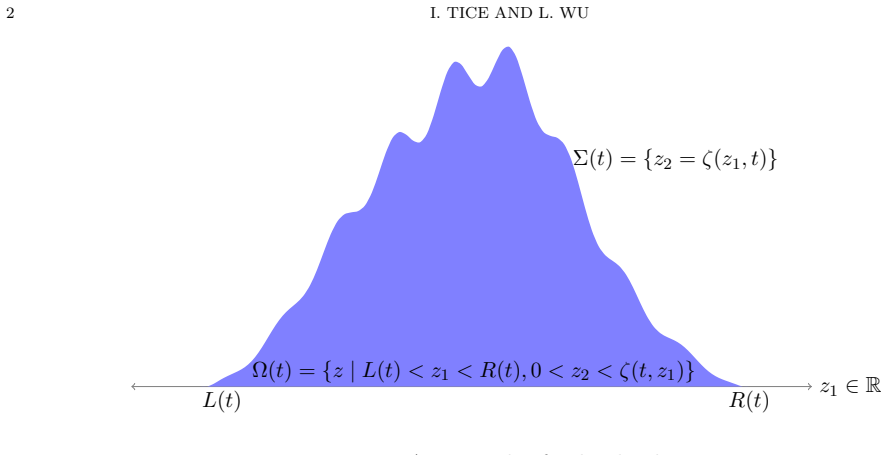
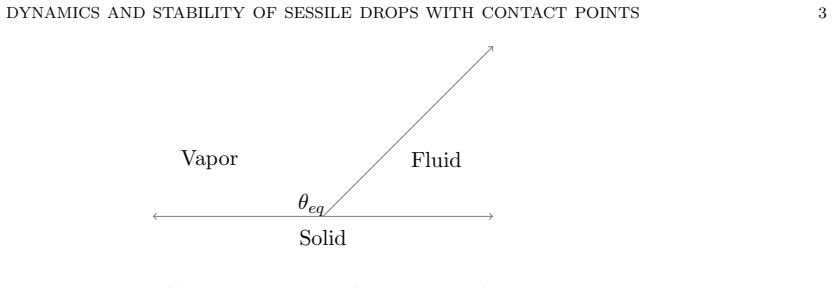
In an effort to study the stability of contact lines in fluids, we consider the dynamics of a drop of incompressible viscous Stokes fluid evolving above a one-dimensional flat surface under the influence of gravity. This is a free boundary problem: the interface between the fluid on the surface and the air above (modeled by a trivial fluid) is free to move and experiences capillary forces. The three-phase interface where the fluid, air, and solid vessel wall meet is known as a contact point, and the angle formed between the free interface and the flat surface is called the contact angle. We consider a model of this problem that allows for fully dynamic contact points and angles. We develop a scheme of a priori estimates for the model, which then allow us to show that for initial data sufficiently close to equilibrium, the model admits global solutions that decay to a shifted equilibrium exponentially fast.
Editorial analysis
A structured set of objections, weighed in public.
Referee Report
Summary. The manuscript analyzes the free boundary problem for a sessile drop of incompressible viscous Stokes fluid on a flat surface, subject to gravity and capillarity, with fully dynamic contact points and angles. The central claim is that a scheme of a priori estimates closes, yielding global solutions that decay exponentially to a shifted equilibrium when the initial data are sufficiently close to equilibrium.
Significance. If the a priori estimates close rigorously, the result supplies a quantitative stability theorem for a physically motivated model of contact-line motion that permits dynamic angles. This strengthens the mathematical understanding of relaxation in viscous wetting problems, where contact-line dynamics are typically difficult to control.
minor comments (2)
- [Abstract] The phrase 'shifted equilibrium' is used in the abstract without an immediate definition; a short clarifying sentence in the introduction would help readers.
- [§2] Notation for the contact angle and its evolution equation could be introduced with a dedicated display equation in §2 to improve readability.
Simulated Author's Rebuttal
We thank the referee for their positive summary, recognition of the significance of the result, and recommendation to accept the manuscript. There are no major comments requiring a response.
Circularity Check
No significant circularity identified
full rationale
The paper develops a scheme of a priori estimates for the Stokes free-boundary problem with dynamic contact points that closes to produce global existence and exponential decay to a shifted equilibrium for data near equilibrium. This is a standard, self-contained PDE analysis strategy relying on energy estimates and bootstrap arguments rather than any self-definitional reduction, fitted-input prediction, or load-bearing self-citation. No equation or step is shown to equal its own input by construction, and the abstract presents the result as derived from independent estimates without circular closure.
Axiom & Free-Parameter Ledger
axioms (2)
- domain assumption The fluid is modeled as incompressible viscous Stokes fluid evolving above a one-dimensional flat surface under gravity.
- domain assumption The three-phase interface (contact point) and contact angle are fully dynamic.
Lean theorems connected to this paper
-
IndisputableMonolith/Cost/FunctionalEquation.leanwashburn_uniqueness_aczel unclear?
unclearRelation between the paper passage and the cited Recognition theorem.
We have d/dt (∫ g/2 |ζ|² + σ √(1+|∂z1ζ|²) − [γ](R−L)) + (∫ μ/2 |Dzu|² + ∫ β |u·τ|² + (W(∂tL)∂tL + W(∂tR)∂tR)) = 0 (Theorem 1.1).
-
IndisputableMonolith/Foundation/RealityFromDistinction.leanreality_from_one_distinction unclear?
unclearRelation between the paper passage and the cited Recognition theorem.
Global solutions that decay to a shifted equilibrium exponentially fast for data near equilibrium (Theorem 2.1).
What do these tags mean?
- matches
- The paper's claim is directly supported by a theorem in the formal canon.
- supports
- The theorem supports part of the paper's argument, but the paper may add assumptions or extra steps.
- extends
- The paper goes beyond the formal theorem; the theorem is a base layer rather than the whole result.
- uses
- The paper appears to rely on the theorem as machinery.
- contradicts
- The paper's claim conflicts with a theorem or certificate in the canon.
- unclear
- Pith found a possible connection, but the passage is too broad, indirect, or ambiguous to say the theorem truly supports the claim.
Reference graph
Works this paper leans on
- [1]
-
[2]
D. Blake. Dynamic contact angles and wetting kinetics. Wettability. Edited by J. C. Berg. Marcel Dekker, New York, 1993
work page 1993
- [3]
-
[4]
S. Bodea. The motion of a fluid in an open channel. Ann. Sc. Norm. Super. Pisa Cl. Sci. (5) 5 (2006), no. 1, 77–105
work page 2006
-
[5]
R. Cox. The dynamics of the spreading of liquids on a solid surface: Part 1 Viscous flow. J. Fluid Mech. 168 (1986), 169–220
work page 1986
- [6]
-
[7]
E. Dussan. On the spreading of liquids on solid surfaces: Static and dynamic contact lines. Annu. Rev. Fluid Mech. 11 (1979), 371–400
work page 1979
-
[8]
R. Finn. Equilibrium capillary surfaces. Grundlehren der Mathematischen Wissenschaften [Fundamen tal Principles of Mathematical Sciences], 284. Springer-Verlag, New York, 1 986
-
[9]
Y. Guo, I. Tice. Stability of contact lines in fluids: 2D St okes flow. Arch. Ration. Mech. Anal. 227 (2018), no. 2, 767–854
work page 2018
-
[10]
C. Gauss. Principia generalia theoriae figurae fluidoru m in statu equilibrii. G¨ ott. Gelehrte Anz. (1829), Werke 5, 29?7
-
[11]
B. Jin. Free boundary problem of steady incompressible flow with contact angle π/2. J. Differential Equations 217 (2005), no. 1, 1–25
work page 2005
-
[12]
H. Kn¨ upfer, N. Masmoudi. Darcy’s flow with prescribed c ontact angle: well-posedness and lubrication approximati on. Arch. Ration. Mech. Anal. 218 (2015), no. 2, 589–646
work page 2015
-
[13]
M. de Laplace. Celestial mechanics. Vols. I–IV. Translated from the French, with a commentary, by Nathaniel Bowditch Chelsea Publishing Co., Inc., Bronx, N.Y. 1966
work page 1966
-
[14]
W. Ren, W. E. Boundary conditions for the moving contact line problem. Phys. Fluids 19 (2007), no. 2, 022101-1–022101- 15
work page 2007
-
[15]
W. Ren, W. E. Derivation of continuum models for the movi ng contact line problem based on thermodynamic principles. Commun. Math. Sci. 9 (2011), no. 2, 597–606
work page 2011
- [16]
-
[17]
J. Socolowsky. The solvability of a free boundary probl em for the stationary Navier-Stokes equations with a dynami c contact line. Nonlinear Anal. 21 (1993), no. 10, 763–784
work page 1993
-
[18]
V. Solonnikov. On some free boundary problems for the Na vier-Stokes equations with moving contact points and lines . Math. Ann. 302 (1995), no. 4, 743–772
work page 1995
-
[19]
T. Young. An essay on the cohesion of fluids. Philos. Trans. R. Soc. London 95 (1805), 65–87
-
[20]
Y. Zheng, I. Tice. Local well-posedness of the contact l ine problem in 2D Stokes flow. SIAM J. Math. Anal. 49 (2017), no. 2, 899–953. DYNAMICS AND STABILITY OF SESSILE DROPS WITH CONTACT POINTS 57 (I. Tice) Department of Mathematical Sciences, Carnegie Mellon Univ ersity Pittsburgh, P A 15213, USA E-mail address : iantice@andrew.cmu.edu (L. Wu) Department...
work page 2017
discussion (0)
Sign in with ORCID, Apple, or X to comment. Anyone can read and Pith papers without signing in.