REVIEW 5 major objections 6 minor 1 cited by
An Acoustic Model for Sunquakes Unifying the Solar Interior and Atmosphere
T0 review · 5 major / 6 minor · reviewed 2026-08-04 · deepseek-v4-flash
Pith's one-line read Particle beams that make sunquakes also make Moreton waves
desk verdict A genuinely new, clearly explained attempt to unite sunquakes, Moreton waves, and EUV fronts under one beam-driven acoustic model, but the quantitative Moreton result rests on a linear model doing nonlinear work. read the letter →
The pith
A machine-rendered reading of the paper's core claim, the machinery that carries it, and where it could break.
The reading
What carries the argument
The central object is a semi-spectral 3D acoustic model of the Sun whose domain is extended upward through the transition region and lower corona. It couples a standard solar interior model to a semi-empirical chromosphere-corona atmosphere model, solves the linear adiabatic wave equations spectrally in horizontal angle and with a fourth-order finite difference in radius, and expands solutions in spherical harmonics up to angular degree 6000 over 1378 radial grid points. The model is driven by two source prescriptions derived from radiative-hydrodynamic flare simulations: an acceleration method using pressure perturbations and a heating method converting volumetric heating into pressure pert
What would settle it
Run the same beam-heating profiles in a nonlinear magnetohydrodynamic model with a realistic magnetic field: the paper's refraction chain predicts a downward vertical wavefront just below the transition region whose arrival time is set by the coronal sound speed. If the wave instead propagates as a fast magnetosonic shock at the local magnetosonic speed, with no refraction delay, the mechanism is falsified. Observationally, high-cadence H-alpha and EUV Doppler data across a Moreton event should show the chromospheric front's onset delay growing with distance from the source at the coronal-fron
Extended reading notes
Core claim
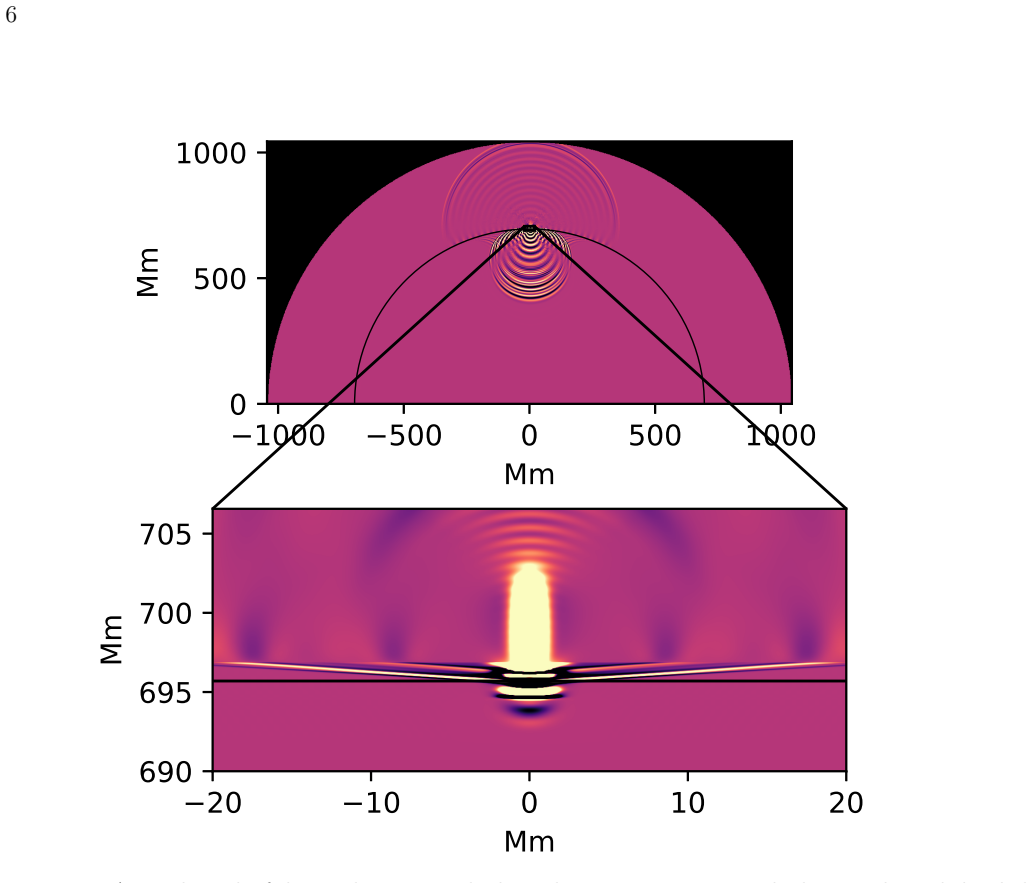
Using a linear adiabatic acoustic model whose domain extends from the solar interior through the transition region and lower corona, the authors simulate the response to particle-beam energy deposition prescribed by radiative-hydrodynamic flare simulations. For proton and electron beams with a power-law energy distribution, the model produces a sunquake wavefront in the photosphere, a fast outward coronal wavefront, and a chromospheric wavefront whose horizontal track moves at about 117 km/s while the local sound speed in the chromosphere is only about 7 km/s. The apparent supersonic speed is not a chromospheric propagation speed: the coronal wave, traveling at about 75 km/s in the low coron
Load-bearing premise
The load-bearing premise is that the chromosphere and corona behave as a linear, adiabatic, non-magnetic acoustic gas; in the real low-beta solar atmosphere the waves are fast magnetosonic and shock-forming, so the transition-region refraction chain and the 117 km/s apparent speed could differ or disappear.
Editorial extensions
If this is right
- A single particle-beam source can excite all three wave classes, so Moreton waves and coronal fronts observed without a coronal mass ejection need not require a different driver.
- The Moreton wave's apparent supersonic speed is a projection of the fast coronal wave's horizontal travel, not a real supersonic disturbance moving through the chromosphere.
- Electron beams, which in the simulations give weak sunquake signals but strong Moreton-like fronts, predict Moreton/EUV waves unaccompanied by detectable sunquakes; proton beams predict the opposite, offering an observational discriminator.
- The sign of the initial photospheric radial velocity beneath the source differs between proton and electron beams, so Doppler observations of sunquake sources could diagnose the beam composition.
- The simulated Moreton-analogue wave has a downflow at its leading edge, matching the observed H-alpha red-wing absorption and blue-wing enhancement signature.
Reading between the lines
- A natural extension is to rerun the same beam-heated source profiles in nonlinear magnetohydrodynamic simulations with a background magnetic field; the refraction chain would survive where the fast magnetosonic speed stratification follows the sound-speed profile and break where it does not.
- The electron-beam amplitude ratios imply a specific observational census: events with clear Moreton/EUV fronts but no detectable sunquake should be electron-beam dominated, while strong sunquake events with weak or absent Moreton fronts would point to proton beams.
- Because the apparent horizontal speed equals the coronal sound speed at the height where the wave crosses the transition region, the model predicts a measurable correlation between coronal temperature and observed Moreton-wave speed variations across events.
Editorial analysis
A structured set of objections, weighed in public.
Referee Report
Summary. The manuscript extends the semi-spectral 3D acoustic model of Stefan & Kosovichev (2020) upward through the chromosphere and lower corona, and excites it with RADYN-derived heating profiles for power-law proton and electron beams. Two source prescriptions are compared: an acceleration source from RADYN pressure perturbations and a pressure-rate source from volumetric heating. The simulations produce a sunquake, a chromospheric Moreton-like wavefront, and a coronal wavefront. The central interpretation is that the chromospheric wavefront is not truly supersonic; it is a local-sound-speed response to a coronal wave sweeping along the transition region, yielding an apparent horizontal speed of 117 km/s. The paper also reports species-dependent amplitude ratios and photospheric velocity signs, and proposes electron beams as a source of Moreton waves without detectable sunquakes.
Significance. If correct, the paper provides a single beam-driven mechanism that simultaneously produces sunquake, Moreton-like, and LCPF-like waves, and a geometric/sweeping explanation for the apparent supersonic Moreton speed without imposing that speed. The agreement between the two source-injection methods on the main wave pattern is a strength, as is the emergence of the Moreton-like speed from prescribed heating and background stratification. The paper also yields falsifiable, if preliminary, predictions: relative Moreton-to-sunquake amplitudes depend on beam species, and photospheric velocity sign depends on beam species. The main caveat is that the atmospheric conclusions rest on a linear, adiabatic, non-magnetic model whose limitations the authors explicitly acknowledge (Section 4); the significance is therefore conditional on those limitations being quantified or tested with nonlinear MHD simulations.
major comments (5)
- [Section 3 (seed-wave formation) vs Section 2.1] Section 3 describes the coronal seed wave as produced by an 'expanding region of over-pressure', by outflows that 'collide with the surrounding stationary plasma, increasing the local density', and by overdense plasma that 'falls since hydrostatic equilibrium is lost'. These are nonlinear advective and gravitational descriptions, but Section 2.1 states that 'non-linear perturbations are removed' from Equations (1)-(3). Convergent flows and acoustic-gravity oscillations can be represented linearly, but 'collisions' and the loss of hydrostatic equilibrium as described are not mechanisms available to the linearized system. Since the apparent Moreton speed in Figure 4 is set by this seed wave's travel time, the paper should show that the seed wave is a small-amplitude linear wave of the model, or provide a nonlinear calculation. Section 4's statement that the atmospheric wavefronts have 'sup
- [Section 4 (non-magnetic approximation)] The atmospheric and Moreton conclusions are drawn from a purely acoustic model, while observed Moreton and EUV waves are generally understood as fast magnetosonic disturbances in a low-beta corona. The paper itself says the analogies are 'purely qualitative', yet the abstract and Section 4 claim to explain the apparent supersonic nature of Moreton waves. In a magnetized plasma the relevant speed is sqrt(c_s^2 + v_A^2), the transition-region refraction depends on field orientation, and mode conversion changes the wave that reaches the chromosphere. The 117 km/s sweeping mechanism could change or disappear. I request a quantitative estimate of the fast-mode speed stratification for representative coronal field strengths and a discussion of whether the sweeping geometry survives oblique fields, or a clear downgrade of the Moreton claim to a purely acoustic analogue.
- [Section 4/Figure 4 (boundary reflections)] Section 4 notes that the coronal wave reflects at the upper boundary despite non-reflecting conditions, and that the Moreton-like wave reflects at the photosphere, exciting additional coronal waves. The time-distance data in Figure 4 extend to 700 s, and the amplitude ratios in Section 3 are measured after the first reflected signals may re-enter the region. The damping scheme was designed for p-modes, not atmospheric waves, so these reflections may contaminate the quoted 117 km/s speed and the Moreton-to-sunquake amplitude ratios. Please mark reflected arrival times on the time-distance diagrams, or perform a sensitivity test with a larger/absorbing domain.
- [Section 3 (apparent speed scaling)] The quoted apparent speed is 117 km/s, but the model's coronal sound speed just above the transition region is 75 km/s and the chromospheric sound speed is 7 km/s; observed Moreton speeds are typically several hundred km/s. The mechanism may scale with the background sound-speed and density stratification, but the paper does not give a scaling law or dimensionless relation. Without this, it is difficult to assess whether the sweeping/refraction explanation is quantitatively relevant to real Moreton waves, whose speeds are set by coronal fast-mode speeds of order 500-1000 km/s. Please provide a scaling estimate in terms of coronal sound speed, transition-region height, and source geometry.
- [Section 3 (amplitude ratios)] The Moreton-analog-to-sunquake amplitude ratios differ substantially between source prescriptions for the same beam species: for protons, 2.3 (acceleration method) versus 10.1 (heating method); for electrons, 12.3 versus 21.1. The conclusion that electron beams may be primarily responsible for Moreton waves without a detectable sunquake is therefore sensitive to the source-injection method, with a factor-of-four spread in the proton case. The paper does not explain which method is more realistic. Please address this sensitivity before using the ratios as observational discriminants.
minor comments (6)
- [Section 2.2, Eq. (4)] Units in the sentence following Eq. (4) are inconsistent: '10^11 cm^-2 s^-1' should read '10^11 erg cm^-2 s^-1' (or be explicitly identified as number flux N0).
- [Eq. (5)] Typo: 'rho0' should be '\rho_0'.
- [Figure 3] Text refers to 'the left panel of Figure 3', but the figure caption describes a single panel; if there are multiple panels, label them; otherwise remove 'left panel'.
- [Abstract / Section 3] The abstract says the domain is extended 'several 10's of Mm above the photosphere', but Section 3 says the top boundary is at 1.5 R_sun. Please state the actual upper boundary in Mm relative to the photosphere and reconcile the two descriptions.
- [Figure 4] Specify how the 117 km/s speed was obtained from the time-distance diagram (least-squares fit to the leading edge? a specified time window?).
- [Section 4] The statement that the fast magnetosonic speed 'changes with height in a similar fashion to the sound speed in the presence of a uniform magnetic field' is not generally true because v_A depends on density stratification and field geometry. Reword or justify.
Circularity Check
No significant circularity: the Moreton-analogue speed is an emergent output of prescribed beam heating and background sound-speed stratification, not a fitted target.
full rationale
The paper's derivation chain is self-contained: beam parameters (Eq. 4) feed RADYN; RADYN pressure/heating perturbations are converted by Eqs. (5)-(6) into source terms for the previously published linear acoustic model (Eqs. 1-3); the apparent Moreton-analogue speed (~117 km/s) is then read off a time-distance diagram, not imposed. The background sound-speed jump across the transition region (75 vs 7 km/s) is taken from standard independent atmospheric models (VAL-C, SSM), and the 'each TR point acts as a wave generator' mechanism is explicitly tied to the external Uchida (1968) coronal-wave picture. Although the authors cite their own acoustic model (Stefan & Kosovichev 2020), the governing equations and source construction are reproduced in this paper, so the citation supplies infrastructure rather than the result. The admitted neglect of magnetic fields and nonlinear/shock physics (Section 4) undermines realism but does not make the argument circular; a linear wave model can still produce a qualitative refraction-induced apparent speed. No fitted parameter is renamed as a prediction, and no uniqueness or ansatz is imported from self-citations. Score 1 reflects only the minor reliance on the authors' own RADYN/acoustic-model pipeline, which is not load-bearing for the central claim.
Assumptions & free parameters
free parameters (5)
- Beam spectral index delta =
5
- Beam energy cutoff Ec =
50 keV protons, 14 keV electrons
- Total beam energy flux =
10^11 erg cm^-2 s^-1
- Horizontal source FWHM =
~1.5 Mm
- Wave damping timescales =
quiet-Sun p-mode power-spectrum timescales
assumptions (5)
- domain assumption Standard solar model plus VAL-C atmosphere stratification joined at equal density
- domain assumption Linear, adiabatic, non-magnetic wave propagation
- domain assumption RADYN 1D beam response can be extrapolated to 3D with azimuthal symmetry
- domain assumption Initial hydrostatic equilibrium of the background
- standard math Ideal-gas relation dP'/dt = Q'_vol (gamma-1)
Cite this review
Pith. "Pith review of An Acoustic Model for Sunquakes Unifying the Solar Interior and Atmosphere." pith.science (2026). https://pith.science/paper/YV2QWZXC
@misc{pith2026250906848,
  author       = {Pith},
  title        = {Pith review of: An Acoustic Model for Sunquakes Unifying the Solar Interior and Atmosphere},
  year         = {2026},
  howpublished = {\url{https://pith.science/paper/YV2QWZXC}},
  note         = {Machine review of arXiv:2509.06848}
}
read the original abstract
One of the leading hypotheses for sunquake generation suggests that flare-accelerated particles originating from the reconnection site in the corona travel down to the chromosphere and photosphere, where they deposit energy through collisions and subsequently drive acoustic oscillations. To properly encompass this top-down excitation mechanism, we extend the domain of a semi-spectral 3D acoustic model of the global Sun up to several 10's of Mm above the photosphere, where the transition region and lower corona are resolved. We then use the radially-dependent heating rates derived from the flare radiative hydrodynamic (RADYN) simulations -- extrapolated to a 3D profile -- to realistically excite sunquakes. In addition to the usual sunquake wavefronts, we also observe waves that propagate through the chromosphere and corona in a similar fashion to Moreton-Ramsey waves and large-scale coronal propagating fronts (LCPFs). We examine the dynamics of these waves and discuss how they may be used to constrain models of sunquake excitation.
Figures


Figures from the paper (2 more)


Forward citations
Cited by 1 Pith paper
-
Origin of Coronal Extreme Ultraviolet Shockwaves without a Coronal Mass Ejection Event
Coronal waves without a CME are slower, more impulsive, and less energetic than CME-associated waves, suggesting a distinct particle-driven generation path.
Reference graph
Works this paper leans on
-
[1]
2020, ApJ, 890, 22, doi: 10.3847/1538-4357/ab665f
Abbasvand, V., Sobotka, M., Heinzel, P., et al. 2020, ApJ, 890, 22, doi: 10.3847/1538-4357/ab665f
-
[2]
Allred, J. C., Kowalski, A. F., & Carlsson, M. 2015, ApJ, 809, 104, doi: 10.1088/0004-637X/809/1/104
-
[3]
Antiochos, S. K., DeVore, C. R., & Klimchuk, J. A. 1999, ApJ, 510, 485, doi: 10.1086/306563
doi:10.1086/306563 1999
-
[4]
Arber, T. D., Longbottom, A. W., Gerrard, C. L., & Milne, A. M. 2001, Journal of Computational Physics, 171, 151, doi: 10.1006/jcph.2001.6780
arXiv 2001
-
[5]
Byrne, J. P., Long, D. M., Gallagher, P. T., et al. 2013, A&A, 557, A96, doi: 10.1051/0004-6361/201321223
-
[6]
P., Asai, A., Ichimoto, K., et al
Cabezas, D. P., Asai, A., Ichimoto, K., et al. 2019, ApJ, 883, 32, doi: 10.3847/1538-4357/ab3a35
-
[7]
Chen, P. F., Wu, S. T., Shibata, K., & Fang, C. 2002, ApJL, 572, L99, doi: 10.1086/341486
doi:10.1086/341486 2002
- [8]
Show all 41 references
-
[9]
V., et al
Christensen-Dalsgaard, J., Dappen, W., Ajukov, S. V., et al. 1996, Science, 272, 1286, doi: 10.1126/science.272.5266.1286
1996
-
[10]
K., Schmieder, B., & Joshi, R
Devi, P., Chandra, R., Awasthi, A. K., Schmieder, B., & Joshi, R. 2022, SoPh, 297, 153, doi: 10.1007/s11207-022-02082-6
2022 doi
-
[11]
M., et al
Downs, C., Warmuth, A., Long, D. M., et al. 2021, ApJ, 911, 118, doi: 10.3847/1538-4357/abea78
2021 doi
- [12]
-
[13]
Hudson, H. S. 2012, Solar Physics, 277, 59, doi: 10.1007/s11207-011-9907-2
2012 doi
-
[14]
H., Canfield, R
Fisher, G. H., Canfield, R. C., & McClymont, A. N. 1985, ApJ, 289, 414, doi: 10.1086/162901
1985 doi
-
[15]
2022, ApJ, 928, 98, doi: 10.3847/1538-4357/ac590d
Hou, Z., Tian, H., Wang, J.-S., et al. 2022, ApJ, 928, 98, doi: 10.3847/1538-4357/ac590d
2022 doi
-
[16]
Klassen, A., Aurass, H., Mann, G., & Thompson, B. J. 2000, A&AS, 141, 357, doi: 10.1051/aas:2000125 13
2000 doi
- [17]
-
[18]
Kosovichev, A. G. 2015, in Extraterrestrial Seismology, 306–322, doi: 10.1017/CBO9781107300668.025
2015 doi
-
[19]
G., Sadykov, V
Kosovichev, A. G., Sadykov, V. M., & Stefan, J. T. 2023, The Astrophysical Journal, 958, 160, doi: 10.3847/1538-4357/acf9eb
2023 doi
-
[20]
G., & Zharkova, V
Kosovichev, A. G., & Zharkova, V. V. 1995, in ESA Special Publication, Vol. 376, Helioseismology, 341
1995
-
[21]
G., & Zharkova, V
Kosovichev, A. G., & Zharkova, V. V. 1998, Nature, 393, 317, doi: 10.1038/30629
1998 doi
-
[22]
2018, A&A, 619, A65, doi: 10.1051/0004-6361/201832896
Macrae, C., Zharkov, S., Zharkova, V., et al. 2018, A&A, 619, A65, doi: 10.1051/0004-6361/201832896
2018 doi
-
[23]
2000, AcA, 50, 405
Medrek, M., Murawski, K., & Nakariakov, V. 2000, AcA, 50, 405
2000
-
[24]
Moreton, G. E. 1960, The Astronomical Journal, 65, 494, doi: 10.1086/108346
1960 doi
-
[25]
E., & Ramsey, H
Moreton, G. E., & Ramsey, H. E. 1960, Publications of the Astronomical Society of the Pacific, 72, 357, doi: 10.1086/127549
1960 doi
-
[26]
M., Kienreich, I
Muhr, N., Veronig, A. M., Kienreich, I. W., et al. 2014, SoPh, 289, 4563, doi: 10.1007/s11207-014-0594-7
2014 doi
-
[27]
V., Schrijver, C
Nitta, N. V., Schrijver, C. J., Title, A. M., & Liu, W. 2013, ApJ, 776, 58, doi: 10.1088/0004-637X/776/1/58
2013 doi
-
[28]
Pedram, E., & Matthews, S. A. 2012, SoPh, 277, 317, doi: 10.1007/s11207-011-9922-3
2012 doi
-
[29]
2018, ApJ, 860, 24, doi: 10.3847/1538-4357/aabe7f
Piantschitsch, I., Vršnak, B., Hanslmeier, A., et al. 2018, ApJ, 860, 24, doi: 10.3847/1538-4357/aabe7f
2018 doi
-
[30]
Podesta, J. J. 2005, SoPh, 232, 1, doi: 10.1007/s11207-005-8774-0
2005 doi
-
[31]
Hudson, H. S. 2016, ApJ, 831, 42, doi: 10.3847/0004-637X/831/1/42
2016 doi
- [32]
-
[33]
N., & Kosovichev, A
Sharykin, I. N., & Kosovichev, A. G. 2020, The Astrophysical Journal, 895, 76, doi: 10.3847/1538-4357/ab88d1
2020 doi
-
[34]
N., Kosovichev, A
Sharykin, I. N., Kosovichev, A. G., Sadykov, V. M., Zimovets, I. V., & Myshyakov, I. I. 2017, ApJ, 843, 67, doi: 10.3847/1538-4357/aa77f1
2017 doi
-
[35]
T., & Kosovichev, A
Stefan, J. T., & Kosovichev, A. G. 2020, ApJ, 895, 65, doi: 10.3847/1538-4357/ab88ae
2020 doi
-
[36]
J., Gurman, J
Thompson, B. J., Gurman, J. B., Neupert, W. M., et al. 1999, ApJL, 517, L151, doi: 10.1086/312030
1999 doi
-
[37]
1968, SoPh, 4, 30, doi: 10.1007/BF00146996
Uchida, Y. 1968, SoPh, 4, 30, doi: 10.1007/BF00146996
1968 doi
-
[38]
M., Gömöry, P., Kienreich, I
Veronig, A. M., Gömöry, P., Kienreich, I. W., et al. 2011, ApJL, 743, L10, doi: 10.1088/2041-8205/743/1/L10 Vršnak, B., Žic, T., Lulić, S., Temmer, M., &
2011 doi
-
[39]
Veronig, A. M. 2016, SoPh, 291, 89, doi: 10.1007/s11207-015-0822-9
2016 doi
-
[40]
2015, SoPh, 290, 3163, doi: 10.1007/s11207-015-0813-x
Zharkova, V., & Zharkov, S. 2015, SoPh, 290, 3163, doi: 10.1007/s11207-015-0813-x
2015 doi
-
[41]
2023, ApJL, 949, L8, doi: 10.3847/2041-8213/acd0ac
Zheng, R., Liu, Y., Liu, W., et al. 2023, ApJL, 949, L8, doi: 10.3847/2041-8213/acd0ac
2023 doi
Reviewed August 4, 2026 · model on record in the stance chip above.
Discussion (0). Continue with ORCID to comment.