REVIEW 4 major objections 5 minor 38 references
Symmetries of weighted networks: weight approximation method and its application to food webs
T0 review · 4 major / 5 minor · reviewed 2026-08-07 · deepseek-v4-flash
Pith's one-line read Coarse-graining edge weights exposes approximate symmetries in food webs that raw data hide.
desk verdict A genuinely new and simple method for approximating weighted-graph symmetries, whose ecological interpretation is under-tested without a null model. read the letter →
The pith
A machine-rendered reading of the paper's core claim, the machinery that carries it, and where it could break.
The reading
What carries the argument
The central object is the aggregation operator $\Phi_\alpha$ defined in Eq. (1), together with the automorphism orbit partition it induces. $\Phi_\alpha$ discretizes edge weights into logarithmic bins set by $\alpha$ (with $\alpha$ taken as powers of two so that bins are nested), turning a weighted digraph into a sequence of coarser graphs on which standard graph automorphisms can be computed. Orbits of those automorphisms are the paper's working definition of approximate symmetry: vertices that become interchangeable at precision $\alpha$. The smallest $\alpha$ at which two vertices enter the same orbit provides the proposed quantitative measure of role similarity, and the three network-level measures -- the symmetric vertex ratio $SV$, redundancy $r$, and the $\beta$ measure $\beta$ -- summarize the orbit and automorphism-group structure at the level of whole graphs.
What would settle it
Take a food web with a two-vertex orbit at $\alpha=2$, such as the Peruvian pair Booby and Pelican, and compare their actual diets and biomass flows: if the two species turn out not to be interchangeable in an independent ecological sense -- for example, one feeds at a distinctly different trophic level or responds differently to the removal of a shared prey -- then the aggregated graph's symmetry is not tracking functional substitutability. Equivalently, in a dynamical model constrained by the empirical flows, substituting one orbit-mate for the other should leave the community dynamics essentially unchanged; any large divergence would falsify the role-similarity interpretation.
Extended reading notes
Core claim
On its own terms, the paper claims that approximate symmetries of weighted networks are not a separate concept requiring edge removal or mismatch penalties: they are the exact automorphisms of a deliberately coarsened copy of the network. The aggregation function $\Phi_\alpha$ replaces each flow value by $1+\lfloor(\log_{10}\phi_{\max}-\log_{10}\phi_{ij})/\alpha\rfloor$, with $\alpha=0$ giving the original weights and $\alpha=\infty$ giving the unweighted simplification, so that weights within the same order of magnitude become identical. The automorphism orbits of these aggregated graphs then identify vertices that are structurally interchangeable at precision $\alpha$. In 250 food webs, 0.8% of raw networks have any nontrivial symmetry, but this fraction rises to 14.4%, 22.8%, 28.4%, and 38.4% at $\alpha=1,2,4,\infty$; orbits almost always contain two or three vertices, and high-degree vertices participate. The Peruvian Upwelling case study shows orbits such as {Booby, Pelican} and {Fur seal, Sea lion} emerging at $\Phi_2$ and expanding into broader functional groups at $\Phi_\infty$. The paper's central proposed quantity is the minimal aggregation level at which two species become symmetric, read as a measure of role similarity.
Load-bearing premise
The whole construction hinges on the premise that grouping flows that differ by less than an order of magnitude produces ecologically meaningful equivalence classes, so that two species becoming interchangeable after rounding are truly functionally similar and not just similar in a coarse model.
Editorial extensions
If this is right
- Orbit membership under $\Phi_\alpha$ gives a quantitative, purely structural definition of functional substitutability that does not require species trait data.
- Because the method preserves all edges and only re-labels their weights, it retains weak links, which earlier findings tie to ecosystem stability.
- The rarity of orbits larger than two or three vertices supports the competitive-exclusion intuition: very few species in a web share exactly the same functional role.
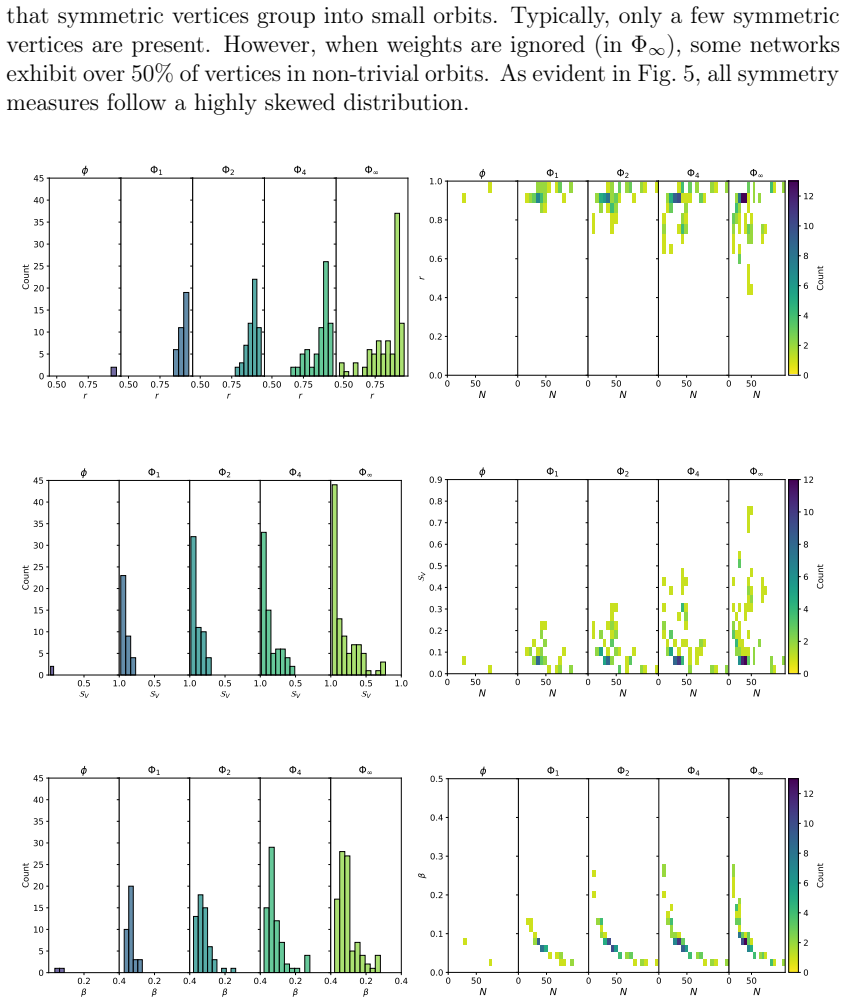
- The three symmetry measures are not interchangeable; in food webs $\beta$ is almost entirely determined by network size, while $SV$ and $r$ track the fraction of symmetric vertices and the orbit structure.
- At the heaviest aggregation $\Phi_\infty$, approximate symmetry reduces to ordinary unweighted automorphisms, so the method contains classical symmetry analysis as a limiting case.
Reading between the lines
- The $\alpha$-threshold similarity measure could be lifted from food webs to other weighted networks such as gene regulatory, metabolic, or infrastructure networks, since nothing in Eq. (1) except the logarithmic binning choice is food-web-specific.
- Because $\Phi_\alpha$ depends only on ratios of weights to the maximum weight, any global multiplicative rescaling of all flows leaves the orbits unchanged; this scale invariance is implicit in the construction but not tested in the paper.
- A natural test of the role-similarity interpretation is to remove one species from a two-vertex orbit in a dynamical food-web model and ask whether its orbit-mate compensates the flows it provided; the paper does not run this perturbation experiment, but its substitutability claim implies it should.
- The near-perfect correlation between $\beta$ and network size limits cross-size comparisons of $\beta$ in food webs; a defensible extension would be to normalize $\beta$ by a size-dependent null model.
Editorial analysis
A structured set of objections, weighed in public.
Referee Report
Summary. The paper introduces a weight-aggregation method, Eq. (1), that rounds edge weights into order-of-magnitude bins via a family of functions Φα, producing a sequence of coarser graphs on which ordinary graph automorphisms can be computed. The method is applied to 250 empirical food webs, with reported results on orbit-size distributions, trophic levels of symmetric vertices, three graph-level symmetry measures, and a case study of the Peruvian Upwelling food web. The central claim is that approximate automorphisms emerge at low aggregation levels, mostly as small orbits, and that the smallest aggregation level at which two vertices share an orbit provides a quantitative measure of functional role similarity.
Significance. If the ecological interpretation is secured, the paper offers a simple and computationally explicit way to extend automorphism analysis to weighted networks, with a potentially useful notion of role similarity. The computational pipeline is clearly specified (Eq. (1) plus SageMath), and the application to 250 real food webs is a substantial empirical effort. The Peru case study is biologically plausible and illustrates the method well. However, the central empirical claims are currently under-tested: the observed symmetries are produced by the paper's own binning rule, and no null-model or robustness analysis shows that they reflect biological structure rather than discretization artifacts. In addition, Eq. (5) contains an index inconsistency that affects all trophic-level-based results, and the proposed 'minimal aggregation level' similarity measure is never formally defined. These are load-bearing issues for the paper's main conclusions.
major comments (4)
- [Section 2.2 and Table 3] The headline empirical fractions (14.4% of webs with nontrivial orbits at Φ1, rising to 38.4% at Φ∞) are not interpretable without a null-model baseline. Any set of positive weights spanning several orders of magnitude will produce coincidences after logarithmic binning, so the reported emergence of orbits could be an artifact of the discretization rather than evidence of functional role similarity. The Discussion even concedes that 'some observed symmetries may reflect modelling choices rather than biological reality.' Please add a null model that reshuffles weights among existing edges (or samples weights from the empirical distribution while preserving the topology) and compare the orbit-size distribution and fraction of webs with nontrivial orbits under the same Φα aggregations. Also report a sensitivity analysis with respect to bin-boundary choices (e.g., different logarithmic bases or shifted cutoffs) to show that orbit membership is stable.
- [Section 2.5, Eq. (5)] Eq. (5) is inconsistent with the edge convention stated in Section 2.4. The text says φ_ij represents the biomass flow from vertex j to vertex i, but the trophic-level formula normalizes by Σ_k φ_ki, which under that convention is the total outflow from vertex i, not the total inflow to vertex i. The correct normalization for the incoming-flow-weighted average is Σ_k φ_ik (or, equivalently, the formula should use φ_ji throughout). Since the trophic-level results in Fig. 4, Table 1, and Section 3.2.2 all depend on this quantity, the index error is load-bearing. Please correct the equation, restate the convention consistently, and verify that the reported trophic levels and trophic spans were computed with the intended definition.
- [Abstract and Discussion] The 'minimal aggregation level at which two vertices become substitutable' is presented as a quantitative measure of role similarity, but it is never formally defined anywhere in the paper. It is not clear whether it is the smallest α such that two vertices belong to the same orbit in G_α, what value is assigned when the vertices never co-occur in an orbit, or how the global dependence on φmax and on the arbitrary bin boundaries affects the measure. Please provide an explicit definition and a robustness check showing that the measure is stable under small perturbations of the binning; without this, the central interpretative claim of the paper is not testable.
- [Section 3.3, Eq. (4) and Table 4] The near-perfect Spearman correlation between β and network size (rs ≈ -0.99) is largely a mathematical consequence of the definition β = (|Aut(G)|/N!)^{1/N}, not an independent empirical discovery. For the small automorphism groups reported in the paper, the factorial term makes β essentially a function of N. The statement that symmetric vertices 'do not substantially increase the number of automorphisms' is therefore not well supported by this correlation. Please separate the size effect from the symmetry information, for example by reporting log|Aut(G)| conditionally on N, or by normalizing β in a way that does not depend so strongly on the factorial term.
minor comments (5)
- [Section 2.2] The notation for the aggregation levels is confusing: α is described as a natural number, but the sequence used is 0, 1, 2, 4, ... and the text says α values are powers of two. Please clarify the allowable values of α and the nesting property that motivates the sequence.
- [Figure 3] The histogram subplots in Fig. 3 appear to lack clear labels identifying which panel corresponds to which aggregation level; please add explicit panel titles or axis annotations for Φ1, Φ2, and Φ4.
- [Reference [37]] The SageMath reference contains the placeholders 'Version x.y.z' and 'YYYY'; please cite a specific version and year.
- [Section 2.1] The term 'asymmetric orbit' for an orbit containing more than one vertex is unconventional and potentially misleading, since the orbit itself arises from a symmetry. Consider using 'nontrivial orbit' instead.
- [Tables 4 and 5] The column header 'pν' appears to denote a p-value; please use a standard notation such as 'p' and define it in the caption.
Circularity Check
No significant circularity: the aggregation-based symmetry measure is an explicit operational definition, and the empirical findings are data-dependent rather than forced by construction.
full rationale
The paper's derivation chain is: Eq. (1) defines discrete weight aggregations Phi_alpha; automorphisms are computed on the resulting graphs; properties of orbits (size, trophic level, network position) are then reported as empirical regularities over 250 food webs. None of these steps reduces to its inputs by construction: the appearance of symmetries at Phi_1 in 14.4% of webs and the observed orbit-size distribution are contingent facts about the dataset, not consequences of the definition. The 'minimal aggregation level' measure is explicitly introduced as a definition ('We define functional similarity as the minimum weight approximation needed for two species to share an orbit in the automorphism group', Discussion), so calling it a quantitative measure of role similarity is a stipulative operationalization rather than a derived prediction; the paper does not claim to have independently validated it outside the method. The Discussion even concedes that 'some observed symmetries may reflect modelling choices rather than biological reality', which acknowledges the limitation that a lack of a null model would raise. The only self-citation in the load-bearing sense is absent; the reference to the authors' own foodwebviz tool [38] is used solely for drawing Fig. 2 and is not an argument. Thus there is no circular step: the central claim is self-contained as a methodological proposal, with ecological interpretation left as an external-validity question rather than smuggled into the definition.
Assumptions & free parameters
free parameters (1)
- Aggregation level alpha
assumptions (4)
- domain assumption Vertices in the same automorphism orbit of a coarse-grained food web are functionally substitutable in the original ecosystem.
- domain assumption The 250 food webs drawn from Ecobase and Ecopath models are accurate, comparable, and unbiased for the studied questions.
- ad hoc to paper Logarithmic order-of-magnitude binning in Eq. (1) is a valid approximation path for biomass flows.
- standard math The trophic level equation (5) has a unique solution for each web.
Cite this review
Pith. "Pith review of Symmetries of weighted networks: weight approximation method and its application to food webs." pith.science (2026). https://pith.science/paper/YX3QBAJ2
@misc{pith2026250611824,
  author       = {Pith},
  title        = {Pith review of: Symmetries of weighted networks: weight approximation method and its application to food webs},
  year         = {2026},
  howpublished = {\url{https://pith.science/paper/YX3QBAJ2}},
  note         = {Machine review of arXiv:2506.11824}
}
read the original abstract
Graph symmetries identify structural regularities and reduce the computational complexity of network analysis. In weighted graphs, however, exact automorphisms are rare because real-valued weights seldom coincide. We introduce a general framework for detecting approximate symmetries by aggregating weights into discrete categories, generating a sequence of coarser graphs on which classical automorphism analysis applies. The approximation path is fully configurable, based on interaction magnitudes, and can be matched to the empirical weight distribution. Applied to 250 empirical food webs using logarithmic aggregation, the method reveals that automorphisms emerge even at low approximation levels and almost always form small orbits. Orbit sizes rarely exceed two or three vertices, reflecting the combinatorial fragility of larger symmetric sets. Even so, symmetric vertices occupy diverse structural positions in the network and high connectivity does not imply asymmetry. The observation of just local permutations confirms the conclusions of trophic species and niche analysis. A case study demonstrates that automorphisms can also recover latent ecological structure. The minimal aggregation level at which two vertices become substitutable provides a quantitative measure of role similarity. The framework offers a principled, automorphism-based approach for quantifying similarity and redundancy in weighted complex networks.
Figures


Figures from the paper (3 more)


Reference graph
Works this paper leans on
-
[1]
N. J. Mitra, L. J. Guibas, L. J. Guibas, M. Pauly, M. Pauly, Partial and ap- proximate symmetry detection for 3d geometry, ACM Transactions on Graph- 18 ics (2006).doi:10.1145/1141911.1141924
arXiv 2006
-
[2]
M. Pakdemirli, M. Yürüsoy, İhsan Timuçin Dolapçı, Comparison of approxi- mate symmetry methods for differential equations, Acta Applicandae Math- ematicae (2004).doi:10.1023/b:acap.0000018792.87732.25
-
[3]
Y. Liu, Approximate network symmetry, arXiv: Physics and Society (2020). doi:10.48550/arXiv.2012.05129
work page Pith review arXiv doi:10.48550/arxiv.2012.05129 2020
-
[4]
A. Pidnebesna, D. Hartman, A. Pokorná, M. Straka, J. Hlinka, Comput- ing approximate global symmetry of complex networks with application to brain lateral symmetry, Information Systems Frontiers (2025).doi:10.1007/ s10796-025-10585-3
work page 2025
-
[5]
G. Rosell-Tarragó, A. Díaz-Guilera, Quasi-symmetries in complex networks: a dynamical model approach, Journal of Complex Networks (2021).doi: 10.1093/comnet/cnab025
-
[6]
K. McCann, A. Hastings, G. R. Huxel, Weak trophic interactions and the balance of nature, Nature 395 (6704) (1998) 794–798.doi:10.1038/27427
-
[7]
C. Jacquet, C. Moritz, L. Morissette, P. Legagneux, F. Massol, P. Archam- bault, D. Gravel, No complexity–stability relationship in empirical ecosys- tems, Nature Communications 7 (2016) 12573.doi:10.1038/ncomms12573
-
[8]
R. J. Sánchez-García, Exploiting symmetry in network analysis, Communica- tions Physics 3 (1) (May 2020).doi:10.1038/s42005-020-0345-z
Show all 38 references
-
[9]
Holme, Detecting degree symmetries in networks, Phys
P. Holme, Detecting degree symmetries in networks, Phys. Rev. E 74 (2006) 036107.doi:10.1103/PhysRevE.74.036107
2006 doi
-
[10]
B. D. MacArthur, R. J. Sánchez-García, J. W. Anderson, Symmetry in com- plex networks, Discrete Applied Mathematics 156 (18) (2008) 3525–3531. doi:10.1016/j.dam.2008.04.008
2008 doi
-
[11]
Xiao, W.-T
Y.-H. Xiao, W.-T. Wu, H. Wang, M. Xiong, W. Wang, Symmetry-based structure entropy of complex networks, Physica A: Statistical Mechanics and its Applications 387 (11) (2008) 2611–2619.doi:10.1016/j.physa.2008. 01.027
2008 doi
-
[12]
G. F. Gause, The struggle for existence, Williams & Wilkins, Baltimore, 1934
1934
-
[13]
Chesson, Mechanisms of maintenance of species diversity, Annual Re- view of Ecology, Evolution, and Systematics (2000).doi:10.1146/annurev
P. Chesson, Mechanisms of maintenance of species diversity, Annual Re- view of Ecology, Evolution, and Systematics (2000).doi:10.1146/annurev. ecolsys.31.1.343. 19
2000 doi
-
[14]
Chesson, Updates on mechanisms of maintenance of species diversity, Jour- nal of Ecology (2018).doi:10.1111/1365-2745.13035
P. Chesson, Updates on mechanisms of maintenance of species diversity, Jour- nal of Ecology (2018).doi:10.1111/1365-2745.13035
2018
-
[15]
Hutchinson, Concluding remarks, coldspring harbor symposium., Quant
C. Hutchinson, Concluding remarks, coldspring harbor symposium., Quant. Biol. 22 (1957) 415–427
1957
-
[16]
J. M. Levine, J. Bascompte, J. Bascompte, F. R. Adler, P. B. Adler, S. Allesina, Beyond pairwise mechanisms of species coexistence in complex communities, Nature (2017).doi:10.1038/nature22898
2017 doi
-
[17]
E. R. Pianka, Niche overlap and diffuse competition, Proceedings of the Na- tional Academy of Sciences 71 (5) (1974) 2141–2145.doi:10.1073/pnas.71. 5.2141
1974 doi
-
[18]
R. H. Macarthur, R. A. Levins, The limiting similarity, convergence, and divergence of coexisting species, The American Naturalist 101 (1967) 377 – 385
1967
-
[19]
Yodzis, K
P. Yodzis, K. O. Winemiller, In search of operational trophospecies in a trop- ical aquatic food web, Oikos 87 (2) (1999) 327–340.doi:10.2307/3546747
1999 doi
-
[20]
R. J. Williams, N. D. Martinez, Simple rules yield complex food webs, Nature 404 (6774) (2000) 180–183.doi:10.1038/35004572
2000 doi
-
[21]
E. A. Fulton, A. D. M. Smith, C. R. Johnson, Effect of complexity on marine ecosystem models, Marine Ecology Progress Series 253 (2003) 1–16.doi: 10.3354/meps253001
2003 doi
-
[22]
1111/j.1461-0248.2006.00978.x
U.Brose, R.J.Williams, N.D.Martinez, Allometricscalingenhancesstability in complex food webs, Ecology Letters 9 (11) (2006) 1228–1236.doi:10. 1111/j.1461-0248.2006.00978.x
2006
-
[23]
M. E. J. Newman, Modularity and community structure in networks, Pro- ceedings of the National Academy of Sciences 103 (23) (2006) 8577–8582. doi:10.1073/pnas.0601602103
2006 doi
-
[24]
Fortunato, Community detection in graphs, Physics Reports 486 (3–5) (2010) 75–174.doi:10.1016/j.physrep.2009.11.002
S. Fortunato, Community detection in graphs, Physics Reports 486 (3–5) (2010) 75–174.doi:10.1016/j.physrep.2009.11.002
2010 doi
-
[25]
M. A. Leibold, M. Holyoak, N. Mouquet, P. Amarasekare, J. M. Chase, M. F. Hoopes, R. D. Holt, J. B. Shurin, R. Law, D. Tilman, M. Loreau, A. Gonzalez, Themetacommunityconcept: aframeworkformulti-scalecommunityecology, Ecology Letters 7 (7) (2004) 601–613.doi:10.1111/j.1461-024...
2004
-
[26]
Hanski, Metapopulation dynamics, Nature 396 (6706) (1998) 41–49.doi: 10.1038/23876
I. Hanski, Metapopulation dynamics, Nature 396 (6706) (1998) 41–49.doi: 10.1038/23876
1998 doi
-
[27]
P.Holme, Localsymmetriesincomplexnetworks, JournaloftheKoreanPhys- ical Society 50 (2007) 300–303.arXiv:cond-mat/0608695
2007 arXiv
-
[28]
Y. Chen, Y. Zhao, X. Han, Characterization of symmetry of complex net- works, Symmetry 11 (5) (2019).doi:10.3390/sym11050692
2019 doi
- [29]
-
[30]
Smith, B
D. Smith, B. Webb, Hidden symmetries in real and theoretical networks, Physica A: Statistical Mechanics and its Applications 514 (2019) 855–867. doi:10.1016/j.physa.2018.09.131
2019 doi
-
[31]
C. Hu, G. Fakhri, Q. Li, Evaluating structural symmetry of weighted brain networks via graph matching, Medical Image Computing and Computer- Assisted Intervention – MICCAI 2014 17 (2014) 733–40.doi:10.1007/ 978-3-319-10470-6_101
2014
-
[32]
Jarre-Teichmann, D
A. Jarre-Teichmann, D. Pauly, Seasonal changes in the peruvian upwelling ecosystem, in: V. Christensen, D. Pauly (Eds.), Trophic models of aquatic ecosystems. ICLARM Conference Proceedings, Vol. 26, 1993, pp. 307–314
1993
-
[33]
T. Okey, et al., A trophodynamic model of albatross bay, gulf of carpentaria: revealing a plausible fishing explanation for prawn catch declines, CSIRO Marine and Atmospheric Research (01 2006).doi:https://doi.org/10. 4225/08/5858239b3a821
2006
-
[34]
Pauly, V
D. Pauly, V. Christensen, J. Dalsgaard, R. Froese, F. Torres, Fishing down marine food webs, Science 279 (5352) (1998) 860–863.doi:10.1126/ science.279.5352.860
1998
-
[35]
C. J. W. Villy Christensen, Ecopath with ecosim: methods, capabilities and limitations, Ecological Modelling 172 (2004) 109–139.doi:10.1016/ j.ecolmodel.2003.09.003
2004
-
[36]
Colléter, A
M. Colléter, A. E. Valls, J. Guitton, L. Morissette, F. F. Arreguín-Sánchez, V. Christensen, D. D. Gascuel, D. D. Pauly, Ecobase: A repository solution to gather and communicate information from ewe models (2013).doi:http: //dx.doi.org/10.14288/1.0354309
2013 doi
-
[37]
Stein, et al., Sage Mathematics Software (Version x.y.z), The Sage Devel- opment Team,http://www.sagemath.org(YYYY)
W. Stein, et al., Sage Mathematics Software (Version x.y.z), The Sage Devel- opment Team,http://www.sagemath.org(YYYY). 21
-
[38]
Pawluczuk, M
L. Pawluczuk, M. Iskrzyński, Food web visualisation: Heat map, interactive graph and animated flow network, Methods in Ecology and Evolution 14 (1) (2023) 57–64.doi:https://doi.org/10.1111/2041-210X.13839. 22
2023 doi
Reviewed August 7, 2026 · model on record in the stance chip above.
Discussion (0). Sign in to comment.