REVIEW 3 major objections 6 minor 1 cited by
On the origin of the Hercules group: II. the Trojan quasi-periodic identity on the orbital level
T0 review · 3 major / 6 minor · reviewed 2026-08-12 · deepseek-v4-flash
Pith's one-line read In a slow, long bar model, quasi-periodic Trojan orbits around the L4/L5 Lagrange points carry inner-Galactic stars over the bar's effective-potential rim into the solar neighbourhood and produce the Hercules kinematic group.
desk verdict A careful orbital-level study of the Trojan-origin idea for Hercules, but the central claim stands or falls with the slow-bar pattern speed, which the authors themselves flag. read the letter →
The pith
A machine-rendered reading of the paper's core claim, the machinery that carries it, and where it could break.
The reading
What carries the argument
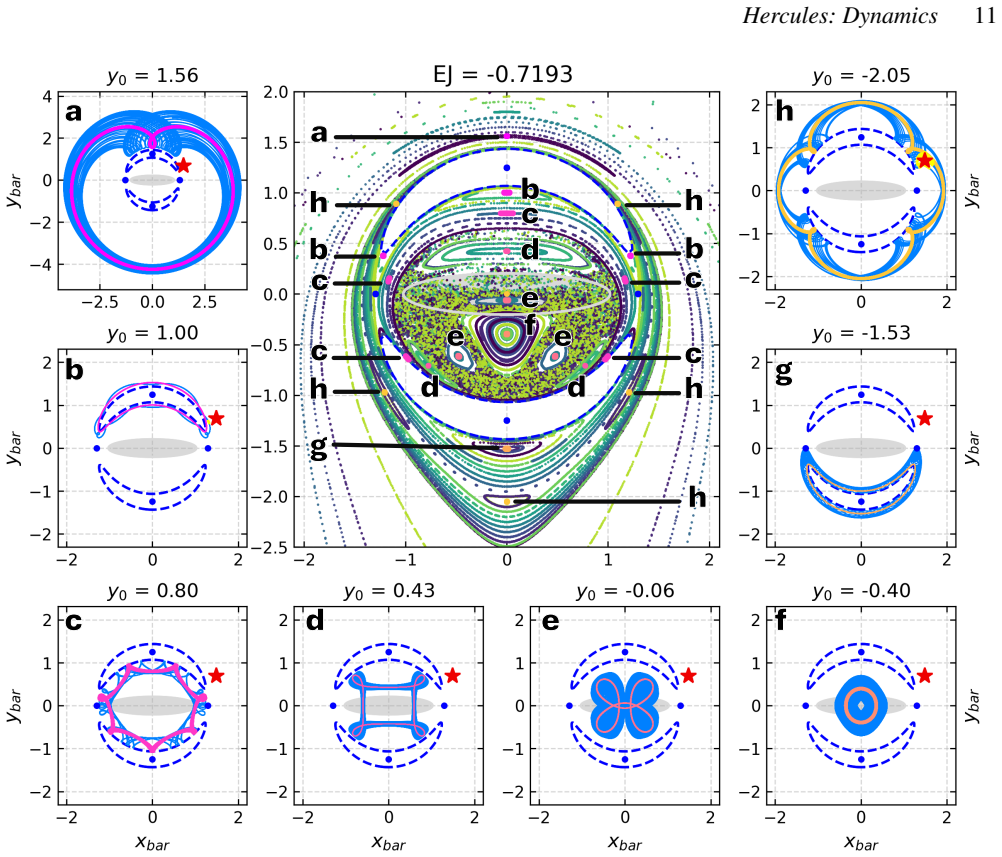
The load-bearing object is the Trojan quasi-periodic orbit: a trajectory trapped around one of the two stable periodic orbit families that librate about the L4 Lagrange point (and its centrosymmetric partner L5) of the barred potential, which sits at the bar's corotation resonance. These points are maxima of the effective potential, whose 'volcano' rim they form together with the L1/L2 saddle points; the Jacobi integral $E_J = E - \Omega_b L_Z$ is the only conserved quantity, and its value selects which orbit family a star belongs to. The machinery runs on three tools: numerical integration of the equations of motion in the corotating frame of a Ferrers bar (an inhomogeneous prolate spheroid with density $\rho = \rho_0(1-m^2)^2$) plus a logarithmic disc-halo potential; Poincaré surfaces of section cut at $\dot{y} = 0$ that map the stability of the orbit families across $E_J$; and mock observations that record the $L_Z$ and $V_R$ of every orbit as it crosses the solar-neighbourhood cylinder, connecting phase-space morphology to the observed kinematics. The spectral decomposition of the orbits into a fast ($\sim 9\ \mathrm{Gyr}^{-1}$) and a slow ($\sim 1\ \mathrm{Gyr}^{-1}$) mode is what lets a single family morph from a near-circular 'thickened' orbit into a banana-shaped extended orbit, and it is the extended QPOs that reach the Sun and build the Hercules signal.
What would settle it
A decisive single observation is a secure, model-independent measurement of the bar's pattern speed: a value clearly above the adopted 40 km/s/kpc, which places corotation inside the solar circle, would move the L4/L5 Trojan orbits inside the Sun's orbit and falsify the mechanism, since the Trojan orbits would no longer reach the solar neighbourhood.
Extended reading notes
Core claim
On the paper's own terms, the central discovery is that the Hercules group is the orbital-level manifestation of the bar's corotation resonance. In a potential built from a Ferrers bar (semi-major axis about 5 kpc) plus a logarithmic disc-halo component, rotating with pattern speed $\Omega_b = 40\ \mathrm{km\,s^{-1}\,kpc^{-1}}$, the L4 and L5 Lagrange points on the bar's minor axis trap two families of retrograde periodic orbits: a fast, near-circular family with frequency about $9\ \mathrm{Gyr}^{-1}$, and a slow, banana-shaped family of about $1\ \mathrm{Gyr}^{-1}$ that hugs the zero-velocity curve. Both families are stable, and quasi-periodic orbits around them — especially the strongly extended QPOs of the fast family — can wander up to 5 kpc from the parent orbit, far enough to pass through the solar-neighbourhood cylinder. Mock-observed there, these orbits populate the $L_Z$–$V_R$ plane in a boomerang-shaped region that matches the Hercules over-density and its outward $V_R$ bias: lower-energy orbits feed the high-$L_Z$ subgroups, while higher-energy orbits feed the low-$L_Z$, more metal-rich subgroups III and IV. The effective potential has the topology of a volcano whose rim, formed by the L4/L5 maxima and the L1/L2 saddle points, blocks most orbits from crossing between the inner and outer galaxy; the Trojan families are the rim-crossers, making them the natural ordered transport mechanism for the inner-Galactic chemical population identified in the companion paper.
Load-bearing premise
The result stands on the adopted bar parameters — a bar about 5 kpc long rotating at about 40 km/s/kpc — which place corotation, and with it the Trojan orbits at L4/L5, outside the Sun's orbit; if the bar is instead short and fast, corotation lies inside the solar circle and the Trojans never reach the solar neighbourhood, a sensitivity the authors flag in Sections 2.2 and 4.
Editorial extensions
If this is right
- The four Hercules subgroups are slices of one dynamical family rather than separate populations: low-$E_J$ quasi-periodic orbits map onto the high-$L_Z$ subgroups (I and II), and high-$E_J$ orbits onto the low-$L_Z$, metal-rich subgroups III and IV.
- Inner-bar stars reach the solar neighbourhood by ordered rim-crossing transport, so no stochastic radial migration is needed to explain the Hercules chemistry.
- The same barred potential reproduces other nearby kinematic groups (the Arch/Hat and Hyades structures) from other orbit families, pointing toward one unified orbital mechanism for the near-Sun kinematic groups.
- Because the Trojan families stay stable across a wide parameter range, their existence alone cannot fix the bar's pattern speed, but their mapped kinematics in the solar neighbourhood can constrain it.
- Any disc galaxy hosting a long, slow bar should show analogous Trojan kinematic structures at corotation, visible in surveys of disc neighbourhoods other than the Sun's.
Reading between the lines
- A testable 3D extension: stars deposited in the solar neighbourhood by rim-crossing Trojan QPOs should carry a vertical kinematic signature tied to the phase of their rim crossing, unlike stars brought in by radial migration — something the paper's planar model cannot see but a 3D run could check.
- If the transport is as ordered as claimed, the iron-abundance gradient across the Hercules subgroups should be sharper than diffusive radial migration would produce, since Trojan capture preserves phase information rather than scrambling it.
- The volcano-rim picture generalizes to external galaxies: barred discs viewed in line-of-sight velocity fields should show corotation-radius kinematic anomalies where the rim crosses the disc plane, offering a way to find Trojan traps beyond the Milky Way.
Signed reviews
Editorial analysis
A structured set of objections, weighed in public.
Referee Report
Summary. The paper proposes that the Hercules kinematic group in the solar neighbourhood is produced by quasi-periodic Trojan orbits trapped around stable periodic orbit families at the L4/L5 Lagrange points of a slowly rotating, long Galactic bar. The authors construct a planar Ferrers-bar plus logarithmic disc/halo potential with bar semi-major axis a = 5.1 kpc and pattern speed Omega_b = 40 km/s/kpc, integrate orbits in the rotating frame, and map the SNd passages of selected quasi-periodic orbits into the L_Z-V_R plane. They find that such orbits can cover the observed Hercules subgroups with a positive V_R bias and lower L_Z, and they use surfaces of section to argue that the fast Trojan family is dynamically stable over a wide range of Jacobi integral. The paper connects this dynamics to the chemical signatures reported in Paper I and concludes that Trojan orbits are the most likely origin of Hercules.
Significance. If the central claim holds, the paper provides an orbital-level mechanism for the Hercules group in the slow-bar scenario, complementing the chemical analysis of Paper I and offering a concrete alternative to the OLR interpretation. The numerical work is careful: Jacobi integral conservation is checked to six significant figures, the surfaces of section are generated systematically, and the code for the Ferrers potential is publicly available. The paper also makes a falsifiable prediction that Trojan-related kinematic signatures should appear in other Galactic neighbourhoods, which is a strength. However, the significance is limited by two load-bearing gaps: the SNd match is demonstrated only with a few hand-selected orbits rather than a population-weighted model, and the entire mechanism depends on the adopted slow-bar parameters, which the authors themselves note are not universally accepted. The capture process that would put inner-disc stars onto Trojan orbits is also not demonstrated.
major comments (3)
- [Section 3.2, Figs 5 and 6] The claimed agreement with the observed Hercules group is established only by visually matching a small number of manually chosen quasi-periodic orbits that are selected precisely because they reach the SNd. Figure 5 shows four orbits and Figure 6 shows three perturbations per energy, with no weighting by the phase-space volume, stellar distribution function, or integration-time coverage of the initial-condition space. The paper states that Hercules contains about 23 per cent of SNd stars, but no synthetic population built from the QPO families is compared to the data, so the mechanism's ability to produce an overdensity of that amplitude is not quantified. At minimum, the authors should compute the fraction of the (E_J, y0) initial-condition space that reaches the SNd and discuss how a physically motivated stellar distribution would populate those orbits.
- [Sections 2.2 and 4] The central result is conditional on Omega_b = 40 km/s/kpc and a = 5.1 kpc, since these place corotation near 6 kpc and allow the most extended Trojan QPOs to reach R = 8.2 kpc. The paper itself notes in Section 4 that published pattern-speed estimates range from 30 to 60 km/s/kpc and that the short-fast-bar scenario is not observationally excluded. For a faster bar, corotation moves inward and the SNd-reaching Trojan channel disappears, so the proposed origin would not operate. This is not a minor caveat but a load-bearing sensitivity of the main conclusion. I would like to see either a quantitative exploration of Omega_b and bar-length variations (for example, showing at what Omega_b the Trojan QPOs stop reaching the SNd) or an explicit reframing of the conclusion as applying only under the slow-long-bar assumption. The authors' transparency about the limitation is appreciated, but the manuscript currently presents the conclusion in unconditional terms in the abstract and Section 5.
- [Section 4, paragraph on capture] The paper's origin claim requires that inner Galactic stars can be captured into the stable Trojan QPOs and then transported to the SNd. However, the capture mechanism is only sketched: the text states that if an unstable orbit approaches a Trojan orbit on the same line in the (L_Z, E) plane it 'may be captured', and that instabilities near L1/L2 'should allow' capture. No example orbit, cross-section, or reference to a quantitative capture study is provided. Since the conclusions explicitly say that Hercules stars are 'captured by the Trojan orbits', this missing step leaves the transport story incomplete. A demonstration for at least one family of inner-disc orbits, or a clear statement that capture is assumed and will be tested in future work, is needed here.
minor comments (6)
- [Abstract] The phrase 'fast-rotating periodic Trojan orbits around the L4 Lagrange point of the bar minor axis' is confusing, because 'fast' refers to the orbit family rather than the bar rotation; consider rewording, and capitalise 'We' consistently.
- [Section 3.3.1 / Fig. 7 caption] The text '(±− 1.2,−1.1)' in the description of subplot h contains a typographical error; it should presumably be '(−1.2,−1.1)' or similar.
- [Software / Data Availability] There is a typo in 'Gaia arcive'; also the sentence 'Code used for data analysis and plotting are available on request' should be 'is available'.
- [Section 3.2] The text contains 'expecially' instead of 'especially' in the sensitivity discussion.
- [Fig. 3] The bottom panel's y-axis label '3/(R )' appears garbled; it should read 'azimuthal force' with the correct units.
- [Section 2.2] When introducing the dimensionless numbers Q and P, the paper does not explicitly define the physical meaning of P; a short sentence would improve readability, since P appears only in the equations of motion.
Circularity Check
No significant circularity: the model parameters are adopted from independent Milky Way constraints, and the SNd kinematics are forward-integrated orbit outputs rather than fitted quantities.
full rationale
After walking the derivation chain, I find no circular step. The bar model parameters (a = 5.1 kpc, Omega_b = 40 km/s/kpc, V = 240 km/s, R_c = 2.5 kpc, M_b = 2 x 10^10 M_sun) are fixed in Section 2.2 by independent observations and literature constraints, not by fitting to Hercules kinematics. Orbits are integrated from sampled (E_J, y_0) initial conditions in the analytic Ferrers-plus-logarithmic potential, and the L_Z-V_R distributions in Figures 5 and 6 are computed from the resulting phase-space crossings of the pre-defined solar-neighbourhood cylinder; no parameter is regressed to the Gaia overdensity. The comparison with Hercules is therefore a forward-model consistency check, not a fitted input renamed as a prediction. The self-citation to Paper I (arXiv:2411.19085) provides independent GALAH/APOGEE chemical evidence used as corroboration for the proposed inner-Galactic origin; the Trojan orbital mechanism itself does not reduce to that citation. The acknowledged sensitivity of the mechanism to the adopted slow bar pattern speed (Sections 2.2 and 4) is a robustness or correctness caveat, not a circularity.
Assumptions & free parameters
free parameters (5)
- Bar pattern speed Omega_b =
40 km/s/kpc
- Bar semi-major scale epsilon (a = 5.1 kpc) =
5 kpc (epsilon^2 = a^2 - c^2)
- Bar mass M_b =
2 x 10^10 M_sun
- Logarithmic potential scale V and core radius R_c =
V = 240 km/s, R_c = 2.5 kpc
- Selected QPO initial conditions (E_J, y0) =
e.g., E_J = -0.6967, y0 = 0.85; E_J = -0.5117, y0 = 0.60
assumptions (6)
- domain assumption The Ferrers bar plus logarithmic disc/halo potential adequately represents the in-plane Milky Way potential for studying orbital families.
- domain assumption The Galactic bar is long and slowly rotating with Omega_b = 40 km/s/kpc and a = 5.1 kpc.
- domain assumption Motion can be restricted to the Galactic plane (z = 0) without changing conclusions.
- ad hoc to paper Only y-axis-symmetric orbits with initial velocity parallel to the bar minor axis need be considered to characterize the Trojan families.
- ad hoc to paper Stars can be captured into Trojan orbits from inner Galactic orbits (e.g., via L1/L2 or unstable bar orbits).
- domain assumption The chemical origin of Hercules III and IV in the outer bar, as concluded in Paper I by the same authors, is correct.
Cite this review
Pith. "Pith review of On the origin of the Hercules group: II. the Trojan quasi-periodic identity on the orbital level." pith.science (2026). https://pith.science/paper/YX6Z7HXP
@misc{pith2026241119097,
  author       = {Pith},
  title        = {Pith review of: On the origin of the Hercules group: II. the Trojan quasi-periodic identity on the orbital level},
  year         = {2026},
  howpublished = {\url{https://pith.science/paper/YX6Z7HXP}},
  note         = {Machine review of arXiv:2411.19097}
}
abstract
The Hercules kinematic group is a stellar anomaly structure observed in the solar neighbourhood (SNd). In the previous paper, we analysed chemical signatures and related the origin of this stellar population to the outer bar. Next to consider is how this alien population migrate out into the SNd. Often, this kinematic structure is associated with bar resonances. In this paper, We consider the driving mechanism of Hercules on the orbital level. We construct a simple Milky Way-like potential model with a slowly rotating long bar and explore some of the stellar orbit families and their stability. With this model, our numerical solutions of the equations of motion show that quasi-periodic orbits trapped around fast-rotating periodic Trojan orbits around the L4 Lagrange point of the bar minor axis can pass through the SNd. When observed in the SNd, they populate the Hercules structure in the $L_Z$-$V_R$ kinematics space. Moreover, the variation in radial coverage in the galactic plane with the SNd kinematics shows good agreement with chemical signatures found in Paper I. Furthermore, the effective potential shows the topology of a volcano, the rim of which limits most orbits to stay inside or outside. Trojan orbits are a stable orbit family that can transport inner Galactic stars out to the SNd. They can explain the stellar kinematics of Hercules, and provide a straightforward basis for its chemical properties. We support that Trojan orbits associated with the slowly rotating Galactic bar explain the Hercules structure observed in the SNd.
Figures


Figures from the paper (7 more)




Forward citations
Cited by 1 Pith paper
-
On the origin of the Hercules group: I. chemical signatures indicating the outer bar origin
The low-angular-momentum Hercules III and IV subgroups, after removing high-alpha thick disk stars, show iron-peak and Odd-Z enhancements that suggest an origin near the Milky Way's outer bar.
Reference graph
Works this paper leans on
-
[1]
Abdurro'uf et al., 2022, @doi [ ] 10.3847/1538-4365/ac4414 , https://ui.adsabs.harvard.edu/abs/2022ApJS..259...35A 259, 35
-
[2]
Antoja T., et al., 2014, @doi [ ] 10.1051/0004-6361/201322623 , https://ui.adsabs.harvard.edu/abs/2014A&A...563A..60A 563, A60
-
[3]
Asano T., Fujii M. S., Baba J., B \'e dorf J., Sellentin E., Portegies Zwart S., 2020, @doi [ ] 10.1093/mnras/staa2849 , https://ui.adsabs.harvard.edu/abs/2020MNRAS.499.2416A 499, 2416
-
[4]
Asplund M., Grevesse N., Sauval A. J., Scott P., 2009, @doi [ ] 10.1146/annurev.astro.46.060407.145222 , https://ui.adsabs.harvard.edu/abs/2009ARA&A..47..481A 47, 481
arXiv 2009
-
[5]
Astropy Collaboration et al., 2013, @doi [ ] 10.1051/0004-6361/201322068 , https://ui.adsabs.harvard.edu/abs/2013A&A...558A..33A 558, A33
-
[6]
Astropy Collaboration et al., 2018, @doi [ ] 10.3847/1538-3881/aabc4f , https://ui.adsabs.harvard.edu/abs/2018AJ....156..123A 156, 123
-
[7]
Astropy Collaboration et al., 2022, @doi [ ] 10.3847/1538-4357/ac7c74 , https://ui.adsabs.harvard.edu/abs/2022ApJ...935..167A 935, 167
-
[8]
Athanassoula E., 1992, @doi [ ] 10.1093/mnras/259.2.328 , https://ui.adsabs.harvard.edu/abs/1992MNRAS.259..328A 259, 328
Show all 77 references
-
[9]
Athanassoula E., Bienayme O., Martinet L., Pfenniger D., 1983, , https://ui.adsabs.harvard.edu/abs/1983A&A...127..349A 127, 349
1983
-
[10]
J., 2009, @doi [ ] 10.1111/j.1365-2966.2009.15583.x , https://ui.adsabs.harvard.edu/abs/2009MNRAS.400.1706A 400, 1706
Athanassoula E., Romero-G \'o mez M., Bosma A., Masdemont J. J., 2009, @doi [ ] 10.1111/j.1365-2966.2009.15583.x , https://ui.adsabs.harvard.edu/abs/2009MNRAS.400.1706A 400, 1706
2009
-
[11]
A., P \'e rez-Villegas A., L \'e pine J
Barros D. A., P \'e rez-Villegas A., L \'e pine J. R. D., Michtchenko T. A., Vieira R. S. S., 2020, @doi [ ] 10.3847/1538-4357/ab59d1 , https://ui.adsabs.harvard.edu/abs/2020ApJ...888...75B 888, 75
2020 doi
-
[12]
S., Feltzing S., Gustafsson B., 2007, @doi [ ] 10.1086/512014 , https://ui.adsabs.harvard.edu/abs/2007ApJ...655L..89B 655, L89
Bensby T., Oey M. S., Feltzing S., Gustafsson B., 2007, @doi [ ] 10.1086/512014 , https://ui.adsabs.harvard.edu/abs/2007ApJ...655L..89B 655, L89
2007 doi
-
[13]
Bernet M., Ramos P., Antoja T., Famaey B., Monari G., Al Kazwini H., Romero-G \'o mez M., 2022, @doi [ ] 10.1051/0004-6361/202244070 , https://ui.adsabs.harvard.edu/abs/2022A&A...667A.116B 667, A116
2022 doi
-
[14]
Binney J., 2020, @doi [ ] 10.1093/mnras/staa1103 , https://ui.adsabs.harvard.edu/abs/2020MNRAS.495..895B 495, 895
2020 doi
-
[15]
Binney J., Spergel D., 1982, @doi [ ] 10.1086/159559 , https://ui.adsabs.harvard.edu/abs/1982ApJ...252..308B 252, 308
1982 doi
-
[16]
Binney J., Tremaine S., 2008, Galactic Dynamics: Second Edition
2008
-
[17]
E., Hut P., 1985, @doi [ ] 10.1093/mnras/215.1.59 , https://ui.adsabs.harvard.edu/abs/1985MNRAS.215...59B 215, 59
Binney J., Gerhard O. E., Hut P., 1985, @doi [ ] 10.1093/mnras/215.1.59 , https://ui.adsabs.harvard.edu/abs/1985MNRAS.215...59B 215, 59
1985 doi
-
[18]
G., Sormani M
Borodina O., Williams T. G., Sormani M. C., Meidt S., Schinnerer E., 2023, @doi [ ] 10.1093/mnras/stad2068 , https://ui.adsabs.harvard.edu/abs/2023MNRAS.524.3437B 524, 3437
2023 doi
-
[19]
W., Hunt J
Bovy J., Leung H. W., Hunt J. A. S., Mackereth J. T., Garc \' a-Hern \'a ndez D. A., Roman-Lopes A., 2019, @doi [ ] 10.1093/mnras/stz2891 , https://ui.adsabs.harvard.edu/abs/2019MNRAS.490.4740B 490, 4740
2019 doi
-
[20]
P., 1973, Algorithms for Minimization without Derivatives , 1st edn
Brent R. P., 1973, Algorithms for Minimization without Derivatives , 1st edn. Prentice-Hall, Englewood Cliffs, New Jersey
1973
- [21]
-
[22]
Chiba R., Sch \"o nrich R., 2021, @doi [ ] 10.1093/mnras/stab1094 , https://ui.adsabs.harvard.edu/abs/2021MNRAS.505.2412C 505, 2412
2021 doi
-
[23]
Chiba R., Friske J. K. S., Sch \"o nrich R., 2021, @doi [ ] 10.1093/mnras/staa3585 , https://ui.adsabs.harvard.edu/abs/2021MNRAS.500.4710C 500, 4710
2021 doi
-
[24]
M., Sim \'o C., 2000, @doi [ ] 10.1051/aas:2000108 , https://ui.adsabs.harvard.edu/abs/2000A&AS..147..205C 147, 205
Cincotta P. M., Sim \'o C., 2000, @doi [ ] 10.1051/aas:2000108 , https://ui.adsabs.harvard.edu/abs/2000A&AS..147..205C 147, 205
2000 doi
-
[25]
Aguerri J
D'Onghia E., L. Aguerri J. A., 2020, @doi [ ] 10.3847/1538-4357/ab6bd6 , https://ui.adsabs.harvard.edu/abs/2020ApJ...890..117D 890, 117
2020 doi
-
[26]
Dehnen W., 2000, @doi [ ] 10.1086/301226 , https://ui.adsabs.harvard.edu/abs/2000AJ....119..800D 119, 800
2000 doi
-
[27]
Drimmel R., et al., 2023, @doi [ ] 10.1051/0004-6361/202244605 , https://ui.adsabs.harvard.edu/abs/2023A&A...670A..10D 670, A10
2023 doi
-
[28]
J., 1983, @doi [ ] 10.1086/113352 , https://ui.adsabs.harvard.edu/abs/1983AJ.....88..642E 88, 642
Eggen O. J., 1983, @doi [ ] 10.1086/113352 , https://ui.adsabs.harvard.edu/abs/1983AJ.....88..642E 88, 642
1983 doi
-
[29]
J., 1996, @doi [ ] 10.1086/118126 , https://ui.adsabs.harvard.edu/abs/1996AJ....112.1595E 112, 1595
Eggen O. J., 1996, @doi [ ] 10.1086/118126 , https://ui.adsabs.harvard.edu/abs/1996AJ....112.1595E 112, 1595
1996 doi
-
[30]
W., Rix H.-W., Ness M
Eilers A.-C., Hogg D. W., Rix H.-W., Ness M. K., 2019, @doi [ ] 10.3847/1538-4357/aaf648 , https://ui.adsabs.harvard.edu/abs/2019ApJ...871..120E 871, 120
2019 doi
-
[31]
Englmaier P., Gerhard O., 1999, @doi [ ] 10.1046/j.1365-8711.1999.02280.x , https://ui.adsabs.harvard.edu/abs/1999MNRAS.304..512E 304, 512
1999
-
[32]
Famaey B., Jorissen A., Luri X., Mayor M., Udry S., Dejonghe H., Turon C., 2005, @doi [ ] 10.1051/0004-6361:20041272 , https://ui.adsabs.harvard.edu/abs/2005A&A...430..165F 430, 165
2005 doi
-
[33]
M., 1877, The Quarterly Journal of Pure and Applied Mathematics, https://ui.adsabs.harvard.edu/abs/1877QJPAM..14....1F 14, 1
Ferrers N. M., 1877, The Quarterly Journal of Pure and Applied Mathematics, https://ui.adsabs.harvard.edu/abs/1877QJPAM..14....1F 14, 1
-
[34]
Fragkoudi F., et al., 2019, @doi [ ] 10.1093/mnras/stz1875 , https://ui.adsabs.harvard.edu/abs/2019MNRAS.488.3324F 488, 3324
2019 doi
-
[35]
C., 1966, @doi [ ] 10.1093/mnras/133.1.47 , https://ui.adsabs.harvard.edu/abs/1966MNRAS.133...47F 133, 47
Freeman K. C., 1966, @doi [ ] 10.1093/mnras/133.1.47 , https://ui.adsabs.harvard.edu/abs/1966MNRAS.133...47F 133, 47
1966 doi
-
[36]
GRAVITY Collaboration et al., 2019, @doi [ ] 10.1051/0004-6361/201935656 , https://ui.adsabs.harvard.edu/abs/2019A&A...625L..10G 625, L10
2019 doi
-
[37]
GRAVITY Collaboration et al., 2021, @doi [ ] 10.1051/0004-6361/202040208 , https://ui.adsabs.harvard.edu/abs/2021A&A...647A..59G 647, A59
2021 doi
-
[38]
Gaia Collaboration et al., 2023, @doi [ ] 10.1051/0004-6361/202243940 , https://ui.adsabs.harvard.edu/abs/2023A&A...674A...1G 674, A1
2023 doi
- [39]
-
[40]
R., et al., 2020, @doi [Nature] 10.1038/s41586-020-2649-2 , 585, 357
Harris C. R., et al., 2020, @doi [Nature] 10.1038/s41586-020-2649-2 , 585, 357
2020 doi
-
[41]
Henon M., Heiles C., 1964, @doi [ ] 10.1086/109234 , https://ui.adsabs.harvard.edu/abs/1964AJ.....69...73H 69, 73
1964 doi
-
[42]
Hunt J. A. S., Bovy J., 2018, @doi [ ] 10.1093/mnras/sty921 , https://ui.adsabs.harvard.edu/abs/2018MNRAS.477.3945H 477, 3945
2018 doi
-
[43]
Hunt J. A. S., Hong J., Bovy J., Kawata D., Grand R. J. J., 2018, @doi [ ] 10.1093/mnras/sty2532 , https://ui.adsabs.harvard.edu/abs/2018MNRAS.481.3794H 481, 3794
2018 doi
-
[44]
D., 2007, @doi [Computing in Science & Engineering] 10.1109/MCSE.2007.55 , 9, 90
Hunter J. D., 2007, @doi [Computing in Science & Engineering] 10.1109/MCSE.2007.55 , 9, 90
2007 doi
- [45]
-
[46]
J., 1991, in Sundelius B., ed., Dynamics of Disc Galaxies
Kalnajs A. J., 1991, in Sundelius B., ed., Dynamics of Disc Galaxies. p. 323
1991
-
[47]
Khoperskov S., Gerhard O., 2022, @doi [ ] 10.1051/0004-6361/202141836 , https://ui.adsabs.harvard.edu/abs/2022A&A...663A..38K 663, A38
2022 doi
-
[48]
Kim W.-T., Seo W.-Y., Kim Y., 2012, @doi [ ] 10.1088/0004-637X/758/1/14 , https://ui.adsabs.harvard.edu/abs/2012ApJ...758...14K 758, 14
2012 doi
-
[49]
W., Bovy J., Mackereth J
Leung H. W., Bovy J., Mackereth J. T., Hunt J. A. S., Lane R. R., Wilson J. C., 2023, @doi [ ] 10.1093/mnras/stac3529 , https://ui.adsabs.harvard.edu/abs/2023MNRAS.519..948L 519, 948
2023 doi
-
[50]
P., 2022, @doi [ ] 10.3847/1538-4357/ac3823 , https://ui.adsabs.harvard.edu/abs/2022ApJ...925...71L 925, 71
Li Z., Shen J., Gerhard O., Clarke J. P., 2022, @doi [ ] 10.3847/1538-4357/ac3823 , https://ui.adsabs.harvard.edu/abs/2022ApJ...925...71L 925, 71
2022 doi
- [51]
-
[52]
Liang X., Yoon S.-J., Zhao J., Li Z., Zhang J., Wu Y., 2023, @doi [ ] 10.3847/1538-4357/acf295 , https://ui.adsabs.harvard.edu/abs/2023ApJ...956..146L 956, 146
2023 doi
-
[53]
Lucchini S., D'Onghia E., Aguerri J. A. L., 2024, @doi [ ] 10.1093/mnrasl/slae024 , https://ui.adsabs.harvard.edu/abs/2024MNRAS.531L..14L 531, L14
2024 doi
-
[54]
A., L \'e pine J
Michtchenko T. A., L \'e pine J. R. D., P \'e rez-Villegas A., Vieira R. S. S., Barros D. A., 2018, @doi [ ] 10.3847/2041-8213/aad804 , https://ui.adsabs.harvard.edu/abs/2018ApJ...863L..37M 863, L37
2018 doi
-
[55]
Monari G., Kawata D., Hunt J. A. S., Famaey B., 2017, @doi [ ] 10.1093/mnrasl/slw238 , https://ui.adsabs.harvard.edu/abs/2017MNRAS.466L.113M 466, L113
2017 doi
-
[56]
Monari G., Famaey B., Siebert A., Wegg C., Gerhard O., 2019, @doi [ ] 10.1051/0004-6361/201834820 , https://ui.adsabs.harvard.edu/abs/2019A&A...626A..41M 626, A41
2019 doi
-
[57]
G., Schuster W
Moreno E., Fern \'a ndez-Trincado J. G., Schuster W. J., P \'e rez-Villegas A., Chaves-Velasquez L., 2021, @doi [ ] 10.1093/mnras/stab1908 , https://ui.adsabs.harvard.edu/abs/2021MNRAS.506.4687M 506, 4687
2021 doi
-
[58]
D., Dermott S
Murray C. D., Dermott S. F., 1999, Solar System Dynamics , @doi 10.1017/CBO9781139174817
1999 doi
-
[59]
Pagel B. E. J., Edmunds M. G., 1981, @doi [ ] 10.1146/annurev.aa.19.090181.000453 , https://ui.adsabs.harvard.edu/abs/1981ARA&A..19...77P 19, 77
1981
-
[60]
Perek L., 1962, @doi [Advances in Astronomy and Astrophysics] 10.1016/B978-1-4831-9919-1.50008-X , https://ui.adsabs.harvard.edu/abs/1962AdA&A...1..165P 1, 165
1962 doi
-
[61]
E., 2007, @doi [Computing in Science and Engineering] 10.1109/MCSE.2007.53 , 9, 21
P\'erez F., Granger B. E., 2007, @doi [Computing in Science and Engineering] 10.1109/MCSE.2007.53 , 9, 21
2007 doi
-
[62]
P \'e rez-Villegas A., Portail M., Wegg C., Gerhard O., 2017, @doi [ ] 10.3847/2041-8213/aa6c26 , https://ui.adsabs.harvard.edu/abs/2017ApJ...840L...2P 840, L2
2017 doi
-
[63]
Portail M., Gerhard O., Wegg C., Ness M., 2017, @doi [ ] 10.1093/mnras/stw2819 , https://ui.adsabs.harvard.edu/abs/2017MNRAS.465.1621P 465, 1621
2017 doi
-
[64]
C., et al., 2018, @doi [ ] 10.1093/mnras/sty865 , https://ui.adsabs.harvard.edu/abs/2018MNRAS.478..228Q 478, 228
Quillen A. C., et al., 2018, @doi [ ] 10.1093/mnras/sty865 , https://ui.adsabs.harvard.edu/abs/2018MNRAS.478..228Q 478, 228
2018 doi
-
[65]
J., Combes F., 2008, @doi [ ] 10.1051/0004-6361:200809644 , https://ui.adsabs.harvard.edu/abs/2008A&A...489..115R 489, 115
Rodriguez-Fernandez N. J., Combes F., 2008, @doi [ ] 10.1051/0004-6361:200809644 , https://ui.adsabs.harvard.edu/abs/2008A&A...489..115R 489, 115
2008 doi
-
[66]
A., Wilkinson A., 1993, @doi [Reports on Progress in Physics] 10.1088/0034-4885/56/2/001 , https://ui.adsabs.harvard.edu/abs/1993RPPh...56..173S 56, 173
Sellwood J. A., Wilkinson A., 1993, @doi [Reports on Progress in Physics] 10.1088/0034-4885/56/2/001 , https://ui.adsabs.harvard.edu/abs/1993RPPh...56..173S 56, 173
1993 doi
-
[67]
C., Binney J., Magorrian J., 2015, @doi [ ] 10.1093/mnras/stv2067 , https://ui.adsabs.harvard.edu/abs/2015MNRAS.454.1818S 454, 1818
Sormani M. C., Binney J., Magorrian J., 2015, @doi [ ] 10.1093/mnras/stv2067 , https://ui.adsabs.harvard.edu/abs/2015MNRAS.454.1818S 454, 1818
2015 doi
-
[68]
C., et al., 2022, @doi [ ] 10.1093/mnras/stac639 , https://ui.adsabs.harvard.edu/abs/2022MNRAS.512.1857S 512, 1857
Sormani M. C., et al., 2022, @doi [ ] 10.1093/mnras/stac639 , https://ui.adsabs.harvard.edu/abs/2022MNRAS.512.1857S 512, 1857
2022 doi
-
[69]
D., 1984, @doi [ ] 10.1086/184292 , https://ui.adsabs.harvard.edu/abs/1984ApJ...282L...5T 282, L5
Tremaine S., Weinberg M. D., 1984, @doi [ ] 10.1086/184292 , https://ui.adsabs.harvard.edu/abs/1984ApJ...282L...5T 282, L5
1984 doi
-
[70]
Virtanen P., et al., 2020, @doi [Nature Methods] 10.1038/s41592-019-0686-2 , https://rdcu.be/b08Wh 17, 261
2020 doi
-
[71]
Wegg C., Gerhard O., Portail M., 2015, @doi [ ] 10.1093/mnras/stv745 , https://ui.adsabs.harvard.edu/abs/2015MNRAS.450.4050W 450, 4050
2015 doi
-
[72]
J., Sellwood J
Weiner B. J., Sellwood J. A., 1999, @doi [ ] 10.1086/307786 , https://ui.adsabs.harvard.edu/abs/1999ApJ...524..112W 524, 112
1999 doi
-
[73]
H., Fragkoudi F., Ness M., 2022, @doi [ ] 10.3847/1538-4357/ac7da0 , https://ui.adsabs.harvard.edu/abs/2022ApJ...935...28W 935, 28
Wheeler A., Abril-Cabezas I., Trick W. H., Fragkoudi F., Ness M., 2022, @doi [ ] 10.3847/1538-4357/ac7da0 , https://ui.adsabs.harvard.edu/abs/2022ApJ...935...28W 935, 28
2022 doi
-
[74]
Zhou Y., Li X., Huang Y., Zhang H., 2023, @doi [ ] 10.3847/1538-4357/acadd9 , https://ui.adsabs.harvard.edu/abs/2023ApJ...946...73Z 946, 73
2023 doi
-
[75]
da Costa-Luis C., et al., 2024, tqdm: A fast, Extensible Progress Bar for Python and CLI , @doi 10.5281/zenodo.595120
2024 doi
-
[76]
C., 1972, @doi [Vistas in Astronomy] 10.1016/0083-6656(72)90026-8 , https://ui.adsabs.harvard.edu/abs/1972VA.....14..163D 14, 163
de Vaucouleurs G., Freeman K. C., 1972, @doi [Vistas in Astronomy] 10.1016/0083-6656(72)90026-8 , https://ui.adsabs.harvard.edu/abs/1972VA.....14..163D 14, 163
1972 doi
-
[77]
write newline
" write newline "" before.all 'output.state := FUNCTION fin.entry write newline FUNCTION new.block output.state before.all = 'skip after.block 'output.state := if FUNCTION new.sentence output.state after.block = 'skip output.state before.all = 'skip after.sentence 'output.stat...
Reviewed August 12, 2026 · model on record in the stance chip above.
Discussion (0). Continue with ORCID to comment.