REVIEW 4 major objections 5 minor 44 references
Optoacoustic Model-Based Inversion Using Anisotropic Adaptive Total-Variation Regularization
T0 review · 4 major / 5 minor · reviewed 2026-08-14 · deepseek-v4-flash
Pith's one-line read Adaptive anisotropic total-variation regularization preserves non-convex blood-vessel boundaries in optoacoustic tomography.
desk verdict A clean, honest application of the authors' A2TV regularizer to optoacoustic inversion; the core idea is sound but the headline 4x contrast claim rests on thin experimental support. read the letter →
The pith
A machine-rendered reading of the paper's core claim, the machinery that carries it, and where it could break.
The reading
What carries the argument
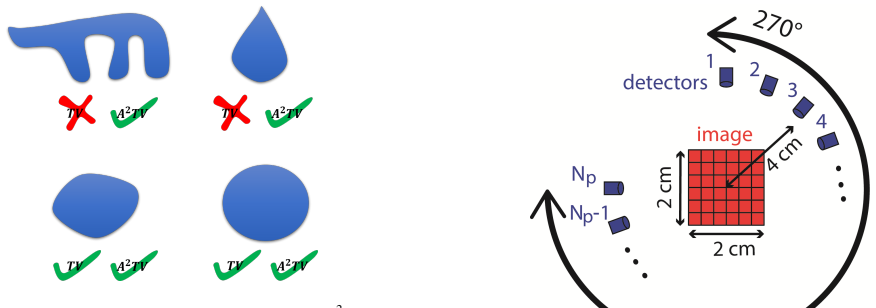
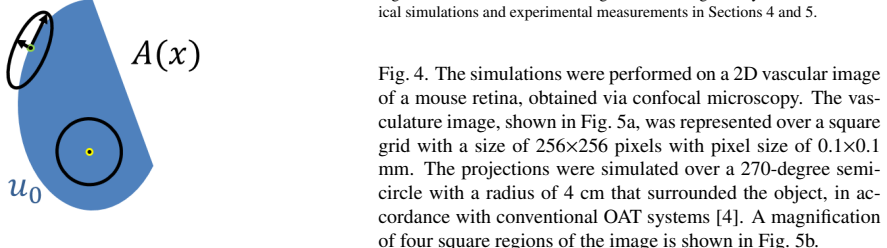
The central object is the A2TV functional $J_{\mathrm{A2TV}}(u)=\int_\Omega \|A(x)\nabla u(x)\|_2\,dx$, where $A(x)\in\mathbb{R}^{2\times2}$ is a spatially adaptive tensor that defines an adaptive gradient. The tensor is built from the eigenvalue decomposition of a smoothed structure tensor $J_\rho(\nabla u_{0;\sigma})$ computed from an initial reconstruction: in flat regions its eigenvalues are left equal so the cost reduces to standard isotropic TV, while near edges the eigenvalue along the gradient direction is suppressed so regularization flows along the tangent, preserving boundary curvature. The anisotropy parameter $k$ controls how much of the image is treated anisotropically and thereby the degree of non-convexity that can be preserved. Reconstruction is posed as a generalized ROF model, $u^*=\arg\min_u J_{\mathrm{A2TV}}(u)+\frac{\lambda}{2}\|Mu-p\|_2^2$, and solved with a first-order primal-dual algorithm that alternates between updating the image and updating the tensor $A(x)$.
What would settle it
A reader could settle the claim by imaging a phantom with a known ground-truth vessel whose boundary is deliberately non-convex with high curvature, scanning the regularization parameters for both A2TV and TV-$L_1$, and measuring the distance between the reconstructed boundary and the truth, for example the mean absolute error or Hausdorff distance at matched regularization strength. If TV-$L_1$ preserves the boundary as well as A2TV, or if A2TV's advantage disappears when the ground truth is known, the central claim fails; likewise, if the alternating optimization stalls and the final image depends strongly on initialization, the practical claim collapses.
Extended reading notes
Core claim
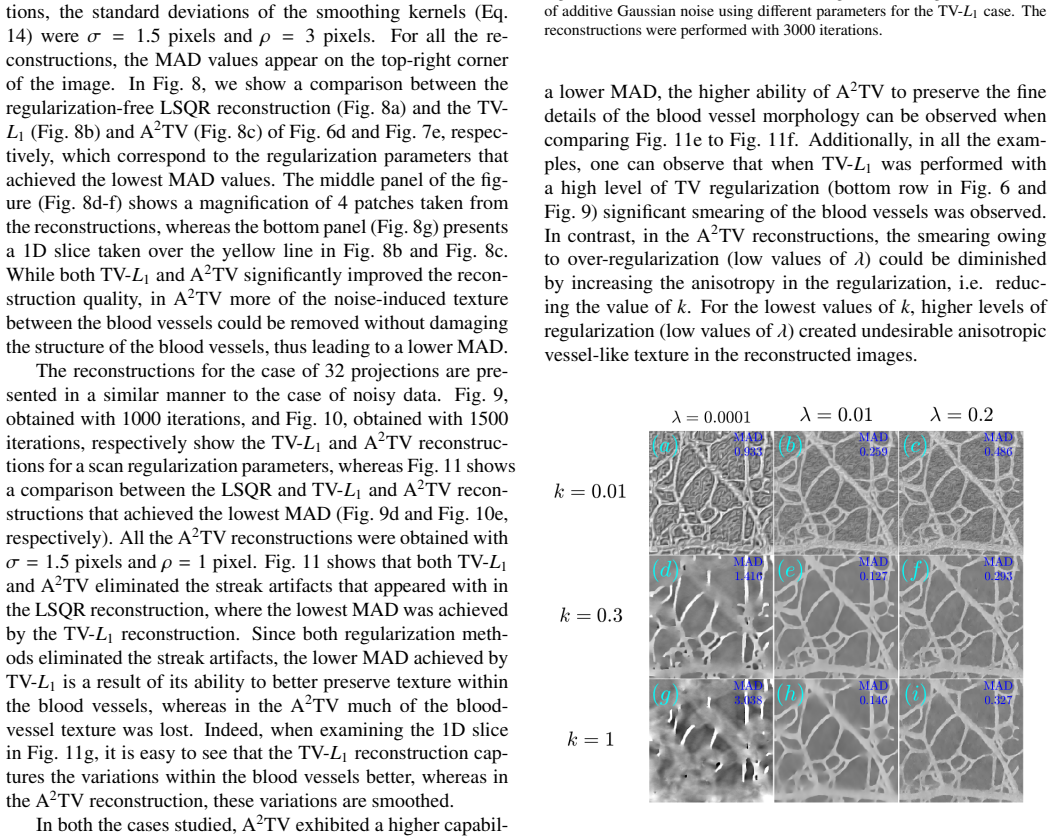
The paper's central discovery is that a regularizer which adapts its anisotropy to the local image structure, A2TV, can be embedded in model-based optoacoustic inversion and outperforms TV-$L_1$ when the reconstruction target has complex, non-convex boundaries. Concretely, the authors demonstrate on a mouse-retina vasculature image that under strong regularization TV-$L_1$ smears the vessels, while A2TV removes noise between vessels and preserves their curvature; in the sparse-projection (32-projection) simulation TV-$L_1$ attains a lower mean absolute distance because it preserves intra-vessel texture, yet A2TV still better retains fine vessel morphology. On the experimental hair phantom, the A2TV reconstruction achieves the highest image quality, with the bottom weak hair reaching over four times the peak-to-peak signal of the TV-$L_1$ reconstruction. The underlying claim is that A2TV shifts the trade-off frontier: stronger denoising no longer costs the vessel boundary shape.
Load-bearing premise
The image and the adaptive tensor are updated alternately, and although the energy is convex for a fixed tensor, it is non-convex in the joint variables; the paper states there is no mathematical proof of convergence, so the claimed boundary preservation depends on this alternation actually reaching a good fixed point.
Editorial extensions
If this is right
- In optoacoustic images dominated by blood vessels, A2TV permits stronger denoising (lower $\lambda$) without smearing vessel morphology, making weak and small vessels visible that TV-$L_1$ would erase.
- Under-sampled data: both A2TV and TV-$L_1$ remove the streak artifacts of unregularized inversion; A2TV sacrifices intra-vessel texture, which the paper treats as an acceptable price for cleaner morphology.
- Because the structure-tensor construction is dimension-agnostic, the same A2TV framework extends to 3D and to 4D optoacoustic reconstruction (three spatial dimensions plus time), where TV regularization has already been used.
- In applications where vascular morphology is the diagnostic feature, A2TV offers a different operating point on the regularization frontier than TV-$L_1$: equal denoising with less boundary rounding.
Reading between the lines
- If A2TV's boundary preservation transfers to other ill-posed linear inversions whose targets are thin curved structures, such as ultrasound or x-ray imaging of vessels, the same tensor-adaptation mechanism could replace isotropic TV in those settings; the paper does not test this.
- The four-parameter tuning ($\sigma$, $\rho$, $\lambda$, $k$) is the main practical cost; a natural extension would be to make the structure-tensor scales adaptive to local noise or resolution, which could widen the range of $\lambda$ over which A2TV beats TV-$L_1$.
- Because A2TV deliberately removes texture inside vessels, it would be unsuitable for imaging tasks where that texture carries information, such as speckle-based flow or red-blood-cell distribution; the paper acknowledges this trade-off but does not quantify it.
- The non-convexity of the joint energy suggests a testable diagnostic: recording the full energy or the dual residual over iterations could reveal whether the heuristic convergence seen in the examples is reliable, and whether restarting the tensor update from different initializations changes the reconstruction.
Signed reviews
Editorial analysis
A structured set of objections, weighed in public.
Referee Report
Summary. The paper proposes an adaptive anisotropic total-variation (A2TV) regularizer for model-based optoacoustic tomography. The tensor A(x) is constructed from an initial estimate using structure-tensor eigenvalue analysis, and the reconstruction minimizes the A2TV energy together with a quadratic data-fidelity term, solved by a Chambolle-Pock-type algorithm in which the tensor is updated within the iterations. The method is evaluated on simulated mouse-retina vasculature images with additive Gaussian noise and with 32 projections, and on an experimental phantom of four intersecting hairs. The authors claim that A2TV preserves non-convex blood-vessel boundaries and enhances weak-structure contrast better than TV-L1 regularization.
Significance. If the claims are established, A2TV would provide a practical regularization framework that avoids the boundary-rounding artifact of conventional TV while enabling stronger denoising, with natural extensions to 3D and 4D optoacoustic imaging. The paper contains a clear forward-model formulation, an explicit algorithm description, and both numerical and experimental demonstrations. However, the central comparative claims currently rest on manual parameter selection, a single experimental phantom without repeated measurements, a visual morphology assessment in the case where the quantitative metric favors TV-L1, and an unproved convergence of the adaptive alternating scheme. These issues must be resolved before the claimed advantage over TV-L1 can be considered robust.
major comments (4)
- [Section 3.2 and Algorithm 1] The manuscript explicitly states in Section 3.2 that there is no mathematical proof of convergence of the alternating minimization, and Algorithm 1 updates the tensor A(x) inside the Chambolle-Pock iterations (step 12), which changes the operator K during the primal-dual update. Because the reconstructions and the comparison in Sections 4 and 5 depend on the fixed point of this procedure, the lack of a convergence guarantee is load-bearing. Please provide empirical convergence evidence (e.g., residual norms of u and A versus iteration count, or a fixed-point distance measure) for the noisy, sparse, and experimental cases, or give a proof under reasonable assumptions.
- [Section 4, Figs. 9-11] In the sparse-projection case the paper reports that TV-L1 achieves a lower MAD than A2TV (text near Figs. 9-11) and then claims superiority of A2TV based on visual inspection of vessel morphology. A quantitative metric such as boundary localization error, Dice overlap of a segmented vessel mask, or structural similarity must be reported to support the claim that A2TV preserves non-convex structures better; otherwise the central comparative conclusion is contradicted by the stated MAD values.
- [Section 5, Fig. 15] The experimental support is a single agar phantom, with no repeated measurements and no error bars, and the reported 4x peak-to-peak improvement in weak-hair contrast is read from one normalized 1D slice (Fig. 15g). The choice of the displayed reconstructions (Figs. 13e and 14e) from the parameter grid is not justified by any stated selection rule. To support the contrast-enhancement claim, the authors should report statistics over multiple slices and repeated measurements and define the parameter-selection criterion before evaluating the reconstructions.
- [Section 5 and comparison to [25]] The adaptive directional TV method of Wang et al. [25] is cited in the Introduction but is never compared against numerically or experimentally. Since A2TV's additional adaptive degrees of freedom may be responsible for the reported gains, including [25] as a baseline (or explicitly arguing why it is not applicable to the settings considered) is necessary to attribute the improvement specifically to A2TV rather than to the added adaptivity.
minor comments (5)
- [Algorithm 1, line 7] The displayed update contains the string 'xxxxxx' between the two proximal arguments; this appears to be a typographical artifact and should be corrected.
- [Section 4] Please state explicitly whether the MAD-based parameter selection used the true image as an oracle; if so, discuss the implications for the comparison and whether a validation-set rule would change the conclusions.
- [Section 5] The text does not specify the number of experimental measurements or the protocol for identifying the weak hair structure; please add these details for reproducibility.
- [Section 4 and Algorithm 1] The stopping criterion for 'numerical convergence' is not quantified; please report the iteration count at which the reconstructions stabilize in terms of the change in u and A.
- [Reference [26]] Reference [26] is cited as an arXiv preprint; if it has since been published in a peer-reviewed venue, please update the citation.
Circularity Check
No significant circularity: the adaptive tensor construction is disclosed as a design choice, and the self-citation to [26] supplies independent mathematical support rather than a circular premise.
full rationale
Walking the derivation chain, I find no step in which a claimed result is equivalent to its inputs by construction. The adaptive tensor A(x) in Eqs. (18)-(20) is intentionally constructed from an initial estimate u0 so that regularization is weaker across detected edges, and the paper states this design goal explicitly: "In order to preserve structure, we should change the relation between those eigenvalues so that for flat-like areas in the image we will smooth the image in an isotropic way, while for edge-like areas, we will perform more smoothing in the tangent direction rather the gradient one." This is an openly adaptive regularizer, not a hidden fit renamed as a prediction. The theoretical statement that A2TV admits stable non-convex and high-curvature structures is imported from the authors' prior work [26], but that is a mathematical analysis of the same functional rather than an assertion already containing the OAT reconstruction results, and the paper's comparative claims are also supported by the numerical and experimental demonstrations in Sections 4 and 5. The parameter choices, including the lowest-MAD selection in the numerical study and manual selection in the phantom experiment, create in-sample comparison and reproducibility concerns, but they are not a circular reduction: no fitted parameter is relabeled as a prediction. The central experimental comparisons are against a standard TV-L1 baseline on the same data and are not forced by the definition of A2TV, so no significant circularity is present.
Assumptions & free parameters
free parameters (4)
- sigma (image-gradient smoothing in structure tensor) =
1.5 pixels
- rho (structure-tensor smoothing) =
3 pixels (noisy case), 1 pixel (sparse-angle and experimental)
- lambda (fidelity weight in Eq. (22)) =
Values such as 0.0001 and others scanned in Figs. 6-15
- k (anisotropy threshold) =
Values such as 1.0, 0.1, 0.01 scanned in figures
assumptions (5)
- domain assumption The discrete model p=Mu in Eq. (4), with the linear-interpolation pixel model of [32], accurately represents the optoacoustic forward problem for the geometry used.
- standard math The stable-set results of the authors' earlier A2TV analysis [26] correctly characterize which shapes are preserved by A2TV regularization.
- domain assumption The initial reconstruction u0 (LSQR or TV) provides sufficiently reliable edge orientations for the structure tensor, so that A(x) genuinely represents vessel boundaries rather than artifacts.
- ad hoc to paper The alternating minimization in Algorithm 1 converges practically to a good solution even though no proof is given.
- domain assumption In the experimental study, the hairs lie approximately in the 2D imaging plane so that the 2D reconstruction and the photograph are comparable.
Cite this review
Pith. "Pith review of Optoacoustic Model-Based Inversion Using Anisotropic Adaptive Total-Variation Regularization." pith.science (2026). https://pith.science/paper/YXMUJROW
@misc{pith2026190802825,
  author       = {Pith},
  title        = {Pith review of: Optoacoustic Model-Based Inversion Using Anisotropic Adaptive Total-Variation Regularization},
  year         = {2026},
  howpublished = {\url{https://pith.science/paper/YXMUJROW}},
  note         = {Machine review of arXiv:1908.02825}
}
abstract
In optoacoustic tomography, image reconstruction is often performed with incomplete or noisy data, leading to reconstruction errors. Significant improvement in reconstruction accuracy may be achieved in such cases by using nonlinear regularization schemes, such as total-variation minimization and $L_1$-based sparsity-preserving schemes. In this paper, we introduce a new framework for optoacoustic image reconstruction based on adaptive anisotropic total-variation regularization, which is more capable of preserving complex boundaries than conventional total-variation regularization. The new scheme is demonstrated in numerical simulations on blood-vessel images \textcolor{black} {as well as on experimental data} and is shown to be more capable than the total-variation-$L_1$ scheme in enhancing image contrast.
Figures

Figures from the paper (8 more)




Reference graph
Works this paper leans on
-
[25]
J. Wang, C. Zhang, Y . Wang, A photoacoustic imaging reconstruc- tion method based on directional total variation with adaptive directivity, Biomedical engineering online 16 (2017) 64
work page 2017
-
[26]
Adaptive Anisotropic Total Variation - A Nonlinear Spectral Analysis
S. Biton, G. Gilboa, Adaptive anisotropic total variation - a nonlinear spectral analysis, ArXiv preprint 1811.11281 (2018)
work page Pith review arXiv 2018
-
[1]
V . Ntziachristos, Going deeper than microscopy: the optical imaging frontier in biology, Nature methods 7 (2010) 603. 10
work page 2010
-
[2]
L. V . Wang, S. Hu, Photoacoustic tomography: in vivo imaging from organelles to organs, science 335 (2012) 1458–1462
work page 2012
-
[3]
V . Ntziachristos, D. Razansky, Molecular imaging by means of multi- spectral optoacoustic tomography (msot), Chemical reviews 110 (2010) 2783–2794
work page 2010
-
[4]
A. Taruttis, V . Ntziachristos, Advances in real-time multispectral optoa- coustic imaging and its applications, Nature Photonics 9 (2015) 219
work page 2015
-
[5]
L. V . Wang, Multiscale photoacoustic microscopy and computed tomog- raphy, Nature photonics 3 (2009) 503
work page 2009
-
[6]
A. Rosenthal, V . Ntziachristos, D. Razansky, Acoustic inversion in op- toacoustic tomography: A review, Current medical imaging reviews 9 (2013) 318–336
work page 2013
Show all 44 references
-
[7]
Buehler, E
A. Buehler, E. Herzog, D. Razansky, V . Ntziachristos, Video rate optoa- coustic tomography of mouse kidney perfusion, Optics letters 35 (2010) 2475–2477
2010
-
[8]
X. L. De ´an-Ben, S. J. Ford, D. Razansky, High-frame rate four dimen- sional optoacoustic tomography enables visualization of cardiovascular dynamics and mouse heart perfusion, Scientific reports 5 (2015) 10133
2015
-
[9]
Y . Xu, L. V . Wang, Time reversal and its application to tomography with diffracting sources, Physical review letters 92 (2004) 033902
2004
-
[10]
M. Xu, L. V . Wang, Universal back-projection algorithm for photoacous- tic computed tomography, Physical Review E 71 (2005) 016706
2005
-
[11]
R. J. Schulze, O. Scherzer, G. Zangerl, M. Holotta, D. Meyer, F. Handle, R. Nuster, G. Paltauf, On the use of frequency-domain reconstruction algorithms for photoacoustic imaging, Journal of biomedical optics 16 (2011) 086002
2011
-
[12]
Rosenthal, Algebraic determination of back-projection operators for optoacoustic tomography, Biomed
A. Rosenthal, Algebraic determination of back-projection operators for optoacoustic tomography, Biomed. Opt. Express 9 (2018) 5173–5193
2018
-
[13]
Calvetti, S
D. Calvetti, S. Morigi, L. Reichel, F. Sgallari, Tikhonov regularization and the l-curve for large discrete ill-posed problems, Journal of computa- tional and applied mathematics 123 (2000) 423–446
2000
-
[14]
Z. Yuan, C. Wu, H. Zhao, H. Jiang, Imaging of small nanoparticle- containing objects by finite-element-based photoacoustic tomography, Optics letters 30 (2005) 3054–3056
2005
-
[15]
Y . Han, S. Tzoumas, A. Nunes, V . Ntziachristos, A. Rosenthal, Sparsity- based acoustic inversion in cross-sectional multiscale optoacoustic imag- ing, Medical physics 42 (2015) 5444–5452
2015
-
[16]
Provost, F
J. Provost, F. Lesage, The application of compressed sensing for photo- acoustic tomography, IEEE transactions on medical imaging 28 (2009) 585–594
2009
-
[17]
Z. Guo, C. Li, L. Song, L. V . Wang, Compressed sensing in photoacoustic tomography in vivo, Journal of biomedical optics 15 (2010) 021311
2010
-
[18]
Liang, H
D. Liang, H. F. Zhang, L. Ying, Compressed-sensing photoacoustic imag- ing based on random optical illumination, International Journal of Func- tional Informatics and Personalised Medicine 2 (2009) 394–406
2009
-
[19]
M. Sun, N. Feng, Y . Shen, X. Shen, L. Ma, J. Li, Z. Wu, Photoacoustic imaging method based on arc-direction compressed sensing and multi- angle observation, Optics express 19 (2011) 14801–14806
2011
-
[20]
J. Meng, L. V . Wang, L. Ying, D. Liang, L. Song, Compressed-sensing photoacoustic computed tomography in vivo with partially known sup- port, Optics Express 20 (2012) 16510–16523
2012
-
[21]
X. Liu, D. Peng, W. Guo, X. Ma, X. Yang, J. Tian, Compressed sens- ing photoacoustic imaging based on fast alternating direction algorithm, Journal of Biomedical Imaging 2012 (2012) 12
2012
-
[22]
K. Wang, E. Y . Sidky, M. A. Anastasio, A. A. Oraevsky, X. Pan, Limited data image reconstruction in optoacoustic tomography by constrained to- tal variation minimization, in: Photons Plus Ultrasound: Imaging and Sensing 2011, volume 7899, International Society for Optics and ...
2011
-
[23]
L. Yao, H. Jiang, Enhancing finite element-based photoacoustic tomogra- phy using total variation minimization, Applied Optics 50 (2011) 5031– 5041
2011
-
[24]
L. Yao, H. Jiang, Photoacoustic image reconstruction from few-detector and limited-angle data, Biomedical optics express 2 (2011) 2649–2654
2011
-
[27]
Andreu, C
F. Andreu, C. Ballester, V . Caselles, J. M. Maz´on, Minimizing total vari- ation flow, Differential and Integral Equations 14 (2001) 321–360
2001
-
[28]
Peura, J
M. Peura, J. Iivarinen, E fficiency of simple shape descriptors, in: Pro- ceedings of the third international workshop on visual form, volume 443, Citeseer, 1997, p. 451
1997
-
[29]
R. A. Kruger, P. Liu, Y . Fang, C. R. Appledorn, et al., Photoacoustic ultrasound (paus)reconstruction tomography, Medical physics 22 (1995) 1605–1609
1995
-
[30]
D. T. Blackstock, Fundamentals of physical acoustics, John Wiley & Sons, 2000
2000
-
[31]
Paltauf, J
G. Paltauf, J. Viator, S. Prahl, S. Jacques, Iterative reconstruction algo- rithm for optoacoustic imaging, The Journal of the Acoustical Society of America 112 (2002) 1536–1544
2002
-
[32]
Rosenthal, D
A. Rosenthal, D. Razansky, V . Ntziachristos, Fast semi-analytical model- based acoustic inversion for quantitative optoacoustic tomography, IEEE transactions on medical imaging 29 (2010) 1275–1285
2010
-
[33]
C. C. Paige, M. A. Saunders, Lsqr: An algorithm for sparse linear equa- tions and sparse least squares, ACM transactions on mathematical soft- ware 8 (1982) 43–71
1982
-
[35]
Grasmair, F
M. Grasmair, F. Lenzen, Anisotropic total variation filtering, Applied Mathematics & Optimization 62 (2010) 323–339
2010
-
[36]
Weickert, Anisotropic di ffusion in image processing, volume 1, Teub- ner Stuttgart, 1998
J. Weickert, Anisotropic di ffusion in image processing, volume 1, Teub- ner Stuttgart, 1998
1998
-
[37]
Chambolle, T
A. Chambolle, T. Pock, A first-order primal-dual algorithm for convex problems with applications to imaging, Journal of mathematical imaging and vision 40 (2011) 120–145
2011
-
[38]
A. Dima, N. C. Burton, V . Ntziachristos, Multispectral optoacoustic to- mography at 64, 128, and 256 channels, Journal of biomedical optics 19 (2014) 036021
2014
-
[39]
P. Wray, L. Lin, P. Hu, L. V . Wang, Photoacoustic computed tomography of human extremities, Journal of biomedical optics 24 (2019) 026003
2019
-
[40]
Matsumoto, Y
Y . Matsumoto, Y . Asao, A. Yoshikawa, H. Sekiguchi, M. Takada, M. Furu, S. Saito, M. Kataoka, H. Abe, T. Yagi, et al., Label-free pho- toacoustic imaging of human palmar vessels: a structural morphological analysis, Scientific reports 8 (2018) 786
2018
-
[41]
M. Toi, Y . Asao, Y . Matsumoto, H. Sekiguchi, A. Yoshikawa, M. Takada, M. Kataoka, T. Endo, N. Kawaguchi-Sakita, M. Kawashima, et al., Visu- alization of tumor-related blood vessels in human breast by photoacoustic imaging system with a hemispherical detector array, Scientific...
2017
-
[42]
X. L. De ´an-Ben, H. L ´opez-Schier, D. Razansky, Optoacoustic micro- tomography at 100 volumes per second, Scientific Reports 7 (2017) 6850
2017
-
[43]
Gateau, A
J. Gateau, A. Chekkoury, V . Ntziachristos, Ultra-wideband three- dimensional optoacoustic tomography, Optics letters 38 (2013) 4671– 4674
2013
-
[44]
M. Omar, M. Schwarz, D. Soliman, P. Symvoulidis, V . Ntziachristos, Pushing the optical imaging limits of cancer with multi-frequency-band raster-scan optoacoustic mesoscopy (rsom), Neoplasia 17 (2015) 208– 214
2015
-
[45]
¨Ozbek, X
A. ¨Ozbek, X. L. De ´an-Ben, D. Razansky, Optoacoustic imaging at kilo- hertz volumetric frame rates, Optica 5 (2018) 857–863. 11
2018
Reviewed August 14, 2026 · model on record in the stance chip above.
Discussion (0). Continue with ORCID to comment.