REVIEW 3 major objections 4 minor 30 references
Probing clumpy wind accretion in IGR J18027-2016 with XMM-Newton
T0 review · 3 major / 4 minor · reviewed 2026-08-14 · deepseek-v4-flash
Pith's one-line read Using six XMM-Newton observations of the classical supergiant X-ray binary IGR J18027-2016, the paper shows that flare spectral variations match the clump-accretion pattern previously seen in supergiant fast X-ray transients: absorption…
desk verdict A careful first application of the SFXT hardness-resolved technique to a classical SgXB; the clump interpretation is plausible but rests on an untested spectral model choice. read the letter →
The pith
A machine-rendered reading of the paper's core claim, the machinery that carries it, and where it could break.
The reading
What carries the argument
The key instrument is the hardness-resolved spectral analysis: energy-resolved XMM-Newton light curves are rebinned adaptively to keep signal-to-noise high, grouped by hardness ratio into time intervals, and each interval's spectrum is fit with an absorbed power law to track the absorption column density $N_H$ and photon index $\Gamma$ on timescales of hundreds of seconds. This lets the paper separate changes in local absorption from changes in spectral slope during flares. A partial-covering absorption component ($pcfabs$) is used to model the average spectra, describing part of the emission that escapes local absorption; the same component is the basis for interpreting the soft excess, although a blackbody soft component fits equally well.
What would settle it
Re-fit the HR-resolved flare spectra from OBSIDs 0745060401 (egress), 0745060501, and 0745060601 with an absorbed power law plus a blackbody soft component instead of the partial-covering model, and check whether the blackbody normalization tracks the flare flux while $N_H$ stays constant. If $N_H$ no longer dips at flare peaks under this alternative model, the clump photoionization signature disappears; if the $N_H$ dip persists regardless of the soft-excess model, the clump interpretation is robust.
Extended reading notes
Core claim
In the classical supergiant X-ray binary IGR J18027-2016, the spectral variations measured during X-ray flares follow the same clump-accretion pattern seen in supergiant fast X-ray transients: the absorbing column density rises as a flare begins, drops sharply at the flare peak, and rises again during the decay. The paper interprets this as a dense clump approaching the neutron star and enhancing the accretion rate, then being photoionized by the increased X-ray flux at the peak, with recombination restoring absorption afterward. With the caveat that absolute clump properties remain hard to pin down, this is the first time this specific flare-related spectral signature has been reported for a classical SgXB, and it suggests wind clumps, not some other mechanism, help trigger flares in both subclasses.
Load-bearing premise
The clump interpretation rests on the assumption that the soft excess is partial-covering absorption rather than an additional soft spectral component, since the authors concede a blackbody fits the averaged spectra equally well and would make the flare-peak $N_H$ drop an artifact.
Editorial extensions
If this is right
- If clumps trigger flares in classical SgXBs, the boundary between classical systems and SFXTs is not a categorical difference in flare mechanism but likely a difference in clump properties or wind parameters.
- The same hardness-resolved analysis can be applied to archival and future XMM-Newton observations of other classical supergiant X-ray binaries to test whether the clump signature is common.
- The observed pre-flare absorption rise and post-peak recombination can be used to estimate clump sizes and densities, although the paper notes this remains challenging.
- The relatively flat, low-absorption observation at orbital phases 0.219-0.250 suggests some orbital phases sample a smoother, more ionized part of the wind, implying wind structure varies along the orbit.
Reading between the lines
- A natural extension the authors leave implicit: if the $N_H$ dip at flare peaks is caused by photoionization of the clump, the amplitude of the dip should correlate with peak luminosity across flares and across sources; IGR J18027-2016's fainter flare showing less of an effect is a hint in that direction.
- The blackbody-versus-partial-covering degeneracy could be broken with higher signal-to-noise broad-band spectra extending below 0.5 keV or with simultaneous covering-factor variations across eclipses, which the current data cannot do.
- If the same analysis is applied to many classical systems, the clump imprints could turn the neutron star into a wind probe, measuring clump sizes and photoionization timescales in a regime where direct wind observations fail.
- The authors treat the absence of an accretion wake in IGR J18027-2016 as speculative; a testable consequence is that at phases near eclipse ingress/egress, where the comparison source shows a wake-related absorber, IGR J18027-2016 should instead show only smooth orbital absorption changes.
Signed reviews
Editorial analysis
A structured set of objections, weighed in public.
Referee Report
Summary. This paper analyzes six XMM-Newton observations of the classical supergiant X-ray binary IGR J18027-2016. The authors extract average spectra for each observation and perform a hardness-ratio-resolved spectral analysis using absorbed power-law fits to track the absorbing column on timescales of hundreds to thousands of seconds. They report that the local absorption column increases before flares, decreases at flare peaks, and increases again in the decay, interpreting this pattern as evidence that flares are triggered by dense clumps in the stellar wind, with photoionization reducing absorption at the peak. They also measure orbital-phase-dependent absorption, including a large column at eclipse ingress, and compare the behavior with previous results for supergiant fast X-ray transients (SFXTs).
Significance. The result is potentially significant because it would extend the clump-triggered flare scenario, previously developed for SFXTs by the same group (Bozzo et al. 2017), to a classical SgXB, supporting a unified picture of wind accretion in both subclasses. The paper is honest about the main spectral degeneracy, uses the full XMM-Newton EPIC dataset, and includes careful handling of background, pile-up, and pulse-period binning. However, the central flare-related NH pattern is derived from a single spectral model and is not yet demonstrated to be robust against the alternative soft-excess description acknowledged in the average-spectrum analysis.
major comments (3)
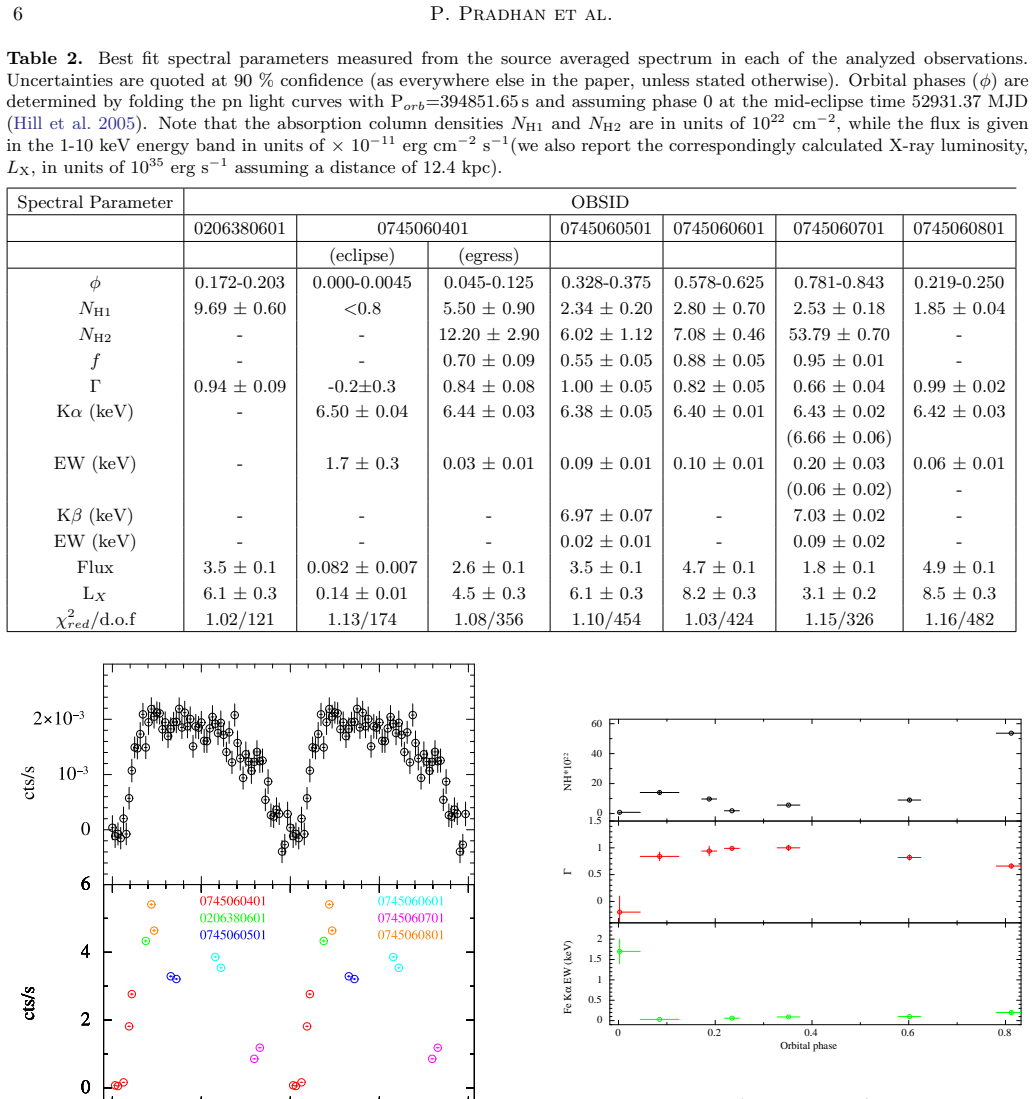
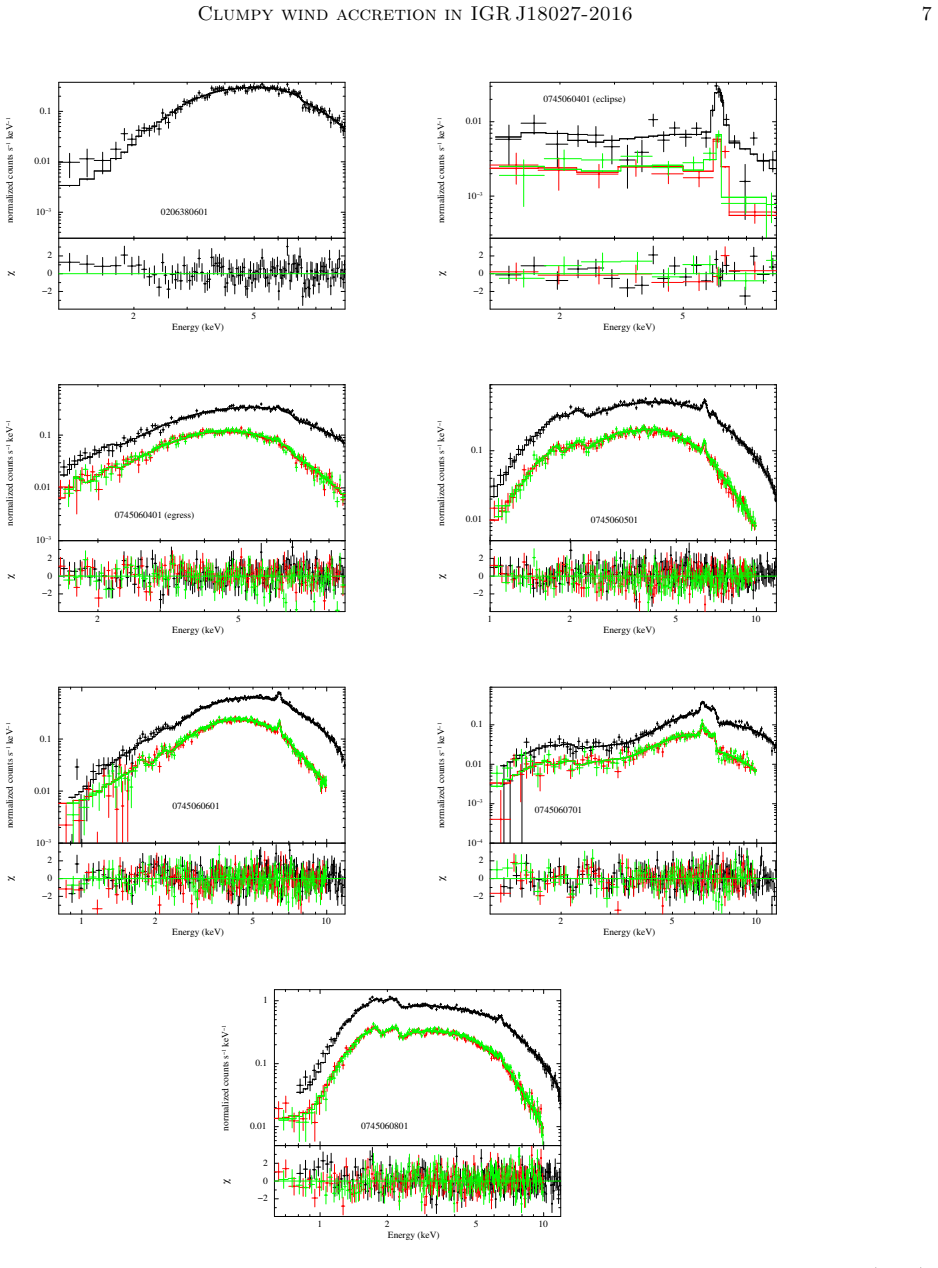
- [§3, HR-resolved spectral analysis (Fig. 5)] The central claim rests on HR-resolved spectra fitted with an absorbed power-law only, even though the average spectra of the same observations require a soft excess that is equally well described by partial covering or a ~0.2 keV blackbody. If the true soft excess is a separate component whose normalization tracks the X-ray flux, fitting an absorbed power-law alone can mimic a flux-correlated NH decrease at flare peaks and an NH increase during the rise/decay. The authors note the blackbody degeneracy for the average spectra but do not test the alternative model on the HR-resolved spectra. I request that the HR-resolved analysis be repeated using the physically distinct alternatives (e.g., phabs*pcfabs*pow and phabs*(pow+bbody)) and that the NH pattern be shown to be stable, or that the interpretation be softened accordingly.
- [§3, Table 2] The rejection of the blackbody soft-excess model is based on the inferred emitting radius of ~100 km, claimed to be more compatible with an accretion disk than with a hot spot on the neutron star. This is a weak model-selection criterion: no quantitative comparison is given, the expected radius of a polar cap or accretion column is not discussed, and the physical state of the accretor in this wind-fed system is not established. The radius argument alone is not sufficient to dismiss an equally good fit, especially because the model choice determines the interpretation of the HR-resolved NH variations.
- [§4, Fig. 5] The reported NH increase before flares, dip at peaks, and increase in decay are described qualitatively; no statistical test is shown that the NH changes are significant relative to the 90% errors in the HR-resolved fits, nor is a constant-NH model compared against the varying-NH model. Given that some of the NH variations in Fig. 5 appear comparable to the quoted error bars, I ask for a quantitative significance assessment (e.g., Δχ2 for the sequence of HR-resolved spectra with and without the NH trend, or an F-test) to support the conclusion.
minor comments (4)
- [§3, general] There are several typographical errors: 'Pennnsylvania' in the affiliations, 'OB-SID' instead of 'OBSID', 'in-homogeneous' instead of 'inhomogeneous', and 'in turns affect' instead of 'in turn affect'.
- [§3, data reduction] The description of the average spectral model is ambiguous: the text says 'corrected for the line of sight Galactic and local absorption with a phabs component' and then notes that partial covering was required. Please clarify at the point of the model description that the final model is phabs*pcfabs*powerlaw (plus emission lines) for the high-statistics spectra.
- [Fig. 5 caption] The caption states that absorption and photon index are shown 'in blue and in cyan', but the figure panels are not labeled with a legend. Please add explicit labels or a legend to each panel so the reader can identify which quantity is plotted.
- [§3, Table 2] The blackbody fit results are mentioned in the text but not included in Table 2. Since the degeneracy is important for the interpretation, provide the blackbody temperatures, normalizations, and radii (or a supplementary table) so readers can assess the alternative model.
Circularity Check
No significant circularity: the paper applies an existing clump-accretion scenario from prior work to a new source, with measured NH variations rather than fitted quantities presented as predictions.
full rationale
The paper's central claim is an empirical compatibility statement: HR-resolved XMM-Newton spectra of IGR J18027-2016 show NH rises before flares, NH dips at peaks, and NH rises in decays, and the authors compare this pattern with the one reported for SFXTs by Bozzo et al. (2017). This is an independent application of a previously proposed scenario to a new data set, not a derivation in which an input parameter is renamed as a prediction. No fitted parameter is called a prediction, no quantity is defined in terms of the claimed result, and no uniqueness theorem is invoked. The self-citations to Bozzo et al. (2017) and Bozzo et al. (2013b) supply the interpretative template and analysis technique, but the NH variations are measured from the new observations and the cited work concerns a different source class, so the citation does not force the present result by construction. The paper does explicitly acknowledge a modeling degeneracy: 'an equivalently good fit could be obtained by using a thermal blackbody component with a temperature of ~0.2 keV and a radius of ~100 km to describe the soft-excess' (Sect. 3). Because the HR-resolved spectra were fit only with an absorbed power law, the inferred NH pattern could in principle be affected by this degeneracy. That is a robustness or correctness concern about the spectral model, not circularity: the alternative model was not fitted to the HR-resolved data, but neither is the adopted NH pattern a construction equivalent to its own input. The strongest claim is also explicitly limited ('compatible with the idea that these events are triggered by the presence of clumps'), and the paper notes that measuring clump physical properties remains challenging. Overall, the derivation chain is self-contained with respect to the new data, and the minor self-citations are not load-bearing in a circular sense.
Assumptions & free parameters
free parameters (3)
- Orbital period P_orb =
394851.65 s
- Mid-eclipse time T0 =
52931.37 MJD
- HR-resolved NH2 and covering fraction f =
varies per observation (e.g., 6 to 8 x 10^22 cm^-2 away from eclipse; up to 53.8 during eclipse ingress)
assumptions (3)
- domain assumption Stellar winds of OB supergiants are clumpy, with overdense regions dominating accretion variability.
- ad hoc to paper The soft excess in the source spectra is best described by partial covering absorption rather than a separate soft spectral component such as a blackbody.
- domain assumption X-ray variability on timescales of hundreds of seconds is due to wind accretion, not to the neutron star magnetosphere or a settling accretion regime.
Cite this review
Pith. "Pith review of Probing clumpy wind accretion in IGR J18027-2016 with XMM-Newton." pith.science (2026). https://pith.science/paper/YZBJTSED
@misc{pith2026190803582,
  author       = {Pith},
  title        = {Pith review of: Probing clumpy wind accretion in IGR J18027-2016 with XMM-Newton},
  year         = {2026},
  howpublished = {\url{https://pith.science/paper/YZBJTSED}},
  note         = {Machine review of arXiv:1908.03582}
}
read the original abstract
Supergiant X-ray binaries usually comprise a neutron star accreting from the wind of a OB supergiant companion. They are classified as classical systems and the supergiant fast X-ray transients (SFXTs). The different behavior of these sub-classes of sources in X-rays, with SFXTs displaying much more pronounced variability, is usually (at least) partly ascribed to different physical properties of the massive star clumpy stellar wind. In case of SFXTs, a systematic investigation of the effects of clumps on flares/outbursts of these sources has been reported by Bozzo et al. (2017) exploiting the capabilities of the instruments on-board XMM-Newton to perform a hardness-resolved spectral analysis on timescales as short as a few hundreds of seconds. In this paper, we use six XMM-Newton observations of IGR J18027-2016 to extend the above study to a classical supergiant X-ray binary and compare the findings with those derived in the case of SFXTs. As these observations of IGR J18027-2016 span different orbital phases, we also study its X-ray spectral variability on longer timescales and compare our results with previous publications. Although obtaining measurements of the clump physical properties from X-ray observations of accreting supergiant X-ray binaries was already proven to be challenging, our study shows that similar imprints of clumps are found in the X-ray observations of the supergiant fast X-ray transients and at least one classical system, i.e. IGR J18027-2016. This provides interesting perspectives to further extend this study to many XMM-Newton observations already performed in the direction of other classical supergiant X-ray binaries.
Figures

Figures from the paper (2 more)


Reference graph
Works this paper leans on
- [1]
- [2]
-
[6]
The two peaks, as reported previously by Aftab et al
XMM-Newton energy-resolved pulse profiles of IGR J18027-2016. The two peaks, as reported previously by Aftab et al. (2016), are visible in all observations. Note that the observation ID 0745060701 caught the source during the ingress to the eclipse, and the large absorption column density hampered the detection of pulsations in the 0.3-3 keV energy band. M...
arXiv 2016
- [30]
- [133]
- [140]
- [197]
- [209]
Show all 30 references
-
[212]
2005 A&A 441 L1
in’t Zand JJM. 2005 A&A 441 L1. Jain C, et al. 2009 Research in Astronomy and Astrophysics 9
2005
-
[216]
2019 arXiv e-prints arXiv:1901.01882
Sidoli L, & Paizis A. 2019 arXiv e-prints arXiv:1901.01882. Staubert R, et al. 2019 A&A 622 A61. Torrej´ on JM, et al. 2010a A&A 510 A61. Torrej´ on JM, et al. 2010b ApJ 715
2019 arXiv
-
[243]
2015 SSRv 191
Revnivtsev M, & Mereghetti S. 2015 SSRv 191
2015
-
[252]
2014 MNRAS 442
Pradhan P, et al. 2014 MNRAS 442
2014
-
[255]
2004 in Revista Mexicana de Astronomia y Astrofisica Conference Series, Vol
Iaria R, et al. 2004 in Revista Mexicana de Astronomia y Astrofisica Conference Series, Vol. 20, Revista Mexicana de Astronomia y Astrofisica Conference Series, ed. Tovmassian G, & Sion E
2004
-
[275]
2011 A&A 526 A62
Manousakis A, & Walter R. 2011 A&A 526 A62. 12 P. Pradhan et al. 1 2 (0.3−3 keV) Norm. Intensity 0206380601 0 0.5 1 1.5 0.5 1 1.5 (3−10 keV) Norm. Intensity Phase 0.5 1 1.5 (0.3−3 keV) Norm. Intensity 0745060401 0 0.5 1 1.5 0.5 1 1.5 (3−10 keV) Norm. Intensity Phase 0.5 1 1.5 ...
2011
-
[293]
2004 Astronomy Letters 30
Revnivtsev MG, et al. 2004 Astronomy Letters 30
2004
-
[335]
2006 A&A 453
Walter R, et al. 2006 A&A 453
2006
-
[382]
2015 A&A 576 L4
Romano P, et al. 2015 A&A 576 L4. Sako M, et al. 2003 ArXiv Astrophysics e-prints, astro-ph/0309503. Clumpy wind accretion in IGR J18027-2016 13 Sch¨ onherr G, et al. 2014 in European Physical Journal Web of Conferences, Vol. 64, European Physical Journal Web of Conferences 02...
2015 arXiv
-
[435]
2018 in American Astronomical Society Meeting Abstracts, Vol
Becker PA, & Wolff MT. 2018 in American Astronomical Society Meeting Abstracts, Vol. 231, American Astronomical Society Meeting Abstracts #231 333.04. Bozzo E, et al. 2017 A&A 608 A128. Bozzo E, et al. 2008 ApJ 683
2018
-
[487]
2015 A&A Rv 23
Walter R, et al. 2015 A&A Rv 23
2015
-
[511]
2016 Advances in Space Research 58
Krtiˇ cka J, & Kub´ at J. 2016 Advances in Space Research 58
2016
-
[710]
2015 A&A 579 A111
Krtiˇ cka J, et al. 2015 A&A 579 A111. Leahy DA. 1987 A&A 180
2015
-
[783]
2015 ApJ 808
Coley JB, et al. 2015 ApJ 808
2015
-
[947]
1996 ApJ 465
Verner DA, et al. 1996 ApJ 465
1996
-
[1031]
2015 Advances in Space Research 55
Bozzo E, et al. 2015 Advances in Space Research 55
2015
-
[1255]
2013a A&A 556 A30
Bozzo E, et al. 2013a A&A 556 A30. Bozzo E, et al. 2013b A&A 556 A30. Bozzo E, et al. 2011 A&A 531 A130. Bozzo E, et al. 2016 A&A 596 A16. Chaty S, et al. 2008 A&A 484
2011
-
[1303]
2008 A&A 492
Kreykenbohm I, et al. 2008 A&A 492
2008
-
[2032]
1989 GeoCoA 53
Anders E, & Grevesse N. 1989 GeoCoA 53
1989
-
[2152]
2015 A&A 577 A130
Falanga M, et al. 2015 A&A 577 A130. Farinelli R, et al. 2016 A&A 591 A29. F¨ urst F, et al. 2010 A&A 519 A37. F¨ urst F, et al. 2014 ApJ 780
2015
-
[2175]
2013 A&A 556 A72
Ducci L, et al. 2013 A&A 556 A72. Ducci L, et al. 2009 MNRAS 398
2013
-
[2691]
2008 A&A Rv 16
Puls J, et al. 2008 A&A Rv 16
2008
Reviewed August 14, 2026 · model on record in the stance chip above.
Discussion (0). Continue with ORCID to comment.