REVIEW 2 major objections 5 minor 1 cited by
Exact Conditional Score-Guided Generative Modeling for Amortized Inference in Uncertainty Quantification
T0 review · 2 major / 5 minor · reviewed 2026-08-15 · deepseek-v4-flash
Pith's one-line read A Gaussian-mixture prior makes diffusion posterior sampling analytically exact, reducing it to a single feedforward network at inference.
desk verdict Genuine exact conditional score for GMM priors, honest error decomposition, but the bridge to the true conditional rests on hand-set bandwidths the paper itself flags as open. read the letter →
The pith
A machine-rendered reading of the paper's core claim, the machinery that carries it, and where it could break.
The reading
What carries the argument
The machine is the exact conditional score identity (3.46), where the score is the gradient of the log density of the forward-diffused posterior. It decomposes the otherwise intractable posterior score into two tractable terms: a weighted sum of per-component Gaussian scores, with weights $p_{\xi|Z_t,Y}(k|z_t,y)$ from Eq. (3.38), plus the likelihood score pushed through the reverse conditional kernel by the Jacobian $J_{0|t,k}$ and evaluated at the Kalman-conditional mean (3.43). This identity turns the reverse probability-flow ODE (3.7) into a deterministic map from standard Gaussian noise to posterior samples, which in turn makes the supervised labeling step (3.60) and the final non-reversible feedforward generator possible.
What would settle it
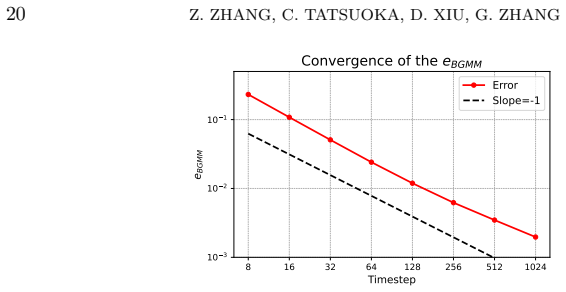
Take a small dataset where the analytic Gaussian-mixture posterior $p_{X|Y}(x|y)$ can be computed exactly, run the reverse ODE with the exact score (3.46) for increasing numbers of time steps, and compare the generated samples with the analytic posterior. The KL divergence should shrink at a first-order rate in the time step, as in the paper's Fig. 2; any nonzero floor or plateau would show the score formula is not exact.
Extended reading notes
Core claim
Under Assumption 3.1, the prior is $p_X(x)=\sum_{k=1}^K \pi_k \phi(x;\mu_k,\Sigma_k)$, a Gaussian mixture with one component per training sample. For the linear Gaussian observation model $Y=HX+\varepsilon_y$, the paper derives the exact score of the diffused posterior, Eq. (3.46): $S_{Z_t|Y}(z_t|y)=\sum_{k=1}^K p_{\xi|Z_t,Y}(k|z_t,y)\left(S_{Z_t|\xi}(z_t|k)+J_{0|t,k}S_{Y|Z_0}(\mu_{0|t,k,Y}(z_t,y))\right)$. Every ingredient is closed-form: the forward score of each Gaussian component, the Jacobian of the reverse conditional mean, the posterior component weights from Eq. (3.38), and the likelihood score evaluated at the Kalman conditional mean from Eq. (3.43). Substituting this score into the probability-flow ODE (3.7) makes the reverse dynamics an exact sampler for the Bayesian Gaussian-mixture posterior, up to ODE discretization error. In the spherical-covariance case used in the experiments, the weights and score collapse to scalar form (3.57) and (3.59), avoiding matrix inversions.
Load-bearing premise
The load-bearing premise is Assumption 3.1: the Gaussian mixture built from the training samples, with variances $\sigma_U^2$ and $\sigma_V^2$ chosen by a nearest-neighbor heuristic and observation noise $\sigma_Y^2$ set very small, faithfully represents the true joint density; if these bandwidths are wrong, the sampler still hits its own surrogate posterior but no longer approximates the target conditional distribution.
Editorial extensions
If this is right
- Because the score is analytic, the diffusion stage requires no score-network training; sampling from the Gaussian-mixture posterior is exact up to the ODE time step, and the experiments show that discretization error decreases linearly with the number of steps.
- The labeled dataset of Eq. (3.60) turns the reverse ODE into supervised training data, so the amortized sampler can be a non-reversible feedforward network trained with ordinary L2 loss.
- Once trained, conditional samples for any observation $y$ are generated in a single forward pass, avoiding MCMC reruns and iterative reverse diffusion at inference time.
- The error against the true conditional separates cleanly into a stable ODE discretization error, a Bayesian relaxation error controlled by $\sigma_Y$, and a GMM smoothing error controlled by $\sigma_U$ and $\sigma_V$, so users can tune each source independently.
- Numerical results on a 20-dimensional two-mode Gaussian and on permeability inference for a two-dimensional elliptic PDE indicate that multi-modality and moderate dimensionality are handled without special architectures.
Reading between the lines
- Beyond the paper, the same score identity could be adapted to nonlinear observation operators by replacing the Kalman conditional mean with a Gaussian approximation, but the exactness guarantee would be lost; the paper lists nonlinear $h(x)$ as future work.
- Beyond the paper, the cost of evaluating the exact score grows linearly with the number of training samples $K$, so for very large datasets a subsampled or approximate weighting would be a natural stress test of the method's scalability.
- Beyond the paper, the hand-tuned bandwidths could be selected by held-out likelihood or posterior calibration instead of the nearest-neighbor heuristic; the paper explicitly leaves a rigorous selection rule as ongoing work.
Signed reviews
Editorial analysis
A structured set of objections, weighed in public.
Referee Report
Summary. The paper proposes a two-stage method for amortized conditional sampling. In the first stage, the authors assume a Gaussian mixture prior with one component per training sample (Assumption 3.1) and a linear Gaussian observation model, and derive an exact closed-form expression for the conditional score of the diffused posterior (Eq. (3.46)). This score is used to solve the reverse probability-flow ODE (3.7), generating labeled pairs (noise, observation, posterior sample) without training a diffusion network. In the second stage, a feedforward network is trained on these pairs to map observations and Gaussian noise directly to posterior samples, enabling fast amortized inference. Numerical experiments include a 1D bimodal ablation study, a 20D Gaussian mixture conditional sampling task, and a 2D elliptic PDE parameter inference problem.
Significance. If the exactness claim is taken with respect to the Gaussian mixture surrogate, the derivation is algebraically sound and the numerical evidence is consistent: the error e_BGMM remains small across Table 1 and converges at slope -1 in Figure 2, which is strong evidence that the ODE reproduces the GMM posterior. The amortized network idea is practical and the PDE example illustrates a plausible UQ workflow. However, the significance for real UQ problems is tempered by a load-bearing gap: the discrepancy between the GMM surrogate and the true conditional distribution is not controlled by any result in the paper, and the paper explicitly states that a rigorous hyperparameter selection procedure is ongoing work.
major comments (2)
- [Section 3.5 and Table 1] The paper should provide a principled selection rule for sigma_U^2, sigma_V^2, sigma_Y^2 or at least an analysis of how the approximation error depends on them. Without this, the exactness of the score is exactness for an uncontrolled surrogate, and the numerical results in Sections 4.2 and 4.3 (which fix sigma_U^2=sigma_V^2=0.10 and sigma_Y^2=10^{-5}) are not shown to be representative.
- [Section 2 (Eq. (2.2)) and Section 3.4 (Eqs. (3.60)-(3.61))] This issue is load-bearing because it affects the description of the amortized sampler that is the paper's final deliverable. If the network is actually trained on the full noise, then Eq. (2.2) is a typo; if it is trained only on the U-part, the method would likely fail because the deterministic ODE map from z to u is not independent of z_V.
minor comments (5)
- [Section 4.1] In the bimodal experiment, the observation model is defined as Y := [1, 0]^T X + epsilon_Y, which conditions on the U component, but the target is p_{U|V}(u|1), which requires conditioning on V. This appears to be a typo for H = [0,1]; as written, the setup is inconsistent with the reported densities in Figure 1.
- [Section 3.4, Eq. (3.47)] The notation for the scalar coefficients s^u_{i,t}, s^v_{i,t} in Eq. (3.49) is hard to read; consider writing them as matrices or explicitly defining the block-diagonal structure in a table or display equation.
- [Eq. (3.38)] In the expression for p_{xi|Z_t,Y}(k|z_t,y), the proportionalities in Eqs. (3.33)-(3.35) drop several factors that are independent of k; it would be clearer to state explicitly that the normalization is over k after computing the weights.
- [Abstract and Section 3.4] The abstract calls the method 'training-free' in the context of the diffusion model, but the overall framework includes the second-stage training of the amortized network. Consider clarifying that only the conditional score model is training-free, to avoid confusing readers about the complete pipeline.
- [Section 4.1, Eq. (4.2)] The KL divergence is defined as D(p_ref || p_DM), which is the reverse of the usual convention. The direction is applied consistently, but a brief note justifying the choice (e.g., finite-sample support of p_DM) would help.
Circularity Check
No significant circularity: the exact score formula is derived algebraically from the stated GMM prior and linear-Gaussian likelihood, and the numerical experiments are benchmarked against independent ground truths; the hand-set smoothing parameters are a limitation, not a circular step.
full rationale
The derivation of Eq. (3.46) is self-contained: it starts from Assumption 3.1 (GMM prior, Eq. 3.2), the linear-Gaussian likelihood (Eq. 2.7), and the forward SDE kernel (Eq. 3.5), then obtains the score by Bayes' rule, Gaussian identities (Propositions 3.2 and 3.3), and a Kalman update (Eq. 3.43). No displayed equation substitutes the posterior distribution that the sampler is meant to produce, so the 'exact conditional score' claim is an algebraic consequence of the stated model rather than an input-output tautology. The amortized network is trained on ODE-generated labels (Eq. 3.60), but its quality is evaluated against external references: the analytic true posterior in Section 4.1, the true two-mode GMM conditional in Section 4.2, and held-out PDE test cases in Section 4.3; hence the numerical claims are falsifiable outside the fitted values. Several self-citations appear ([1,2,11,23,24]), but none is load-bearing: the alpha_t, beta_t schedule is written out explicitly in Eq. (3.5), and the deterministic ODE mapping is a standard property of probability-flow ODEs, so the cited works do not supply the paper's central content. The genuine limitation, stated in Section 3.5, is that sigma_U^2, sigma_V^2, and sigma_Y^2 are set by a nearest-neighbor heuristic and by fiat, with 'a rigorous study ... ongoing work'; Table 1 shows e_exact varies by an order of magnitude with these choices. That is a robustness gap in approximating the true conditional, not a circular step, because the error is measured against the true conditional rather than re-imported from the fitted GMM. Overall, the paper's derivation chain does not reduce to its inputs by construction, and no specific circular reduction can be exhibited from the text.
Assumptions & free parameters
free parameters (3)
- sigma_U^2 (GMM bandwidth for inferred variables) =
0.005 to 0.05 (1D ablation), 0.10 (20D and PDE experiments)
- sigma_V^2 (GMM bandwidth for conditioning variables) =
Set equal to sigma_U^2 in all experiments (Section 3.5)
- sigma_Y^2 (artificial observation noise in the Bayesian reformulation) =
10^-4 or 10^-5 (1D), 10^-5 (20D and PDE)
assumptions (5)
- domain assumption The true prior p_X is replaced by a Gaussian mixture with one isotropic component per training sample (Assumption 3.1, Eq. 3.2).
- domain assumption The observation model is linear Gaussian, Y = H X + epsilon_Y with epsilon_Y ~ N(0, Sigma_Y) (Eqs. 2.4 and 2.7).
- domain assumption The Bayesian posterior converges to the target conditional as the artificial noise vanishes: p_{X_U|Y} tends to p_{U|V} as epsilon_Y tends to 0 (Eq. 2.9).
- standard math The probability-flow ODE (3.7) has the same marginals as the forward SDE (3.3), so solving it produces samples from p_{Z_t|Y}.
- standard math Diffusing a Gaussian component keeps it Gaussian (Proposition 3.2), and the Kalman filter formula (Eq. 3.43) gives the conditional mean used in the likelihood-score term.
Cite this review
Pith. "Pith review of Exact Conditional Score-Guided Generative Modeling for Amortized Inference in Uncertainty Quantification." pith.science (2026). https://pith.science/paper/YZCCOBQR
@misc{pith2026250618227,
  author       = {Pith},
  title        = {Pith review of: Exact Conditional Score-Guided Generative Modeling for Amortized Inference in Uncertainty Quantification},
  year         = {2026},
  howpublished = {\url{https://pith.science/paper/YZCCOBQR}},
  note         = {Machine review of arXiv:2506.18227}
}
read the original abstract
We propose an efficient framework for amortized conditional inference by leveraging exact conditional score-guided diffusion models to train a non-reversible neural network as a conditional generative model. Traditional normalizing flow methods require reversible architectures, which can limit their expressiveness and efficiency. Although diffusion models offer greater flexibility, they often suffer from high computational costs during inference. To combine the strengths of both approaches, we introduce a two-stage method. First, we construct a training-free conditional diffusion model by analytically deriving an exact score function under a Gaussian mixture prior formed from samples of the underlying joint distribution. This exact conditional score model allows us to efficiently generate noise-labeled data, consisting of initial diffusion Gaussian noise and posterior samples conditioned on various observation values, by solving a reverse-time ordinary differential equation. Second, we use this noise-labeled data to train a feedforward neural network that maps noise and observations directly to posterior samples, eliminating the need for reversibility or iterative sampling at inference time. The resulting model provides fast, accurate, and scalable conditional sampling for high-dimensional and multi-modal posterior distributions, making it well-suited for uncertainty quantification tasks, e.g., parameter estimation of complex physical systems. We demonstrate the effectiveness of our approach through a series of numerical experiments.
Figures


Figures from the paper (5 more)


Forward citations
Cited by 1 Pith paper
-
IEnSF: Iterative Ensemble Score Filter for Reducing Error in Posterior Score Estimation in Nonlinear Data Assimilation
By iteratively refitting a Gaussian reference posterior inside a reverse-time diffusion sampler, IEnSF reduces posterior-score bias and outperforms LETKF on 1000-D Lorenz-96 with nonlinear observations.
Reference graph
Works this paper leans on
-
[1]
F. Bao, Z. Zhang, and G. Zhang , An ensemble score filter for tracking high-dimensional nonlinear dynamical system , Computer Methods in Applied Mechanics and Engineering, 432 (2024), p. 117447
2024
-
[2]
F. Bao, Z. Zhang, and G. Zhang , A score-based filter for nonlinear data assimilation , arXiv- preprint, arXiv:2306.09282, (2024)
arXiv 2024
-
[3]
R. Baptista, A. Dasgupta, N. B. Kovachki, A. Oberai, and A. M. Stuart , Memorization and regularization in generative diffusion models, arXiv preprint arXiv:2501.15785, (2025). 26 Z. ZHANG, C. TATSUOKA, D. XIU, G. ZHANG
arXiv 2025
-
[4]
R. Baptista, A. Pooladian, M. Brennan, Y. Marzouk, and J. Niles-Weed , Conditional simulation via entropic optimal transport: Toward non-parametric estimation of condi- tional brenier maps , arXiv preprint arXiv:2411.07154, (2024)
arXiv 2024
-
[5]
G. Cardoso, Y. J. E. Idrissi, S. L. Corff, and E. Moulines , Monte carlo guided diffusion for bayesian linear inverse problems , arXiv preprint arXiv:2308.07983, (2023)
arXiv 2023
-
[6]
T. Chen, R. Zhang, and G. Hinton , Analog bits: Generating discrete data using diffusion models with self-conditioning, arXiv preprint arXiv:2208.04202, (2022)
arXiv 2022
- [7]
-
[8]
K. Cranmer, J. Brehmer, and G. Louppe , The frontier of simulation-based inference , Pro- ceedings of the National Academy of Sciences, 117 (2020), pp. 30055–30062
work page 2020
Show all 36 references
-
[9]
A. P. Dempster, N. M. Laird, and D. B. Rubin , Maximum likelihood from incomplete data via the em algorithm , Journal of the royal statistical society: series B (methodological), 39 (1977), pp. 1–22
1977
-
[10]
Dou and Y
Z. Dou and Y. Song , Diffusion posterior sampling for linear inverse problem solving: A filtering perspective, in The Twelfth International Conference on Learning Representations, 2024
2024
-
[11]
M. F an, Z. Zhang, D. Lu, and G. Zhang , Genai4uq: A software for inverse uncertainty quan- tification using conditional generative models , arXiv preprint arXiv:2412.07026, (2024)
2024 arXiv
-
[12]
B. T. Feng, J. Smith, M. Rubinstein, H. Chang, K. L. Bouman, and W. T. Freeman , Score-based diffusion models as principled priors for inverse imaging , in Proceedings of the IEEE/CVF International Conference on Computer Vision, 2023, pp. 10520–10531
2023
-
[13]
A. P. Generale, A. E. Robertson, and S. R. Kalidindi , Conditional variable flow matching: Transforming conditional densities with amortized conditional optimal transport , arXiv preprint arXiv:2411.08314, (2024)
2024 arXiv
-
[14]
S. Gong, M. Li, J. Feng, Z. Wu, and L. Kong , Diffuseq: Sequence to sequence text generation with diffusion models , arXiv preprint arXiv:2210.08933, (2022)
2022 arXiv
-
[15]
W. K. Hastings , Monte carlo sampling methods using markov chains and their applications , (1970)
1970
-
[16]
Ho and T
J. Ho and T. Salimans , Classifier-free diffusion guidance , arXiv preprint arXiv:2207.12598, (2022)
2022 arXiv
-
[17]
M. D. Hoffman, D. M. Blei, C. W ang, and J. Paisley , Stochastic variational inference, the Journal of machine Learning research, 14 (2013), pp. 1303–1347
2013
-
[18]
Jalal, M
A. Jalal, M. Arvinte, G. Daras, E. Price, A. G. Dimakis, and J. Tamir , Robust compressed sensing mri with deep generative priors , Advances in Neural Information Processing Sys- tems, 34 (2021), pp. 14938–14954
2021
-
[19]
Kingma, T
D. Kingma, T. Salimans, B. Poole, and J. Ho , Variational diffusion models , Advances in neural information processing systems, 34 (2021), pp. 21696–21707
2021
-
[20]
D. P. Kingma, M. Welling, et al. , Auto-encoding variational bayes, 2013
2013
-
[21]
X. Li, J. Thickstun, I. Gulrajani, P. S. Liang, and T. B. Hashimoto , Diffusion-lm improves controllable text generation, Advances in neural information processing systems, 35 (2022), pp. 4328–4343
2022
-
[22]
Y. Liu, Y. Chen, D. Xiu, and G. Zhang , A training-free conditional diffusion model for learning stochastic dynamical systems , arXiv preprint arXiv:2410.03108, (2024)
2024 arXiv
-
[23]
Y. Liu, M. Yang, Z. Zhang, F. Bao, Y. Cao, and G. Zhang , Diffusion-model-assisted super- vised learning of generative models for density estimation , Journal of Machine Learning for Modeling and Computing, 5 (2024)
2024
-
[24]
D. Lu, Y. Liu, Z. Zhang, F. Bao, and G. Zhang , A diffusion-based uncertainty quantification method to advance e3sm land model calibration, Journal of Geophysical Research: Machine Learning and Computation, 1 (2024), p. e2024JH000234
2024
-
[25]
Mardani, J
M. Mardani, J. Song, J. Kautz, and A. V ahdat , A variational perspective on solving inverse problems with diffusion models , arXiv preprint arXiv:2305.04391, (2023)
2023 arXiv
-
[26]
Ramesh, P
A. Ramesh, P. Dhariwal, A. Nichol, C. Chu, and M. Chen , Hierarchical text-conditional image generation with clip latents , arXiv preprint arXiv:2204.06125, 1 (2022), p. 3
2022 arXiv
-
[27]
Saharia, W
C. Saharia, W. Chan, S. Saxena, L. Li, J. Whang, E. L. Denton, K. Ghasemipour, R. Gontijo Lopes, B. Karagol Ayan, T. Salimans, et al. , Photorealistic text-to-image diffusion models with deep language understanding , Advances in neural information pro- cessing systems, 35 (202...
2022
-
[28]
J. Song, A. V ahdat, M. Mardani, and J. Kautz , Pseudoinverse-guided diffusion models for inverse problems, in International Conference on Learning Representations, 2023
2023
-
[29]
Y. Song, J. Sohl-Dickstein, D. P. Kingma, A. Kumar, S. Ermon, and B. Poole , Score- based generative modeling through stochastic differential equations , International Confer- EXACT CONDITIONAL SCORE-GUIDED GENERATIVE MODELING FOR UQ 27 ence on Learning Representations, (2021)
2021
-
[30]
Y. Sun, Z. Wu, Y. Chen, B. T. Feng, and K. L. Bouman , Provable probabilistic imaging using score-based generative priors, IEEE Transactions on Computational Imaging, (2024)
2024
-
[31]
Venkatraman, M
S. Venkatraman, M. Jain, L. Scimeca, M. Kim, M. Sendera, M. Hasan, L. Rowe, S. Mit- tal, P. Lemos, E. Bengio, et al. , Amortizing intractable inference in diffusion models for vision, language, and control , arXiv preprint arXiv:2405.20971, (2024)
2024 arXiv
-
[32]
W ang, W
Y. W ang, W. Bai, W. Luo, W. Chen, and H. Sun , Integrating amortized inference with diffusion models for learning clean distribution from corrupted images , arXiv preprint arXiv:2407.11162, (2024)
2024 arXiv
-
[33]
Z. O. W ang, R. Baptista, Y. Marzouk, L. Ruthotto, and D. Verma , Efficient neural net- work approaches for conditional optimal transport with applications in bayesian inference , arXiv preprint arXiv:2310.16975, (2023)
2023 arXiv
-
[34]
Z. Wu, Y. Sun, Y. Chen, B. Zhang, Y. Yue, and K. Bouman , Principled probabilistic imaging using diffusion models as plug-and-play priors , Advances in Neural Information Processing Systems, 37 (2024), pp. 118389–118427
2024
- [35]
-
[36]
P. Yu, S. Xie, X. Ma, B. Jia, B. Pang, R. Gao, Y. Zhu, S.-C. Zhu, and Y. N. Wu , Latent dif- fusion energy-based model for interpretable text modeling, arXiv preprint arXiv:2206.05895, (2022)
2022 arXiv
Reviewed August 15, 2026 · model on record in the stance chip above.
Discussion (0). Continue with ORCID to comment.