REVIEW 3 major objections 4 minor 1 cited by
Detailed Simulations of Massive Hierarchical Triple Star Systems - Exploring the impact of the stellar physics on the evolutionary pathways of massive hierarchical triple systems
T0 review · 3 major / 4 minor · reviewed 2026-08-16 · deepseek-v4-flash
Pith's one-line read Detailed stellar-structure models shrink the minimum safe orbit for massive triple stars by a thousandfold, changing predicted gravitational-wave progenitor rates.
desk verdict First on-the-fly TRES+MESA coupling shows massive triple pathways really do diverge from SeBa, but the headline three-orders-of-magnitude Pmin reduction is an extreme-case artifact. read the letter →
The pith
A machine-rendered reading of the paper's core claim, the machinery that carries it, and where it could break.
The reading
What carries the argument
The load-bearing mechanism is an on-the-fly coupling of the TRES triple secular evolution code to MESA, a detailed one-dimensional stellar-structure code, so that the star's full structure (radius, core mass, apsidal motion constant, gyration radius) is recomputed as the three-body dynamics evolve. In this setup, wind mass loss feeds back into the stellar structure continuously, which is what keeps the most massive models from swelling to red-supergiant dimensions. A second structural ingredient is the apsidal motion constant $k_{\rm AMC}$, retrieved from the MESA profile at each timestep; it decreases by more than an order of magnitude during the main sequence, reducing precession from tidal and rotational distortion and thereby strengthening the von Zeipel-Lidov-Kozai mechanism. The comparison baseline is the fast code SeBa, whose Hurley fitting formulae extrapolate a grid that ends at 50 solar masses, and Roche-lobe overflow is judged at periastron using the Eggleton formula with an eccentricity correction.
What would settle it
Interferometric or eclipsing-binary radius measurements of an ~85$\,M_\odot$, solar-metallicity star near the end of main-sequence life would settle which code is right: the detailed model holds the maximum radius to tens of solar radii, while the fast code predicts a red-supergiant expansion to thousands of solar radii, so one such star observed at large radius would overturn the MESA-based period reduction.
Extended reading notes
Core claim
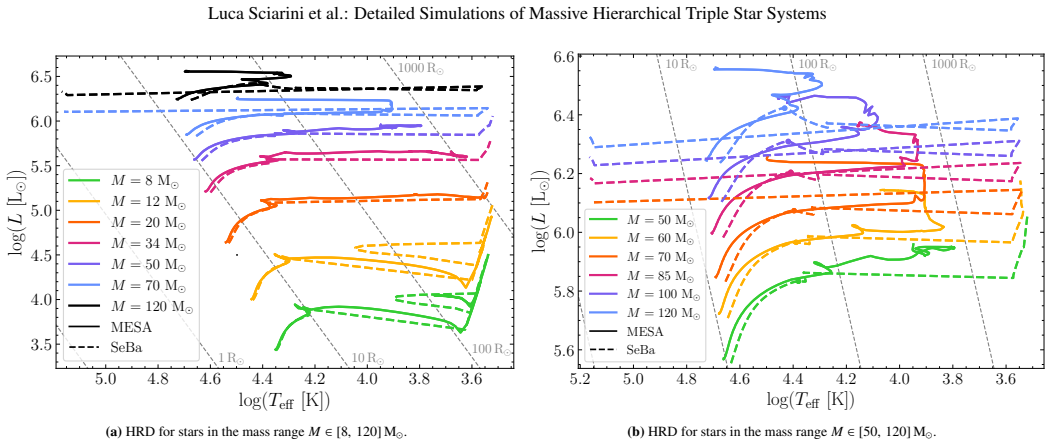
On the paper's own terms, the central discovery is that the stellar-evolution physics, not the secular dynamics alone, controls many of the divergent fates of massive hierarchical triples. In the fast code, a 70 to 120 solar-mass star loses mass but then shifts onto the track of a lower-mass star, swelling to a red supergiant of thousands of solar radii; in the detailed code, the same star reacts to wind mass loss by contracting, so its maximum radius stays at tens to hundreds of solar radii. Because Roche-lobe overflow is decided by radius against the periastron Roche lobe, this radius gap translates directly into a different classification of the system's evolution. The paper demonstrates divergent outcomes for every category it tracks: inner versus tertiary mass transfer, mass transfer versus dynamical destabilization, mass transfer versus orbit unbinding, and mass transfer versus a non-interacting triple that can become a triple compact object. The same self-consistent stellar structure also lowers the apsidal motion constant along the main sequence, weakening tidal and rotational precession and letting von Zeipel-Lidov-Kozai oscillations persist longer, which further increases the chance of interaction.
Load-bearing premise
The result rests on assuming that the detailed code's non-rotating models, with their chosen wind mass-loss rates, describe how very massive stars really expand; if real winds are weaker or rotation makes the stars swell, the claimed thousand-fold period reduction shrinks.
Editorial extensions
If this is right
- If MESA's radius evolution is the faithful one, fast-code population synthesis has been overcounting interacting massive triples: systems previously classified as mass-transferring would instead remain detached through the main sequence.
- The minimum inner period for avoiding Roche-lobe overflow drops from about 6,000 days to about 6 days, enlarging the parameter space for triple compact objects that can later merge through gravitational-wave emission.
- Structure-dependent precession, through a falling apsidal motion constant, keeps von Zeipel-Lidov-Kozai oscillations alive longer, making eccentric mass transfer more likely than constant-coefficient models suggest.
- The divergence between codes produces opposite outcomes in every tracked category: inner versus tertiary mass transfer, mass transfer versus dynamical destabilization, mass transfer versus orbit unbinding, and mass transfer versus a non-interacting triple.
- The choice of dynamical-tide prescription also changes outcomes for eccentric inner binaries, with the revised prescription producing eccentricity growth instead of circularization for systems above roughly e = 0.7.
Reading between the lines
- A consequence the paper leaves implicit: the same fast-code radius bias likely affects massive binary population synthesis, so the correction to interaction rates may extend to binary black-hole merger channels as well as triple ones.
- Because the MESA models are non-rotating, the three-orders-of-magnitude period reduction is best read as an upper bound; adding rotation could let stars expand and close part of the gap.
- A testable follow-up would be a grid-based population synthesis with the detailed code, converting the per-system pathway flips shown here into a quantitative revision of predicted gravitational-wave merger rates.
Signed reviews
Editorial analysis
A structured set of objections, weighed in public.
Referee Report
Summary. The paper presents a new coupling of the MESA detailed stellar evolution code to the TRES secular triple-star evolution code through AMUSE, and uses it to compare the evolutionary pathways of massive hierarchical triples with those obtained using the rapid SeBa code. The authors report that MESA and SeBa single-star tracks diverge increasingly with initial mass and wind mass-loss efficiency, that the maximum radii can differ by up to two orders of magnitude, and that the minimum inner period for avoiding Roche-lobe overflow is reduced by three orders of magnitude when MESA replaces SeBa. Several illustrative systems are shown in which the two codes predict different pathways: inner versus tertiary mass transfer, mass transfer versus dynamical destabilization, mass transfer versus orbital unbinding, interacting versus non-interacting outcomes, and a case where self-consistently computed apsidal-motion constants change the outcome. The paper also explores the impact of a modified dynamical-tides prescription from Sciarini et al. (2024).
Significance. If the central period-reduction claim holds, the results imply that rapid-code population synthesis of massive triples systematically overestimates interaction rates and underestimates the formation of triple compact objects, directly affecting gravitational-wave merger rate predictions. The qualitative divergence between rapid and detailed stellar codes for masses above 50 M_sun is consistent with Bavera et al. (2023) and is an important caution for the field. The methodological advance of coupling MESA on-the-fly to a secular triple code is valuable, and the authors make the code publicly available. The paper also provides a careful single-star comparison and is transparent about wind and rotation prescriptions. The main quantitative claim, however, is derived from an extreme corner of the grid and is not robust across the paper's own default choices, so it needs qualification.
major comments (3)
- [Sect. 4.5, Abstract, Sect. 5] The three-orders-of-magnitude reduction in the minimum inner period (Pmin,MESA∼6 days vs Pmin,SeBa∼6×10^3 days) is derived in Sect. 4.5 from a single 85 M_sun MESA track computed with Dutch_scaling_factor=1 (the 'TCO' system). This is not representative of the paper's default wind setting: in Sect. 2.2.4 the authors adopt Dutch_scaling_factor=0.333 as the default, and under that prescription the MESA/SeBa maximum-radius discrepancy in the considered mass range is about one order of magnitude, not two (Sect. 3.1, Fig. 1b; lower panel of Fig. 3). Since the limiting period scales as R_max^{3/2}, a factor-of-ten radius gap implies only a ~30-fold reduction in Pmin (i.e., ~200 days), not a 1000-fold reduction. The abstract and conclusion present the 6-day value as a general result without these qualifications. I recommend stating that the three-orders reduction is an extreme-case upper limit valid for the strongest winds and the highest masses, and giving the estimate under the default wind prescription.
- [Sect. 2.2.3 and Appendix A] The MESA tracks are normalized to SeBa at 50 M_sun via the overshoot parameter α_ov, calibrated without winds to reproduce the SeBa maximum MS radius. The paper notes that this calibrated value may be underestimated for higher masses (Sect. 2.2.3, Appendix A). Consequently, the quantitative divergence between MESA and SeBa above 50 M_sun is not fully independent of the chosen calibration; part of the high-mass difference could reflect the one-point normalization rather than solely the self-consistent reaction to mass loss. The authors should state this calibration dependence explicitly when quoting the Pmin estimates and interpreting the order-of-magnitude radius discrepancies.
- [Sect. 4.7 and Appendix D] The result that the S24 dynamical-tides prescription makes the eccentricity increase for e≳0.7 is a model-dependent property of the low-order Zahn (1977) expansion, as the authors state in Sect. 4.7 and Appendix D. The abstract and the concluding section do not repeat this caveat, so a reader could mistake this for a robust physical finding. Please add an explicit caveat, both in the abstract and in the conclusions, that this eccentricity increase is a prediction of the S24 model and may change if higher-order eccentricity terms are included.
minor comments (4)
- [Sect. 4.5] In the sentence 'Given Kepler 3rd law (P2∝ a3)', the notation should be typeset as P^2 ∝ a^3, and the derivation should mention explicitly that the Roche-lobe radius is taken as proportional to a at fixed mass ratio, so that the period scales as R_max^{3/2}.
- [Table 1 and Appendix B] The system labeled 'η Carinae*' is marked as 'Divergent: No' in Table 1, but Appendix B states that the MESA and SeBa pathways do differ (eccentric versus circular mass transfer). The table footnote explains the nomenclature, but the caption should also note this distinction to avoid apparent inconsistency.
- [Abstract and Sect. 5] The abstract should state that the reduction in Pmin is 'up to three orders of magnitude' under the strongest wind prescription, rather than presenting it as a unique value, so that the headline matches the internal-consistency concerns raised in Sect. 4.5.
- [General] There are minor typographical issues, such as the misplaced diacritic in the reference 'Krtiˇcka' and the equation-number formatting in Appendix D. A careful proofread of the final version is recommended.
Circularity Check
No significant circularity; the code comparison, Pmin estimate, and S24 tide discussion are transparent derivations, not self-validating fits.
full rationale
The central MESA-vs-SeBa comparison is not circular. The paper openly calibrates alpha_ov = 0.31 to match the 50 Msun SeBa maximum MS radius (Sect. 2.2.3 and Appendix A), but the divergent behavior that drives the conclusions is the unforced mass and wind-scaling dependence above 50 Msun (Sect. 3.1, Fig. 3). The single calibration point does not encode the two-orders-of-magnitude high-mass radius gaps or the non-monotonic Rmax behavior with winds. The claimed Pmin reduction is likewise a derived consequence, not a fitted input: Sect. 4.5 takes the computed Rmax discrepancy and applies Kepler's third law plus the Roche-lobe relation (Eq. 9) to estimate Pmin,MESA ~ 6 days vs Pmin,SeBa ~ 6e3 days. This is an arithmetic propagation of model outputs; whether the three-orders magnitude is robust outside the strongest-wind/highest-mass corner is a scope and internal-consistency question, not a circularity. The S24 tidal discussion is also transparent: the eccentricity-increasing result for e >= 0.7 is derived in Appendix D from the explicit S24/Z77 equations, and the paper explicitly states that the physical justification is beyond the scope and that the result 'directly stems from Z77 formalism' (Sect. 4.7, Appendix D). It is a model-implication statement, not an independent prediction used to validate the model. The SeBa-side Pmin reference to Kummer et al. (2023) involves overlapping authors, but the present paper recomputes the SeBa tracks and Rmax values in Figs. 1-3, so the comparison is code-reproduced here rather than resting solely on the self-citation. In sum, all load-bearing quantities are either computed in this paper or explicitly recycled with their assumptions stated; there is no step where a prediction reduces by construction to its own input.
Assumptions & free parameters
free parameters (2)
- alpha_ov (overshooting parameter) =
0.31
- Dutch_scaling_factor (wind mass-loss scaling) =
0.333 and 1.0
assumptions (5)
- domain assumption The secular approximation for triple dynamics, as implemented in seculartriple/TRES, remains valid for the hierarchical systems considered.
- domain assumption The H00/P98 fitting formulae underlying SeBa are a standard representation of stellar evolution for the comparison.
- domain assumption The Dutch wind combination (Vink, de Jager, Nugis & Lamers) is an appropriate standard for high-mass winds, and the adopted scaling factors bracket the uncertainty.
- domain assumption MESA is a more faithful model of massive-star evolution than SeBa/H00 for the purposes of this comparison.
- domain assumption The S24 dynamical tide model (Sciarini et al. 2024) correctly describes tidal evolution in eccentric orbits, including the sign change of f_e at Omega_spin/Omega_orb = 2.007.
Cite this review
Pith. "Pith review of Detailed Simulations of Massive Hierarchical Triple Star Systems - Exploring the impact of the stellar physics on the evolutionary pathways of massive hierarchical triple systems." pith.science (2026). https://pith.science/paper/YZPCMCS3
@misc{pith2026250500071,
  author       = {Pith},
  title        = {Pith review of: Detailed Simulations of Massive Hierarchical Triple Star Systems - Exploring the impact of the stellar physics on the evolutionary pathways of massive hierarchical triple systems},
  year         = {2026},
  howpublished = {\url{https://pith.science/paper/YZPCMCS3}},
  note         = {Machine review of arXiv:2505.00071}
}
read the original abstract
Recent observations estimate that 30% of early B and O-type stars are found in triple systems. So far, the evolution of triple star systems has mainly been modeled using fast stellar codes. Their accuracy decreases with increasing mass, limiting their reliability for predicting the evolutionary pathways of massive triple systems. We coupled Tres, which by default uses Seba (fast stellar code) to Mesa to perform the first simulations of triple systems that combine a triple secular evolutionary code with a detailed, on-the-fly stellar code. After examining the differences between the stellar evolution predicted by the two codes, we simulate the evolution of a set of triple systems and compare their predicted evolutionary pathways. The predicted stellar tracks become increasingly divergent with increasing mass and wind mass loss efficiency. The maximal radial extent, crucial for determining whether the components of the triple systems interact, differ by up to two orders of magnitude between the two stellar codes in the considered mass range. This leads to divergences in the triples evolutionary pathways predicted by mesa and seba. Using mesa instead of seba, the minimum period for avoiding inner mass transfer is reduced by three orders of magnitude. This has important consequences for the formation of GW sources through the triple compact object channel. Our simulations offer new insights into the physics of triple systems, as key processes (mass loss, radial expansion, precession) are treated self-consistently. They indicate that the results of triple systems population synthesis studies must be interpreted cautiously, in particular when the considered masses are outside the range of the grid the fast codes are based on and when significant stellar winds are considered.
Figures


Figures from the paper (6 more)


Forward citations
Cited by 1 Pith paper
-
The IACOB project XIX. Revisiting massive-star evolution with empirical TAMS constraints: updated models, overshoot calibration, and the population of blue supergiants
Massive-star models require mass-dependent core overshoot (α_ov ≈ 0.18–0.45) to match the empirical TAMS, but still fail to explain the velocity dependence of the TAMS and the observed blue supergiant population.
Reference graph
Works this paper leans on
-
[1]
2023, , 525, 933
Agrawal , P., Hurley , J., Stevenson , S., et al. 2023, , 525, 933
2023
-
[2]
Andrews , J. J., Bavera , S. S., Briel , M., et al. 2024, arXiv e-prints, arXiv:2411.02376
arXiv 2024
-
[3]
Antonini , F., Toonen , S., & Hamers , A. S. 2017, , 841, 77
2017
-
[4]
S., Fragos , T., Zapartas , E., et al
Bavera , S. S., Fragos , T., Zapartas , E., et al. 2023, Nature Astronomy, 7, 1090
2023
-
[5]
2002, , 572, 407
Belczynski , K., Kalogera , V., & Bulik , T. 2002, , 572, 407
2002
-
[6]
E., et al
Belczynski , K., Repetto , S., Holz , D. E., et al. 2016, , 819, 108
2016
-
[7]
O., Singh , S
Bj \"o rklund , R., Sundqvist , J. O., Singh , S. M., Puls , J., & Najarro , F. 2023, , 676, A109
2023
-
[8]
C., Lanz , T., & Hillier , D
Bouret , J. C., Lanz , T., & Hillier , D. J. 2005, , 438, 301
2005
Show all 109 references
-
[9]
A., de Koter , A., Bestenlehner , J
Brands , S. A., de Koter , A., Bestenlehner , J. M., et al. 2022, , 663, A36
2022
-
[10]
2020, , 898, 71
Breivik , K., Coughlin , S., Zevin , M., et al. 2020, , 898, 71
2020
-
[11]
Brooker , R. A. & Olle , T. W. 1955, , 115, 101
1955
-
[12]
E., Cantiello , M., et al
Brott , I., de Mink , S. E., Cantiello , M., et al. 2011, , 530, A115
2011
-
[13]
W., Boekholt , T., Kummer , F., & Toonen , S
Bruenech , C. W., Boekholt , T., Kummer , F., & Toonen , S. 2025, , 693, A14
2025
-
[14]
2016, , 823, 102
Choi , J., Dotter , A., Conroy , C., et al. 2016, , 823, 102
2016
-
[15]
1999, , 350, 56
Claret , A. 1999, , 350, 56
1999
-
[16]
2004, , 424, 919
Claret , A. 2004, , 424, 919
2004
-
[17]
& Gimenez , A
Claret , A. & Gimenez , A. 1989, , 81, 37
1989
-
[18]
& Gimenez , A
Claret , A. & Gimenez , A. 1992, , 96, 255
1992
-
[19]
& Gim \'e nez , A
Claret , A. & Gim \'e nez , A. 2010, , 519, A57
2010
-
[20]
2012, Astronomy & Geophysics, 53, 4.30
Crowther, P. 2012, Astronomy & Geophysics, 53, 4.30
2012
-
[21]
S., & Lopes , D
Damineli , A., Conti , P. S., & Lopes , D. F. 1997, , 2, 107
1997
-
[22]
1997, , 2, 387
Davidson , K. 1997, , 2, 387
1997
-
[23]
J., Siess , L., & Deschamps , R
Davis , P. J., Siess , L., & Deschamps , R. 2013, , 556, A4
2013
-
[24]
de Jager , C., Nieuwenhuijzen , H., & van der Hucht , K. A. 1988, , 72, 259
1988
-
[25]
E., Langer , N., Izzard , R
de Mink , S. E., Langer , N., Izzard , R. G., Sana , H., & de Koter , A. 2013, , 764, 166
2013
-
[26]
& Eggen , O
de Vaucouleurs , G. & Eggen , O. J. 1952, , 64, 185
1952
-
[27]
E., & Kummer , F
Dorozsmai , A., Toonen , S., Vigna-G \'o mez , A., de Mink , S. E., & Kummer , F. 2024, , 527, 9782
2024
-
[28]
Eggleton , P. P. 1983, , 268, 368
1983
-
[29]
L., Johnston , C., Toonen , S., et al
Eisner , N. L., Johnston , C., Toonen , S., et al. 2022, , 511, 4710
2022
-
[30]
Eldridge , J. J. & Stanway , E. R. 2022, , 60, 455
2022
-
[31]
J., Stanway , E
Eldridge , J. J., Stanway , E. R., Xiao , L., et al. 2017, , 34, e058
2017
-
[32]
& Tremaine , S
Fabrycky , D. & Tremaine , S. 2007, , 669, 1298
2007
-
[33]
B., Kozinsky , B., & Rasio , F
Ford , E. B., Kozinsky , B., & Rasio , F. A. 2000, , 535, 385
2000
-
[34]
& Antonini , F
Fragione , G. & Antonini , F. 2019, , 488, 728
2019
-
[35]
J., Bavera , S
Fragos , T., Andrews , J. J., Bavera , S. S., et al. 2023, , 264, 45
2023
-
[36]
L., Belczynski , K., Wiktorowicz , G., et al
Fryer , C. L., Belczynski , K., Wiktorowicz , G., et al. 2012, , 749, 91
2012
-
[37]
W., Massa , D
Fullerton , A. W., Massa , D. L., & Prinja , R. K. 2006, , 637, 1025
2006
-
[38]
& Perets , H
Generozov , A. & Perets , H. B. 2024, , 964, 83
2024
-
[39]
E., Pols , O
Glebbeek , E., Gaburov , E., de Mink , S. E., Pols , O. R., & Portegies Zwart , S. F. 2009, , 497, 255
2009
-
[40]
Hamers, A. S. & Dosopoulou, F. 2019, The Astrophysical Journal, 872, 119
2019
-
[41]
S., Glanz , H., & Neunteufel , P
Hamers , A. S., Glanz , H., & Neunteufel , P. 2022, , 259, 25
2022
-
[42]
S., Rantala , A., Neunteufel , P., Preece , H., & Vynatheya , P
Hamers , A. S., Rantala , A., Neunteufel , P., Preece , H., & Vynatheya , P. 2021, , 502, 4479
2021
-
[43]
Hayward , C. C. & Hopkins , P. F. 2017, , 465, 1682
2017
-
[44]
P., Schneider , F
Hirai , R., Podsiadlowski , P., Owocki , S. P., Schneider , F. R. N., & Smith , N. 2021, , 503, 4276
2021
-
[45]
Humphreys , R. M. & Davidson , K. 1994, , 106, 1025
1994
-
[46]
M., Davidson , K., & Smith , N
Humphreys , R. M., Davidson , K., & Smith , N. 1999, , 111, 1124
1999
-
[47]
R., Pols , O
Hurley , J. R., Pols , O. R., & Tout , C. A. 2000, , 315, 543
2000
-
[48]
R., Tout , C
Hurley , J. R., Tout , C. A., & Pols , O. R. 2002, , 329, 897
2002
-
[49]
1981, , 99, 126
Hut , P. 1981, , 99, 126
1981
-
[50]
& Soker , N
Kashi , A. & Soker , N. 2010, , 723, 602
2010
-
[51]
1962, , 67, 591
Kozai , Y. 1962, , 67, 591
1962
-
[52]
2021, , 647, A28
Krti c ka , J., Kub \'a t , J., & Krti c kov \'a , I. 2021, , 647, A28
2021
-
[53]
U., Tauris , T
Kruckow , M. U., Tauris , T. M., Langer , N., Kramer , M., & Izzard , R. G. 2018, , 481, 1908
2018
-
[54]
2023, , 678, A60
Kummer , F., Toonen , S., & de Koter , A. 2023, , 678, A60
2023
-
[55]
2012, , 50, 107
Langer , N. 2012, , 50, 107
2012
-
[56]
Lidov , M. L. 1962, , 9, 719
1962
-
[57]
& Naoz , S
Lithwick , Y. & Naoz , S. 2011, , 742, 94
2011
-
[58]
M., & Moriya , T
Marchant , P., Langer , N., Podsiadlowski , P., Tauris , T. M., & Moriya , T. J. 2016, , 588, A50
2016
-
[59]
& Aarseth , S
Mardling , R. & Aarseth , S. 1999, in NATO Advanced Study Institute (ASI) Series C, Vol. 522, The Dynamics of Small Bodies in the Solar System, A Major Key to Solar System Studies, ed. B. A. Steves & A. E. Roy , 385
1999
-
[60]
Mardling , R. A. & Aarseth , S. J. 2001, , 321, 398
2001
-
[61]
Martinez , M. A. S., Rodriguez , C. L., & Fragione , G. 2022, , 937, 78
2022
-
[62]
& Di Stefano , R
Moe , M. & Di Stefano , R. 2017, , 230, 15
2017
-
[63]
2016, , 54, 441
Naoz , S. 2016, , 54, 441
2016
-
[64]
P., & Rasio , F
Naoz , S., Fragos , T., Geller , A., Stephan , A. P., & Rasio , F. A. 2016, , 822, L24
2016
-
[65]
& Lamers , H
Nugis , T. & Lamers , H. J. G. L. M. 2000, , 360, 227
2000
-
[66]
Offner , S. S. R., Moe , M., Kratter , K. M., et al. 2023, in Astronomical Society of the Pacific Conference Series, Vol. 534, Protostars and Planets VII, ed. S. Inutsuka , Y. Aikawa , T. Muto , K. Tomida , & M. Tamura , 275
2023
-
[67]
2011, , 192, 3
Paxton , B., Bildsten , L., Dotter , A., et al. 2011, , 192, 3
2011
-
[68]
2013, , 208, 4
Paxton , B., Cantiello , M., Arras , P., et al. 2013, , 208, 4
2013
-
[69]
2015, , 220, 15
Paxton , B., Marchant , P., Schwab , J., et al. 2015, , 220, 15
2015
-
[70]
B., et al
Paxton , B., Schwab , J., Bauer , E. B., et al. 2018, , 234, 34
2018
-
[71]
2019, , 243, 10
Paxton , B., Smolec , R., Schwab , J., et al. 2019, , 243, 10
2019
-
[72]
I., van Elteren , A., de Vries , N., et al
Pelupessy , F. I., van Elteren , A., de Vries , N., et al. 2013, , 557, A84
2013
-
[73]
T., Caputo , D
Pijloo , J. T., Caputo , D. P., & Portegies Zwart , S. F. 2012, , 424, 2914
2012
-
[74]
R., Schr \"o der , K.-P., Hurley , J
Pols , O. R., Schr \"o der , K.-P., Hurley , J. R., Tout , C. A., & Eggleton , P. P. 1998, , 298, 525
1998
-
[75]
2009, , 14, 369
Portegies Zwart , S., McMillan , S., Harfst , S., et al. 2009, , 14, 369
2009
-
[76]
Portegies Zwart , S., McMillan , S. L. W., van Elteren , E., Pelupessy , I., & de Vries , N. 2013, Computer Physics Communications, 184, 456
2013
-
[77]
Portegies Zwart, S. F. & van den Heuvel, E. P. J. 2016, Monthly Notices of the Royal Astronomical Society, 456, 3401
2016
-
[78]
Portegies Zwart , S. F. & Verbunt , F. 1996, , 309, 179
1996
-
[79]
P., Hamers , A
Preece , H. P., Hamers , A. S., Battich , T., & Rajamuthukumar , A. S. 2022, , 517, 2111
2022
-
[80]
W., et al
Riley , J., Agrawal , P., Barrett , J. W., et al. 2022, , 258, 34
2022
-
[81]
Rodriguez , C. L. & Antonini , F. 2018, , 863, 7
2018
-
[82]
A., et al
Rosu , S., Noels , A., Dupret , M. A., et al. 2020, , 642, A221
2020
-
[83]
E., de Koter , A., et al
Sana , H., de Mink , S. E., de Koter , A., et al. 2012, Science, 337, 444
2012
-
[84]
B., Lacour , S., et al
Sana , H., Le Bouquin , J. B., Lacour , S., et al. 2014, , 215, 15
2014
-
[85]
2024, , 681, L1
Sciarini , L., Ekstr \"o m , S., Eggenberger , P., et al. 2024, , 681, L1
2024
-
[86]
F., Willems , B., Kalogera , V., & Rasio , F
Sepinsky , J. F., Willems , B., Kalogera , V., & Rasio , F. A. 2007, , 667, 1170
2007
-
[87]
Shappee , B. J. & Thompson , T. A. 2013, , 766, 64
2013
-
[88]
2025 a , , 983, 115
Shariat , C., Naoz , S., El-Badry , K., et al. 2025 a , , 983, 115
2025
-
[89]
2025 b , , 978, 47
Shariat , C., Naoz , S., El-Badry , K., et al. 2025 b , , 978, 47
2025
-
[90]
& Tremaine , S
Silsbee , K. & Tremaine , S. 2017, , 836, 39
2017
-
[91]
& Willems , B
Smeyers , P. & Willems , B. 2001, , 373, 173
2001
-
[92]
2015, , 451, 4086
Spera , M., Mapelli , M., & Bressan , A. 2015, , 451, 4086
2015
-
[93]
2022, , 516, 1406
Stegmann , J., Antonini , F., & Moe , M. 2022, , 516, 1406
2022
-
[94]
2024, , 971, 139
Su , Y., Liu , B., & Xu , S. 2024, , 971, 139
2024
-
[95]
O., Puls , J., & Feldmeier , A
Sundqvist , J. O., Puls , J., & Feldmeier , A. 2010, , 510, A11
2010
-
[96]
Toonen , S., Boekholt , T. C. N., & Portegies Zwart , S. 2022, , 661, A61
2022
-
[97]
2016, Computational Astrophysics and Cosmology, 3, 6
Toonen , S., Hamers , A., & Portegies Zwart , S. 2016, Computational Astrophysics and Cosmology, 3, 6
2016
-
[98]
2012, , 546, A70
Toonen , S., Nelemans , G., & Portegies Zwart , S. 2012, , 546, A70
2012
-
[99]
, Hamers, A
Toonen , S., Portegies Zwart, S. , Hamers, A. S. , & Bandopadhyay, D. 2020, , 640, A16
2020
-
[100]
A., Rastello , S., Di Carlo , U
Trani , A. A., Rastello , S., Di Carlo , U. N., et al. 2022, , 511, 1362
2022
-
[101]
2017, , 608, A57
Verbunt , F., Igoshev , A., & Cator , E. 2017, , 608, A57
2017
-
[102]
Vink , J. S. 2022, , 60, 203
2022
-
[103]
S., de Koter , A., & Lamers , H
Vink , J. S., de Koter , A., & Lamers , H. J. G. L. M. 2001, , 369, 574
2001
-
[104]
1910, Astronomische Nachrichten, 183, 345
von Zeipel , H. 1910, Astronomische Nachrichten, 183, 345
1910
-
[105]
S., Mardling, R
Vynatheya, P., Hamers, A. S., Mardling, R. A., & Bellinger, E. P. 2022, Monthly Notices of the Royal Astronomical Society, 516, 4146–4155
2022
-
[106]
E., Heger , A., & Weaver , T
Woosley , S. E., Heger , A., & Weaver , T. A. 2002, Reviews of Modern Physics, 74, 1015
2002
-
[107]
Zahn , J. P. 1977, , 57, 383
1977
-
[108]
, " * write output.state after.block = add.period write newline
ENTRY address archiveprefix author booktitle chapter edition editor howpublished institution eprint journal key month note number organization pages publisher school series title type volume year label extra.label sort.label short.list INTEGERS output.state before.all mid.sent...
-
[109]
write newline
" write newline "" before.all 'output.state := FUNCTION n.dashify 't := "" t empty not t #1 #1 substring "-" = t #1 #2 substring "--" = not "--" * t #2 global.max substring 't := t #1 #1 substring "-" = "-" * t #2 global.max substring 't := while if t #1 #1 substring * t #2 gl...
Reviewed August 16, 2026 · model on record in the stance chip above.
Discussion (0). Continue with ORCID to comment.