REVIEW 4 major objections 6 minor 55 references
Griffiths phases in structurally disordered CeRhSn: Experimental evidence and theoretical modeling
T0 review · 4 major / 6 minor · reviewed 2026-08-07 · deepseek-v4-flash
Pith's one-line read CeRhSn exhibits two distinct Griffiths phases controlled by structural disorder.
desk verdict Solid new data on CeRhSn, but the classical-vs-quantum Griffiths split rests on a fragile two-slope fit with no error bars and an inconsistent exponent. read the letter →
The pith
A machine-rendered reading of the paper's core claim, the machinery that carries it, and where it could break.
The reading
What carries the argument
The load-bearing object is the Griffiths power law, $\chi^{-1} \propto (T - T_C^g)^{(1-\lambda)}$ with $0<\lambda<1$, used to extract the Griffiths exponent from the log-log slope of inverse susceptibility. A second piece of machinery is the toy model: a fixed number of elementary moments of size $s$ form ferromagnetic clusters with a power-law size distribution $n(J) \propto J^{-a}$, which converts the observed steep increase of $\chi(T)$ below the onset temperature into an estimate of the average cluster size $\bar{n}$. The model shows that even a tiny admixture of small clusters can enlarge the susceptibility substantially, because the ratio of zeta functions $\zeta(a-2)/\zeta(a-1)$ diverges as $a \to 3^+$.
What would settle it
A decisive test would be to measure the dc susceptibility of a high-quality single crystal of CeRhSn with reduced structural disorder down to millikelvin temperatures, and check whether the two-slope feature in $\log(\chi^{-1})$ versus $\log(T/T_C^g - 1)$ persists. If the low-temperature slope change disappears or the exponent $\lambda$ extracted from susceptibility and specific heat disagree in the $T<6$ K region, the claimed classical-to-quantum Griffiths transition is falsified.
Extended reading notes
Core claim
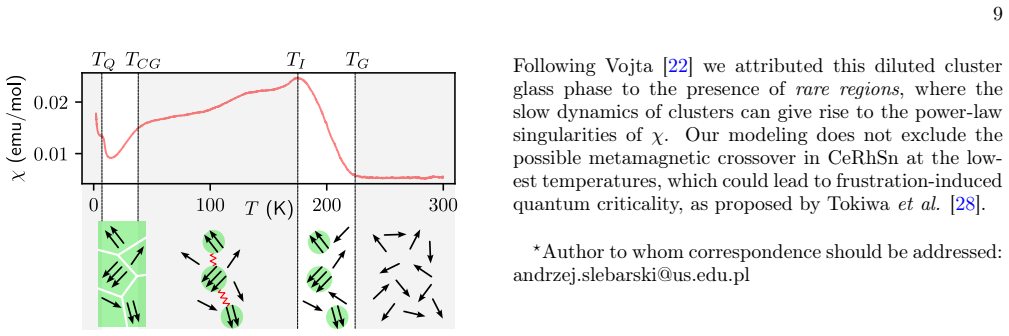
The central claim is that CeRhSn hosts a Griffiths phase over a wide temperature range. Below $T_G \sim 220$ K the inverse magnetic susceptibility follows $\chi^{-1} \propto (T - T_C^g)^{(1-\lambda)}$ with $\lambda \approx 0.45$, and the specific heat and susceptibility show power-law divergences with exponent $n \approx 0.4$; such singularities are the fingerprint of diluted magnetic clusters whose slow dynamics dominate the thermodynamic response. The paper further divides the Griffiths regime into a classical part above $T_Q \sim 6$ K and a quantum Griffiths phase below it, where non-Fermi-liquid behavior persists down to the lowest measured temperatures. These conclusions are supported by dc and ac susceptibility, magnetization relaxation, specific heat, and a toy model in which the susceptibility increase below $T_G$ is produced by a small number of small ferromagnetic clusters.
Load-bearing premise
The two-regime picture rests on the claim that the log-log plot of inverse susceptibility versus the reduced temperature shows two straight segments with different slopes; if that slope change is not real, the separate classical and quantum Griffiths phases collapse into one, even though the overall Griffiths scenario could survive.
Editorial extensions
If this is right
- The slope change in the log-log plot of $\chi^{-1}$ versus $(T/T_C^g - 1)$ is proposed as a criterion for distinguishing classical from quantum Griffiths phases in other strongly correlated disordered systems.
- Below $T_Q \sim 6$ K, CeRhSn is predicted to show non-Fermi-liquid power laws $\chi \sim T^{-n}$ and $C/T \sim T^{-n}$ with $n \approx 0.4$ down to the lowest temperatures, before possible metamagnetic crossover sets in.
- The cluster spin-glass freezing near $T_{CG} \sim 35$ K is interpreted as the freezing of rare magnetic regions, consistent with the Griffiths scenario.
- Applied magnetic fields above roughly 1 T suppress the Griffiths singularity, revealing the finite size of the magnetic clusters.
- The phase diagram resembles the general theoretical picture for magnetic quantum phase transitions in disordered metals, with a quantum Griffiths phase and an infinite-randomness quantum critical point.
Reading between the lines
- The two-slope criterion, if borne out in other materials, would give experimenters a simple bulk probe to separate classical and quantum Griffiths regimes without needing microscopic imaging.
- The toy model's conclusion that large susceptibility changes require only a small population of small clusters suggests that local probes resolving clusters of a few spins, rather than large ferromagnetic domains, are the right experimental target.
- A direct extension would be to apply the same analysis to single crystals of CeRhSn with controlled disorder levels; one testable prediction is that the classical-to-quantum crossover temperature $T_Q$ shifts systematically with defect concentration.
- The paper leaves open whether the quantum Griffiths phase and the frustration-induced quantum criticality claimed at millikelvin temperatures are the same phenomenon or two competing low-energy states; that question could be settled by tuning disorder in a controlled way.
Editorial analysis
A structured set of objections, weighed in public.
Referee Report
Summary. The paper reports a combined experimental and modeling study of polycrystalline CeRhSn, arguing that structural disorder produces dilute ferromagnetic clusters whose slow dynamics generate Griffiths-phase singularities. The central claim is that CeRhSn exhibits a classical Griffiths phase below T_G ≈ 220 K and a quantum Griffiths phase with non-Fermi-liquid behavior below T_Q ≈ 6 K, based on dc/ac susceptibility, specific heat, and isothermal remnant magnetization measurements, supported by a toy model of a power-law cluster-size distribution. The paper proposes a magnetic phase diagram in the spirit of Vojta's scenario and contrasts the Griffiths interpretation with frustration-induced quantum criticality proposed previously for the same material.
Significance. If the central claim holds, CeRhSn becomes a concrete, well-characterized example of a structurally disordered Kondo lattice in which classical and quantum Griffiths regimes can be distinguished in a single material. The paper has real strengths: it combines several complementary probes (XRD, STM, dc/ac susceptibility, specific heat, magnetization relaxation), documents the field dependence and downward curvature of the inverse susceptibility that are hallmarks of Griffiths singularities, and presents an explicit analytic toy model. However, the incremental claim beyond prior work on CeRhSn is the classical-to-quantum Griffiths split, and the evidence for that split is fragile: it rests on a two-slope fit in Fig. 5(b) with an extrapolated critical temperature and no reported uncertainties. The toy model, while transparent, extracts its central quantity a(T) from the very susceptibility data used to define the regimes, so it does not independently corroborate the dichotomy.
major comments (4)
- [Sec. IV.A, Fig. 5(b)] The distinction between a classical Griffiths phase below T_G ≈ 220 K and a quantum Griffiths phase below T_Q ≈ 6 K rests entirely on the claim that log(χ⁻¹) versus log(T/T_g^C − 1) exhibits two linear regimes with different slopes for T_g^C = 0.8 K and λ = 0.45. No uncertainties are reported for these fit parameters, and T_g^C = 0.8 K lies below the lowest measured temperature of 1.8 K, so the singularity is an extrapolation. The manuscript should provide error bars, a sensitivity analysis with respect to the fitted temperature range and to the choice of T_g^C, and ideally a comparison of the two-regime fit against a single-power-law fit over the entire T < T_G range.
- [Fig. 3(b) inset versus Fig. 5(b)] There is an internal inconsistency in the quoted Griffiths exponent. The inset of Fig. 3(b) reports χ ∼ T^(−0.38) at B = 1 T, which would correspond to λ ≈ 0.62 if one uses the quantum Griffiths form χ ∼ T^(λ−1). Figure 5(b), on the other hand, uses the classical form χ⁻¹ ∼ (T − T_g^C)^(1−λ) and reports λ = 0.45 at B = 0.5 T. The manuscript does not reconcile these values or discuss whether λ is expected to be field-dependent. Since the quantum Griffiths prediction is χ ∼ T^(λ−1), not χ⁻¹ ∼ (T − T_g^C)^(1−λ), the slope change in Fig. 5(b) does not by itself establish a classical-to-quantum crossover unless the functional form appropriate to each regime is separately fitted and the resulting exponents are shown to be consistent.
- [Sec. IV.B, Eqs. (13) and (14)] The toy model's central 'prediction', the average cluster size n̄(T) in Eq. (14), is computed from a(T), which is extracted from the measured susceptibility χ(T) via Eq. (13). This is not an independent test of the Griffiths scenario; it is a re-parameterization of the input data. Moreover, the model assumes a power-law cluster-size distribution n(J) ∝ J^(−a) without microscopic justification, and the series convergence constraint a > 3 is imposed by the choice of distribution. The manuscript should state explicitly that the model is illustrative rather than predictive, and should ideally confront n̄(T) with an independent estimate (e.g., from the field dependence of χ or from STM-derived cluster sizes) before using the model to support the existence of a distinct quantum Griffiths regime.
- [Sec. IV.A and Fig. 7] The interpretation of the low-temperature feature near T ≈ 5.5–6 K in C/T and in χ″ as the boundary between classical and quantum Griffiths phases is under-supported. The authors themselves note that this feature is not typical of a glassy transition and that ac susceptibility does not show a characteristic frequency dependence at this temperature. Given that the quantum Griffiths phase is characterized by power laws rather than by a thermodynamic anomaly, the manuscript should either provide a quantitative argument for why a crossover at T_Q produces this feature or soften the claim that T_Q is marked by the observed anomaly. Otherwise, the assignment of T_Q ≈ 6 K appears to rely on a qualitative feature that could have a more mundane origin.
minor comments (6)
- [Abstract and Sec. I] The abstract contains an unusual phrase, 'Our report paves the way for insight into a structural disorder', which is not idiomatic and should be revised for clarity and professional tone.
- [Fig. 3 and Fig. 5] The power-law fits shown in Fig. 3(b), its inset, and Fig. 5(b) do not include uncertainty bands or residual plots; adding these would allow readers to assess the quality of the fits, especially where the two-slope claim is made.
- [Sec. II] The discussion of prior work on CeRhSn is thorough, but the text repeats the sentence about power laws confirmed for single-crystalline CeRhSn (the sentence appears twice in close succession); one instance should be deleted.
- [Sec. III and Fig. 7] The manuscript acknowledges that the Apiezon N grease contributes to the specific heat anomaly near 230 K and states that this contribution is subtracted, but the subtraction procedure and its accuracy are not described. A brief description or a reference to the method used for subtraction would strengthen confidence in the ∆C and ∆S analyses.
- [Sec. IV.B] The notation for the elementary moment s and the total cluster moment J = i s is clear, but the transition from Eq. (10) to Eq. (11) would benefit from an intermediate step showing the zeta-function identities, since the convergence condition a > 3 is central to the model.
- [References] Reference [28] (Tokiwa et al.) is cited as the source of the frustration-induced quantum criticality scenario, but the manuscript does not always distinguish clearly between the authors' own prior results and those of Tokiwa et al.; a few sentences in Sec. II would profit from more explicit attribution.
Circularity Check
The toy model's central output — the average cluster size n̄(T) — is extracted from the measured susceptibility via Eq. (13) and then reported as a prediction, so the model does not independently support the Griffiths scenario; the experimental Griffiths-phase evidence itself is real but independent.
-
fitted input called prediction
[Sec. IV B, Eqs. (13)-(14), Fig. 9]
"By measuring the ratio on the left-hand side of Eq. (13) one can determine the exponent a(T), which allows calculating the temperature dependence of the average number of elementary moments in a cluster as the ratio of the average cluster moment to s, that is, ¯n(T) = ζ(a−1)/ζ(a)."
Equation (13) equates the measured susceptibility ratio to a function of a(T); the paper then uses that measured ratio to determine a(T). Equation (14) defines n̄(T) as a deterministic function of a(T). Therefore the 'predicted' cluster growth curve in Fig. 9(b) is nothing but a reparameterization of the same χ(T) fed into Eq. (13). It cannot be counted as an independent model prediction or as independent support for the Griffiths scenario; it is a fit of the input data presented as a calculated result.
full rationale
The central experimental claim — power-law χ, C/T, and magnetization, field-dependent inverse susceptibility, and slow relaxation — is based on direct measurements and is not circular. The two-regime classical/quantum Griffiths split is a data interpretation and is not definitionally forced. The only load-bearing step that reduces by construction is the toy-model 'prediction' of cluster size: a(T) is inverted from measured χ(T) and n̄(T) follows algebraically, so Fig. 9 is a fit reported as a prediction. Self-citations to prior NFL power laws are not load-bearing because independent single-crystal data and new measurements are also presented. Overall, the circularity is partial, so the score is 6.
Assumptions & free parameters
free parameters (6)
- a(T) =
varies with T; saturates near 3.01
- T0 =
230 K
- s =
1/2
- T_g^C =
0.8 K
- lambda =
0.45
- low-T exponents =
n = 0.38 (χ), n = 0.4 (C/T), 0.65 (M vs B), alpha = 7.9e-3 (relaxation)
assumptions (4)
- standard math The magnetic response is described by Brillouin function for independent clusters in the high-temperature limit.
- ad hoc to paper The cluster-size distribution is assumed to be a power law, n(J) ∝ J^{-a}.
- domain assumption The exponent a(T) remains greater than 3 for all temperatures considered.
- domain assumption The clusters are non-interacting below T0.
invented entities (1)
-
Dilute magnetic clusters (or rare regions)
Cite this review
Pith. "Pith review of Griffiths phases in structurally disordered CeRhSn: Experimental evidence and theoretical modeling." pith.science (2026). https://pith.science/paper/Z23QRMUW
@misc{pith2026250604312,
  author       = {Pith},
  title        = {Pith review of: Griffiths phases in structurally disordered CeRhSn: Experimental evidence and theoretical modeling},
  year         = {2026},
  howpublished = {\url{https://pith.science/paper/Z23QRMUW}},
  note         = {Machine review of arXiv:2506.04312}
}
abstract
Our report paves the way for insight into a structural disorder and its impact on the physical properties of strongly correlated electron systems (SCESs). In a critical regime, each perturbation, e.g., disorder due to structural defects or doping, can have a significant effect on the nature of the quantum macrostate of these materials. For a select group of SCESs, we have empirically documented the Griffiths singularity, as exemplified by CeRhSn, which exhibits non-Fermi-liquid characteristics in susceptibility and specific heat. Our numerical analysis has supported the Griffiths phase scenario for CeRhSn and has revealed that its dc magnetic susceptibility is strongly dependent on the size of inhomogeneous magnetic particles that form in these materials. In the presence of strong disorder, we have proposed a magnetic phase diagram for CeRhSn. The classical Griffiths phase has been identified in the temperature range below the onset temperature of $T_G$ ~ 220 K, while the quantum Griffiths phase with non-Fermi liquid behavior emerges below the quantum critical temperature of $T_Q$ ~ 6 K. The phase diagram developed in this study bears notable similarities to the scenario previously proposed by Vojta for magnetic quantum phase transitions in disordered metals.
Figures


Figures from the paper (7 more)


Reference graph
Works this paper leans on
-
[1]
P. W. Anderson, Absence of diffusion in certain random lattices, Phys. Rev.109, 1492 (1958)
1958
-
[2]
(13), which was used to calculatea
The dashed red line shows the susceptibilityχ(T < T0)that enters Eq. (13), which was used to calculatea. The inset illustrates the distribution for a = 3.01. (b) The blue line shows the temperature depen- dence of the size of an average cluster¯n [see Eq. (14)] for the same parameters as in panel (a). In order to demonstrate the predictions of the model, ...
-
[3]
J. Spałek and W. Wójcik, A strong effect of disorder on Mott transition: Hubbard-Lloyd model, Acta Phys. Pol. B 34, 399 (2003)
work page 2003
-
[4]
C. Grenzebach, F. B. Anders, G. Czycholl, and T. Pr- uschke, Influence of disorder on the transport proper- ties of heavy-fermion systems, Phys. Rev. B77, 115125 (2008)
work page 2008
-
[5]
J. A. Mydosh, Disorder and frustration in heavy-fermion compounds, Physica B259—261, 882 (1999)
work page 1999
-
[6]
Gebhard, The Mott Metal-Insulator Transition , (Spronger Verlag, Berlin 1997); M
F. Gebhard, The Mott Metal-Insulator Transition , (Spronger Verlag, Berlin 1997); M. Imada, A. Fujimori, and T. Tokura, Rev. Mod. Phys.70, 1039 (1998)
work page 1998
-
[7]
V. Dobrosavljević, T. R. Kirkpatrick, and G. Kotliar, Kondo effect in disordered systems, Phys. Rev. Lett.69 1113 (1992)
work page 1992
-
[8]
Cf. special issue of J. Phys.: Conden Matter8, No. 48 (1996), (edited by P. Coleman, M. B. Maple, and A. Mil- lis)
work page 1996
Show all 55 references
-
[9]
Miranda, V
E. Miranda, V. Dobrosavljević, and G. Kotliar, Disorder- driven non-Fermi-liquid behavior in Kondo alloys, Phys. Rev. Lett.78, 290 (1997)
1997
-
[10]
O. O. Bernal, D. E. MacLaughlin, H. G. Lukefahr, and B. Andraka, Copper NMR and thermodynamics of UCu5−xPdx: Evidence for Kondo disorder, Phys. Rev. Lett. 75, 2023 (1995)
1995
-
[11]
Phys.: Condens
E Miranda, V Dobrosavljević, and G Kotliar, Kondo disorder: a possible route towards non-Fermi-liquid be- haviour, J. Phys.: Condens. Matter8, 9871 (1996)
1996
-
[12]
Seaman, M
C. Seaman, M. B. Maple, B. W. Lee, S. Ghamaty, M. S. Torikachvili, J. -S. Kang, L. Z. Liu, J. W. Allen, and D. L. Cox, Evidence for non-Fermi liquid behavior in the Kondo alloy Y1−xUxPd3, Phys. Rev. Lett.67, 2882 (1991); B. Andraka and A. M. Tsvelik, Observation of non-Fermi-l...
1991
-
[13]
M. B. Maple, M. C. de Andrade, J. Herrmann, Y. Dalichaouch, D. A. Gajewski, C. L. Seaman, R. Chau, R. Movshovieh, M. C. Aronson, and R. Osborn, Non Fermi liquid ground states in strongly correlated f-electron ma- terials, J.Low Temp. Phys.99, 223 (1995)
1995
-
[14]
Andraka and G
B. Andraka and G. R. Stewart, Heavy-non-Fermi-liquid behavior in U(Cu,Pd)5, Phys. Rev. B47, 3208 (1993); M. C. Aronson, R. Osborn, R. A. Robinson, J. W. Lynn, R. Chau, C. L. Seaman, and M.B. Maple, Non-Fermi- liquid scaling of the magnetic response in UCu5−xPdx (x = 1, 1.5), P...
1993
-
[15]
Andraka, Anomalous specific heat of Ce1−xThxRhSb alloys, Phys
B. Andraka, Anomalous specific heat of Ce1−xThxRhSb alloys, Phys. Rev.B49, 348 (1994)
1994
-
[16]
A. H. Castro Neto, G. Castilla, and B. A. Jones, Non- Fermi liquid behavior and Griffiths phase in f-lectron compounds, Phys. Rev. Lett.81, 3531 (1998)
1998
-
[17]
B.Andraka, Anomalous low-temperature properties of di- lute Ce alloys CexLa1−xCu2.2Si2 (x ≤ 0.2), Phys. Rev. B 49, 3589 (1994)
1994
-
[18]
M. C. de Andrade, R. Chau, R. P. Dickey, N. R. Dil- ley, E. J. Freeman, D. A. Gajewski, M. B. Maple, R. 10 Movshovich, A. H. Castro Neto, G. Castilla, and B. A. Jones, Evidence for a common physical description of non-Fermi-liquid behavior in chemically substituted f- electron...
1998
-
[19]
Vollmer, T
R. Vollmer, T. Pietrus, H. v. Löhneysen, R. Chau, and M. B. Maple, Phase transitions and non-Fermi-liquid be- havior in UCu5−xPdx at low temperatures, Phys. Rev. B 61, 1218 (2000)
2000
-
[20]
A. H. Castro Neto and B. A. Jones, Non-Fermi-liquid behavior in U and Ce alloys: Criticality, disorder, dissi- pation, and Griffiths-McCoy singularities, Phys. Rev. B 62, 14975 (2000)
2000
-
[21]
The intermediate phase located be- tween the ferromagnetic and paramagnetic state of the sample is referred to as the Griffiths phase
Griffiths discussed a nonanalytic behavior of the magne- tization above Curie temperature in a randomly diluted Ising ferromagnet, caused by the formation of ferromag- netic clusters [20]. The intermediate phase located be- tween the ferromagnetic and paramagnetic state of the...
-
[22]
Vojta, Quantum Griffiths effects and smeared phase transitions in metals: Theory and experiment, J
T. Vojta, Quantum Griffiths effects and smeared phase transitions in metals: Theory and experiment, J. Low. Temp. Phys.161, 299 (2010)
2010
-
[23]
R. B. Griffiths, Nonanalytic behavior above the critical point in a random Ising ferromagnet, Phys. Rev. Lett. 23, 17 (1969)
1969
-
[24]
Ślebarski, N
A. Ślebarski, N. A. Frederick, and M. B. Maple, Strongly correlated electron behaviour in stoichiometric CeRhSn and non-stoichiometric CexRhSn, Phil. Mag. B82, 1275 (2002)
2002
-
[25]
P. -C. Ho, V. S. Zapf, A. Ślebarski, and M. B. Maple, Non-Fermi-liquid behavior in CeRhSn, Phil. Mag. 84, 2119 (2004)
2004
-
[26]
Ślebarski, M
A. Ślebarski, M. B. Maple, E. J. Freeman, C. Sirvent, M. Radłowska, A. Jezierski, E. Granado, Q. Huang, and J. W. Lynn, Strongly correlated electron behaviour in the compound CeRhSn, Phil. Mag. B82, 943 (2002)
2002
-
[27]
H. Tou, M. S. Kim, T. Takabatake, and M. Sera, Antifer- romagnetic spin fluctuations in CeRhSn probed by119Sn NMR, Phys. Rev. B70, 100407(R) (2004)
2004
-
[28]
Tokiwa, Ch
Y. Tokiwa, Ch. Stingl, M. -S. Kim, T. Takabatake, and P. Gegenwart, Characteristic signatures of quantum crit- icality driven by geometrical frustration, Sci. Adv. 1, e1500001 (2015)
2015
-
[29]
(note that, atT = 1.5 K any magnetic order within a limit for an ordered moment of 0.25µB, has not been detected, using a high-resolution neutron spectrometer [23]). The scenario of frustration-induced quantum criti- cality appears to be correct for describing the thermody- na...
-
[30]
M. S. Kim, Y. Echizen, K. Umeo, S. Kobayashi, M. Sera, P. S. Salamakha, O. L. Sologub, T. Takabatake, X. Chen, T. Tayama, T. Sakakibara, M. H. Jung, and M. B. Maple, Low-temperature anomalies in magnetic, transport, and thermal properties of single-crystal CeRhSn with valence ...
2003
-
[31]
Huang, Ch
T.U.Böhm, N.S.Sirica, B.G.Jang, Y.Liu, E.D.Bauer, Y. Huang, Ch. C. Homes, J. -X. Zhu, and F. Ronning, Anisotropic hybridization in CeRhSn, Phys. Rev. B110, L121107 (2024)
2024
-
[32]
Kittaka, Y
S. Kittaka, Y. Kono, S. Tsuda, T. Takabatake, and T. Sakakibara, Field-angle-resolved landscape of non- Fermi-liquid behavior in the quasi-Kagome Kondo lattice CeRhSn, J. Phys. Soc. Jpn.90, 064703 (2021)
2021
- [33]
-
[34]
L. Zhu, M. Garst, A. Rosch, and Q. Si, Universally di- verging Grüneisen parameter and the magnetocaloric ef- fect close to quantum critical points, Phys. Rev. Lett.91, 066404 (2003)
2003
-
[35]
Ślebarski, K
A. Ślebarski, K. Grube, R. Lortz, C. Meingast, and H. v. Löhneysen, ThermalandmagneticpropertiesofCeRhSn, J. Magn. Magn. Mater.272-276, 234 (2004)
2004
-
[36]
Ślebarski, Grüneisen ratio in Kondo-lattice compound CeRhSn, J
A. Ślebarski, Grüneisen ratio in Kondo-lattice compound CeRhSn, J. Phys.: Conf. Ser.303, 012109 (2011)
2011
-
[37]
compound a (Å) c (Å) CeRhSn 7.4486 4.0807 LaRhSn 7.4911 4.2231 FIG
Rexp < 0.9%, Rwp < 4.5%, and RBragg < 2.9%. compound a (Å) c (Å) CeRhSn 7.4486 4.0807 LaRhSn 7.4911 4.2231 FIG. 1. Observed (black points) and calculated (red line) profiles for CeRhSn at RT (the intensity is expressed in arbi- trary units). The short vertical lines indicate t...
-
[38]
references in [28]), however, in these materials, divergent behavior inα/T can be observed along all main directions
Anisotropy in the linear thermal expansion has been found in number of quantum critical tetragonal or or- thorhombic heavy fermion metals (cf. references in [28]), however, in these materials, divergent behavior inα/T can be observed along all main directions. This behavior is...
-
[39]
Rodriguez-Carvajal, Recent advances in magnetic structure determination by neutron powder diffraction, Physica B192, 55 (1993)
J. Rodriguez-Carvajal, Recent advances in magnetic structure determination by neutron powder diffraction, Physica B192, 55 (1993)
1993
-
[40]
B. H. Toby, R factors in Rietveld analysis: How good is good enough? Powder Diffr. 21, 67 (2006)
2006
-
[41]
Apiezon Products, M&I Materials, Manchester, M32 0ZD United Kingdom
-
[42]
Schnelle, J
W. Schnelle, J. Engelhardt, and E. Gmelin, Specific heat capacity of Apiezon N high vacuum grease and of Duran borosilicate glass, Cryogenics39, 271 (1999)
1999
-
[43]
H. H. Hill, The Early Actinides: the Periodic System’s f Electron Transition Metal Series, in Plutonium 1970 and Other Actinides (AIME, New York, 1970)
1970
-
[44]
Ślebarski and A
A. Ślebarski and A. Jezierski, Non-Fermi liquid behavior in CeRhSn coexistent with magnetic order, Phys. Stat. Sol. B236, 340 (2003)
2003
-
[45]
In CeRhSn, Kondo temperature is about 140 K [23]
-
[46]
A. J. Cox, J. G. Louderback, S. E. Apsel, and L. A. Bloomfield, Magnetism in 4d-transition metal clusters, Phys. Rev. B49, 12295 (1994)
1994
-
[47]
Castro, C
M. Castro, C. Jamorski, and D. R. Salahub, Structure, bonding, and magnetism of small Fen, Con, and Nin clus- ters, n ≤ 5, Chem. Phys. Lett.271, 133 (1997)
1997
-
[48]
Y. Jo, M. H. Jung, M. C. Kyum, K. H. Park, and Y. N. Kim, Magnetic properties of nano-sized CuNi clusters, J. Magnetics, 11, 156 (2006)
2006
-
[49]
Ślebarski, M
A. Ślebarski, M. Radłowska, T. Zawada, M. B. Maple, A. Jezierski, and A. Zygmunt, Experimental study of the physical properties in the complex magnetic phase dia- gram of Ce1−xLaxRhSn, Phys. Rev. B66, 104434 (2002)
2002
-
[50]
J. G. Bunting, T. Ashworth, and H. Steeple, A corre- lation between thermal conductance and specific heat anomalies and the glass temperature of Apiezon N and T greases, Cryogenics9, 385 (1969)
1969
-
[51]
Ślebarski, J
A. Ślebarski, J. Goraus, and M. Fijałkowski, Short-range ferromagnetic correlations in disordered FeVGa with dis- tinct similarities to the Griffiths phase, Phys. Rev. B84, 075154 (2011)
2011
-
[52]
T. Naka, A. M. Nikitin, Yu Pan, A. de Visser, T. Nakane, F. Ishikawa, Y. Yamada, M. Imai, and A. Mat- sushita, Composition induced metal–insulator quantum phase transition in the Heusler type Fe2VAl, J. Phys.: Condens. Matter28, 285601 (2016)
2016
-
[53]
Ślebarski, M
A. Ślebarski, M. Fijałkowski, J. Deniszczyk, M. M. Maśka, and D. Kaczorowski, Off-stoichiometric effect on magnetic and electron transport properties of Fe2VAl1.35 and Ni2VAl: A comparative study, Phys. Rev. B109, 165105 (2024)
2024
-
[54]
B. S. Shivaram, J. C. Prestigiacomo, A. Xu, Zhenyuan Zeng, T. D. Ford, I. Kimchi, S. Li, and P. A. Lee, Non- analytic magnetic response and intrinsic ferromagnetic clusters in a kagome spin-liquid candidate, Phys. Rev. B 110, L121105 (2024)
2024
-
[55]
F. Tian, Q. Zhao, J. Guo, Y. Zhang, M. Fang, T. Chang, Z. Dai, Ch. Zhou, K. Cao, and S. Yang, Griffiths phase arising from local lattice distortion and spin glass 11 above the Curie temperature in Ni2MnSb polycrystalline Heusler alloy, Phys. Rev. B109, 224405 (2024)
2024
Reviewed August 7, 2026 · model on record in the stance chip above.
Discussion (0). Sign in to comment.