REVIEW 3 major objections 3 minor 93 references
Human-Agent Interaction in Synthetic Social Networks: A Framework for Studying Online Polarization
T0 review · 3 major / 3 minor · reviewed 2026-08-09 · deepseek-v4-flash
Pith's one-line read A hybrid LLM and opinion-dynamics platform gives researchers a controlled way to study online polarization.
desk verdict A well-engineered framework that marries formal opinion dynamics with LLM agents, but the user study's headline effects are partially baked into the manipulation and the computational findings are mostly model illustrations. read the letter →
The pith
A machine-rendered reading of the paper's core claim, the machinery that carries it, and where it could break.
The reading
What carries the argument
The central object is the opinion-update rule combining homophilous assimilation and reactance, governed by a parameter $\sigma_{\mathrm{eff}}$ that sets the width of an effective attraction zone. An agent's opinion shifts toward a perceived message stance when the opinion difference is smaller than this width, and away from it when the difference is larger. This rule is embedded in LLM-based agents that generate and interpret natural-language messages, which are then filtered through a recommendation system and a co-evolving network structure. The mechanism aims to let the same equations that track opinion trajectories also drive realistic communication.
What would settle it
Run the same user study with a fourth condition that varies only one content dimension—for example, holding extremity constant while raising emotionality—and with a condition that varies only extremity. If participants' perceptions and engagement do not shift in the reported directions under these dissociated manipulations, the paper's attribution of its effects to a global "polarization" construct would be weakened.
Extended reading notes
Core claim
The paper claims that its framework enables the study of polarization with both analytical rigor and ecological validity. In the framework, each agent holds a continuous opinion $o_i(t)\in[-1,1]$, updates it through a probabilistic assimilation–repulsion rule driven by the perceived stance of encountered messages, and generates natural-language content through an LLM conditioned on that state. The authors report that offline simulations reproduce known polarization phenomena — consensus, bipolarization, trimodal distributions, echo chambers — and that the user study shows human participants perceive polarized agent discourse as more emotional, group-salient, biased, and polarized, and less uncertain, while also showing effects on opinion-change magnitude. If this holds, the framework offers a way to manipulate polarization causally in a realistic online environment.
Load-bearing premise
The user-study manipulation treats "polarization degree" as a single factor, but the polarized condition differs from the moderate one simultaneously in extremity, emotionality, certainty, and cooperativeness, so the observed effects on perception and engagement cannot be attributed specifically to polarization as opposed to any one of those correlated dimensions.
Editorial extensions
If this is right
- Researchers could run controlled experiments on polarization with human participants in a realistic social-media-like environment, manipulating opinion-dynamics parameters or algorithmic exposure directly.
- The framework could test theoretical predictions from opinion-dynamics models under more linguistically realistic conditions than previous simulations.
- The reported link between polarization and reduced perceived uncertainty suggests a concrete route toward studying dogmatism and group identity in online discourse.
- The framework could be extended to other contentious topics or to intervention strategies aimed at depolarization.
- The finding that polarized environments reduce commenting behavior could inform platform design and moderation policies.
Reading between the lines
- A natural next step would be to disentangle the user-study manipulation by independently varying extremity, emotionality, certainty, and cooperativeness; the current design conflates these dimensions, so the specific causal role of each is untested.
- The framework's LLM-based message evaluation and generation could be used in reverse, as a measurement tool to quantify polarization in existing social-media corpora by aligning them with the simulated dimensions.
- If the algorithmic trade-off between low discovery rate (higher opinion polarization) and high discovery rate (higher structural modularity) generalizes, it suggests that designing recommendation systems for viewpoint diversity may inadvertently increase social fragmentation.
- A possible extension is to use the platform over longer timescales or with repeated exposure, since the current user study only measures short-term effects without a zero-treatment control group.
Editorial analysis
A structured set of objections, weighed in public.
Referee Report
Summary. The paper introduces a computational framework that couples formal opinion dynamics equations (Appendix A) with LLM-generated agent communication, and evaluates it through offline simulations and a 122-participant user study. The authors report that polarized agent environments increase participants' perceived emotionality and group identity salience while reducing perceived uncertainty, and they propose the framework as a controlled platform for studying online polarization.
Significance. The integration of mathematical opinion-update rules with LLM-based natural language generation is a genuinely useful methodological ambition, and the paper provides a unusually detailed model specification in Appendix A. The computational experiments cover a broad parameter space, and the user study uses multiple dependent measures and structural equation modeling; the reported perception effects are large and statistically significant. The main value of the paper, if the validation concerns are addressed, would be as a reusable experimental platform rather than as a new empirical discovery about polarization itself.
major comments (3)
- [Section 5.1, Table 9] The Polarization Degree manipulation is not a single factor: the polarized condition differs from the moderate condition simultaneously in extremity, emotionality, certainty, and cooperativeness, and the dependent variables include perceived emotionality, perceived group salience, and perceived uncertainty. The large effects (Hedges' g 0.73-1.53) therefore partly reflect manipulation checks rather than effects of opinion divergence per se. The abstract and Section 5.2 attribute these differences to 'polarized environments,' but the design cannot separate polarization from the content style bundled into the manipulation. Section 6.3 acknowledges the absence of a zero-treatment control but does not acknowledge this multidimensional confounding. The claims about the specific role of polarization need to be reframed as effects of a polarized discourse bundle, or the design needs disentangled conditions.
- [Section 4.3, Appendix C.1, Table 2] The offline content analysis is circular in a way that undermines the 'validation' claim: the same LLM that generates agent messages is used to score their emotionality, group identity salience, uncertainty, and opinion. Table 2 explicitly instructs high-intensity messages to use 'strong emotional language' and 'pronounced group identification,' so the finding in Fig. 9 that polarized messages are more emotional, more group-salient, and less uncertain may simply reflect prompt adherence rather than a model property. The paper should either use independent human annotation for these content dimensions or demonstrate that the effects persist when the scoring LLM is different from the generating LLM and is blind to the condition.
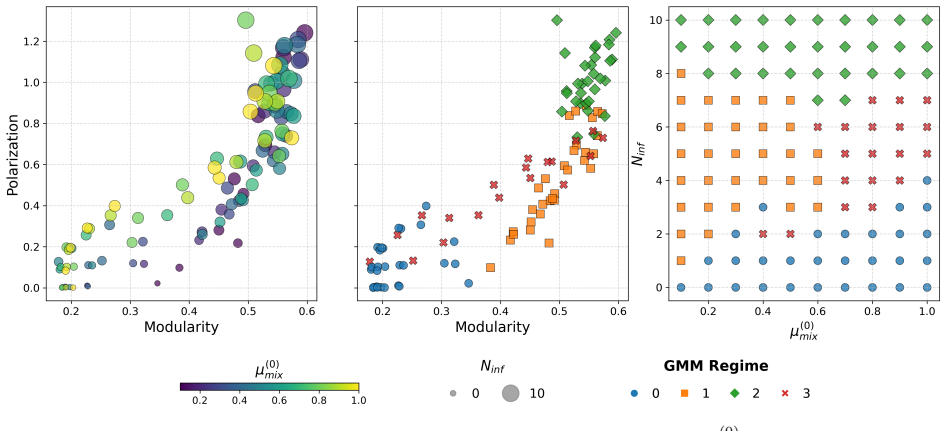
- [Section 4.2, Table 3] Several simulation-based conclusions, such as the 'algorithmic trade-off' between discovery rate and modularity in Figs. 5b and 6b, are presented as substantive findings, but the model contains roughly twenty hand-set parameters (Table 3) with no external calibration and no systematic sensitivity analysis. Because the opinion-update and interaction functions in Eqs. (12)-(21) already encode assumptions about assimilation, reactance, and homophily, the qualitative patterns may be inherent to those assumptions. The authors should either calibrate or vary the key parameters (e.g., sigma_base, p_dis, delta_rec) over wide ranges and show that the trade-off is robust, or explicitly frame these results as model demonstrations rather than empirical discoveries.
minor comments (3)
- [Figure 9 and Figure 13] The text alternates between 'moderate vs. polarized' (Section 5.1) and 'unpolarized' (Fig. 9, Fig. 13 captions); please use consistent labels throughout.
- [Section 5.1, Appendix D] The Group Salience scale was shortened to two items following psychometric analysis; please report the full item set and the factor loadings for the dropped items, since two-item scales can have reliability and validity concerns.
- [Section 6.3] The limitations section is candid about short exposure and the absence of a zero-treatment control, but it should also note the possibility that the LLM-based content analysis in Section 4.3 is confounded with the message generation prompt, as this affects the offline validation claims.
Circularity Check
Content-analysis and user-study polarization effects are partly built into the message-generation prompts and the bundled Polarization Degree manipulation.
-
self definitional
[Section 4.3 and Appendix C.1, Table 2 and Table 4, Fig. 9]
"From Table 2: "High (|oi|>0.7): Strong emotional language; pronounced group identification; dehumanization of opponents; hyperbolic terminology; portrays opposing views as threats." From Section 4.3: "Our LLM-based content analysis reveals that polarized environments, compared to unpolarized ones, generate discourse with significantly more extreme opinions, dramatically higher group identity salience, increased emotionality, and reduced uncertainty.""
The message-generation prompt (Table 2) explicitly instructs high-intensity messages to contain stronger emotionality, group identification, and threat framing than low-intensity messages, and the LLM-based content analysis then "finds" that polarized messages have dramatically higher group salience and emotionality and lower uncertainty (Table 4: group identity 0.72 vs 0.15; emotionality 0.75 vs 0.42; uncertainty 0.20 vs 0.56). These measured dimensions are properties written into the generation instructions, so the computational finding that polarization transforms discourse is a restatement of the prompt construction rather than an independent discovery.
-
self definitional
[Section 5.1 'Design and Manipulations'; Section 5.2 'Perception of Debate Climate'; Fig. 14]
"From Section 5.1: "manipulating: (1) Polarization Degree (Moderate vs. Polarized agent discourse styles, differing in extremity, emotionality, certainty, and cooperativeness)". From Section 5.2: "Polarized discussions were accurately perceived as significantly more polarized, emotional, biased, and group-salient, but less uncertain, than moderate discussions (all p < .001, large effect sizes).""
The Polarization Degree manipulation is defined as discourse styles differing in extremity, emotionality, certainty, and cooperativeness, while the key dependent variables include perceived emotionality, perceived uncertainty, and perceived group salience - the same dimensions used to construct the conditions. The headline finding (polarized environments increase emotional perception and group salience while reducing perceived uncertainty) is therefore largely a manipulation check: participants are expected to rate high-emotion, high-certainty, group-identity-laden content as more emotional, less uncertain, and more group-salient by construction. The SEM mediation of Perceived Polarization through Perceived Group Salience and Perceived Emotionality (Fig.
full rationale
The simulation component of the paper (Sections 4.1-4.2, Appendices A-B) is a self-contained model exploration: the attraction-repulsion dynamics, network co-evolution, and algorithmic discovery results follow from the stated equations and are not circular. The self-citations to Donkers and Ziegler (2021, 2023) appear only as background and do not carry the argument. The genuine circularity lies in the empirical validation chain. First, the offline content analysis (Section 4.3, Appendix C.1) presents as a finding that polarized environments generate more emotional, more group-identity-laden, less uncertain messages, but Table 2's prompting scheme directly instructs high-intensity messages to use strong emotional language, pronounced group identification, and threat framing while instructing low-intensity messages to emphasize uncertainty; the LLM-based scorer then measures precisely these instructed dimensions. Second, the user study defines the Polarized condition as discourse 'differing in extremity, emotionality, certainty, and cooperativeness' (Section 5.1) and then reports that this condition increases perceived emotionality and group salience and reduces perceived uncertainty (Section 5.2) - the dependent variables are components of the independent variable's construction, so the large effects are largely manipulation checks. The SEM mediation via perceived group salience and emotionality (Fig. 14) inherits the same bundling. The limitation section acknowledges the missing zero-treatment control but does not acknowledge that the manipulation bundles multiple content dimensions that coincide with the outcome measures. The opinion-change magnitude and engagement findings are not definitionally forced and provide some independent content, which is why the paper is only partially circular rather than fully reducible to its inputs.
Assumptions & free parameters
free parameters (12)
- sigma_base (base attraction width) =
1.0 baseline; varied 0.0 to 2.0
- lambda (learning rate) =
0.01
- mu_mix_0 (initial community mixing) =
0.5 baseline; varied 0.0 to 1.0
- delta_rec (discovery rate) =
0.5 baseline; varied 0.0 to 1.0
- N_inf (number of influencers per side) =
0 baseline; varied 0 to 10
- o_max_0 (initial opinion range limit) =
0.7 baseline; varied 0.1 to 1.0
- p_dis (discordance propensity) =
0.0 baseline; varied 0.0 to 1.0
- sigma_con (concordance width) =
0.1
- sigma_dis_base (baseline discordance width) =
1.0
- p_base (base interaction probability) =
0.5
- gamma_pl (preferential attachment exponent) =
1.0
- rho_e (initial edge density) =
0.15
assumptions (7)
- domain assumption Opinions are univariate scalars in [-1,1] and all agents discuss a single topic.
- ad hoc to paper The cubic update function omega_i(m)=d*(d^2 - sigma_eff^2) with tanh clipping is a valid operationalization of assimilation and reactance.
- domain assumption The LLM stance evaluation pi(A_i,m) recovers the semantic position of messages accurately enough for opinion updates.
- domain assumption Network initialization with community mixing mu_mix and preferential attachment gamma_pl approximates real online network topology.
- domain assumption The recommendation model (discovery rate delta_rec and mixing mu_c_disc) captures the essential algorithmic curation of real platforms.
- domain assumption LLM-generated personas and memory states provide sufficient population heterogeneity for realistic interaction.
- standard math The Esteban-Ray index and modularity are appropriate outcome measures for the claims.
invented entities (3)
-
Effective attraction width sigma_eff
-
Discordance trigger probability P_dis_eff
-
Adaptive discovery mixing parameter mu_c_disc
Cite this review
Pith. "Pith review of Human-Agent Interaction in Synthetic Social Networks: A Framework for Studying Online Polarization." pith.science (2026). https://pith.science/paper/Z2VX2Y2H
@misc{pith2026250201340,
  author       = {Pith},
  title        = {Pith review of: Human-Agent Interaction in Synthetic Social Networks: A Framework for Studying Online Polarization},
  year         = {2026},
  howpublished = {\url{https://pith.science/paper/Z2VX2Y2H}},
  note         = {Machine review of arXiv:2502.01340}
}
read the original abstract
Online social networks have dramatically altered the landscape of public discourse, creating both opportunities for enhanced civic participation and risks of deepening social divisions. Prevalent approaches to studying online polarization have been limited by a methodological disconnect: mathematical models excel at formal analysis but lack linguistic realism, while language model-based simulations capture natural discourse but often sacrifice analytical precision. This paper introduces an innovative computational framework that synthesizes these approaches by embedding formal opinion dynamics principles within LLM-based artificial agents, enabling both rigorous mathematical analysis and naturalistic social interactions. We validate our framework through comprehensive offline testing and experimental evaluation with 122 human participants engaging in a controlled social network environment. The results demonstrate our ability to systematically investigate polarization mechanisms while preserving ecological validity. Our findings reveal how polarized environments shape user perceptions and behavior: participants exposed to polarized discussions showed markedly increased sensitivity to emotional content and group affiliations, while perceiving reduced uncertainty in the agents' positions. By combining mathematical precision with natural language capabilities, our framework opens new avenues for investigating social media phenomena through controlled experimentation. This methodological advancement allows researchers to bridge the gap between theoretical models and empirical observations, offering unprecedented opportunities to study the causal mechanisms underlying online opinion dynamics.
Figures


Figures from the paper (24 more)




Reference graph
Works this paper leans on
-
[1]
, author Aggarwal, C
author Al Amin, M.T. , author Aggarwal, C. , author Yao, S. , author Abdelzaher, T. , author Kaplan, L. , year 2017 . title Unveiling polarization in social networks: A matrix factorization approach , in: booktitle IEEE INFOCOM 2017- IEEE Conference on Computer Communications , publisher IEEE . pp. pages 1--9
2017
-
[2]
author Allahverdyan, A.E. , author Galstyan, A. , year 2014 . title Opinion Dynamics with Confirmation Bias . journal PLOS ONE volume 9 , pages 1--14 . :10.1371/journal.pone.0099557. note publisher: Public Library of Science
-
[3]
author Alsinet, T. , author Argelich, J. , author Béjar, R. , author Martínez, S. , year 2021 . title Measuring Polarization in Online Debates . journal Applied Sciences volume 11 . :10.3390/app112411879
-
[4]
author Amelkin, V. , author Bullo, F. , author Singh, A.K. , year 2017 . title Polar Opinion Dynamics in Social Networks . journal IEEE Transactions on Automatic Control volume 62 , pages 5650--5665 . :10.1109/TAC.2017.2694341
-
[5]
, year 1951
author Asch, S.E. , year 1951 . title Effects of group pressure upon the modification and distortion of judgments , in: booktitle Groups, leadership and men; research in human relations . publisher Carnegie Press , address Oxford, England , pp. pages 177--190
1951
-
[6]
, year 2006
author Axelrod, R. , year 2006 . title Agent-based modeling as a bridge between disciplines . journal Handbook of computational economics volume 2 , pages 1565--1584 . note Publisher: Elsevier
2006
-
[7]
, author Argyle, L.P
author Bail, C.A. , author Argyle, L.P. , author Brown, T.W. , author Bumpus, J.P. , author Chen, H. , author Hunzaker, M.F. , author Lee, J. , author Mann, M. , author Merhout, F. , author Volfovsky, A. , year 2018 . title Exposure to opposing views on social media can increase political polarization . journal Proceedings of the National Academy of Scien...
2018
-
[8]
, author Messing, S
author Bakshy, E. , author Messing, S. , author Adamic, L.A. , year 2015 . title Exposure to ideologically diverse news and opinion on Facebook . journal Science volume 348 , pages 1130--1132 . note Publisher: American Association for the Advancement of Science
2015
Show all 93 references
-
[9]
, author Calvo, E
author Banks, A. , author Calvo, E. , author Karol, D. , author Telhami, S. , year 2021 . title \# PolarizedFeeds : Three Experiments on Polarization , Framing , and Social Media . journal The International Journal of Press/Politics volume 26 , pages 609--634 . https://doi.org...
2021 doi
-
[10]
, year 1958
author Bateson, G. , year 1958 . title Naven: A survey of the problems suggested by a composite picture of the culture of a New Guinea tribe drawn from three points of view . volume volume 21 . publisher Stanford University Press
1958
-
[11]
, author Lorenz-Spreen, P
author Baumann, F. , author Lorenz-Spreen, P. , author Sokolov, I.M. , author Starnini, M. , year 2020 . title Modeling echo chambers and polarization dynamics in social networks . journal Physical Review Letters volume 124 , pages 048301 . note Publisher: APS
2020
-
[12]
, author Bouguettaya, A
author Bliuc, A.M. , author Bouguettaya, A. , author Felise, K.D. , year 2021 . title Online intergroup polarization across political fault lines: An integrative review . journal Frontiers in Psychology volume 12 , pages 641215
2021
-
[13]
, author Sweitzer, M.D
author Bond, R.M. , author Sweitzer, M.D. , year 2022 . title Political Homophily in a Large - Scale Online Communication Network . journal Communication Research volume 49 , pages 93--115 . :10.1177/0093650218813655
2022 doi
-
[14]
, author Egdal, D
author Breum, S. , author Egdal, D. , author Mortensen, V. , author Møller, A. , author Aiello, L. , year 2024 . title The Persuasive Power of Large Language Models . journal Proceedings of the International AAAI Conference on Web and Social Media volume 18 , pages 152--163 . ...
2024 doi
-
[15]
, author Rabl, L
author Buder, J. , author Rabl, L. , author Feiks, M. , author Badermann, M. , author Zurstiege, G. , year 2021 . title Does negatively toned language use on social media lead to attitude polarization? journal Computers in Human Behavior volume 116 . :https://doi.org/10.1016/j...
2021
-
[16]
, author González-Avella, J.C
author Centola, D. , author González-Avella, J.C. , author Eguíluz, V.M. , author Miguel, M.S. , year 2007 . title Homophily, cultural drift, and the co-evolution of cultural groups . journal Journal of Conflict Resolution volume 51 , pages 905--929 . :10.1177/0022002707307632
2007 doi
-
[17]
, author Zanette, D.H
author Chacoma, A. , author Zanette, D.H. , year 2015 . title Opinion formation by social influence: From experiments to modeling . journal PLOS ONE volume 10 , pages 1--16 . :10.1371/journal.pone.0140406
2015 doi
-
[18]
, year 2014
author Chaiken, S. , year 2014 . title The heuristic model of persuasion , in: booktitle Social influence . publisher Psychology Press , pp. pages 3--39
2014
-
[19]
, author Glass, D.H
author Chen, S. , author Glass, D.H. , author McCartney, M. , year 2016 . title Characteristics of successful opinion leaders in a bounded confidence model . journal Physica A: Statistical Mechanics and its Applications volume 449 , pages 426--436 . :https://doi.org/10.1016/j....
2016 doi
-
[20]
, author Wang, Y
author Chen, T. , author Wang, Y. , author Yang, J. , author Cong, G. , year 2021 . title Modeling Multidimensional Public Opinion Polarization Process under the Context of Derived Topics . journal International Journal of Environmental Research and Public Health volume 18 . :...
2021 doi
-
[21]
, author Goyal, A
author Chuang, Y.S. , author Goyal, A. , author Harlalka, N. , author Suresh, S. , author Hawkins, R. , author Yang, S. , author Shah, D. , author Hu, J. , author Rogers, T. , year 2024 . title Simulating Opinion Dynamics with Networks of LLM -based Agents , in: editor Duh, K....
2024
-
[22]
, year 2024
author Cisneros-Velarde, P. , year 2024 . title On the principles behind opinion dynamics in multi-agent systems of large language models . https://arxiv.org/abs/2406.15492, http://arxiv.org/abs/2406.15492 arXiv:2406.15492
2024 arXiv
-
[23]
, author Ratkiewicz, J
author Conover, M. , author Ratkiewicz, J. , author Francisco, M. , author Goncalves, B. , author Menczer, F. , author Flammini, A. , year 2011 . title Political Polarization on Twitter . journal Proceedings of the International AAAI Conference on Web and Social Media volume 5...
2011 doi
-
[24]
, author Singer, N
author Cornacchia, E. , author Singer, N. , author Abbe, E. , year 2020 . title Polarization in Attraction - Repulsion Models , in: booktitle 2020 IEEE International Symposium on Information Theory ( ISIT ) , pp. pages 2765--2770 . :10.1109/ISIT44484.2020.9174010
2020
-
[25]
, author Gollapudi, S
author Das, A. , author Gollapudi, S. , author Munagala, K. , year 2014 . title Modeling opinion dynamics in social networks , in: booktitle Proceedings of the 7th ACM international conference on Web search and data mining , pp. pages 403--412
2014
-
[26]
, author Neau, D
author Deffuant, G. , author Neau, D. , author Amblard, F. , author Weisbuch, G. , year 2000 . title Mixing beliefs among interacting agents . journal Advances in Complex Systems volume 3 , pages 87--98 . note Publisher: World Scientific
2000
-
[27]
, year 1974
author DeGroot, M.H. , year 1974 . title Reaching a consensus . journal Journal of the American Statistical Association volume 69 , pages 118--121 . note Publisher: Taylor & Francis Group
1974
-
[28]
, author Scala, A
author Del Vicario, M. , author Scala, A. , author Caldarelli, G. , author Stanley, H.E. , author Quattrociocchi, W. , year 2017 . title Modeling confirmation bias and polarization . journal Scientific reports volume 7 , pages 40391 . note Publisher: Nature Publishing Group
2017
-
[29]
, author Shi, Y
author DellaPosta, D. , author Shi, Y. , author Macy, M. , year 2015 . title Why do liberals drink lattes? journal American Journal of Sociology volume 120 , pages 1473--1511
2015
-
[30]
, author Ziegler, J
author Donkers, T. , author Ziegler, J. , year 2021 . title The Dual Echo Chamber : Modeling Social Media Polarization for Interventional Recommending , in: booktitle Fifteenth ACM Conference on Recommender Systems , pp. pages 12--22
2021
-
[31]
, author Ziegler, J
author Donkers, T. , author Ziegler, J. , year 2023 . title De-sounding echo chambers: Simulation -based analysis of polarization dynamics in social networks . journal Online Social Networks and Media volume 37-38 . https://www.sciencedirect.com/science/article/pii/S2468696423...
2023
-
[32]
, author Blank, G
author Dubois, E. , author Blank, G. , year 2018 . title The echo chamber is overstated: the moderating effect of political interest and diverse media . journal Information, communication & society volume 21 , pages 729--745 . note Publisher: Taylor & Francis
2018
-
[33]
, year 1957
author Festinger, L. , year 1957 . title A theory of cognitive dissonance . publisher Stanford University Press , address Stanford, California
1957
-
[34]
, author Mäs, M
author Flache, A. , author Mäs, M. , author Feliciani, T. , author Chattoe-Brown, E. , author Deffuant, G. , author Huet, S. , author Lorenz, J. , year 2017 . title Models of Social Influence : Towards the Next Frontiers . journal Journal of Artificial Societies and Social Sim...
2017 doi
-
[35]
, year 1998
author Friedkin, N.E. , year 1998 . title A structural theory of social influence. publisher Cambridge University Press
1998
-
[36]
, author Johnsen, E.C
author Friedkin, N.E. , author Johnsen, E.C. , year 1990 . title Social influence and opinions . journal The Journal of Mathematical Sociology volume 15 , pages 193--206 . https://doi.org/10.1080/0022250X.1990.9990069, :10.1080/0022250X.1990.9990069. note publisher: Routledge ...
1990
-
[37]
, author Lan, X
author Gao, C. , author Lan, X. , author Li, N. , author Yuan, Y. , author Ding, J. , author Zhou, Z. , author Xu, F. , author Li, Y. , year 2023 a. title Large language models empowered agent-based modeling and simulation: A survey and perspectives . https://arxiv.org/abs/231...
2023 arXiv
-
[38]
, author Lan, X
author Gao, C. , author Lan, X. , author Lu, Z. , author Mao, J. , author Piao, J. , author Wang, H. , author Jin, D. , author Li, Y. , year 2023 b. title S3: Social-network simulation system with large language model-empowered agents . https://arxiv.org/abs/2307.14984, http:/...
2023 arXiv
-
[39]
, author Lorenz, J
author Geschke, D. , author Lorenz, J. , author Holtz, P. , year 2019 . title The triple-filter bubble: Using agent-based modelling to test a meta-theoretical framework for the emergence of filter bubbles and echo chambers . journal British Journal of Social Psychology volume ...
2019
-
[40]
, author Majumdar, A
author Ghaffarzadegan, N. , author Majumdar, A. , author Williams, R. , author Hosseinichimeh, N. , year 2024 . title Generative agent-based modeling: an introduction and tutorial . journal System Dynamics Review volume 40 . :https://doi.org/10.1002/sdr.1761, http://arxiv.org/...
2024 doi
-
[41]
, year 2024
author Gurcan, O. , year 2024 . title Llm-augmented agent-based modelling for social simulations: Challenges and opportunities . https://arxiv.org/abs/2405.06700, http://arxiv.org/abs/2405.06700 arXiv:2405.06700
2024 arXiv
-
[42]
People Nowadays Will Take Everything They Can Get
author Hamilton, L. , author Yorgun, M. , author Wright, A. , year 2022 . title “ People Nowadays Will Take Everything They Can Get ”: American Perceptions of Basic Income Usage . journal Journal of Policy Practice and Research volume 3 . :10.1007/s42972-021-00035-0
2022 doi
-
[43]
, author Krause, U
author Hegselmann, R. , author Krause, U. , year 2002 . title Opinion dynamics and bounded confidence: models, analysis and simulation
2002
-
[44]
, year 2007
author Hogg, M.A. , year 2007 . title Uncertainty-identity theory , in: editor Zanna, M.P. (Ed.), booktitle Advances in experimental social psychology . publisher Academic Press , address San Diego, CA . volume volume 39 , pp. pages 69--126
2007
-
[45]
, author Liggett, T.M
author Holley, R.A. , author Liggett, T.M. , year 1975 . title Ergodic Theorems for Weakly Interacting Infinite Systems and the Voter Model . journal The Annals of Probability volume 3 , pages 643 -- 663 . :10.1214/aop/1176996306
1975
-
[46]
, author Miller, N
author Holtz, R. , author Miller, N. , year 2001 . title Intergroup Competition , Attitudinal Projection , and Opinion Certainty : Capitalizing on Conflict . journal Group Processes & Intergroup Relations volume 4 , pages 61--73 . :10.1177/1368430201041005
2001 doi
-
[47]
, author Nihiser, T.H
author Holtz, R. , author Nihiser, T.H. , year 2008 . title Relative Deprivation , Attitude Contrast Projection , and Opinion Certainty . journal Group Processes & Intergroup Relations volume 11 , pages 89--114 . https://doi.org/10.1177/1368430207084848, :10.1177/1368430207084848
2008 doi
-
[48]
, author Sood, G
author Iyengar, S. , author Sood, G. , author Lelkes, Y. , year 2012 . title Affect, Not Ideology : A Social Identity Perspective on Polarization . journal Public Opinion Quarterly volume 76 , pages 405--431 . :10.1093/poq/nfs038
2012 doi
-
[49]
, year 1982
author Janis, I.L. , year 1982 . title Groupthink: Psychological Studies of Policy Decisions and Fiascoes . edition 2 ed., publisher Houghton Mifflin , address Boston
1982
-
[50]
, author Chen, E
author Jiang, J. , author Chen, E. , author Yan, S. , author Lerman, K. , author Ferrara, E. , year 2020 . title Political polarization drives online conversations about COVID -19 in the United States . journal Human Behavior and Emerging Technologies volume 2 , pages 200--211...
2020
-
[51]
, year 2023
author Junprung, E. , year 2023 . title Exploring the intersection of large language models and agent-based modeling via prompt engineering . https://arxiv.org/abs/2308.07411, http://arxiv.org/abs/2308.07411 arXiv:2308.07411
2023 arXiv
-
[52]
, author Knetsch, J.L
author Kahneman, D. , author Knetsch, J.L. , author Thaler, R.H. , year 1991 . title Anomalies: The endowment effect, loss aversion, and status quo bias . journal Journal of Economic Perspectives volume 5 , pages 193–206 . :10.1257/jep.5.1.193
1991 doi
-
[53]
, author Cuskley, C
author Karjus, A. , author Cuskley, C. , year 2024 . title Evolving linguistic divergence on polarizing social media . journal Humanities and Social Sciences Communications volume 11 , pages 422 . :10.1057/s41599-024-02922-9
2024 doi
-
[54]
, author Lazarsfeld, P.F
author Katz, E. , author Lazarsfeld, P.F. , year 1955 . title Personal influence: The part played by people in the flow of mass communications . publisher Free Press , address Glencoe, IL
1955
-
[55]
, author Tak, H
author Kim, S.H. , author Tak, H. , author Cho, H.G. , year 2019 . title Polarized Topic Modeling for User Characteristics in Online Discussion Community , in: booktitle 2019 IEEE International Conference on Big Data and Smart Computing ( BigComp ) , pp. pages 1--4 . :10.1109/...
2019
-
[56]
, author Kashima, Y
author Koudenburg, N. , author Kashima, Y. , year 2022 . title A Polarized Discourse : Effects of Opinion Differentiation and Structural Differentiation on Communication . journal Personality and Social Psychology Bulletin volume 48 , pages 1068--1086 . :10.1177/01461672211030816
2022 doi
-
[57]
, year 1990
author Kunda, Z. , year 1990 . title The case for motivated reasoning . journal Psychological Bulletin volume 108 , pages 480--498 . :10.1037/0033-2909.108.3.480
1990 doi
-
[58]
, author Mouffe, C
author Laclau, E. , author Mouffe, C. , year 2014 . title Hegemony and socialist strategy: Towards a radical democratic politics . volume volume 8 . publisher Verso Books
2014
-
[59]
, year 2016
author Lelkes, Y. , year 2016 . title Mass polarization: Manifestations and measurements . journal Public Opinion Quarterly volume 80 , pages 392--410 . :10.1093/poq/nfw005
2016 doi
-
[60]
, year 2016
author Levendusky, M.S. , year 2016 . title Americans, not partisans: Can priming american national identity reduce affective polarization? journal The Journal of Politics volume 78 , pages 59--70
2016
-
[61]
, year 2013
author Lewin, K. , year 2013 . title Principles of topological psychology . publisher Read Books Ltd
2013
-
[62]
, author Devos, T
author Mackie, D.M. , author Devos, T. , author Smith, E.R. , year 2000 . title Intergroup emotions: E xplaining offensive action tendencies in an intergroup context . journal Journal of Personality and Social Psychology volume 79 , pages 602--616
2000
-
[63]
, year 2018
author Mason, L. , year 2018 . title Uncivil agreement: How politics became our identity . publisher University of Chicago Press
2018
-
[64]
, author Reifler, J
author Nyhan, B. , author Reifler, J. , year 2010 . title When corrections fail: The persistence of political misperceptions . journal Political Behavior volume 32 , pages 303--330 . :10.1007/s11109-010-9112-2
2010 doi
-
[65]
, year 2024
author Ohagi, M. , year 2024 . title Polarization of Autonomous Generative AI Agents Under Echo Chambers , in: booktitle Proceedings of the 14th Workshop on Computational Approaches to Subjectivity , Sentiment , & Social Media Analysis , publisher Association for Computational...
2024
-
[66]
, year 2011
author Pariser, E. , year 2011 . title The filter bubble: What the Internet is hiding from you . publisher Penguin UK
2011
-
[67]
, author Ramaciotti, P
author Peralta, A.F. , author Ramaciotti, P. , author Kertész, J. , author Iñiguez, G. , year 2024 . title Multidimensional political polarization in online social networks . journal Phys. Rev. Res. volume 6 , pages 013170 . https://link.aps.org/doi/10.1103/PhysRevResearch.6.0...
2024 doi
-
[68]
, author Cacioppo, J.T
author Petty, R.E. , author Cacioppo, J.T. , year 1986 . title The elaboration likelihood model of persuasion , in: booktitle Communication and persuasion . publisher Springer , pp. pages 1--24
1986
-
[69]
, author Uyheng, J
author Phillips, S.C. , author Uyheng, J. , author Carley, K.M. , year 2023 . title A high-dimensional approach to measuring online polarization . journal Journal of Computational Social Science volume 6 , pages 1147--1178 . https://doi.org/10.1007/s42001-023-00227-6, :10.1007...
2023 doi
-
[70]
, author Zago, G
author Recuero, R. , author Zago, G. , author Soares, F. , year 2019 . title Using Social Network Analysis and Social Capital to Identify User Roles on Polarized Political Conversations on Twitter . journal Social Media + Society volume 5 , pages 2056305119848745 . https://doi...
2019 doi
-
[71]
, author Spears, R
author Reicher, S.D. , author Spears, R. , author and, T.P. , year 1995 . title A social identity model of deindividuation phenomena . journal European Review of Social Psychology volume 6 , pages 161--198 . :10.1080/14792779443000049
1995 doi
-
[72]
, author Royzman, E.B
author Rozin, P. , author Royzman, E.B. , year 2001 . title Negativity bias, negativity dominance, and contagion . journal Personality and Social Psychology Review volume 5 , pages 296--320 . :10.1207/S15327957PSPR0504\_2
2001 doi
-
[73]
, author Chen, W
author Sasahara, K. , author Chen, W. , author Peng, H. , author Ciampaglia, G.L. , author Flammini, A. , author Menczer, F. , year 2021 . title Social influence and unfollowing accelerate the emergence of echo chambers . journal Journal of Computational Social Science volume ...
2021
-
[74]
, author Joly, P
author Schieferdecker, D. , author Joly, P. , author Faas, T. , year 2024 . title Affective polarization between opinion-based groups in a context of low partisan discord: Measuring its prevalence and consequences . journal International Journal of Public Opinion Research volu...
2024 doi
-
[75]
, year 2008
author Schmitt, C. , year 2008 . title The concept of the political: Expanded edition . publisher University of Chicago Press
2008
-
[76]
, author Sherif, M
author Sherif, C.W. , author Sherif, M. , author Nebergall, R.E. , year 1965 . title Attitude and attitude change: The social judgment-involvement approach . publisher W. B. Saunders Company , address Philadelphia, PA
1965
-
[77]
, year 1936
author Sherif, M. , year 1936 . title The Psychology of Social Norms . publisher Harper & Brothers , address New York
1936
-
[78]
, author Brady, W.J
author Simchon, A. , author Brady, W.J. , author Van Bavel, J.J. , year 2022 . title Troll and divide: the language of online polarization . journal PNAS Nexus volume 1 . :10.1093/pnasnexus/pgac019
2022 doi
-
[79]
, author Mosleh, M
author Stewart, A.J. , author Mosleh, M. , author Diakonova, M. , author Arechar, A.A. , author Rand, D.G. , author Plotkin, J.B. , year 2019 . title Information gerrymandering and undemocratic decisions . journal Nature volume 573 , pages 117--121 . :10.1038/s41586-019-1507-6
2019 doi
-
[80]
, year 2017
author Sunstein, C.R. , year 2017 . title \# Republic : Divided democracy in the age of social media . publisher Princeton University Press
2017
-
[81]
, author Sznajd, J
author Sznajd-Weron, K. , author Sznajd, J. , year 2000 . title Opinion evolution in closed community . journal International Journal of Modern Physics C volume 11 , pages 1157--1165
2000
-
[82]
, author Lodge, M
author Taber, C.S. , author Lodge, M. , year 2006 . title Motivated skepticism in the evaluation of political beliefs . journal American Journal of Political Science volume 50 , pages 755--769
2006
-
[83]
, author Billig, M.G
author Tajfel, H. , author Billig, M.G. , author Bundy, R.P. , author Flament, C. , year 1971 . title Social categorization and intergroup behaviour . journal European journal of social psychology volume 1 , pages 149--178 . note Publisher: Wiley Online Library
1971
-
[84]
, author Castagnos, S
author Treuillier, C. , author Castagnos, S. , author Lagier, C. , author Brun, A. , year 2024 . title Gaining a better understanding of online polarization by approaching it as a dynamic process . journal Scientific Reports volume 14 , pages 8702 . :10.1038/s41598-024-58915-w
2024 doi
-
[85]
, author Cinelli, M
author Valensise, C.M. , author Cinelli, M. , author Quattrociocchi, W. , year 2023 . title The drivers of online polarization: Fitting models to data . journal Information Sciences volume 642 , pages 119152 . https://www.sciencedirect.com/science/article/pii/S0020025523007375...
2023
-
[86]
, author Martin, S
author Vande Kerckhove, C. , author Martin, S. , author Gend, P. , author Rentfrow, P.J. , author Hendrickx, J.M. , author Blondel, V.D. , year 2016 . title Modelling influence and opinion evolution in online collective behaviour . journal PLOS ONE volume 11 , pages 1--25 . :1...
2016 doi
-
[87]
, year 2019
author Vlandas, T. , year 2019 . title The Politics of the Basic Income Guarantee : Analysing Individual Support in Europe . journal Basic Income Studies volume 14 . https://doi.org/10.1515/bis-2018-0021, :doi:10.1515/bis-2018-0021
2019 doi
-
[88]
, author Feixas, G
author Winter, D.A. , author Feixas, G. , year 2019 . title Toward a constructivist model of radicalization and deradicalization: A conceptual and methodological proposal . journal Frontiers in psychology volume 10 , pages 412 . note Publisher: Frontiers Media SA
2019
-
[89]
, year 2011
author Wojcieszak, M. , year 2011 . title Deliberation and attitude polarization . journal Journal of Communication volume 61 , pages 596--617 . :10.1111/j.1460-2466.2011.01568.x
2011
-
[90]
, author Tubergen, F.v
author Wuestenenk, N. , author Tubergen, F.v. , author Stark, T.H. , year 2023 . title The influence of group membership on online expressions and polarization on a discussion platform: An experimental study . journal New Media & Society volume 0 . :10.1177/14614448231172966
2023 doi
-
[91]
, author Wang, X
author Xing, Y. , author Wang, X. , author Qiu, C. , author Li, Y. , author He, W. , year 2022 . title Research on opinion polarization by big data analytics capabilities in online social networks . journal Technology in Society volume 68 , pages 101902 . https://www.sciencedi...
2022
-
[92]
, author Baden, C
author Yarchi, M. , author Baden, C. , author Kligler-Vilenchik, N. , year 2021 . title Political Polarization on the Digital Sphere : A Cross -platform, Over -time Analysis of Interactional , Positional , and Affective Polarization on Social Media . journal Political Communic...
2021
-
[93]
, year 2022
author Yousafzai, A.W. , year 2022 . title POLITICAL POLARIZATION AND ITS IMPACT ON MENTAL HEALTH : WHERE DO WE STAND ? journal KHYBER MEDICAL UNIVERSITY JOURNAL volume 14 , pages 1--2 . :10.35845/kmuj.2022.22777
2022
Reviewed August 9, 2026 · model on record in the stance chip above.
Discussion (0). Continue with ORCID to comment.