Photometric light curves analysis of SU UMa-type dwarf novae: the case of RZ LMi and KV Dra
Pith reviewed 2026-06-27 17:59 UTC · model grok-4.3
The pith
New photometry of RZ LMi and KV Dra detects superhumps during superoutbursts and refines their dwarf-nova subclass assignments.
A machine-rendered reading of the paper's core claim, the machinery that carries it, and where it could break.
Core claim
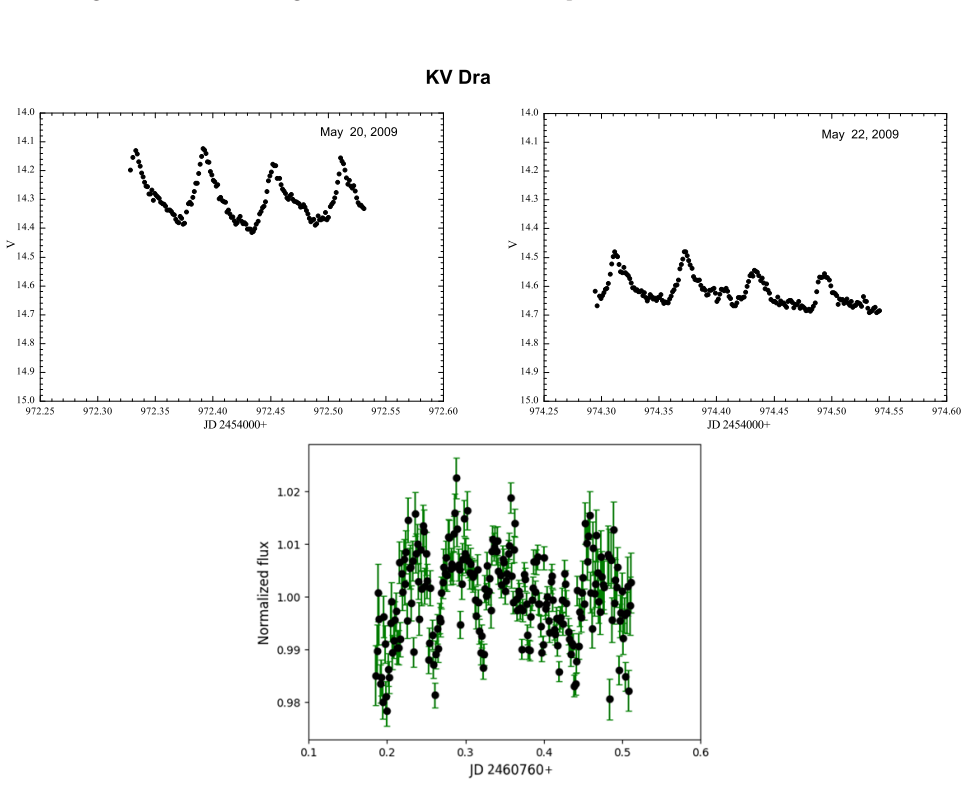
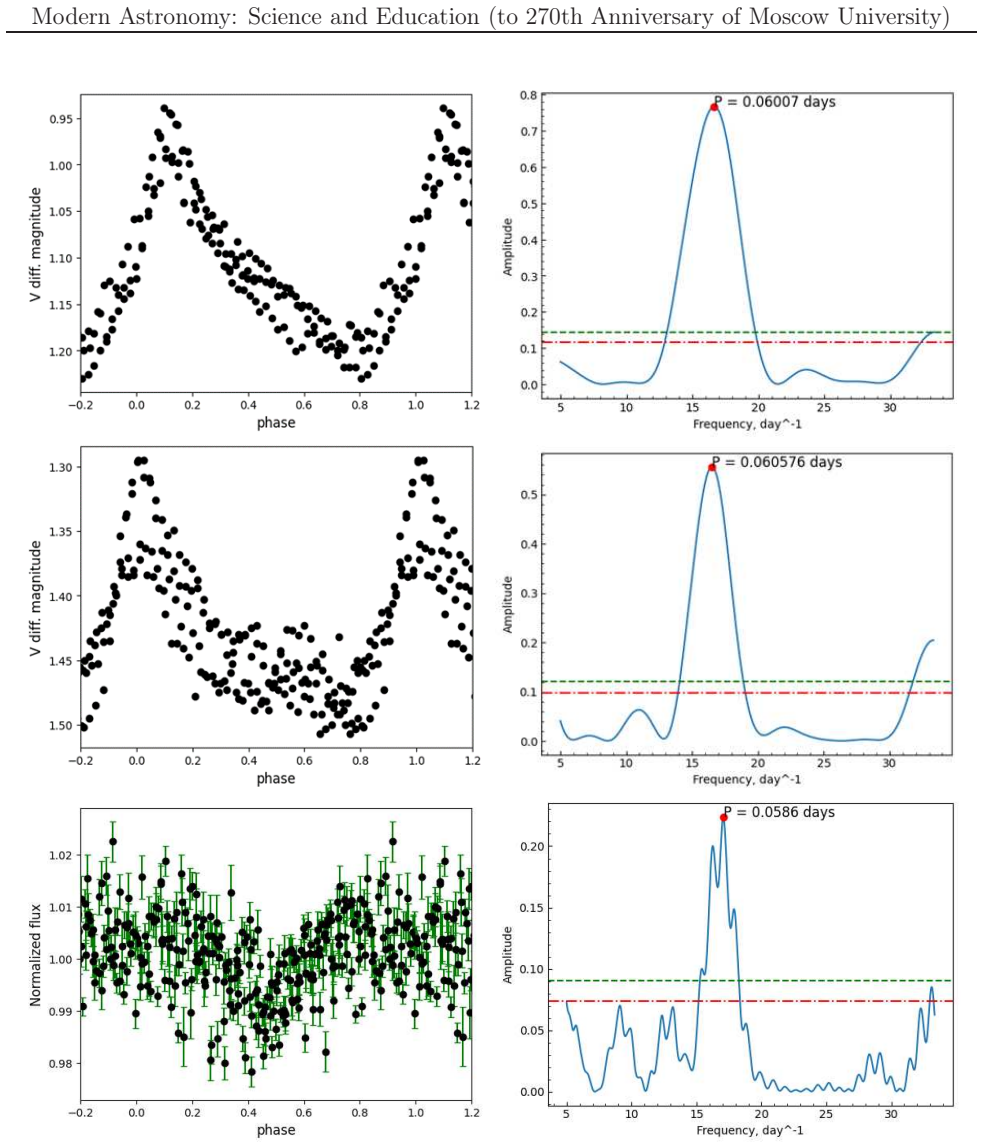
Photometric light curves obtained during superoutbursts show superhumps in both RZ LMi and KV Dra. Measured superhump periods and amplitudes allow the systems to be placed in the ER UMa subclass (RZ LMi) and the WZ Sge subclass (KV Dra), while an orbital period of 0.0586 days is determined for KV Dra.
What carries the argument
Detection and period measurement of superhumps in photometric light curves recorded during superoutbursts.
If this is right
- The superhump periods supply mass-ratio constraints for binary-evolution calculations of these two systems.
- RZ LMi is expected to exhibit frequent superoutbursts typical of the ER UMa group.
- KV Dra should show the long recurrence times and large amplitudes characteristic of WZ Sge stars.
- The newly determined orbital period for KV Dra enables direct comparison with binary-orbit models.
Where Pith is reading between the lines
- Repeated monitoring could test whether the reported superhump periods remain stable across multiple outbursts.
- Similar period searches on other poorly classified SU UMa stars might reveal additional members of the ER UMa and WZ Sge groups.
- The orbital period of KV Dra can be combined with radial-velocity data to estimate component masses.
Load-bearing premise
The repeating signals extracted from the light curves are superhumps (and the orbital signal in KV Dra) rather than aliases or other variability.
What would settle it
Independent photometry that shows either no periodic signals at the reported superhump periods or outburst statistics inconsistent with the stated subclass assignments.
Figures
read the original abstract
The results of new photometric observations of two SU~UMa type dwarf novae are presented. Superhumps were detected on the light curves of these systems during superoutbursts and their periods and amplitudes determined. The classification of objects as dwarf novae of the ER~UMa subclass (for RZ~LMi) and subclass WZ~Sge (for KV~Dra) has been clarified. Orbital period $0^{d}.0586$ for KV Dra was determined.
Editorial analysis
A structured set of objections, weighed in public.
Referee Report
Summary. The paper reports new ground-based photometric observations of the SU UMa-type dwarf novae RZ LMi and KV Dra. It claims detection of superhumps during superoutbursts, with measured periods and amplitudes; reclassification of RZ LMi into the ER UMa subclass and KV Dra into the WZ Sge subclass; and determination of an orbital period of 0.0586 d for KV Dra.
Significance. If the superhump and orbital identifications are robust, the work would provide useful constraints on the outburst properties and evolutionary placement of these systems within the SU UMa family, particularly by refining subclass boundaries that depend on superhump period and amplitude. The orbital period for KV Dra would enable direct comparison with the superhump excess.
major comments (2)
- [Results / Analysis] The manuscript provides no description of the period-search algorithm (e.g., Lomb-Scargle, ANOVA, or CLEAN), no power spectra, and no explicit tests for daily aliases or window-function sidelobes. This directly undermines the central claims of superhump periods and the resulting subclass reassignments, as ground-based data of this type are known to produce spurious peaks at 1 d aliases.
- [Abstract and Results] No error bars, formal uncertainties, or significance levels are reported for any of the quoted periods or amplitudes (abstract and results). Without these, it is impossible to evaluate whether the reported values are distinguishable from aliases or noise, which is load-bearing for both the numerical results and the classification changes.
minor comments (2)
- [Abstract] The abstract states periods and amplitudes were 'determined' but supplies neither the values themselves nor any table of observations; these should be added for reproducibility.
- [Discussion] Notation for periods (e.g., 0d.0586) should be standardized and accompanied by the corresponding superhump excess calculation for KV Dra to allow direct comparison with the orbital period.
Simulated Author's Rebuttal
We thank the referee for the careful reading and constructive comments on our manuscript. The points raised highlight areas where additional methodological detail will improve clarity and allow readers to better assess the robustness of the period determinations. We address each major comment below and will incorporate the necessary revisions.
read point-by-point responses
-
Referee: [Results / Analysis] The manuscript provides no description of the period-search algorithm (e.g., Lomb-Scargle, ANOVA, or CLEAN), no power spectra, and no explicit tests for daily aliases or window-function sidelobes. This directly undermines the central claims of superhump periods and the resulting subclass reassignments, as ground-based data of this type are known to produce spurious peaks at 1 d aliases.
Authors: We agree that the period-search procedure requires explicit description. The superhump periods were identified via Lomb-Scargle periodograms applied to the detrended light curves, followed by confirmation through phase-folded profiles and consistency across multiple nights. In the revised manuscript we will add a Methods subsection detailing the algorithm, include the relevant power spectra as figures, and present the spectral window function with explicit checks for 1 d aliases. These additions will directly address the concern and support the reported periods and subclassifications. revision: yes
-
Referee: [Abstract and Results] No error bars, formal uncertainties, or significance levels are reported for any of the quoted periods or amplitudes (abstract and results). Without these, it is impossible to evaluate whether the reported values are distinguishable from aliases or noise, which is load-bearing for both the numerical results and the classification changes.
Authors: We concur that uncertainties must be reported. The quoted periods were derived from multiple independent cycle measurements; we will add formal uncertainties (derived from the scatter across nights and bootstrap resampling) to all periods and amplitudes in both the abstract and results sections. Significance will be quantified via false-alarm probabilities from the periodograms. These changes will enable quantitative evaluation of the detections. revision: yes
Circularity Check
No circularity: direct observational period extraction
full rationale
The paper consists of photometric observations of two dwarf novae, reporting detected superhumps, measured periods/amplitudes, subclass clarifications, and one orbital period. No derivation chain, first-principles predictions, fitted parameters renamed as predictions, or self-citation load-bearing steps are present or claimed. Results are empirical extractions from light curves and stand as direct measurements without reduction to inputs by construction.
Axiom & Free-Parameter Ledger
free parameters (3)
- superhump period and amplitude for RZ LMi
- superhump period and amplitude for KV Dra
- orbital period for KV Dra
Reference graph
Works this paper leans on
-
[1]
They consist of a white dwarf primary and low mass main sequen ce star as a secondary one
INTRODUCTION SU UMa type systems are subclass of dwarf novae with orbital p eriods less than 2.5 hours. They consist of a white dwarf primary and low mass main sequen ce star as a secondary one. The latest fills its Roche lobe and transfers matter to the whi te dwarf, forming an accretion disk around it. These objects usually show two kind of outbursts: no...
2025
-
[2]
Green et al
RZ LMI RZ LMi was originally discovered as a variable with ultravio let-excess by Lipovetskii and Stepanyan [ 2]. Green et al. (1982) later confirmed it spectroscopically a s a cataclysmic variable (CV) [3]. Robertson and his colleagues in 1995 performed photometr y of RZ LMi and two other stars with similar behavior. As a result they found similar c harac...
1982
-
[3]
The first mention of this system as a possible dwarf nova appeared in 2000 [ 8] when the first outburst of this object was recorded in May 2000
KV DRA The RX J14505+6403 system was discovered during the ROSAT Al l-Sky Survey as a possible cataclysmic variable of unknown type with a magnitude of 16.3 − 17.1 [ 7]. The first mention of this system as a possible dwarf nova appeared in 2000 [ 8] when the first outburst of this object was recorded in May 2000. During intensive observations, su perhumps w...
2000
-
[4]
Observations covered 3 normal outbursts and 4 superoutbursts of RZ LMi
OBSER V A TIONS Our observations of dwarf nova RZ LMi were carried during 20 n ights from February - April, 2024 and prolonged on the next year, in March (10 nights), wit h 50–cm telescope of INASAN Kislovodsk optical station with sCMOS camera ZWO ASI6200MM Pro in V band. Observations covered 3 normal outbursts and 4 superoutbursts of RZ LMi. Th e accurac...
2024
-
[5]
RZ LMi One of the two overall light curves of RZ LMi obtained during o ur observations in 2024 and 2025 is shown in Fig 1 as an example
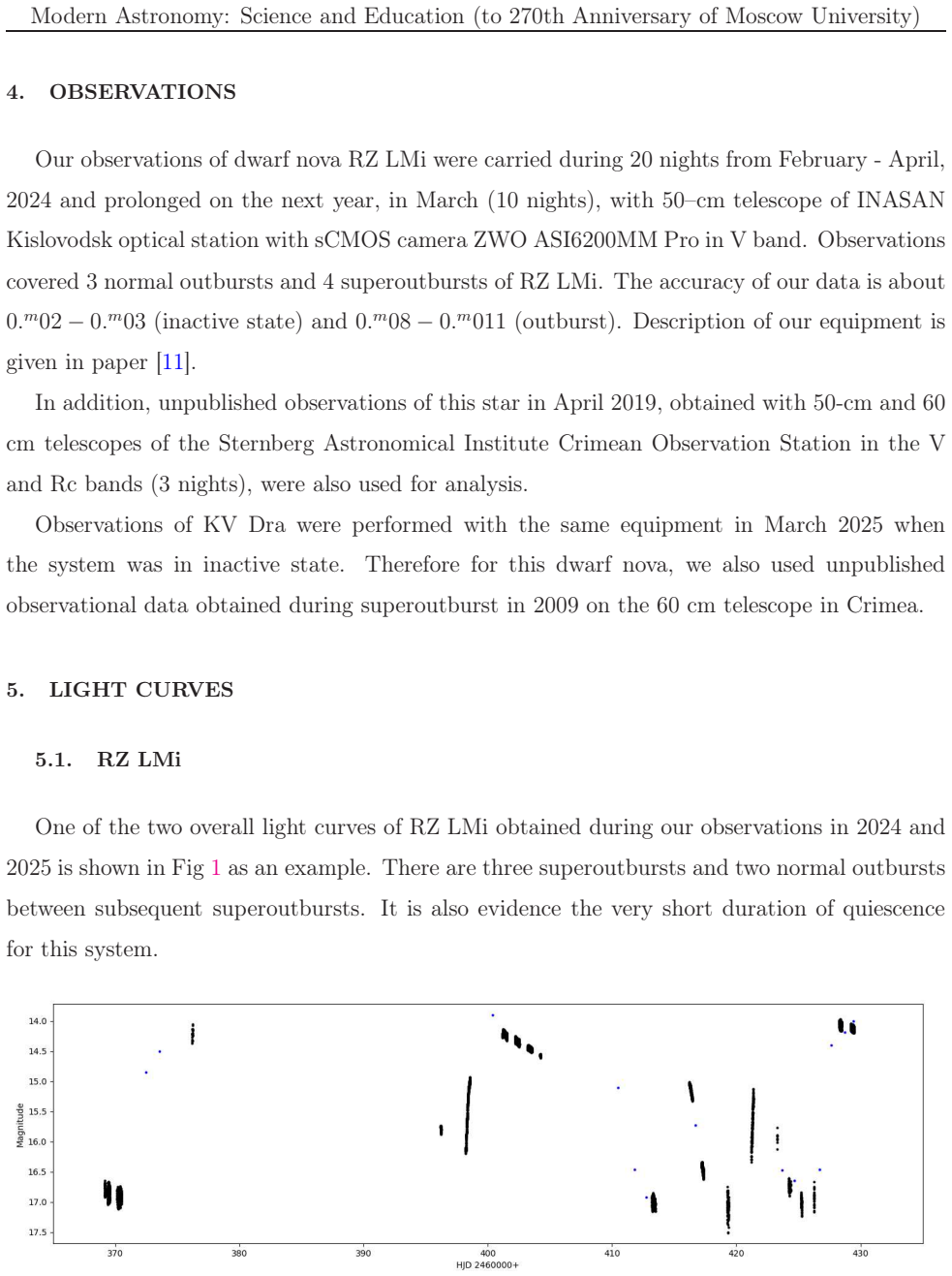
LIGHT CUR VES 5.1. RZ LMi One of the two overall light curves of RZ LMi obtained during o ur observations in 2024 and 2025 is shown in Fig 1 as an example. There are three superoutbursts and two normal outbursts between subsequent superoutbursts. It is also evidence the very short duration of quiescence for this system. Figure 1. The overall light curve o...
2024
-
[6]
The light curve obtained on April 2025 during quiescence is demonstrated in lower pan el of Fig 5
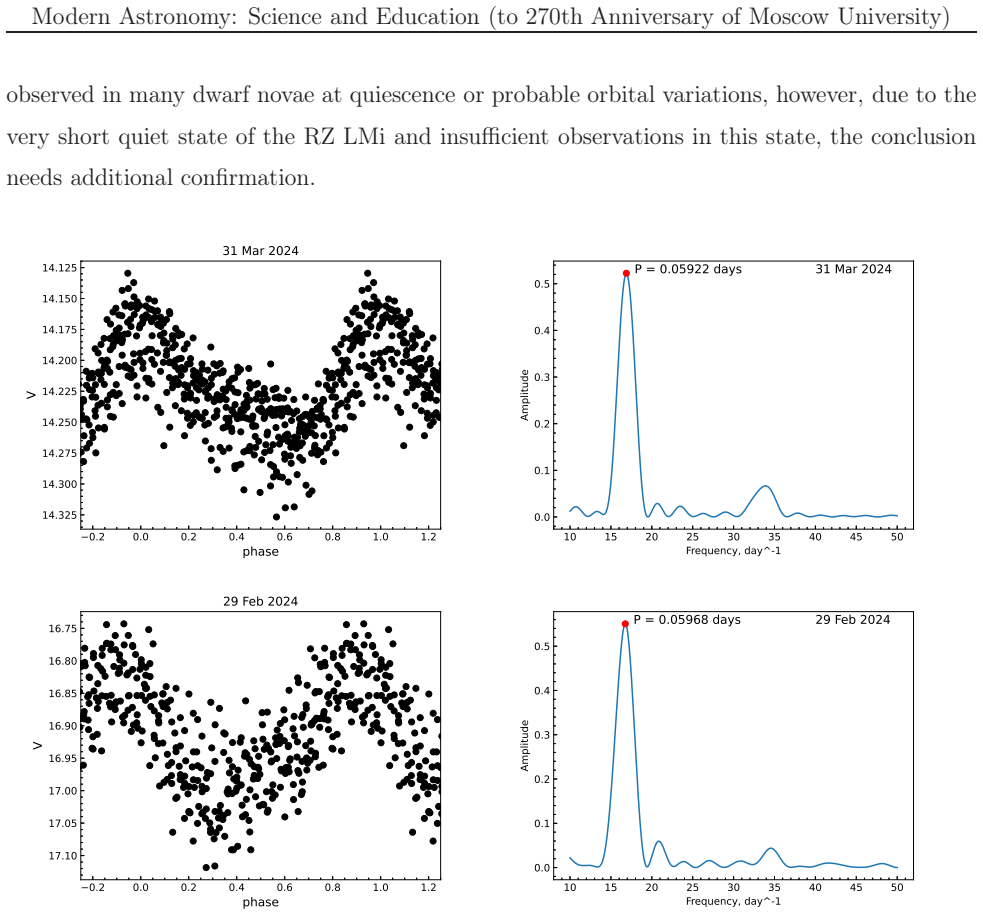
Below, in Fig 5 (a and b) one can see the individual light curves of this dwarf nova (for 20 and 22 May 2 009). The light curve obtained on April 2025 during quiescence is demonstrated in lower pan el of Fig 5. The power spectra were constructed during the determinatio n of periods by the Lomb-Scargle method. Some of them together with the corresponding p...
2025
-
[7]
Based on analysis of these observation s the light curves of both stars were constructed
CONCLUSIONS The new photometric observations of two dwarf novae in activ e and quiet states were made during 2024 and 2025. Based on analysis of these observation s the light curves of both stars were constructed. The following conclusions can be drawn fr om consideration of these light x–8 Moscow University Physics Bulletin 80(7), x (2025) curves: For RZ LMi:
2024
-
[8]
They appear on the light curve 1.7 d after the start of brightness r ise and disappear after 7.2 d
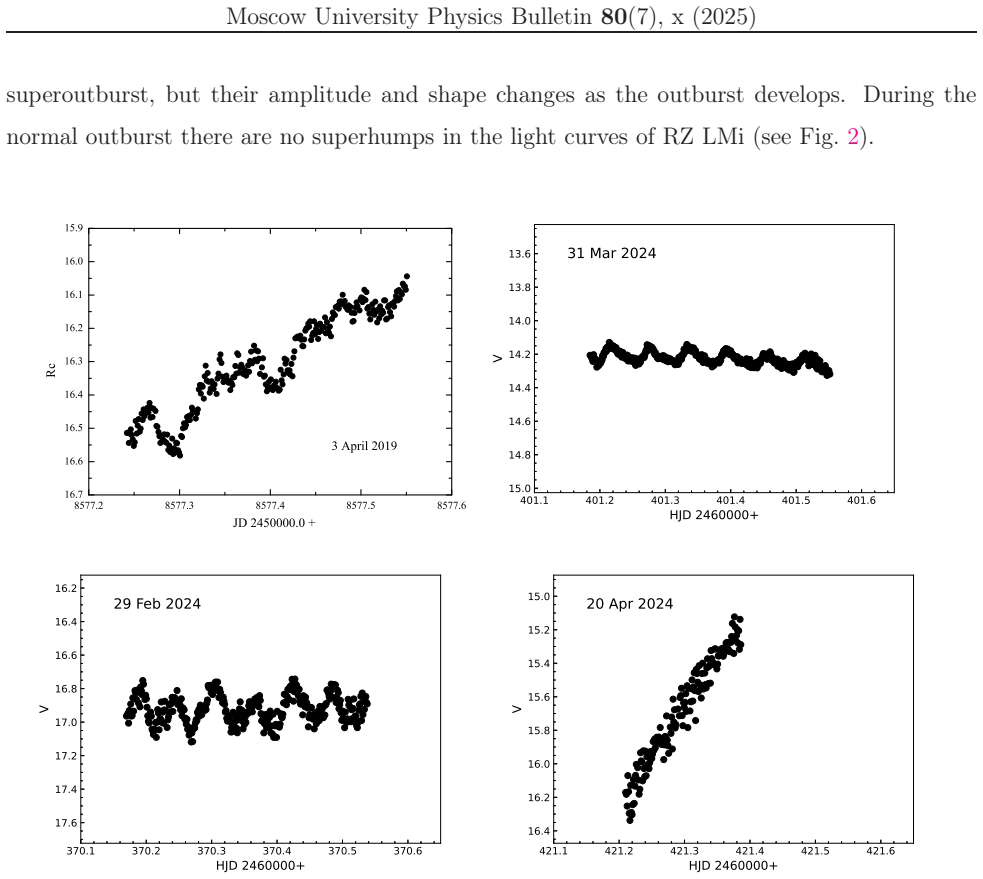
Superhumps were detected on the light curves of this syste m during superoutbursts. They appear on the light curve 1.7 d after the start of brightness r ise and disappear after 7.2 d. At the beginning they have a symmetrical sawtooth shape, later an a symmetry occurs – the descending branch by the end of the visibility of the superhumps signific antly exce...
-
[9]
The amplitude of the s uperhumps at the beginning of the outburst exceeds 0m.1, and then decreases to 0m.06
Duration of superoutburst is 13.8 d. The amplitude of the s uperhumps at the beginning of the outburst exceeds 0m.1, and then decreases to 0m.06. Duration of a normal outburst is 3d.8
-
[10]
The average magnitude in V band is 14m.2 (superoutburst) and 16.m85 - 17m.0 (quies/hyphen.alt cence)
-
[11]
The light curve outside of normal outburst is bell-shaped
The light curve during superouburst have a characteristi c saw-tooth shape with variation amplitude approximately 0m.2. The light curve outside of normal outburst is bell-shaped
-
[12]
Our value of superhumps periods for this stage are in good agreement with results given in [ 13]
The superhumps detected in the light curves on April 28 and 29, 2024 (2-nd superoutburst in Fig 1) belong to stage A (growing phase of superhumps accor ding to classification given in paper [ 13]). Our value of superhumps periods for this stage are in good agreement with results given in [ 13]. The superhumps periods obtained for other dates are mainl y th...
2024
-
[13]
The almost constant presence of superhumps on the light curves p revents the detection of orbital changes in brightness by photometric methods
We have not been able to determine the orbital period of RZ L Mi, since the quiet states in this system are very short, which also makes it difficult to m easure radial velocities. The almost constant presence of superhumps on the light curves p revents the detection of orbital changes in brightness by photometric methods. Without know ledge of the orbital ...
2016
-
[14]
For KV Dra:
Our new observations of RZ LMi give evidence that it is a mem ber of ER UMa dwarf nova. For KV Dra:
-
[15]
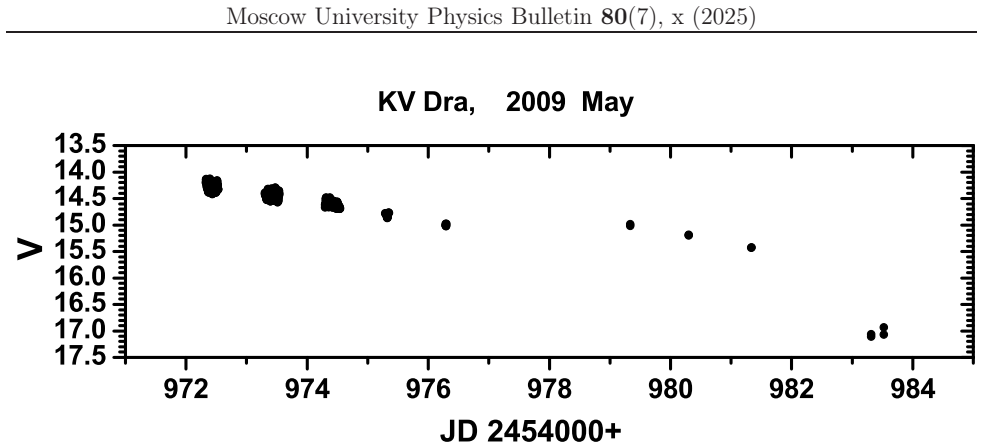
Our photometric observations of KV Dra during a superoutb urst in May 2009 permitted to detect superhumps in the light curves of this system
2009
-
[16]
The periods of superhumps determined by these observatio ns are the periods of stage B, x–9 Modern Astronomy: Science and Education (to 270th Annivers ary of Moscow University) (intermediate stage, when the periods of superhumps varies [6])
-
[17]
This value is in good agreement with the spectral period determined by Thorstensen 0d.0588
The value of the period obtained by observations in quiesc ence of 0d.0586 represented apparently the orbital period of the system. This value is in good agreement with the spectral period determined by Thorstensen 0d.0588. However, this conclusion requires confirmation from more numerous observations with the larger telescope
-
[18]
ACKNOWLEDGMENTS The study was conducted under the state assignment of Lomono sov Moscow State university
Our photometric observations of KV Dra during a superoutb urst and in a quiet state confirm the assumption that this is a typical WZ Sge dwarf nova , since it lacks normal outbursts, superoutbursts occur quite rarely, indicating a large outb urst cycle and the amplitude of the outburst is quite high. ACKNOWLEDGMENTS The study was conducted under the state ...
-
[19]
Osaki, Publications of the Astronomical Society of th e Pacific 108, 39 (1996)
Y. Osaki, Publications of the Astronomical Society of th e Pacific 108, 39 (1996). https://doi.org/10.1086/133689
-
[20]
V. A. Lipovetsky, and J. A. Stepanian, Astrofizika 17, 573 (1981)
1981
-
[21]
R. F. Green, D. H. Ferguson, J. Liebert, and M. Schmidt, Pu blications of the Astronomical Society of the Pacific 94, 560-564 (1982). https://doi.org/10.1086/131022
-
[22]
A. Olech, M. Wisniewski, K. Zloczewski, L. M. Cook, K. Mul arczyk, and P. Kedzierski, Acta Astronomica 58, 131-152 (2008). https://doi.org/10.48550/arXiv.0806. 1657
-
[23]
Nogami, T
D. Nogami, T. Kato, S. Masuda, R. Hirata, K. Matsumoto, K. Tanabe, and T. Yokoo, Publications of the Astronomical Society of Japan 47, 897-902 (1995)
1995
-
[24]
T. Kato, R. Ishioka, K. Isogai, et al., Publications of th e Astronomical Society of Japan 68, 6, id. 107 (2016). https://doi.org/10.1093/pasj/psw101
-
[25]
J. R. Chisholm, F. R. Harnden, J. F. Schachter, G. Micela, S. Sciortino, and F. Favata, The Astronomical Journal 117, 4, 1845-1851 (1999). https://doi.org/10.1086/300812 x–10 Moscow University Physics Bulletin 80(7), x (2025)
-
[26]
Vanmunster, D
T. Vanmunster, D. R. Skillman, R. E. Fried, J. Kemp, and R. Novak, Information Bulletin on Variable Stars 4940, 1 (2000)
2000
-
[27]
J. R. Thorstensen, vsnet-alert 4848, (2000) https://www.kusastro.kyoto-u.ac.jp/vsnet/Mail/vsnet-alert/msg04848
2000
-
[28]
D. Nogami, D. Engels, B. T. G¨ ansicke, E. P. Pavlenko, R. N ov´ ak, and K. Reinsch, Astronomy and Astrophysics 364, 701-705 (2000) https://doi.org/10.48550/arXiv.astro- ph/0008323
-
[29]
S. A. Naroenkov, A. N. Tarasenkov, and M. A. Nalivkin, IN ASAN Science Reports 9, 1, 6-11 (2024) https://doi.org/10.51194/INASAN.2024.9.1.002
-
[30]
J. T. VanderPlas, The Astrophysical Journal Supplemen t Series 236, 1, id. 16 (2018) https://doi.org/10.3847/1538-4365/aab766
work page internal anchor Pith review doi:10.3847/1538-4365/aab766 2018
-
[31]
T. Kato, F.-J. Hambsch, B. Monard, et al., Publications o f the Astronomical Society of Japan 68, 4, id. 65 (2009) https://doi.org/10.1093/pasj/psw064 x–11
discussion (0)
Sign in with ORCID, Apple, or X to comment. Anyone can read and Pith papers without signing in.