A Distributed Quantum Approximate Optimization Algorithm Simulator for Engineering Design Optimization
Pith reviewed 2026-06-26 01:25 UTC · model grok-4.3
The pith
The distributed QAOA simulator recovers identical optimal bitstrings and costs as monolithic QAOA on engineering QUBO problems including unit commitment.
A machine-rendered reading of the paper's core claim, the machinery that carries it, and where it could break.
Core claim
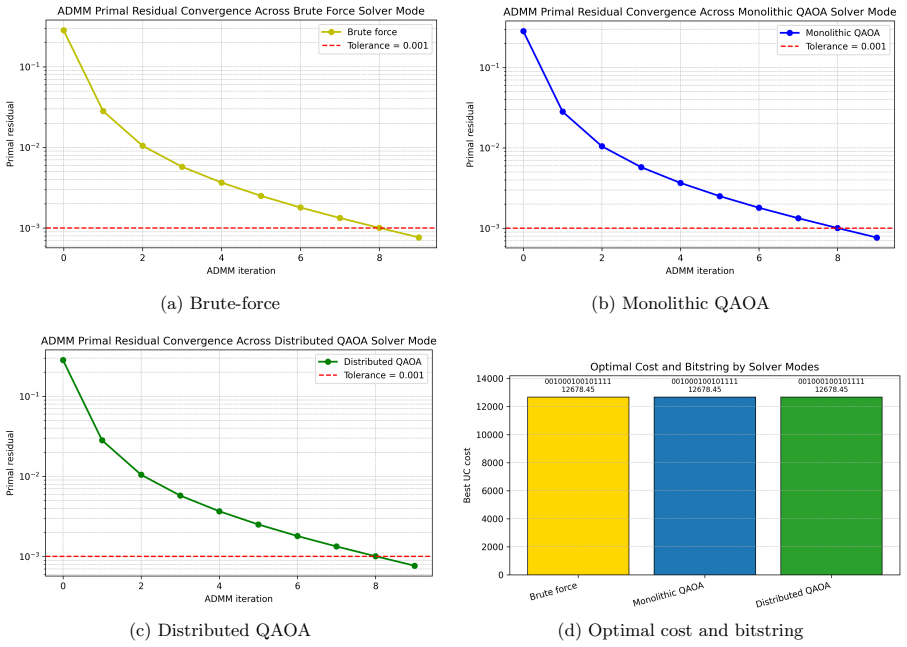
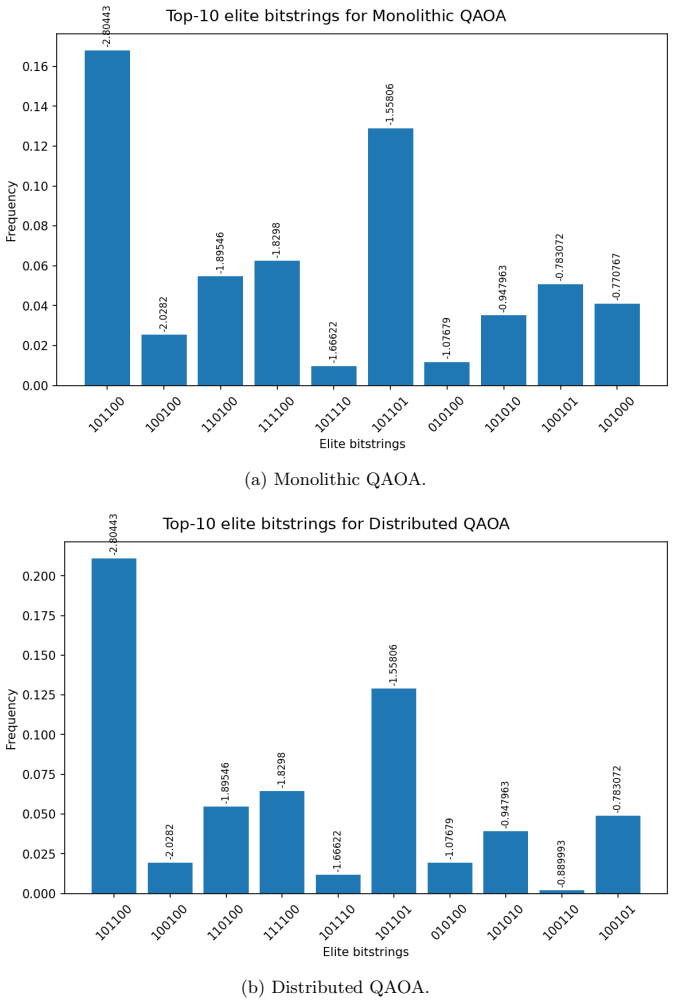
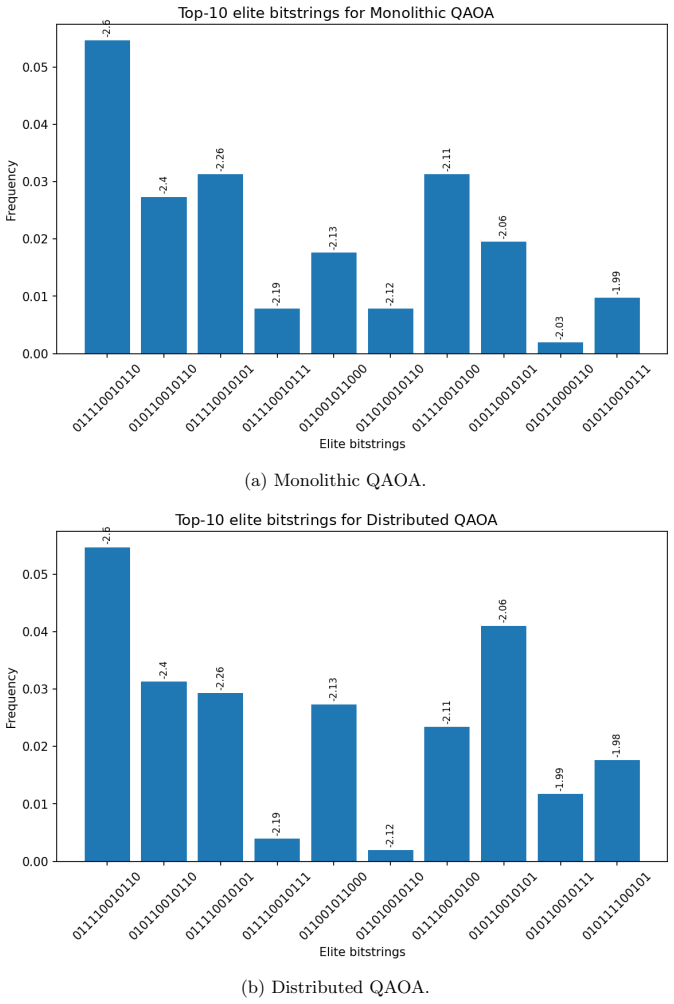
The simulator produces results consistent with classical monolithic QAOA references in terms of optimal bitstrings and costs. In the unit commitment case, brute force, monolithic QAOA, and distributed QAOA recover the same commitment bitstring and operating cost. Across multiple case studies, the simulator produces results consistent with classical monolithic QAOA references in terms of optimal bitstrings and costs.
What carries the argument
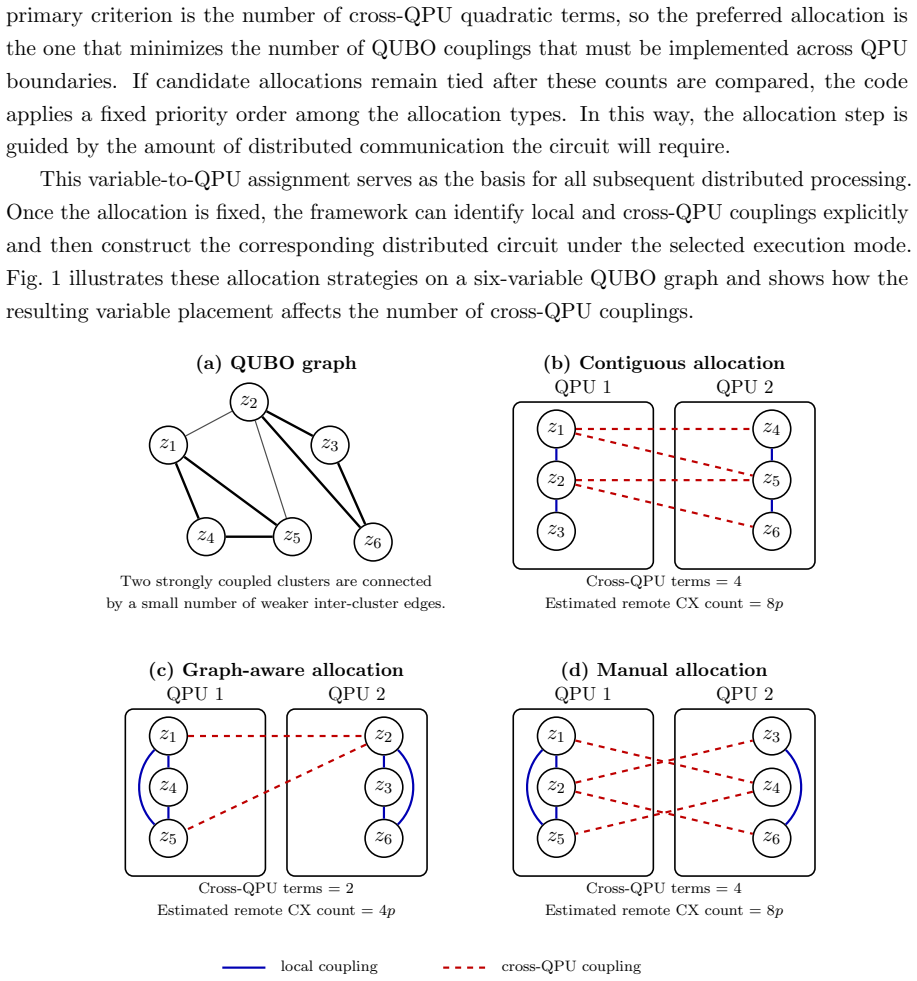
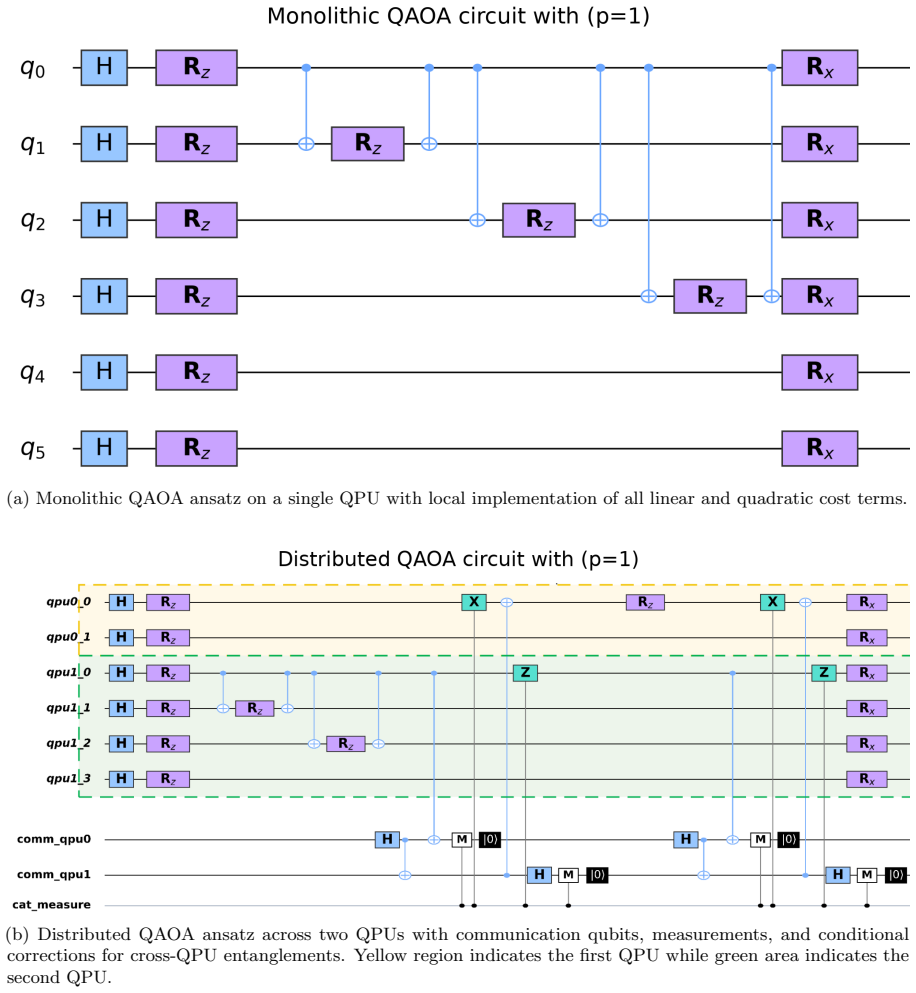
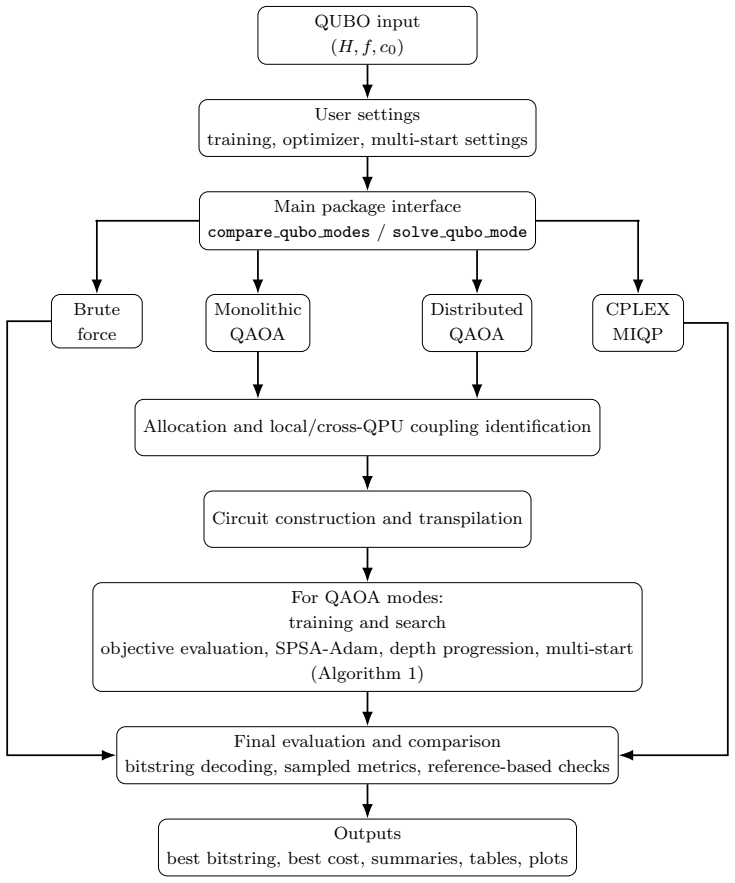
The end-to-end workflow that canonicalizes the QUBO model, maps it to a cost Hamiltonian, allocates variables across QPUs with configurable capacities, identifies local and cross-QPU couplings, and constructs the circuits, supported by runtime optimizations including parameterized circuit reuse, objective reuse at fixed depth, batched evaluations, and parallel multi-start execution.
If this is right
- The same optimal solutions can be obtained whether running QAOA on one processor or distributed across several.
- Runtime can be reduced through circuit reuse and parallel execution in the simulator.
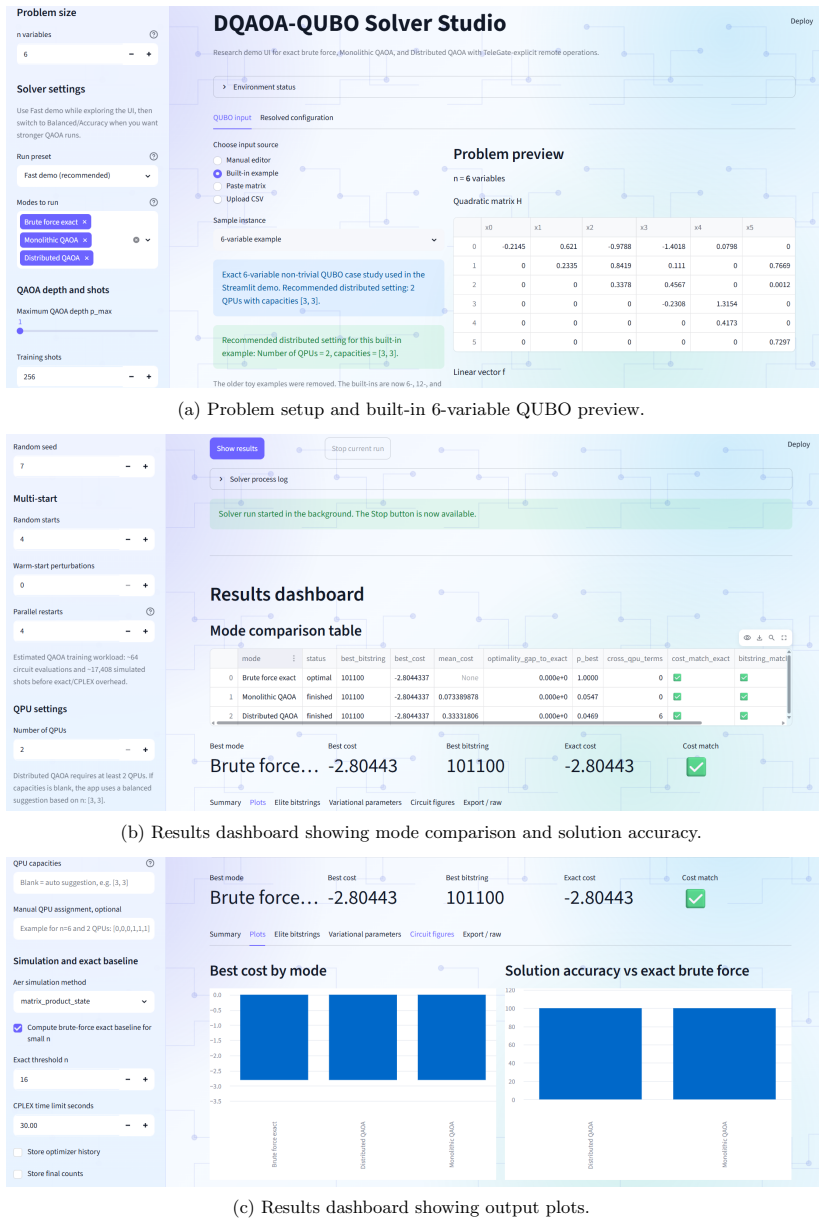
- Researchers can compare monolithic and distributed QAOA modes on the same QUBO instances using the provided GUI.
- The approach applies to power system unit commitment and other engineering decision problems modeled as QUBO.
Where Pith is reading between the lines
- If the variable allocation method avoids quality loss on larger instances, distributed QAOA could handle problems exceeding single-QPU capacity.
- The simulator's open-source nature allows extension to test distribution strategies on noisy intermediate-scale quantum devices.
- Consistent results across modes suggest that cross-QPU couplings can be managed without changing the recovered optima in these cases.
Load-bearing premise
The workflow that canonicalizes the QUBO model, maps it to a cost Hamiltonian, allocates variables across QPUs, and identifies local versus cross-QPU couplings is assumed to preserve solution quality without introducing modeling or allocation errors that would change the recovered bitstring.
What would settle it
Finding a QUBO instance where the distributed QAOA mode returns a different bitstring or higher cost than the monolithic QAOA or brute-force optimum would falsify the claim of consistency.
Figures
read the original abstract
This paper presents a Qiskit-compatible distributed quantum approximate optimization algorithm (DQAOA) simulator for quadratic unconstrained binary optimization (QUBO) problems arising in engineering design and decision applications. The open-source simulator is available through the RAISE LAB website and GitHub repository, with README documentation for installation, input formatting, configurable parameters, and example workflows. The package addresses the need for a reusable simulator that can solve and compare QUBO instances across different QAOA execution modes. It supports monolithic QAOA on a single quantum processing unit (QPU) and distributed QAOA across a user-specified number of QPUs with configurable capacities. The workflow canonicalizes the QUBO model, maps it to a cost Hamiltonian, allocates variables across QPUs, identifies local and cross-QPU couplings, and constructs the corresponding circuits. Runtime optimizations, including parameterized circuit reuse, objective reuse at fixed depth, batched evaluations, and parallel multi-start execution, reduce repeated overhead. A Streamlit graphical user interface is also provided for entering or uploading QUBO instances, configuring solver settings, running selected modes, and visualizing solution-quality metrics without editing Python scripts. The package is demonstrated on standalone QUBO benchmarks and a power generation unit commitment application. In the unit commitment case, brute force, monolithic QAOA, and distributed QAOA recover the same commitment bitstring and operating cost. Across multiple case studies, the simulator produces results consistent with classical monolithic QAOA references in terms of optimal bitstrings and costs. Staged runtime analysis shows substantial runtime reduction across implementation stages, while distributed QAOA remains more demanding because cross-QPU couplings require remote operations.
Editorial analysis
A structured set of objections, weighed in public.
Referee Report
Summary. The paper presents an open-source Qiskit-compatible simulator for distributed QAOA (DQAOA) on QUBO problems from engineering design. The tool supports monolithic QAOA on one QPU and distributed execution across user-specified QPUs, with a workflow that canonicalizes the QUBO, maps it to a cost Hamiltonian, allocates variables, identifies local vs. cross-QPU couplings, and builds circuits. Runtime optimizations (parameterized reuse, batched evaluation, parallel multi-start) and a Streamlit GUI are included. Demonstrations on benchmarks and a unit-commitment instance show that brute force, monolithic QAOA, and distributed QAOA recover identical bitstrings and costs.
Significance. If the reported consistency holds, the simulator supplies a reusable, documented platform for comparing QAOA modes on practical QUBO instances, with open-source code and GUI lowering the barrier for engineering users. The empirical end-to-end checks on concrete instances provide direct evidence that the allocation and cross-QPU handling preserve solution quality on the tested cases.
major comments (1)
- [Abstract and results section] Abstract and unit-commitment demonstration: identical bitstrings and costs are reported across brute force, monolithic QAOA, and distributed QAOA, but no quantitative error bars, iteration counts, convergence statistics, or details on how remote cross-QPU operations were validated are supplied; these would be needed to assess robustness beyond the specific instances shown.
minor comments (1)
- [Workflow description] The description of the variable-allocation step and the criterion used to classify couplings as local or cross-QPU should be expanded with a short pseudocode or explicit rule set so readers can reproduce the partitioning logic.
Simulated Author's Rebuttal
We thank the referee for the constructive review and recommendation for minor revision. We address the single major comment below and will update the manuscript accordingly.
read point-by-point responses
-
Referee: [Abstract and results section] Abstract and unit-commitment demonstration: identical bitstrings and costs are reported across brute force, monolithic QAOA, and distributed QAOA, but no quantitative error bars, iteration counts, convergence statistics, or details on how remote cross-QPU operations were validated are supplied; these would be needed to assess robustness beyond the specific instances shown.
Authors: We agree that additional quantitative details would improve clarity. In the revised manuscript we will report the iteration counts, number of multi-start runs, and any convergence statistics available from the QAOA executions on the unit-commitment instance. Because the simulator returns deterministic bitstrings for fixed parameters and the brute-force reference confirms exact agreement on the tested cases, we will explicitly note that the reported solutions are exact matches rather than statistical averages; this removes the need for error bars on these particular demonstrations. We will also add a short paragraph describing the internal validation steps used to confirm correct handling of remote cross-QPU couplings (bitstring partitioning, remote Pauli-term evaluation, and final cost reconstruction). These changes will appear in the results section and, space permitting, a brief mention in the abstract. revision: yes
Circularity Check
No significant circularity; empirical consistency checks are independent of any fitted or self-referential inputs
full rationale
The paper describes an open-source simulator implementing monolithic and distributed QAOA for QUBO problems, with workflow steps for canonicalization, Hamiltonian mapping, variable allocation, and circuit construction. Central claims rest on direct empirical comparisons: brute force, monolithic QAOA, and distributed QAOA recover identical bitstrings and costs on the unit commitment instance (and similar agreement on other benchmarks). These are end-to-end output matches on concrete instances, not predictions derived from fitted parameters or prior self-citations. No equations reduce by construction to inputs, no ansatzes are smuggled via self-citation, and no uniqueness theorems are invoked. The validation directly tests whether the full workflow preserves solution quality, making the results self-contained against external benchmarks.
Axiom & Free-Parameter Ledger
axioms (2)
- domain assumption The canonical QUBO-to-cost-Hamiltonian mapping preserves the original optimization problem.
- domain assumption Cross-QPU couplings can be handled via remote operations without changing the recovered optimal bitstring.
Reference graph
Works this paper leans on
-
[1]
A tutorial on formulating and using qubo models.arXiv preprint arXiv:1811.11538, 2018
Fred Glover, Gary Kochenberger, and Yu Du. A tutorial on formulating and using qubo models.arXiv preprint arXiv:1811.11538, 2018
arXiv 2018
-
[2]
Quantum optimisation for supply chain: Qubo for- mulations and qaoa solutions for facility location and load balancing.Results in Engineering, page 108373, 2025
Luis A Moncayo-Mart´ ınez and Naihui He. Quantum optimisation for supply chain: Qubo for- mulations and qaoa solutions for facility location and load balancing.Results in Engineering, page 108373, 2025
2025
-
[3]
The air traffic flow management problem with enroute capacities.Operations research, 46(3):406–422, 1998
Dimitris Bertsimas and Sarah Stock Patterson. The air traffic flow management problem with enroute capacities.Operations research, 46(3):406–422, 1998
1998
-
[4]
Convex relaxations for gas expansion planning.INFORMS Journal on Computing, 28(4):645–656, 2016
Conrado Borraz-S´ anchez, Russell Bent, Scott Backhaus, Hassan Hijazi, and Pascal Van Hentenryck. Convex relaxations for gas expansion planning.INFORMS Journal on Computing, 28(4):645–656, 2016
2016
-
[5]
Genetic algorithms for least-cost design of water distribution networks.Journal of water resources planning and management, 123(2):67–77, 1997
Dragan A Savic and Godfrey A Walters. Genetic algorithms for least-cost design of water distribution networks.Journal of water resources planning and management, 123(2):67–77, 1997
1997
-
[6]
Optimising the configuration of food supply chains
Haitao Li, De Li, and Dali Jiang. Optimising the configuration of food supply chains. International journal of production research, 59(12):3722–3746, 2021
2021
-
[7]
Yale university press, 2008
Harry M Markowitz.Portfolio selection: efficient diversification of investments. Yale university press, 2008
2008
-
[8]
Taxonomy of pmu placement methodologies.IEEE Transactions on power Systems, 27(2):1070–1077, 2012
Nikolaos M Manousakis, George N Korres, and Pavlos S Georgilakis. Taxonomy of pmu placement methodologies.IEEE Transactions on power Systems, 27(2):1070–1077, 2012
2012
-
[9]
A holistic d-pmu optimal placement framework considering pragmatic constraints in smart grids
Mohammadreza Fathizadan, Mehdi Karrari, Gevork B Gharehpetian, Roya Ahmadiahangar, Jako Kilter, and Argo Rosin. A holistic d-pmu optimal placement framework considering pragmatic constraints in smart grids. In2022 IEEE 16th International Conference on Compatibility, Power Electronics, and Power Engineering (CPE-POWERENG), pages 1–7. IEEE, 2022
2022
-
[10]
Multi-objective method to reconfigure radial power distribution system with dgs considering transformer tap-changing
Hooman Torkaman, Maral Shadaei, Nasim Deyhimi, and Hamed Torkaman. Multi-objective method to reconfigure radial power distribution system with dgs considering transformer tap-changing. In2021 IEEE International Conference on Environment and Electrical Engi- neering and 2021 IEEE Industrial and Commercial Power Systems Europe (EEEIC/I&CPS Europe), pages 1–...
2021
-
[11]
Electric distribution network reconfiguration optimized for pv distributed generation and energy storage.Electric Power Systems Research, 184:106319, 2020
Raul Vitor Arantes Monteiro, Jakson Paulo Bonaldo, Raoni Florentino da Silva, and Arturo Suman Bretas. Electric distribution network reconfiguration optimized for pv distributed generation and energy storage.Electric Power Systems Research, 184:106319, 2020
2020
-
[12]
A review of graph neural networks and their applications in power systems
Wenlong Liao, Birgitte Bak-Jensen, Jayakrishnan Radhakrishna Pillai, Yuelong Wang, and Yusen Wang. A review of graph neural networks and their applications in power systems. Journal of Modern Power Systems and Clean Energy, 10(2):345–360, 2021. 34
2021
-
[13]
John Wiley & Sons, 2020
Laurence A Wolsey.Integer programming. John Wiley & Sons, 2020
2020
-
[14]
Springer Science & Business Media, 2003
Fred W Glover and Gary A Kochenberger.Handbook of metaheuristics, volume 57. Springer Science & Business Media, 2003
2003
-
[15]
Parallel branch-and-bound algorithms for general mixed integer pro- gramming on the cm-5.SIAM journal on optimization, 4(4):794–814, 1994
Jonathan Eckstein. Parallel branch-and-bound algorithms for general mixed integer pro- gramming on the cm-5.SIAM journal on optimization, 4(4):794–814, 1994
1994
-
[16]
Machine learning for combinatorial optimization: a methodological tour d’horizon.European Journal of Operational Research, 290(2):405–421, 2021
Yoshua Bengio, Andrea Lodi, and Antoine Prouvost. Machine learning for combinatorial optimization: a methodological tour d’horizon.European Journal of Operational Research, 290(2):405–421, 2021
2021
-
[17]
Milad Hasanzadeh, Ali Rajabi, and Amin Kargarian. A survey on applications of quantum computing for unit commitment.arXiv preprint arXiv:2601.01777, 2026
arXiv 2026
-
[18]
Ising formulations of many np problems.Frontiers in physics, 2:74887, 2014
Andrew Lucas. Ising formulations of many np problems.Frontiers in physics, 2:74887, 2014
2014
-
[19]
Quantum bridge analytics i: a tutorial on formulating and using qubo models.4or, 17(4):335–371, 2019
Fred Glover, Gary Kochenberger, and Yu Du. Quantum bridge analytics i: a tutorial on formulating and using qubo models.4or, 17(4):335–371, 2019
2019
-
[20]
Challenges and opportunities in quantum optimization.Nature Reviews Physics, 6(12):718–735, 2024
Amira Abbas, Andris Ambainis, Brandon Augustino, Andreas B¨ artschi, Harry Buhrman, Carleton Coffrin, Giorgio Cortiana, Vedran Dunjko, Daniel J Egger, Bruce G Elmegreen, et al. Challenges and opportunities in quantum optimization.Nature Reviews Physics, 6(12):718–735, 2024
2024
-
[21]
Quantum annealing in the transverse ising model.Physical Review E, 58(5):5355, 1998
Tadashi Kadowaki and Hidetoshi Nishimori. Quantum annealing in the transverse ising model.Physical Review E, 58(5):5355, 1998
1998
-
[22]
Quantum computation by adiabatic evolution.arXiv preprint quant-ph/0001106, 2000
Edward Farhi, Jeffrey Goldstone, Sam Gutmann, and Michael Sipser. Quantum computation by adiabatic evolution.arXiv preprint quant-ph/0001106, 2000
Pith/arXiv arXiv 2000
-
[23]
A variational eigenvalue solver on a photonic quantum processor.Nature communications, 5(1):4213, 2014
Alberto Peruzzo, Jarrod McClean, Peter Shadbolt, Man-Hong Yung, Xiao-Qi Zhou, Peter J Love, Al´ an Aspuru-Guzik, and Jeremy L O’brien. A variational eigenvalue solver on a photonic quantum processor.Nature communications, 5(1):4213, 2014
2014
-
[24]
A quantum approximate optimization algorithm.arXiv preprint arXiv:1411.4028, 2014
Edward Farhi, Jeffrey Goldstone, and Sam Gutmann. A quantum approximate optimization algorithm.arXiv preprint arXiv:1411.4028, 2014
Pith/arXiv arXiv 2014
-
[25]
Quantum approximate optimization algorithm: Performance, mechanism, and implementation on near-term devices.Physical Review X, 10(2):021067, 2020
Leo Zhou, Sheng-Tao Wang, Soonwon Choi, Hannes Pichler, and Mikhail D Lukin. Quantum approximate optimization algorithm: Performance, mechanism, and implementation on near-term devices.Physical Review X, 10(2):021067, 2020
2020
-
[26]
From the quantum approximate optimization algorithm to a quantum alternating operator ansatz.Algorithms, 12(2):34, 2019
Stuart Hadfield, Zhihui Wang, Bryan O’gorman, Eleanor G Rieffel, Davide Venturelli, and Rupak Biswas. From the quantum approximate optimization algorithm to a quantum alternating operator ansatz.Algorithms, 12(2):34, 2019
2019
-
[27]
A review on quantum approximate optimization algorithm and its variants.Physics Reports, 1068:1–66, 2024
Kostas Blekos, Dean Brand, Andrea Ceschini, Chiao-Hui Chou, Rui-Hao Li, Komal Pandya, and Alessandro Summer. A review on quantum approximate optimization algorithm and its variants.Physics Reports, 1068:1–66, 2024. 35
2024
-
[28]
Empirical performance bounds for quantum approximate optimization.Quantum Information Processing, 20(12):403, 2021
Phillip C Lotshaw, Travis S Humble, Rebekah Herrman, James Ostrowski, and George Siopsis. Empirical performance bounds for quantum approximate optimization.Quantum Information Processing, 20(12):403, 2021
2021
-
[29]
Improving variational quantum optimization using cvar.Quantum, 4:256, 2020
Panagiotis Kl Barkoutsos, Giacomo Nannicini, Anton Robert, Ivano Tavernelli, and Stefan Woerner. Improving variational quantum optimization using cvar.Quantum, 4:256, 2020
2020
-
[30]
Warm-starting quantum optimization
Daniel J Egger, Jakub Mareˇ cek, and Stefan Woerner. Warm-starting quantum optimization. Quantum, 5:479, 2021
2021
-
[31]
Transferability of optimal qaoa parameters between random graphs
Alexey Galda, Xiaoyuan Liu, Danylo Lykov, Yuri Alexeev, and Ilya Safro. Transferability of optimal qaoa parameters between random graphs. In2021 IEEE International Conference on Quantum Computing and Engineering (QCE), pages 171–180. IEEE, 2021
2021
-
[32]
Parameter transfer for quantum approximate optimization of weighted maxcut
Ruslan Shaydulin, Phillip C Lotshaw, Jeffrey Larson, James Ostrowski, and Travis S Humble. Parameter transfer for quantum approximate optimization of weighted maxcut. ACM Transactions on Quantum Computing, 4(3):1–15, 2023
2023
-
[33]
Parameter setting in quantum approximate optimization of weighted problems.Quantum, 8:1231, 2024
Shree Hari Sureshbabu, Dylan Herman, Ruslan Shaydulin, Joao Basso, Shouvanik Chakrabarti, Yue Sun, and Marco Pistoia. Parameter setting in quantum approximate optimization of weighted problems.Quantum, 8:1231, 2024
2024
-
[34]
Trainability barriers in low-depth qaoa landscapes
Joel Rajakumar, John Golden, Andreas B¨ artschi, and Stephan Eidenbenz. Trainability barriers in low-depth qaoa landscapes. InProceedings of the 21st ACM International Conference on Computing Frontiers, pages 199–206, 2024
2024
-
[35]
Gian Giacomo Guerreschi. Solving quadratic unconstrained binary optimization with divide-and-conquer and quantum algorithms.arXiv preprint arXiv:2101.07813, 2021
arXiv 2021
-
[36]
Distributed quantum computing and network control for accelerated vqe.IEEE Transactions on Quantum Engineering, 2:1–21, 2021
Stephen DiAdamo, Marco Ghibaudi, and James Cruise. Distributed quantum computing and network control for accelerated vqe.IEEE Transactions on Quantum Engineering, 2:1–21, 2021
2021
-
[37]
Review of distributed quantum computing: From single qpu to high performance quantum computing.Computer Science Review, 57:100747, 2025
David Barral, F Javier Cardama, Guillermo D´ ıaz-Camacho, Daniel Fa´ ılde, Iago F Llovo, Mariamo Mussa-Juane, Jorge V´ azquez-P´ erez, Juan Villasuso, C´ esar Pi˜ neiro, Natalia Costas, et al. Review of distributed quantum computing: From single qpu to high performance quantum computing.Computer Science Review, 57:100747, 2025
2025
-
[38]
Distribution of quantum circuits over general quantum networks.arXiv preprint arXiv:2206.06437, 2022
Ranjani G Sundaram, Himanshu Gupta, and CR Ramakrishnan. Distribution of quantum circuits over general quantum networks.arXiv preprint arXiv:2206.06437, 2022
arXiv 2022
-
[39]
Qubit allocation for distributed quantum computing
Yingling Mao, Yu Liu, and Yuanyuan Yang. Qubit allocation for distributed quantum computing. InIEEE INFOCOM 2023-IEEE Conference on Computer Communications, pages 1–10. IEEE, 2023
2023
-
[40]
Bo Yue, Shibei Xue, Yu Pan, Min Jiang, and Daoyi Dong. Local to global: A distributed quantum approximate optimization algorithm for pseudo-boolean optimization problems. arXiv preprint arXiv:2310.05062, 2023. 36
arXiv 2023
-
[41]
Seongmin Kim, Vincent R Pascuzzi, Zhihao Xu, Tengfei Luo, Eungkyu Lee, and In-Saeng Suh. Distributed quantum approximate optimization algorithm on a quantum-centric supercomputing architecture.arXiv preprint arXiv:2407.20212, 2024
arXiv 2024
-
[42]
Noise-aware distributed quantum approximate optimization algorithm on near-term quantum hardware
Kuan-Cheng Chen, Xiaotian Xu, Felix Burt, Chen-Yu Liu, Shang Yu, and Kin K Leung. Noise-aware distributed quantum approximate optimization algorithm on near-term quantum hardware. In2024 IEEE International Conference on Quantum Computing and Engineering (QCE), volume 2, pages 144–149. IEEE, 2024
2024
-
[43]
A distributed variational quantum eigensolver algorithm for unit commitment
Milad Hasanzadeh, Ali Rajabi, and Amin Kargarian. A distributed variational quantum eigensolver algorithm for unit commitment. In2026 IEEE Texas Power and Energy Conference (TPEC), pages 1–6. IEEE, 2026
2026
-
[44]
RAISE LAB Website
RAISE LAB. RAISE LAB Website. https://sites.google.com/site/aminkargarian/ home. Accessed: Jun. 15, 2026
2026
-
[45]
RAISE LAB GitHub Repository
RAISE LAB. RAISE LAB GitHub Repository. https://github.com/LSU-RAISE-LAB/. Accessed: Jun. 15, 2026
2026
-
[46]
Asynchronous telegate and teledata protocols for distributed quantum computing
Jacob Peckham, Dwight Makaroff, and Steven Rayan. Asynchronous telegate and teledata protocols for distributed quantum computing. In2024 IEEE 10th World Forum on Internet of Things (WF-IoT), pages 1–6. IEEE, 2024
2024
-
[47]
A general protocol for distributed quantum gates.Quantum Information Processing, 20(8):265, 2021
Moein Sarvaghad-Moghaddam and Mariam Zomorodi. A general protocol for distributed quantum gates.Quantum Information Processing, 20(8):265, 2021. 37
2021
discussion (0)
Sign in with ORCID, Apple, or X to comment. Anyone can read and Pith papers without signing in.