REVIEW 2 major objections 2 minor 1 cited by
Classification of topological ladder models
T0 review · 2 major / 2 minor · reviewed 2026-05-24 · grok-4.3
Pith's one-line read Topological ladder models reduce to six distinct types via Wilson fermion configurations in BDI and AIII classes.
desk verdict The paper classifies topological ladders into six types via Wilson fermion configs in BDI/AIII, using bowtie as canonical with unitary maps and momentum peak diagnostics; the equivalence and exclusivity claims are the parts worth checking closely. read the letter →
The pith
A machine-rendered reading of the paper's core claim, the machinery that carries it, and where it could break.
The reading
What carries the argument
The bowtie ladder, serving as the canonical geometry from which all other topological ladders are reached by unitary transformations that preserve topology; the direct mapping of each type to a unique Wilson-fermion configuration whose properties dictate the edge-mode momentum peaks.
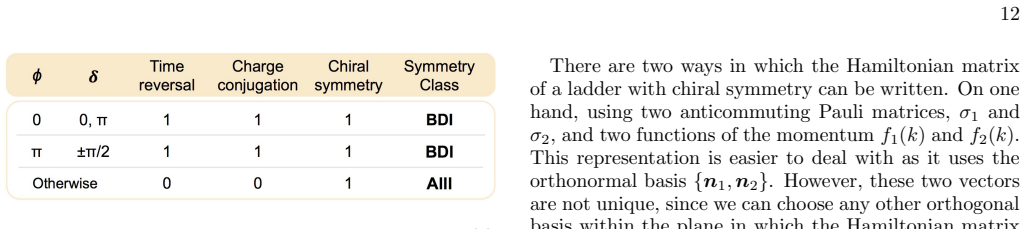
What would settle it
Discovery of a topological ladder whose edge-mode momentum distribution cannot be reproduced by any of the six predicted Wilson-fermion configurations, or a ladder geometry that cannot be obtained from the bowtie ladder by a topology-preserving unitary map.
Extended reading notes
Core claim
All topological ladder models fall into six types that correspond to six distinct configurations of Wilson fermions, three in the BDI symmetry class and three in the AIII symmetry class. These configurations are revealed by the number, momentum location, and height of peaks in the momentum distribution of the topological edge modes. The bowtie ladder is identified as the canonical geometry; every other topological ladder is obtained from it by a unitary transformation that preserves the topological character. The work enumerates all possible topological ladder geometries and determines the regimes of parameters that realize each of the six types.
Load-bearing premise
That every topological ladder model can be reached from the bowtie ladder by a unitary transformation that keeps the topological character intact and that the momentum-distribution peaks are produced solely by the number, chirality, and mass of the Wilson fermions.
Editorial extensions
If this is right
- The momentum distribution of edge modes directly encodes the number, chirality, and mass of the underlying Wilson fermions.
- Three topological types exist in the BDI class and three in the AIII class, each with its own signature peak pattern.
- All topological ladder geometries are generated from the single bowtie geometry by unitary transformations.
- Each of the six types can be realized only inside specific, listed intervals of the model parameters.
Reading between the lines
- The unitary equivalence between geometries implies that experimentalists can choose the ladder shape most convenient for their setup without changing the topological class.
- The direct link between Wilson-fermion properties and observable momentum peaks offers a practical detection route in ultracold-atom experiments.
- The classification supplies a finite checklist that future work can use to decide whether a newly proposed ladder model is topologically novel or already covered.
Signed reviews
Editorial analysis
A structured set of objections, weighed in public.
Referee Report
Summary. The paper classifies topological ladder models into six types (three in BDI, three in AIII), each corresponding to a distinct configuration of Wilson fermions. It identifies the bowtie ladder as a canonical geometry from which all other topological ladder models can be reached by unitary transformation, determines the parameter regimes realizing each type, and shows that the number, chirality, and mass of the Wilson fermions are directly encoded in the number, location, and height of peaks in the momentum distribution of the topological edge modes.
Significance. If the classification and the one-to-one mapping to Wilson-fermion content hold, the work supplies a systematic enumeration of all topological ladder geometries together with an experimentally accessible momentum-space diagnostic. This would be useful for realizing and detecting topological phases in BDI and AIII classes on ladder architectures.
major comments (2)
- [§3] §3 (canonical bowtie ladder): the claim that every topological ladder geometry is reachable from the bowtie ladder by a unitary transformation that leaves the topological invariant unchanged is load-bearing for the completeness of the six-type enumeration; an explicit check that the relevant topological index (e.g., winding number or Zak phase) is preserved under the full set of allowed unitaries is required.
- [§4] §4 (momentum distribution of edge modes): the assertion that the peaks are determined solely by Wilson-fermion number, chirality and mass, with no residual dependence on the original ladder parameters, must be demonstrated by showing that the momentum distribution remains invariant under the unitary maps used to reach the six types; otherwise the diagnostic is not guaranteed to be one-to-one.
minor comments (2)
- Notation for the six types (BDI-1, BDI-2, …) should be introduced once and used consistently; the current alternation between “type” and “configuration” is occasionally ambiguous.
- Figure captions for the momentum-distribution plots should explicitly state the parameter values at which each panel is computed so that the claimed peak-height correspondence can be verified by the reader.
Simulated Author's Rebuttal
We thank the referee for the careful reading of the manuscript and the constructive comments. We address each major comment below.
read point-by-point responses
-
Referee: [§3] §3 (canonical bowtie ladder): the claim that every topological ladder geometry is reachable from the bowtie ladder by a unitary transformation that leaves the topological invariant unchanged is load-bearing for the completeness of the six-type enumeration; an explicit check that the relevant topological index (e.g., winding number or Zak phase) is preserved under the full set of allowed unitaries is required.
Authors: We agree that an explicit verification of topological-index preservation is required to fully substantiate the claim that the bowtie ladder is canonical. The manuscript states that the allowed unitaries preserve the symmetry class (BDI or AIII) and therefore the invariant, but does not compute the index explicitly before and after each map. In the revised manuscript we will add a dedicated subsection (or appendix) that evaluates the winding number (or Zak phase) for representative transformations connecting the six types, confirming invariance in each case. revision: yes
-
Referee: [§4] §4 (momentum distribution of edge modes): the assertion that the peaks are determined solely by Wilson-fermion number, chirality and mass, with no residual dependence on the original ladder parameters, must be demonstrated by showing that the momentum distribution remains invariant under the unitary maps used to reach the six types; otherwise the diagnostic is not guaranteed to be one-to-one.
Authors: We acknowledge that invariance of the momentum distribution under the unitary maps must be shown explicitly if the diagnostic is to be independent of the original ladder geometry. The manuscript demonstrates the correspondence for the bowtie ladder and states that the unitary transformations map the edge-mode wave-functions accordingly, but does not recompute the momentum distribution after each transformation. In the revision we will add explicit calculations confirming that the number, locations, and relative heights of the peaks are unchanged under the maps, thereby establishing the one-to-one character of the diagnostic. revision: yes
Circularity Check
No circularity: classification follows from symmetry classes and unitary equivalence without reduction to inputs
full rationale
The derivation identifies six ladder types (3 BDI, 3 AIII) via Wilson-fermion configurations whose signatures appear in edge-mode momentum distributions, starting from a canonical bowtie geometry reachable by unitary maps. No quoted step equates a claimed prediction or invariant to a fitted parameter by construction, nor does any load-bearing premise collapse to a self-citation chain or ansatz smuggled from prior work. The enumeration rests on symmetry analysis external to the fitted values of any single model, rendering the chain self-contained.
Assumptions & free parameters
assumptions (1)
- standard math Standard BDI and AIII symmetry classes from the tenfold way classification of topological insulators
invented entities (1)
-
Bowtie ladder as canonical geometry
Cite this review
Pith. "Pith review of Classification of topological ladder models." pith.science (2026). https://pith.science/paper/Z4H2IT6A
@misc{pith2026190711460,
  author       = {Pith},
  title        = {Pith review of: Classification of topological ladder models},
  year         = {2026},
  howpublished = {\url{https://pith.science/paper/Z4H2IT6A}},
  note         = {Machine review of arXiv:1907.11460}
}
read the original abstract
Ladder architectures are fruitful systems to realize topological phases of matter. Here we present a classification of ladder models giving rise to topological insulators. We identify six different types of topological ladder models, three in the BDI symmetry class, and three in the AIII symmetry class. They correspond to six distinct configurations of Wilson fermions. The six types are manifested in distinctive momentum distributions of the corresponding topological edge modes. The number of Wilson fermions, their chirality and mass, are directly manifested in the number, momentum and height of the peaks of the momentum distribution of the corresponding topological edge modes. We identify a canonical ladder geometry, the {\em bowtie ladder}, from which any other topological ladder model can be obtained by a unitary transformation. We identify, classify and list all possible topological ladder geometries, determining the parameter regimes in which each of the six types of topological edge modes can be realized. Our results open a route for the experimental realization and detection of topological insulators in novel symmetry classes with ladder architectures.
Figures


Figures from the paper (29 more)






Forward citations
Cited by 1 Pith paper
-
Topology and interactions in the photonic Creutz and Creutz-Hubbard ladders
The authors propose and simulate photonic realizations of the Creutz and Creutz-Hubbard ladders, predicting Aharonov-Bohm caging, doublon caging at half flux, edge states, and a synthetic-dimension implementation scheme.
Reference graph
Works this paper leans on
-
[1]
There are two ways in which the Hamiltonian matrix of a ladder with chiral symmetry can be written
Hamiltonian matrix structure Alternatively, we can obtain the symmetries of the canonical ladder by analasyng its Hamiltonian matrix. There are two ways in which the Hamiltonian matrix of a ladder with chiral symmetry can be written. On one hand, using two anticommuting Pauli matrices, σ1 and σ2, and two functions of the momentum f1(k) and f2(k). This rep...
-
[2]
Shift in the momentum-isospin correspondence Any model in the BDI symmetry class with Hamilto- nian matrix M(k) can be taken to the AIII symmetry class by adding a shift δ in the momentum-isospin rela- tion; that is, transforming M(k) into M(k− δ). In the presence of this phase δ the Hamiltonian matrix has a different form and breaks time reversal and char...
-
[3]
Effective magnetic flux per plaquette We know that if we add a phaseδ̸= 0, π to a particular bowtie ladder parameter configuration in the BDI class, we obtain a model in the AIII class. The Hamiltonian matrix of the new model will be equal to the Hamilto- nian matrix of the BDI model to which the phase δ has been added, but with a shift of δ with respect to ...
-
[4]
Inversion-reflection-conjugation symmetry The bowtie ladder model has an inversion-reflection- conjugation (IRC) symmetry, which can be used in order to obtain important information about the wave function of the edge modes. We consider the bowtie ladder and define the unitary transformation W as: W : { ˆa† n−→ ˆb† N+1−n ˆb† n−→ ˆa† N+1−n. (74) It is clearly...
-
[5]
Chiral symmetry and edge modes polarization The presence of chiral symmetry makes all eigenstates come in pairs of opposite energy, being the two eigen- states of each pair connected by the chiral operator US. That is, being the edge mode|e⟩ in Eq.(84) an eigenstate of the bowtie ladder Hamiltonian with some energy E, then the state US|e⟩ is another eigen...
-
[6]
Zero energy approximation A very good approximation of the edge modes wave function can be obtained by considering them to be zero energy eigenstates of the Hamiltonian. We start by separating the bowtie ladder Hamiltonian for periodic boundary conditions, Hprdc, into two parts: the bowtie ladder Hamiltonian for open boundary con- ditions, Hopen, and an e...
-
[7]
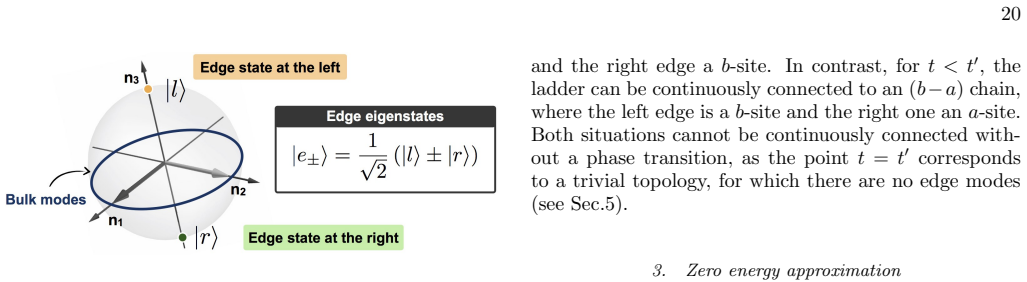
Edge modes in momentum space The momentum density distribution of the edge states can be easily obtained from their wave functions, Eq.(107) and Eq.(108). Both states have the same mo- mentum density distribution: ⟨ˆnk⟩ = 1 κ ρ2(k) , (109) where ˆnk = ˆa† kˆak+ˆb† k ˆbk. Due to the polarization property of the edge states we know that, in the particular c...
-
[8]
Edge modes in position space In the case of the position space, each edge sate shows a different density distribution. However, they are not independent from each other, as the wave function of the edge state |r⟩ can be obtained by complex conjugating and reflecting the wave function of the edge state |l⟩, see Eq. (92) and Eq. (93). We have: ⟨l| ˆnx|l⟩ =|ψ(...
Show all 47 references
-
[9]
(114), Eq
Simultaneous momentum-position localization From the approximated momentum and spatial density distributions of the edge states, Eq. (114), Eq. (124) and Eq. (127), and their corresponding localization lengths, δkj = 2ξj √√ 2− 1 and δxj = log 2/(2ξj), we know that the larger a...
-
[10]
In this context, if a Hamiltonian H presents timer re- versal symmetry there is a global unitary transformation UT such that: UT H U† T = H
Symmetry class correspondence There exists a relation between the symmetry class of the Hamiltonian and the momentum of the symmetry protected edge modes that the system exhibits when it is found to be in its topologically non-trivial phase. In this context, if a Hamiltonian H...
-
[11]
Imposing chiral symetry In order to obtain all ladder geometries realizing a model for a topological insulator we first remark on two ingredients which are needed for a ladder geometry to be chiral symmetric:
-
[12]
The chiral symmetry implies that the Hamiltonian ma- trix has no component proportional to the identity
Opposite horizontal couplings. The chiral symmetry implies that the Hamiltonian ma- trix has no component proportional to the identity. As a consequence, the two horizontal tunneling am- plitudes must have the same modulus and opposite sing. That is, either both terms appear i...
-
[13]
If a model has no diagonal couplings, that is t = t′ = 0, the condition for chiral symmetry (138) is fulfilled independently of the rest of the parameters
Non-vanishing diagonal couplings. If a model has no diagonal couplings, that is t = t′ = 0, the condition for chiral symmetry (138) is fulfilled independently of the rest of the parameters. However, such a model will always be in a trivial phase. To see this we consider the mos...
-
[14]
(138), vanishes and, thus, the on-site energy can take any value
If the two diagonal couplings are the same, t = t′, the first term in the chiral condition, Eq. (138), vanishes and, thus, the on-site energy can take any value. The chiral condition is then fulfilled if FIG. 29. Ladder geometries with chiral symmetry (ii). Topological ladder ge...
-
[15]
This corresponds to the last model [Fig
If the two diagonal couplings are different, t̸= t′, the chiral condition implies a constraint to the on- site energy ϵ = 2J J′ (t cos φ1− t′ cos φ2) /(t2− t′2). This corresponds to the last model [Fig. 31(b)]. In this way we have obtained twelve topological ladder geometries, ...
-
[16]
(139) and Eq
Imposing time reversal symmetry In order to find all ladder models in the BDI class and in the AIII class we need to impose the two time rever- sal symmetry conditions, Eq. (139) and Eq. (140), to the topological ladder geometries we have obtained before- hand. When they are fu...
-
[17]
H¨ ugel and B
D. H¨ ugel and B. Paredes, Phys. Rev. A 89, 023619 (2014)
2014
-
[18]
Aidelsburger, M
M. Aidelsburger, M. Atala, S. Nascimb` ene, S. Trotzky, Y.-A. Chen and I. Bloch, Phys. Rev. Lett. 107, 255301 (2011)
2011
-
[19]
Aidelsburger, M
M. Aidelsburger, M. Atala, M. Lohse, J. T. Barreiro, B. Paredes and I. Bloch, Phys. Rev. Lett. 111, 185301 (2013)
2013
-
[20]
Atala, M
M. Atala, M. Aidelsburger, M. Lohse, J. T. Barreiro, B. Paredes and I. Bloch, Nat. Phys. 10, 588 (2014)
2014
-
[21]
Boada, A
O. Boada, A. Celi, J. I. Latorre and M. Lewenstein, Phys. Rev. Lett. 108, 133001 (2012)
2012
-
[22]
A. Celi, P. Massignan, J. Ruseckas, N Goldman, I. B. Spielman, G. Juzeli¯ unas and M. Lewenstein, Phys. 34 Rev. Lett. 112, 043001 (2014)
2014
-
[23]
Mancini, G
M. Mancini, G. Pagano, G. Cappellini, L. Livi, M. Rider, J. Catani, C. Sias, P. Zoller, M. Inguscio, M. Dalmonte and L. Fallani, Science 349, 1510 (2015)
2015
-
[24]
B. K. Stuhl, H.-I. Lu, L. M. Aycock, D. Genkina and I. B. Spielman, Science 349, 1514 (2015)
2015
-
[25]
L. F. Livi, G. Cappellini, M. Diem, L. Franchi, C. Clivati, M. Frittelli, F. Levi, D. Calonico, J. Catani, M. Inguscio and L. Fallani, Phys. Rev. Lett. 117, 220401 (2016)
2016
-
[26]
Kolkowitz, S
S. Kolkowitz, S. L. Bromley, T. Bothwell, M. L. Wall, G. E. Marti, A. P. Koller, X. Zhang, A. M. Rey, and J. Ye, Nature 542, 66 (2017)
2017
-
[27]
F. A. An, E. J. Maier and B. Gadway Sci. Adv. 3, e1602685 (2017)
2017
-
[28]
J. H. Kang, J. H. Han, and Y. Shin, Phys. Rev. Lett. 121, 150403 (2018)
2018
-
[29]
J. H. Han, J. H. Kang, and Y. Shin, Phys. Rev. Lett. 122, 065303 (2019)
2019
-
[30]
J. H. Kang, J. H. Han, and Y. il Shin, preprint arXiv:1902.10304 (2019)
1902
-
[31]
Anisimovas, M
E. Anisimovas, M. Raˇ ci¯ unas, C. Str¨ ater, A. Eckardt, I. B. Spielman and G. Juzeli¯ unas, Phys. Rev. A 94, 063632 (2016)
2016
-
[32]
J¨ unemann, A
J. J¨ unemann, A. Piga, S.-J. Ran, M. Lewenstein, M. Rizzi and A. Bermudez, Phys. Rev. X 7, 031057 (2017)
2017
-
[33]
E. J. Meier, F. A. An, A. Dauphin, M. Maffei, P. Massig- nan, T. L. Hughes, B. Gadway, Science 362, 929 (2018)
2018
-
[34]
de L´ es´ eleuc, V
S. de L´ es´ eleuc, V. Lienhard, P. Scholl, D. Barredo, S. Weber, N. Lang, H. P. B¨ uchler, T. Lahaye, A. Browaeys, preprint arXiv:1810.13286
-
[35]
Gholizadeh, M
S. Gholizadeh, M. Yahyavi and B. Het´ enyi, EPL, 122, 27001 (2018)
2018
-
[36]
A. P. Schnyder, S. Ryu, A. Furusaki and A. W. W. Lud- wig, Classification of topological insulators and super- conductors in three spatial dimensions, Phys. Rev. B 78, 195125 (2008)
2008
-
[37]
S. Ryu, A. P. Schnyder, A. Furusaki and A. W. W. Lud- wig, New J. Phys. 12, 065010 (2010)
2010
-
[38]
Altland and M
A. Altland and M. R. Zirnbauer, Phys. Rev. B 55, 1142 (1997)
1997
-
[39]
W. P. Su, J. R. Schrieffer and A. J. Heeger, Phys. Rev. Lett. 42, 1698 (1979)
1979
-
[40]
A. J. Heeger, S. Kivelson, J. R. Schrieffer and W. P. Su, Rev. Mod. Phys. 60, 781 (1988)
1988
-
[41]
Sierra, J
G. Sierra, J. Phys. A: Math. Theor. 47, 325204 (2014)
2014
-
[42]
Atala, M
M. Atala, M. Aidelsburger, J. T. Barreire, D. Abanin, T. Kitagawa, E. Demler and I. Bloch, Nat. Phys. 9, 795 (2013)
2013
-
[43]
E. J. Meier, F. A. An, B. Gadway, Nat Commun.7, 13986 (2016)
2016
-
[44]
Leder, C
M. Leder, C. Grossert, L. Sitta, M. Genske, A. Rosch, and M. Weitz, Nat Commun. 7, 13112 (2016)
2016
-
[45]
Wilson, in New Phenomena in Subnuclear Physics , edited by A
K. Wilson, in New Phenomena in Subnuclear Physics , edited by A. Zichichi (Plenum, New York, 1977)
1977
-
[46]
Creutz and I
M. Creutz and I. Horv´ ath, Phys. Rev. D50, 2297 (1994)
1994
-
[47]
Creutz, Rev
M. Creutz, Rev. Mod. Phys. 73, 119 (2001)
2001
Reviewed May 24, 2026 · model on record in the stance chip above.
Discussion (0). Continue with ORCID to comment.