REVIEW 4 major objections 4 minor 12 references
Comprehensive Fuzzy Turing Machines, An Evolution to the Concept of Finite State Machine Control
T0 review · 4 major / 4 minor · reviewed 2026-08-14 · deepseek-v4-flash
Pith's one-line read This paper claims that every conventional fuzzy Turing machine can be recast as a Comprehensive Fuzzy Turing Machine that resolves conflicting memberships, symbols, and directions at each step.
desk verdict A coherent but unproven extension of fuzzy Turing machines; the 'encompasses' claim is likely false for nondeterministic machines and the worked example has real errors. read the letter →
The pith
A machine-rendered reading of the paper's core claim, the machinery that carries it, and where it could break.
The reading
What carries the argument
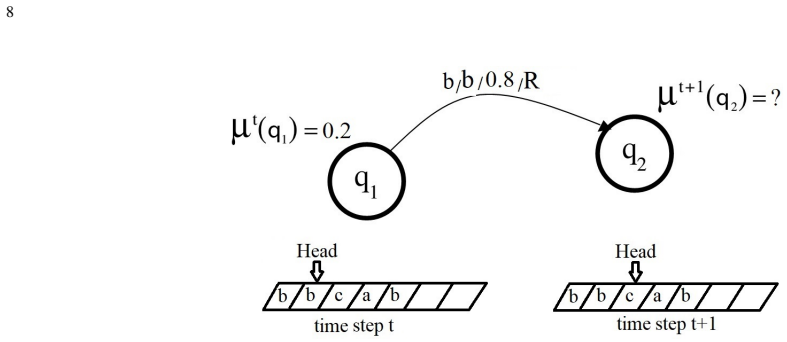
The central object is the tuple $M=(T,F,\widetilde{\delta},\mu)$, the Comprehensive Fuzzy Turing Machine: a single-tape machine whose states, tape alphabet, transition relation, and blank/start/final states come from a conventional fuzzy Turing machine, together with a package $F$ of four functions. $F_1$ assigns a membership value to a successor state from a predecessor membership and a transition weight; $F_2$ merges multiple candidate memberships for one state; $F_3$ chooses the tape symbol to write from the active transitions; and $F_4$ chooses the head direction. The augmented transition function $\widetilde{\delta}$ carries $F_1$ into the transition relation, and the state-membership vector $\mu$ makes the instantaneous description a fuzzy set of states. The work this machinery does is to turn each nondeterministic step into a well-defined single next configuration, and the option $F_1(\mu,\delta)=\delta$ is the lever that makes the conventional machine a special case.
What would settle it
Take a two-transition machine with conflicting outputs, say $(q_0,a,q_1,b,R,0.9)$ and $(q_0,a,q_2,c,L,0.2)$, enumerate all branches with the conventional fuzzy Turing machine to get an acceptance degree, then run the CFTM with max-weight $F_3$ and $F_4$ and any choice of $F_2$; if the resulting truth degree differs from the branch-enumeration degree, the claim that conventional machines are modeled by the CFTM fails for that choice of functions.
Extended reading notes
Core claim
On the paper's own terms, the central discovery is a definitional one: the conventional fuzzy Turing machine, in which only transitions carry weights and the truth degree is read off from a final instantaneous description, can be seen as a special case of a state-based machine. In the CFTM, the instantaneous description is a vector of membership values for all states, and each step applies the augmented transition function to assign successor-state memberships from both predecessor memberships and transition weights, the multi-membership resolution function $F_2$ to merge competing candidates, the multi-symbol resolution function $F_3$ to select one symbol to write, and the multi-direction resolution function $F_4$ to select one head movement. With $F_1(\mu,\delta)=\delta$, the conventional ID-based calculation is recovered, which is the paper's basis for claiming that the CFTM encompasses the conventional definition. Acceptance is then decided by whether a final state has nonzero membership, and the acceptance degree is obtained from the final states' memberships, reusing $F_2$ if more than one final state is active.
Load-bearing premise
The load-bearing premise is that a nondeterministic fuzzy Turing machine's branching behavior can be collapsed, at every step, into one symbol written and one direction moved without changing the truth degree assigned to any string.
Editorial extensions
If this is right
- Every conventional fuzzy Turing machine can be rewritten as a CFTM, so results about one model transfer to the other whenever the paper's encompassing claim holds.
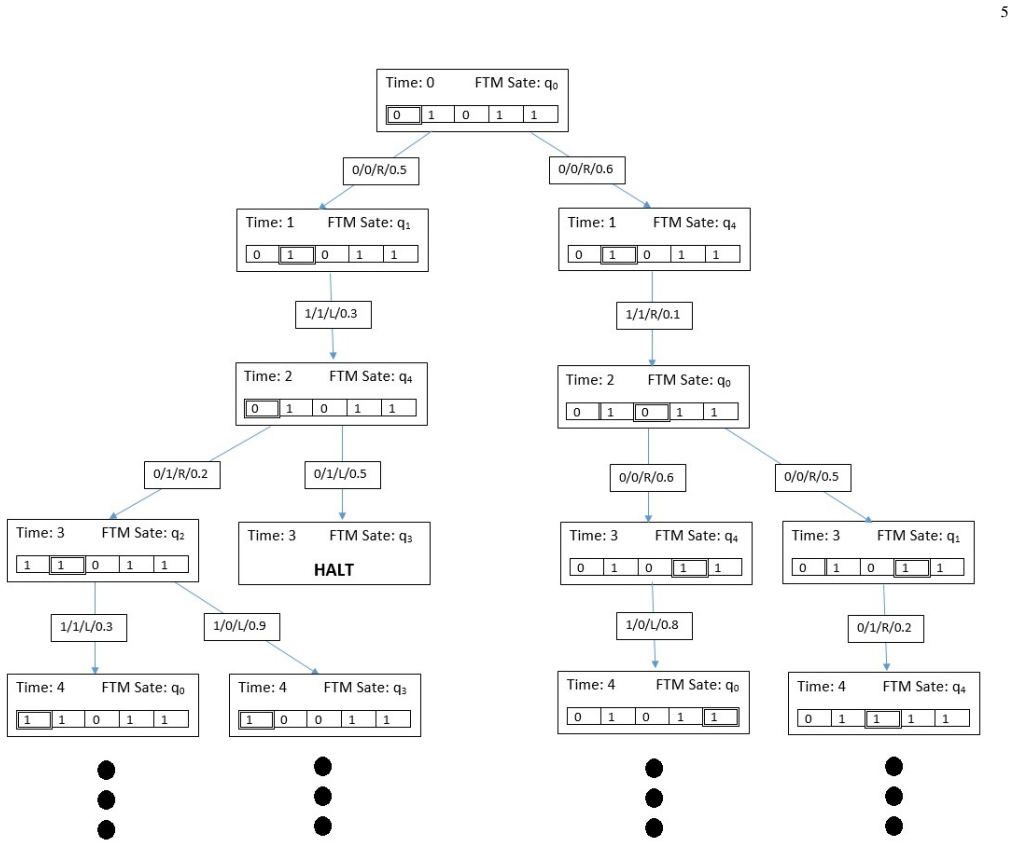
- A CFTM computation can be run step by step with one tape symbol and one head direction at each time, removing the need to grow a full tree of instantaneous descriptions.
- Application designers can choose $F_1$ through $F_4$ to match their intended semantics, for instance averaging or taking maxima, without changing the underlying machine structure.
- The acceptance degree of a string is determined from final-state memberships, making the machine's behavior in acceptor mode a direct fuzzy-language membership degree.
Reading between the lines
- If the encompassing claim is correct, the choice of $F_3$ and $F_4$ is not computationally neutral: different resolution functions will generally produce different accepted fuzzy languages from the same underlying transition relation, so the CFTM family is really a parameterized family of semantics rather than one machine.
- A natural test that the paper does not run is to compare CFTM truth degrees against a conventional branch-tree calculation on small nondeterministic machines; any mismatch would identify exactly which $F_1$ through $F_4$ choices preserve the conventional result.
- The state-vector update resembles a fuzzy determinization of the machine, which suggests the construction could also be phrased as a determinization result for fuzzy automata with outputs, connecting it to known questions about fuzzy language recognizers.
Signed reviews
Editorial analysis
A structured set of objections, weighed in public.
Referee Report
Summary. The paper proposes a new model of fuzzy Turing machine, the Comprehensive Fuzzy Turing Machine (CFTM), motivated by the General Fuzzy Automata framework of Doostfatemeh and Kremer. The CFTM augments Wiedermann's FTM with a state-membership assignment function F1, a multi-membership resolution function F2, and two additional resolution functions F3 and F4 that choose a single tape symbol and a single head direction at each step. The authors claim that the CFTM solves the membership-assignment, multi-membership, multi-symbol, and multi-direction problems in nondeterministic FTMs, and that it encompasses the conventional FTM definition. The paper contains an informal description of the model, definitions of the resolution functions, a worked numerical example, a pseudocode algorithm, and a conclusion asserting that each conventional FTM can be modeled as a CFTM.
Significance. If the central equivalence claim were correct and the definitions were rigorously formulated, the CFTM could provide a practically appealing way to avoid the branching explosion of nondeterministic fuzzy Turing machines, and the state-based membership semantics would connect FTMs to the well-established fuzzy automata literature. The paper also offers a concrete worked example and a prototype implementation, which are useful for reproducibility. However, the significance hinges entirely on the 'encompasses the conventional definition' claim; absent a proof, and given that the proposed mechanisms appear to change the computed truth degree for nondeterministic machines, the contribution would be a new model with its own semantics rather than a generalization of the existing one.
major comments (4)
- [Section VI and Abstract] The core claim that every conventional fuzzy Turing machine can be modeled as a CFTM is asserted without proof. In Section VI the authors write 'It is easy to prove that each conventional fuzzy Turing machine can be modeled in the form of the novel Comprehensive Fuzzy Turing Machine (CFTM),' but no proof or construction is given. For nondeterministic conventional FTMs, the truth degree of an input is defined over the entire tree of branch IDs, typically as the maximum over accepting branches, as the authors themselves describe in Example II.1. In a CFTM, however, F3 and F4 (Definitions IV.5 and IV.6) resolve the active transition set at each step to one tape symbol and one head direction, and F2 aggregates memberships, so the computation proceeds along a single path. A single path with memoryless, locally resolved choices cannot in general reproduce the maximum over branches that split and reconverge with different tape contents and head positions. The observation in Section III that F1(µ,δ)=δ reduces membership assignment to the ID-based method applies only to a single trajectory. This unproven equivalence is the load-bearing claim of the paper; without it the CFTM has not been shown to encompass the conventional definition.
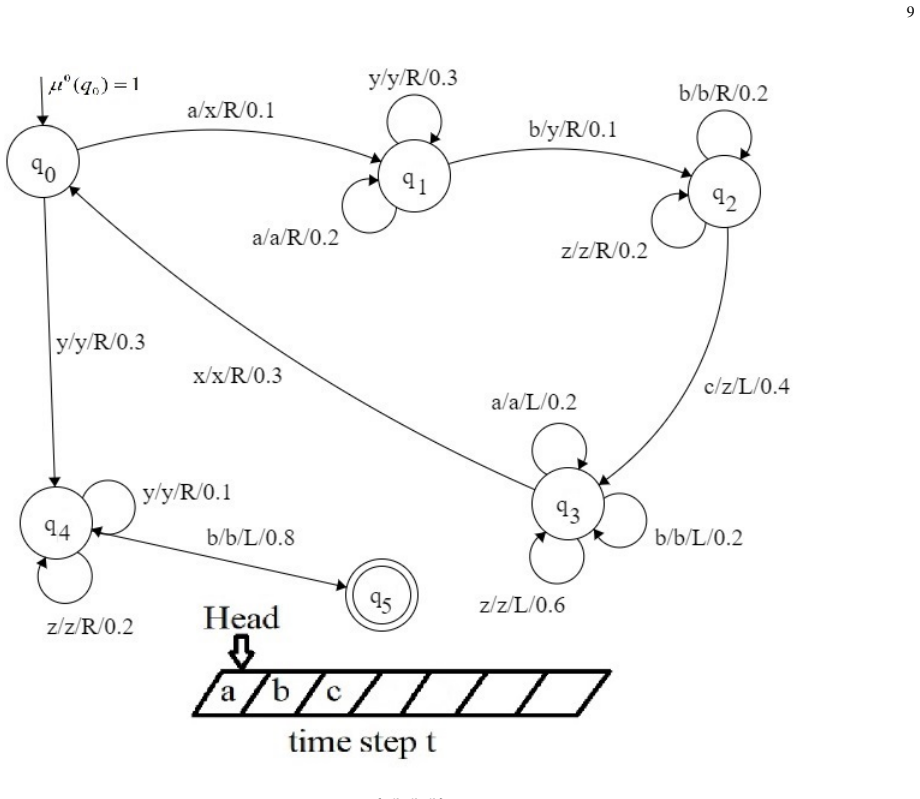
- [Section V, Example V.1] The worked example contains internal errors that undermine its role as an illustration. At time t=1, the head is at cell 2 and the symbol read is '1', but the listed active set Δ1_Act(1) includes transitions on symbol 0, e.g., (q3,0,q0,0,R) and (q3,0,q4,0,L). At time t=2, the active set includes transitions from state q5 even though the membership vector after t=1 gives µ1(q5)=0, contradicting Convention IV.2, which defines active transitions as those whose origin state has nonzero membership. These are not mere rounding issues; they affect which transitions are actually active and therefore change all subsequent state memberships. The example also miscomputes one geometric mean: for q0 at t=2 the text gives √(0.515×0.775)=0.637, while the correct value is approximately 0.632. The example needs to be recomputed carefully before it can support the claimed computational efficiency.
- [Section IV, Definitions IV.5-IV.6, Eqs. (11)-(17)] The definitions of the multi-symbol and multi-direction resolution functions F3 and F4 are not mathematically well-formed as written. In Eq. (11), the universal condition ranges over pairs [(q'i,ak,q'j,b'k,d'), F1(µt(qi), δ(q'i,ak,q'j,b'k,d'))], but the membership value used in F1 is µt(qi) rather than µt(q'i), making the inequality ill-defined. Eq. (13) is called 'maximum cardinal' but actually sums ceiling values of F1 membership degrees; cardinality should be the number of transitions supporting a symbol, not a sum of F1 values. The text also switches without a subsection heading from multi-symbol resolution to multi-direction resolution, and the equations for F4 (Eqs. 15–17) reuse the same notation with d and d' without clearly defining how the chosen direction relates to the recommended symbols. Since F3 and F4 are defining components of the CFTM, these ambiguities must be fixed before the model is usable.
- [Section V, Definition V.3] The acceptance definition determines the truth degree by applying F2 to the membership values of all final states, where F2 is a user-chosen function. This makes the semantics of the CFTM dependent on the arbitrary choice of F2, and the paper does not show that this matches the conventional FTM's truth degree even in the deterministic case. For example, conventional FTMs may use a t-norm or a different aggregation over the path weights, but the paper never states the conventional semantics in a formal way, so the 'encompasses' claim cannot be checked. The relation between the CFTM acceptance degree and the conventional maximum-over-branches degree needs to be made precise and proved for the claimed generalization to hold.
minor comments (4)
- [Throughout] The manuscript contains many typos and grammatical errors, including 'Alen Turing' (should be Alan Turing), 'instigated' (likely 'investigated'), 'Wiedermann's above statement is investigated' (should be 'Wiedermann's statement is investigated'), and corrupted author names such as 'Ù ˇRDoostfatemeh'.
- [Section IV] Equation numbering is inconsistent: there is no Eq. (14), while the text refers to Eqs. (16) and (17) with phrases like 'represented in Eq.16' and 'in Eq.17' that interrupt the flow. A subsection heading for multi-direction resolution appears to be missing between Eq. (13) and the discussion of F4.
- [Algorithm 1] The pseudocode states that F3 and F4 are 'symbol and direction with maximum cardinalities,' but the formal definitions in Eqs. (13) and (17) use sums of ceiling F1 values. The pseudocode should be aligned with the corrected definitions.
- [References] The Python code is said to be available in reference [1], which is a book by the first author rather than a public repository. If the code is meant to be accessible for reproducibility, a direct link or a clear way to obtain it should be provided.
Circularity Check
The central 'encompasses conventional FTM' claim is installed by the definitional choice F1(µ,δ)=δ rather than derived from the conventional FTM's branch-based truth-degree semantics.
-
self definitional
[Section III, immediately before Example III.2; the claim is repeated in the abstract and in Section VI.]
"It is obvious that ID-based membership assignment to the next configuration can be considered as a special case where F1(µ,δ)=δ. This fact, enables our version of FTM to encompass the conventional versions of FTM."
The CFTM is defined with F1 as a free membership-assignment function in Definition V.1, so choosing F1(µ,δ)=δ is a definitional choice inside the proposed model. The paper's only argument for the central 'encompasses conventional FTM' claim is precisely this choice: the old ID-based update is declared to be a special case by setting a CFTM parameter to a particular value. That is a reduction by construction, not a derivation from the conventional FTM semantics. The paper does not show that the conventional truth degree, which in Example II.1 aggregates transition weights over whole branches and takes a maximum over final IDs, is reproduced by the resulting CFTM computation.
full rationale
The main circular step is the support for the paper's central claim that CFTM 'encompasses the conventional definition' of fuzzy Turing machines. The paper's explicit, quoted justification reduces to setting the user-chosen membership-assignment function F1 equal to the transition weight δ. Since F1 is part of the CFTM definition, this makes the encompassment true by construction for the membership update, without an independent proof that the conventional FTM's branch-aggregated truth degree matches the CFTM's resolved state membership values. The paper itself notes that the conventional method is ID-based and branches over multiple final IDs, but no equation shows that the local choice F1(µ,δ)=δ, together with F2-F4, reproduces the maximum-over-branches calculation. That is the flagged self-definitional reduction. The paper also cites the authors' own General Fuzzy Automata framework [3] for F1 and F2, and the definitions are restated in the present paper rather than independently verified; however, the self-citation is not used to forbid alternatives and is not the main source of circularity. There is no fitted-data prediction and no renaming of a known result; the issue is concentrated in the derivation of the 'encompasses' claim. The score reflects that the central claim is partially circular by construction, while the proposed CFTM framework itself has independent definitional content.
Assumptions & free parameters
free parameters (4)
- F1 membership assignment function =
Unspecified; examples min, mean, geometric mean, Yager t-conorm
- F2 multi-membership resolution function =
Unspecified; examples maximum, arithmetic mean, geometric mean
- F3 multi-symbol resolution function =
Unspecified; examples max-F1, sigma-count, max count
- F4 multi-direction resolution function =
Unspecified; examples max-F1, sigma-count
assumptions (5)
- domain assumption The conventional fuzzy Turing machine definition after Wiedermann is the standard baseline model.
- domain assumption State-level membership semantics from General Fuzzy Automata transfer to Turing machines.
- domain assumption A single tape with one written symbol and one head direction per step is the required semantics.
- domain assumption Axioms 1 through 5 constrain F1 and F2 with bounds, boundary values, unanimity, and empty-set behavior.
- domain assumption Active transitions are exactly those whose predecessor state has nonzero membership.
invented entities (2)
-
F3 multi-symbol resolution function
-
F4 multi-direction resolution function
Cite this review
Pith. "Pith review of Comprehensive Fuzzy Turing Machines, An Evolution to the Concept of Finite State Machine Control." pith.science (2026). https://pith.science/paper/Z4PIKW6B
@misc{pith2026190801994,
  author       = {Pith},
  title        = {Pith review of: Comprehensive Fuzzy Turing Machines, An Evolution to the Concept of Finite State Machine Control},
  year         = {2026},
  howpublished = {\url{https://pith.science/paper/Z4PIKW6B}},
  note         = {Machine review of arXiv:1908.01994}
}
read the original abstract
The Turing machine is an abstract concept of a computing device which introduced new models for computation. The idea of Fuzzy algorithms defined by Zadeh and Lee was followed by introducing Fuzzy Turing Machine (FTM) to create a platform for a new fuzzy computation model. Then, in his investigations on its computational power, Wiedermann showed that FTM is able to solve undecidable problems. His suggested FTM structure, which highly resembles the original definition was one of the most well-known classical definitions of FTM lately.To improve some of its weaknesses and vague points which will be discussed extensively in this paper, we will develop a more complete definition for fuzzy Turing machines. Our proposed definition of FTM, which encompasses the conventional definition, is motivated from the definition of General Fuzzy Automata (GFA) introduced by Doostfatemeh and Kremer. As it improved the conventional definition of fuzzy automata, especially the problem of membership assignment and multi-membership resolution, we also improved the same aspects of FTM through the definition of Comprehensive Fuzzy Turing Machine (CFTM). In addition, we address on some possible vaguenesses in FTM was not the subject of focus in fuzzy automata. As example, we investigate the issue of multi-path and multi-direction which are possible in case of nondeterminism. Finally, we show the simplicity, applicability and computational efficiency of the CFTM through an explanatory example.
Figures

Figures from the paper (3 more)


Reference graph
Works this paper leans on
-
[1]
Fuzzy Turing Machine and Its Capabilities
Najmeh Ahang. Fuzzy Turing Machine and Its Capabilities . Shiraz University Publications, 2018
work page 2018
-
[2]
On the computing power of fuzzy turing machines
Benjamín Callejas Bedregal and Santiago Figueira. On the computing power of fuzzy turing machines. Fuzzy Sets and Systems, 159(9):1072–1083, 2008
work page 2008
-
[3]
Mansoor Doostfatemeh and Stefan C. Kremer. New directions in fuzzy automata. International Journal of Approximate Reasoning, 38(2):175–214, February 2005
work page 2005
-
[4]
Meta-type fuzzy computations and fuzzy com- plexity
Hadi Farahani. Meta-type fuzzy computations and fuzzy com- plexity. Journal of Intelligent & Fuzzy Systems , 34(1):81–92, 2018
work page 2018
-
[5]
Fuzzy turing machines: Normal form and limitative theorems
Giangiacomo Gerla. Fuzzy turing machines: Normal form and limitative theorems. Fuzzy Sets and Systems, 333:87–105, 2018
work page 2018
-
[6]
Fuzzy sets and fuzzy logic, volume 4
George Klir and Bo Yuan. Fuzzy sets and fuzzy logic, volume 4. Prentice hall New Jersey, 1995
work page 1995
-
[7]
Edward T Lee and Lotfi A Zadeh. Note on fuzzy languages. In Fuzzy Sets, Fuzzy Logic, And Fuzzy Systems: Selected Papers by Lotfi A Zadeh , pages 69–82. World Scientific, 1996
work page 1996
-
[8]
Fuzzy automata and languages: theory and applications
John N Mordeson and Davender S Malik. Fuzzy automata and languages: theory and applications . Chapman and Hall/CRC, 2002
work page 2002
Show all 12 references
-
[9]
Equivalence in knowledge representation: automata, recurrent neural networks, and dynamical fuzzy systems
Christian W Omlin, C Lee Giles, and Karvel K Thornber. Equivalence in knowledge representation: automata, recurrent neural networks, and dynamical fuzzy systems. Proceedings of the IEEE, 87(9):1623–1640, 1999
1999
-
[10]
Eugene S. Santos. Fuzzy algorithms. Information and Control, 17(4):326 – 339, 1970
1970
-
[11]
Characterizing the super-turing comput- ing power and efficiency of classical fuzzy turing machines
Ji ˇrıÌ ˛ A Wiedermann. Characterizing the super-turing comput- ing power and efficiency of classical fuzzy turing machines. Theoretical Computer Science , 317(1-3):61–69, 2004
2004
-
[12]
Fuzzy Turing machines revised
JiÅ ´ZÃ Wiedermann. Fuzzy Turing machines revised. Com- puting and Informatics , 21(3):251–263, 2002
2002
Reviewed August 14, 2026 · model on record in the stance chip above.
Discussion (0). Continue with ORCID to comment.