REVIEW 6 major objections 6 minor 27 references
Towards AI-Native Fronthaul: Neural Compression for NextG Cloud RAN
T0 review · 6 major / 6 minor · reviewed 2026-08-07 · deepseek-v4-flash
Pith's one-line read Neural compression trained end-to-end on CPRI radio signals beats classical scalar and vector quantization in rate-distortion, with a learned arithmetic-coded latent model delivering the largest error-vector-magnitude gains in both uplink…
desk verdict Solid application of learned image compression to CPRI fronthaul, but the central R-D claim rests on estimated rather than measured bit rates and the closest DL baseline is missing. read the letter →
The pith
A machine-rendered reading of the paper's core claim, the machinery that carries it, and where it could break.
The reading
What carries the argument
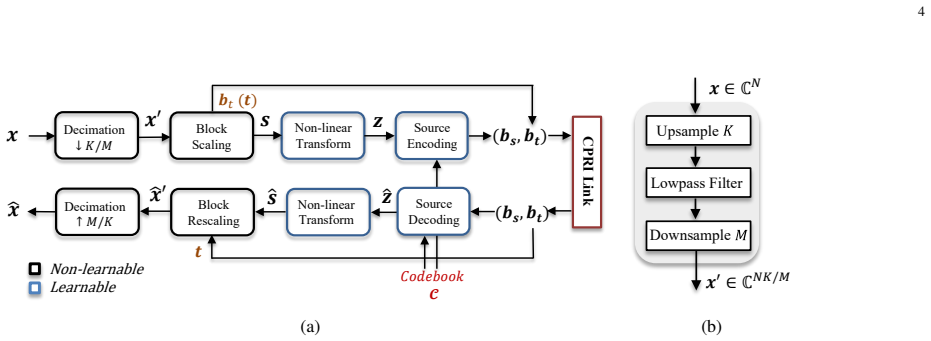
The load-bearing object is the learned nonlinear transform $f_s(\cdot)$, a two-layer bidirectional Gated Recurrent Unit (bi-GRU) followed by a fully connected layer, which maps the block-scaled, decimated CPRI signal $s$ into a latent vector $z$. For the top-performing scheme the second load-bearing object is the factorized probability model $P_\varphi$, one learned probability mass function per latent channel as in (22)–(24), which feeds an arithmetic encoder that turns the rounded latent $\hat{Z}$ into a near-entropy bit stream; the lookup-table form in (24) makes the model practical at deployment. For the latent-quantization scheme, the carrying object is a VQ-VAE-style learned codebook trained jointly with the transform through a codebook loss and a commitment loss. The role of this machinery is to undo the correlation that Proposition 1 proves to exist in the decimated signal, so that quantization acts on near-independent latent elements rather than on the raw correlated samples.
What would settle it
Reproduce the uplink experiment of Fig. 7(c) with the trained models and compare the actual arithmetic-coder bit rate to the predicted entropy of (23): if the realized rate systematically exceeds the prediction by more than the one-bit bound, the probability model is miscalibrated for CPRI statistics, and the claimed $Q \approx 0.3$ advantage at 32 dB EVM would shrink or reverse. A complementary ablation replaces the learned probability model with an empirical histogram of the rounded latents: if EVM at fixed $Q$ is unchanged, the transform, not the entropy model, is carrying the gain.
Extended reading notes
Core claim
On the paper's own terms, the central discovery is that a learned nonlinear transformation of the block-scaled CPRI signal into a latent space, followed by quantization and — in the stronger scheme — arithmetic coding of the quantized latent under a learned factorized probability model, outperforms the conventional scalar quantization [4] and vector quantization [5] baselines in the downlink experiments at every rate tested, and in the uplink beats the conventional vector quantizer by roughly $Q \approx 0.3$ bits per element at 32 dB EVM. The transform is a two-layer bidirectional GRU with fully connected heads; Proposition 1 supplies the justification by computing the covariance of the decimation-module output and showing that off-diagonal correlations appear whenever a guard band is present, so element-wise and block-wise i.i.d. assumptions are invalid. The paper further claims the scheme degrades only slightly under mismatched SNR, modulation order, and channel-tap counts, and that the variable-rate and successive-refinement extensions preserve most of the performance of separately trained models while saving storage or exploiting heterogeneous link reliability.
Load-bearing premise
The load-bearing premise is that the learned factorized probability model, imported from image-compression practice with its training details left out of the paper, accurately tracks the true distribution of the quantized latent features of CPRI signals; if that model is miscalibrated, the arithmetic coder pays more bits than the model predicts and the scheme's edge over simpler quantizers shrinks.
Editorial extensions
If this is right
- At equal bit rates, the neural-compression scheme yields better EVM than classical scalar and vector CPRI quantization in the downlink, and it beats conventional vector quantization in the uplink by roughly $Q \approx 0.3$ bits per element at 32 dB EVM.
- Learned latent vector quantization beats its uniform counterpart and beats the conventional vector quantizer, while the paper honestly reports that learned uniform latent quantization can fall behind conventional non-uniform scalar quantization in the uplink at low rates, since the fading channel reshapes the signal distribution.
- Models trained at one SNR, one modulation order, or one channel-tap count transfer to other conditions with only small rate-distortion loss, which supports deployment without retraining per environment.
- A single shared transform with latent scaling preserves most of the rate-distortion performance of separately trained models while cutting storage to about $1/W$, since only small probability lookup tables are stored per rate point.
- Successive refinement across links of different reliability reconstructs a usable coarse signal from the first, most reliable packets and refines it additively from later packets, at a small cost relative to separately trained point designs.
Reading between the lines
- The covariance structure derived in Proposition 1 suggests a fixed linear whitening transform might capture part of the decorrelation gain; the paper never tests this no-learning baseline, so the gap between what the bi-GRU transform buys and what a closed-form whitener would buy remains open.
- Because the variable-rate trick scales the latent by $a_w$ and rescales the decoder input by $1/a_w$, it should transfer to other learned compressors with continuous latents; a testable extension is applying the same scaling trick to image or point-cloud codecs that currently retrain per rate point.
- The paper claims near-identical rate-distortion performance across modulation orders but omits the supporting figure; a direct replication of that mismatched-modulation experiment would test whether the learned transform really is modulation-agnostic.
Editorial analysis
A structured set of objections, weighed in public.
Referee Report
Summary. The paper proposes two learned CPRI fronthaul compression schemes for C-RAN: (i) latent quantization, in which a bi-GRU nonlinear transform is followed by learned scalar or vector quantization of the latent, and (ii) neural compression, in which the rounded latent is arithmetic-coded using a factorized probability model imported from Balle et al. [13]. It also introduces a successive-refinement architecture for multiple CPRI links with heterogeneous reliability and a variable-rate model that shares one transform across rate points to reduce storage. The experiments evaluate EVM versus bits per sample against classical scalar and vector quantization baselines [4], [5] in downlink and uplink, and include mismatched SNR and channel-tap scenarios. The central claim is that modeling the latent distribution gives better rate-distortion performance than conventional CPRI compression.
Significance. If the rate-distortion advantage is confirmed with measured bitstream lengths, this is a timely and useful contribution: CPRI fronthaul compression is an active standardization area, and adapting learned nonlinear transforms plus entropy coding to OFDM/SC-FDMA signal statistics is a natural next step. Proposition 1 is a clean parameter-free derivation of the non-i.i.d. structure of the decimated signal, and the EVM-domain comparison against classical baselines [4], [5] is appropriate. The successive-refinement and variable-rate extensions address real deployment constraints. The main caveat is that the headline empirical claim currently rests on estimated entropy rather than achieved bit rate, and several supporting claims (modulation robustness, superiority over the closest DL baseline) are not backed by shown data.
major comments (6)
- [Section IV-A/IV-B, Fig. 7] The rate axis for the 'Learned Compression' curves appears to be the predicted entropy from Eq. (27), justified by Eq. (23), which bounds arithmetic-coding length only when the factorized probability model P_phi matches the true distribution of the rounded latent. The latent is produced by a bi-GRU (Fig. 3), so temporal dependence may make the factorized assumption optimistic. The paper reports no measured bitstream length, no comparison of predicted entropy to the empirical entropy of the rounded latents, and no calibration experiment. Since the claimed uplink advantage over VQ is about Q = 0.3 (Section V-B2), even modest miscalibration could shift the learned-compression curve right and erase the advantage. Please report actual arithmetic-coded bit lengths and/or an entropy-versus-empirical-rate plot, and state explicitly what Q denotes for the learned-compression curves.
- [Eq. (5)] The compression-ratio formula is internally inconsistent. N-prime is defined immediately above as the post-decimation output length, yet the denominator is described as the number of bits in the original uncompressed signal. The displayed expression Lb divided by (2 times 15 times N-prime) is therefore not the ratio of compressed to original bits unless N-prime happens to equal the original signal length. The final algebraic expression can be made correct by writing the denominator as 30 times N_orig equals 30 times M times N-prime divided by K, but as printed it conflates compressed and uncompressed lengths. Please define both Lb and the denominator explicitly, since this formula underlies the paper's fronthaul-bandwidth-reduction claims.
- [Section V-C2] The abstract claims robustness to modulation formats, and the text states that 'almost identical R-D performance' is obtained regardless of modulation order, but the simulation result is explicitly omitted due to the page limit. No figure, table, or number supports this claim. Please add the modulation-mismatch result or qualify the abstract and conclusion accordingly.
- [Introduction and Section V] The introduction identifies [18] as the most relevant deep-learning baseline and states that the proposed schemes 'extend and surpass' it, but [18] is not included in any experiment in Section V. Without a numerical comparison against [18], or an explicit statement that such a comparison is outside the paper's scope, the claim of surpassing [18] is unsupported.
- [Figs. 7-10] All rate-distortion curves are presented as single trajectories with no error bars, confidence intervals, or number of seeds. The paper reports quantitative gaps such as 'Q = 0.3' (Section V-B2) and 'Q = 0.1' (Section V-D2) that are small relative to typical training variability for GRU-based learned codecs. Please report multiple trials/seeds and the spread of the curves, at least for the headline comparisons and for the variable-rate and successive-refinement results.
- [Section IV-D, Eq. (33)] The approximation b_w times floor(a_w times Z* plus 1/2) approximately equals the original quantized latent is heuristic: for a_w less than 1, rounding error introduced in the scaled domain is amplified by the factor 1 divided by a_w after rescaling. The text asserts 'nearly identical distribution' without quantification. Because the same decoder g*_d is reused for all w, this approximation directly controls the distortion of the variable-rate model and should be quantified, either analytically or with a numerical comparison of the induced latent distributions for each a_w.
minor comments (6)
- [Eq. (25)] The density notation in the equation is garbled; it should denote a density evaluated at a value given the parameters of that channel.
- [Section V-B1] The text says entropy coding is 'illustrated in (5)'; the entropy-coding method is described in [5], not in Eq. (5).
- [Section V-C3] 'Mismatch in the number of hops' should read 'mismatch in the number of taps.'
- [Section V-D2] 'Negelectable' should be 'negligible.'
- [Fig. 11] The codebook plots contain raw unicode escape sequences (e.g., '/uni00000053') in the labels; these should be rendered as proper characters.
- [Eq. (23)] 'Can be closely approximate' should be 'can closely approximate.'
Circularity Check
No circularity: the paper's statistical motivation and experimental comparisons are self-contained or anchored to external benchmarks, with only a correctness-level entropy-calibration caveat.
full rationale
The derivation chain does not reduce to its own inputs. Proposition 1 and Appendix A derive the non-i.i.d. statistics of the decimation output from the OFDM/SC-FDMA signal model and the guard band structure; this is a parameter-free statistical statement, not a quantity fitted to the paper's results. The neural compression pipeline adopts the factorized probability model from Ballé et al. [12], [13] as external prior work, not from the present authors, and trains the transform and entropy model against the cross-entropy objective in Eq. (27) while evaluating EVM on actual reconstructions. The R-D curves in Fig. 7 are therefore measured reconstruction quality plotted against a model-estimated rate; they are not a prediction forced by a fitted parameter. The variable-rate scheme in Section IV-D fixes the learned encoder/decoder, retrains only the probability model, and compares against separately trained models and the classical SQ/VQ baselines [4], [5]. Self-citations [15], [16], [22], [25] appear only as background or as standard technique references and are not load-bearing to the central claim. The paper reports no measured arithmetic-coded bitstream length and does not compare the predicted entropy in Eq. (23) with the empirical entropy of the rounded latent; for CPRI-specific signal statistics this is a legitimate reproducibility and calibration concern, but it is not a circular reduction under the paper's own equations.
Assumptions & free parameters
free parameters (5)
- latent scaling factors a_w =
a_w in {0.1, 0.25, 0.5, 0.9, 1}
- R-D trade-off weights lambda =
lambda in {1e2, 5e2, 1e3, 5e3, 1e4}
- latent dimension V per time step =
V = 2
- GRU hidden size N_h =
N_h = 32
- VQ commitment weight beta =
beta = 1
assumptions (5)
- domain assumption QAM symbols on occupied subcarriers are i.i.d., zero-mean, with average power P
- domain assumption The decimation low-pass filter preserves the occupied subcarriers exactly, leaving a spectrum w = [0^T, c^T, 0^T] with a narrower guard band
- ad hoc to paper The probability prediction network from Ballé et al. [13], details omitted, models the quantized latent distribution accurately enough that arithmetic coding approaches the predicted entropy
- ad hoc to paper The approximation in Eq. (33): b_w * floor(a_w * Z^* + 1/2) is nearly identically distributed to the original quantized latent \hat{Z}^*
- domain assumption The uplink channel is modeled as a 7-tap Rayleigh fading channel with i.i.d. complex Gaussian taps
Cite this review
Pith. "Pith review of Towards AI-Native Fronthaul: Neural Compression for NextG Cloud RAN." pith.science (2026). https://pith.science/paper/Z4WBWIV2
@misc{pith2026250606925,
  author       = {Pith},
  title        = {Pith review of: Towards AI-Native Fronthaul: Neural Compression for NextG Cloud RAN},
  year         = {2026},
  howpublished = {\url{https://pith.science/paper/Z4WBWIV2}},
  note         = {Machine review of arXiv:2506.06925}
}
read the original abstract
The rapid growth of data traffic and the emerging AI-native wireless architectures in NextG cellular systems place new demands on the fronthaul links of Cloud Radio Access Networks (C-RAN). In this paper, we investigate neural compression techniques for the Common Public Radio Interface (CPRI), aiming to reduce the fronthaul bandwidth while preserving signal quality. We introduce two deep learning-based compression algorithms designed to optimize the transformation of wireless signals into bit sequences for CPRI transmission. The first algorithm utilizes a non-linear transformation coupled with scalar/vector quantization based on a learned codebook. The second algorithm generates a latent vector transformed into a variable-length output bit sequence via arithmetic encoding, guided by the predicted probability distribution of each latent element. Novel techniques such as a shared weight model for storage-limited devices and a successive refinement model for managing multiple CPRI links with varying Quality of Service (QoS) are proposed. Extensive simulation results demonstrate notable Error Vector Magnitude (EVM) gains with improved rate-distortion performance for both algorithms compared to traditional methods. The proposed solutions are robust to variations in channel conditions, modulation formats, and noise levels, highlighting their potential for enabling efficient and scalable fronthaul in NextG AI-native networks as well as aligning with the current 3GPP research directions.
Figures


Figures from the paper (8 more)


Reference graph
Works this paper leans on
-
[4]
Compressed transport of baseband signals in radio access networks,
D. Samardzija, J. Pastalan, M. MacDonald, S. Walker, and R. Valenzuela, “Compressed transport of baseband signals in radio access networks,” IEEE Trans. Wireless Commun. , vol. 11, no. 9, pp. 3216–3225, 2012
work page 2012
-
[5]
A novel and efficient vector quantization based CPRI compression algorithm,
H. Si, B.-L. Ng, M.-S. Rahman, and J. Zhang, “A novel and efficient vector quantization based CPRI compression algorithm,” IEEE Trans. Veh. Technol., vol. 66, no. 8, pp. 7061–7071, 2017
work page 2017
-
[18]
Deep learning-based nonlinear quantizer for fronthaul compression,
S. Yagi, M. Nakahara, K. Suzuoki, T. Kozuno, and D. Hisano, “Deep learning-based nonlinear quantizer for fronthaul compression,” in Op- toElectronics and Commun. Conf. (OECC) and Int. Conf. Photonics in Switching and Computing (PSC) , 2022, pp. 1–3
work page 2022
-
[13]
Variational image compression with a scale hyperprior,
J. Ball ´e, D. Minnen, S. Singh, S. J. Hwang, and N. Johnston, “Variational image compression with a scale hyperprior,” in Int. Conf. Learn. Represent. (ICLR), 2018
work page 2018
-
[1]
Cloud radio access network (C-RAN): a primer,
J. Wu, Z. Zhang, Y . Hong, and Y . Wen, “Cloud radio access network (C-RAN): a primer,” IEEE Netw., vol. 29, no. 1, pp. 35–41, 2015. 6The distribution of the imaginary part follows the same analysis
work page 2015
-
[2]
An overview of the CPRI specification and its application to C-RAN-based LTE scenarios,
A. De la Oliva, J.-A. Hernandez, D. Larrabeiti, and A. Azcorra, “An overview of the CPRI specification and its application to C-RAN-based LTE scenarios,” IEEE Commun. Mag., vol. 54, no. 2, pp. 152–159, 2016
work page 2016
-
[3]
LTE/LTE-A signal compression on the CPRI interface,
B. Guo, W. Cao, A. Tao, and D. Samardzija, “LTE/LTE-A signal compression on the CPRI interface,” Bell Labs Tech. J. , vol. 18, no. 2, pp. 117–133, 2013
work page 2013
-
[6]
Time-domain compression of complex- baseband LTE signals for cloud radio access networks,
K. F. Nieman and B. L. Evans, “Time-domain compression of complex- baseband LTE signals for cloud radio access networks,” in IEEE Global Conf. Signal Inf. Process. (GlobalSIP) , 2013, pp. 1198–1201
work page 2013
Show all 27 references
-
[7]
Robust and efficient distributed compression for cloud radio access networks,
S. H. Park, O. Simeone, O. Sahin, and S. Shamai, “Robust and efficient distributed compression for cloud radio access networks,” IEEE Trans. Veh. Technol., vol. 62, no. 2, pp. 692–703, 2013
2013
-
[8]
Meta-learning-based fronthaul compression for cloud radio access networks,
R. Qiao, T. Jiang, and W. Yu, “Meta-learning-based fronthaul compression for cloud radio access networks,” IEEE Trans. Wireless Commun. , vol. 23, no. 9, pp. 11015–11029, 2024
2024
-
[9]
Space-time fronthaul compression of complex baseband uplink LTE signals,
J. Choi, B. L. Evans, and A. Gatherer, “Space-time fronthaul compression of complex baseband uplink LTE signals,” in IEEE Int. Conf. Commun. (ICC), 2016, pp. 1–6
2016
-
[10]
Learning to Detect,
N. Samuel, T. Diskin, and A. Wiesel, “Learning to Detect,” IEEE Trans. Signal Process., vol. 67, no. 10, pp. 2554–2564, 2019
2019
-
[11]
AMP-inspired deep networks for sparse linear inverse problems,
M. Borgerding, P. Schniter, and S. Rangan, “AMP-inspired deep networks for sparse linear inverse problems,” IEEE Trans. Signal Process., vol. 65, no. 16, pp. 4293–4308, 2017
2017
-
[12]
End-to-end optimized image compression,
J. Ball ´e, V . Laparra, and E. P. Simoncelli, “End-to-end optimized image compression,” in Int. Conf. Learn. Represent. (ICLR) , 2017
2017
-
[14]
An introduction to deep learning for the physical layer,
T. O’Shea and J. Hoydis, “An introduction to deep learning for the physical layer,” IEEE Trans. Cogn. Commun. Netw. , vol. 3, no. 4, pp. 563–575, 2017
2017
-
[15]
All you need is feedback: Communication with block attention feedback codes,
E. Ozfatura, Y . Shao, A. G Perotti, B. M Popovi ´c, and D. G ¨und¨uz, “All you need is feedback: Communication with block attention feedback codes,” IEEE J. Sel. Areas Inf. Theory , vol. 3, no. 3, pp. 587–602, 2022
2022
-
[16]
Deep joint source- channel coding for wireless image transmission,
E. Bourtsoulatze, D. B. Kurka, and D. G ¨und¨uz, “Deep joint source- channel coding for wireless image transmission,” IEEE Trans. Cogn. Commun. Netw., 2019
2019
-
[17]
Constrained deep reinforcement learning for fronthaul compression optimization,
A. Gr ¨onland, A. Russo, Y . Jedra, B. Klaiqi, and X. Gelabert, “Constrained deep reinforcement learning for fronthaul compression optimization,” in IEEE Intl. Conf. Mach. Learn. Commun. Netw. (ICMLCN) , 2024, pp. 498–504
2024
-
[19]
Variable rate deep image compression with modulated autoencoder,
F. Yang, L. Herranz, J. v. d. Weijer, J. A. I. Guiti ´an, A. M. L ´opez, and M. G. Mozerov, “Variable rate deep image compression with modulated autoencoder,” IEEE Signal Process. Lett. , vol. 27, pp. 331–335, 2020
2020
-
[20]
Asymmetric gained deep image compression with continuous rate adaptation,
Z. Cui, J. Wang, S. Gao, T. Guo, Y . Feng, and B. Bai, “Asymmetric gained deep image compression with continuous rate adaptation,” in Proc. IEEE/CVF Conf. Comput. Vis. Pattern Recognit. (CVPR) , 2021, pp. 10532–10541
2021
-
[21]
Variable bitrate image compression with quality scaling factors,
T. Chen and Z. Ma, “Variable bitrate image compression with quality scaling factors,” in IEEE Int. Conf. Acoust., Speech Signal Process. (ICASSP), 2020, pp. 2163–2167
2020
-
[22]
D EEP JSCC-1++: Robust and bandwidth-adaptive wireless image transmission,
C. Bian, Y . Shao, and D. G ¨und¨uz, “D EEP JSCC-1++: Robust and bandwidth-adaptive wireless image transmission,” in IEEE Global Com- mun. Conf. (GLOBECOM) , 2023, pp. 3148–3154
2023
-
[23]
D. P. Bertsekas, Constrained optimization and Lagrange multiplier methods, Academic Press, 2014
2014
-
[24]
Learning phrase representations using RNN encoder–decoder for statistical machine translation,
K. Cho, B. van Merrienboer, C. Gulcehre, D. Bahdanau, F. Bougares, H. Schwenk, and Y . Bengio, “Learning phrase representations using RNN encoder–decoder for statistical machine translation,” in Conf. Empir. Methods Nat. Lang. Process. (EMNLP) , 2014, pp. 1724–1734
2014
-
[25]
D EEP JSCC-Q: Constellation constrained deep joint source-channel coding,
T.-Y . Tung, D. B. Kurka, M. Jankowski, and D. G ¨und¨uz, “D EEP JSCC-Q: Constellation constrained deep joint source-channel coding,” IEEE J. Sel. Areas Inf. Theory , vol. 3, no. 4, pp. 720–731, 2022
2022
-
[26]
Neural discrete representation learning,
A. Van Den Oord, O. Vinyals, et al., “Neural discrete representation learning,” Adv. Neural Inf. Process. Syst. , vol. 30, 2017
2017
-
[27]
New radio physical layer abstraction for system-level simulations of 5G networks,
S. Lagen, K. Wanuga, H. Elkotby, S. Goyal, N. Patriciello, and L. Giup- poni, “New radio physical layer abstraction for system-level simulations of 5G networks,” in IEEE Int. Conf. Commun. (ICC) , 2020, pp. 1–7
2020
Reviewed August 7, 2026 · model on record in the stance chip above.
Discussion (0). Sign in to comment.