Stokes-anti-Stokes correlations of light propagating through weakly guiding optical fiber
Pith reviewed 2026-06-30 20:22 UTC · model grok-4.3
The pith
Spatial orthogonality of fiber modes suppresses non-classical Stokes-anti-Stokes intensity correlations in multi-mode fibers.
A machine-rendered reading of the paper's core claim, the machinery that carries it, and where it could break.
Core claim
The model shows that spatial orthogonality of the fiber modes makes the light propagating through these modes uncorrelated in the standard detection scheme. This leads to suppression of non-classical intensity correlations of the total field in the multi-mode fiber, with the degree of suppression increasing as more modes propagate at the Stokes and anti-Stokes frequencies.
What carries the argument
Spatial orthogonality of the fiber modes, which renders independent-mode contributions to total intensity uncorrelated under integrated detection.
If this is right
- Non-classical correlations survive propagation even when the sample contains many molecules.
- The measured correlation strength falls monotonically with the number of propagating modes.
- The second-order autocorrelation functions of the Stokes and anti-Stokes fields likewise decrease with added modes.
- The residual correlation can be expressed in closed form from the fiber's modal parameters.
- Fiber geometry therefore becomes a controllable parameter for preserving or reducing non-classical Stokes-anti-Stokes correlations.
Where Pith is reading between the lines
- A mode-resolved detector that registers each spatial mode separately would recover the full per-mode correlations that are washed out by total-intensity summation.
- The same orthogonality argument applies to any multi-mode waveguide or free-space beam where orthogonal transverse profiles are integrated without spatial filtering.
- Single-mode fiber segments inserted before detection could serve as a simple filter to restore higher observed correlations without changing the source.
- The model supplies a quantitative design rule for choosing core size and length to achieve a target correlation value in fiber-based quantum optics experiments.
Load-bearing premise
The Raman process produces correlations carried independently by each fiber mode and detection integrates total intensity without resolving individual modes.
What would settle it
Record the normalized Stokes-anti-Stokes intensity correlation while varying the number of supported modes (by changing fiber length, core diameter, or wavelength) and check whether the measured drop follows the predicted dependence on mode count.
Figures
read the original abstract
Statistical properties of light produced in spontaneous Raman scattering on an ensemble of molecules indicate the quantum nature of this phenomenon. The scattered light is non-classical and has high non-classical intensity correlations between Stokes and anti-Stokes components. The temporal coherence of this light is well investigated, while many questions related to spatial coherence remain open. Recent experiments reveal two peculiar features of the spatial coherence of the Stokes and anti-Stokes light. First, the intensity correlations between Stokes and anti-Stokes light remain non-classical even for macroscopic samples containing many molecules. Second, these correlations decrease when signal propagates through a multi-mode optical fiber: the more propagating fiber modes at Stokes and anti-Stokes frequencies the less the correlations. Moreover, the second-order autocorrelation function of Stokes and anti-Stokes light also decreases with the number of propagating modes in multi-mode fiber. In this paper, we build a model of spontaneous Raman scattering correlations of light produced by an ensemble of molecules and propagating through weakly guiding optical fiber that quantitatively explains all these observations. We show that spacial orthogonality of the fiber modes makes the light propagating through these modes uncorrelated in the standard detection scheme. This leads to suppression of non-classical intensity correlations of the total field in the multi-mode fiber. We find the degree of non-classical correlations on fiber parameters. The obtained results pave the way for engineering of non-classical Stokes -- anti-Stokes correlations.
Editorial analysis
A structured set of objections, weighed in public.
Referee Report
Summary. The paper develops a theoretical model of spontaneous Raman scattering correlations between Stokes and anti-Stokes light from an ensemble of molecules, with propagation through weakly guiding multi-mode optical fiber. It shows that spatial orthogonality of the fiber modes causes the per-mode correlations to add incoherently under total-intensity detection, quantitatively explaining the observed suppression of non-classical g^(2) correlations as the number of supported modes increases at each frequency; the degree of correlation is expressed as a function of fiber parameters.
Significance. If the derivation holds, the work supplies a parameter-free explanation, based on mode orthogonality integrals, for the two key experimental features (persistence of non-classical correlations in macroscopic samples and their suppression in multi-mode fiber). This directly links fiber modal structure to measurable intensity correlations and offers a route to engineering such correlations without additional assumptions.
minor comments (3)
- [§3] §3, after Eq. (8): the transition from the single-mode correlator to the multi-mode sum could be made more explicit by writing the orthogonality integral ∫ψ_m*ψ_n dA = δ_mn explicitly before stating that cross terms vanish.
- [Fig. 2] Fig. 2 caption: the plotted quantity is labeled g^(2) but the axis label uses G^(2); consistent notation throughout would avoid reader confusion.
- [§4] The final paragraph of §4 states that the model 'quantitatively explains' the data; adding a short table comparing predicted versus measured correlation values for the reported fiber lengths would strengthen this claim.
Simulated Author's Rebuttal
We thank the referee for the positive assessment of our work, the clear summary of its contributions, and the recommendation to accept the manuscript. We are pleased that the referee recognizes the parameter-free explanation based on mode orthogonality for the persistence of non-classical correlations and their suppression in multi-mode fibers.
Circularity Check
No significant circularity in derivation chain
full rationale
The paper constructs its model from the standard orthogonality of weakly guiding fiber modes (a textbook property of the waveguide equation) and the per-mode independence of Raman scattering. The intensity correlator is expanded using mode orthogonality integrals that eliminate cross terms by construction of the fiber eigenmodes; the resulting suppression factor scales directly with the number of supported modes. No parameter is fitted to the target correlation data, no self-citation supplies a load-bearing uniqueness theorem, and the final expressions are explicit functions of fiber parameters (core radius, NA, length) rather than re-statements of the input observations. The derivation is therefore self-contained against external benchmarks.
Axiom & Free-Parameter Ledger
axioms (2)
- domain assumption Fiber modes are spatially orthogonal and the detection scheme measures the total integrated intensity without mode resolution.
- domain assumption Spontaneous Raman scattering from an ensemble of molecules produces non-classical Stokes-anti-Stokes correlations that propagate independently per mode.
Reference graph
Works this paper leans on
-
[1]
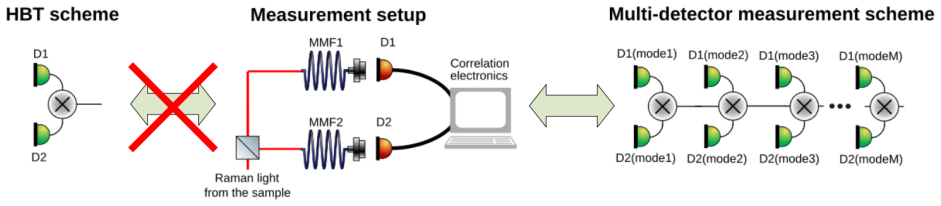
HBT scheme
whereN(R m) is the concentration of the molecules and the integration goes along the volume of the sample. Here, we used that the thermal occupationsn (th) mj are approximately equal ton (th) vib and we denoted the duration of the read and write pulsesτ (write/read) = R +∞ −∞ [F (write/read)(t)]2dtand the temporal overlaps of the scattered lights. One can...
-
[2]
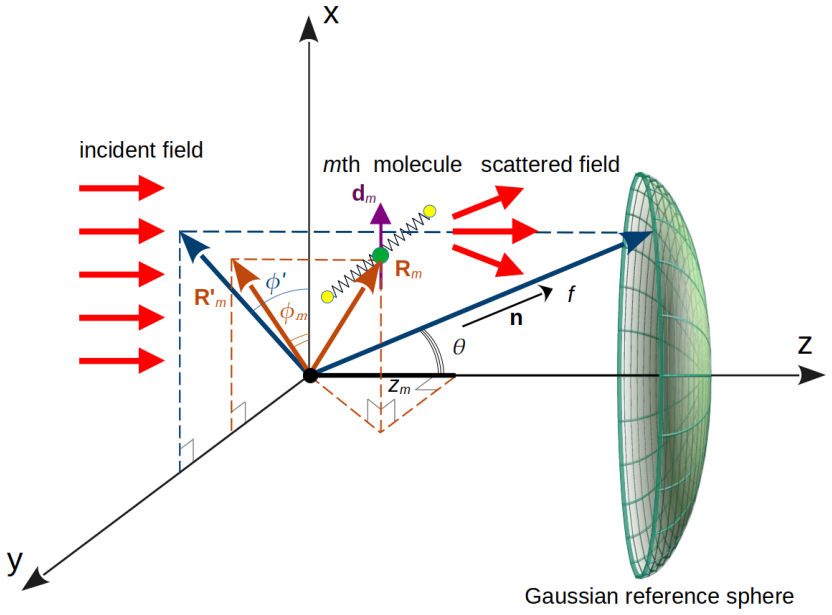
In the time domain the electric field of the write pulse,E (write)(Rm, t) = R E(write) ω (Rm)e−iωtdω/2π, takes the form E(write)(Rm, t) =E (write) 0 (t−˜nzm/c) exp (−R′2 m/2w2 0)
exp (i˜nkzm). In the time domain the electric field of the write pulse,E (write)(Rm, t) = R E(write) ω (Rm)e−iωtdω/2π, takes the form E(write)(Rm, t) =E (write) 0 (t−˜nzm/c) exp (−R′2 m/2w2 0). Thus, we obtain the Rabi frequency of the write pulse Ω(write) m (t) =A (write)e−R′2 m/2w2 0 F (write) t− ˜nzm c e−iω(write)(t−˜nzm/c),(A2) whereF (write)(t) is th...
-
[3]
ˆE(aSt)† k2 (t′ 2)}T←{ ˆE(aSt) k3 (t′
-
[4]
ˆE(St) k4 (t′ 4)} E ,(D1) whereG k(∆t) = 0 at ∆t <0. Taking into account the orthogonality of the modes, R d2r1f (St) k1 (r1)f (St) k4 (r1) =δ k1k4 and R d2r2f (aSt) k2 (r2)f (aSt) k3 (r2) =δ k2k3, discussed in the main text, and the identity +∞R −∞ dtG∗ k(t−t 1)Gk(t−t 2) =δ(t 1 −t 2), we obtain ˜G(2) St,aSt(τ) =|A (St)|2|A(aSt)|2 N (modes) LPX k1=1 N (mo...
-
[5]
Kasperczyk, F
M. Kasperczyk, F. S. de Aguiar J´ unior, C. Rabelo, A. Saraiva, M. F. Santos, L. Novotny, and A. Jorio, Temporal quantum correlations in inelastic light scattering from water, Physical review letters117, 243603 (2016)
2016
-
[6]
Vento, S
V. Vento, S. Tarrago Velez, A. Pogrebna, and C. Galland, Measurement-induced collective vibrational quantum coherence under spontaneous raman scattering in a liquid, Nature Com- munications14, 2818 (2023)
2023
-
[7]
Saraiva, F
A. Saraiva, F. S. d. A. J´ unior, R. de Melo e Souza, A. P. Pena, C. H. Monken, M. F. Santos, B. Koiller, and A. Jorio, Photonic counterparts of cooper pairs, Physical review letters119, 193603 (2017)
2017
-
[8]
P. J. Bustard, J. Erskine, D. G. England, J. Nunn, P. Hockett, R. Lausten, M. Spanner, and B. J. Sussman, Nonclassical correlations between terahertz-bandwidth photons mediated by rotational quanta in hydrogen molecules, Optics letters40, 922 (2015)
2015
-
[9]
Kasperczyk, A
M. Kasperczyk, A. Jorio, E. Neu, P. Maletinsky, and L. Novotny, Stokes–anti-stokes correla- tions in diamond, Optics letters40, 2393 (2015)
2015
-
[10]
S. T. Velez, K. Seibold, N. Kipfer, M. D. Anderson, V. Sudhir, and C. Galland, Preparation and decay of a single quantum of vibration at ambient conditions, Physical Review X9, 041007 (2019)
2019
-
[11]
Riedinger, S
R. Riedinger, S. Hong, R. A. Norte, J. A. Slater, J. Shang, A. G. Krause, V. Anant, M. As- pelmeyer, and S. Gr¨ oblacher, Non-classical correlations between single photons and phonons from a mechanical oscillator, Nature530, 313 (2016)
2016
-
[12]
S. Hong, R. Riedinger, I. Marinkovi´ c, A. Wallucks, S. G. Hofer, R. A. Norte, M. Aspelmeyer, and S. Gr¨ oblacher, Hanbury brown and twiss interferometry of single phonons from an op- tomechanical resonator, Science358, 203 (2017)
2017
-
[13]
Galland, N
C. Galland, N. Sangouard, N. Piro, N. Gisin, and T. J. Kippenberg, Heralded single-phonon preparation, storage, and readout in cavity optomechanics, Physical review letters112, 143602 (2014)
2014
-
[14]
M. D. Anderson, S. Tarrago Velez, K. Seibold, H. Flayac, V. Savona, N. Sangouard, and C. Galland, Two-color pump-probe measurement of photonic quantum correlations mediated by a single phonon, Physical review letters120, 233601 (2018). 25
2018
-
[15]
Marinkovi´ c, A
I. Marinkovi´ c, A. Wallucks, R. Riedinger, S. Hong, M. Aspelmeyer, and S. Gr¨ oblacher, Op- tomechanical bell test, Physical review letters121, 220404 (2018)
2018
-
[16]
L.-M. Duan, M. D. Lukin, J. I. Cirac, and P. Zoller, Long-distance quantum communication with atomic ensembles and linear optics, Nature414, 413 (2001)
2001
-
[17]
C. Chou, S. Polyakov, A. Kuzmich, and H. Kimble, Single-photon generation from stored excitation in an atomic ensemble, Physical Review Letters92, 213601 (2004)
2004
-
[18]
Farrera, G
P. Farrera, G. Heinze, B. Albrecht, M. Ho, M. Ch´ avez, C. Teo, N. Sangouard, and H. De Ried- matten, Generation of single photons with highly tunable wave shape from a cold atomic ensemble, Nature communications7, 13556 (2016)
2016
-
[19]
Park, Y.-W
K.-K. Park, Y.-W. Cho, Y.-T. Chough, and Y.-H. Kim, Experimental demonstration of quan- tum stationary light pulses in an atomic ensemble, Physical Review X8, 021016 (2018)
2018
-
[20]
Zhang, C
S. Zhang, C. Liu, S. Zhou, C.-S. Chuu, M. M. Loy, and S. Du, Coherent control of single- photon absorption and reemission in a two-level atomic ensemble, Physical review letters109, 263601 (2012)
2012
-
[21]
N. V. Corzo, J. Raskop, A. Chandra, A. S. Sheremet, B. Gouraud, and J. Laurat, Waveguide- coupled single collective excitation of atomic arrays, Nature566, 359 (2019)
2019
-
[22]
K. Lee, B. Sussman, M. Sprague, P. Michelberger, K. Reim, J. Nunn, N. Langford, P. Bustard, D. Jaksch, and I. Walmsley, Macroscopic non-classical states and terahertz quantum processing in room-temperature diamond, Nature Photonics6, 41 (2012)
2012
-
[23]
England, P
D. England, P. Bustard, J. Nunn, R. Lausten, and B. Sussman, From photons to phonons and back: A thz optical memory in diamond, Physical review letters111, 243601 (2013)
2013
-
[24]
D. G. England, K. A. Fisher, J.-P. W. MacLean, P. J. Bustard, R. Lausten, K. J. Resch, and B. J. Sussman, Storage and retrieval of thz-bandwidth single photons using a room- temperature diamond quantum memory, Physical review letters114, 053602 (2015)
2015
-
[25]
Hou, Y.-Y
P.-Y. Hou, Y.-Y. Huang, X.-X. Yuan, X.-Y. Chang, C. Zu, L. He, and L.-M. Duan, Quan- tum teleportation from light beams to vibrational states of a macroscopic diamond, Nature communications7, 11736 (2016)
2016
-
[26]
K. A. Fisher, D. G. England, J.-P. W. MacLean, P. J. Bustard, K. J. Resch, and B. J. Suss- man, Frequency and bandwidth conversion of single photons in a room-temperature diamond quantum memory, Nature communications7, 11200 (2016)
2016
-
[27]
K. A. Fisher, D. G. England, J.-P. W. MacLean, P. J. Bustard, K. Heshami, K. J. Resch, 26 and B. J. Sussman, Storage of polarization-entangled thz-bandwidth photons in a diamond quantum memory, Physical Review A96, 012324 (2017)
2017
-
[28]
Tarrago Velez, V
S. Tarrago Velez, V. Sudhir, N. Sangouard, and C. Galland, Bell correlations between light and vibration at ambient conditions, Science Advances6, eabb0260 (2020)
2020
-
[29]
F. S. d. A. J´ unior, M. F. Santos, C. H. Monken, and A. Jorio, Lifetime and polarization for real and virtual correlated stokes-anti-stokes raman scattering in diamond, Physical Review Research2, 013084 (2020)
2020
-
[30]
Gardiner and P
C. Gardiner and P. Zoller,Quantum noise: a handbook of Markovian and non-Markovian quantum stochastic methods with applications to quantum optics(Springer Science & Business Media, 2004)
2004
-
[31]
Hohenester,Nano and Quantum Optics(Springer, 2020)
U. Hohenester,Nano and Quantum Optics(Springer, 2020)
2020
-
[32]
Novotny and B
L. Novotny and B. Hecht,Principles of nano-optics(Cambridge university press, 2012)
2012
-
[33]
B. E. Saleh and M. C. Teich,Fundamentals of photonics, 2 volume set(john Wiley & sons, 2019)
2019
-
[34]
M. O. Scully and M. S. Zubairy,Quantum optics(Cambridge university press, 1997)
1997
-
[35]
H. J. Carmichael,Statistical methods in quantum optics 1: master equations and Fokker-Planck equations(Springer Science & Business Media, 2013)
2013
-
[36]
V. Y. Shishkov, E. Andrianov, A. Pukhov, and A. Vinogradov, Enhancement of stokes–anti- stokes correlations by the classical incoherent incident light, Physical Review A103, 013514 (2021)
2021
-
[37]
A. A. Lisyansky, E. S. Andrianov, A. P. Vinogradov, and V. Y. Shishkov,Quantum Optics of Light Scattering(Springer, 2024)
2024
-
[38]
Tokmakoff and M
A. Tokmakoff and M. Fayer, Infrared photon echo experiments: exploring vibrational dynamics in liquids and glasses, Accounts of chemical research28, 437 (1995)
1995
-
[39]
Rector, A
K. Rector, A. Kwok, C. Ferrante, R. Francis, and M. Fayer, Vibrational echo studies of pure dephasing: Mechanisms in liquids and glasses, Chemical physics letters276, 217 (1997)
1997
-
[40]
Solimeno,Guiding, diffraction, and confinement of optical radiation(Elsevier, 2012)
S. Solimeno,Guiding, diffraction, and confinement of optical radiation(Elsevier, 2012)
2012
-
[41]
M. P. Edgar, D. S. Tasca, F. Izdebski, R. E. Warburton, J. Leach, M. Agnew, G. S. Buller, R. W. Boyd, and M. J. Padgett, Imaging high-dimensional spatial entanglement with a camera, Nature communications3, 984 (2012)
2012
-
[42]
Kn¨ oll, W
L. Kn¨ oll, W. Vogel, and D.-G. Welsch, Quantum noise in spectral filtering of light, JOSA B 27 3, 1315 (1986)
1986
-
[43]
Vogel and D.-G
W. Vogel and D.-G. Welsch,Quantum optics(John Wiley & Sons, 2006)
2006
-
[44]
Panyukov, V
I. Panyukov, V. Y. Shishkov, and E. Andrianov, Heralded single-photon source based on an ensemble of raman-active molecules, JOSA B39, 2138 (2022)
2022
-
[45]
Id100 visible single photon detector,https://marketing.idquantique.com/acton/ attachment/11868/f-0236/1/-/-/-/-/ID100_Brochure.pdf, accessed: 2015-07-24. 28
2015
discussion (0)
Sign in with ORCID, Apple, or X to comment. Anyone can read and Pith papers without signing in.